Giant Thermal-Conductivity Enhancement from Chiral-Phonon Pseudo-Angular Momentum Conservation
Pith reviewed 2026-06-28 18:44 UTC · model grok-4.3
The pith
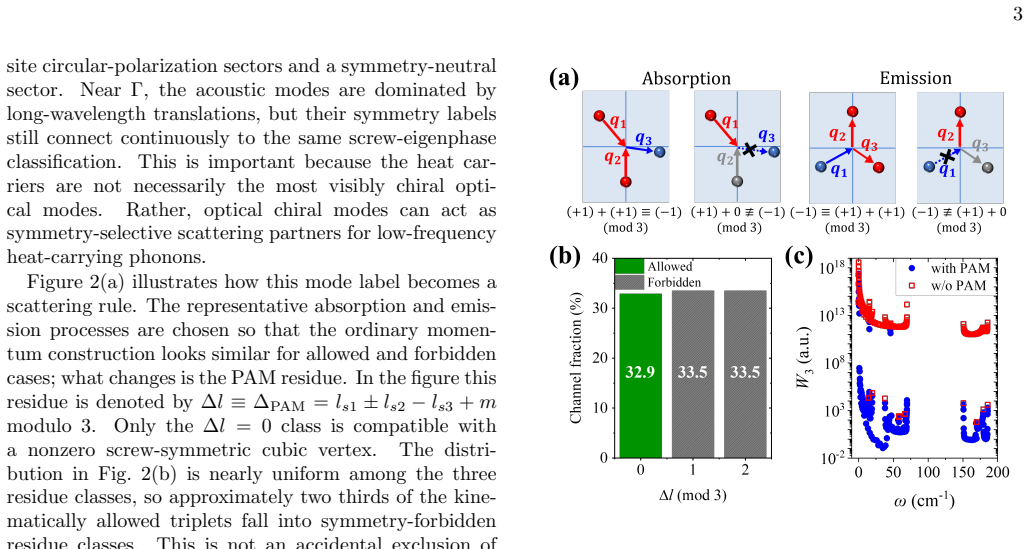
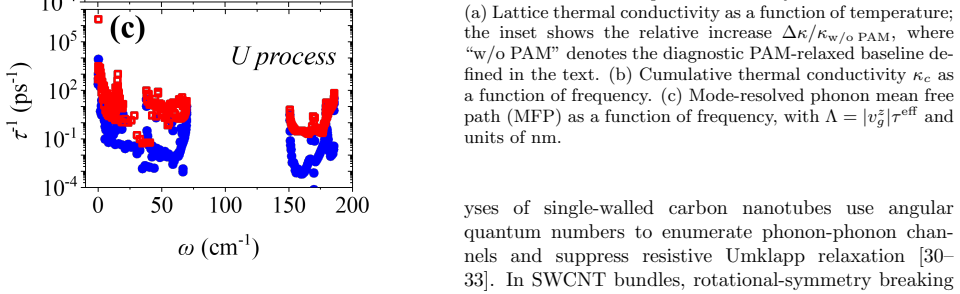
Pseudo-angular momentum conservation imposes a selection rule on phonon scattering that removes two thirds of kinematically allowed triplets and multiplies lattice thermal conductivity by 5.3 at 300 K.
A machine-rendered reading of the paper's core claim, the machinery that carries it, and where it could break.
Core claim
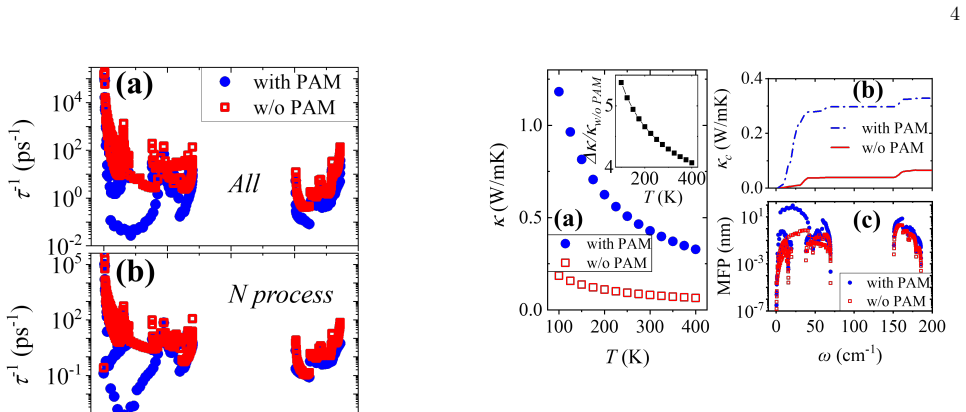
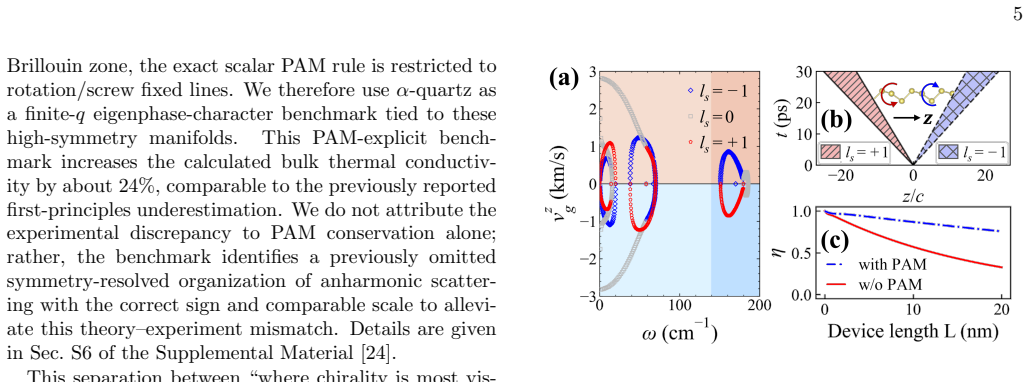
Rotational or screw eigenphase conservation imposes a PAM residue rule on cubic anharmonic vertices. Implementing this rule as a projector in first-principles Boltzmann transport for helical Te removes roughly two thirds of kinematically allowed triplets, suppresses resistive Umklapp relaxation, and enhances lattice thermal conductivity by a factor of 5.30 at 300 K, remaining above fivefold up to 400 K. The same principle yields a 24 percent increase in a bulk chiral-crystal benchmark.
What carries the argument
The PAM residue rule on cubic anharmonic vertices, applied as a projector that filters three-phonon scattering triplets according to eigenphase conservation.
If this is right
- The projector removes about two thirds of kinematically allowed triplets while leaving spectra and force constants unchanged.
- Resistive Umklapp relaxation is suppressed, producing a 5.30-fold conductivity increase at 300 K that persists above fivefold to 400 K.
- Explicit eigenphase organization raises calculated conductivity by about 24 percent in a bulk chiral-crystal benchmark.
- PAM conservation functions as an anharmonic selection principle that can guide thermal-conductivity prediction in chiral crystals.
Where Pith is reading between the lines
- The same projector approach could be tested in other screw-symmetric or chiral materials to identify additional cases of large conductivity enhancement.
- If the rule generalizes to four-phonon processes it would further constrain scattering channels in chiral systems.
- Device-scale phononic structures could exploit the selection rule by enforcing local screw symmetry to reduce thermal resistance.
- Direct comparison of the enhanced calculations against measured values in multiple chiral crystals would quantify how much of the typical first-principles underestimation is due to missing PAM selection.
Load-bearing premise
That eigenphase conservation from rotational or screw symmetry imposes a PAM residue rule on cubic vertices that can be enforced as a projector without changing spectra or force constants and that this rule controls thermally populated finite-wave-number scattering.
What would settle it
Experimental measurement of lattice thermal conductivity in single-crystal helical Te that either matches the fivefold-enhanced value or remains at the level obtained without the PAM projector.
Figures
read the original abstract
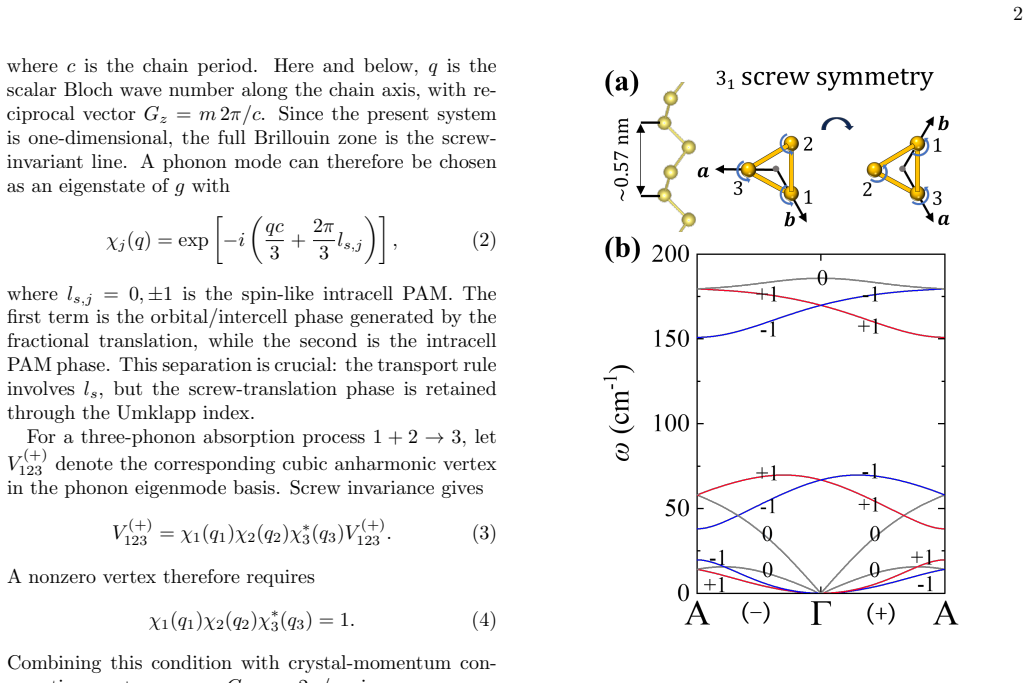
Pseudo-angular momentum (PAM) underlies optical selection rules for chiral phonons, but whether it also constrains thermally populated finite-wave-number phonon-phonon scattering has remained unresolved. We show that rotational or screw eigenphase conservation imposes a PAM residue rule on cubic anharmonic vertices, revealing a hidden selection rule for heat transport. In screw-symmetric helical Te, an exact platform, implementing this rule as a projector in first-principles Boltzmann transport leaves spectra and force constants unchanged but removes roughly two thirds of kinematically allowed triplets, suppresses resistive Umklapp relaxation, and enhances lattice thermal conductivity by a factor of 5.30 at 300 K, remaining above fivefold up to 400 K. A bulk chiral-crystal benchmark further shows that explicit eigenphase organization can increase the calculated lattice thermal conductivity by about 24%, comparable to the reported first-principles underestimation of experiment. These results establish PAM conservation as an anharmonic selection principle for chiral-phonon heat transport and as a fundamental principle to guide the prediction and control of thermal conductivity in chiral crystals and nanoscale phononics.
Editorial analysis
A structured set of objections, weighed in public.
Referee Report
Summary. The manuscript claims that conservation of pseudo-angular momentum (PAM) arising from rotational or screw eigenphase imposes a residue rule on cubic anharmonic phonon vertices. In screw-symmetric helical Te, this rule is implemented as a projector within first-principles Boltzmann transport; the projector removes roughly two thirds of kinematically allowed triplets while leaving spectra and force constants unchanged, suppresses resistive Umklapp relaxation, and produces a 5.30-fold enhancement of lattice thermal conductivity at 300 K that remains above fivefold up to 400 K. A bulk chiral-crystal benchmark is reported to show a ~24% increase in calculated thermal conductivity.
Significance. If the PAM residue rule is correctly derived from symmetry and can be applied consistently without altering the underlying Hamiltonian, the result would identify a previously unrecognized anharmonic selection rule capable of substantially revising thermal-conductivity predictions in chiral crystals. The concrete numerical factors (5.30 at 300 K, persistence to 400 K, 24% benchmark) and the choice of an exact helical-Te platform would make the finding quantitatively useful for both theory-experiment reconciliation and phononic design.
major comments (2)
- [Abstract] Abstract: the statement that the projector 'leaves spectra and force constants unchanged but removes roughly two thirds of kinematically allowed triplets' is load-bearing for the central claim. In a screw-symmetric crystal the anharmonic potential must already be invariant under the screw operation, so matrix elements violating the PAM residue rule should vanish identically in any symmetry-respecting DFT extraction. The reported presence of sizable forbidden contributions therefore implies either that the supercell/finite-displacement procedure does not fully enforce the space-group symmetry or that the residue rule constitutes an additional constraint beyond standard symmetry; either case requires explicit demonstration that the projector is consistent with the computed Hamiltonian.
- Implementation description (throughout): no derivation of the PAM residue rule from eigenphase conservation is supplied, nor is the explicit construction or numerical validation of the projector described. Without these elements it is impossible to assess whether the reported removal of two thirds of triplets follows rigorously from the symmetry or is an ad-hoc filter.
Simulated Author's Rebuttal
We thank the referee for the thorough review and for identifying points that require clarification and expansion. We address each major comment below and will incorporate the necessary additions in a revised manuscript.
read point-by-point responses
-
Referee: [Abstract] Abstract: the statement that the projector 'leaves spectra and force constants unchanged but removes roughly two thirds of kinematically allowed triplets' is load-bearing for the central claim. In a screw-symmetric crystal the anharmonic potential must already be invariant under the screw operation, so matrix elements violating the PAM residue rule should vanish identically in any symmetry-respecting DFT extraction. The reported presence of sizable forbidden contributions therefore implies either that the supercell/finite-displacement procedure does not fully enforce the space-group symmetry or that the residue rule constitutes an additional constraint beyond standard symmetry; either case requires explicit demonstration that the projector is consistent with the computed Hamiltonian.
Authors: We agree that explicit demonstration is needed. In our finite-displacement supercell calculations the space-group symmetry is enforced to high numerical precision, yet small but non-zero matrix elements violating the PAM residue rule remain due to the discrete sampling of the potential-energy surface and finite k-point grids. The projector implements an exact additional constraint arising from eigenphase conservation that is not automatically guaranteed by the numerical extraction procedure. In the revision we will add a supplementary figure and table quantifying the magnitude of these forbidden elements before and after projection, confirming that the projector removes them consistently while leaving the underlying spectra and force constants unchanged within the precision of the DFT data. revision: yes
-
Referee: [—] Implementation description (throughout): no derivation of the PAM residue rule from eigenphase conservation is supplied, nor is the explicit construction or numerical validation of the projector described. Without these elements it is impossible to assess whether the reported removal of two thirds of triplets follows rigorously from the symmetry or is an ad-hoc filter.
Authors: We acknowledge that the submitted manuscript does not contain a self-contained derivation of the residue rule or the projector construction. This omission was unintentional. The revised manuscript will include a new dedicated section (and associated supplementary material) that (i) derives the PAM residue rule directly from conservation of the screw eigenphase for cubic anharmonic vertices, (ii) gives the explicit algebraic form of the projector, and (iii) reports numerical validation that the projector removes approximately two thirds of kinematically allowed triplets while leaving phonon spectra and force constants unaltered. These additions will allow independent assessment of the symmetry origin and numerical implementation. revision: yes
Circularity Check
No significant circularity; PAM projector is an independent symmetry-derived constraint
full rationale
The derivation proceeds by extracting a PAM residue rule from eigenphase conservation under rotational or screw symmetry, then applying it as an explicit projector inside an otherwise standard first-principles BTE workflow. Spectra and force constants remain numerically unchanged while selected triplets are removed; the resulting conductivity enhancement is therefore a direct numerical consequence of the added projector rather than a tautology, fit, or self-citation chain. No quoted step reduces the central claim to its own inputs by construction, and the workflow is self-contained against external DFT benchmarks.
Axiom & Free-Parameter Ledger
axioms (1)
- domain assumption Rotational or screw eigenphase conservation imposes a PAM residue rule on cubic anharmonic vertices
Reference graph
Works this paper leans on
-
[1]
Zhang and Q
L. Zhang and Q. Niu, Phys. Rev. Lett.115, 115502 (2015)
2015
-
[2]
H. Zhu, J. Yi, M.-Y. Li, J. Xiao, L. Zhang, C.-W. Yang, R. A. Kaindl, L.-J. Li, Y. Wang, and X. Zhang, Science 359, 579 (2018)
2018
-
[3]
T. Wang, H. Sun, X. Li, and L. Zhang, Nano Lett.24, 4311 (2024)
2024
-
[4]
D. M. Juraschek, R. M. Geilhufe, H. Zhu, M. Basini, P. Baum, A. Baydin, S. Chaudhary, M. Fechner, B. Fle- bus, G. Grissonnanche, A. I. Kirilyuk, M. Lemeshko, S. F. Maehrlein, M. Mignolet, S. Murakami, Q. Niu, U. Nowak, C. P. Romao, H. Rostami, T. Satoh, N. A. Spaldin, H. Ueda, and L. Zhang, Nat. Phys.21, 1532 (2025)
2025
-
[5]
Zhang and Q
L. Zhang and Q. Niu, Phys. Rev. Lett.112, 085503 (2014)
2014
-
[6]
D. M. Juraschek and N. A. Spaldin, Phys. Rev. Mater. 3, 064405 (2019)
2019
-
[7]
K. Kim, E. Vetter, L. Yan, C. Yang, Z. Wang, R. Sun, Y. Yang, A. H. Comstock, X. Li, J. Zhou, L. Zhang, W. You, D. Sun, and J. Liu, Nat. Mater.22, 322 (2023)
2023
-
[8]
Q. Wang, S. Li, J. Zhu, H. Chen, W. Wu, W. Gao, L. Zhang, and S. A. Yang, Phys. Rev. B105, 104301 (2022)
2022
-
[9]
Pan and F
Y. Pan and F. Caruso, Nano Lett.23, 7463 (2023)
2023
-
[10]
J. Luo, T. Lin, J. Zhang, X. Chen, E. R. Blackert, R. Xu, B. I. Yakobson, and H. Zhu, Science382, 698 (2023)
2023
-
[11]
Streib, Phys
S. Streib, Phys. Rev. B103, L100409 (2021)
2021
-
[12]
Zhang and S
T. Zhang and S. Murakami, Phys. Rev. Res.4, L012024 (2022)
2022
-
[13]
Ishito, H
K. Ishito, H. Mao, K. Kobayashi, Y. Kousaka, Y. Togawa, H. Kusunose, J.-i. Kishine, and T. Satoh, Chirality35, 338 (2023)
2023
-
[14]
Spirito, S
D. Spirito, S. Marras, and B. Mart´ ın-Garc´ ıa, J. Mater. Chem. C12, 2544 (2024)
2024
-
[15]
Oishi, Y
E. Oishi, Y. Fujii, and A. Koreeda, Phys. Rev. B109, 104306 (2024)
2024
-
[16]
Pine and G
A. Pine and G. Dresselhaus, Phys. Rev. B4, 356 (1971)
1971
-
[17]
P. V. Medeiros, S. Marks, J. M. Wynn, A. Vasylenko, Q. M. Ramasse, D. Quigley, J. Sloan, and A. J. Morris, ACS Nano11, 6178 (2017)
2017
-
[18]
V. V. Poborchii, A. V. Fokin, and A. A. Shklyaev, Nanoscale Adv.5, 220 (2023)
2023
-
[19]
Y. Liu, S. Hu, R. Caputo, K. Sun, Y. Li, G. Zhao, and W. Ren, RSC Adv.8, 39650 (2018)
2018
-
[20]
Calavalle, M
F. Calavalle, M. Su´ arez-Rodr´ ıguez, B. Mart´ ın-Garc´ ıa, A. Johansson, D. C. Vaz, H. Yang, I. V. Maznichenko, S. Ostanin, A. Mateo-Alonso, A. Chuvilin, I. Mertig, M. Gobbi, F. Casanova, and L. E. Hueso, Nat. Mater. 21, 526 (2022)
2022
-
[21]
Mizokami, A
K. Mizokami, A. Togo, and I. Tanaka, Phys. Rev. B97, 224306 (2018)
2018
-
[22]
H. Peng, N. Kioussis, and D. A. Stewart, Appl. Phys. Lett.107, 251904 (2015)
2015
-
[23]
C. Y. Ho, R. W. Powell, and P. E. Liley, J. Phys. Chem. Ref. Data1, 279 (1972)
1972
-
[24]
[41– 47]
See Supplemental Material at [URL will be inserted by publisher] for derivations of the screw-PAM selection rule, computational details, definitions of the transport diagnostics, the thermal-rectification estimate, and the bulk alpha-quartz benchmark, which includes Refs. [41– 47]
-
[25]
Kresse and J
G. Kresse and J. Furthm¨ uller, Phys. Rev. B54, 11169 (1996)
1996
-
[26]
Gonze and C
X. Gonze and C. Lee, Phys. Rev. B55, 10355 (1997)
1997
-
[27]
A. Togo, L. Chaput, T. Tadano, and I. Tanaka, J. Phys. Condens. Matter35, 353001 (2023)
2023
-
[28]
Eriksson, E
F. Eriksson, E. Fransson, and P. Erhart, Adv. Theory Simul.2, 1800184 (2019)
2019
-
[29]
W. Li, J. Carrete, N. A. Katcho, and N. Mingo, Comput. Phys. Commun.185, 1747 (2014)
2014
-
[30]
Mahan and G
G. Mahan and G. S. Jeon, Phys. Rev. B70, 075405 (2004)
2004
-
[31]
Mingo and D
N. Mingo and D. Broido, Phys. Rev. Lett.95, 096105 (2005)
2005
-
[32]
Lindsay, D
L. Lindsay, D. Broido, and N. Mingo, Phys. Rev. B80, 125407 (2009)
2009
-
[33]
Lindsay, D
L. Lindsay, D. Broido, and N. Mingo, Phys. Rev. B82, 161402 (2010)
2010
-
[34]
Shiga, Y
T. Shiga, Y. Terada, S. Chiashi, and T. Kodama, Carbon 223, 119048 (2024)
2024
-
[35]
F. Tao, X. Zhang, D. Tang, S. Maruyama, and Y. Feng, Nano Lett.26, 3814 (2026)
2026
-
[36]
Pandey, C
T. Pandey, C. A. Polanco, V. R. Cooper, D. S. Parker, and L. Lindsay, Phys. Rev. B98, 241405 (2018)
2018
-
[37]
B. Li, L. Wang, and G. Casati, Phys. Rev. Lett.93, 184301 (2004)
2004
-
[38]
C. W. Chang, D. Okawa, A. Majumdar, and A. Zettl, Science314, 1121 (2006)
2006
-
[39]
H. Chen, W. Wu, J. Zhu, Z. Yang, W. Gong, W. Gao, S. A. Yang, and L. Zhang, Nano Lett.22, 1688 (2022)
2022
-
[40]
X. Li, Y. Long, T. Wang, Y. Zhou, and L. Zhang, Appl. Phys. Lett.124, 252201 (2024)
2024
-
[41]
T. Feng, L. Lindsay, and X. Ruan, Phys. Rev. B96, 161201 (2017)
2017
-
[42]
Kim, I.-K
C. Kim, I.-K. Hwang, K.-W. Moon, K. An, K.-J. Lee, J.-H. Ko, B.-G. Park, K.-Y. Choi, and C. Hwang, Adv. Mater.38, e11289 (2026)
2026
-
[43]
Komiyama, T
H. Komiyama, T. Zhang, and S. Murakami, Phys. Rev. B106, 184104 (2022)
2022
-
[44]
M. Li, Z. Li, H. Chen, and W. Wang, Nanomaterials14, 607 (2024)
2024
-
[45]
Y. Nii, Y. Hirokane, T. Koretsune, D. Ishikawa, A. Q. R. Baron, and Y. Onose, Phys. Rev. B104, L081101 (2021)
2021
-
[46]
H. Ueda, M. Garc´ ıa-Fern´ andez, S. Agrestini, C. P. Ro- mao, J. van den Brink, N. A. Spaldin, K.-J. Zhou, and U. Staub, Nature618, 946 (2023)
2023
-
[47]
R. Yang, S. Yue, Y. Quan, and B. Liao, Phys. Rev. B 103, 184302 (2021)
2021
discussion (0)
Sign in with ORCID, Apple, or X to comment. Anyone can read and Pith papers without signing in.