Spacetime torsion signatures in neutrino oscillation physics
Pith reviewed 2026-06-28 18:22 UTC · model grok-4.3
The pith
Background torsion in Einstein-Cartan theory modifies neutrino oscillation formulas in a manner dependent on neutrino spin orientation.
A machine-rendered reading of the paper's core claim, the machinery that carries it, and where it could break.
Core claim
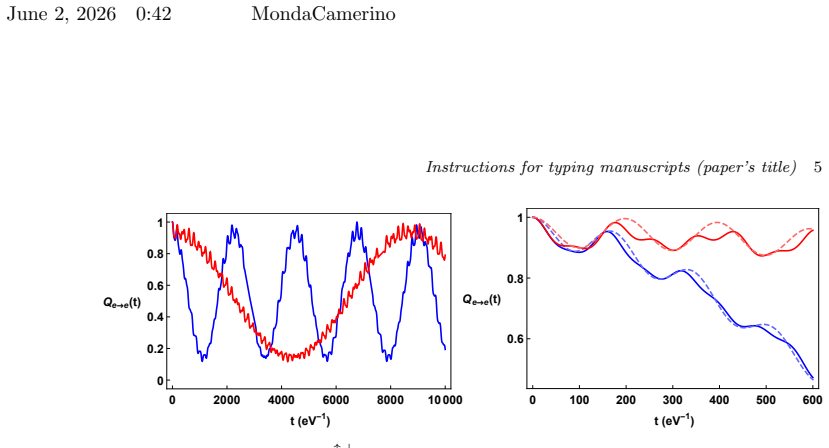
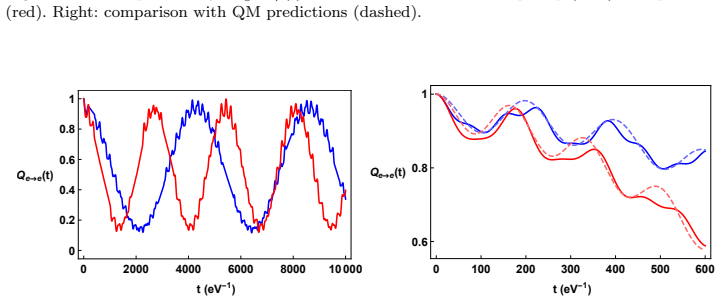
In the context of Einstein-Cartan theory, new oscillation formulas are found for constant torsion and linearly time-dependent torsion. The oscillation formulas obtained depend on the orientation of the spin.
What carries the argument
The torsion tensor treated as an external classical source that couples to neutrino spin and alters the effective propagation Hamiltonian.
If this is right
- Oscillation probabilities acquire an additional phase term that depends on the alignment between spin and torsion vector.
- Constant torsion produces a fixed shift in the effective oscillation parameters.
- Linearly time-dependent torsion causes the oscillation pattern to evolve predictably with time.
- The magnitude of the effect scales with the component of torsion parallel to the spin direction.
Where Pith is reading between the lines
- Polarized neutrino beams in controlled settings could isolate torsion signatures from standard oscillation effects.
- The same spin-dependent coupling might apply to other spin-1/2 particles propagating through torsion.
- Early-universe torsion could have left imprints on relic neutrino distributions.
Load-bearing premise
The background torsion field can be treated as an external classical source that is either constant or linearly time-dependent without dynamical back-reaction or quantization effects.
What would settle it
An observation of identical oscillation probabilities for neutrinos with opposite spin orientations in a torsion background would contradict the derived formulas.
Figures
read the original abstract
We report on recent results concerning neutrino oscillation in the presence of background torsion. In the context of Einstein-Cartan theory, we find new oscillation formulas for constant torsion and linearly time-dependent torsion. The oscillation formulas obtained depend on the orientation of the spin.
Editorial analysis
A structured set of objections, weighed in public.
Referee Report
Summary. The paper claims that in Einstein-Cartan theory, new neutrino oscillation formulas are derived for constant torsion and linearly time-dependent torsion backgrounds; these formulas depend on the orientation of the neutrino spin.
Significance. If the derivations are valid, the work would identify potential torsion signatures in neutrino oscillations, offering a concrete extension of standard propagation models to modified gravity. Credit is due for identifying the spin-orientation dependence as a distinguishing feature.
major comments (1)
- [Setup of the background torsion and derivation of oscillation formulas] The central claim rests on treating the torsion (constant or linearly time-dependent) as a fixed external classical background that can be directly inserted into the neutrino Dirac/propagation Hamiltonian. In Einstein-Cartan theory the contorsion is algebraically fixed by the spin-density tensor of matter; an arbitrary external torsion is therefore consistent only if the neutrino spin density is negligible or the geometry is externally prescribed. Neither condition is shown to hold for propagating neutrinos, so the derived phase factors and spin-orientation dependence rest on an unverified decoupling assumption.
Simulated Author's Rebuttal
We thank the referee for the positive evaluation of the work's significance and for the detailed comment. We address the major concern point by point below, maintaining that the derivations hold under the standard test-particle approximation for background torsion in Einstein-Cartan theory.
read point-by-point responses
-
Referee: The central claim rests on treating the torsion (constant or linearly time-dependent) as a fixed external classical background that can be directly inserted into the neutrino Dirac/propagation Hamiltonian. In Einstein-Cartan theory the contorsion is algebraically fixed by the spin-density tensor of matter; an arbitrary external torsion is therefore consistent only if the neutrino spin density is negligible or the geometry is externally prescribed. Neither condition is shown to hold for propagating neutrinos, so the derived phase factors and spin-orientation dependence rest on an unverified decoupling assumption.
Authors: Our analysis treats the torsion as an external background sourced by dominant matter (e.g., in cosmological settings), with neutrinos as test particles whose spin density is negligible. This is the standard decoupling approximation in phenomenological studies of torsion effects on fermions, analogous to geodesic motion in GR. The spin-orientation dependence follows directly from the Dirac equation coupled to the background contorsion. We will revise the manuscript to add an explicit paragraph in Section 2 clarifying this assumption, its regime of validity, and why it applies to propagating neutrinos. revision: yes
Circularity Check
No circularity: derivation extends standard Dirac propagation by torsion terms without self-referential reduction
full rationale
The provided abstract and context describe new oscillation formulas obtained by including torsion in the neutrino propagation framework within Einstein-Cartan theory. No equations, self-citations, fitted parameters renamed as predictions, or ansatzes smuggled via prior work are exhibited that would reduce the claimed formulas to their inputs by construction. The central step is presented as a direct extension of the standard Hamiltonian, which remains independent of the output formulas themselves. This is the most common honest finding when no load-bearing circular step can be quoted.
Axiom & Free-Parameter Ledger
Forward citations
Cited by 1 Pith paper
-
Spin-dependent neutrino oscillations in torsion backgrounds: A quantum-field-theoretic analysis
Constant spatial torsion induces spin-dependent effective masses for neutrinos that modify both frequencies and amplitudes of flavor oscillations in the QFT description, with largest effects at low momentum when torsi...
Reference graph
Works this paper leans on
-
[1]
Fruscianti, L
N. Fruscianti, L. Perenon,Phys. Rep.857, 1–63 (2020)
2020
-
[2]
P. J. Steinhardt, N. Turok,Science312, 1180–1183 (2006)
2006
-
[3]
V. C. Rubin, W. K. Ford, N. Thonnard,Astrophys. J.238, 471–487 (1980)
1980
-
[4]
Salucci,Astron
P. Salucci,Astron. Astrophys. Rev.27, 2 (2019)
2019
-
[5]
Rubin, W
V. Rubin, W. K. Ford,Astrophys. J.159, 379 (1970)
1970
-
[6]
P. F. Smith, J. D. Lewin,Phys. Rep.187, 5 (1990)
1990
-
[7]
Capozziello, M
S. Capozziello, M. D. Laurentis,Phys. Rep.509, 167–321 (2011)
2011
-
[8]
Heisenberg,Phys
L. Heisenberg,Phys. Rep.1066, 1–78 (2024)
2024
-
[9]
Nojiri, S
S. Nojiri, S. D. Odintsov,Phys. Rept.505, 59–144 (2011)
2011
-
[10]
Nojiri, S
S. Nojiri, S. D. Odintsov, V. K. Oikonomou,Phys. Rept.692, 1–104 (2017)
2017
-
[11]
Brans, R
C. Brans, R. H. Dicke,Phys. Rev.124, 925 (1961)
1961
-
[12]
Capolupo, G
A. Capolupo, G. D. Maria, S. Monda, A. Quaranta, R. Serao,Universe10(4), 170 (2024)
2024
-
[13]
F. W. Hehl, P. Von der Heyde, G. D. Kerlick,Rev. Mod. Phys.48, 393 (1976)
1976
-
[14]
I. L. Shapiro,Phys. Rep.357, 113–213 (2002)
2002
-
[15]
N. E. Mavromatos, P. Pais, A. Iorio,Universe9, 516 (2023)
2023
-
[16]
Fabbri, S
L. Fabbri, S. Vignolo,Class. Quantum Grav.28, 125002 (2011)
2011
-
[17]
Fabbri, S
L. Fabbri, S. Vignolo, S. Carloni,Phys. Rev. D90, 024012 (2014)
2014
-
[18]
M. Adak, T. Dereli, H. Ryder,Class. Quantum Grav.18, 1503–1512 (2001)
2001
-
[19]
D. J. Cirilo-Lombardo,EPL127, 10002 (2019)
2019
-
[20]
Aartsen et al
M. Aartsen et al. [IceCube Collaboration],Science361, 6398 (2018)
2018
-
[21]
Aartsen et al
M. Aartsen et al. [IceCube Collaboration],Science361, eaat1378 (2018)
2018
-
[22]
Abbasi et al
R. Abbasi et al. [IceCube Collaboration],Astrophys. J.964, 126 (2024)
2024
-
[23]
A. A. Abud et al. [DUNE Collaboration],Phys. Rev. D107, 112012 (2023)
2023
-
[24]
Capolupo, S
A. Capolupo, S. Carloni, A. Quaranta,Phys. Rev. D105, 105013 (2022)
2022
-
[25]
Capolupo, G
A. Capolupo, G. Lambiase, A. Quaranta,Phys. Rev. D101, 095022 (2020)
2020
-
[26]
D. B. Kaplan, A. E. Nelson, N. Weiner,Phys. Rev. Lett.93, 091801 (2004)
2004
-
[27]
S. M. Bilenky, B. Pontecorvo,Phys. Rep.41, 225 (1978)
1978
-
[28]
Aad et al
G. Aad et al. [ATLAS Collaboration],Phys. Lett. B716, 1–29 (2012)
2012
-
[29]
Blasone, A
M. Blasone, A. Capolupo, G. Vitiello,Phys. Rev. D66, 025033 (2002)
2002
-
[30]
Fujii, C
K. Fujii, C. Habe, T. Yabuki,Phys. Rev. D59, 113003 (1999)
1999
-
[31]
K. C. Hannabuss, D. C. Latimer,J. Phys. A33, 1369 (2000)
2000
-
[32]
C. Y. Cardall, G. M. Fuller,Phys. Rev. D55, 7960 (1997)
1997
-
[33]
Capolupo, A
A. Capolupo, A. Quaranta,Phys. Lett. B839, 137776 (2023)
2023
-
[34]
S. M. Bilenky, J. Hoˇ sek, S. T. Petcov,Phys. Lett. B94, 495–498 (1980)
1980
-
[35]
Capozzi, E
F. Capozzi, E. D. Valentino, E. Lisi, A. Marrone, A. Melchiorri, A. Palazzo,Phys. Rev. D95, 096014 (2017)
2017
-
[36]
J. I. Kapusta,Phys. Rev. Lett.93, 251801 (2004)
2004
-
[37]
A Capolupo, S Capozziello, G Pisacane, A Quaranta,Physics of the Dark Universe, 48, 101894 (2025)
2025
-
[38]
Capolupo, O
A. Capolupo, O. Luongo, A. Quaranta,Eur. Phys. J. C,86, 154 (2026)
2026
-
[39]
Capolupo, S
A. Capolupo, S. Carloni, L. Fabbri, S. Monda, A. Quaranta, S. Vignolo,Int. J. Geom. Meth. Mod. Phys., 2650012 (25 pages), (2026)
2026
-
[40]
Boshkayev, O
K. Boshkayev, O. Luongo, M. Muccino,Eur. Phys. J. C,80, 964 (2020)
2020
-
[41]
Geralico, O
A. Geralico, O. Luongo,Phys. Lett. A,376, 15 (2012)
2012
-
[42]
Johns,Phys
L. Johns,Phys. Rev. D,105, 033002 (2022)
2022
-
[43]
Capolupo, S
A. Capolupo, S. M. Giampaolo, B. C. Hiesmayr, G. Vitiello,Phys. Lett. B,780, 216-220 (2018)
2018
-
[44]
D. V. Ahluwalia, C. Burgard,Gen. Relat. Gravit.,28, 1161–1170 (1996). June 2, 2026 0:42 MondaCamerino 8Authors’ Names
1996
-
[45]
Capolupo, A
A. Capolupo, A. Quaranta,J. Phys. G51, 105202 (2024)
2024
discussion (0)
Sign in with ORCID, Apple, or X to comment. Anyone can read and Pith papers without signing in.