Hybrid Bit and Semantic Communications for UAV-Enabled Wireless Power Transfer Networks: A Decision-Assisted Deep Reinforcement Learning Approach
Pith reviewed 2026-06-28 18:18 UTC · model grok-4.3
The pith
A hybrid bit-semantic framework with decision-assisted DSAC maximizes efficiency in UAV wireless power transfer networks.
A machine-rendered reading of the paper's core claim, the machinery that carries it, and where it could break.
Core claim
In UAV-enabled wireless power transfer networks, a multi-layer hybrid bit and semantic communication framework maximizes semantic communication efficiency by jointly optimizing UAV trajectory, EHBS selection, user association, semantic mode selection, and energy harvesting time allocation, with the optimization solved by a decision-assisted distributional soft actor-critic algorithm that achieves superior long-term performance in dynamic environments.
What carries the argument
Decision-assisted distributional soft actor-critic (DSAC) algorithm applied to joint optimization over the multi-layer hybrid bit-semantic framework.
If this is right
- The hybrid framework enables adaptation to different SNR levels and task requirements.
- Joint optimization of trajectory, selection, association, mode, and time allocation improves energy efficiency.
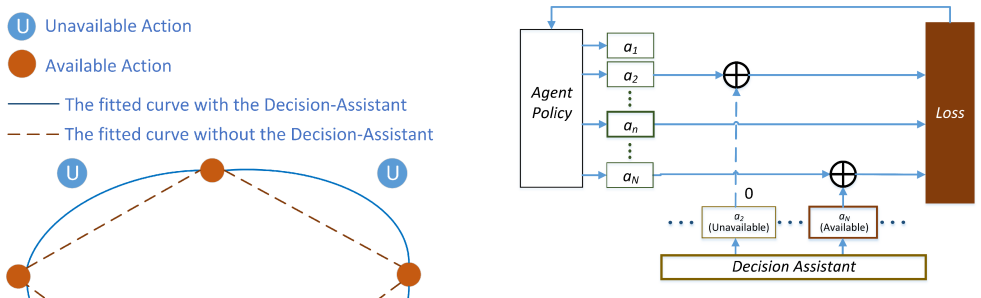
- The decision assistant enhances convergence of the DSAC algorithm.
- Superior long-term optimization performance holds in dynamic network environments.
Where Pith is reading between the lines
- The same joint-optimization structure could be tested in other mobile energy-harvesting settings such as ground-vehicle or low-altitude platform networks.
- The efficiency metric may provide a quantitative basis for comparing semantic versus bit modes under power constraints.
Load-bearing premise
The semantic communication efficiency metric and the hybrid framework's ability to adapt to SNR and tasks are well-defined and sufficient to produce meaningful optimization gains.
What would settle it
A set of simulations in which the proposed decision-assisted DSAC fails to exceed the long-term efficiency of standard actor-critic or non-hybrid baselines across multiple dynamic UAV-WPT scenarios would falsify the superiority claim.
Figures
read the original abstract
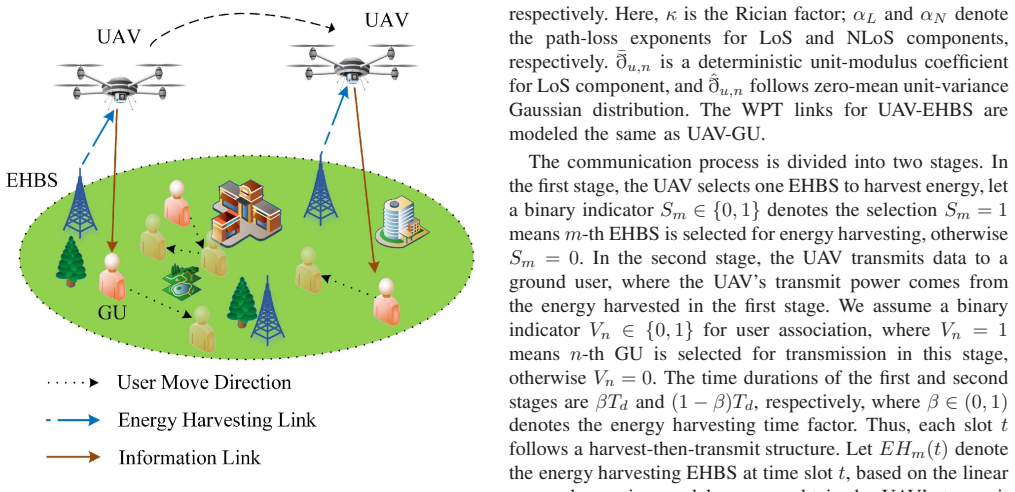
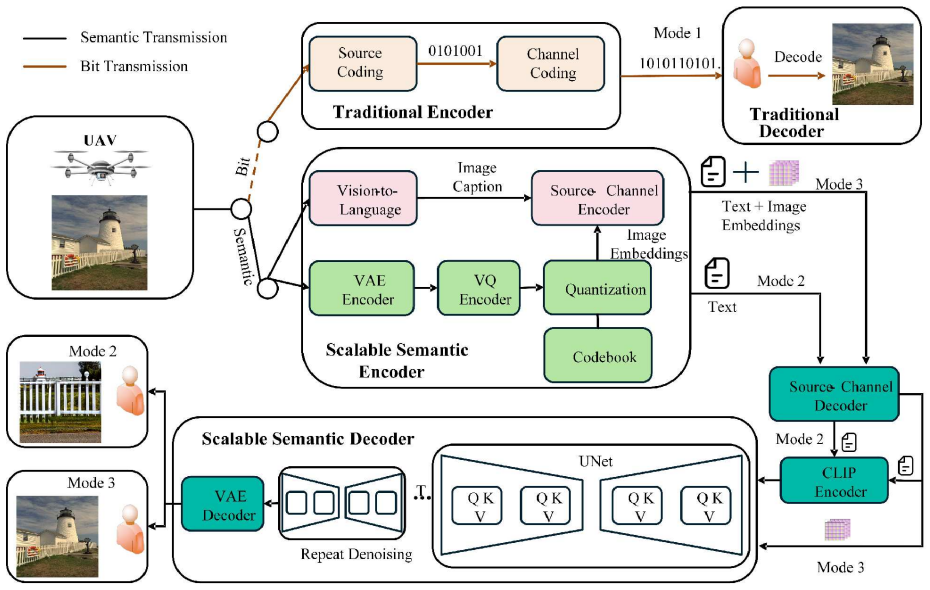
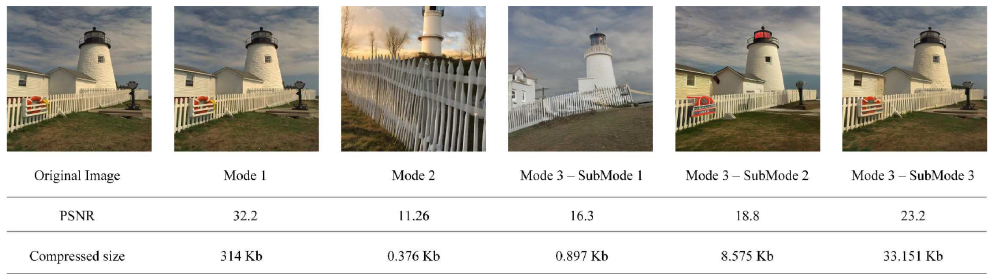
Semantic communications which can significantly reduce spectrum consumption in wireless networks, have recently become a popular research area. When combined with wireless power transfer (WPT), semantic communications can help achieve high spectral efficiency for energy-limited devices in wireless communications. In energy-constrained and link budget-limited scenarios such as UAV networks, the integration of semantic communications and WPT enables highly energyefficient transmission mechanisms. In this paper, we investigate semantic communications in UAV-enabled WPT networks. To achieve adaptability to varying signal-to-noise ratio (SNR) and task requirements, we introduce a multi-layer hybrid bit and semantic communication framework. We adopt a semantic communication efficiency metric and aim to maximize it by jointly optimizing UAV trajectory, energy harvesting base station (EHBS) selection, user association, semantic mode selection, and energy harvesting time allocation. To address this complex longterm optimization problem, we introduce the distributional soft actor-critic (DSAC) algorithm and introduce a decision assistant to further enhance the convergence performance of DSAC. Simulation results validate the effectiveness of the proposed method and framework and demonstrate that our algorithm can achieve superior long-term optimization performance in dynamic network environments.
Editorial analysis
A structured set of objections, weighed in public.
Referee Report
Summary. The paper proposes a multi-layer hybrid bit and semantic communication framework for UAV-enabled wireless power transfer networks to achieve adaptability to varying SNR and task requirements. It adopts a semantic communication efficiency metric and formulates a long-term optimization problem over UAV trajectory, EHBS selection, user association, semantic mode selection, and energy harvesting time allocation. The distributional soft actor-critic (DSAC) algorithm augmented with a decision assistant is introduced to solve the problem, with simulation results claimed to validate effectiveness and superior performance in dynamic environments.
Significance. If the simulation claims hold with appropriate baselines and statistical support, the work would demonstrate a practical application of distributional RL to joint optimization of hybrid semantic/bit communications and WPT in UAV networks. This could be relevant for energy-constrained dynamic scenarios, with the decision-assistant enhancement to DSAC as a potential incremental contribution to convergence in such settings.
minor comments (1)
- [Abstract] Abstract contains a minor typographical issue ('energyefficient' should be hyphenated as 'energy-efficient').
Simulated Author's Rebuttal
We thank the referee for the summary of our work on the hybrid bit and semantic communication framework for UAV-enabled WPT networks using decision-assisted DSAC. The summary accurately reflects the problem formulation, optimization variables, and algorithmic approach. No specific major comments were provided in the report, so we have no point-by-point responses at this time. We remain available to address any additional questions or concerns the referee may have regarding the simulations, baselines, or other aspects of the manuscript.
Circularity Check
No significant circularity identified
full rationale
The paper proposes a hybrid bit/semantic communication framework for UAV-enabled WPT networks and applies the distributional soft actor-critic (DSAC) algorithm with a decision assistant to jointly optimize trajectory, EHBS selection, user association, mode selection, and harvesting time in order to maximize a semantic efficiency metric. No equations, fitted parameters, or self-referential definitions appear in the abstract. The optimization is presented as a standard RL formulation whose performance is assessed via external simulation benchmarks. No load-bearing step reduces by construction to its own inputs, and no self-citation chain is invoked to justify uniqueness or ansatz choices. The central claim therefore remains independent of the method itself.
Axiom & Free-Parameter Ledger
Reference graph
Works this paper leans on
-
[1]
Semantics-empowered communications: A tutorial-cum-su rvey,
Z. Lu, R. Li, K. Lu, X. Chen, E. Hossain, Z. Zhao, and H. Zhan g, “Semantics-empowered communications: A tutorial-cum-su rvey,” IEEE Commun. Surveys Tuts. , vol. 26, no. 1, pp. 41–79, 2024
2024
-
[2]
Deep learning en abled semantic communication systems,
H. Xie, Z. Qin, G. Y . Li, and B.-H. Juang, “Deep learning en abled semantic communication systems,” IEEE Trans. Signal Processing , vol. 69, pp. 2663–2675, Apr. 2021
2021
-
[3]
Deep joi nt source– channel coding for wireless image transmission,
E. Bourtsoulatze, D. B. Kurka, and D. G¨ und¨ uz, “Deep joi nt source– channel coding for wireless image transmission,” IEEE Trans. Cogn. Commun. Netw., vol. 5, no. 3, pp. 567–579, Sep. 2019
2019
-
[4]
Beyond transmitting bits: Cont ext, semantics, and task-oriented communications,
D. G¨ und¨ uz, Z. Qin, I. E. Aguerri, H. S. Dhillon, Z. Y ang, A. Y ener, K.-K. Wong, and C.-B. Chae, “Beyond transmitting bits: Cont ext, semantics, and task-oriented communications,” IEEE J. Select. Areas Commun., vol. 41, no. 1, pp. 5–41, Jan. 2023
2023
-
[5]
Wireless powered communica tion networks: an overview,
S. Bi, Y . Zeng, and R. Zhang, “Wireless powered communica tion networks: an overview,” IEEE Wireless Communications, vol. 23, no. 2, pp. 10–18, Apr. 2016
2016
-
[6]
G. Pan, Y . Wu, Y . Si, Z. Hua, X. Gao, S. Wang, J. An, and D. Niyato, “Distributed movable antenna systems for reliab le, flex- ible, and resilient communications: Architectures, techn iques, and challenges,” IEEE Wireless Communications , pp. 1–9, 2025, doi: 10.1109/MWC.2025.3599138
-
[7]
Wireless communication s with un- manned aerial vehicles: Opportunities and challenges,
Y . Zeng, R. Zhang, and T. J. Lim, “Wireless communication s with un- manned aerial vehicles: Opportunities and challenges,” IEEE Commun. Mag., vol. 54, no. 5, pp. 36–42, May. 2016
2016
-
[8]
UA V-enabled wireless power transfer: A tutorial overview,
L. Xie, X. Cao, J. Xu, and R. Zhang, “UA V-enabled wireless power transfer: A tutorial overview,” IEEE Trans. Green Commun. Netw. , vol. 5, no. 4, pp. 2042–2064, Dec. 2021
2042
-
[9]
Trajectory design for UA V-enabled multiuser wireless power transfer,
X. Y uan, Y . Hu, J. Xu, and A. Schmeink, “Trajectory design for UA V-enabled multiuser wireless power transfer,” IEEE Trans. Wireless Commun., vol. 20, no. 1, pp. 26–42, Feb. 2021
2021
-
[10]
Resource all ocation for text semantic communications,
L. Y an, Z. Qin, R. Zhang, Y . Li, and G. Y . Li, “Resource all ocation for text semantic communications,” IEEE Wireless Commun. Lett. , vol. 11, no. 7, pp. 1394–1398, Jul. 2022
2022
-
[11]
Semantic communication systems for speech transmission,
Z. Weng and Z. Qin, “Semantic communication systems for speech transmission,” IEEE J. Select. Areas Commun. , vol. 39, no. 8, pp. 2434– 2444, Aug. 2021
2021
-
[12]
Toward semanti c communications: Deep learning-based image semantic codin g,
D. Huang, F. Gao, X. Tao, Q. Du, and J. Lu, “Toward semanti c communications: Deep learning-based image semantic codin g,” IEEE J. Select. Areas Commun. , vol. 41, no. 1, pp. 55–71, Jan. 2023
2023
-
[13]
Resource optimization for semantic- aware networks with task offloading,
Z. Ji, Z. Qin, X. Tao, and Z. Han, “Resource optimization for semantic- aware networks with task offloading,” IEEE Trans. Wireless Commun. , vol. 23, no. 9, pp. 12 284–12 296, Sep. 2024
2024
-
[14]
Wit t: A wireless image transmission transformer for semantic comm unications,
K. Y ang, S. Wang, J. Dai, K. Tan, K. Niu, and P . Zhang, “Wit t: A wireless image transmission transformer for semantic comm unications,” IEEE International Conference on Acoustics, Speech and Sig nal Pro- cessing (ICASSP) , Rhodes Island, Greece, Jun. 2023
2023
-
[15]
Ad aptive bit rate control in semantic communication with incremental kn owledge- based HARQ,
Q. Zhou, R. Liu, J. Zhang, R. He, R. Wang, and R. Zhang, “Ad aptive bit rate control in semantic communication with incremental kn owledge- based HARQ,” IEEE Open J. Commun. Soc , vol. 3, pp. 1075–1089, Jul. 2022
2022
-
[16]
Energy-efficient probabilistic semantic communication o ver space-air- ground integrated networks,
Z. Zhao, Z. Y ang, M. Chen, C. Zhu, W. Xu, Z. Zhang, and K. Hu ang, “Energy-efficient probabilistic semantic communication o ver space-air- ground integrated networks,” IEEE Trans. Wireless Commun. , vol. 24, no. 10, pp. 8814–8829, Oct. 2025
2025
-
[17]
A robust image semantic communication system with multi-scale vision tra nsformer,
X. Peng, Z. Qin, X. Tao, J. Lu, and K. B. Letaief, “A robust image semantic communication system with multi-scale vision tra nsformer,” IEEE J. Select. Areas Commun. , vol. 43, no. 4, pp. 1278–1291, Apr. 2025
2025
-
[18]
What will the future of UA V cellular communications be? a flight fr om 5G to 6G,
G. Geraci, A. Garcia-Rodriguez, M. M. Azari, A. Lozano, M. Mez- zavilla, S. Chatzinotas, Y . Chen, S. Rangan, and M. D. Renzo, “What will the future of UA V cellular communications be? a flight fr om 5G to 6G,” IEEE Commun. Surveys Tuts. , vol. 24, no. 3, pp. 1304–1335, Thirdquarter, 2022
2022
-
[19]
Beam domain channel modeling and prediction for U A V communications,
H. Chang, C.-X. Wang, R. Feng, C. Huang, L. Hou, and E.-H. M. Aggoune, “Beam domain channel modeling and prediction for U A V communications,” IEEE Trans. Wireless Commun. , vol. 24, no. 2, pp. 969–983, Feb. 2025
2025
-
[20]
X. Xu, H. Xu, D. Wei, W. Saad, M. Bennis, and M. Chen, “Transformer-based collaborative reinforcement learnin g for fluid an- tenna system (FAS)-enabled 3D UA V positioning,” IEEE Journal on Selected Areas in Communications , vol. 44, pp. 1128–1143, 2026, doi: 10.1109/JSAC.2025.3625523
-
[21]
Y . Y ao, W. Xiao, P . Miao, G. Chen, H. Y ang, C.-B. Chae, and K.-K. Wong, “UA V-relay-aided secure maritime networks coe xisting with satellite networks: Robust beamforming and trajector y optimiza- tion,” IEEE Trans. Wireless Commun. , Early Access, 2025. DOI: 10.1109/TWC.2025.3596136
-
[22]
UA V-RIS-aided space-air-ground integrate d network: In- terference alignment design and DoF analysis,
J. Li, G. Chen, T. Zhang, W. Feng, W. Jiang, T. Q. S. Quek, a nd R. Tafazolli, “UA V-RIS-aided space-air-ground integrate d network: In- terference alignment design and DoF analysis,” IEEE Trans. Wireless Commun., vol. 23, no. 9, pp. 11 678–11 692, Sep. 2024
2024
-
[23]
D eep learning empowered trajectory and passive beamforming des ign in UA V-RIS enabled secure cognitive non-terrestrial network s,
Y . Liu, C. Huang, G. Chen, R. Song, S. Song, and P . Xiao, “D eep learning empowered trajectory and passive beamforming des ign in UA V-RIS enabled secure cognitive non-terrestrial network s,” IEEE Wireless Commun. Lett. , vol. 13, no. 1, pp. 188–192, Jan. 2024
2024
-
[24]
Collab orative reinforcement learning based unmanned aerial vehicle (UA V ) trajectory design for 3D UA V tracking,
Y . Zhu, M. Chen, S. Wang, Y . Hu, Y . Liu, and C. Yin, “Collab orative reinforcement learning based unmanned aerial vehicle (UA V ) trajectory design for 3D UA V tracking,” IEEE Trans. Mobile Comput. , vol. 23, no. 12, pp. 10 787–10 802, Dec. 2024
2024
-
[25]
UA V-assisted communica tions in SAGIN-ISAC: Mobile user tracking and robust beamforming,
W. Mao, Y . Lu, G. Pan, and B. Ai, “UA V-assisted communica tions in SAGIN-ISAC: Mobile user tracking and robust beamforming,” IEEE Journal on Selected Areas in Communications , vol. 43, no. 1, pp. 186– 200, Jan. 2025
2025
-
[26]
Flexible reconfigurable intelligent surface-ai ded covert communications in UA V networks,
C. Huang, G. Chen, Z. Xu, J. Zhu, T. Pan, R. Tafazolli, and W. Huang, “Flexible reconfigurable intelligent surface-ai ded covert communications in UA V networks,” IEEE Journal on Selected Areas in Communications , vol. 44, pp. 1577–1588, 2026, doi: 10.1109/JSAC.2025.3639197
-
[27]
Dynamic interference management by using the enhanced clu stering and deep reinforcement learning in VLC-enabled UA V communication,
L. Pang, K. Song, P . Miao, C. Huang, B. Ji, Z. An, and G. Che n, “Dynamic interference management by using the enhanced clu stering and deep reinforcement learning in VLC-enabled UA V communication,” IEEE Transactions on Consumer Electronics , vol. 71, no. 3, pp. 7584– 7596, Aug. 2025
2025
-
[28]
Joint optimization of delay and power efficiency of neighbor discovery in UA V networks,
H. Fan, Z. Song, X. Y ang, T. Li, S. Wang, C. Y . Leow, G. Pan, and D. Niyato, “Joint optimization of delay and power efficiency of neighbor discovery in UA V networks,” IEEE Transactions on Mobile Computing , pp. 1–16, 2025, doi: 10.1109/TMC.2025.3649859
-
[29]
RIS-assisted UA V communications for IoT with wireless power transfer using deep reinforcement learning,
K. K. Nguyen, A. Masaracchia, V . Sharma, H. V . Poor, and T . Q. Duong, “RIS-assisted UA V communications for IoT with wireless power transfer using deep reinforcement learning,” IEEE J. Sel. Top. Signal Process., vol. 16, no. 5, pp. 1086–1096, Aug. 2022
2022
-
[30]
Energy minim ization in RIS-assisted UA V-enabled wireless power transfer syste ms,
H. Ren, Z. Zhang, Z. Peng, L. Li, and C. Pan, “Energy minim ization in RIS-assisted UA V-enabled wireless power transfer syste ms,” IEEE Internet Things J. , vol. 10, no. 7, pp. 5794–5809, Apr. 2023
2023
-
[31]
A two- stage strategy for UA V-enabled wireless power transfer in u nknown environments,
J. Shi, P . Cong, L. Zhao, X. Wang, S. Wan, and M. Guizani, “ A two- stage strategy for UA V-enabled wireless power transfer in u nknown environments,” IEEE Trans. Mobile Comput. , vol. 23, no. 2, pp. 1785– 1802, Jan. 2024
2024
-
[32]
Aggregate throughput maxi mization for UA V-enabled relay networks with wireless power transfe r: Joint trajectory and power optimization,
H. Y u, M. Ju, and H.-C. Y ang, “Aggregate throughput maxi mization for UA V-enabled relay networks with wireless power transfe r: Joint trajectory and power optimization,” IEEE Trans. V eh. Technol., vol. 73, no. 6, pp. 8253–8265, Jun. 2024
2024
-
[33]
Economics of semantic communication system in wireless po wered Internet of Things,
Z. Q. Liew, Y . Cheng, W. Y . B. Lim, D. Niyato, C. Miao, and S . Sun, “Economics of semantic communication system in wireless po wered Internet of Things,” in IEEE International Conference on Acoustics, Speech and Signal Processing (ICASSP) , Singapore, Singapore, May. 2022, pp. 8637-8641
2022
-
[34]
Semantic com- munications for simultaneous wireless information and pow er transfer,
N. Khalfet, C. Psomas, S. Chatzinotas, and I. Krikidis, “Semantic com- munications for simultaneous wireless information and pow er transfer,” IEEE Trans. Commun. , vol. 73, no. 1, pp. 173–188, Jan. 2025
2025
-
[35]
Semantics-aware updates fro m remote energy harvesting devices to interconnected LEO satellite s,
E. Delfani and N. Pappas, “Semantics-aware updates fro m remote energy harvesting devices to interconnected LEO satellite s,” IEEE Commun. Lett. , vol. 29, no. 8, pp. 1928–1932, Aug. 2025
1928
-
[36]
Wireless power transfer me ets semantic communication for resource-constrained IoT netw orks: A joint transmission mode selection and resource management appro ach,
N. H. Sang, N. D. Hai, N. D. D. Anh, N. C. Luong, V .-D. Nguye n, S. Gong, D. Niyato, and D. I. Kim, “Wireless power transfer me ets semantic communication for resource-constrained IoT netw orks: A joint transmission mode selection and resource management appro ach,” IEEE Internet Things J. , vol. 12, no. 1, pp. 556–569, Jan. 2025
2025
-
[37]
3D trajectory optimization in rici an fading for UA V-enabled data harvesting,
C. Y ou and R. Zhang, “3D trajectory optimization in rici an fading for UA V-enabled data harvesting,” IEEE Trans. Wireless Commun., vol. 18, no. 6, pp. 3192–3207, Jun. 2019
2019
-
[38]
Secure D2D communication in large-scale cognitive cellul ar networks: A wireless power transfer model,
Y . Liu, L. Wang, S. A. Raza Zaidi, M. Elkashlan, and T. Q. D uong, “Secure D2D communication in large-scale cognitive cellul ar networks: A wireless power transfer model,” IEEE Trans. Commun., vol. 64, no. 1, pp. 329–342, Jan. 2016
2016
-
[39]
Robust resource allocation for MIMO wireless powered comm unica- tion networks based on a non-linear EH model,
E. Boshkovska, D. W. K. Ng, N. Zlatanov, A. Koelpin, and R . Schober, “Robust resource allocation for MIMO wireless powered comm unica- tion networks based on a non-linear EH model,” IEEE Transactions on Communications, vol. 65, no. 5, pp. 1984–1999, May. 2017
1984
-
[40]
Auto-encoding variationa l bayes,
D. P . Kingma and M. Welling, “Auto-encoding variationa l bayes,” International Conference on Learning Representations (IC LR), Banff, Canada, Apr. 2014
2014
-
[41]
C. Huang, X. Chen, G. Chen, P . Xiao, G. Y . Li, and W. Huang, “Deep reinforcement learning-based resource allocation f or hybrid bit and generative semantic communications in space-air-grou nd integrated networks,” IEEE J. Select. Areas Commun. , Early Access, 2025. DOI: 10.1109/JSAC.2025.3623157
-
[42]
BLIP-2: Bootstrap ping language- image pre-training with frozen image encoders and large lan guage models,
J. Li, D. Li, S. Savarese, and S. Hoi, “BLIP-2: Bootstrap ping language- image pre-training with frozen image encoders and large lan guage models,” International Conference on Machine Learning (ICML) , vol. 202, Hawaii, USA, Jul. 2023, pp. 19730-19742
2023
-
[43]
Learning transferable visual models from natural languag e supervi- sion,
A. Radford, J. W. Kim, C. Hallacy, A. Ramesh, G. Goh, S. Ag arwal, G. Sastry, A. Askell, P . Mishkin, J. Clark, G. Krueger, and I. Sutskever, “Learning transferable visual models from natural languag e supervi- sion,” International Conference on Machine Learning (ICML) , vol. 139, Jul. 2021, pp. 8748-8763
2021
-
[44]
High- resolution image synthesis with latent diffusion models,
R. Rombach, A. Blattmann, D. Lorenz, P . Esser, and B. Omm er, “High- resolution image synthesis with latent diffusion models,” IEEE/CVF Conference on Computer Vision and Pattern Recognition (CVP R), New Orleans, USA, Jun. 2022, pp. 10684-10695
2022
-
[45]
Neural discrete representation learning,
A. van den Oord, O. Vinyals, and k. kavukcuoglu, “Neural discrete representation learning,” Advances in Neural Information Processing Systems (NeurIPS) , vol. 30, Long Beach, USA, Dec. 2017
2017
-
[46]
Classifier-free diffusion guida nce,
J. Ho and T. Salimans, “Classifier-free diffusion guida nce,” Neural Information Processing Systems (NeurIPS) , Dec. 2021
2021
-
[47]
Di stributional soft actor-critic: Off-policy reinforcement learning for addressing value estimation errors,
J. Duan, Y . Guan, S. E. Li, Y . Ren, Q. Sun, and B. Cheng, “Di stributional soft actor-critic: Off-policy reinforcement learning for addressing value estimation errors,” IEEE Trans. Neural Netw. Learn. , vol. 33, no. 11, pp. 6584–6598, Nov. 2022
2022
-
[48]
D. Wei, X. Xu, Y . Liu, H. Vincent Poor, and M. Chen, “Op- timizing model splitting and device task assignment for dec eptive signal-assisted private multi-hop split learning,” IEEE Journal on Se- lected Areas in Communications , vol. 44, pp. 1512–1528, 2026, doi: 10.1109/JSAC.2025.3637738
-
[49]
Joint offloading and resource allocation for hybrid cloud and edge computing in SAGINs: A decision assisted hybrid action space deep rein forcement learning approach,
C. Huang, G. Chen, P . Xiao, Y . Xiao, Z. Han, and J. A. Chamb ers, “Joint offloading and resource allocation for hybrid cloud and edge computing in SAGINs: A decision assisted hybrid action space deep rein forcement learning approach,” IEEE J. Select. Areas Commun. , vol. 42, no. 5, pp. 1029–1043, May. 2024
2024
-
[50]
Delay-constrained buff er-aided relay selection in the Internet of Things with decision-assisted reinforcement learning,
C. Huang, G. Chen, and Y . Gong, “Delay-constrained buff er-aided relay selection in the Internet of Things with decision-assisted reinforcement learning,” IEEE Internet Things J. , vol. 8, no. 12, pp. 10 198–10 208, Jun. 2021
2021
-
[51]
The surprising effectiveness of PPO in cooperative multi- agent games,
C. Y u, A. V elu, E. Vinitsky, J. Gao, Y . Wang, A. Bayen, and Y . WU, “The surprising effectiveness of PPO in cooperative multi- agent games,” Conference on Neural Information Processing Systems (Neur IPS), New Orleans, LA, Nov. 2022, pp. 24611-24624
2022
discussion (0)
Sign in with ORCID, Apple, or X to comment. Anyone can read and Pith papers without signing in.