Comparisons of triple-differential cross sections for quasielastic-like ν_μ-hydrocarbon interactions using langle E_νrangle sim 3~GeV versus sim 6~GeV beams in MINERvA
Pith reviewed 2026-06-28 18:09 UTC · model grok-4.3
The pith
Data from two neutrino beam energies in MINERvA indicate models overestimate final state interactions of protons and charged pions in quasielastic-like events.
A machine-rendered reading of the paper's core claim, the machinery that carries it, and where it could break.
Core claim
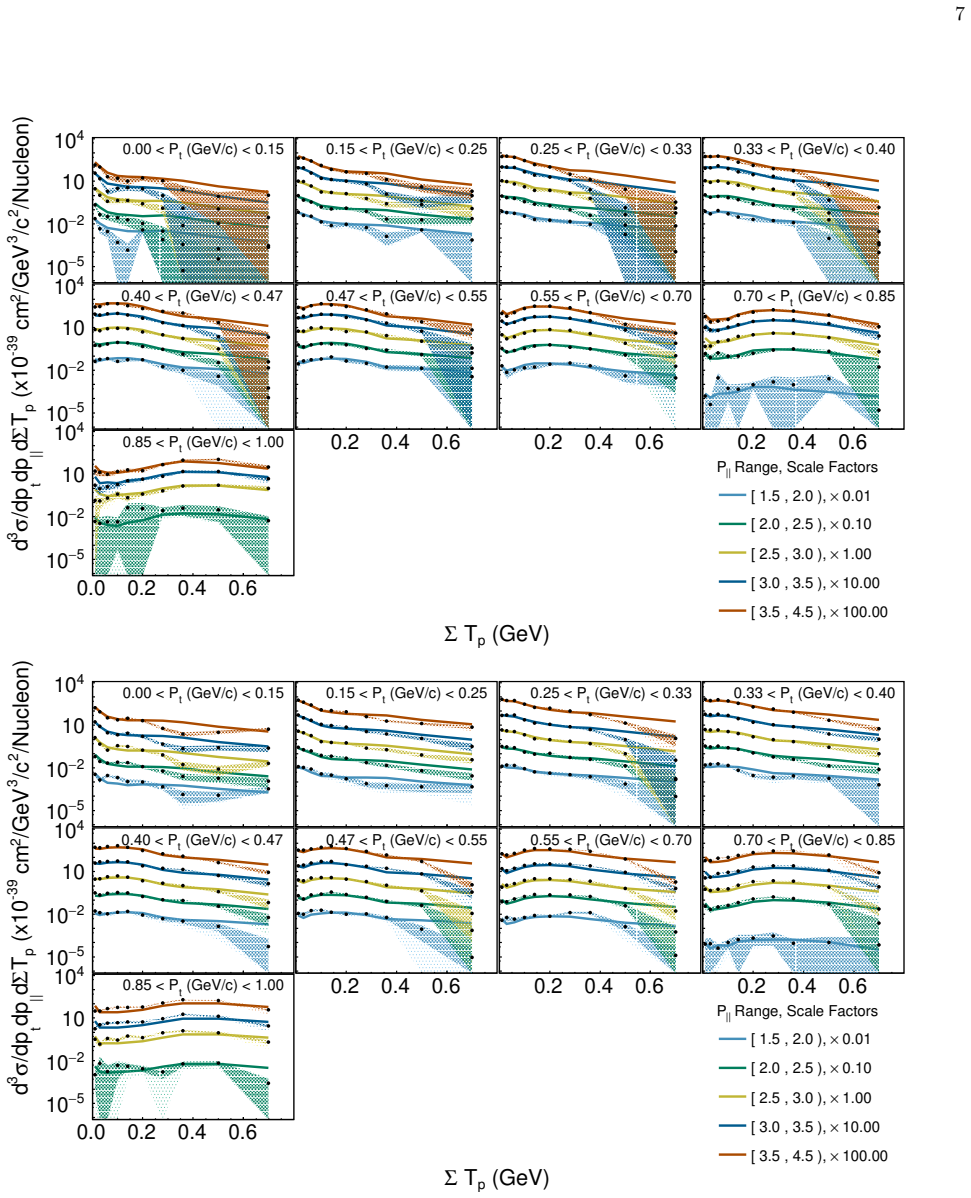
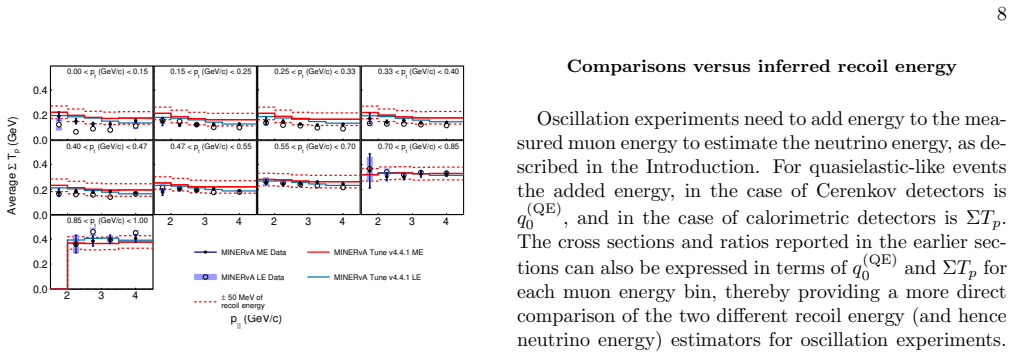
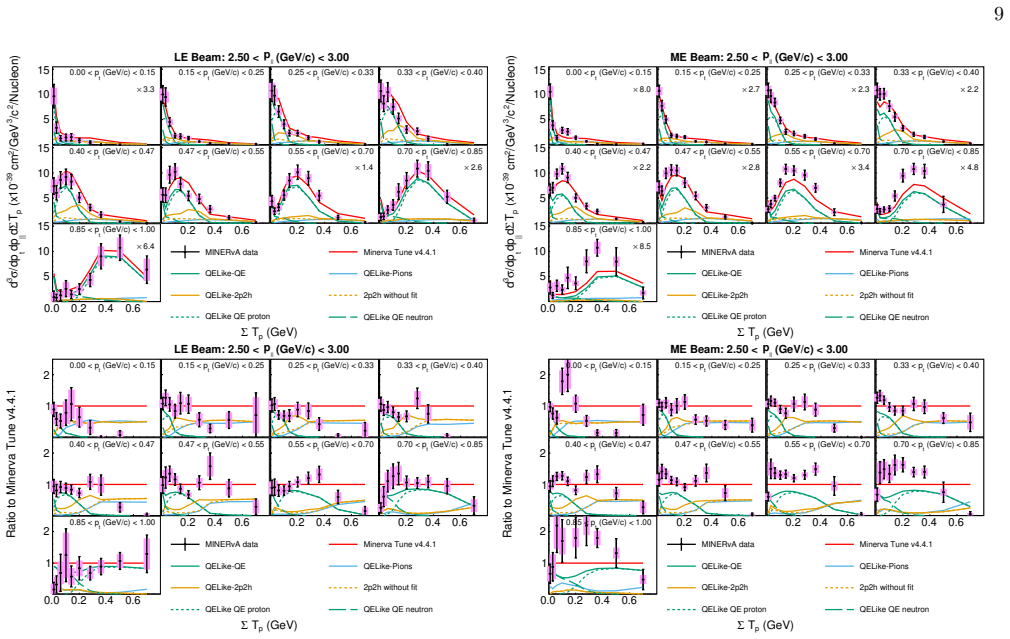
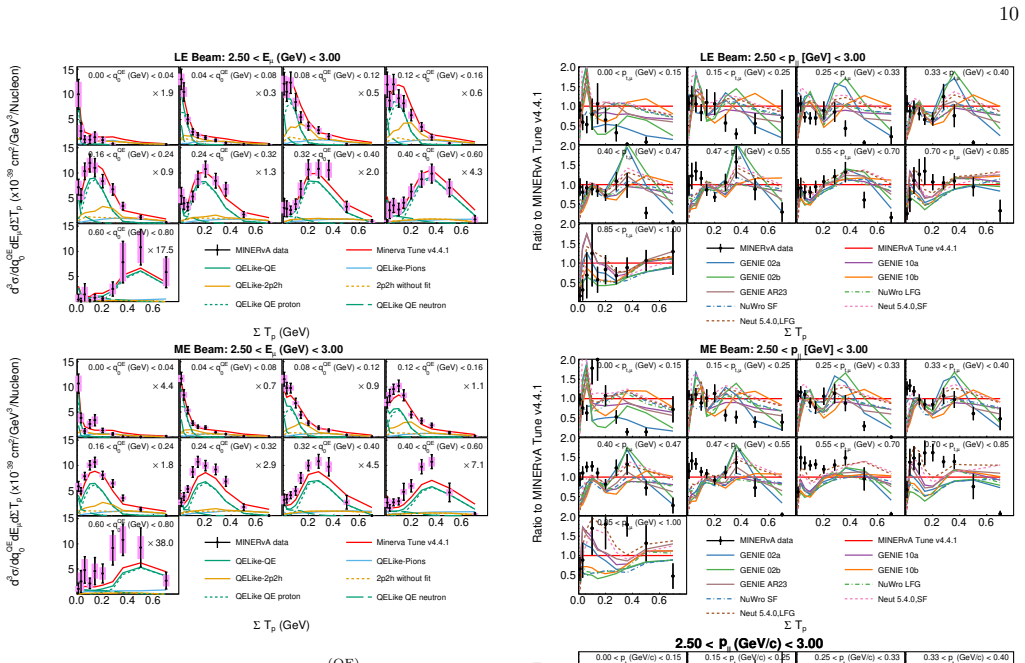
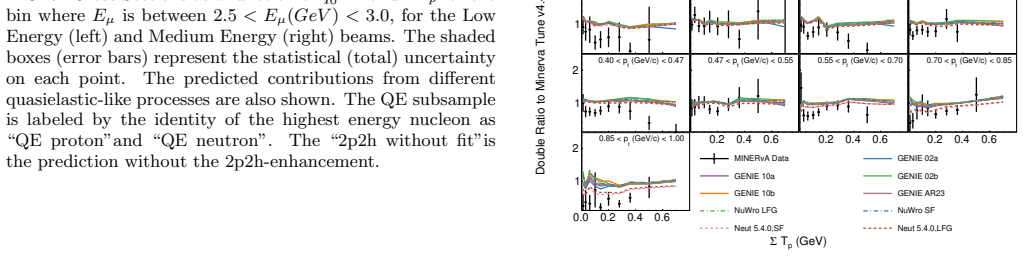
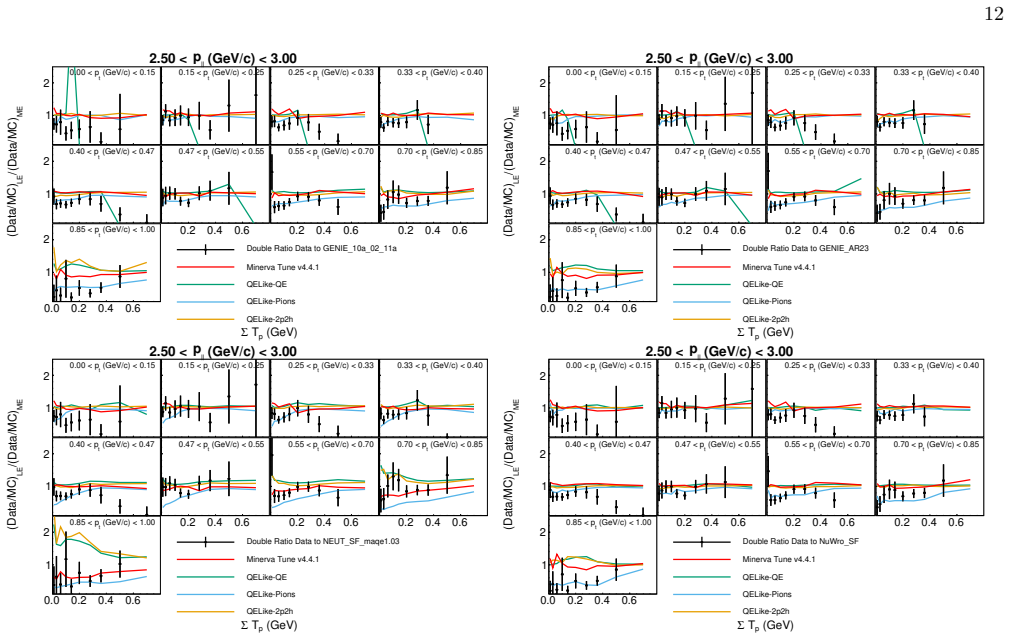
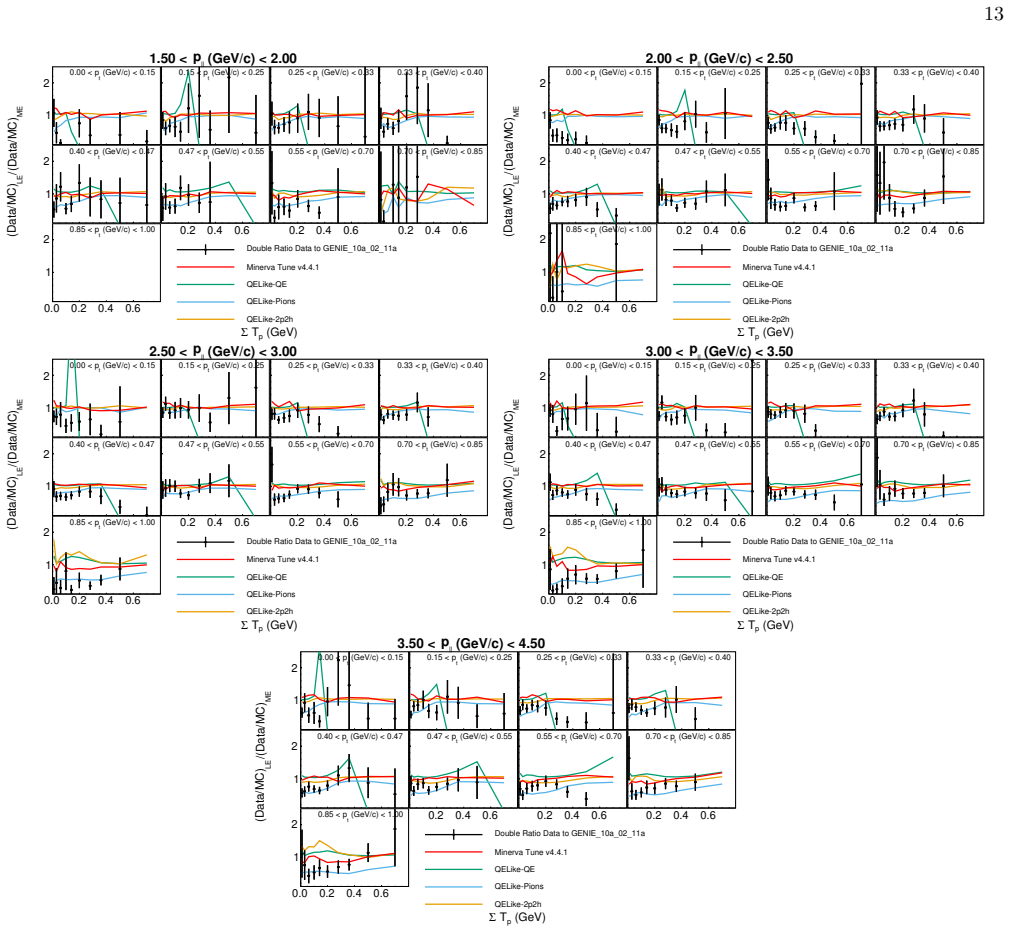
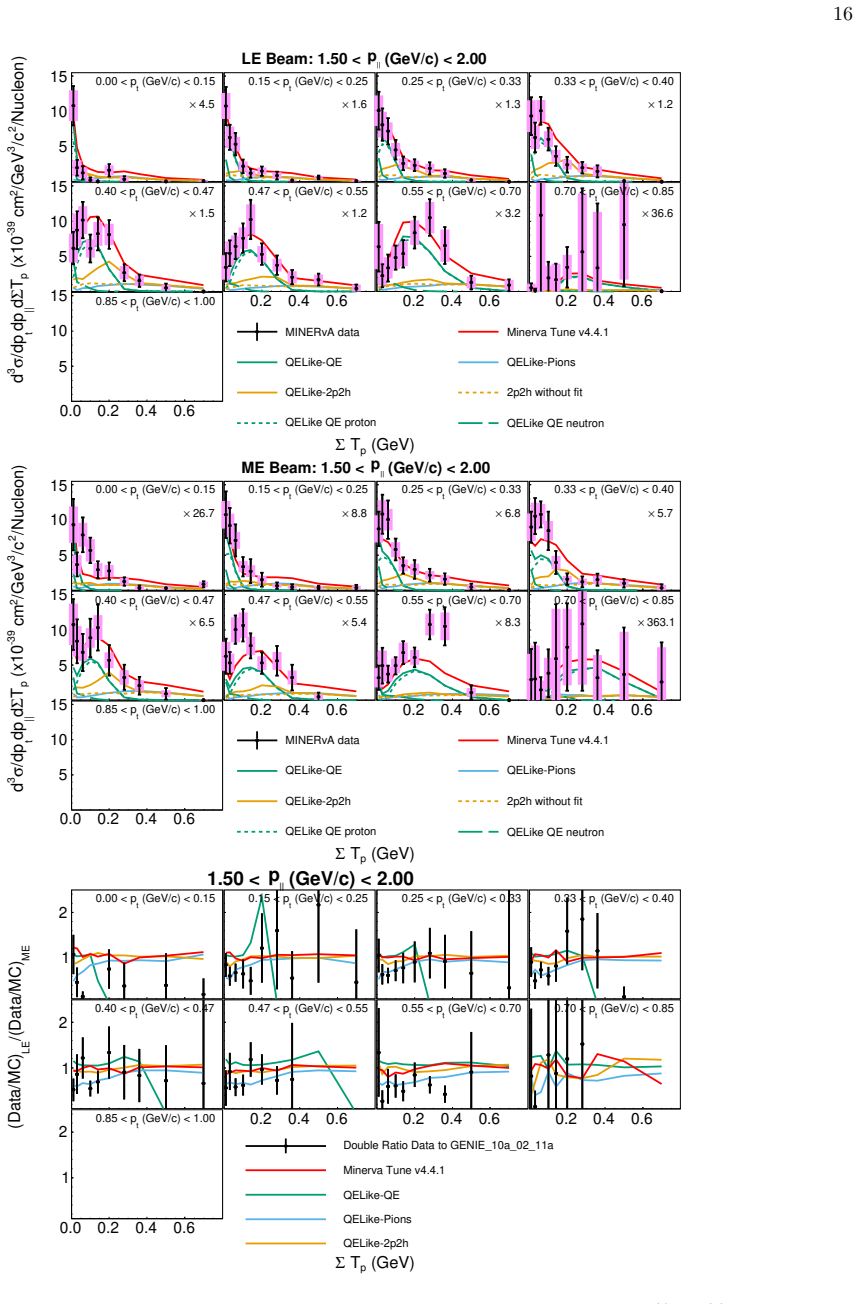
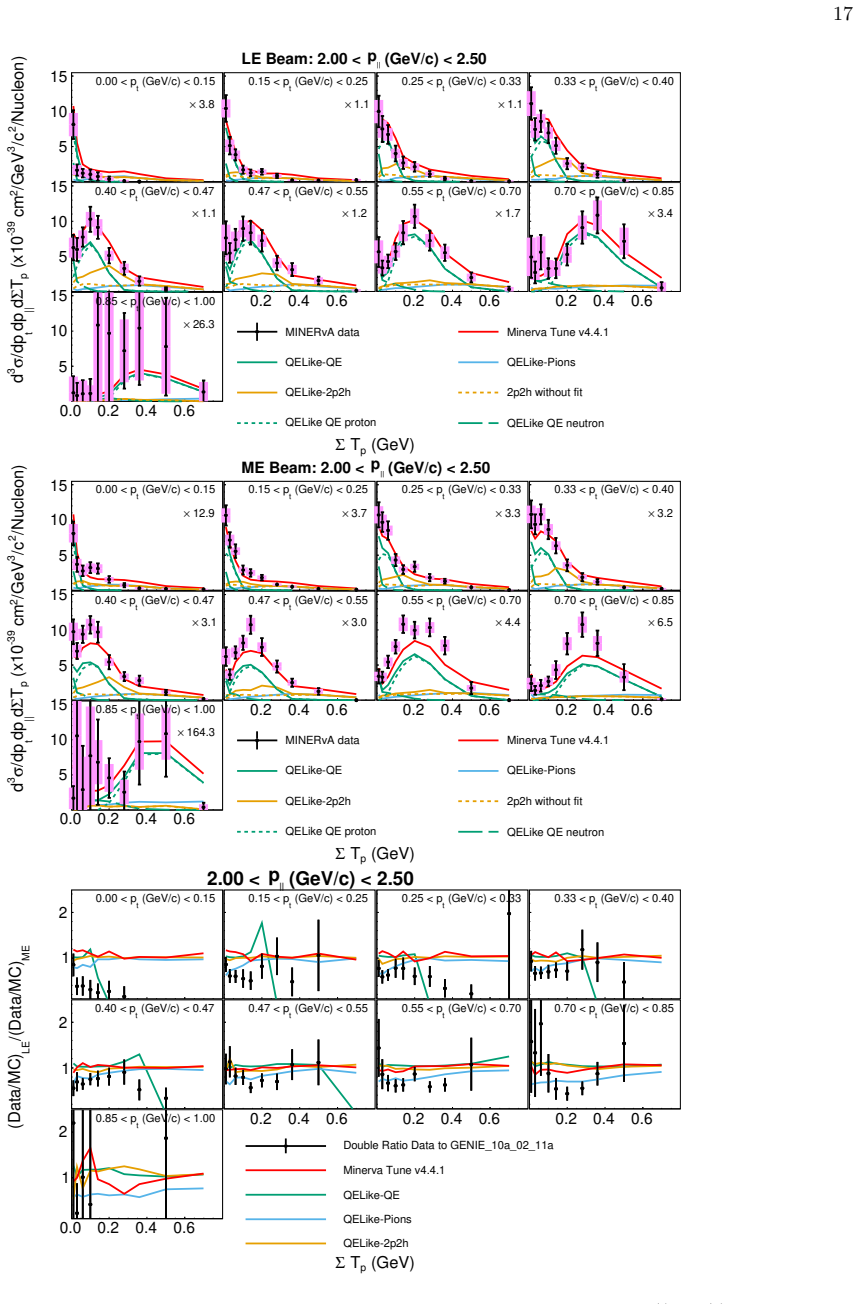
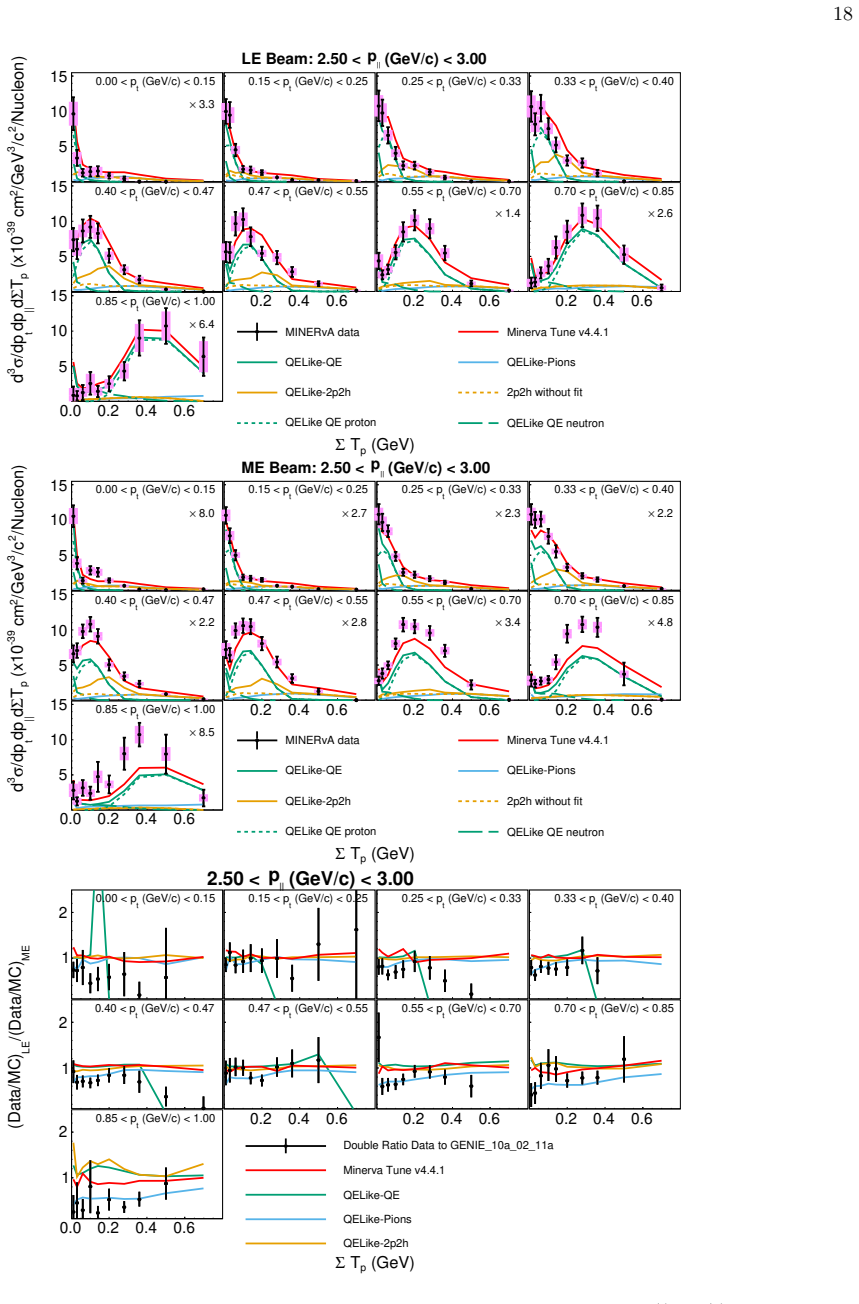
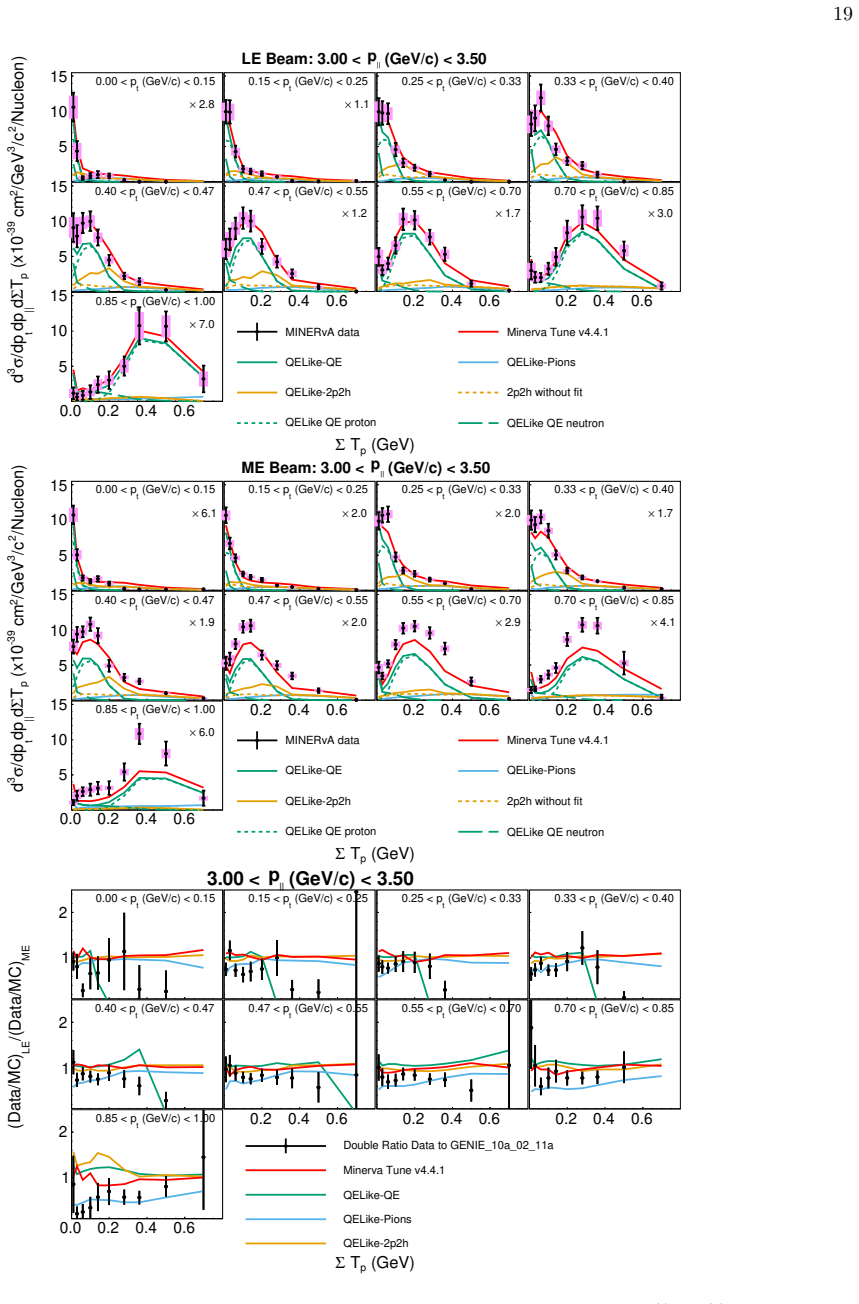
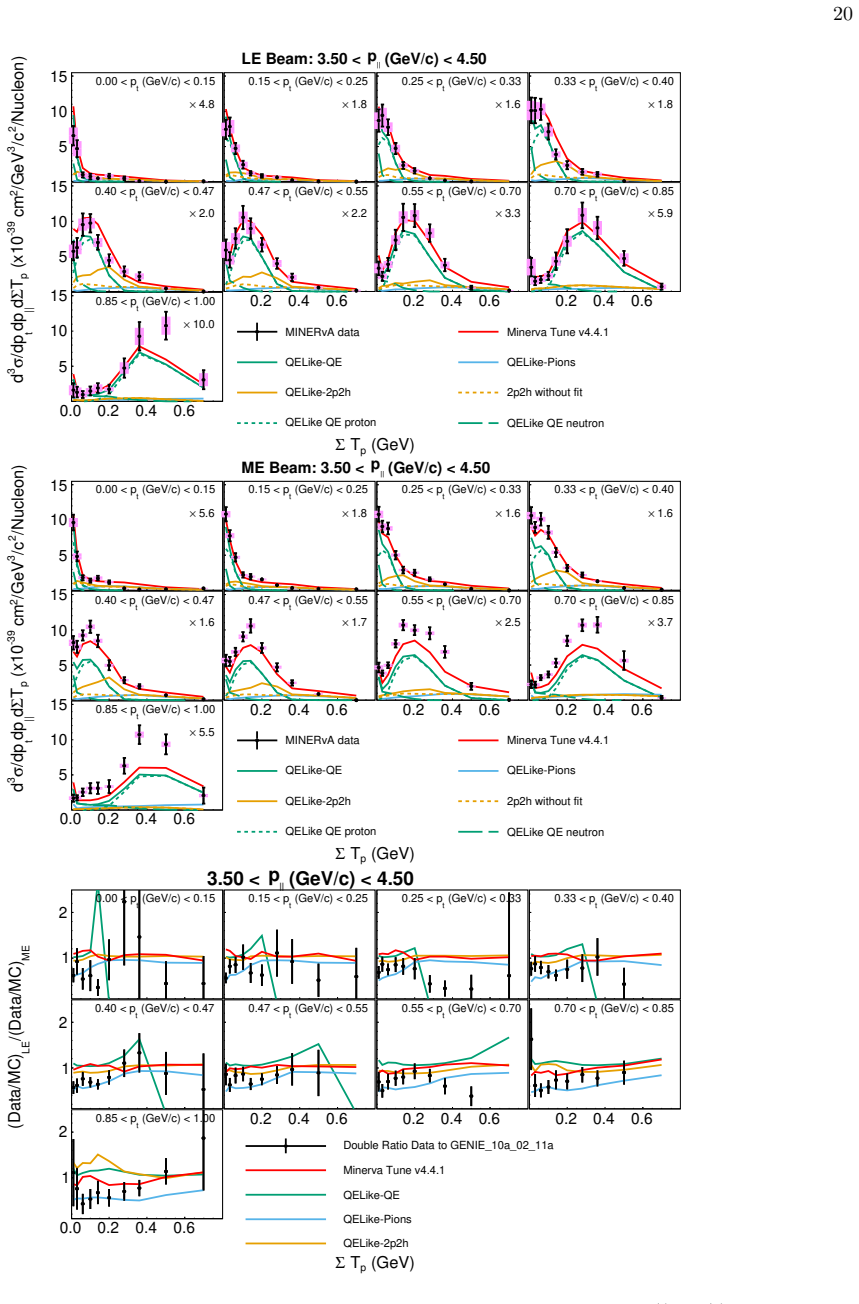
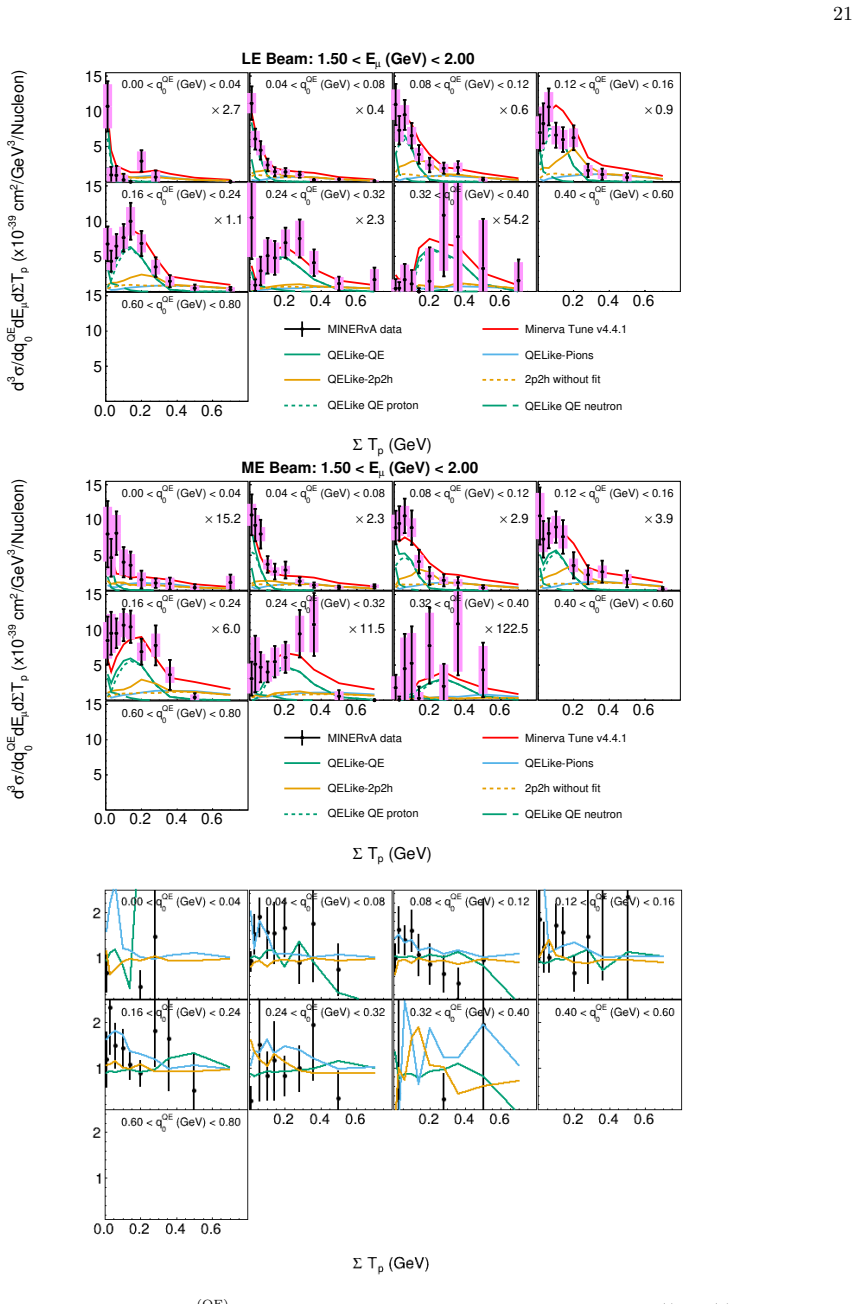
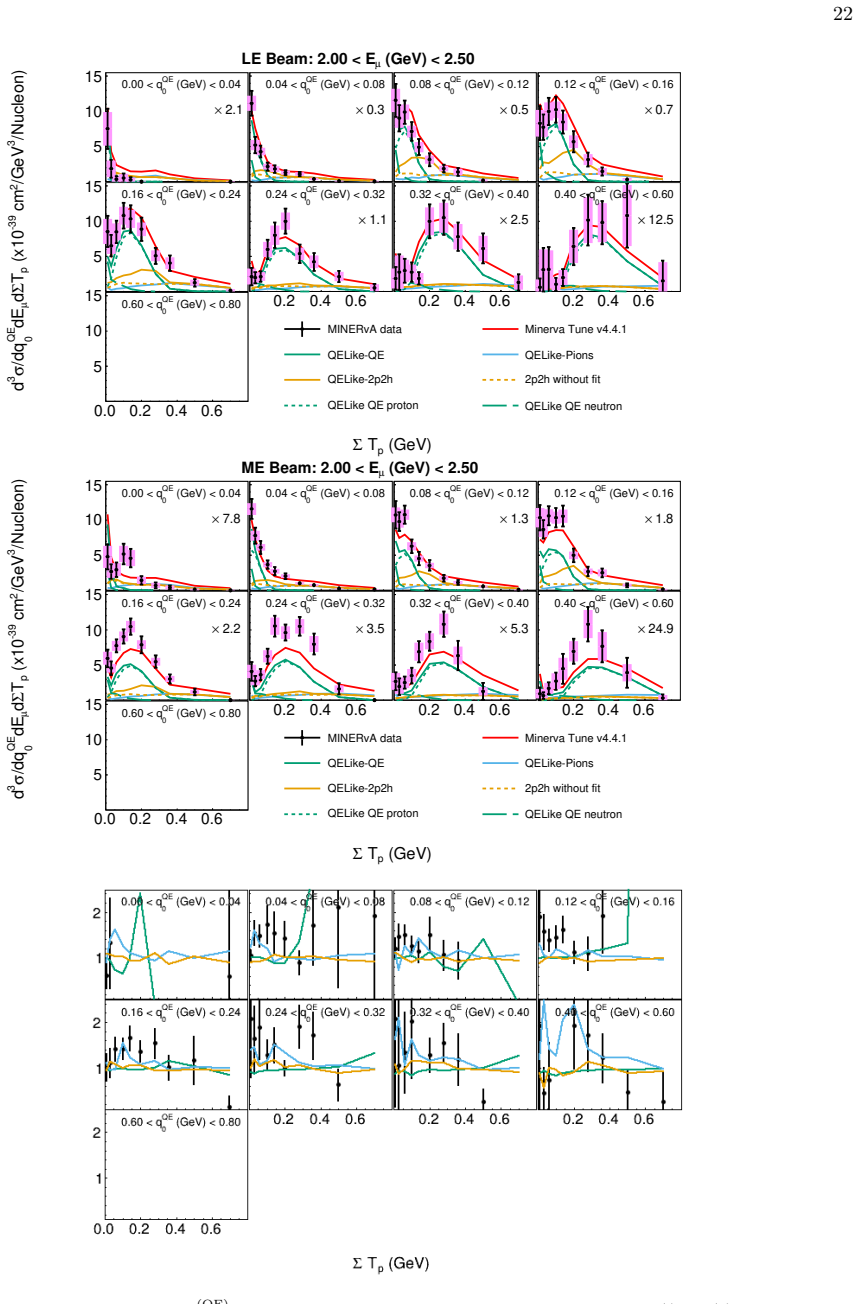
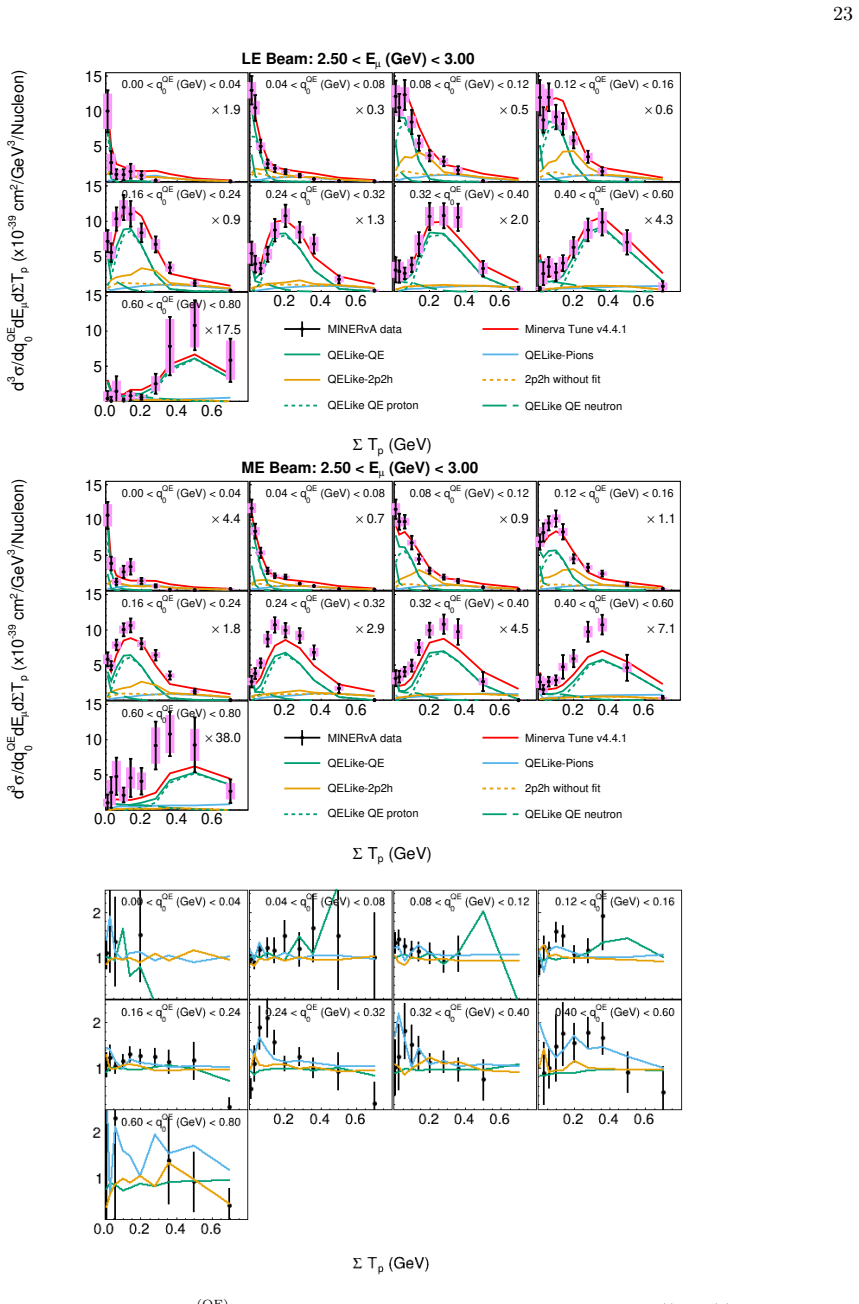
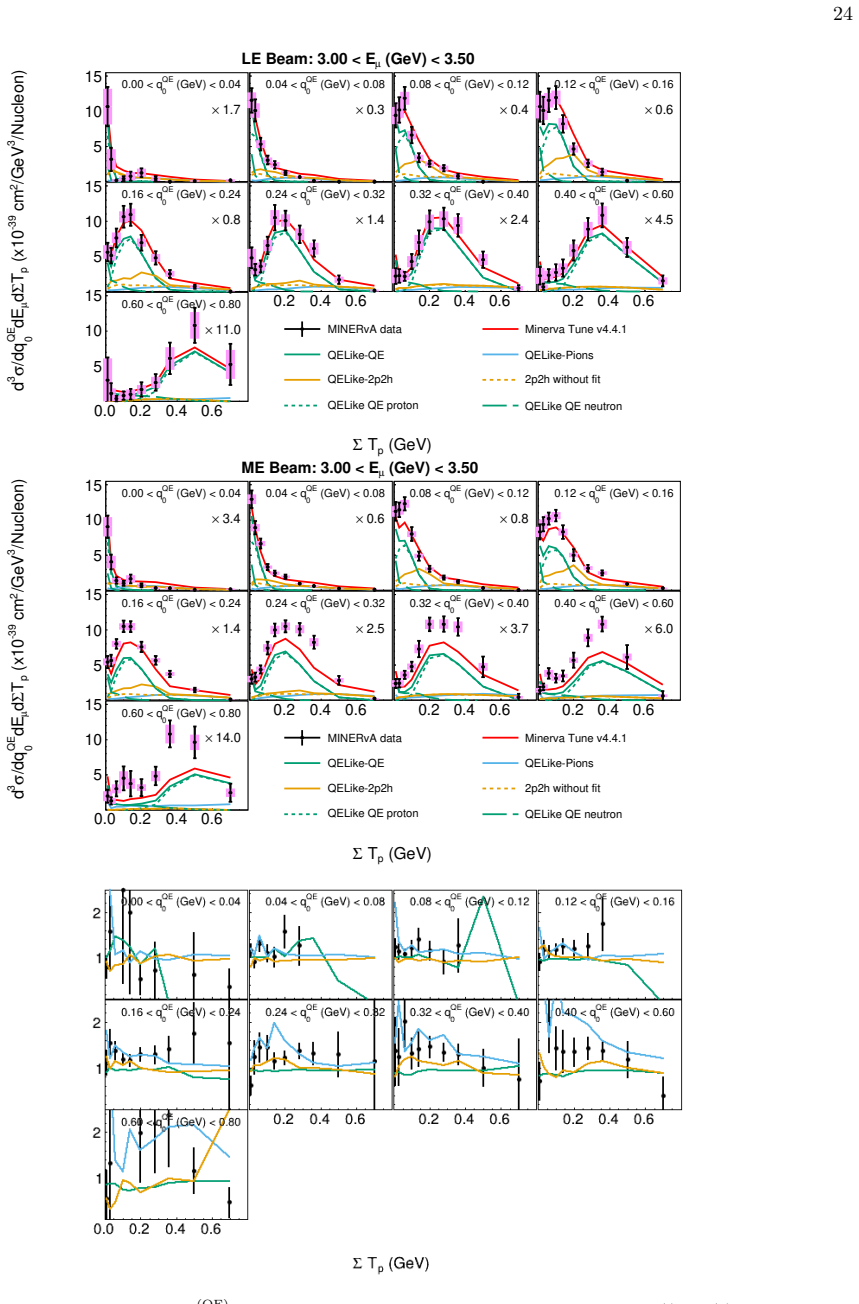
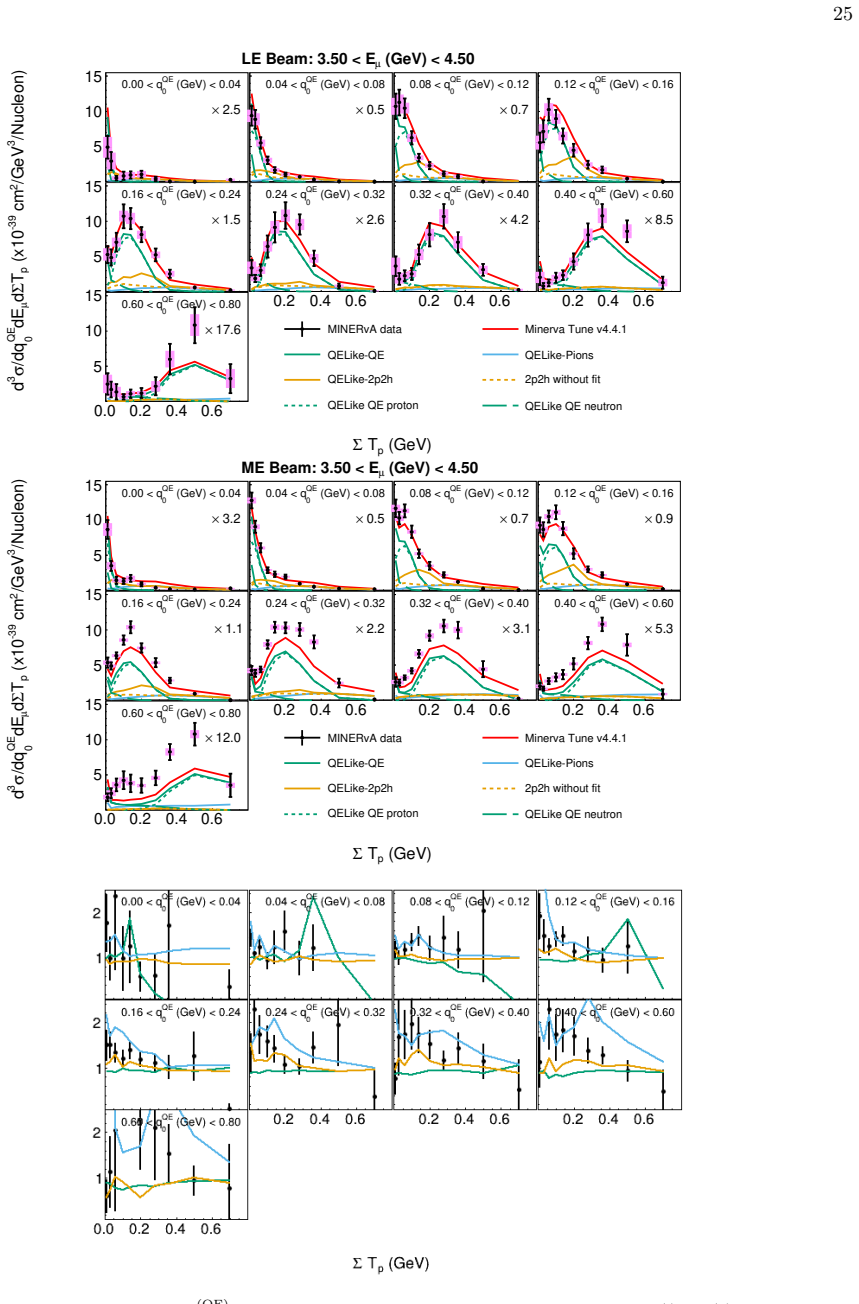
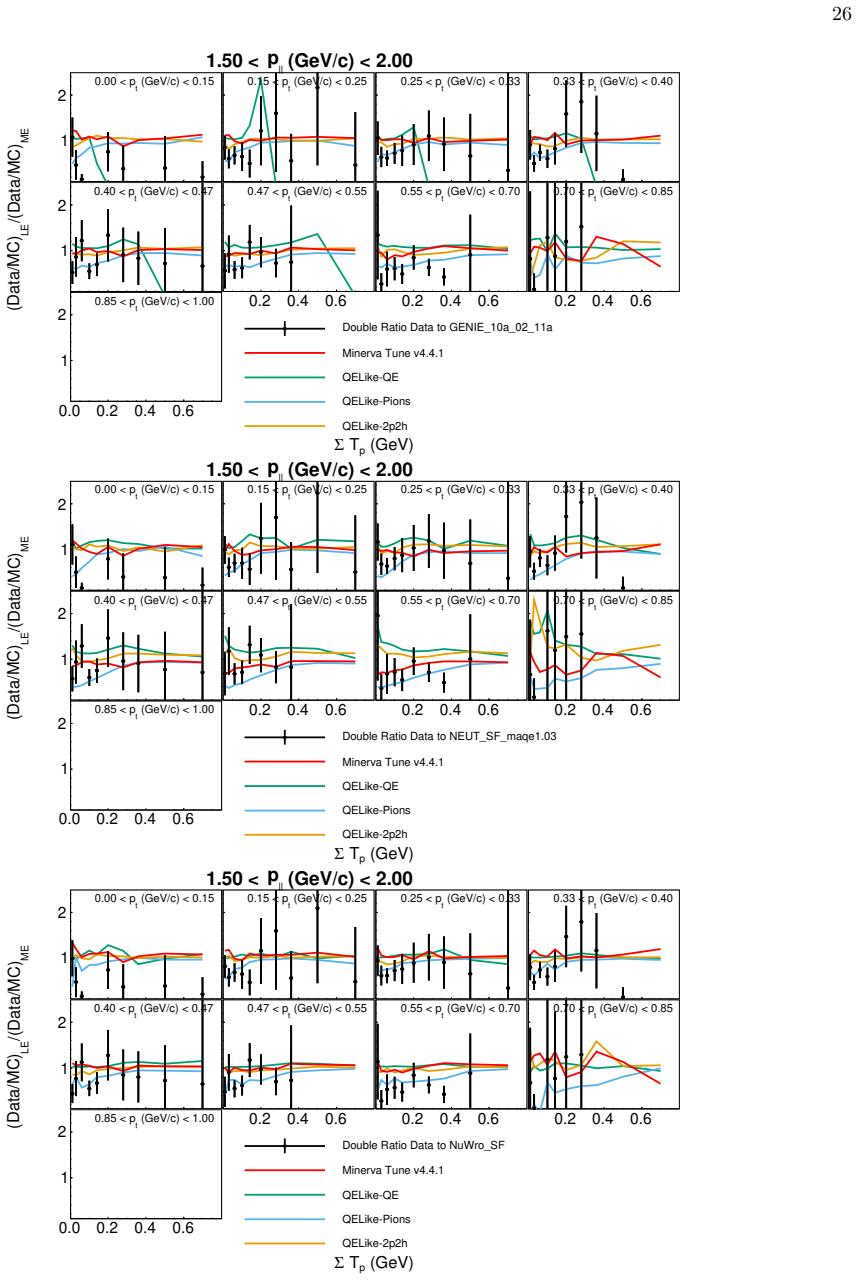
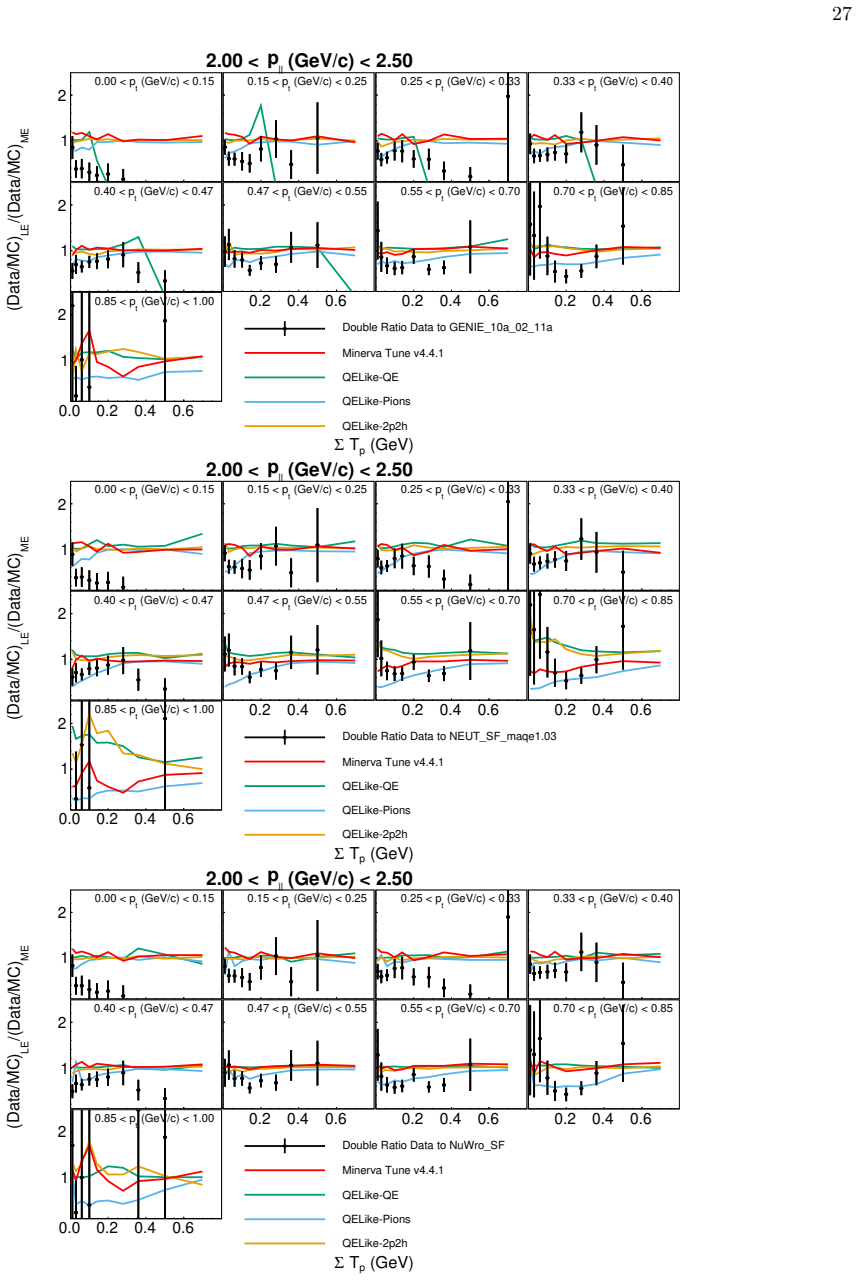
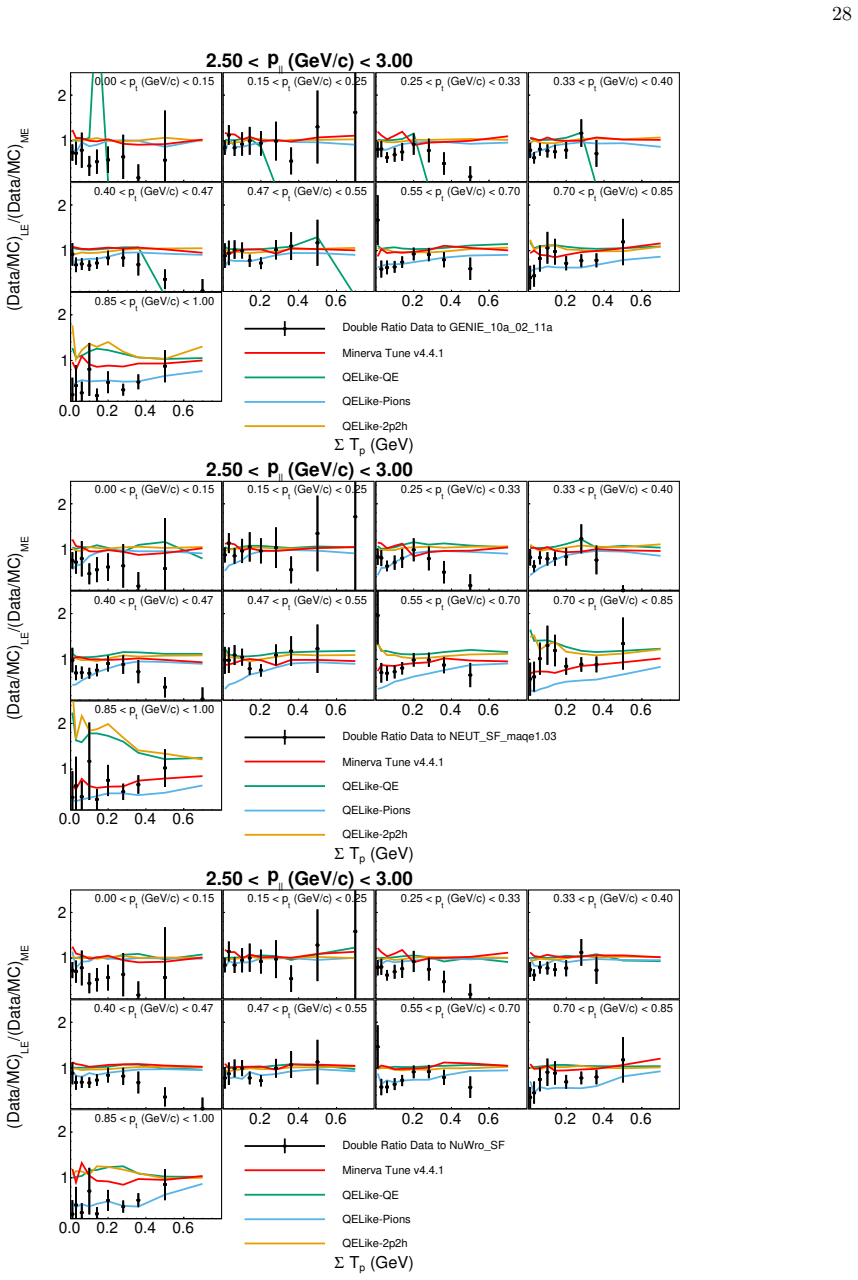
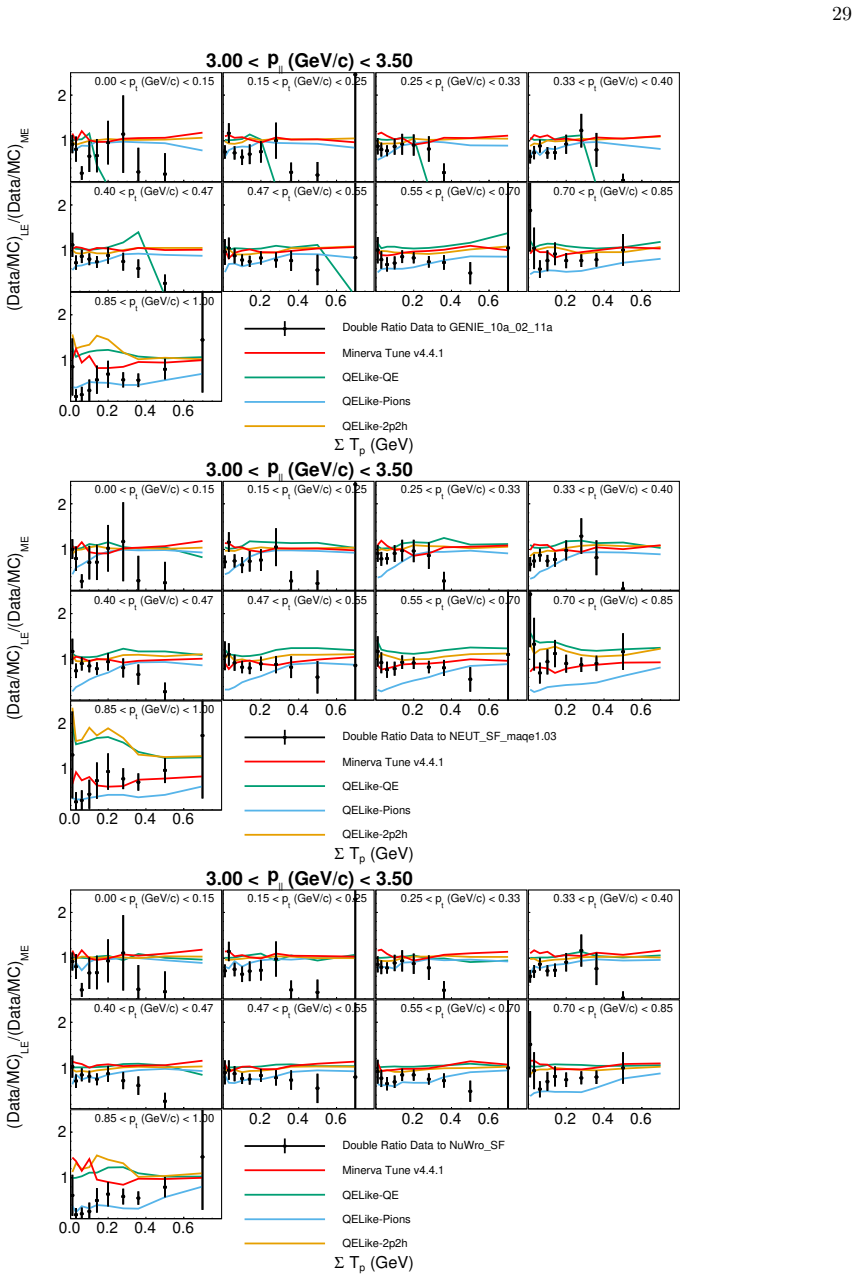
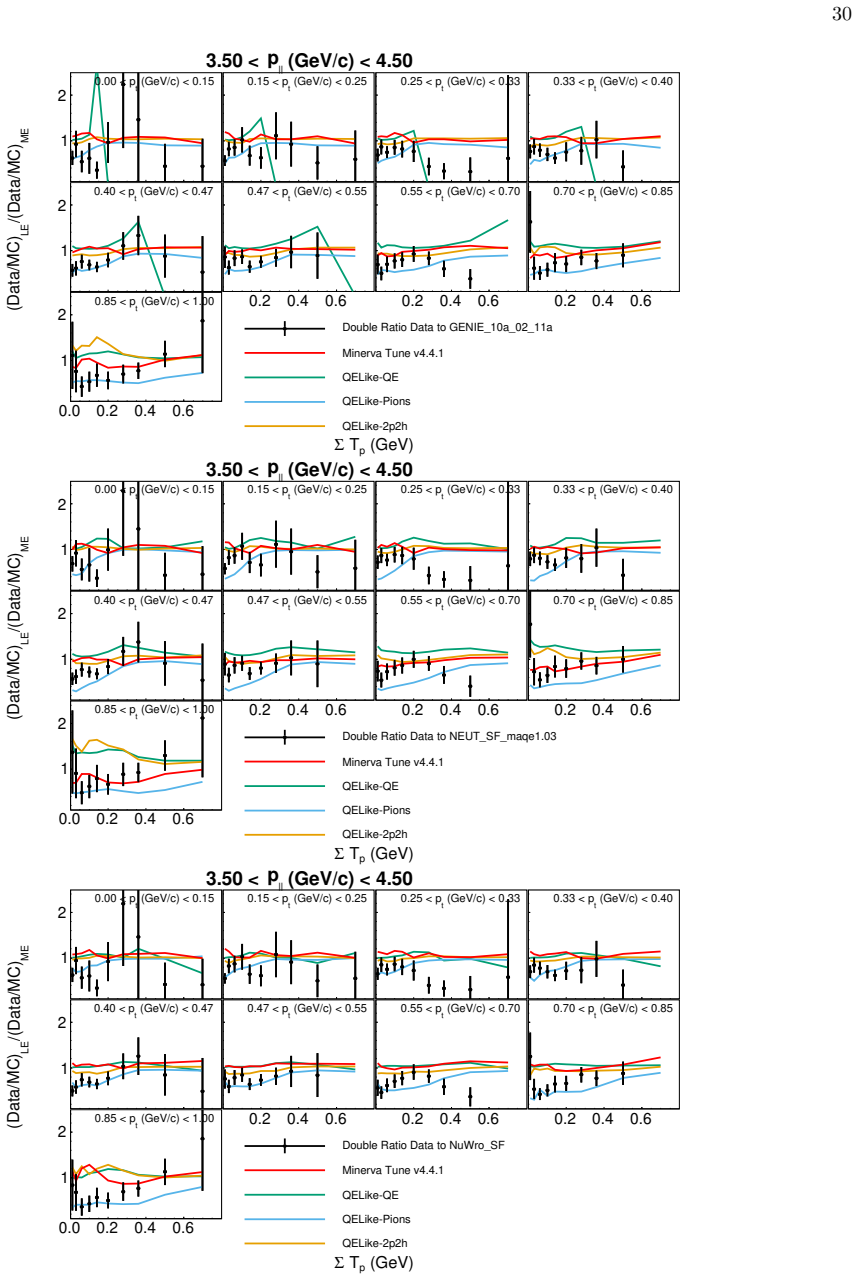
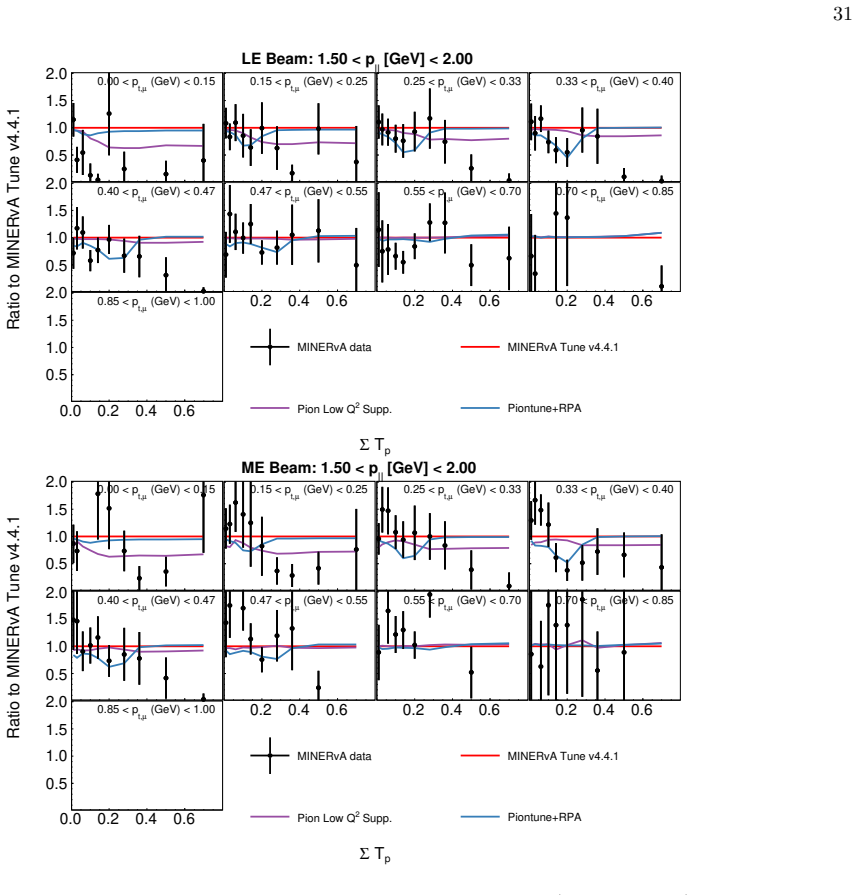
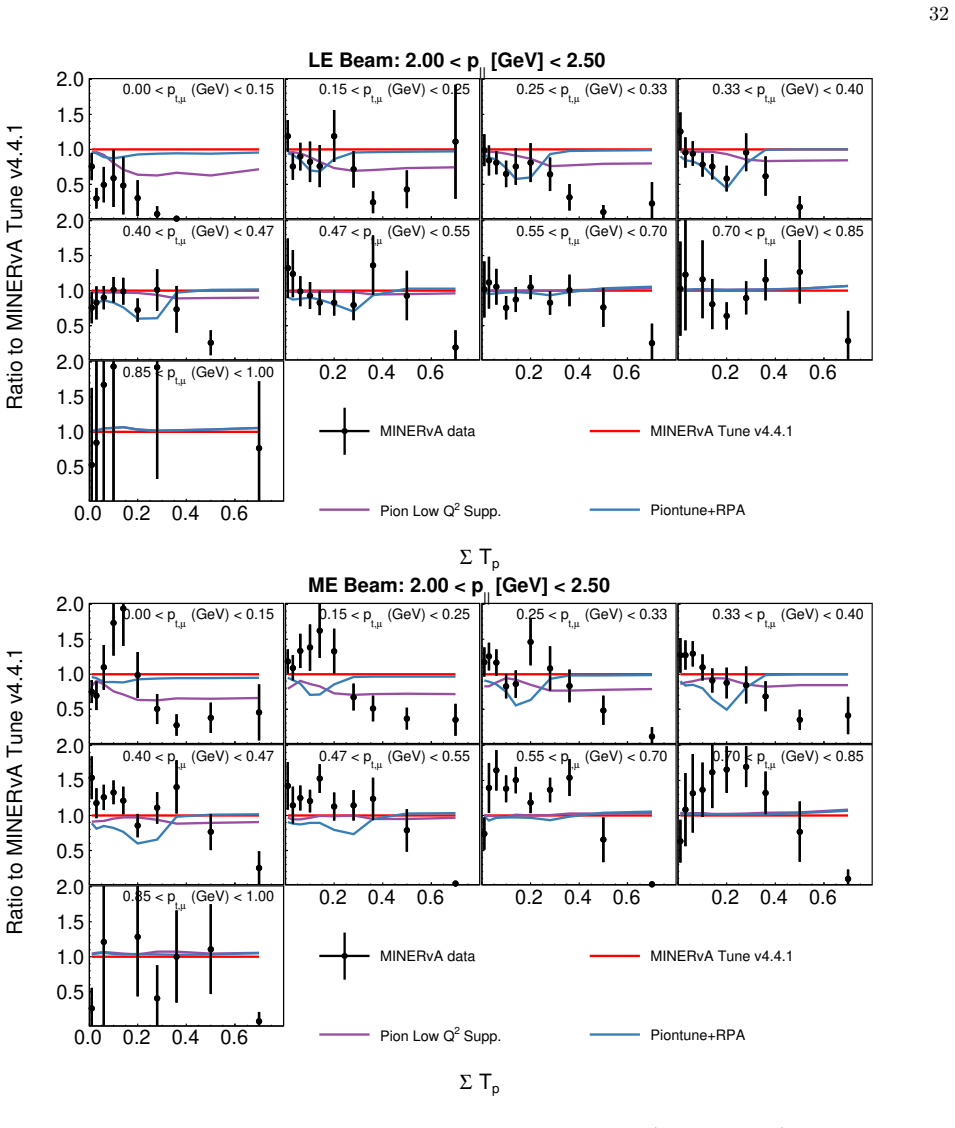
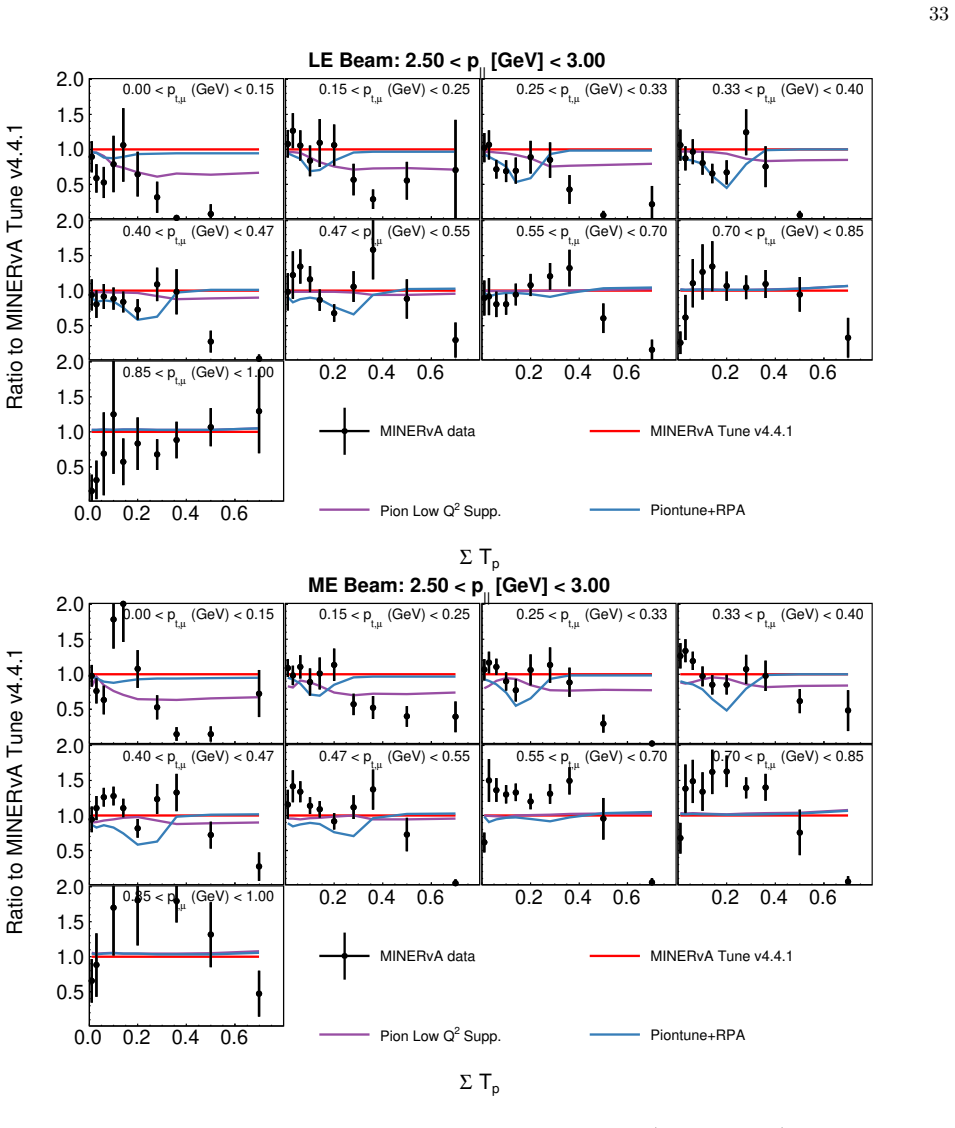
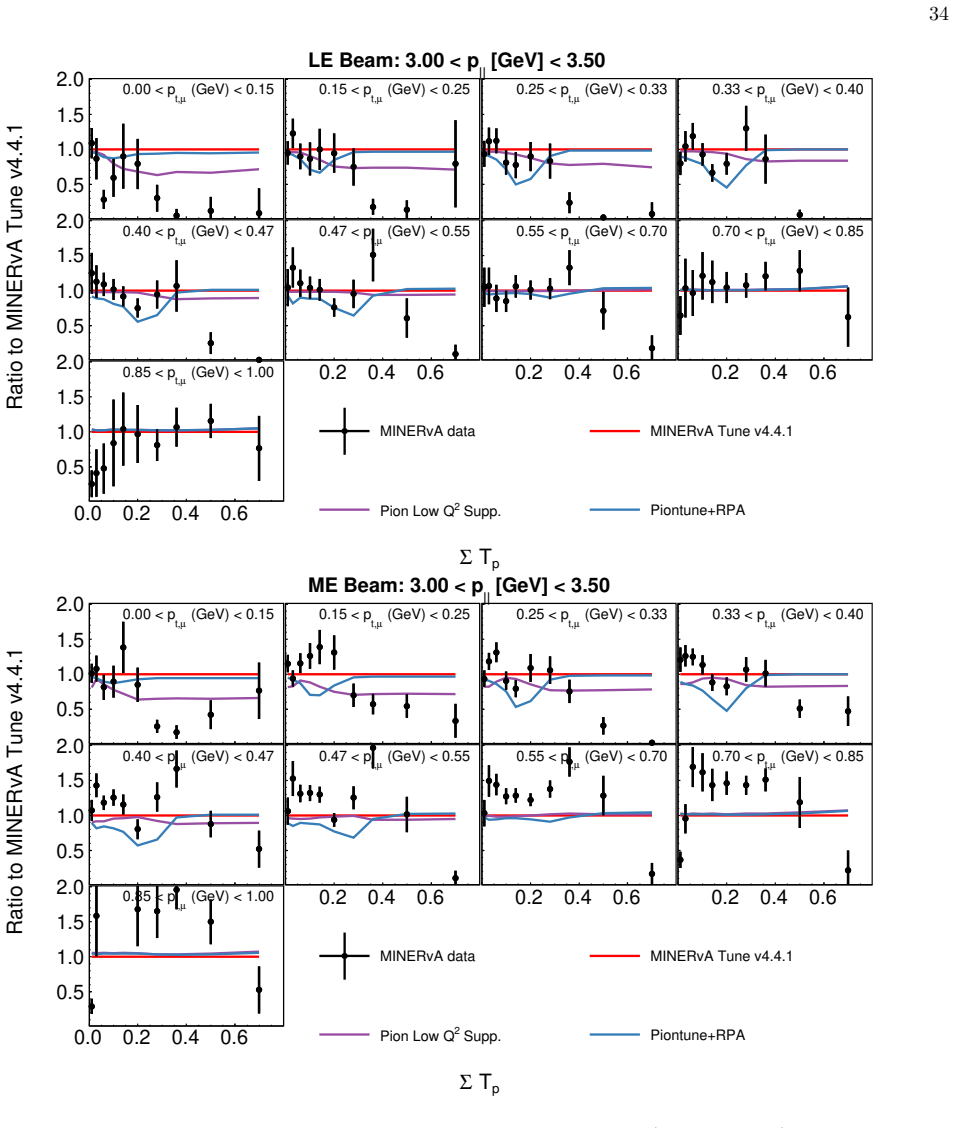
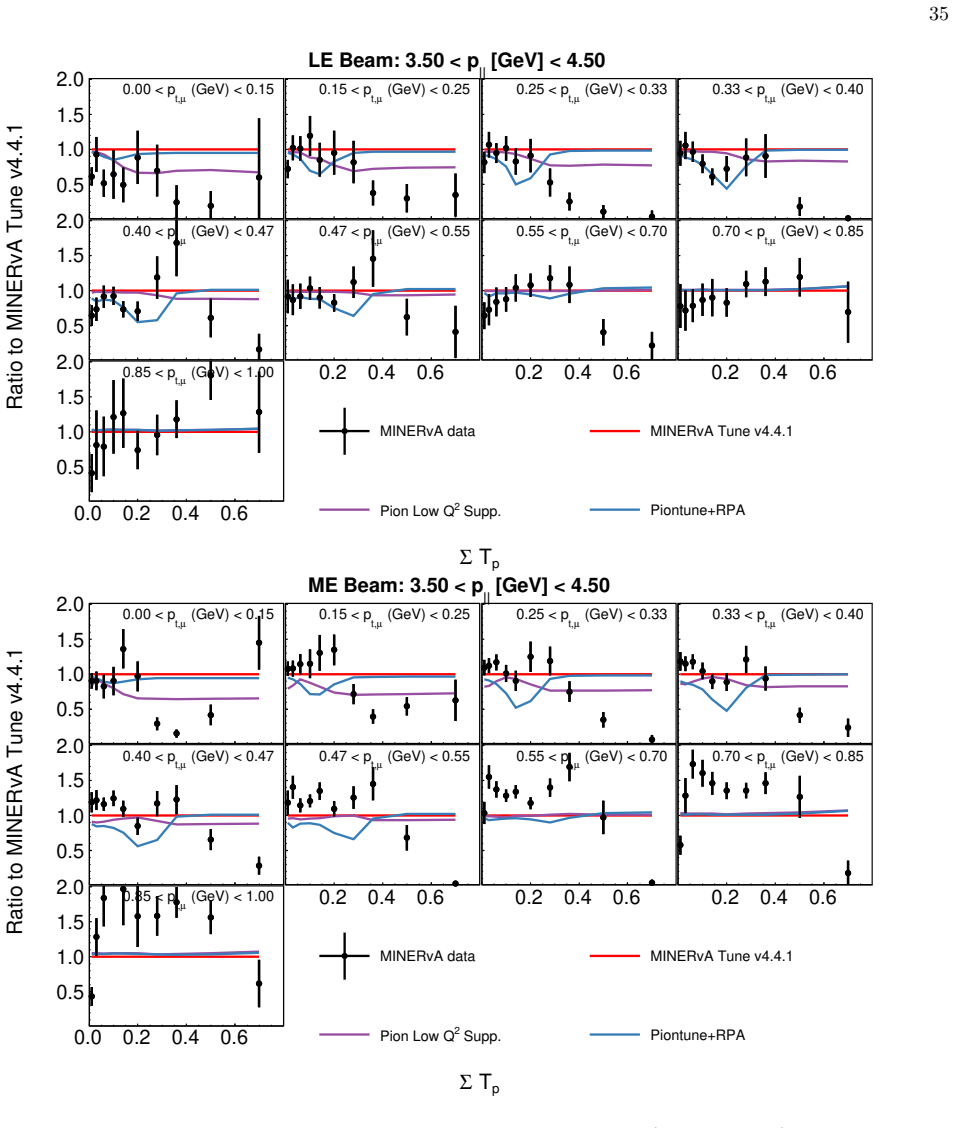
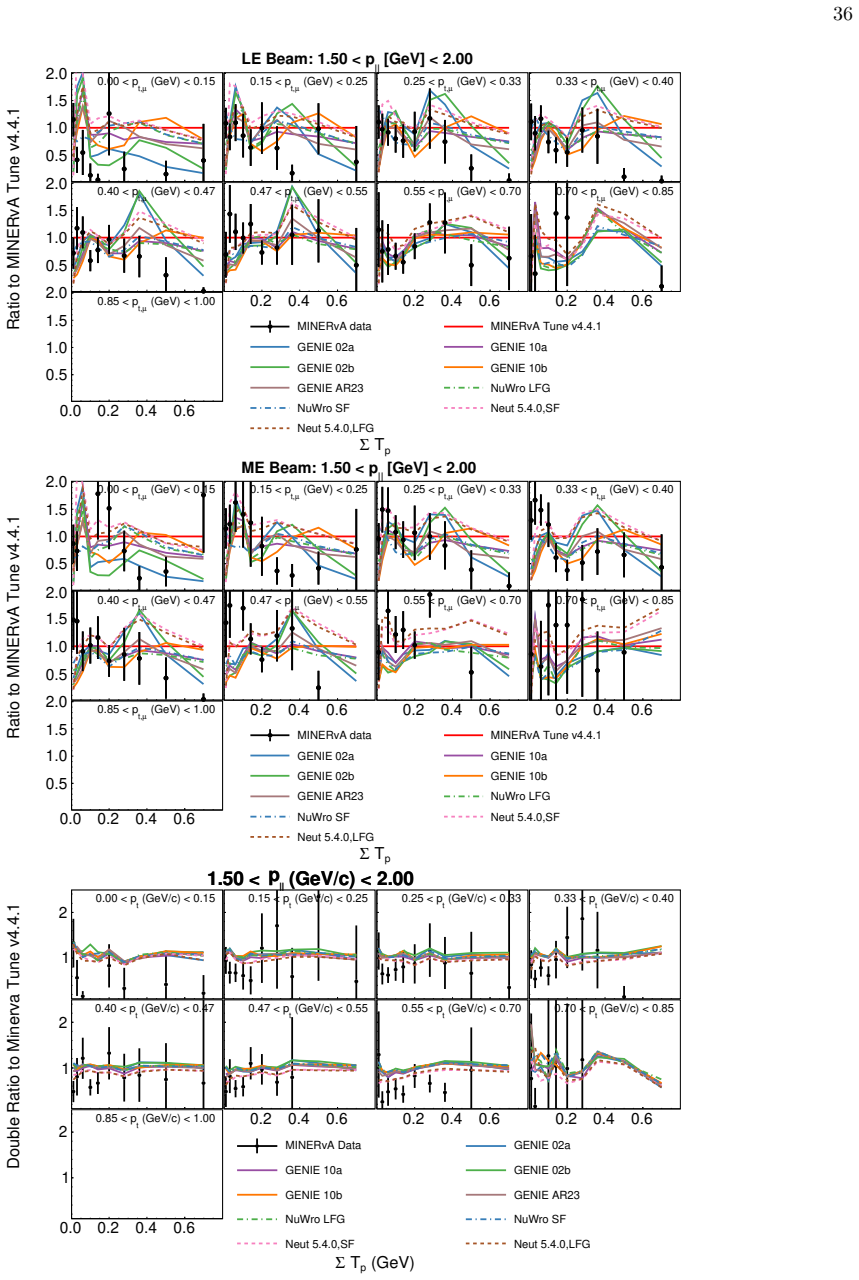
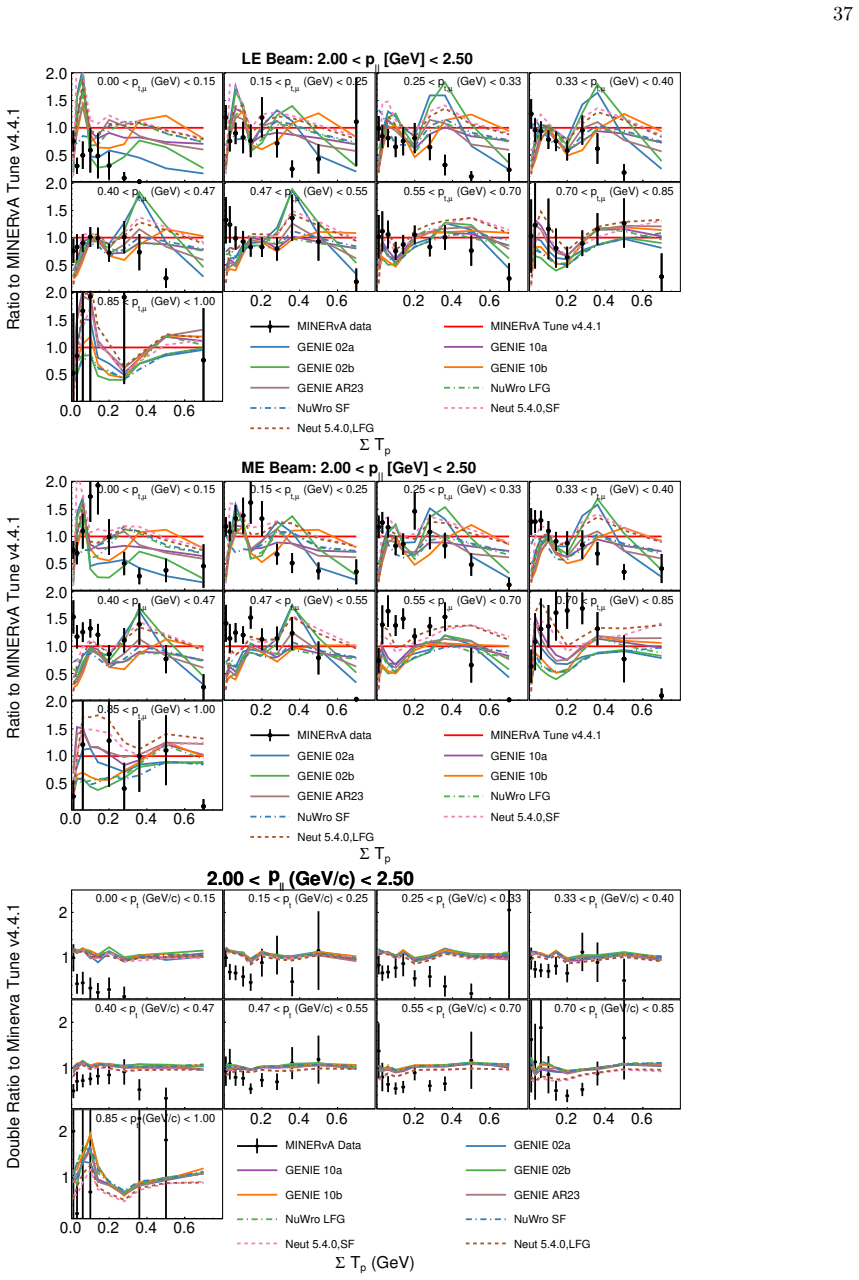
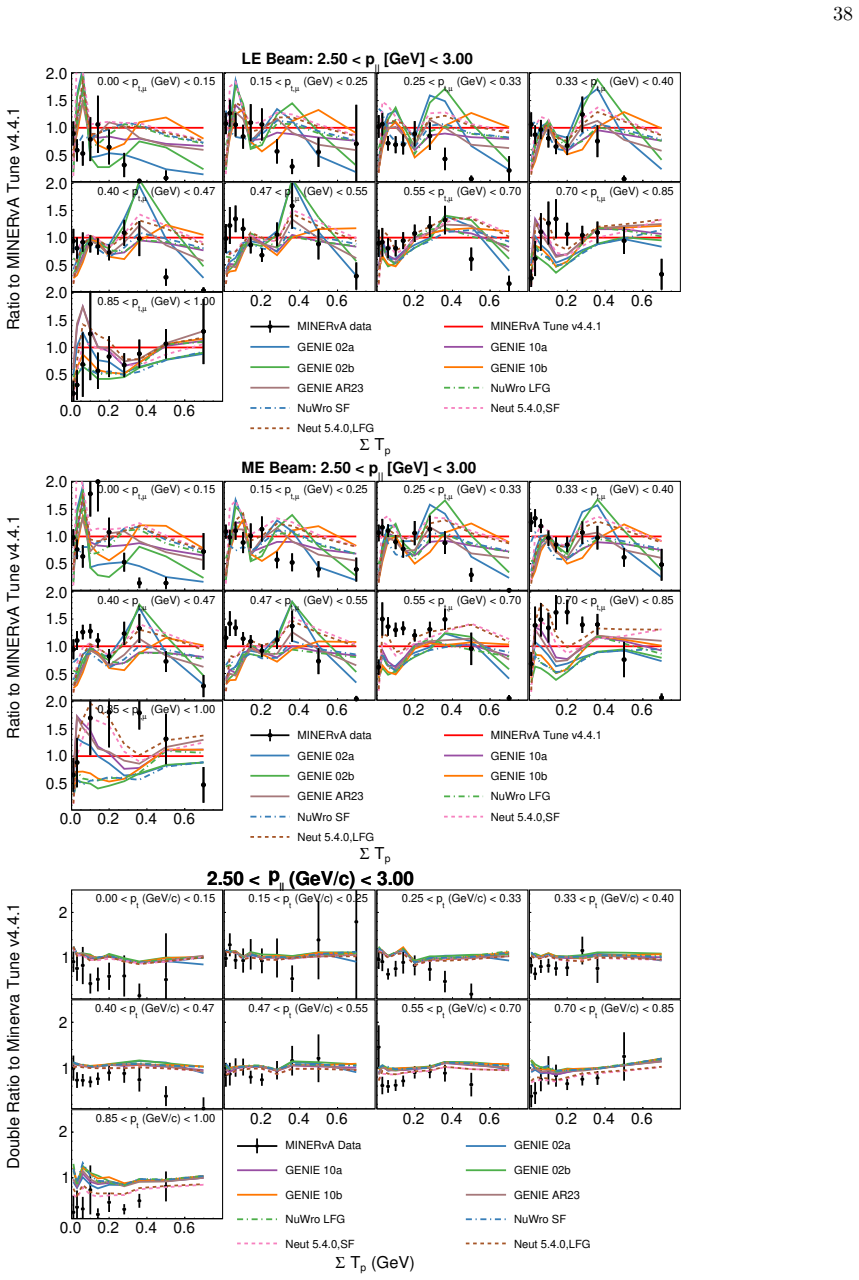
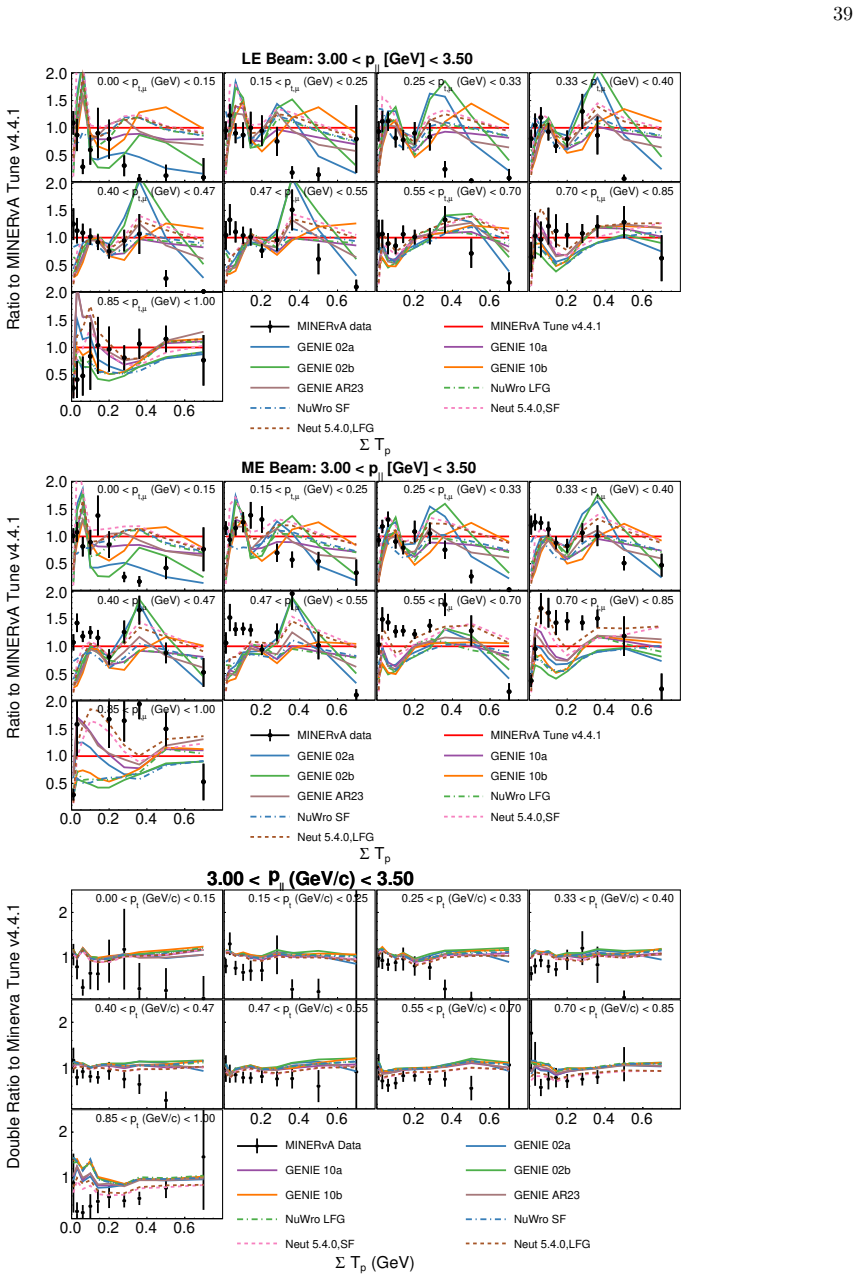
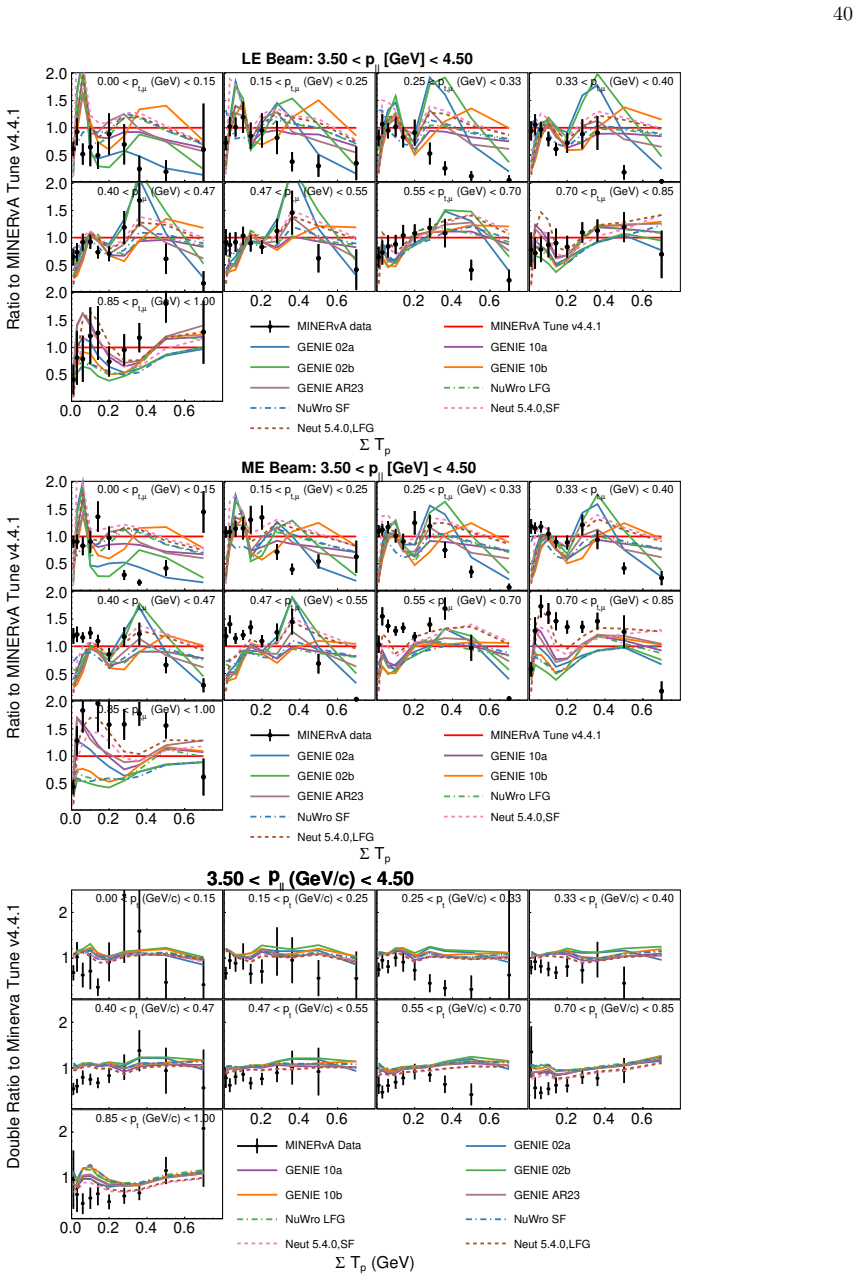
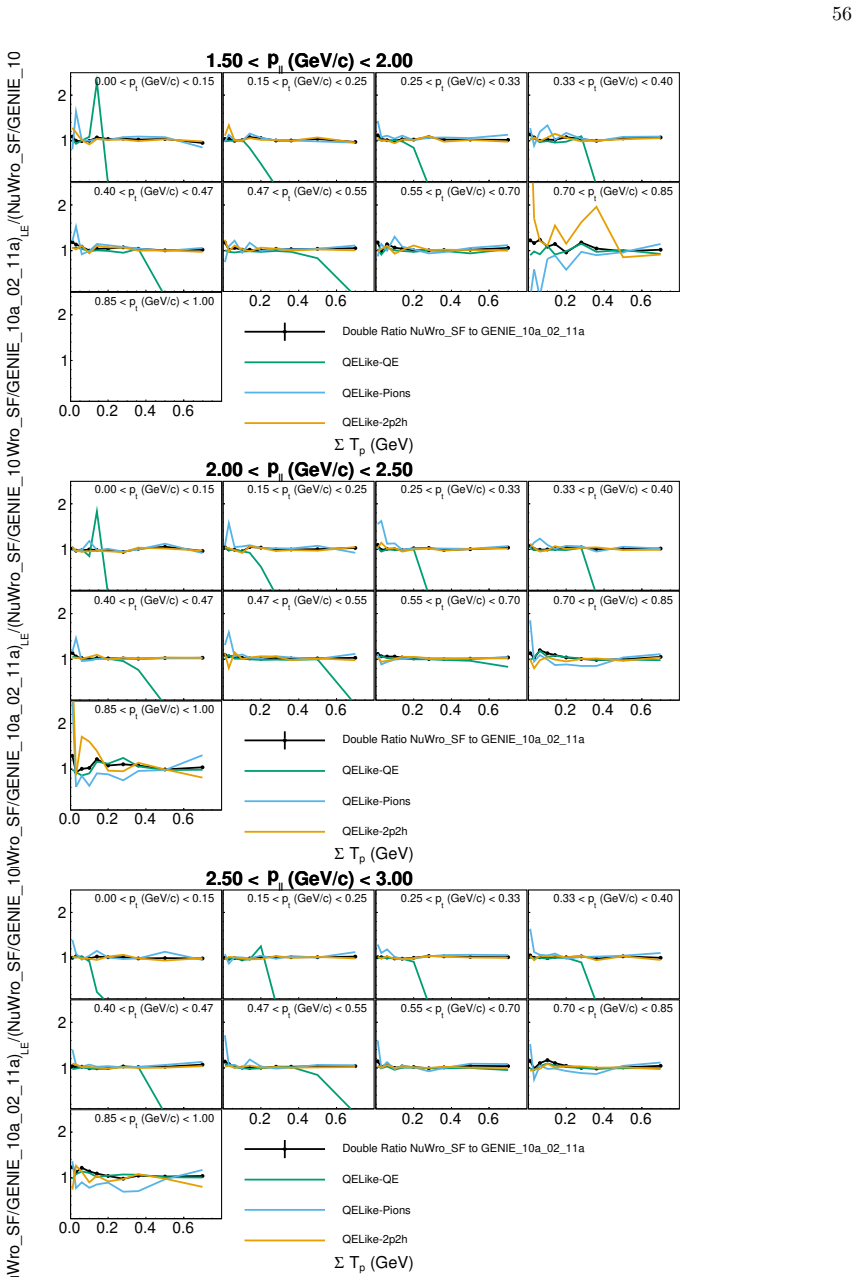
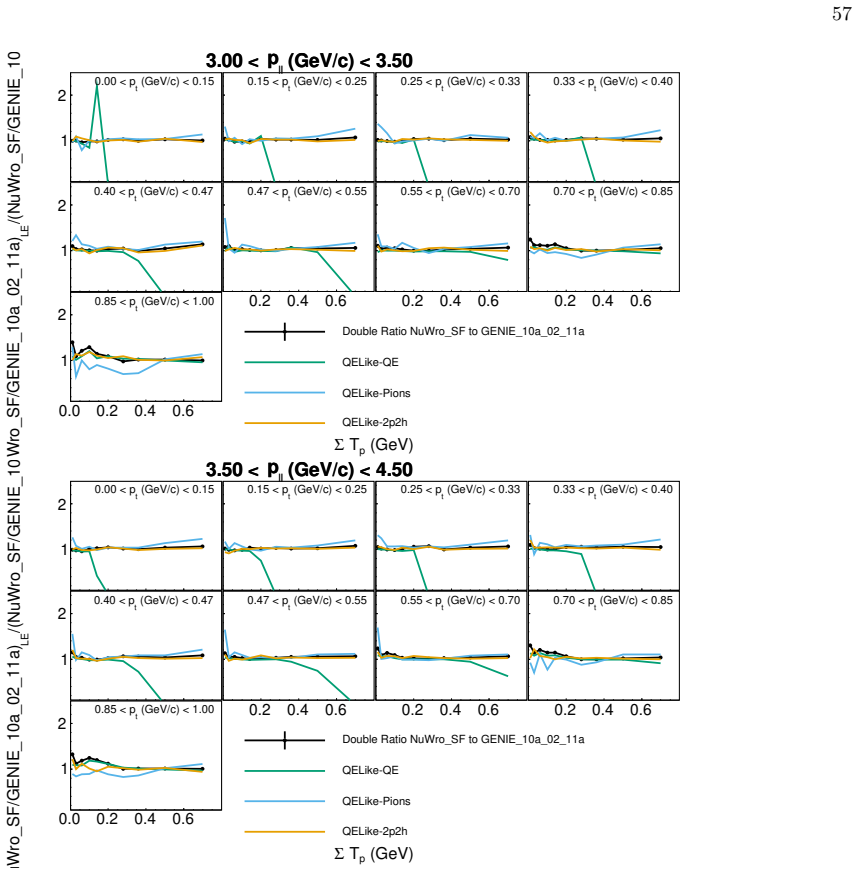
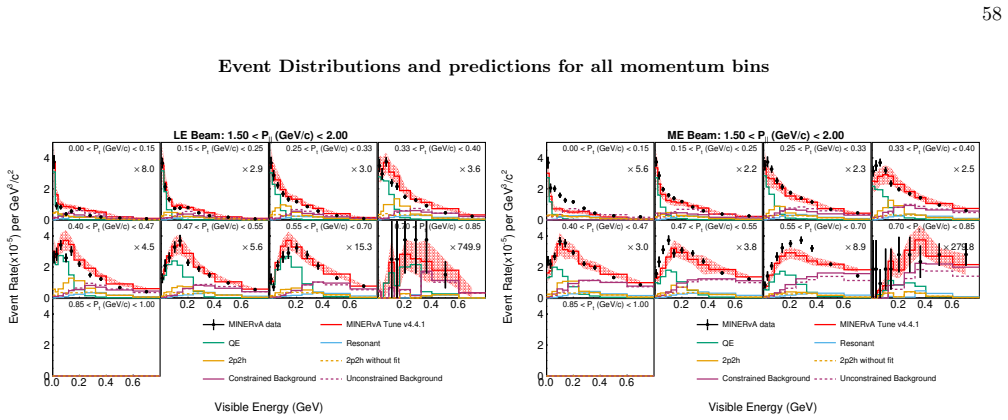
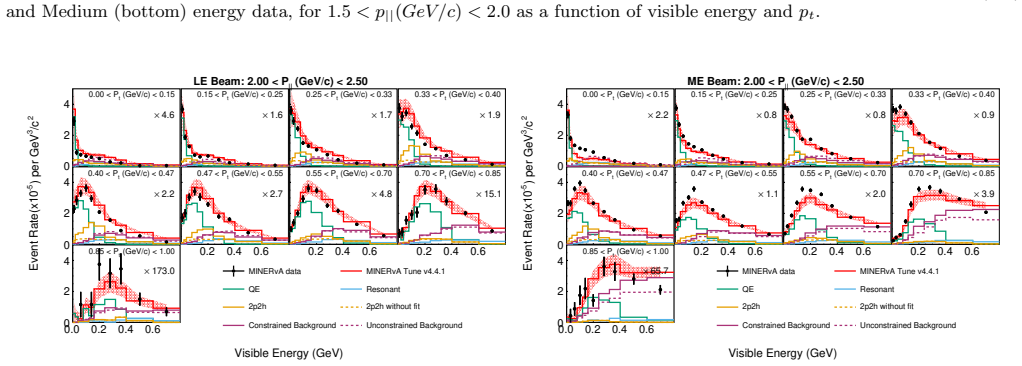
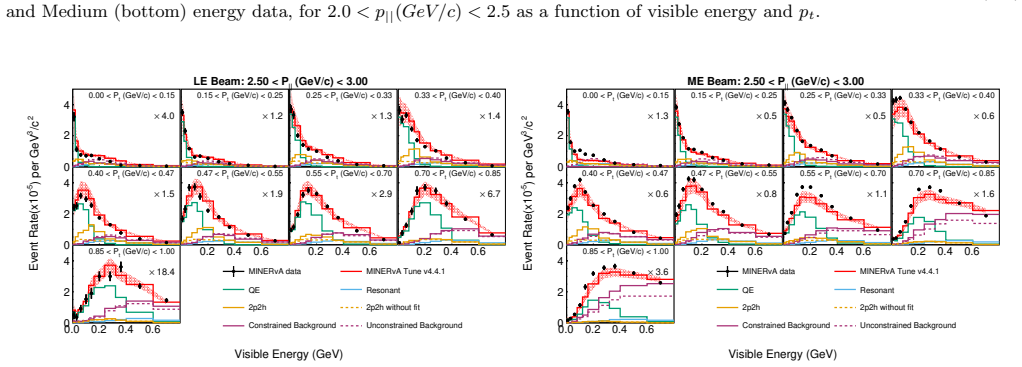
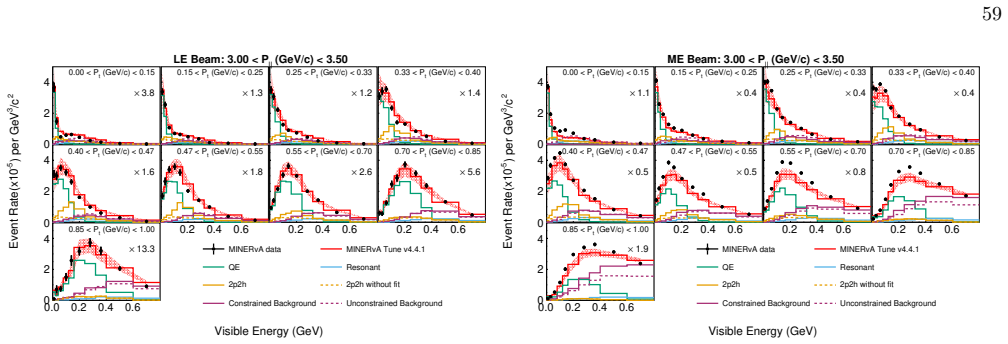
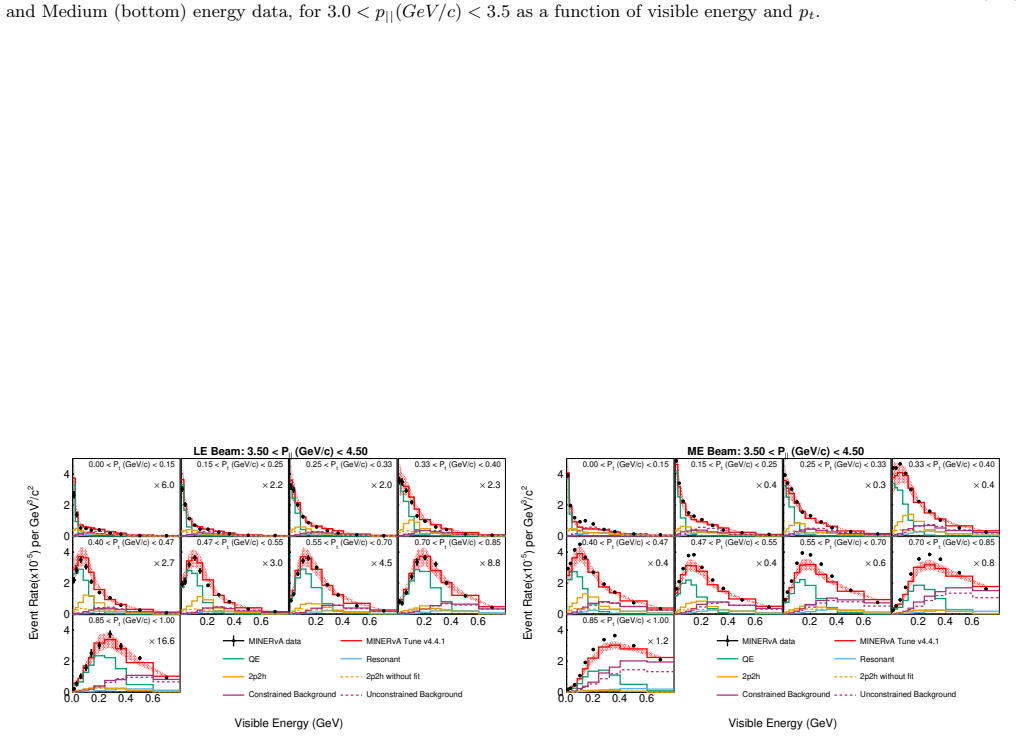
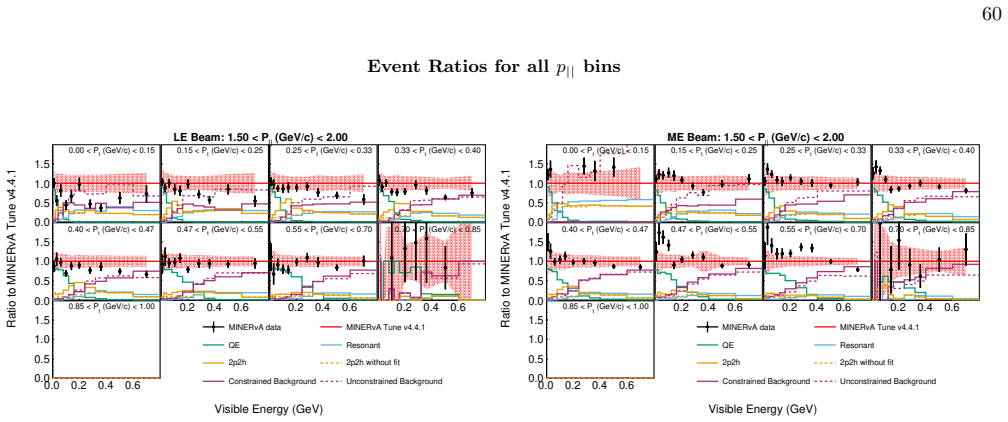
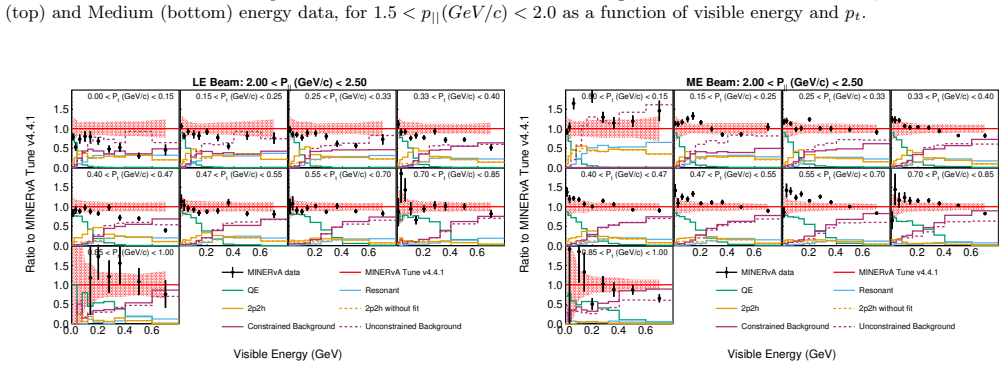
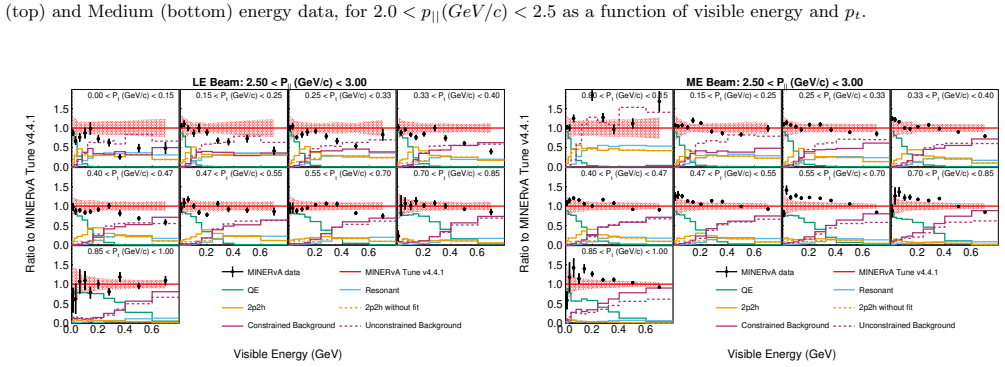
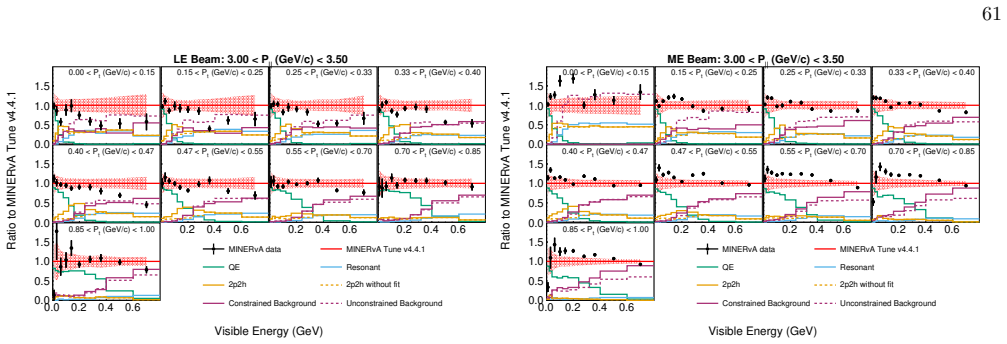
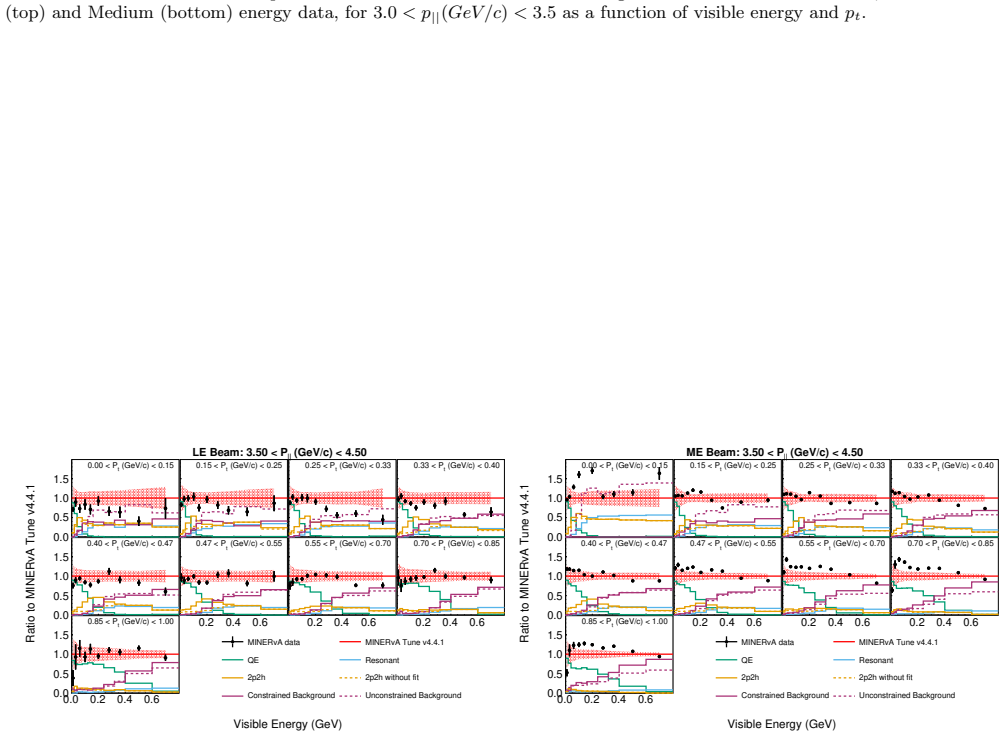
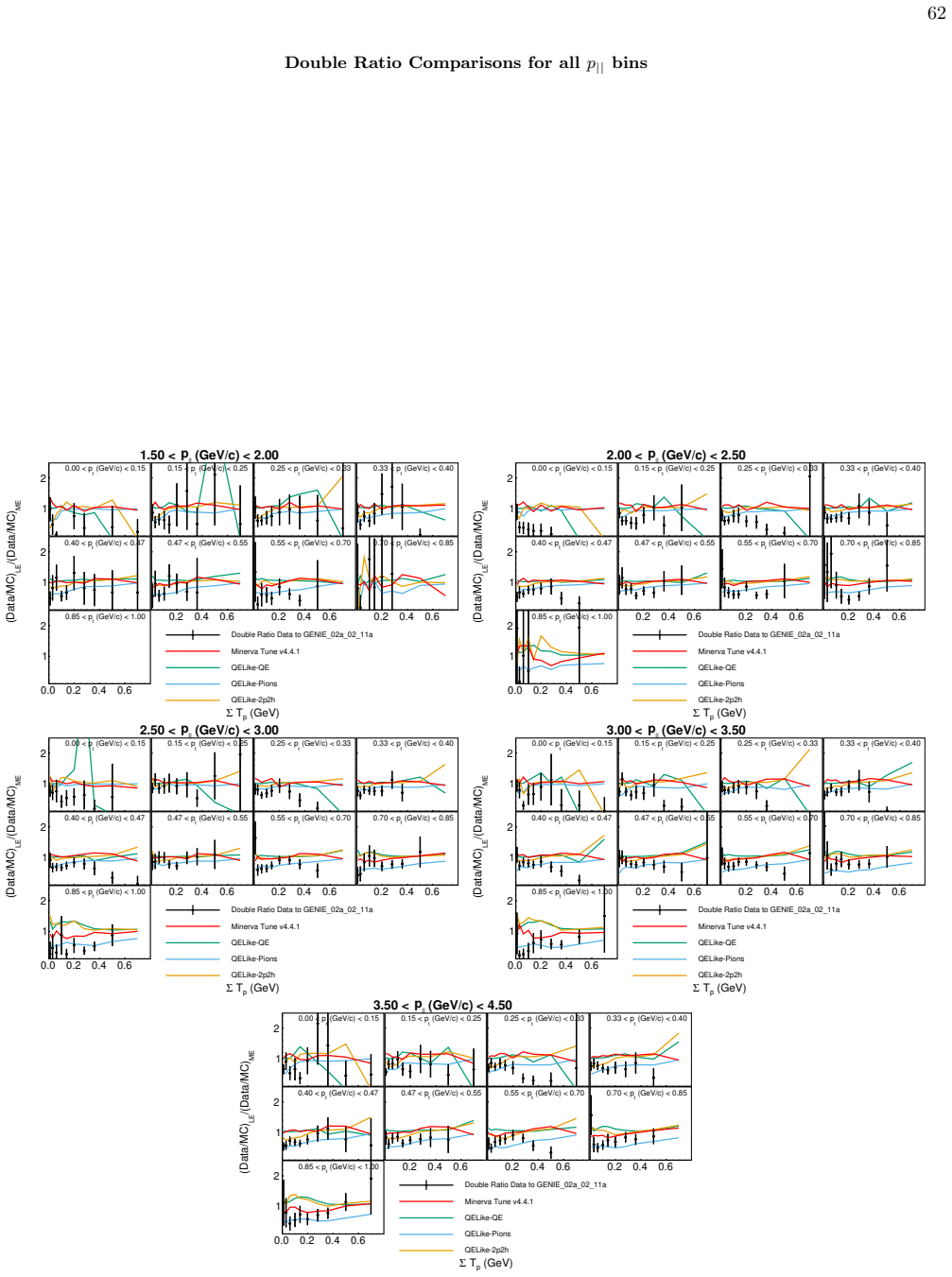
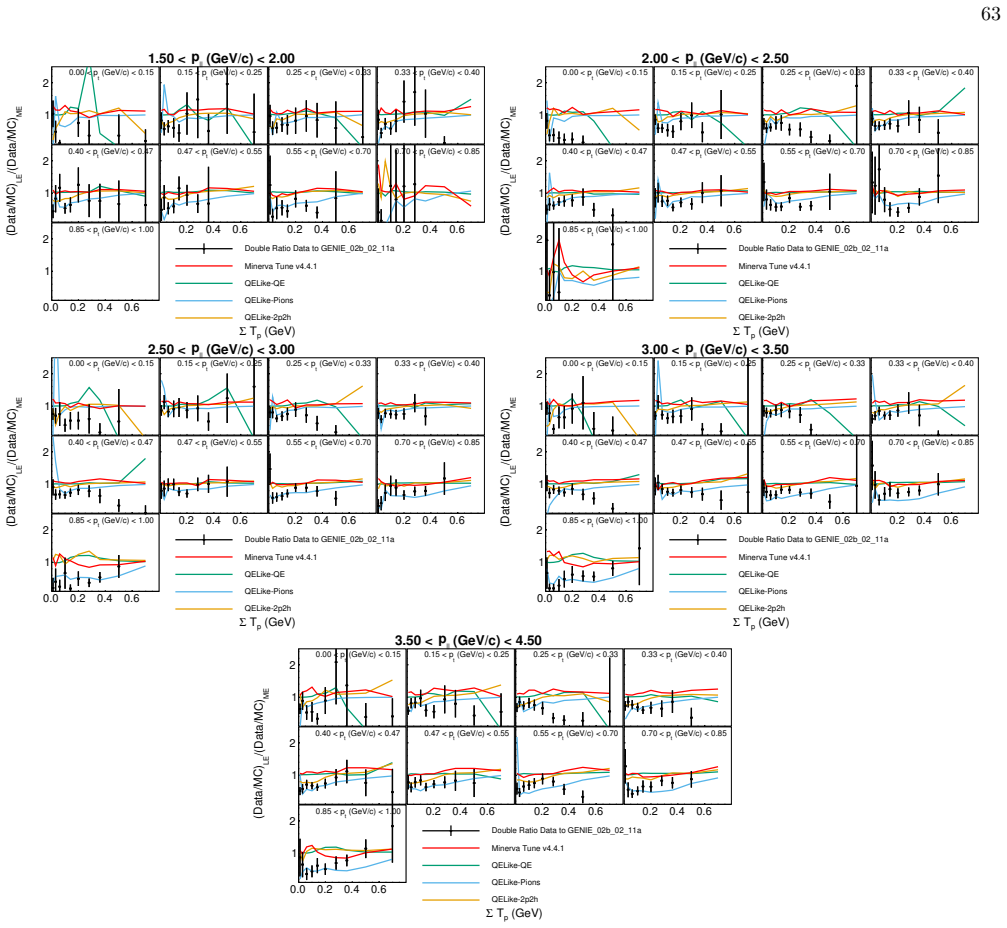
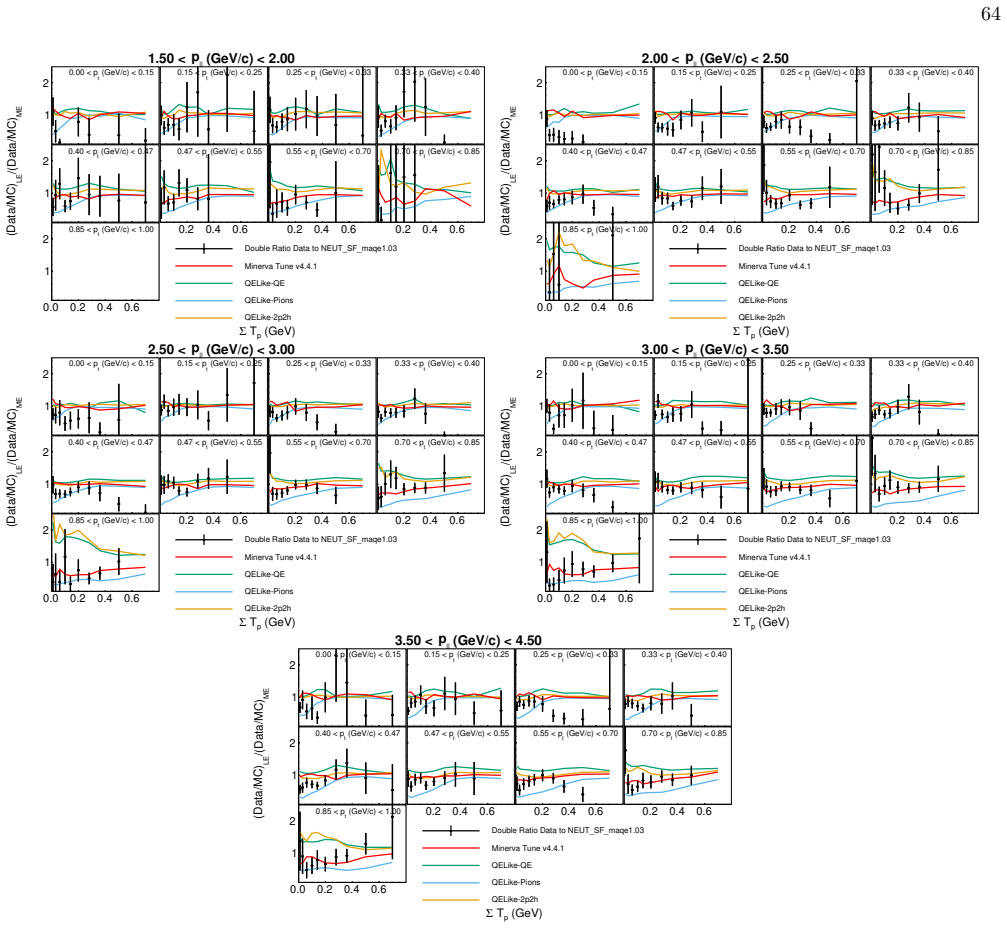
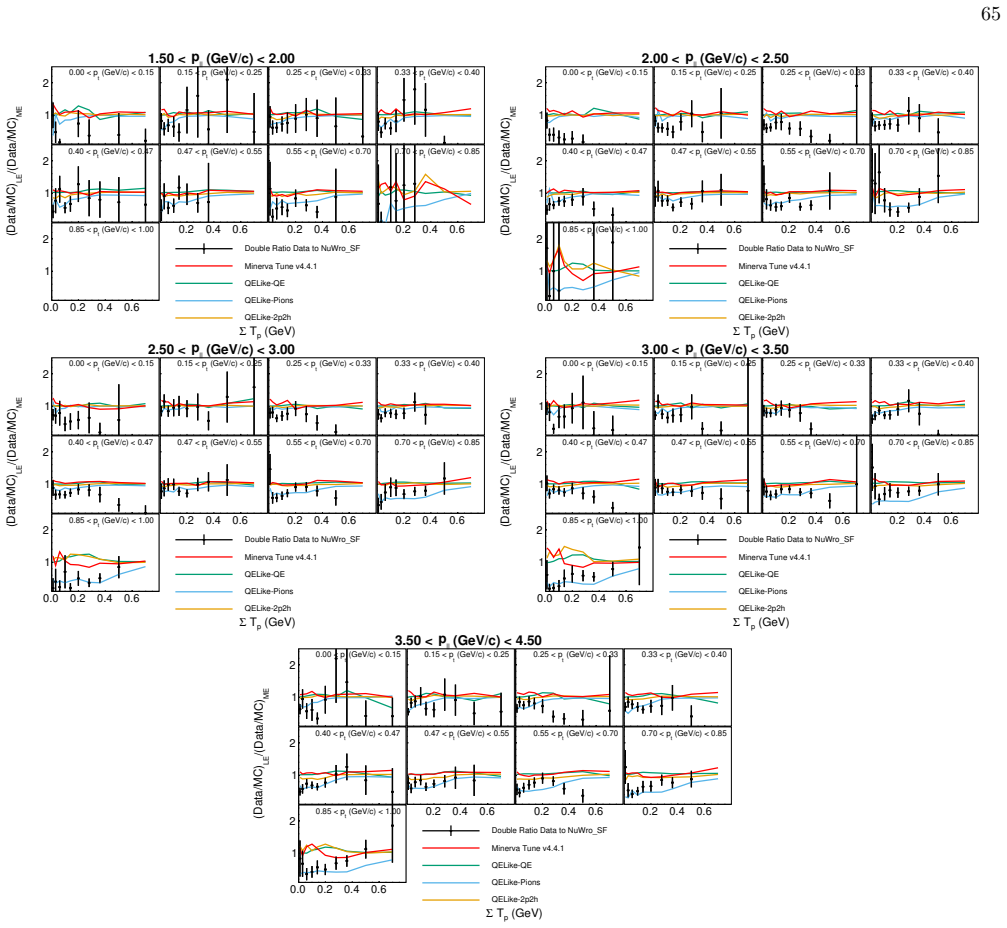
Comparisons of differential cross sections in muon and proton kinematics for these two exposures probe deviations from free-neutron scattering that arise from the processes involving the nuclear medium, and provide a test of neutrino interaction models used to infer neutrino energies in oscillation experiments. Discrepancies are observed between the data and predictions that point to overestimates of the final state interactions of both protons and charged pions in quasielastic-like events.
What carries the argument
Triple-differential cross sections in muon and proton kinematics compared across two neutrino beam spectra with different peak energies.
If this is right
- Nuclear medium processes produce measurable deviations from free-nucleon kinematics in quasielastic-like events at few-GeV energies.
- Neutrino interaction models require reduced final state interaction strengths for protons and pions to match the observed cross sections.
- Energy reconstruction methods in oscillation experiments that rely on these models will carry systematic biases from the overestimated interactions.
- The energy dependence between the 3 GeV and 6 GeV exposures constrains how nuclear effects scale with neutrino energy.
Where Pith is reading between the lines
- If final state interactions are overestimated across models, similar discrepancies may appear in other nuclei or at higher energies where pion production grows.
- The two-energy comparison provides a lever arm that could be used to separate initial-state nuclear effects from final-state rescattering in future analyses.
- Adjusting interaction models based on these data would alter predicted event rates and backgrounds in long-baseline oscillation detectors.
Load-bearing premise
Differences observed between the two beam exposures arise primarily from nuclear medium effects and final state interactions rather than from unaccounted differences in beam flux, detector response, or analysis selections between the two data sets.
What would settle it
A measurement showing that proton and charged pion absorption or rescattering rates in the nucleus match model predictions exactly, without needing adjustment, would contradict the claim of overestimates.
Figures
read the original abstract
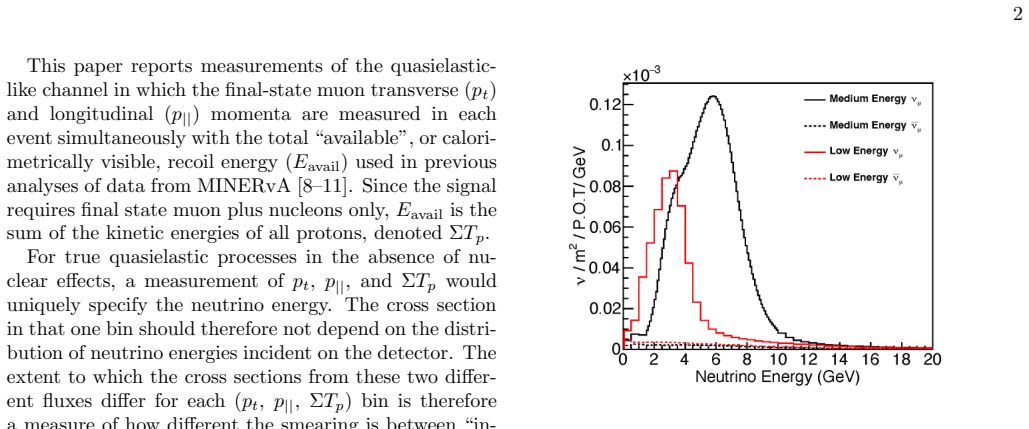
Neutrino charged-current quasielastic-like scattering, a reaction category extensively used in neutrino oscillation measurements, receives contributions from single nucleon knockout processes, multinucleon processes, and inelastic scattering with subsequent rescattering or absorption in the nucleus to produce only nucleons in the final state. In this article, comparisons are presented of the same measurement in two different wideband neutrino beams: one beam peaks near 3 GeV with few neutrinos above 6 GeV; the other peaks near 6 GeV with few neutrinos above 10 GeV. Comparisons of differential cross sections in muon and proton kinematics for these two exposures probe deviations from free-neutron scattering that arise from the processes involving the nuclear medium, and provide a test of neutrino interaction models used to infer neutrino energies in oscillation experiments. Discrepancies are observed between the data and predictions that point to overestimates of the final state interactions of both protons and charged pions in quasielastic-like events.
Editorial analysis
A structured set of objections, weighed in public.
Referee Report
Summary. The manuscript compares triple-differential cross sections for quasielastic-like charged-current ν_μ interactions on hydrocarbon targets in MINERvA, using two wideband beams with ⟨E_ν⟩ ≈ 3 GeV and ≈ 6 GeV. It reports discrepancies between data and model predictions that are interpreted as evidence for overestimates of final-state interactions (FSI) involving protons and charged pions.
Significance. If the attribution of discrepancies to energy-dependent nuclear effects holds after accounting for experimental differences, the result supplies useful constraints on neutrino interaction models employed in oscillation analyses. The dual-beam-energy design is a strength for isolating nuclear-medium contributions from free-nucleon scattering.
major comments (2)
- [Abstract] Abstract and results sections: the central claim that observed data-prediction mismatches arise from FSI overestimates (rather than residual differences between exposures) requires explicit demonstration that beam-flux modeling, detector-response corrections, and analysis selections are consistent between the two datasets at a level smaller than the reported discrepancies. No such quantification is described.
- [Abstract] The manuscript provides no information on how systematic uncertainties, background subtraction, or efficiency corrections are evaluated or compared across the two beam exposures; without these details the strength of the FSI interpretation cannot be assessed.
minor comments (2)
- Clarify the precise kinematic ranges and binning choices used for the triple-differential cross sections to allow direct comparison with other experiments.
- Ensure all model implementations (including specific FSI treatments) are referenced with version numbers or parameter settings in the text.
Simulated Author's Rebuttal
We thank the referee for the detailed review and constructive comments on our manuscript. We address each major comment below and describe the revisions that will be incorporated in the next version of the paper.
read point-by-point responses
-
Referee: [Abstract] Abstract and results sections: the central claim that observed data-prediction mismatches arise from FSI overestimates (rather than residual differences between exposures) requires explicit demonstration that beam-flux modeling, detector-response corrections, and analysis selections are consistent between the two datasets at a level smaller than the reported discrepancies. No such quantification is described.
Authors: The referee correctly identifies that the manuscript does not include an explicit quantitative comparison demonstrating that differences in beam-flux modeling, detector-response corrections, and analysis selections between the two exposures are smaller than the reported discrepancies. We will add a new subsection to the results section that provides this side-by-side quantification, including estimates of the residual differences in each category and a direct comparison to the size of the observed data-model discrepancies. revision: yes
-
Referee: [Abstract] The manuscript provides no information on how systematic uncertainties, background subtraction, or efficiency corrections are evaluated or compared across the two beam exposures; without these details the strength of the FSI interpretation cannot be assessed.
Authors: We agree that the current manuscript lacks an explicit comparison of how systematic uncertainties, background subtraction, and efficiency corrections are evaluated and compared between the two beam exposures. We will revise the methods and results sections to include this information, with a focus on any differences in the treatment of these elements across the datasets and their potential impact on the FSI interpretation. revision: yes
Circularity Check
No circularity: pure experimental measurement
full rationale
This is a direct experimental measurement of triple-differential cross sections in two neutrino beam exposures, with results compared to external model predictions. No derivation, ansatz, fitted parameter renamed as prediction, or self-citation chain reduces any central claim to the paper's own inputs by construction. The analysis stands on measured data and independent models.
Axiom & Free-Parameter Ledger
axioms (1)
- standard math Standard assumptions of the Standard Model and nuclear physics models for neutrino-nucleus interactions
Reference graph
Works this paper leans on
-
[1]
A Next-to-Leading Order QCD Analysis of Neutrino - Iron Structure Functions at the Tevatron
Seligman, William Glenn. A Next-to-Leading Order QCD Analysis of Neutrino - Iron Structure Functions at the Tevatron. 1997. doi:10.2172/1421736
-
[2]
Adamson, P. and others. Neutrino and Antineutrino Inclusive Charged-current Cross Section Measurements with the MINOS Near Detector. Phys. Rev. D. 2010. doi:10.1103/PhysRevD.81.072002. arXiv:0910.2201
work page internal anchor Pith review Pith/arXiv arXiv doi:10.1103/physrevd.81.072002 2010
-
[3]
Wu, Q. and others. A Precise measurement of the muon neutrino-nucleon inclusive charged current cross-section off an isoscalar target in the energy range 2.5 < E(nu) < 40-GeV by NOMAD. Phys. Lett. B. 2008. doi:10.1016/j.physletb.2007.12.027. arXiv:0711.1183
work page internal anchor Pith review Pith/arXiv arXiv doi:10.1016/j.physletb.2007.12.027 2008
-
[4]
Ren, L. and others. Measurement of the antineutrino to neutrino charged-current interaction cross section ratio in MINERvA. Phys. Rev. D. 2017. doi:10.1103/PhysRevD.97.019902, 10.1103/PhysRevD.95.072009. arXiv:1701.04857
work page internal anchor Pith review Pith/arXiv arXiv doi:10.1103/physrevd.97.019902 2017
-
[5]
Devan, J. and others. Measurements of the Inclusive Neutrino and Antineutrino Charged Current Cross Sections in MINERvA Using the Low- Flux Method. Phys. Rev. D. 2016. doi:10.1103/PhysRevD.94.112007. arXiv:1610.04746
work page internal anchor Pith review Pith/arXiv arXiv doi:10.1103/physrevd.94.112007 2016
-
[6]
Abe, K. and others. Measurement of inclusive double-differential _ charged-current cross section with improved acceptance in the T2K off-axis near detector. Phys. Rev. D. 2018. doi:10.1103/PhysRevD.98.012004. arXiv:1801.05148
work page internal anchor Pith review Pith/arXiv arXiv doi:10.1103/physrevd.98.012004 2018
-
[7]
Abratenko, P. and others. First Measurement of Inclusive Muon Neutrino Charged Current Differential Cross Sections on Argon at E_ 0.8 GeV with the MicroBooNE Detector. Phys. Rev. Lett. 2019. doi:10.1103/PhysRevLett.123.131801. arXiv:1905.09694
-
[8]
Measurement of Neutrino Flux from Neutrino-Electron Elastic Scattering
Park, J. and others. Measurement of Neutrino Flux from Neutrino-Electron Elastic Scattering. Phys. Rev. D. 2016. doi:10.1103/PhysRevD.93.112007. arXiv:1512.07699
work page internal anchor Pith review Pith/arXiv arXiv doi:10.1103/physrevd.93.112007 2016
-
[9]
Valencia, E. and others. Constraint of the MINER A medium energy neutrino flux using neutrino-electron elastic scattering. Phys. Rev. D. 2019. doi:10.1103/PhysRevD.100.092001. arXiv:1906.00111
-
[10]
Harewood, L. A. and Gran, R. Elastic hadron-nucleus scattering in neutrino-nucleus reactions and transverse kinematics measurements. 2019. arXiv:1906.10576
Pith/arXiv arXiv 2019
-
[11]
Stowell, P. and others. Tuning the GENIE Pion Production Model with MINER A Data. Phys. Rev. D. 2019. doi:10.1103/PhysRevD.100.072005. arXiv:1903.01558
-
[12]
Simulations from a new neutrino event generator
Juszczak, Cezary and Nowak, Jaroslaw A. and Sobczyk, Jan T. Simulations from a new neutrino event generator. Nucl. Phys. B Proc. Suppl. 2006. doi:10.1016/j.nuclphysbps.2006.08.069. arXiv:hep-ph/0512365
work page internal anchor Pith review Pith/arXiv arXiv doi:10.1016/j.nuclphysbps.2006.08.069 2006
-
[13]
Bercellie, A. and others. Simultaneous Measurement of Muon Neutrino Charged-Current Single + Production in CH, C, H2O, Fe, and Pb Targets in MINERvA. Phys. Rev. Lett. 2023. doi:10.1103/PhysRevLett.131.011801. arXiv:2209.07852
-
[14]
Peele's Pertinent Puzzle
Peelle, R.W. Peele's Pertinent Puzzle. informal Oak Ridge National Lab memorandum. 1987
1987
-
[15]
and Cox, D.R
Box, G.E.P. and Cox, D.R. An analysis of transformations. Journal of the Royal Statistical Society, series B (Methodological). 1964
1964
-
[17]
Dytman, Steven. Neutrino event generators, Proceedings of Hadronic Shower Simulation Workshop: Batavia, IL, September 6-8, 2006. AIP Conf. Proc. 2007. doi:10.1063/1.2720468
-
[19]
Altinok, O. and others. Measurement of _ charged-current single ^ 0 production on hydrocarbon in the few-GeV region using MINERvA. Phys. Rev. D. 2017. doi:10.1103/PhysRevD.96.072003. arXiv:1708.03723
-
[20]
Le, T. and others. Measurement of _ Charged-Current Single ^ - Production on Hydrocarbon in the Few-GeV Region using MINERvA. Phys. Rev. D. 2019. doi:10.1103/PhysRevD.100.052008. arXiv:1906.08300
-
[21]
McGivern, C. L. and others. Cross sections for _ and _ induced pion production on hydrocarbon in the few-GeV region using MINERvA. Phys. Rev. D. 2016. doi:10.1103/PhysRevD.94.052005. arXiv:1606.07127
work page internal anchor Pith review Pith/arXiv arXiv doi:10.1103/physrevd.94.052005 2016
-
[22]
Betancourt, M. and others. Direct Measurement of Nuclear Dependence of Charged Current Quasielasticlike Neutrino Interactions Using MINER A. Phys. Rev. Lett. 2017. doi:10.1103/PhysRevLett.119.082001. arXiv:1705.03791
work page internal anchor Pith review Pith/arXiv arXiv doi:10.1103/physrevlett.119.082001 2017
-
[23]
Rodrigues, P. A. and others. Identification of nuclear effects in neutrino-carbon interactions at low three-momentum transfer. Phys. Rev. Lett. 2016. doi:10.1103/PhysRevLett.116.071802. arXiv:1511.05944
-
[24]
Deuterium target data for precision neutrino-nucleus cross sections
Meyer, Aaron S. and Betancourt, Minerba and Gran, Richard and Hill, Richard J. Deuterium target data for precision neutrino-nucleus cross sections. Phys. Rev. D. 2016. doi:10.1103/PhysRevD.93.113015. arXiv:1603.03048
work page internal anchor Pith review Pith/arXiv arXiv doi:10.1103/physrevd.93.113015 2016
-
[25]
Reanalysis of bubble chamber measurements of muon-neutrino induced single pion production
Wilkinson, Callum and others. Reanalysis of bubble chamber measurements of muon-neutrino induced single pion production. Phys. Rev. D. 2014. doi:10.1103/PhysRevD.90.112017. arXiv:1411.4482
work page internal anchor Pith review Pith/arXiv arXiv doi:10.1103/physrevd.90.112017 2014
-
[26]
Rodrigues, Philip and Wilkinson, Callum and McFarland, Kevin. Constraining the GENIE model of neutrino-induced single pion production using reanalyzed bubble chamber data. Eur. Phys. J. C. 2016. doi:10.1140/epjc/s10052-016-4314-3. arXiv:1601.01888
work page internal anchor Pith review Pith/arXiv arXiv doi:10.1140/epjc/s10052-016-4314-3 2016
-
[27]
Progress and open questions in the physics of neutrino cross sections
Alvarez-Ruso, L. and Hayato, Y. and Nieves, J. Progress and open questions in the physics of neutrino cross sections at intermediate energies. New J. Phys. 2014. doi:10.1088/1367-2630/16/7/075015. arXiv:1403.2673
work page internal anchor Pith review Pith/arXiv arXiv doi:10.1088/1367-2630/16/7/075015 2014
-
[28]
Formaggio, J. A. and Zeller, G. P. From eV to EeV: Neutrino Cross Sections Across Energy Scales. Rev. Mod. Phys. 2012. doi:10.1103/RevModPhys.84.1307. arXiv:1305.7513
work page internal anchor Pith review Pith/arXiv arXiv doi:10.1103/revmodphys.84.1307 2012
-
[29]
Gallagher, H. and Garvey, G. and Zeller, G. P. Neutrino-nucleus interactions. Ann. Rev. Nucl. Part. Sci. 2011. doi:10.1146/annurev-nucl-102010-130255
-
[31]
Mishra, S. R. Talk presented at Workshop on Hadron Structure Functions and Parton Distributions. Proceedings of the Workshop on Hadron Structure Functions and Parton Distributions. 1990
1990
-
[32]
Seligman , title = "
W. Seligman , title = "
-
[33]
Methods to Determine Neutrino Flux at Low Energies:Investigation of the Low $\nu$ Method
Bodek, A. and Sarica, U. and Naples, D. and Ren, L. Methods to Determine Neutrino Flux at Low Energies:Investigation of the Low Method. Eur. Phys. J. C. 2012. doi:10.1140/epjc/s10052-012-1973-6. arXiv:1201.3025
work page internal anchor Pith review Pith/arXiv arXiv doi:10.1140/epjc/s10052-012-1973-6 2012
-
[34]
Devan, Joshua D. Measurement of Neutrino and Antineutrino Charged-Current Inclusive Cross Sections with the MINERvA Detector. 2015. doi:10.2172/1248217
-
[35]
J. Devan. Measurement of Neutrino and Antineutrino Charged-Current Inclusive Cross Sections with the MINERvA Detector. 2016
2016
-
[36]
Pandey, V. and Jachowicz, N. and Van Cuyck, T. and Ryckebusch, J. and Martini, M. Low-energy excitations and quasielastic contribution to electron-nucleus and neutrino-nucleus scattering in the continuum random-phase approximation. Phys. Rev. C. 2015. doi:10.1103/PhysRevC.92.024606. arXiv:1412.4624
work page internal anchor Pith review Pith/arXiv arXiv doi:10.1103/physrevc.92.024606 2015
-
[37]
Neutrino versus antineutrino cross sections and CP violation
Ericson, M. and Martini, M. Neutrino versus antineutrino cross sections and CP violation. Phys. Rev. C. 2015. doi:10.1103/PhysRevC.91.035501. arXiv:1501.02442
work page internal anchor Pith review Pith/arXiv arXiv doi:10.1103/physrevc.91.035501 2015
-
[38]
Neutrino-nucleus interaction models and their impact on oscillation analyses
Coloma, Pilar and Huber, Patrick and Jen, Chun-Min and Mariani, Camillo. Neutrino-nucleus interaction models and their impact on oscillation analyses. Phys. Rev. D. 2014. doi:10.1103/PhysRevD.89.073015. arXiv:1311.4506
work page internal anchor Pith review Pith/arXiv arXiv doi:10.1103/physrevd.89.073015 2014
-
[41]
Tice, B.G. and Datta, M. and Mousseau, J. and others. Measurement Ratios of _ Charged-Current Cross Sections on C, Fe, and Pb to CH at Neutrino Energies 2-20 GeV. Phys. Rev. Lett. 2014. doi:10.1103/PhysRevLett.112.231801. arXiv:1403.2103
work page internal anchor Pith review Pith/arXiv arXiv doi:10.1103/physrevlett.112.231801 2014
-
[42]
Walton, T. and others. Measurement of muon plus proton final states in _ interactions on hydrocarbon at < E_ > = 4.2 GeV. Phys. Rev. D. 2015. doi:10.1103/PhysRevD.91.071301. arXiv:1409.4497
work page internal anchor Pith review Pith/arXiv arXiv doi:10.1103/physrevd.91.071301 2015
-
[43]
Eberly, B. and others. Charged pion production in _ interactions on hydrocarbon at E_ = 4.0 GeV. Phys. Rev. D. 2015. doi:10.1103/PhysRevD.92.092008. arXiv:1406.6415
work page internal anchor Pith review Pith/arXiv arXiv doi:10.1103/physrevd.92.092008 2015
-
[44]
Mislivec, A. and others. Measurement of total and differential cross sections of neutrino and antineutrino coherent ^ production on carbon. Phys. Rev. D. 2018. doi:10.1103/PhysRevD.97.032014. arXiv:1711.01178
work page internal anchor Pith review Pith/arXiv arXiv doi:10.1103/physrevd.97.032014 2018
-
[45]
Higuera, A. and others. Measurement of Coherent Production of ^ in Neutrino and Antineutrino Beams on Carbon from E_ of 1.5 to 20 GeV. Phys. Rev. Lett. 2014. doi:10.1103/PhysRevLett.113.261802. arXiv:1409.3835
work page internal anchor Pith review Pith/arXiv arXiv doi:10.1103/physrevlett.113.261802 2014
-
[46]
Design, Calibration, and Performance of the MINERvA Detector
Aliaga, L. and others. Design, Calibration, and Performance of the MINERvA Detector. Nucl. Instrum. Meth. A. 2014. doi:10.1016/j.nima.2013.12.053. arXiv:1305.5199
work page internal anchor Pith review Pith/arXiv arXiv doi:10.1016/j.nima.2013.12.053 2014
-
[47]
A study of quasi-elastic muon neutrino and antineutrino scattering in the NOMAD experiment
Lyubushkin, V and others. A Study of quasi-elastic muon neutrino and antineutrino scattering in the NOMAD experiment. Eur. Phys. J. C. 2009. doi:10.1140/epjc/s10052-009-1113-0. arXiv:0812.4543
work page internal anchor Pith review Pith/arXiv arXiv doi:10.1140/epjc/s10052-009-1113-0 2009
-
[49]
Abe, K. and others. Measurement of the muon neutrino charged-current single ^+ production on hydrocarbon using the T2K off-axis near detector ND280. Phys. Rev. D. 2020. doi:10.1103/PhysRevD.101.012007. arXiv:1909.03936
-
[50]
Measurement of the quasi-elastic axial vector mass in neutrino-oxygen interactions
Gran, R. and others. Measurement of the quasi-elastic axial vector mass in neutrino-oxygen interactions. Phys. Rev. D. 2006. doi:10.1103/PhysRevD.74.052002. arXiv:hep-ex/0603034
work page internal anchor Pith review Pith/arXiv arXiv doi:10.1103/physrevd.74.052002 2006
-
[51]
Measurement of the axial vector mass in neutrino-carbon interactions at K2K
Espinal, X and Sanchez, F. Measurement of the axial vector mass in neutrino-carbon interactions at K2K. AIP Conf. Proc. 2007
2007
-
[54]
GENIE implementation of IFIC Valencia model for QE-like 2p2h neutrino-nucleus cross section
Schwehr, Jackie and Cherdack, Dan and Gran, Rik. GENIE implementation of IFIC Valencia model for QE-like 2p2h neutrino-nucleus cross section. 2016. arXiv:1601.02038
Pith/arXiv arXiv 2016
-
[55]
Neutrino-nucleus quasi-elastic and 2p2h interactions up to 10 GeV
Gran, R. and Nieves, J. and Sanchez, F. and Vicente Vacas, M.J. Neutrino-nucleus quasi-elastic and 2p2h interactions up to 10 GeV. Phys. Rev. D. 2013. doi:10.1103/PhysRevD.88.113007. arXiv:1307.8105
work page internal anchor Pith review Pith/arXiv arXiv doi:10.1103/physrevd.88.113007 2013
-
[56]
Inclusive Charged--Current Neutrino--Nucleus Reactions
Nieves, J. and Ruiz Simo, I. and Vicente Vacas, M.J. Inclusive Charged--Current Neutrino--Nucleus Reactions. Phys. Rev. C. 2011. doi:10.1103/PhysRevC.83.045501. arXiv:1102.2777
work page internal anchor Pith review Pith/arXiv arXiv doi:10.1103/physrevc.83.045501 2011
-
[57]
The nucleon axial mass and the MiniBooNE Quasielastic Neutrino-Nucleus Scattering problem
Nieves, J. and Ruiz Simo, I. and Vicente Vacas, M.J. The nucleon axial mass and the MiniBooNE Quasielastic Neutrino-Nucleus Scattering problem. Phys. Lett. B. 2012. doi:10.1016/j.physletb.2011.11.061. arXiv:1106.5374
work page internal anchor Pith review Pith/arXiv arXiv doi:10.1016/j.physletb.2011.11.061 2012
-
[58]
Seagull and pion-in-flight currents in neutrino-induced $1N$ and $2N$ knockout
Van Cuyck, T. and Jachowicz, N. and González-Jiménez, R. and Ryckebusch, J. and Van Dessel, N. Seagull and pion-in-flight currents in neutrino-induced 1N and 2N knockout. Phys. Rev. C. 2017. doi:10.1103/PhysRevC.95.054611. arXiv:1702.06402
work page internal anchor Pith review Pith/arXiv arXiv doi:10.1103/physrevc.95.054611 2017
-
[59]
Extensions of Superscaling from Relativistic Mean Field Theory: the SuSAv2 Model
Gonzaléz-Jiménez, R. and Megias, G. D. and Barbaro, M. B. and Caballero, J. A. and Donnelly, T. W. Extensions of Superscaling from Relativistic Mean Field Theory: the SuSAv2 Model. Phys. Rev. C. 2014. doi:10.1103/PhysRevC.90.035501. arXiv:1407.8346
work page internal anchor Pith review Pith/arXiv arXiv doi:10.1103/physrevc.90.035501 2014
-
[60]
Amaro, Jose Enrique and Barbaro, M. B. and Caballero, J. A. and Donnelly, T. W. and Molinari, A. and Sick, I. Using electron scattering superscaling to predict charge-changing neutrino cross sections in nuclei. Phys. Rev. C. 2005. doi:10.1103/PhysRevC.71.015501. arXiv:nucl-th/0409078
work page internal anchor Pith review Pith/arXiv arXiv doi:10.1103/physrevc.71.015501 2005
-
[61]
Inclusive Quasi-Elastic Charged-Current Neutrino-Nucleus Reactions
Nieves, J. and Amaro, Jose Enrique and Valverde, M. Inclusive quasi-elastic neutrino reactions. Phys. Rev. C. 2004. doi:10.1103/PhysRevC.70.055503, 10.1103/PhysRevC.72.019902. arXiv:nucl-th/0408005
work page internal anchor Pith review Pith/arXiv arXiv doi:10.1103/physrevc.70.055503 2004
-
[62]
Martini, M. and Ericson, M. and Chanfray, G. and Marteau, J. A Unified approach for nucleon knock-out, coherent and incoherent pion production in neutrino interactions with nuclei. Phys. Rev. C. 2009. doi:10.1103/PhysRevC.80.065501. arXiv:0910.2622
work page internal anchor Pith review Pith/arXiv arXiv doi:10.1103/physrevc.80.065501 2009
-
[63]
Nieves, Juan and Sobczyk, Joanna Ewa. In medium dispersion relation effects in nuclear inclusive reactions at intermediate and low energies. 2017. arXiv:1701.03628
Pith/arXiv arXiv 2017
-
[64]
Theoretical uncertainties on quasielastic charged-current neutrino-nucleus cross sections
Valverde, M. and Amaro, Jose Enrique and Nieves, J. Theoretical uncertainties on quasielastic charged-current neutrino-nucleus cross sections. Phys. Lett. B. 2006. doi:10.1016/j.physletb.2006.05.053. arXiv:hep-ph/0604042
work page internal anchor Pith review Pith/arXiv arXiv doi:10.1016/j.physletb.2006.05.053 2006
-
[65]
Model Uncertainties for Valencia RPA Effect for MINERvA
Gran, Richard. Model Uncertainties for Valencia RPA Effect for MINERvA. 2017. arXiv:1705.02932
Pith/arXiv arXiv 2017
-
[66]
Neutrino-Induced Reactions on Nuclei
Gallmeister, K. and Mosel, U. and Weil, J. Neutrino-Induced Reactions on Nuclei. Phys. Rev. C. 2016. doi:10.1103/PhysRevC.94.035502. arXiv:1605.09391
work page internal anchor Pith review Pith/arXiv arXiv doi:10.1103/physrevc.94.035502 2016
-
[67]
Golan, T. and Sobczyk, J.T. and Zmuda, J. NuWro: the Wroclaw Monte Carlo Generator of Neutrino Interactions. Nucl. Phys. Proc. Suppl. 2012. doi:10.1016/j.nuclphysbps.2012.09.136
-
[68]
Final State Interactions Effects in Neutrino-Nucleus Interactions
Golan, Tomasz and Juszczak, Cezary and Sobczyk, Jan T. Final State Interactions Effects in Neutrino-Nucleus Interactions. Phys. Rev. C. 2012. doi:10.1103/PhysRevC.86.015505. arXiv:1202.4197
work page internal anchor Pith review Pith/arXiv arXiv doi:10.1103/physrevc.86.015505 2012
-
[70]
Multinucleon ejection model for Meson Exchange Current neutrino interactions
Sobczyk, Jan T. Multinucleon ejection model for Meson Exchange Current neutrino interactions. Phys. Rev. C. 2012. doi:10.1103/PhysRevC.86.015504. arXiv:1201.3673
work page internal anchor Pith review Pith/arXiv arXiv doi:10.1103/physrevc.86.015504 2012
-
[71]
Modeling nuclear effects in neutrino interactions in 1-GeV region
Sobczyk, Jan T. Modeling nuclear effects in neutrino interactions in 1-GeV region. 2003. arXiv:nucl-th/0307047
Pith/arXiv arXiv 2003
-
[72]
Neutrino Energy Reconstruction and the Shape of the CCQE-like Total Cross Section
Nieves, J. and Sanchez, F. and Ruiz Simo, I. and Vicente Vacas, M.J. Neutrino Energy Reconstruction and the Shape of the CCQE-like Total Cross Section. Phys. Rev. D. 2012. doi:10.1103/PhysRevD.85.113008. arXiv:1204.5404
work page internal anchor Pith review Pith/arXiv arXiv doi:10.1103/physrevd.85.113008 2012
-
[73]
Electron-neutrino scattering off nuclei from two different theoretical perspectives
Martini, M. and Jachowicz, N. and Ericson, M. and Pandey, V. and Van Cuyck, T. and Van Dessel, N. Electron-neutrino scattering off nuclei from two different theoretical perspectives. Phys. Rev. C. 2016. doi:10.1103/PhysRevC.94.015501. arXiv:1602.00230
work page internal anchor Pith review Pith/arXiv arXiv doi:10.1103/physrevc.94.015501 2016
-
[74]
Energy reconstruction effects in neutrino oscillation experiments and implications for the analysis
Martini, M. and Ericson, M. and Chanfray, G. Energy reconstruction effects in neutrino oscillation experiments and implications for the analysis. Phys. Rev. D. 2013. doi:10.1103/PhysRevD.87.013009. arXiv:1211.1523
work page internal anchor Pith review Pith/arXiv arXiv doi:10.1103/physrevd.87.013009 2013
-
[75]
Nieves, J. and Gran, R. and Simo, I. Ruiz and Sanchez, F and Vacas, M. J. Vicente. Neutrino-nucleus CCQE-like scattering. proceedings of the International Conference on High Energy Physics 2014 (ICHEP 2014) Valencia, Spain, July 2-9, 2014. 2014. arXiv:1411.7821
Pith/arXiv arXiv 2014
-
[76]
Single pion production in neutrino-nucleon Interactions
Kabirnezhad, Monireh. Single pion production in neutrino-nucleon Interactions. Phys. Rev. D. 2018. doi:10.1103/PhysRevD.97.013002. arXiv:1711.02403
-
[77]
Energy reconstruction in the Long-Baseline Neutrino Experiment
Mosel, Ulrich and Lalakulich, Olga and Gallmeister, Kai. Energy reconstruction in the Long-Baseline Neutrino Experiment. Phys. Rev. Lett. 2014. doi:10.1103/PhysRevLett.112.151802. arXiv:1311.7288
work page internal anchor Pith review Pith/arXiv arXiv doi:10.1103/physrevlett.112.151802 2014
-
[78]
Meson Exchange Current (MEC) Models in Neutrino Interaction Generators
Katori, Teppei. Meson Exchange Current (MEC) Models in Neutrino Interaction Generators, proceedings of NuInt12 Rio de Janeiro, Brazil. AIP Conf.Proc. 2015. doi:10.1063/1.4919465. arXiv:1304.6014
work page internal anchor Pith review Pith/arXiv arXiv doi:10.1063/1.4919465 2015
-
[79]
Lightbody, J. W. and O'Connell, J. S. Modeling single arm electron scattering and nucleon production from nuclei by GeV electrons. Computers in Physics. 1988
1988
-
[80]
The 2p-2h electromagnetic response in the quasielastic peak and beyond
De Pace, A. and Nardi, M. and Alberico, W. M. and Donnelly, T. W. and Molinari, A. The 2p - 2h electromagnetic response in the quasielastic peak and beyond. Nucl. Phys. A. 2003. doi:10.1016/S0375-9474(03)01625-7. arXiv:nucl-th/0304084
work page internal anchor Pith review Pith/arXiv arXiv doi:10.1016/s0375-9474(03)01625-7 2003
-
[81]
Relativistic effects in two-particle emission for electron and neutrino reactions
Ruiz Simo, I. and Albertus, C. and Amaro, J. E. and Barbaro, M. B. and Caballero, J. A. and Donnelly, T. W. Relativistic effects in two-particle emission for electron and neutrino reactions. Phys. Rev. D. 2014. doi:10.1103/PhysRevD.90.033012. arXiv:1405.4280
work page internal anchor Pith review Pith/arXiv arXiv doi:10.1103/physrevd.90.033012 2014
-
[82]
Angular distribution in two-particle emission induced by neutrinos and electrons
Simo, I. Ruiz and Albertus, C. and Amaro, J. E. and Barbaro, M. B. and Caballero, J. A. and Donnelly, T. W. Angular distribution in two-particle emission induced by neutrinos and electrons. Phys. Rev. D. 2014. doi:10.1103/PhysRevD.90.053010. arXiv:1407.7122
work page internal anchor Pith review Pith/arXiv arXiv doi:10.1103/physrevd.90.053010 2014
-
[83]
Effects of the Nuclear Correlations on the Neutrino-Oxygen Interactions
Marteau, J. Effects of the nuclear correlations on the neutrino oxygen interactions. Eur. Phys. J. A. 1999. doi:10.1007/s100500050274. arXiv:hep-ph/9902210
work page internal anchor Pith review Pith/arXiv arXiv doi:10.1007/s100500050274 1999
-
[84]
Bodek, A. and Budd, H. S. and Christy, M. E. Neutrino Quasielastic Scattering on Nuclear Targets: Parametrizing Transverse Enhancement (Meson Exchange Currents). Eur. Phys. J. C. 2011. doi:10.1140/epjc/s10052-011-1726-y. arXiv:1106.0340
work page internal anchor Pith review Pith/arXiv arXiv doi:10.1140/epjc/s10052-011-1726-y 2011
-
[85]
Coherent pi0 Production in Neutrino Reactions
Rein, Dieter and Sehgal, Lalit M. Coherent pi0 Production in Neutrino Reactions. Nucl. Phys. B. 1983. doi:10.1016/0550-3213(83)90090-1
-
[86]
PCAC and the Deficit of Forward Muons in pi^+ Production by Neutrinos
Rein, D. and Sehgal, L.M. PCAC and the Deficit of Forward Muons in pi+ Production by Neutrinos. Phys. Lett. B. 2007. doi:10.1016/j.physletb.2007.10.025. arXiv:hep-ph/0606185
work page internal anchor Pith review Pith/arXiv arXiv doi:10.1016/j.physletb.2007.10.025 2007
-
[87]
Paschos, E.A. and Schalla, Dario. Coherent Pion Production by Neutrinos. Phys. Rev. D. 2009. doi:10.1103/PhysRevD.80.033005. arXiv:0903.0451
work page internal anchor Pith review Pith/arXiv arXiv doi:10.1103/physrevd.80.033005 2009
-
[88]
PCAC and coherent pion production by low energy neutrinos
Berger, Ch. and Sehgal, L.M. PCAC and coherent pion production by low energy neutrinos. Phys. Rev. D. 2009. doi:10.1103/PhysRevD.79.053003. arXiv:0812.2653
work page internal anchor Pith review Pith/arXiv arXiv doi:10.1103/physrevd.79.053003 2009
-
[89]
and Kopeliovich, B.Z
Belkov, A.A. and Kopeliovich, B.Z. Adler Relation and Neutrino Production of Single Hadrons. Sov. J. Nucl. Phys. 1987
1987
discussion (0)
Sign in with ORCID, Apple, or X to comment. Anyone can read and Pith papers without signing in.