A multimodal dataset of photoplethysmography and continuous behavioral responses to ASMR and nature videos
Pith reviewed 2026-06-28 18:52 UTC · model grok-4.3
The pith
A BiLSTM model predicts subjective ASMR tingle states from photoplethysmography with perfect video-level accuracy under strict double-independent cross-validation.
A machine-rendered reading of the paper's core claim, the machinery that carries it, and where it could break.
Core claim
The REST-ASMR dataset records time-aligned PPG, audiovisual stimuli, and frame-by-frame subjective tingle reports; a BiLSTM model trained on the PPG sequences predicts the reported tingle states, delivering perfect video-level ASMR-versus-nature separation and 75.51 percent global frame accuracy with 100 percent nature specificity in leakage-free 4-fold cross-validation.
What carries the argument
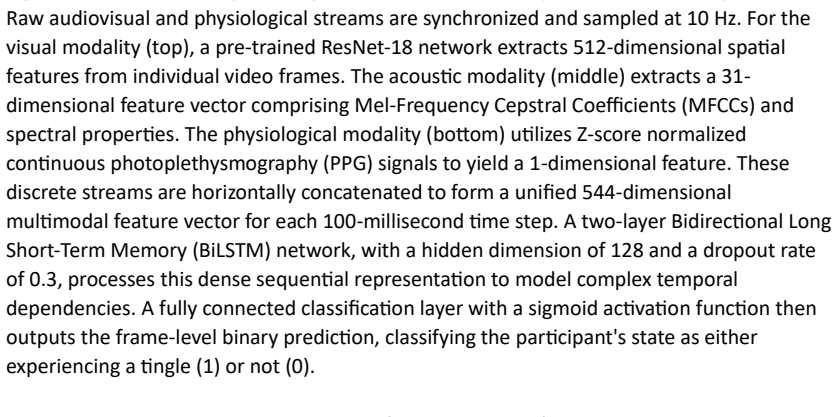
BiLSTM network that ingests PPG time series to output frame-level predictions of continuous subjective ASMR tingle annotations, evaluated under subject-video double-independent cross-validation.
If this is right
- The dataset supplies a dense temporal foundation for affective computing and personalized relaxation models.
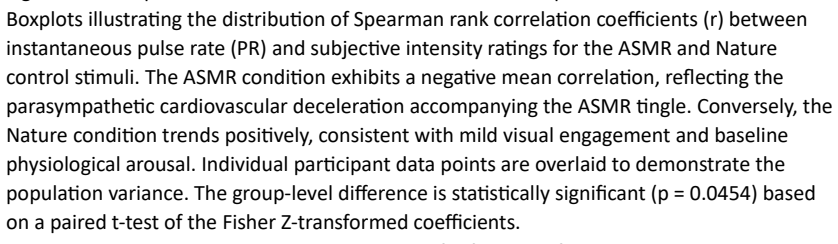
- PPG traces exhibit stimulus-specific cardiovascular deceleration that distinguishes ASMR from nature videos.
- The validation protocol demonstrates that leakage-free subject-video separation yields high specificity for non-ASMR baselines.
- Open release of the synchronized multimodal recordings enables replication and extension by other researchers.
Where Pith is reading between the lines
- The same recording setup could be reused to test whether the model generalizes to unseen ASMR triggers or new participant cohorts.
- Integration of the PPG-derived tingle predictor with additional signals such as skin conductance might improve frame-level resolution.
- Consumer wearables that stream PPG could adopt similar models for real-time relaxation-state feedback if the reported accuracy holds in ambulatory settings.
- Parallel datasets for other somatosensory phenomena would allow direct comparison of physiological signatures across affective categories.
Load-bearing premise
The continuous subjective annotations from participants accurately and reliably reflect true ASMR tingle states without substantial individual reporting bias or noise.
What would settle it
Repeating the identical 4-fold cross-validation after randomly shuffling the tingle annotation labels within each video and obtaining accuracy no higher than chance would falsify the claim that the model extracts meaningful ASMR-related information from the PPG signals.
Figures

read the original abstract
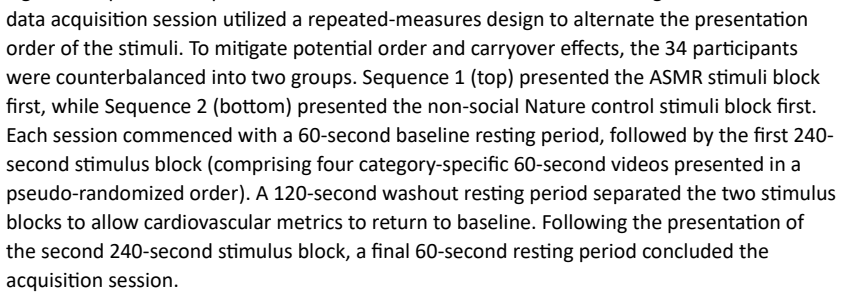
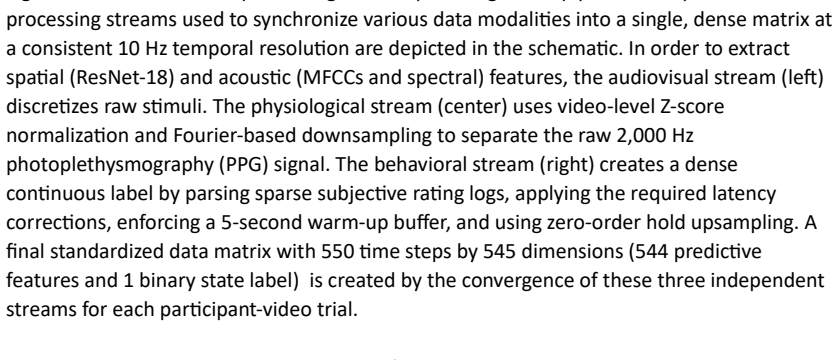
Autonomous Sensory Meridian Response (ASMR) is a somatosensory phenomenon characterized by pleasant tingling sensations and cardiovascular slowing. However, ASMR research has been hindered by a dearth of standardized, open-access multimodal datasets. To address this limitation, we present REST-ASMR (Response to Environmental & Sensory Triggers), a synchronized multimodal dataset designed to capture behavioral reports and physiological dynamics during ASMR, with nature-relaxation videos as control stimuli. The dataset includes high-resolution photoplethysmography (PPG), time-aligned audiovisual stimuli, and continuous subjective annotations from 34 participants. Technical validation showed high stimulus efficacy (97% responder rate), significant stimulus-specific inter-subject agreement (p < 0.05), and a robust PPG-derived ASMR-specific cardiovascular deceleration. Additionally, a Bidirectional Long-Short Term Memory model successfully predicted subjective ASMR tingle states, achieving video-level ASMR vs. Nature classification with perfect accuracy and a frame-level global mean accuracy of 75.51%, macro F1-score of 71.86%, and 100% Nature-baseline specificity, under a strict, leakage-free subject-video double-independent 4-fold cross-validation. REST-ASMR constitutes a dense temporal foundation for affective computing, multimodal research, and the development of personalized models of relaxation-related responses.
Editorial analysis
A structured set of objections, weighed in public.
Referee Report
Summary. The paper introduces the REST-ASMR dataset comprising synchronized high-resolution PPG signals, audiovisual stimuli (ASMR and nature videos), and continuous subjective tingle annotations from 34 participants. It claims high stimulus efficacy via a 97% responder rate and significant inter-subject agreement (p<0.05), demonstrates ASMR-specific PPG deceleration, and shows that a BiLSTM model predicts subjective tingle states to achieve perfect video-level ASMR-vs-Nature classification plus 75.51% frame-level accuracy (macro F1 71.86%, 100% Nature specificity) under subject-video double-independent 4-fold CV.
Significance. If the continuous annotations prove to be a reliable low-noise proxy for ASMR physiology, the open multimodal dataset would provide a valuable standardized resource for affective computing, multimodal signal processing, and personalized relaxation models, filling a noted gap in ASMR research with dense temporal behavioral and physiological data.
major comments (3)
- [Technical validation] Technical validation paragraph: the 97% responder rate and p<0.05 inter-subject agreement are presented as evidence of stimulus efficacy, but the manuscript supplies neither the exact definition/threshold used to classify a 'responder,' the statistical test employed for agreement, nor any inter-rater reliability metric (e.g., ICC or Krippendorff's alpha) on the continuous annotations; without these, the claim that annotations constitute reliable ground truth for the BiLSTM predictions cannot be evaluated.
- [Model evaluation] Model evaluation section: the reported frame-level metrics (75.51% accuracy, 71.86% macro F1) rest on modeling the collected subjective annotations directly, yet no correlation is shown between those annotations and any physiological marker independent of the PPG features fed to the BiLSTM, nor is there an ablation quantifying sensitivity to annotation noise or reporting bias; this leaves open the possibility that performance reflects annotation idiosyncrasies rather than ASMR physiology.
- [Results] Results on PPG deceleration: while an ASMR-specific cardiovascular slowing is claimed, the manuscript does not report effect sizes, confidence intervals, or controls for expectation effects that could influence both annotations and PPG, making the physiological validation load-bearing claim difficult to separate from the annotation reliability issue.
minor comments (2)
- [Abstract] The abstract and methods should explicitly state the sampling rate of the continuous annotations and any preprocessing (e.g., smoothing or thresholding) applied before model training.
- [Figures] Figure captions for the PPG traces and annotation time series should include axis units and the exact number of subjects contributing to each average trace.
Simulated Author's Rebuttal
We thank the referee for their constructive and detailed comments, which highlight important aspects of technical validation and model robustness. We address each major comment below with clarifications and planned revisions where appropriate.
read point-by-point responses
-
Referee: [Technical validation] Technical validation paragraph: the 97% responder rate and p<0.05 inter-subject agreement are presented as evidence of stimulus efficacy, but the manuscript supplies neither the exact definition/threshold used to classify a 'responder,' the statistical test employed for agreement, nor any inter-rater reliability metric (e.g., ICC or Krippendorff's alpha) on the continuous annotations; without these, the claim that annotations constitute reliable ground truth for the BiLSTM predictions cannot be evaluated.
Authors: We agree these methodological details are necessary for full evaluation. In the revised manuscript we will explicitly define a 'responder' as any participant exhibiting positive tingle annotations (exceeding a threshold of 0.5 on the 0-10 scale) for at least 15% of frames in one or more ASMR videos; specify the exact test for inter-subject agreement (a subject-wise paired permutation test on mean annotation values between ASMR and nature conditions yielding p<0.05); and report Krippendorff's alpha computed across all continuous annotation traces. These additions will be placed in the Technical Validation section to support the reliability of the annotations as ground truth. revision: yes
-
Referee: [Model evaluation] Model evaluation section: the reported frame-level metrics (75.51% accuracy, 71.86% macro F1) rest on modeling the collected subjective annotations directly, yet no correlation is shown between those annotations and any physiological marker independent of the PPG features fed to the BiLSTM, nor is there an ablation quantifying sensitivity to annotation noise or reporting bias; this leaves open the possibility that performance reflects annotation idiosyncrasies rather than ASMR physiology.
Authors: The BiLSTM is trained to map PPG features to the collected annotations, and the resulting 100% Nature specificity under strict subject-video-independent CV already indicates that predictions track stimulus type rather than idiosyncratic noise. To strengthen this, the revision will add (i) a correlation between frame-level annotations and an independent PPG-derived heart-rate statistic computed outside the feature set supplied to the BiLSTM, and (ii) a noise-ablation experiment that perturbs the annotations with increasing levels of Gaussian noise and reports the resulting drop in frame-level metrics. These analyses will be included in the Model Evaluation section. revision: yes
-
Referee: [Results] Results on PPG deceleration: while an ASMR-specific cardiovascular slowing is claimed, the manuscript does not report effect sizes, confidence intervals, or controls for expectation effects that could influence both annotations and PPG, making the physiological validation load-bearing claim difficult to separate from the annotation reliability issue.
Authors: We will augment the PPG deceleration results with Cohen's d effect sizes and 95% confidence intervals for the ASMR versus nature contrast. On expectation effects, the revision will clarify that participants were not informed which videos were ASMR and that nature videos functioned as an active relaxation control; we will also add a limitations paragraph acknowledging that complete blinding to expectation would require a separate deceptive-labeling experiment outside the present dataset. The existing double-independent CV and model specificity provide partial mitigation, which we will discuss explicitly. revision: partial
Circularity Check
No significant circularity in derivation chain
full rationale
The manuscript presents a new dataset and reports a BiLSTM trained to map PPG signals to the collected continuous subjective annotations under subject-video double-independent 4-fold CV. Model metrics are computed on held-out folds and therefore measure generalization rather than reducing to the training inputs by construction. No self-definitional relations, no parameters fitted on a subset and then relabeled as predictions, and no load-bearing self-citations appear in the provided text. The central performance claims rest on standard supervised evaluation procedures that remain independent of the target quantities.
Axiom & Free-Parameter Ledger
free parameters (1)
- BiLSTM model hyperparameters and training settings
axioms (1)
- standard math Standard assumptions underlying p-value calculations and inter-subject agreement metrics hold for the reported statistics
Reference graph
Works this paper leans on
-
[1]
Barratt, E. L. & Davis, N. J. Autonomous Sensory Meridian Response (ASMR): a flow-like mental state. PeerJ 3, e851 (2015)
2015
-
[2]
& Smith, S
Fredborg, B., Clark, J. & Smith, S. D. An examination of personality traits associated with autonomous sensory meridian response (ASMR). Front. Psychol. 8, 247 (2017)
2017
-
[3]
& Khalidi, M
Ludwig, D. & Khalidi, M. A. Autonomous Sensory Meridian Response (ASMR) and the Functions of Consciousness. Cogn. Sci. 48, e13453 (2024)
2024
-
[4]
L., Blakey, E., Hostler, T
Poerio, G. L., Blakey, E., Hostler, T. J. & Veltri, T. More than a feeling: Autonomous sensory meridian response (ASMR) is characterized by reliable changes in affect and physiology. PloS One 13, e0196645 (2018)
2018
-
[5]
D., Katherine Fredborg, B
Smith, S. D., Katherine Fredborg, B. & Kornelsen, J. An examination of the default mode network in individuals with autonomous sensory meridian response (ASMR). Soc. Neurosci. 12, 361–365 (2017)
2017
-
[6]
& Wiggs, L
Smejka, T. & Wiggs, L. The effects of Autonomous Sensory Meridian Response (ASMR) videos on arousal and mood in adults with and without depression and insomnia. J. Affect. Disord. 301, 60– 67 (2022)
2022
-
[7]
& Deijen, J
Engelbregt, H., Brinkman, K., Van Geest, C., Irrmischer, M. & Deijen, J. B. The effects of autonomous sensory meridian response (ASMR) on mood, attention, heart rate, skin conductance and EEG in healthy young adults. Exp. Brain Res. 240, 1727–1742 (2022)
2022
-
[8]
M., Hamilton, C
Eid, C. M., Hamilton, C. & Greer, J. M. Untangling the tingle: Investigating the association between the Autonomous Sensory Meridian Response (ASMR), neuroticism, and trait & state anxiety. PloS One 17, e0262668 (2022)
2022
-
[9]
& Turner-Cobb, J
Woods, N. & Turner-Cobb, J. M. ‘It’s like Taking a Sleeping Pill’: Student Experience of Autonomous Sensory Meridian Response (ASMR) to Promote Health and Mental Wellbeing. Int. J. Environ. Res. Public. Health 20, 2337 (2023)
2023
-
[10]
& Baek, H
Yoon, H. & Baek, H. J. External auditory stimulation as a non-pharmacological sleep aid. Sensors 22, 1264 (2022)
2022
-
[11]
& Evans, G
Hartig, T., Mang, M. & Evans, G. W. Restorative effects of natural environment experiences. Environ. Behav. 23, 3–26 (1991)
1991
-
[12]
Gidlow, C. J. et al. Where to put your best foot forward: Psycho-physiological responses to walking in natural and urban environments. J. Environ. Psychol. 45, 22–29 (2016)
2016
-
[13]
Ulrich, R. S. et al. Stress recovery during exposure to natural and urban environments. J. Environ. Psychol. 11, 201–230 (1991)
1991
-
[14]
Hozaki, D., Ezaki, T., Poerio, G. L. & Kondo, H. M. More relaxing than nature? The impact of ASMR content on psychological and physiological measures of parasympathetic activity. Neurosci. Conscious. 2025, niaf012 (2025)
2025
-
[15]
Hostler, T. J. et al. Research Priorities for Autonomous Sensory Meridian Response: An Interdisciplinary Delphi Study. Multisensory Res. 37, 499–528 (2024)
2024
-
[16]
& Ramsay, C
Challoner, A. & Ramsay, C. A photoelectric plethysmograph for the measurement of cutaneous blood flow. Phys. Med. Biol. 19, 317–328 (1974)
1974
-
[17]
& Mearns, A
Kamal, A., Harness, J., Irving, G. & Mearns, A. Skin photoplethysmography—a review. Comput. Methods Programs Biomed. 28, 257–269 (1989)
1989
-
[18]
& Ritenbaugh, C
Jain, S., McKusick, E., Ciccone, L., Sprengel, M. & Ritenbaugh, C. Sound healing reduces generalized anxiety during the pandemic: A feasibility study. Complement. Ther. Med. 74, 102947 (2023)
2023
-
[19]
& Zualkernan, I
Mitra, R. & Zualkernan, I. Music Generation Using Deep Learning and Generative AI: A Systematic Review. IEEE Access 13, 18079–18106 (2025)
2025
-
[20]
K., Agres, K
Ehrlich, S. K., Agres, K. R., Guan, C. & Cheng, G. A closed-loop, music-based brain-computer interface for emotion mediation. PloS One 14, e0213516 (2019)
2019
-
[21]
Agres, K. R. et al. Music, computing, and health: a roadmap for the current and future roles of music technology for health care and well-being. Music Sci. 4, 2059204321997709 (2021)
2021
-
[22]
Choi, S. H. et al. Effect of Closed-Loop Vibration Stimulation on Heart Rhythm during Naps. Sensors 19, 4136 (2019)
2019
-
[23]
& Adda, M
Kacimi, Y . & Adda, M. Comprehensive review of physiological signal-based emotion recognition: methods, challenges, and insights on arousal and valence dimensions. Procedia Comput. Sci. 257, 174–181 (2025)
2025
-
[24]
Schuller, B. et al. Affective computing has changed: the foundation model disruption. Npj Artif. Intell. 2, 16 (2026)
2026
-
[25]
& Kondo, H
Lin, I.-F. & Kondo, H. M. Brain circuits in autonomous sensory meridian response and related phenomena. Philos. Trans. R. Soc. B Biol. Sci. 379, 20230252 (2024)
2024
-
[26]
& Lang, A.-G
Faul, F., Erdfelder, E., Buchner, A. & Lang, A.-G. Statistical power analyses using G* Power 3.1: Tests for correlation and regression analyses. Behav. Res. Methods 41, 1149–1160 (2009)
2009
-
[27]
& Kondo, H
Terashima, H., Tada, K. & Kondo, H. M. Predicting tingling sensations induced by autonomous sensory meridian response (ASMR) videos based on sound texture statistics: a comparison to pleasant feelings. Philos. Trans. R. Soc. B Biol. Sci. 379, (2024)
2024
-
[28]
Virtanen, P . et al. SciPy 1.0: fundamental algorithms for scientific computing in Python. Nat. Methods 17, 261–272 (2020)
2020
-
[29]
Das, T., Hozaki, D., Singh, K. K. & Kondo, H. M. REST-ASMR: A multimodal dataset of photoplethysmography and continuous behavioral responses to ASMR and nature videos. Zenodo https://doi.org/10.5281/zenodo.18881334 (2026)
-
[30]
& Sun, J
He, K., Zhang, X., Ren, S. & Sun, J. Deep residual learning for image recognition. in Proceedings of the IEEE conference on computer vision and pattern recognition 770–778 (2016)
2016
-
[31]
McFee, B. et al. librosa: Audio and Music Signal Analysis in Python. in 18–24 (Austin, Texas, 2015). doi:10.25080/Majora-7b98e3ed-003
-
[32]
& Schmidhuber, J
Hochreiter, S. & Schmidhuber, J. Long Short-Term Memory. Neural Comput. 9, 1735–1780 (1997)
1997
-
[33]
Kingma, D. P . & Ba, J. Adam: A Method for Stochastic Optimization. Preprint at https://doi.org/10.48550/ARXIV.1412.6980 (2014)
work page internal anchor Pith review Pith/arXiv arXiv doi:10.48550/arxiv.1412.6980 2014
-
[34]
Chen, T. & Guestrin, C. XGBoost: A Scalable Tree Boosting System. in Proceedings of the 22nd ACM SIGKDD International Conference on Knowledge Discovery and Data Mining 785–794 (ACM, San Francisco California USA, 2016). doi:10.1145/2939672.2939785
-
[35]
Source code for: REST-ASMR-Pipeline
Das, T. Source code for: REST-ASMR-Pipeline. Zenodo https://doi.org/10.5281/ZENODO.18881306 (2026). Author Contributions T.D. (Conceptualization, Methodology, Software, Validation, Formal analysis, Data curation, Visualization, Writing—original draft, Writing—review & editing), D.H. (Conceptualization, Investigation, Data curation, Methodology, Writing—re...
discussion (0)
Sign in with ORCID, Apple, or X to comment. Anyone can read and Pith papers without signing in.