Thermodynamic origin of medium-entropy stabilization in multicomponent rock-salt oxides
Pith reviewed 2026-06-28 18:17 UTC · model grok-4.3
The pith
Medium-entropy rock-salt oxides with three to five cations form stable single phases at high temperatures through combined entropy terms.
A machine-rendered reading of the paper's core claim, the machinery that carries it, and where it could break.
Core claim
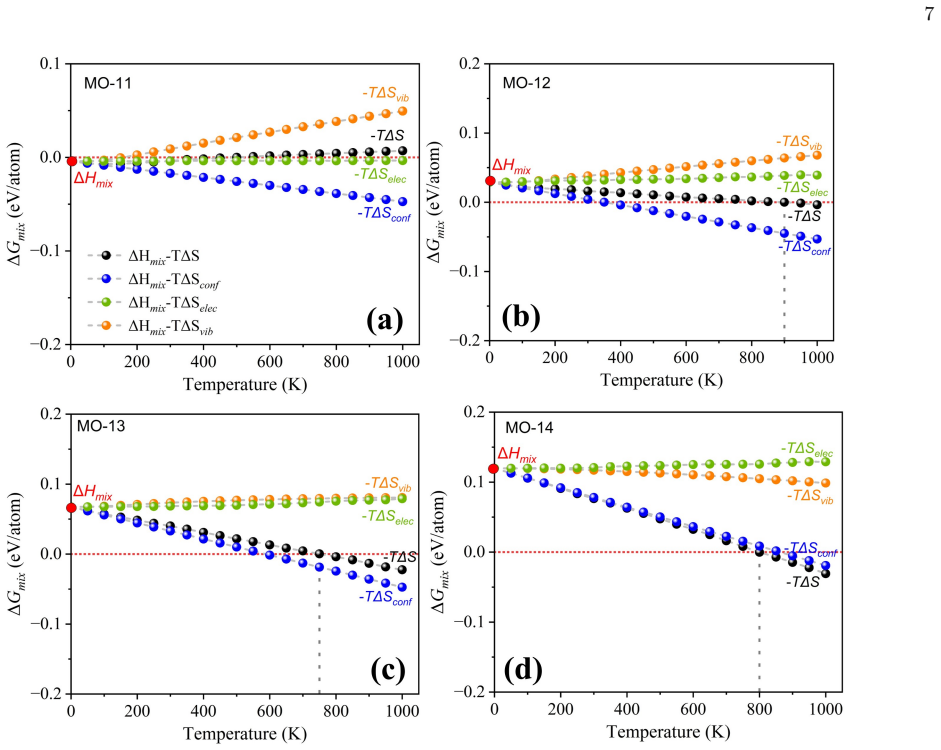
Single-phase rock-salt oxides are not restricted to the conventional high-entropy limit; medium-entropy compositions containing three to five principal cations can also be stabilized under suitable thermodynamic conditions. Density functional theory, special quasirandom structure modeling, and finite-temperature Gibbs free-energy analysis quantify how mixing enthalpy, configurational entropy, vibrational entropy, and electronic entropy together govern phase stability, demonstrating that entropy-driven free-energy reduction enables stability in the three-, four-, and five-cation cases at high temperature while the two-cation case is enthalpy-stabilized.
What carries the argument
Finite-temperature Gibbs free-energy analysis that adds DFT-derived mixing enthalpies to configurational, vibrational, and electronic entropy terms to determine whether the total free energy favors a single-phase rock-salt solid solution.
If this is right
- The two-cation system is stabilized by a favorable mixing enthalpy.
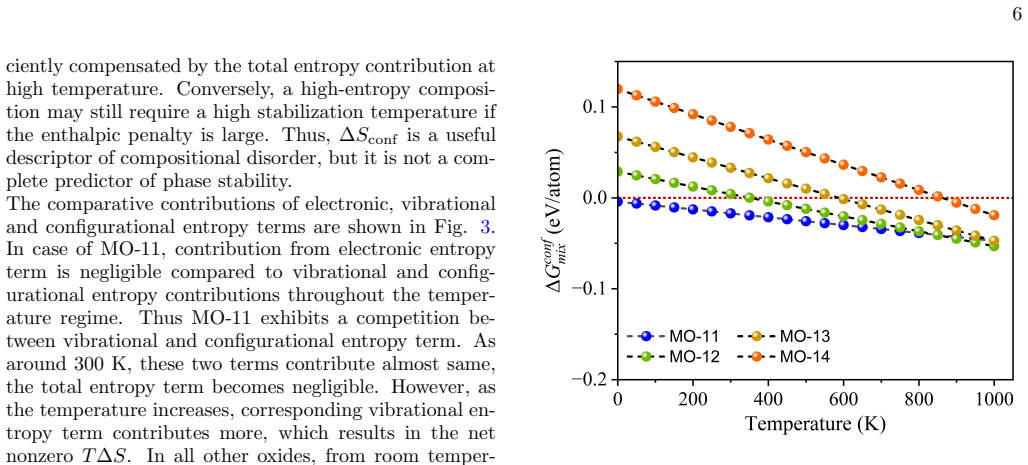
- Three-, four-, and five-cation systems become thermodynamically stable at high temperature due to the entropy-driven reduction in Gibbs free energy.
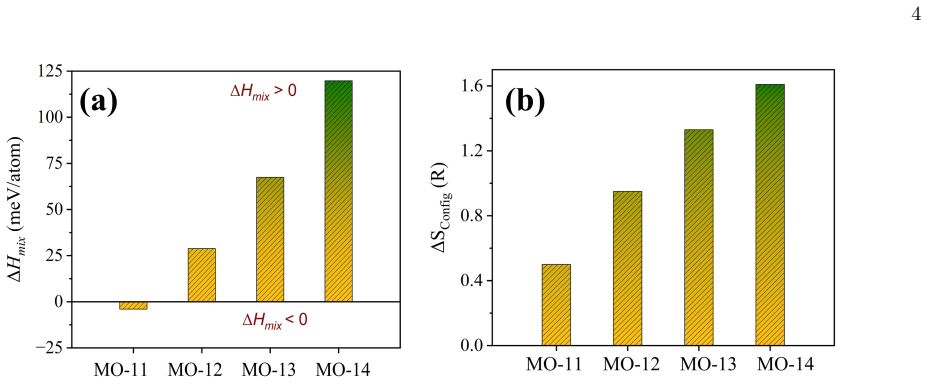
- Configurational entropy alone does not serve as a universal descriptor of phase stability across these compositions.
- Single-phase rock-salt oxides can form with medium-entropy cation counts under appropriate thermal conditions.
Where Pith is reading between the lines
- The same free-energy decomposition could be used to map stability boundaries for other cation combinations or starting temperatures.
- Vibrational and electronic entropy contributions may need explicit inclusion in design rules for medium-entropy oxides rather than being treated as secondary.
- The framework suggests that experimental synthesis routes could target specific temperature windows to access medium-entropy single phases without requiring five components.
Load-bearing premise
The density functional theory mixing enthalpies together with the added vibrational and electronic entropy contributions accurately reflect real-material behavior without large errors from functional choice, neglected anharmonic vibrations, or incomplete configuration sampling.
What would settle it
Direct observation of persistent phase separation in a three-cation rock-salt composition at a temperature where the calculated Gibbs free energy is negative, or single-phase persistence in a composition where the model predicts positive free energy.
Figures
read the original abstract
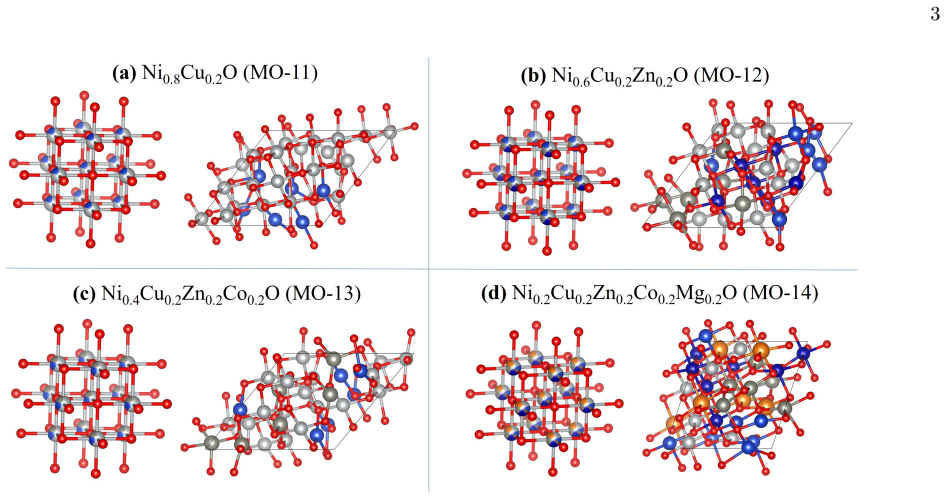
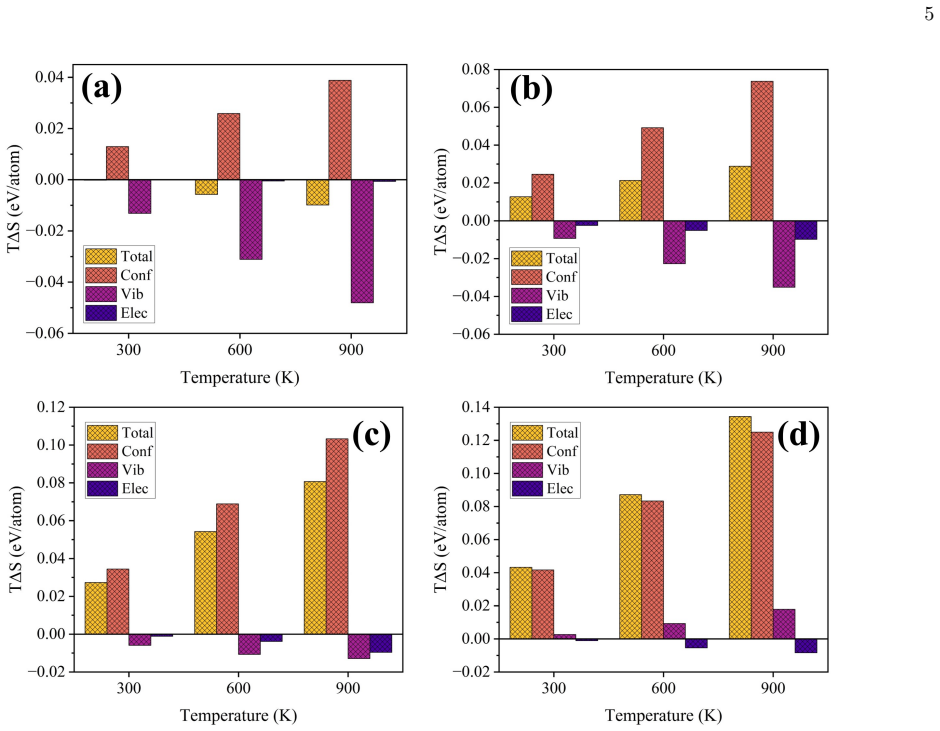
High entropy oxides are commonly associated with high configurational entropy ($\Delta S_{conf}\geq$ 1.61R) corresponding to five equimolar cations occupying a crystallographic sublattice. However, recent experimental observations indicate that medium-entropy compositions may also exhibit entropy-stabilized rock-salt phases, raising an important question regarding the minimum entropy required for phase stabilization. In this work, we employ a first-principles thermodynamic framework to investigate the stability of rock-salt oxides containing two to five principal cations components analogous to (Ni$_{0.8}$Cu$_{0.2}$)O, (Ni$_{0.6}$Cu$_{0.2}$Zn$_{0.2}$)O, (Ni$_{0.4}$Cu$_{0.2}$Zn$_{0.2}$Co$_{0.2}$)O, (Ni$_{0.2}$Cu$_{0.2}$Zn$_{0.2}$Co$_{0.2}$Mg$_{0.2}$)O. Density functional theory, MCSQS-based structural modeling, and finite-temperature Gibbs free-energy analysis are combined to quantify the roles of enthalpy mixing ($\Delta H_{mix}$), configurational ($\Delta S_{conf}$), vibrational ($\Delta S_{vib}$), and electronic contributions towards ($\Delta S_{elec}$) entropy change in governing phase stability. The results show that $\Delta S_{conf}$ alone is not a universal descriptor of phase stability. While the two-cation system is enthalpy-stabilized but three-, four- and five-cation systems become thermodynamically stable at high-temperature due to entropy-driven reduction of the Gibbs free energy. These findings demonstrate that single-phase rock-salt oxides are not restricted to the conventional high-entropy limit and that medium-entropy compositions can also be stabilized under suitable thermodynamic conditions.
Editorial analysis
A structured set of objections, weighed in public.
Referee Report
Summary. The manuscript uses DFT calculations with MCSQS supercells combined with finite-temperature Gibbs free energy analysis (including configurational, vibrational, and electronic entropy terms) to examine the thermodynamic stability of rock-salt oxides with 2 to 5 cations, using compositions analogous to (Ni0.8Cu0.2)O, (Ni0.6Cu0.2Zn0.2)O, (Ni0.4Cu0.2Zn0.2Co0.2)O, and (Ni0.2Cu0.2Zn0.2Co0.2Mg0.2)O. It concludes that while the two-cation system is enthalpy-stabilized, the three-, four-, and five-cation systems become stable at high temperature due to entropy-driven lowering of ΔG, demonstrating that single-phase rock-salt oxides are not limited to the conventional high-entropy (≥1.61R) regime.
Significance. If the computed ΔG(T) crossovers hold, the result meaningfully expands the design space for entropy-stabilized oxides to include medium-entropy compositions, with potential implications for materials synthesis and property tuning. The framework relies on standard first-principles methods and external thermodynamic relations without ad-hoc fitting parameters, which strengthens the internal consistency of the approach.
major comments (1)
- [finite-temperature Gibbs free-energy analysis (as described in abstract and methods)] The central claim that medium-entropy (3- and 4-cation) compositions are thermodynamically accessible rests on the finite-temperature Gibbs free-energy analysis showing ΔG(T) reduction below competing phases. This requires the DFT-derived ΔH_mix (via MCSQS) plus modeled ΔS_vib and ΔS_elec to be accurate to within a few meV/atom; the manuscript should quantify sensitivity to exchange-correlation functional choice, neglected anharmonicity, and configurational sampling completeness, as errors here could shift or reverse the stabilization temperatures for the 3- and 4-cation cases.
minor comments (2)
- Clarify whether the reported compositions maintain equimolar cation fractions in the 3- and 4-cation cases or follow the non-equimolar pattern of the 2-cation example; this affects interpretation of ΔS_conf.
- The abstract states that ΔS_conf alone is not a universal descriptor; the main text should explicitly contrast the computed ΔG contributions across the 2-, 3-, 4-, and 5-cation systems with numerical values or plots to support this.
Simulated Author's Rebuttal
We thank the referee for the constructive feedback and recommendation for major revision. We address the single major comment on the robustness of the finite-temperature Gibbs free-energy analysis point by point below, incorporating additional discussion and supporting information in the revised manuscript.
read point-by-point responses
-
Referee: [finite-temperature Gibbs free-energy analysis (as described in abstract and methods)] The central claim that medium-entropy (3- and 4-cation) compositions are thermodynamically accessible rests on the finite-temperature Gibbs free-energy analysis showing ΔG(T) reduction below competing phases. This requires the DFT-derived ΔH_mix (via MCSQS) plus modeled ΔS_vib and ΔS_elec to be accurate to within a few meV/atom; the manuscript should quantify sensitivity to exchange-correlation functional choice, neglected anharmonicity, and configurational sampling completeness, as errors here could shift or reverse the stabilization temperatures for the 3- and 4-cation cases.
Authors: We agree that the accuracy of the DFT-derived quantities is central to the predicted stabilization temperatures and that explicit sensitivity analysis would further strengthen the claims. In the revised manuscript we have added a dedicated paragraph in the Methods section and a new supplementary note that: (i) justifies the PBE functional by reference to literature benchmarks on rock-salt transition-metal oxides showing typical formation-energy errors of 10–20 meV/atom; (ii) discusses the quasi-harmonic approximation employed for ΔS_vib and cites prior work indicating that anharmonic corrections remain small relative to the configurational entropy contribution at the relevant temperatures; and (iii) reports explicit convergence tests of ΔH_mix with respect to MCSQS supercell size (2×2×2 to 4×4×4), confirming that the reported values are converged to within ~3 meV/atom. While a comprehensive re-calculation across multiple functionals is computationally prohibitive within the present scope, the entropy-driven stabilization for the 3- and 4-cation compositions occurs at temperatures where the –TΔS term exceeds 30–50 meV/atom, providing a margin against the estimated uncertainties. These additions do not alter the central conclusions but directly address the referee’s concern. revision: yes
Circularity Check
No circularity; standard first-principles thermodynamic chain
full rationale
The derivation computes ΔH_mix via DFT+MCSQS on explicit supercells, then evaluates ΔG(T) by adding ΔS_conf (ideal mixing), ΔS_vib, and ΔS_elec from established models. None of these steps reduce by construction to the target stability conclusion; each input is obtained independently from external electronic-structure methods or tabulated thermodynamic relations. No self-citation is invoked as a uniqueness theorem or load-bearing premise, and no parameter is fitted to the high-T crossover itself. The analysis is therefore self-contained against external benchmarks.
Axiom & Free-Parameter Ledger
axioms (2)
- domain assumption Density functional theory with chosen exchange-correlation functional yields reliable mixing enthalpies for these oxide systems
- domain assumption Configurational, vibrational, and electronic entropy terms can be computed independently and added to obtain the total entropy change
Reference graph
Works this paper leans on
-
[1]
C. M. Rost, E. Sachet, T. Borman, A. Moballegh, E. C. Dickey, D. Hou, J. L. Jones, S. Curtarolo, J.-P. Maria, Entropy-stabilized oxides, Nature communications 6 (1) (2015) 8485
2015
-
[2]
Kumar, D
A. Kumar, D. B´ erardan, F. Brisset, D. Dragoe, N. Dra- goe, Novel entropy-stabilized fluorite oxides with multi- functional properties, Journal of Materials Chemistry A 11 (26) (2023) 14320–14332
2023
-
[3]
Vayer, C
F. Vayer, C. Decorse, D. Berardan, N. Dragoe, New entropy-stabilized oxide with pyrochlore structure: Dy 2 (Ti0.2Zr0.2Hf0.2Ge0.2Sn0.2)2O7, Journal of Alloys and Compounds 883 (2021) 160773
2021
-
[4]
Spiridigliozzi, M
L. Spiridigliozzi, M. Biesuz, V. Sglavo, G. Dell’Agli, Design, synthesis and formation mechanism of a novel entropy-stabilized perovskite oxide derived from barium cerate/zirconate, Journal of the European Ceramic Soci- ety 44 (4) (2024) 2223–2232
2024
-
[5]
Fracchia, M
M. Fracchia, M. Coduri, M. Manzoli, P. Ghigna, U. A. Tamburini, Is configurational entropy the main stabiliz- ing term in rock-salt Mg 0.2Co0.2Ni0.2Cu0.2Zn0.2O high entropy oxide?, Nature Communications 13 (1) (2022) 2977
2022
-
[6]
R. J. Spurling, E. A. Lass, X. Wang, K. Page, Entropy- driven phase transitions in complex ceramic oxides, Phys- ical Review Materials 6 (9) (2022) 090301
2022
-
[7]
S. S. Aamlid, M. Oudah, J. Rottler, A. M. Hallas, Under- standing the role of entropy in high entropy oxides, Jour- nal of the American Chemical Society 145 (11) (2023) 5991–6006
2023
-
[8]
Kumar, D
A. Kumar, D. B´ erardan, D. Dragoe, E. Riviere, T. Takayama, H. Takagi, N. Dragoe, Magnetic and elec- trical properties of high-entropy rare-earth manganites, Materials Today Physics 32 (2023) 101026
2023
-
[9]
Kumar, A
A. Kumar, A. Moll, M. N. Mouhamadsiradjoudine, F. Brisset, D. Berardan, N. Dragoe, Thermoelectric prop- erties of high-entropy wolframite oxide:(cocunifezn) 1- xgaxwo4, physica status solidi (RRL)–Rapid Research Letters 18 (3) (2024) 2300372
2024
-
[10]
high entropy
M. Brahlek, M. Gazda, V. Keppens, A. R. Mazza, S. J. McCormack, A. Mielewczyk-Gry´ n, B. Musico, K. Page, C. M. Rost, S. B. Sinnott, et al., What is in a name: Defining “high entropy” oxides, APL Materials 10 (11) (2022)
2022
-
[11]
J. T. Sivak, S. S. Almishal, M. K. Caucci, Y. Tan, D. Srikanth, J. Petruska, M. Furst, L.-Q. Chen, C. M. Rost, J.-P. Maria, et al., Discovering high-entropy oxides with a machine-learning interatomic potential, Physical review letters 134 (21) (2025) 216101
2025
-
[12]
Divilov, H
S. Divilov, H. Eckert, D. Hicks, C. Oses, C. Toher, R. Friedrich, M. Esters, M. J. Mehl, A. C. Zettel, Y. Led- erer, et al., Disordered enthalpy–entropy descriptor for high-entropy ceramics discovery, Nature 625 (7993) (2024) 66–73
2024
-
[13]
A. F. Manch´ on-Gord´ on, P. Panadero-Medianero, J. S. Bl´ azquez, Descriptors for predicting single-and multi- phase formation in high-entropy oxides: A unified frame- work approach, Materials 18 (16) (2025) 3862
2025
-
[14]
Kresse, J
G. Kresse, J. Hafner, Ab initio molecular dynamics for liquid metals, Phys. Rev. B 47 (1) (1993) 558
1993
-
[15]
Kresse, J
G. Kresse, J. Hafner, Ab initio molecular-dynamics simulation of the liquid-metal–amorphous-semiconductor transition in germanium, Physical Review B 49 (20) (1994) 14251
1994
-
[16]
Kresse, J
G. Kresse, J. Furthm¨ uller, Efficiency of ab-initio total energy calculations for metals and semiconductors using a plane-wave basis set, Computational Materials Science 6 (1) (1996) 15–50
1996
-
[17]
P. E. Bl¨ ochl, Projector augmented-wave method, Phys. Rev. B 50 (1994) 17953–17979
1994
-
[18]
J. P. Perdew, K. Burke, M. Ernzerhof, Generalized gradi- ent approximation made simple, Phys. Rev. Lett. 77 (18) (1996) 3865
1996
-
[19]
H. J. Monkhorst, J. D. Pack, Special points for brillouin- zone integrations, Phys. Rev. B 13 (1976) 5188–5192
1976
-
[20]
Konysheva, E
E. Konysheva, E. Suard, J. T. Irvine, Effect of oxygen non stoichiometry and oxidation state of transition ele- ments on high-temperature phase transition in a-site de- ficient la0. 95ni0. 6fe0. 4o3-δperovskite, Chemistry of Materials 21 (21) (2009) 5307–5318
2009
-
[21]
Zunger, S.-H
A. Zunger, S.-H. Wei, L. G. Ferreira, J. E. Bernard, Special quasirandom structures, Physical review letters 65 (3) (1990) 353
1990
-
[22]
Van De Walle, M
A. Van De Walle, M. Asta, G. Ceder, The alloy theoretic automated toolkit: A user guide, Calphad 26 (4) (2002) 539–553
2002
-
[23]
Van De Walle, Multicomponent multisublattice alloys, nonconfigurational entropy and other additions to the al- loy theoretic automated toolkit, Calphad 33 (2) (2009) 266–278
A. Van De Walle, Multicomponent multisublattice alloys, nonconfigurational entropy and other additions to the al- loy theoretic automated toolkit, Calphad 33 (2) (2009) 266–278
2009
-
[24]
van de Walle, P
A. van de Walle, P. Tiwary, M. de Jong, D. L. Olmsted, M. Asta, A. Dick, D. Shin, Y. Wang, L.-Q. Chen, Z.-K. Liu, Efficient stochastic generation of special quasiran- dom structures, Calphad 42 (2013) 13–18
2013
-
[25]
Manzoor, S
A. Manzoor, S. Pandey, D. Chakraborty, S. R. Phillpot, 10 D. S. Aidhy, Entropy contributions to phase stability in binary random solid solutions, npj Computational Mate- rials 4 (1) (2018) 47
2018
-
[26]
Togo, First-principles phonon calculations with phonopy and phono3py, Journal of the Physical Society of Japan 92 (1) (2023) 012001
A. Togo, First-principles phonon calculations with phonopy and phono3py, Journal of the Physical Society of Japan 92 (1) (2023) 012001
2023
-
[27]
A. Togo, I. Tanaka, First principles phonon calculations in materials science, Scripta materialia 108 (2015) 1–5
2015
-
[28]
Z. He, W. Xuan, T. Hu, G. Zhang, J. Chen, Q. Zhang, G. Shao, H. Song, Z. Ren, Development of a novel (mg0. 25co0. 25ni0. 25zn0. 25) o medium entropy oxide for dielectric applications, Ceramics International 50 (17) (2024) 31598–31608
2024
-
[29]
K. C. Pitike, S. Kc, M. Eisenbach, C. A. Bridges, V. R. Cooper, Predicting the phase stability of multicompo- nent high-entropy compounds, Chemistry of Materials 32 (17) (2020) 7507–7515
2020
- [30]
discussion (0)
Sign in with ORCID, Apple, or X to comment. Anyone can read and Pith papers without signing in.