The Pan-Pacific Planet Search -- IX. A menagerie of companions orbiting evolved stars
Pith reviewed 2026-06-28 18:03 UTC · model grok-4.3
The pith
New radial-velocity, TESS, and Hipparcos-Gaia data classify six speculative companions around evolved stars as a planet, a brown dwarf, two low-mass stars, or none.
A machine-rendered reading of the paper's core claim, the machinery that carries it, and where it could break.
Core claim
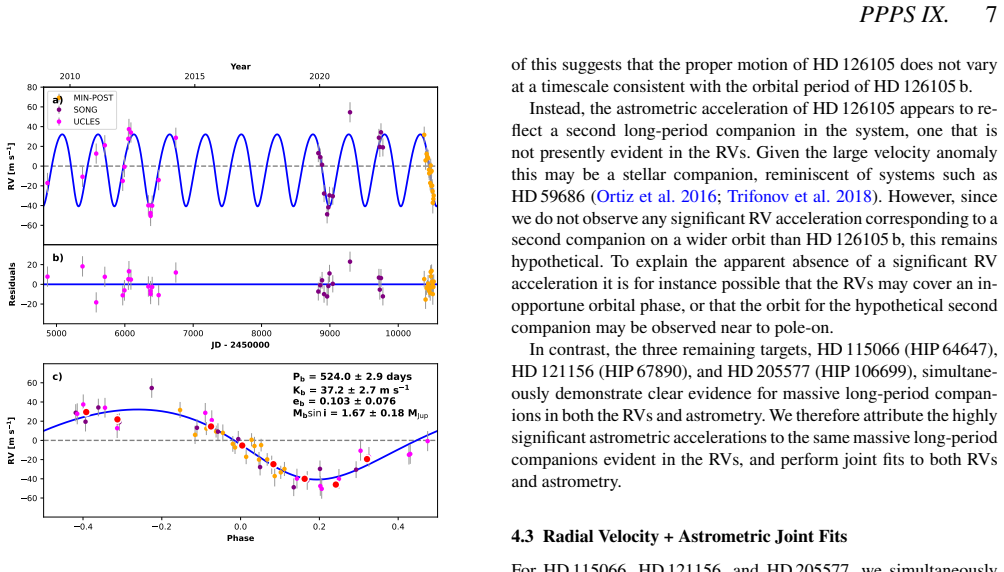
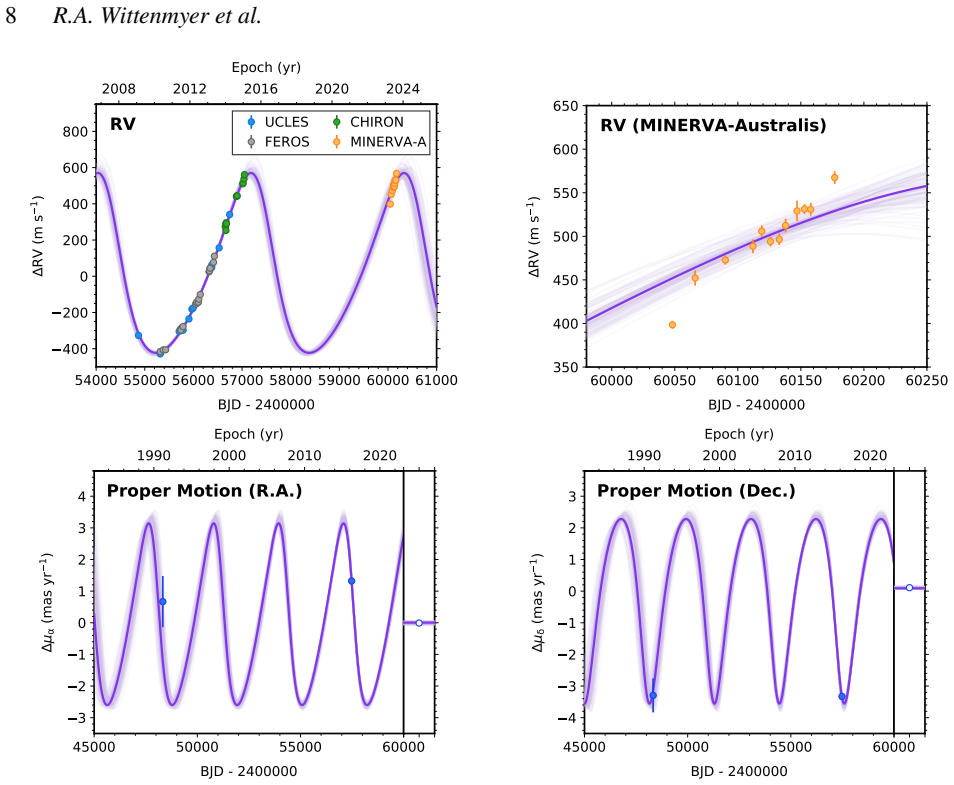
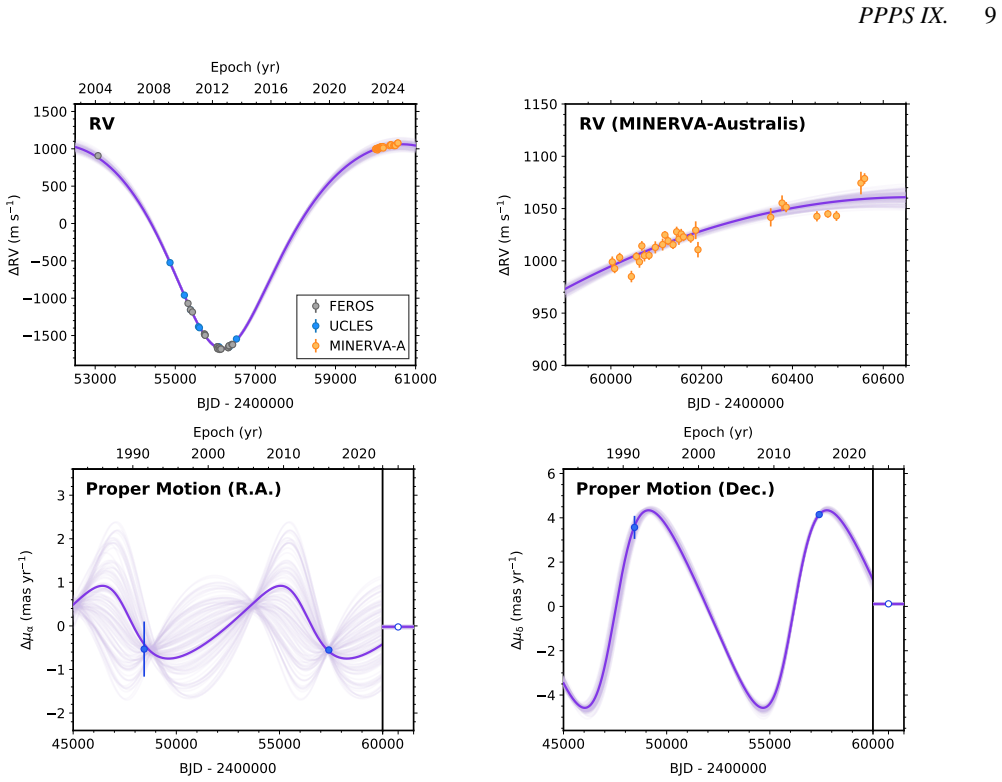
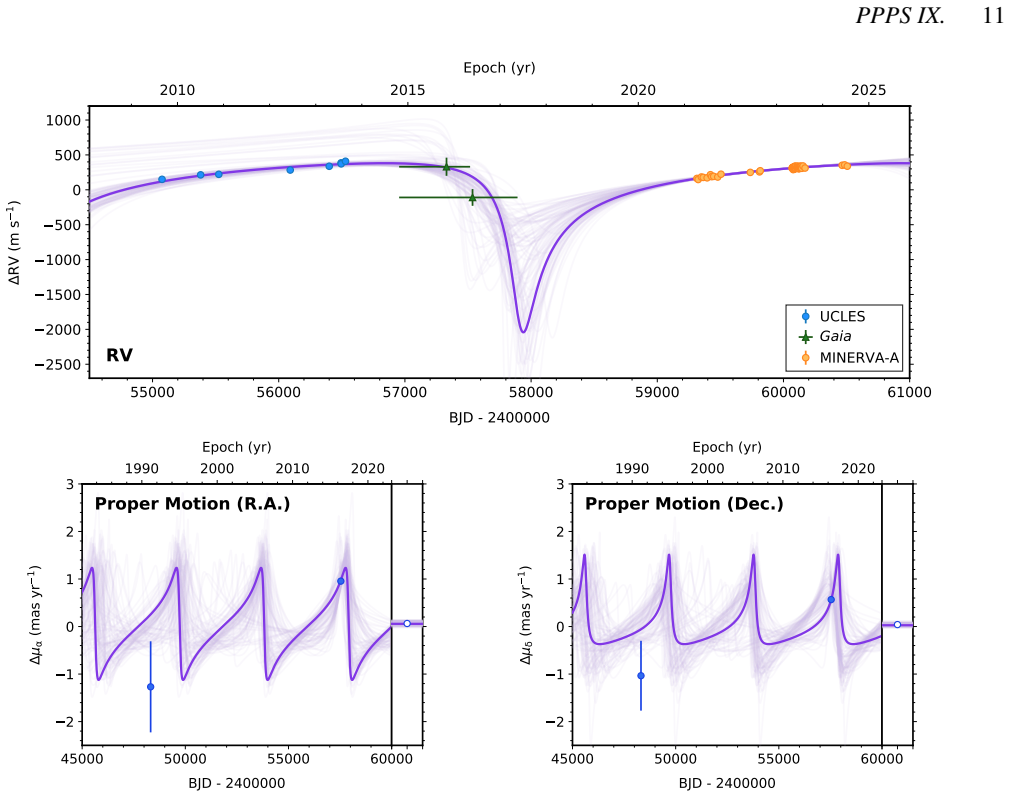
We confirm that HD 126105b is a giant planet (P=524.0±2.9 d, m sin i=1.67+0.19−0.17 M_Jup), and that HD 205577B is a massive, eccentric brown dwarf (P∼11.2 yr, m=77+11−9 M_Jup, e=0.68). HD 115066B and HD 121156B are low-mass stellar companions, while HD 114899 and HD 159743 are shown to be unadorned by any detectable companions whatsoever. This demonstrates the utility of astrometric information to help overcome the temporal limitations of incomplete radial-velocity data sets and elucidate the true nature of suspected companion bodies.
What carries the argument
Combination of new radial-velocity observations with TESS asteroseismology for stellar parameters and Hipparcos-Gaia astrometry to refine companion masses and orbits.
If this is right
- HD 126105b meets the criteria for a giant planet with the stated period and minimum mass.
- HD 205577B meets the criteria for a brown dwarf rather than a planet or star.
- HD 115066B and HD 121156B are reclassified as low-mass stellar companions.
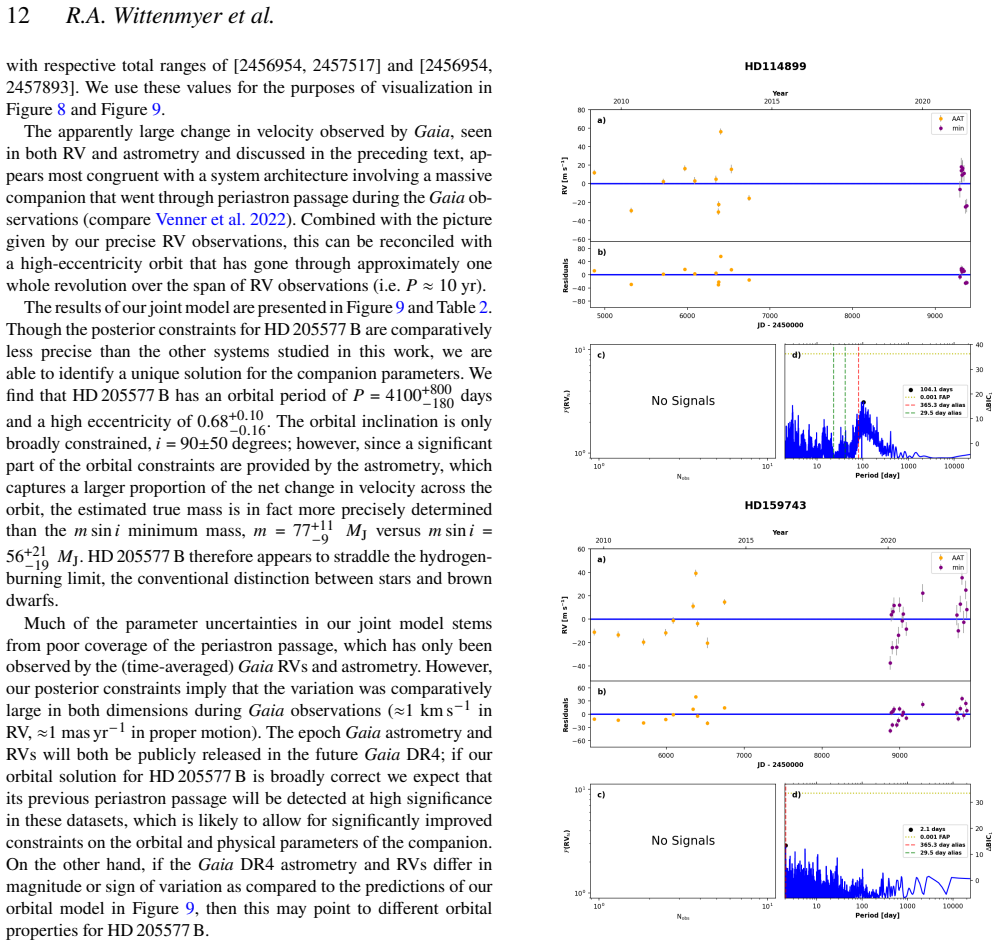
- HD 114899 and HD 159743 show no evidence of any companion above the detection threshold.
- Astrometric data can resolve mass ambiguities left by radial-velocity time series of limited duration.
Where Pith is reading between the lines
- The same combination of techniques could be applied to other radial-velocity surveys that stopped short of full orbital coverage.
- Accurate classification of these objects may adjust occurrence-rate statistics for planets versus brown dwarfs around evolved stars.
- Additional Gaia data releases could tighten the mass and eccentricity constraints further.
Load-bearing premise
The new radial-velocity observations, TESS asteroseismology, and Hipparcos-Gaia astrometry supply independent and accurate constraints that allow unambiguous classification without significant contamination from stellar activity or other effects.
What would settle it
Future observations that reveal a mismatch between the astrometric signals predicted by the radial-velocity orbits and the actual Hipparcos-Gaia proper-motion anomalies would invalidate the assigned companion types and masses.
Figures
read the original abstract
We present resolutions as to the nature of six speculative candidate companions proposed in the final data release of the Pan-Pacific Planet Search, a 6-year radial-velocity survey of 164 southern evolved stars using the now-decommissioned UCLES spectrograph on the 3.9m Anglo-Australian Telescope. New radial-velocity observations, TESS asteroseismology, and Hipparcos-Gaia astrometry are incorporated to refine the companion and host-star parameters. We confirm that HD 126105b is a giant planet ($P=524.0\pm$2.9 d, $m$ sin $i=1.67^{+0.19}_{-0.17}M_{Jup}$), and that HD 205577B is a massive, eccentric brown dwarf ($P\sim$11.2 yr, $m=77^{+11}_{-9}M_{Jup}$, $e=0.68$). HD 115066B and HD 121156B are low-mass stellar companions, while HD 114899 and HD 159743 are shown to be unadorned by any detectable companions whatsoever. This demonstrates the utility of astrometric information to help overcome the temporal limitations of incomplete radial-velocity data sets and elucidate the true nature of suspected companion bodies.
Editorial analysis
A structured set of objections, weighed in public.
Referee Report
Summary. The paper resolves the nature of six candidate companions identified in the final release of the Pan-Pacific Planet Search (a 6-year RV survey of 164 evolved stars) by incorporating new radial-velocity observations, TESS asteroseismology, and Hipparcos-Gaia astrometry. It confirms HD 126105b as a giant planet (P=524.0±2.9 d, m sin i=1.67+0.19−0.17 M_Jup), HD 205577B as a massive eccentric brown dwarf (P∼11.2 yr, m=77+11−9 M_Jup, e=0.68), HD 115066B and HD 121156B as low-mass stellar companions, and HD 114899 and HD 159743 as having no detectable companions. The work emphasizes the role of astrometric data in overcoming temporal limitations of incomplete RV datasets.
Significance. If the multi-technique classifications hold, the paper provides concrete, observationally grounded examples of how combined RV, asteroseismic, and astrometric constraints can unambiguously distinguish planets, brown dwarfs, and stellar companions around evolved stars. This directly addresses a common challenge in long-period companion searches and supplies specific fitted parameters with uncertainties that can be used for population studies. The explicit demonstration of the method's utility on six targets is a modest but useful contribution to the Pan-Pacific Planet Search series.
minor comments (3)
- §3 (Methods): the description of how the joint RV+astrometric likelihood is constructed and how stellar activity is mitigated should be expanded with explicit equations or a reference to the precise model used, as this is central to the claim of unambiguous classification.
- Table 2: the reported uncertainties on the brown-dwarf mass and eccentricity for HD 205577B appear to come from a single posterior; clarify whether these are 1σ credible intervals from the full MCMC chain or approximate values.
- Figure 4: the phase-folded RV plot for HD 126105b would benefit from an additional panel showing the residuals after subtracting the best-fit orbit to allow visual assessment of any remaining periodic signals.
Simulated Author's Rebuttal
We thank the referee for their positive assessment of the manuscript, accurate summary of its content, and recommendation for minor revision. The referee correctly identifies the key results and the utility of combining RV, asteroseismic, and astrometric data. No major comments were raised in the report.
Circularity Check
No significant circularity: observational fitting with independent multi-technique constraints
full rationale
The paper reports new radial-velocity observations, TESS asteroseismology, and Hipparcos-Gaia astrometry to classify six candidate companions around evolved stars. All reported quantities (periods, masses, eccentricities) are direct outputs of standard orbit fitting to the combined datasets. No derivation chain, uniqueness theorem, ansatz, or self-citation is invoked to force results; the classifications follow from the data themselves. The work contains no mathematical derivation that could reduce to its inputs by construction.
Axiom & Free-Parameter Ledger
free parameters (4)
- Orbital period of HD 126105b =
524.0 days
- Minimum mass of HD 126105b =
1.67 Jupiter masses
- Mass of HD 205577B =
77 Jupiter masses
- Eccentricity of HD 205577B =
0.68
axioms (3)
- domain assumption Radial velocity signals arise from gravitational interactions with orbiting companions following Keplerian orbits
- domain assumption Asteroseismic measurements from TESS yield accurate stellar parameters such as mass and radius
- domain assumption Hipparcos-Gaia proper motion anomalies accurately trace the astrometric wobble due to companions
Reference graph
Works this paper leans on
-
[1]
First Results From The Hertzsprung Song Telescope: Asteroseismology Of The G5 Subgiant Star {\Mu}Her
First Results from the Hertzsprung SONG Telescope: Asteroseismology of the G5 Subgiant Star Herculis. , keywords =. doi:10.3847/1538-4357/836/1/142 , archivePrefix =. 1701.03365 , primaryClass =
work page internal anchor Pith review Pith/arXiv arXiv doi:10.3847/1538-4357/836/1/142
-
[2]
TESS Asteroseismic Masses and Radii of Red Giants with (and without) Planets. , keywords =. doi:10.3847/1538-4357/ad685d , archivePrefix =. 2410.02051 , primaryClass =
-
[3]
Pyodine: an open, flexible reduction software for iodine-calibrated precise radial velocities. , keywords =. doi:10.1051/0004-6361/202244441 , archivePrefix =. 2306.13615 , primaryClass =
-
[4]
The Pan-Pacific Planet Search. IV. Two Super-Jupiters in a 3:5 Resonance Orbiting the Giant Star HD 33844. , keywords =. doi:10.3847/0004-637X/818/1/35 , archivePrefix =. 1512.07316 , primaryClass =
work page internal anchor Pith review Pith/arXiv arXiv doi:10.3847/0004-637x/818/1/35
-
[5]
The rovibrational spectrum of BeH, MgH and CaH in the X ^ 2 ^ + state
Fundamental parameters and infrared excesses of Hipparcos stars. , keywords =. doi:10.1111/j.1365-2966.2012.21873.x , archivePrefix =. 1208.2037 , primaryClass =
-
[6]
Assessment of [Fe/H] determinations for FGK stars in spectroscopic surveys. , keywords =. doi:10.1051/0004-6361/202142409 , archivePrefix =. 2112.07545 , primaryClass =
-
[7]
Retired A Stars and Their Companions. VI. A Pair of Interacting Exoplanet Pairs Around the Subgiants 24 Sextanis and HD 200964. , keywords =. doi:10.1088/0004-6256/141/1/16 , archivePrefix =. 1007.4552 , primaryClass =
work page internal anchor Pith review Pith/arXiv arXiv doi:10.1088/0004-6256/141/1/16
-
[8]
Resonances Required: Dynamical Analysis of the 24 Sex and HD 200964 Planetary Systems
Resonances Required: Dynamical Analysis of the 24 Sex and HD 200964 Planetary Systems. , keywords =. doi:10.1088/0004-637X/761/2/165 , archivePrefix =. 1211.1078 , primaryClass =
work page internal anchor Pith review Pith/arXiv arXiv doi:10.1088/0004-637x/761/2/165
-
[9]
Precise radial velocities of giant stars. XIII. A second Jupiter orbiting in 4:3 resonance in the 7 CMa system. , keywords =. doi:10.1051/0004-6361/201936464 , archivePrefix =. 1910.05853 , primaryClass =
-
[10]
HD 76920 b pinned down: A detailed analysis of the most eccentric planetary system around an evolved star. , keywords =. doi:10.1017/pasa.2021.8 , archivePrefix =. 2102.08902 , primaryClass =
-
[11]
Revisiting planetary systems in the Okayama Planet Search Program: A new long-period planet, RV astrometry joint analysis, and a multiplicity-metallicity trend around evolved stars. , keywords =. doi:10.1093/pasj/psad056 , archivePrefix =. 2308.05343 , primaryClass =
-
[12]
The Pan-Pacific Planet Search. VI. Giant Planets Orbiting HD 86950 and HD 222076. , keywords =. doi:10.3847/1538-3881/153/2/51 , archivePrefix =. 1611.07648 , primaryClass =
work page internal anchor Pith review Pith/arXiv arXiv doi:10.3847/1538-3881/153/2/51
-
[13]
Four new planets around giant stars and the mass-metallicity correlation of planet-hosting stars
Four new planets around giant stars and the mass-metallicity correlation of planet-hosting stars. , keywords =. doi:10.1051/0004-6361/201628067 , archivePrefix =. 1603.03738 , primaryClass =
work page internal anchor Pith review Pith/arXiv arXiv doi:10.1051/0004-6361/201628067
-
[14]
I.: A Noninflated Hot Jupiter Orbiting a Massive Subgiant
TESS Giants Transiting Giants. I.: A Noninflated Hot Jupiter Orbiting a Massive Subgiant. , keywords =. doi:10.3847/1538-3881/ac38a1 , archivePrefix =. 2108.02294 , primaryClass =
-
[15]
Giant Planet Occurrence within 0.2 au of Low-luminosity Red Giant Branch Stars with K2. , keywords =. doi:10.3847/1538-3881/ab4c35 , archivePrefix =. 1910.05346 , primaryClass =
-
[17]
Study of the impact of the post-MS evolution of the host star on the orbits of close-in planets. I. Sample definition and physical properties. , keywords =. doi:10.1051/0004-6361/201117887 , archivePrefix =. 1110.6459 , primaryClass =
work page internal anchor Pith review Pith/arXiv arXiv doi:10.1051/0004-6361/201117887
-
[18]
An Eccentric Hot Jupiter Orbiting the Subgiant HD 185269
An Eccentric Hot Jupiter Orbiting the Subgiant HD 185269. , keywords =. doi:10.1086/508255 , archivePrefix =. astro-ph/0608035 , primaryClass =
work page internal anchor Pith review Pith/arXiv arXiv doi:10.1086/508255
-
[19]
Radial-Velocity Variability of G-Type Giants: First Three Years of the Okayama Planet Search Program. , keywords =. doi:10.1093/pasj/57.1.97 , adsurl =
-
[20]
Precise radial velocities of giant stars. XVI. Planet occurrence rates from the combined analysis of the Lick, EXPRESS, and PPPS giant star surveys. , keywords =. doi:10.1051/0004-6361/202142501 , archivePrefix =. 2202.12800 , primaryClass =
-
[21]
The Pan-Pacific Planet Search. VII. The Most Eccentric Planet Orbiting a Giant Star. , keywords =. doi:10.3847/1538-3881/aa9894 , archivePrefix =. 1711.05378 , primaryClass =
work page internal anchor Pith review Pith/arXiv arXiv doi:10.3847/1538-3881/aa9894
-
[22]
The Pan-Pacific Planet Search. I. A Giant Planet Orbiting 7 CMa. , keywords =. doi:10.1088/0004-637X/743/2/184 , archivePrefix =. 1111.1007 , primaryClass =
work page internal anchor Pith review Pith/arXiv arXiv doi:10.1088/0004-637x/743/2/184
-
[23]
CORALIE radial-velocity search for companions around evolved stars (CASCADES). I. Sample definition and first results: Three new planets orbiting giant stars. , keywords =. doi:10.1051/0004-6361/202040078 , archivePrefix =. 2201.01528 , primaryClass =
-
[24]
Two New HATNet Hot Jupiters around A Stars and the First Glimpse at the Occurrence Rate of Hot Jupiters from TESS. , keywords =. doi:10.3847/1538-3881/ab36b5 , archivePrefix =. 1906.00462 , primaryClass =
-
[25]
The California Legacy Survey. I. A Catalog of 178 Planets from Precision Radial Velocity Monitoring of 719 Nearby Stars over Three Decades. , keywords =. doi:10.3847/1538-4365/abe23c , archivePrefix =. 2105.11583 , primaryClass =
-
[26]
Evidence for Reflected Light from the Most Eccentric Exoplanet Known
Evidence for Reflected Light from the Most Eccentric Exoplanet Known. , keywords =. doi:10.3847/0004-637X/821/1/65 , archivePrefix =. 1511.08679 , primaryClass =
work page internal anchor Pith review Pith/arXiv arXiv doi:10.3847/0004-637x/821/1/65
-
[27]
isochrones: Stellar model grid package
-
[28]
A trio of giant planets orbiting evolved star HD 184010. , keywords =. doi:10.1093/pasj/psac070 , archivePrefix =. 2209.09426 , primaryClass =
-
[29]
CORALIE radial-velocity search for companions around evolved stars (CASCADES). III. A new Jupiter host-star: in-depth analysis of HD 29399 using TESS data. , keywords =. doi:10.1051/0004-6361/202040080 , archivePrefix =. 2201.01553 , primaryClass =
-
[30]
A close-in giant planet escapes engulfment by its star. , keywords =. doi:10.1038/s41586-023-06029-0 , archivePrefix =. 2306.15877 , primaryClass =
-
[31]
A simple method to measure _ max for asteroseismology: application to 16 000 oscillating Kepler red giants. , keywords =. doi:10.1093/mnras/stae991 , archivePrefix =. 2401.17557 , primaryClass =
-
[32]
Communications in Asteroseismology , year = 2007, month = jun, volume =
Stellar Oscillations Network Group. Communications in Asteroseismology , year = 2007, month = jun, volume =. doi:10.1553/cia150s300 , adsurl =
-
[33]
The California Planet Survey IV: A Planet Orbiting the Giant Star HD 145934 and Updates to Seven Systems with Long-period Planets. , keywords =. doi:10.1088/0004-637X/800/1/22 , archivePrefix =. 1501.00633 , primaryClass =
work page internal anchor Pith review Pith/arXiv arXiv doi:10.1088/0004-637x/800/1/22
-
[34]
RadVel: The Radial Velocity Modeling Toolkit
RadVel: The Radial Velocity Modeling Toolkit. , keywords =. doi:10.1088/1538-3873/aaaaa8 , archivePrefix =. 1801.01947 , primaryClass =
work page internal anchor Pith review Pith/arXiv arXiv doi:10.1088/1538-3873/aaaaa8
-
[35]
AstroImageJ: Image Processing and Photometric Extraction for Ultra-precise Astronomical Light Curves. , keywords =. doi:10.3847/1538-3881/153/2/77 , archivePrefix =. 1701.04817 , primaryClass =
work page internal anchor Pith review Pith/arXiv arXiv doi:10.3847/1538-3881/153/2/77
-
[36]
Complete results and the occurrence rate of planets around low-luminosity giants
The Pan-Pacific Planet Search - VIII. Complete results and the occurrence rate of planets around low-luminosity giants. , keywords =. doi:10.1093/mnras/stz3378 , archivePrefix =. 1911.11954 , primaryClass =
-
[37]
Ground-based and Airborne Instrumentation for Astronomy IV , year = 2012, editor =
KiwiSpec - an advanced spectrograph for high resolution spectroscopy: optical design and variations. Ground-based and Airborne Instrumentation for Astronomy IV , year = 2012, editor =. doi:10.1117/12.926527 , adsurl =
-
[38]
Spinning up a Daze: TESS Uncovers a Hot Jupiter Orbiting the Rapid Rotator TOI-778. , keywords =. doi:10.3847/1538-3881/acc3a0 , archivePrefix =. 2212.08242 , primaryClass =
-
[39]
TOI-1842b: A Transiting Warm Saturn Undergoing Reinflation around an Evolving Subgiant. , keywords =. doi:10.3847/1538-3881/ac3f39 , archivePrefix =. 2112.00198 , primaryClass =
-
[40]
Minerva-Australis. I. Design, Commissioning, and First Photometric Results. , keywords =. doi:10.1088/1538-3873/ab03aa , archivePrefix =. 1901.11231 , primaryClass =
-
[42]
Evidence of extra mixing in field giants as traced by the lithium and carbon isotope ratio. , keywords =. doi:10.1051/0004-6361/202244518 , archivePrefix =. 2207.08905 , primaryClass =
-
[43]
New spectroscopic binary companions of giant stars and updated metallicity distribution for binary systems. , keywords =. doi:10.1051/0004-6361/201628459 , archivePrefix =. 1608.08260 , primaryClass =
work page internal anchor Pith review Pith/arXiv arXiv doi:10.1051/0004-6361/201628459
-
[44]
Ca II H&K time series for the HARPS radial velocity database
Analysis of the public HARPS/ESO spectroscopic archive. Ca II H&K time series for the HARPS radial velocity database. , keywords =. doi:10.1051/0004-6361/202348263 , archivePrefix =. 2311.12438 , primaryClass =
-
[45]
SPECIES. II. Stellar parameters of the EXPRESS giant star sample. , keywords =. doi:10.1051/0004-6361/202039357 , archivePrefix =. 2009.03371 , primaryClass =
-
[46]
The CORALIE survey for southern extrasolar planets. XVII. New and updated long period and massive planets. , keywords =. doi:10.1051/0004-6361/201219639 , archivePrefix =. 1211.6444 , primaryClass =
work page internal anchor Pith review Pith/arXiv arXiv doi:10.1051/0004-6361/201219639
-
[47]
Determination Of The Orbit Of The Planetary Companion To The Metal Rich Star HD 45350
Determination of the Orbit of the Planetary Companion to the Metal-Rich Star HD 45350. , keywords =. doi:10.1086/503746 , archivePrefix =. astro-ph/0603007 , primaryClass =
work page internal anchor Pith review Pith/arXiv arXiv doi:10.1086/503746
-
[48]
New determination of the hydrogen burning limit
Impact of a new H/He equation of state on the evolution of massive brown dwarfs. New determination of the hydrogen burning limit. , keywords =. doi:10.1051/0004-6361/202243832 , archivePrefix =. 2212.07153 , primaryClass =
-
[49]
Radial Velocity Discovery of an Eccentric Jovian World Orbiting at 18 au. , keywords =. doi:10.3847/1538-3881/ab3e63 , archivePrefix =. 1908.09925 , primaryClass =
-
[50]
The Pan-Pacific Planet Search. V. Fundamental Parameters for 164 Evolved Stars. , keywords =. doi:10.3847/0004-6256/152/1/19 , archivePrefix =. 1605.00323 , primaryClass =
work page internal anchor Pith review Pith/arXiv arXiv doi:10.3847/0004-6256/152/1/19
-
[51]
Volume\_3
Michigan Catalogue of Two-dimensional Spectral Types for the HD stars. Volume\_3. Declinations -40\_ 0 to -26\_ 0
-
[52]
Volume 4, Declinations -26 .0 to -12 .0
Michigan Catalogue of Two-dimensional Spectral Types for the HD Stars. Volume 4, Declinations -26 .0 to -12 .0
-
[53]
, keywords =
The Tycho-2 catalogue of the 2.5 million brightest stars. , keywords =
-
[54]
Rotational and Radial Velocities for a Sample of 761 HIPPARCOS Giants and the Role of Binarity. , keywords =. doi:10.1088/0004-6256/135/1/209 , adsurl =
-
[55]
doi:10.26093/cds/vizier.1350 , adsurl =
VizieR Online Data Catalog: Gaia EDR3 (Gaia Collaboration, 2020). doi:10.26093/cds/vizier.1350 , adsurl =
-
[56]
The Messenger , year = 2003, month = dec, volume = 114, pages =
Setting New Standards with HARPS. The Messenger , year = 2003, month = dec, volume = 114, pages =
2003
-
[57]
Planet-disk interaction and orbital evolution
Planet-Disk Interaction and Orbital Evolution. , keywords =. 2012. doi:10.1146/annurev-astro-081811-125523 , archivePrefix =. 1203.1184 , primaryClass =
work page internal anchor Pith review Pith/arXiv arXiv doi:10.1146/annurev-astro-081811-125523 2012
-
[58]
ArXiv e-prints , keywords =
New Grids of ATLAS9 Model Atmospheres. ArXiv e-prints , keywords =
-
[59]
High-precision radial velocities and two alternative spectral indicators
Spectrum radial velocity analyser (SERVAL). High-precision radial velocities and two alternative spectral indicators. , archivePrefix = "arXiv", eprint =. doi:10.1051/0004-6361/201731483 , adsurl =
-
[60]
, archivePrefix = "arXiv", eprint =
ZASPE: A Code to Measure Stellar Atmospheric Parameters and their Covariance from Spectra. , archivePrefix = "arXiv", eprint =. doi:10.1093/mnras/stx144 , adsurl =
-
[61]
III - Orbital migration of protoplanets
On the tidal interaction between protoplanets and the protoplanetary disk. III - Orbital migration of protoplanets. , keywords =. doi:10.1086/164653 , adsurl =
-
[62]
Shrinking binary and planetary orbits by Kozai cycles with tidal friction
Shrinking Binary and Planetary Orbits by Kozai Cycles with Tidal Friction. , keywords =. doi:10.1086/521702 , archivePrefix =. 0705.4285 , primaryClass =
work page internal anchor Pith review Pith/arXiv arXiv doi:10.1086/521702
-
[63]
Dynamical instabilities and the formation of extrasolar planetary systems. Science , keywords =. doi:10.1126/science.274.5289.954 , adsurl =
-
[64]
, year = 1995, month = nov, volume =
A Jupiter-mass companion to a solar-type star. , year = 1995, month = nov, volume =. doi:10.1038/378355a0 , adsurl =
-
[65]
The Discovery of a Planetary Companion to 16 Cygni B
The Discovery of a Planetary Companion to 16 Cygni B. , keywords =. doi:10.1086/304245 , archivePrefix =. astro-ph/9611230 , primaryClass =
work page internal anchor Pith review Pith/arXiv arXiv doi:10.1086/304245
-
[66]
Evidence for Multiple Companions to Andromedae. , keywords =. doi:10.1086/308035 , adsurl =
-
[67]
The HARPS search for southern extra-solar planets. I. HD 330075 b: A new ``hot Jupiter''. , keywords =. doi:10.1051/0004-6361:20040389 , archivePrefix =. astro-ph/0405252 , primaryClass =
work page internal anchor Pith review Pith/arXiv arXiv doi:10.1051/0004-6361:20040389
-
[68]
A Super-Earth and two Neptunes Orbiting the Nearby Sun-like star 61 Virginis
A Super-Earth and Two Neptunes Orbiting the Nearby Sun-like Star 61 Virginis. , keywords =. doi:10.1088/0004-637X/708/2/1366 , archivePrefix =. 0912.2599 , primaryClass =
work page internal anchor Pith review Pith/arXiv arXiv doi:10.1088/0004-637x/708/2/1366
-
[69]
Astrocut: Tools for creating cutouts of TESS images
-
[70]
ascl:1812.013 , adsurl =
Lightkurve: Kepler and TESS time series analysis in Python. ascl:1812.013 , adsurl =
-
[71]
Exoplanet Detection Techniques
Exoplanet Detection Techniques. Protostars and Planets VI , year = "2014", editor =. doi:10.2458/azu_uapress_9780816531240-ch031 , archivePrefix =. 1505.06869 , primaryClass =
work page internal anchor Pith review Pith/arXiv arXiv doi:10.2458/azu_uapress_9780816531240-ch031 2014
-
[72]
Cool Jupiters greatly outnumber their toasty siblings: occurrence rates from the Anglo-Australian Planet Search. , keywords =. doi:10.1093/mnras/stz3436 , archivePrefix =. 1912.01821 , primaryClass =
-
[73]
TOI-132 b: A short-period planet in the Neptune desert transiting a V = 11.3 G-type star ^ ★. , keywords =. doi:10.1093/mnras/staa277 , archivePrefix =. 1911.02012 , primaryClass =
-
[74]
An ultrahot Neptune in the Neptune desert. Nature Astronomy , keywords =. doi:10.1038/s41550-020-1142-z , archivePrefix =. 2009.12832 , primaryClass =
-
[75]
The HARPS search for southern extra-solar planets. XLIV. Eight HARPS multi-planet systems hosting 20 super-Earth and Neptune-mass companions. , keywords =. 2019. doi:10.1051/0004-6361/201731173 , adsurl =
-
[76]
, archivePrefix = "arXiv", eprint =
CERES: A Set of Automated Routines for Echelle Spectra. , archivePrefix = "arXiv", eprint =. doi:10.1088/1538-3873/aa5455 , adsurl =
-
[77]
The M dwarf planet search programme at the ESO VLT + UVES. A search for terrestrial planets in the habitable zone of M dwarfs. , keywords =. 2009. doi:10.1051/0004-6361/200912479 , archivePrefix =. 0908.0944 , primaryClass =
work page internal anchor Pith review Pith/arXiv arXiv doi:10.1051/0004-6361/200912479 2009
-
[78]
Characterization of the L 98-59 multi-planetary system with HARPS. Mass characterization of a hot super-Earth, a sub-Neptune, and a mass upper limit on the third planet. , keywords =. 2019. doi:10.1051/0004-6361/201935957 , adsurl =
-
[79]
Revisiting the HD 21749 Planetary System with Stellar Activity Modeling. , keywords =. doi:10.1093/mnras/staa3886 , archivePrefix =. 2012.04873 , primaryClass =
-
[80]
TOI-216b and TOI-216c: Two warm, large exoplanets in or slightly wide of the 2:1 orbital resonance
TOI-216b and TOI-216 c: Two Warm, Large Exoplanets in or Slightly Wide of the 2:1 Orbital Resonance. , keywords =. doi:10.3847/1538-3881/ab24ba , archivePrefix =. 1904.11852 , primaryClass =
work page internal anchor Pith review Pith/arXiv arXiv doi:10.3847/1538-3881/ab24ba 1904
-
[81]
Extracting Planet Mass and Eccentricity From TTV data
Extracting Planet Mass and Eccentricity from TTV Data. , keywords =. doi:10.1088/0004-637X/761/2/122 , archivePrefix =. 1207.4192 , primaryClass =
work page internal anchor Pith review Pith/arXiv arXiv doi:10.1088/0004-637x/761/2/122
-
[82]
Daniel Foreman-Mackey , title =. 2016 , month =. doi:10.21105/joss.00024 , url =
discussion (0)
Sign in with ORCID, Apple, or X to comment. Anyone can read and Pith papers without signing in.