OmniEEG-Bench: A Standardized Evaluation Benchmark for EEG Foundation Models
Pith reviewed 2026-06-28 19:16 UTC · model grok-4.3
The pith
EEG foundation models perform better when both their size and pretraining data diversity increase, as shown on a new benchmark covering 54 datasets.
A machine-rendered reading of the paper's core claim, the machinery that carries it, and where it could break.
Core claim
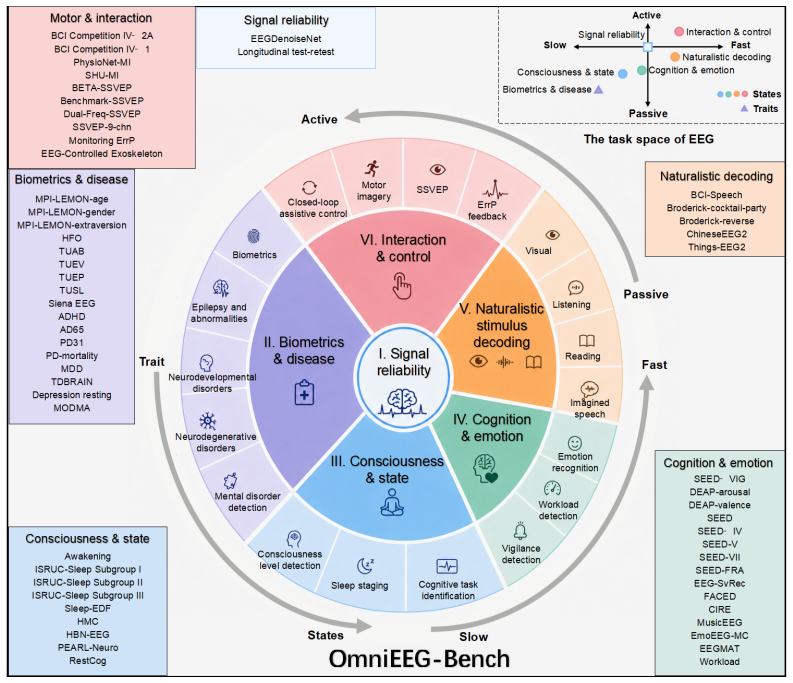
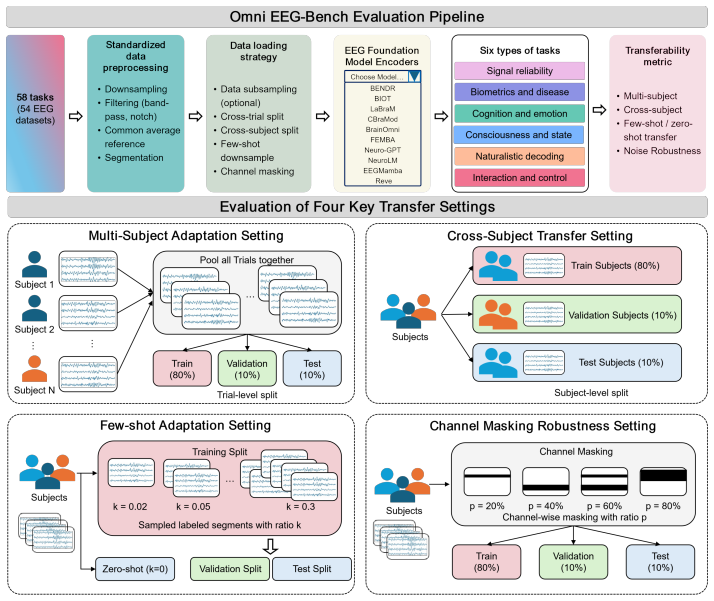
OmniEEG-Bench standardizes deployment, task definitions, and metrics for EEG foundation models across six task families and 54 unified datasets; when ten representative models are evaluated, both pretraining dataset diversity and model size show significant positive association with better average ranks, indicating scaling-law behavior.
What carries the argument
OmniEEG-Bench task-card specification that enforces consistent model deployment, task definitions, and metrics across the six task families and 54 datasets.
If this is right
- Scaling EEG foundation models requires both larger architectures and broader, more diverse pretraining data rather than size alone.
- New EEG foundation models can be compared directly using the shared task-card protocols instead of custom setups.
- Performance trends observed on the six task families can be used to forecast results on additional datasets that follow the same families.
- Development efforts should expand pretraining collections to include more varied recording conditions and subject populations.
Where Pith is reading between the lines
- If the scaling pattern holds, future work could test whether adding specific types of diversity, such as cross-device recordings, produces larger gains than simply increasing total hours of data.
- The benchmark structure could be extended to measure transfer between task families, for example checking whether gains on motor tasks predict gains on emotion tasks.
- Researchers might examine whether the same diversity-size relationship appears when the benchmark is applied to models trained from scratch rather than fine-tuned from existing checkpoints.
Load-bearing premise
The chosen 54 datasets and six task families capture typical real-world EEG capabilities without major selection effects that would create false associations between diversity, size, and performance.
What would settle it
Re-running the ten models on a fresh collection of datasets that deliberately balances or reduces diversity while keeping the same task families and finding no remaining link between diversity or size and rank would falsify the reported association.
Figures
read the original abstract
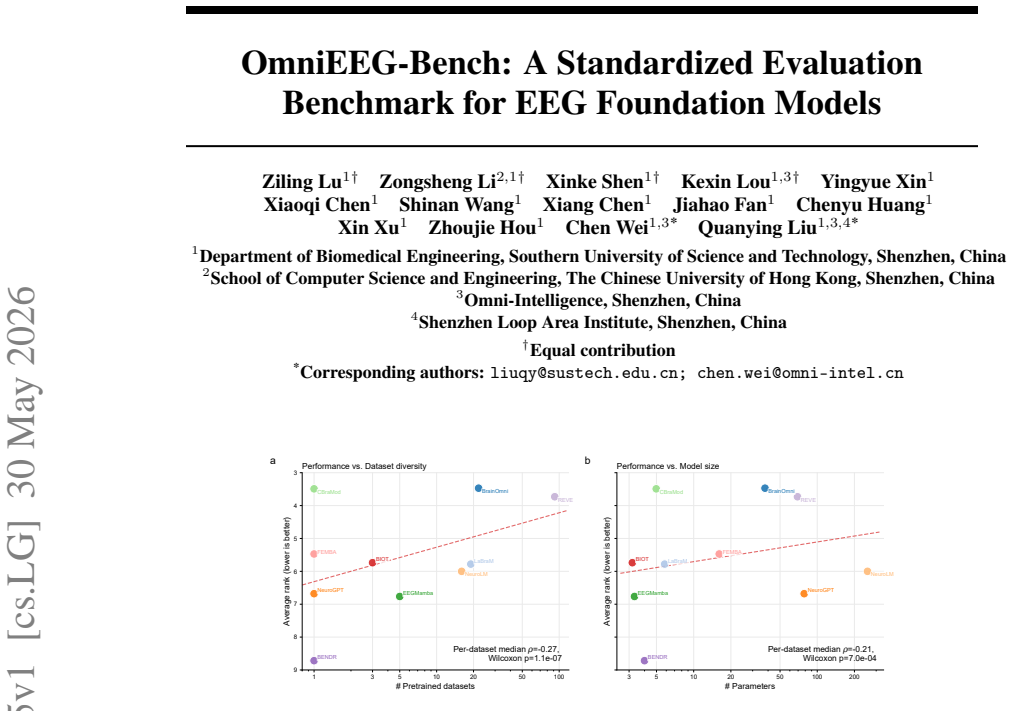
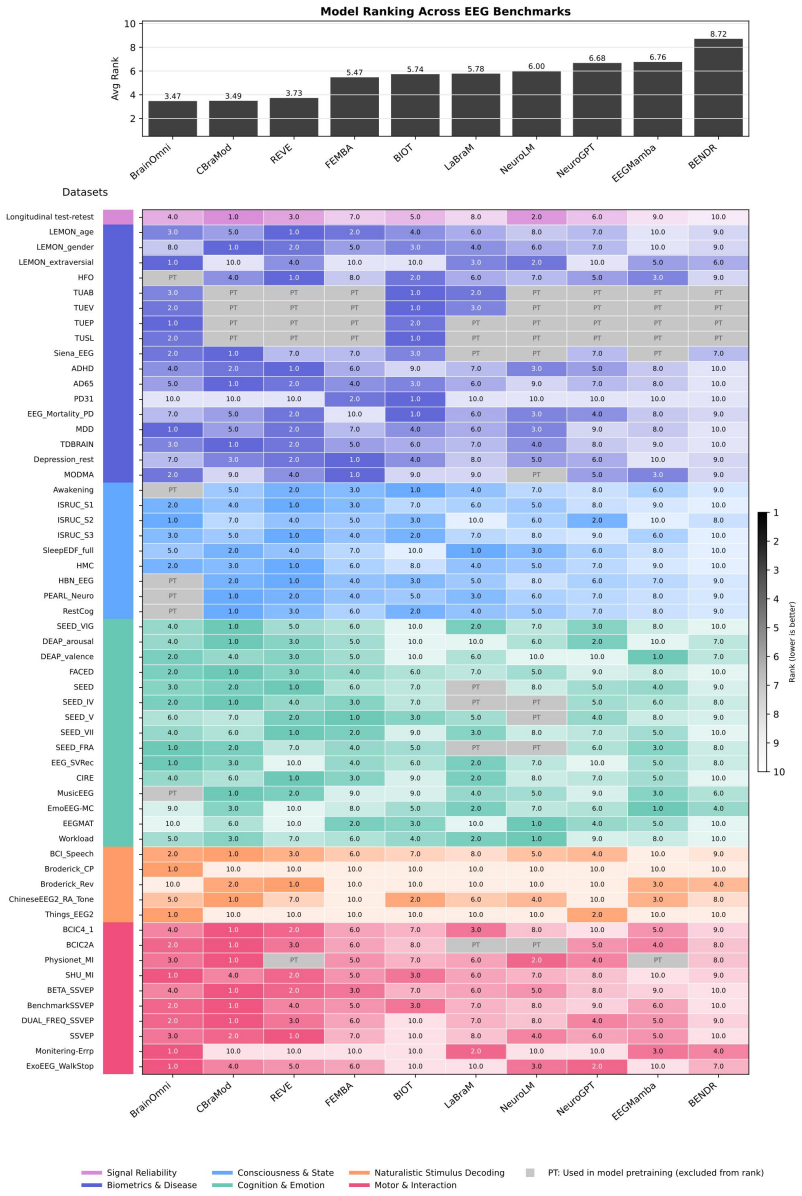
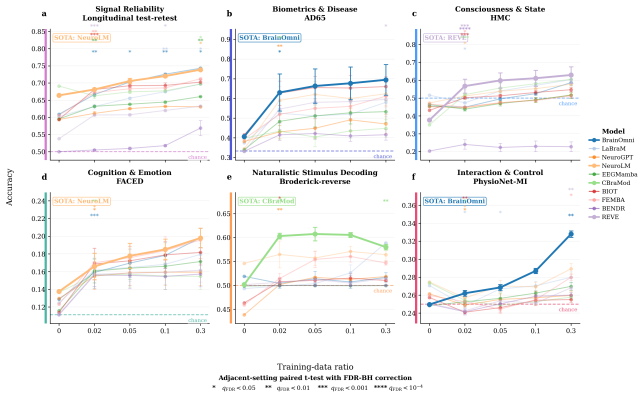
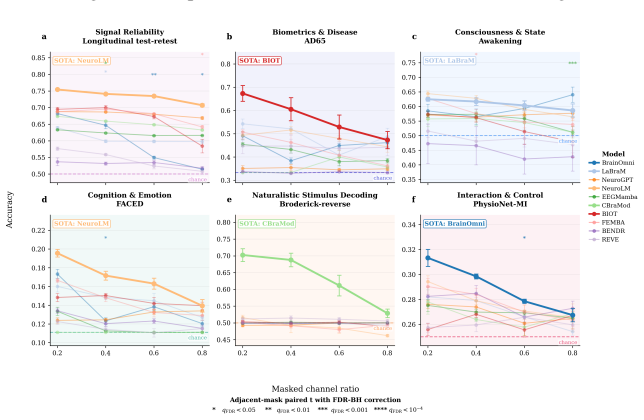
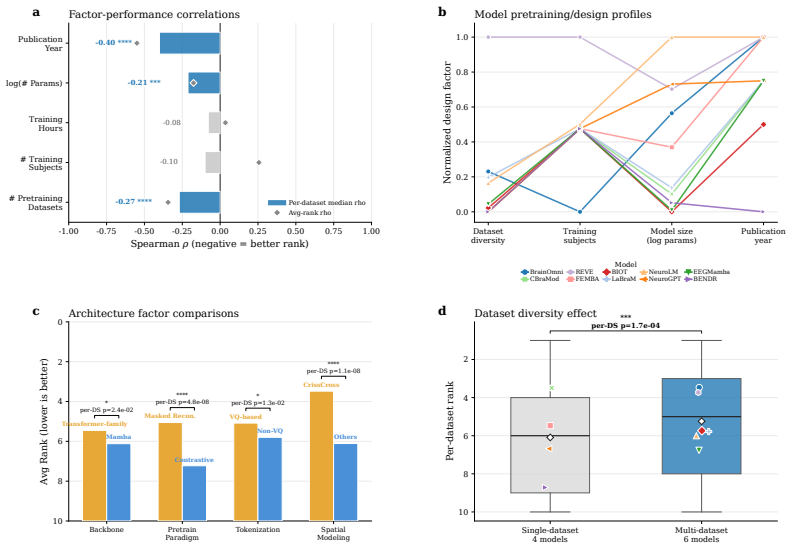
Electroencephalography (EEG) supports a variety of brain-computer interface (BCI) tasks ranging from brain-state monitoring to human-LLM interactions. EEG foundation models are emerging, but evaluation remains fragmented due to heterogeneous datasets and nconsistent task protocols. Here, we introduce OmniEEG-Bench, a unified benchmark and downstream task roadmap for EEG foundation models (FMs). It organizes evaluation of EEG FMs into six task families spanning (i) signal reliability, (ii) biometrics and disease, (iii) consciousness and state, (iv) cognition and emotion, (v) naturalistic stimulus decoding, and (vi) motor and interaction, introducing a new generation of tasks not systematically benchmarked in prior EEG FM work. OmniEEG-Bench standardizes model deployment, task definitions, and metrics through a task-card specification, and unifies 54 EEG datasets with consistent evaluation protocols. We benchmark 10 representative EEG foundation models and report a leaderboard that covers diverse evaluation settings. Both pretraining dataset diversity and model size are significantly associated with better average ranks across datasets, revealing scaling-law behavior in EEG foundation models (Figure 1). These results suggest that scaling EEG foundation models requires not only larger architectures but also broader and more diverse pretraining data. The benchmark code is available at https://github.com/ncclab-sustech/omni-eegbench.git.
Editorial analysis
A structured set of objections, weighed in public.
Referee Report
Summary. The paper introduces OmniEEG-Bench, a standardized benchmark organizing 54 EEG datasets into six task families (signal reliability, biometrics/disease, consciousness/state, cognition/emotion, naturalistic stimulus decoding, motor/interaction) with unified task-card specifications, metrics, and protocols. It benchmarks 10 EEG foundation models, produces a leaderboard, and reports that pretraining dataset diversity and model size are significantly associated with better average ranks across datasets, indicating scaling-law behavior (Figure 1).
Significance. A well-executed unified benchmark with new task families could reduce fragmentation in EEG FM evaluation and enable more comparable progress; the scaling observation, if supported by transparent statistics, would provide actionable guidance on data diversity versus architecture size. The open code release is a positive factor for reproducibility.
major comments (1)
- [Abstract] Abstract (and associated Figure 1 claim): the assertion that 'pretraining dataset diversity and model size are significantly associated with better average ranks' is presented without any description of the statistical test, p-values, confidence intervals, error bars, controls for confounding variables (e.g., model architecture family), or dataset exclusion criteria, rendering the central scaling-law claim unverifiable from the provided text.
Simulated Author's Rebuttal
We thank the referee for the constructive feedback on our manuscript. The single major comment identifies a clear gap in statistical transparency for the scaling-law claim. We address it directly below and will incorporate the requested details in the revision.
read point-by-point responses
-
Referee: [Abstract] Abstract (and associated Figure 1 claim): the assertion that 'pretraining dataset diversity and model size are significantly associated with better average ranks' is presented without any description of the statistical test, p-values, confidence intervals, error bars, controls for confounding variables (e.g., model architecture family), or dataset exclusion criteria, rendering the central scaling-law claim unverifiable from the provided text.
Authors: We agree that the abstract and the text/figure associated with this claim do not currently provide the requested statistical details. In the revised manuscript we will (1) specify the exact statistical test(s) employed (e.g., Spearman rank correlation or linear regression on average rank), (2) report the corresponding p-values and confidence intervals, (3) add error bars or uncertainty measures to the relevant panels of Figure 1 where appropriate, (4) describe any controls or subgroup analyses performed for confounding factors such as model architecture family, and (5) explicitly state dataset exclusion criteria (or confirm that none were applied beyond the stated unification protocol). These additions will be placed in both the abstract (concisely) and the main results or methods section so the claim becomes verifiable. revision: yes
Circularity Check
No significant circularity
full rationale
This is an empirical benchmarking paper that unifies 54 external EEG datasets under standardized protocols and reports observed correlations between model size, pretraining diversity, and average ranks across those datasets. The scaling-law claim is a post-hoc statistical association from direct model evaluations rather than any derivation, equation, or self-citation that reduces the result to the paper's own inputs by construction. No load-bearing step invokes self-referential predictions, fitted parameters renamed as forecasts, or uniqueness theorems from the authors' prior work.
Axiom & Free-Parameter Ledger
Reference graph
Works this paper leans on
-
[1]
EEG foundation models: A critical revi ew of current progress and future directions
Gayal Kuruppu, Neeraj Wagh, Vaclav Kremen, Sandipan Pati, Gregory Worrell, and Yogatheesan Varathara- jah. Eeg foundation models: A critical review of current progress and future directions.arXiv preprint arXiv:2507.11783, 2025
-
[2]
Xinliang Zhou, Chenyu Liu, Zhisheng Chen, Kun Wang, Yi Ding, Ziyu Jia, and Qingsong Wen. Brain foundation models: A survey on advancements in neural signal processing and brain discovery.arXiv preprint arXiv:2503.00580, 2025
-
[3]
Jiamin Wu, Zichen Ren, Junyu Wang, Pengyu Zhu, Yonghao Song, Mianxin Liu, Qihao Zheng, Lei Bai, Wanli Ouyang, and Chunfeng Song. Adabrain-bench: Benchmarking brain foundation models for brain-computer interface applications.arXiv preprint arXiv:2507.09882, 2025
-
[4]
Biot: Biosignal transformer for cross-data learning in the wild.Advances in Neural Information Processing Systems, 36:78240–78260, 2023
Chaoqi Yang, M Westover, and Jimeng Sun. Biot: Biosignal transformer for cross-data learning in the wild.Advances in Neural Information Processing Systems, 36:78240–78260, 2023
2023
-
[5]
Large brain model for learning generic representations with tremendous EEG data in BCI
Wei-Bang Jiang, Li-Ming Zhao, and Bao-Liang Lu. Large brain model for learning generic representations with tremendous EEG data in BCI. InThe Twelfth International Conference on Learning Representations, 2024
2024
-
[6]
Brainomni: A brain foundation model for unified eeg and meg signals
Qinfan Xiao, Ziyun Cui, Chi Zhang, Siqi Chen, Wen Wu, Andrew Thwaites, Alexandra Woolgar, Bowen Zhou, and Chao Zhang. Brainomni: A brain foundation model for unified eeg and meg signals. InThe Thirty-ninth Annual Conference on Neural Information Processing Systems, 2025
2025
-
[7]
The applied principles of eeg analysis methods in neuroscience and clinical neurology.Military Medical Research, 10(1):67, 2023
Hao Zhang, Qing-Qi Zhou, He Chen, Xiao-Qing Hu, Wei-Guang Li, Yang Bai, Jun-Xia Han, Yao Wang, Zhen-Hu Liang, Dan Chen, et al. The applied principles of eeg analysis methods in neuroscience and clinical neurology.Military Medical Research, 10(1):67, 2023
2023
-
[8]
Automatic sleep staging of eeg signals: recent development, challenges, and future directions.Physiological Measurement, 43(4):04TR01, 2022
Huy Phan and Kaare Mikkelsen. Automatic sleep staging of eeg signals: recent development, challenges, and future directions.Physiological Measurement, 43(4):04TR01, 2022
2022
-
[9]
Past, present, and future of eeg-based bci applications.Sensors, 22(9):3331, 2022
Kaido Värbu, Naveed Muhammad, and Yar Muhammad. Past, present, and future of eeg-based bci applications.Sensors, 22(9):3331, 2022
2022
-
[10]
Human eeg recordings for 1,854 concepts presented in rapid serial visual presentation streams.Scientific Data, 9(1):3, 2022
Tijl Grootswagers, Ivy Zhou, Amanda K Robinson, Martin N Hebart, and Thomas A Carlson. Human eeg recordings for 1,854 concepts presented in rapid serial visual presentation streams.Scientific Data, 9(1):3, 2022
2022
-
[11]
Electrophysiological correlates of semantic dissimilarity reflect the comprehension of natural, narrative speech.Current Biology, 28(5):803–809, 2018
Michael P Broderick, Andrew J Anderson, Giovanni M Di Liberto, Michael J Crosse, and Edmund C Lalor. Electrophysiological correlates of semantic dissimilarity reflect the comprehension of natural, narrative speech.Current Biology, 28(5):803–809, 2018
2018
-
[12]
An eeg dataset for multimodal semantic alignment and neural decoding during reading and listening.Scientific Data, 2025
Sitong Chen, Beiqianyi Li, Cuilin He, Dongyang Li, Mingyang Wu, Xinke Shen, Song Wang, Xuetao Wei, Xindi Wang, Haiyan Wu, et al. An eeg dataset for multimodal semantic alignment and neural decoding during reading and listening.Scientific Data, 2025
2025
-
[13]
Naturalistic stimuli in neuroscience: critically acclaimed.Trends in cognitive sciences, 23(8):699–714, 2019
Saurabh Sonkusare, Michael Breakspear, and Christine Guo. Naturalistic stimuli in neuroscience: critically acclaimed.Trends in cognitive sciences, 23(8):699–714, 2019
2019
-
[14]
States, traits, and the resting state eeg task aftereffect.International Journal of Psychophysiology, 210:112523, 2025
Tim Martin, Erica Holliday, Cyril Okhio, Alexis Newman, Lamar LaTella, Makayla Mcginnis, Bruno Giordani, V oyko Kavcic, et al. States, traits, and the resting state eeg task aftereffect.International Journal of Psychophysiology, 210:112523, 2025
2025
-
[15]
Interface, interaction, and intelligence in generalized brain–computer interfaces.Trends in cognitive sciences, 25(8):671–684, 2021
Xiaorong Gao, Yijun Wang, Xiaogang Chen, and Shangkai Gao. Interface, interaction, and intelligence in generalized brain–computer interfaces.Trends in cognitive sciences, 25(8):671–684, 2021
2021
-
[16]
Eegdenoisenet: a benchmark dataset for deep learning solutions of eeg denoising.Journal of Neural Engineering, 18(5):056057, 2021
Haoming Zhang, Mingqi Zhao, Chen Wei, Dante Mantini, Zherui Li, and Quanying Liu. Eegdenoisenet: a benchmark dataset for deep learning solutions of eeg denoising.Journal of Neural Engineering, 18(5):056057, 2021
2021
-
[17]
dataset: Eeg-controlled exoskeleton for walking and standing - a longitudinal study of healthy individuals
Shantanu Sarkar, Kevin Nathan, and Jose L. Contreras-Vidal. "dataset: Eeg-controlled exoskeleton for walking and standing - a longitudinal study of healthy individuals", 2025
2025
-
[18]
A mind-brain-body dataset of mri, eeg, cognition, emotion, and peripheral physiology in young and old adults.Scientific data, 6(1):1–21, 2019
Anahit Babayan, Miray Erbey, Deniz Kumral, Janis D Reinelt, Andrea MF Reiter, Josefin Röbbig, H Lina Schaare, Marie Uhlig, Alfred Anwander, Pierre-Louis Bazin, et al. A mind-brain-body dataset of mri, eeg, cognition, emotion, and peripheral physiology in young and old adults.Scientific data, 6(1):1–21, 2019
2019
-
[19]
dataset of eeg recordings of pediatric patients with epilepsy based on the 10-20 system
Dorottya Cserpan, Ece Boran, Richard Rosch, San Pietro Lo Biundo, Georgia Ramantani, and Johannes Sarnthein. "dataset of eeg recordings of pediatric patients with epilepsy based on the 10-20 system ", 2021. 11
2021
-
[20]
The temple university hospital eeg data corpus.Frontiers in Neuroscience, V olume 10 - 2016, 2016
Iyad Obeid and Joseph Picone. The temple university hospital eeg data corpus.Frontiers in Neuroscience, V olume 10 - 2016, 2016
2016
-
[21]
Improved eeg event classification using differential energy
Amir Harati, Meysam Golmohammadi, Silvia Lopez, Iyad Obeid, and Joseph Picone. Improved eeg event classification using differential energy. InIEEE Signal Processing in Medicine and Biology Symposium (SPMB), 2015
2015
-
[22]
Temple university eeg corpus - downloads, 2026
Neural Engineering Data Consortium. Temple university eeg corpus - downloads, 2026
2026
-
[23]
Siena scalp eeg database.PhysioNet, 2020
Paolo Detti. Siena scalp eeg database.PhysioNet, 2020
2020
-
[24]
A dataset of eeg signals from adults with adhd and healthy controls: Resting state, cognitive function, and sound listening paradigm.Mendeley Data, 2023
Ghasem Sadeghi Bajestani, Shima Abedian, Fatemeh Makhloughi, Motahhareh Raoufitabar, and Hamid Saeedi. A dataset of eeg signals from adults with adhd and healthy controls: Resting state, cognitive function, and sound listening paradigm.Mendeley Data, 2023
2023
-
[25]
A dataset of scalp eeg recordings of alzheimer’s disease, frontotemporal dementia and healthy subjects from routine eeg.Data, 8(6):95, 2023
Andreas Miltiadous, Katerina D Tzimourta, Theodora Afrantou, Panagiotis Ioannidis, Nikolaos Grigoriadis, Dimitrios G Tsalikakis, Pantelis Angelidis, Markos G Tsipouras, Euripidis Glavas, Nikolaos Giannakeas, et al. A dataset of scalp eeg recordings of alzheimer’s disease, frontotemporal dementia and healthy subjects from routine eeg.Data, 8(6):95, 2023
2023
-
[26]
uc san diego resting state eeg data from patients with parkinson’s disease
Alexander P. Rockhill, Nicko Jackson, Jobi George, Adam Aron, and Nicole C. Swann. "uc san diego resting state eeg data from patients with parkinson’s disease", 2021
2021
-
[27]
eeg mortality dataset in parkinson’s disease
Simin Jamshidi, Arturo Espinoza, Soura Dasgupta, and Nandakumar Narayanan. "eeg mortality dataset in parkinson’s disease", 2025
2025
-
[28]
MDD Patients and Healthy Controls EEG Data (New)
Wajid Mumtaz. MDD Patients and Healthy Controls EEG Data (New). 11 2016
2016
-
[29]
The two decades brainclinics research archive for insights in neurophysiology (tdbrain) database.Scientific data, 9(1):333, 2022
Hanneke Van Dijk, Guido Van Wingen, Damiaan Denys, Sebastian Olbrich, Rosalinde Van Ruth, and Martijn Arns. The two decades brainclinics research archive for insights in neurophysiology (tdbrain) database.Scientific data, 9(1):333, 2022
2022
-
[30]
eeg: Depression rest
James F Cavanagh jcavanagh@unm.edu. "eeg: Depression rest", 2021
2021
-
[31]
Modma dataset: a multi-modal open dataset for mental-disorder analysis.CoRR, abs/2002.09283, 2020
Hanshu Cai, Yiwen Gao, Shuting Sun, et al. Modma dataset: a multi-modal open dataset for mental-disorder analysis.CoRR, abs/2002.09283, 2020
-
[32]
A repeated awakening study exploring the capacity of complexity measures to capture dreaming during propofol sedation.Scientific Reports, 15(1):32746, 2025
Imad J Bajwa, Andre S Nilsen, René Skukies, Arnfinn Aamodt, Gernot Ernst, Johan F Storm, and Bjørn E Juel. A repeated awakening study exploring the capacity of complexity measures to capture dreaming during propofol sedation.Scientific Reports, 15(1):32746, 2025
2025
-
[33]
Isruc-sleep: A comprehensive public dataset for sleep researchers.Computer methods and programs in biomedicine, 124:180–192, 2016
Sirvan Khalighi, Teresa Sousa, José Moutinho Santos, and Urbano Nunes. Isruc-sleep: A comprehensive public dataset for sleep researchers.Computer methods and programs in biomedicine, 124:180–192, 2016
2016
-
[34]
Analysis of a sleep-dependent neuronal feedback loop: the slow-wave microcontinuity of the eeg.IEEE Transactions on Biomedical Engineering, 47(9):1185–1194, 2000
Bob Kemp, Aeilko H Zwinderman, Bert Tuk, Hilbert AC Kamphuisen, and Josefien JL Oberye. Analysis of a sleep-dependent neuronal feedback loop: the slow-wave microcontinuity of the eeg.IEEE Transactions on Biomedical Engineering, 47(9):1185–1194, 2000
2000
-
[35]
Haaglanden medisch centrum sleep staging database
Diego Alvarez-Estevez and Roselyne Rijsman. Haaglanden medisch centrum sleep staging database. PhysioNet, 2022
2022
-
[36]
Hbn-eeg: The fair implementation of the healthy brain network (hbn) electroencephalography dataset.bioRxiv, pages 2024–10, 2024
Seyed Yahya Shirazi, Alexandre Franco, Maurício Scopel Hoffmann, Nathalia B Esper, Dung Truong, Arnaud Delorme, Michael P Milham, and Scott Makeig. Hbn-eeg: The fair implementation of the healthy brain network (hbn) electroencephalography dataset.bioRxiv, pages 2024–10, 2024
2024
-
[37]
An open resource for transdiagnostic research in pediatric mental health and learning disorders.Scientific data, 4(1):1–26, 2017
Lindsay M Alexander, Jasmine Escalera, Lei Ai, Charissa Andreotti, Karina Febre, Alexander Mangone, Natan Vega-Potler, Nicolas Langer, Alexis Alexander, Meagan Kovacs, et al. An open resource for transdiagnostic research in pediatric mental health and learning disorders.Scientific data, 4(1):1–26, 2017
2017
-
[38]
Pearl-neuro database: Eeg, fmri, health and lifestyle data of middle-aged people at risk of dementia.Scientific Data, 11(1):276, 2024
Patrycja Dzianok and Ewa Kublik. Pearl-neuro database: Eeg, fmri, health and lifestyle data of middle-aged people at risk of dementia.Scientific Data, 11(1):276, 2024
2024
-
[39]
an eeg dataset recorded during affective music listening
Ian Daly, Nicoletta Nicolaou, Duncan Williams, Faustina Hwang, Alexis Kirke, Eduardo Miranda, and Slawomir J. Nasuto. "an eeg dataset recorded during affective music listening", 2024
2024
-
[40]
A multimodal approach to estimating vigilance using eeg and forehead eog.Journal of neural engineering, 14(2):026017, 2017
Wei-Long Zheng and Bao-Liang Lu. A multimodal approach to estimating vigilance using eeg and forehead eog.Journal of neural engineering, 14(2):026017, 2017. 12
2017
-
[41]
Deap: A database for emotion analysis; using physiological signals.IEEE transactions on affective computing, 3(1):18–31, 2011
Sander Koelstra, Christian Muhl, Mohammad Soleymani, Jong-Seok Lee, Ashkan Yazdani, Touradj Ebrahimi, Thierry Pun, Anton Nijholt, and Ioannis Patras. Deap: A database for emotion analysis; using physiological signals.IEEE transactions on affective computing, 3(1):18–31, 2011
2011
-
[42]
A large finer-grained affective computing eeg dataset.Scientific Data, 10(1):740, 2023
Jingjing Chen, Xiaobin Wang, Chen Huang, Xin Hu, Xinke Shen, and Dan Zhang. A large finer-grained affective computing eeg dataset.Scientific Data, 10(1):740, 2023
2023
-
[43]
Differential entropy feature for eeg-based emotion classification
Ruo-Nan Duan, Jia-Yi Zhu, and Bao-Liang Lu. Differential entropy feature for eeg-based emotion classification. In2013 6th international IEEE/EMBS conference on neural engineering (NER), pages 81–84. IEEE, 2013
2013
-
[44]
Emotionmeter: A multimodal framework for recognizing human emotions.IEEE transactions on cybernetics, 49(3):1110–1122, 2018
Wei-Long Zheng, Wei Liu, Yifei Lu, Bao-Liang Lu, and Andrzej Cichocki. Emotionmeter: A multimodal framework for recognizing human emotions.IEEE transactions on cybernetics, 49(3):1110–1122, 2018
2018
-
[45]
Wei Liu, Jie-Lin Qiu, Wei-Long Zheng, and Bao-Liang Lu. Comparing recognition performance and robustness of multimodal deep learning models for multimodal emotion recognition.IEEE Transactions on Cognitive and Developmental Systems, 14(2):715–729, 2021
2021
-
[46]
Seed-vii: A multimodal dataset of six basic emotions with continuous labels for emotion recognition.IEEE Transactions on Affective Computing, 2024
Wei-Bang Jiang, Xuan-Hao Liu, Wei-Long Zheng, and Bao-Liang Lu. Seed-vii: A multimodal dataset of six basic emotions with continuous labels for emotion recognition.IEEE Transactions on Affective Computing, 2024
2024
-
[47]
An open-source toolbox for standardized use of physionet sleep edf expanded database
Syed Anas Imtiaz and Esther Rodriguez-Villegas. An open-source toolbox for standardized use of physionet sleep edf expanded database. In2015 37th Annual International Conference of the IEEE Engineering in Medicine and Biology Society (EMBC), pages 6014–6017. IEEE, 2015
2015
-
[48]
Eeg-svrec: An eeg dataset with user multidimensional affective engagement labels in short video recommendation
Shaorun Zhang, Zhiyu He, Ziyi Ye, Peijie Sun, Qingyao Ai, Min Zhang, and Yiqun Liu. Eeg-svrec: An eeg dataset with user multidimensional affective engagement labels in short video recommendation. In Proceedings of the 47th International ACM SIGIR Conference on Research and Development in Information Retrieval, pages 698–708, 2024
2024
-
[49]
Cire: A chinese eeg dataset for decoding speech intention modulated by prosodic emotion.Scientific Data, 12(1):1664, 2025
Shengrui He, Zhongjie Li, Jianwu Dang, Yingyi Luo, and Gaoyan Zhang. Cire: A chinese eeg dataset for decoding speech intention modulated by prosodic emotion.Scientific Data, 12(1):1664, 2025
2025
-
[50]
A multi-context emotional eeg dataset for cross-context emotion decoding.Scientific Data, 12(1):1142, 2025
Xin Xu, Xinke Shen, Xuyang Chen, Qingzhu Zhang, Sitian Wang, Yihan Li, Zongsheng Li, Dan Zhang, Mingming Zhang, and Quanying Liu. A multi-context emotional eeg dataset for cross-context emotion decoding.Scientific Data, 12(1):1142, 2025
2025
-
[51]
Electroencephalograms during mental arithmetic task performance.Data, 4(1):14, 2019
Igor Zyma, Sergey Tukaev, Ivan Seleznov, Ken Kiyono, Anton Popov, Mariia Chernykh, and Olexii Shpenkov. Electroencephalograms during mental arithmetic task performance.Data, 4(1):14, 2019
2019
-
[52]
Hinss, Emilie S
Marcel F. Hinss, Emilie S. Jahanpour, Bertille Somon, et al. Open multi-session and multi-task eeg cognitive dataset for passive brain-computer interface applications.Scientific Data, 10:85, 2023
2023
-
[53]
Seong-Whan Lee, Klaus-Robert Müller, and José del R. Millán. 2020 bci competition, track 3, 2020
2020
-
[54]
A large and rich eeg dataset for modeling human visual object recognition.NeuroImage, 264:119754, 2022
Alessandro T Gifford, Kshitij Dwivedi, Gemma Roig, and Radoslaw M Cichy. A large and rich eeg dataset for modeling human visual object recognition.NeuroImage, 264:119754, 2022
2022
-
[55]
The non-invasive berlin brain–computer interface: fast acquisition of effective performance in untrained subjects.NeuroImage, 37(2):539–550, 2007
Benjamin Blankertz, Guido Dornhege, Matthias Krauledat, Klaus-Robert Müller, and Gabriel Curio. The non-invasive berlin brain–computer interface: fast acquisition of effective performance in untrained subjects.NeuroImage, 37(2):539–550, 2007
2007
-
[56]
Bci competition 2008–graz data set a.Institute for knowledge discovery (laboratory of brain-computer interfaces), Graz University of Technology, 16(1-6):34, 2008
Clemens Brunner, Robert Leeb, Gernot Müller-Putz, Alois Schlögl, and Gert Pfurtscheller. Bci competition 2008–graz data set a.Institute for knowledge discovery (laboratory of brain-computer interfaces), Graz University of Technology, 16(1-6):34, 2008
2008
-
[57]
Bci2000: a general-purpose brain-computer interface (bci) system.IEEE Transactions on biomedical engineering, 51(6):1034–1043, 2004
Gerwin Schalk, Dennis J McFarland, Thilo Hinterberger, Niels Birbaumer, and Jonathan R Wolpaw. Bci2000: a general-purpose brain-computer interface (bci) system.IEEE Transactions on biomedical engineering, 51(6):1034–1043, 2004
2004
-
[58]
SHU Multi-session Dataset
Jun Ma, Banghua Yang, Wenzheng Qiu, Yunzhe Li, Shouwei Gao, and XinXing Xia. SHU Multi-session Dataset. 8 2022
2022
-
[59]
Beta: A large benchmark database toward ssvep-bci application.Frontiers in neuroscience, 14:627, 2020
Bingchuan Liu, Xiaoshan Huang, Yijun Wang, Xiaogang Chen, and Xiaorong Gao. Beta: A large benchmark database toward ssvep-bci application.Frontiers in neuroscience, 14:627, 2020
2020
-
[60]
A benchmark dataset for ssvep-based brain- computer interfaces.IEEE Transactions on Neural Systems and Rehabilitation Engineering, 25(10):1746– 1752, 2017
Yijun Wang, Xiaogang Chen, Xiaorong Gao, and Shangkai Gao. A benchmark dataset for ssvep-based brain- computer interfaces.IEEE Transactions on Neural Systems and Rehabilitation Engineering, 25(10):1746– 1752, 2017. 13
2017
-
[61]
Efficient dual-frequency ssvep brain-computer interface system exploiting interocular visual resource disparities.Expert Systems with Applications, 252:124144, 2024
Yike Sun, Yuhan Li, Yuzhen Chen, et al. Efficient dual-frequency ssvep brain-computer interface system exploiting interocular visual resource disparities.Expert Systems with Applications, 252:124144, 2024
2024
-
[62]
A multimodal neuroimaging dataset to study spatiotemporal dynamics of brain activity and gait during real-world walking with and without a lower-limb exoskeleton, 2025
OpenNeuro. A multimodal neuroimaging dataset to study spatiotemporal dynamics of brain activity and gait during real-world walking with and without a lower-limb exoskeleton, 2025
2025
-
[63]
Monitoring error–related potentials
Ricardo Chavarriaga and José del R Millán. Monitoring error–related potentials
-
[64]
Diagnosis of major depressive disorder using eeg signals
Nadide Gulsah Gulenc and Mahmut Ozturk. Diagnosis of major depressive disorder using eeg signals. In 2024 Innovations in Intelligent Systems and Applications Conference (ASYU), pages 1–6. IEEE, 2024
2024
-
[65]
Anna Tegon, Thorir Mar Ingolfsson, Xiaying Wang, Luca Benini, and Yawei Li. Femba: Efficient and scalable eeg analysis with a bidirectional mamba foundation model.arXiv preprint arXiv:2502.06438, 2025
-
[66]
Wei-Bang Jiang, Yansen Wang, Bao-Liang Lu, and Dongsheng Li. Neurolm: A universal multi-task foundation model for bridging the gap between language and eeg signals.arXiv preprint arXiv:2409.00101, 2024
-
[67]
Cbramod: A criss-cross brain foundation model for eeg decoding.arXiv preprint arXiv:2412.07236, 2024
Jiquan Wang, Sha Zhao, Zhiling Luo, Yangxuan Zhou, Haiteng Jiang, Shijian Li, Tao Li, and Gang Pan. Cbramod: A criss-cross brain foundation model for eeg decoding.arXiv preprint arXiv:2412.07236, 2024
-
[68]
Eegmamba: An eeg foundation model with mamba.Neural Networks, page 107816, 2025
Jiquan Wang, Sha Zhao, Zhiling Luo, Yangxuan Zhou, Shijian Li, and Gang Pan. Eegmamba: An eeg foundation model with mamba.Neural Networks, page 107816, 2025
2025
-
[69]
Neuro-gpt: Towards a foundation model for eeg
Wenhui Cui, Woojae Jeong, Philipp Thölke, Takfarinas Medani, Karim Jerbi, Anand A Joshi, and Richard M Leahy. Neuro-gpt: Towards a foundation model for eeg. In2024 IEEE International Symposium on Biomedical Imaging (ISBI), pages 1–5. IEEE, 2024
2024
-
[70]
Yassine El Ouahidi, Jonathan Lys, Philipp Thölke, Nicolas Farrugia, Bastien Pasdeloup, Vincent Gripon, Karim Jerbi, and Giulia Lioi. Reve: A foundation model for eeg–adapting to any setup with large-scale pretraining on 25,000 subjects.arXiv preprint arXiv:2510.21585, 2025
-
[71]
Bendr: Using transformers and a contrastive self-supervised learning task to learn from massive amounts of eeg data.Frontiers in Human Neuroscience, 15:653659, 2021
Demetres Kostas, Stephane Aroca-Ouellette, and Frank Rudzicz. Bendr: Using transformers and a contrastive self-supervised learning task to learn from massive amounts of eeg data.Frontiers in Human Neuroscience, 15:653659, 2021. 14 A Tasks and datasets This supplementary section provides a complete inventory of the datasets included in OmniEEG-Bench. Suppl...
2021
-
[72]
Test-retest reliability
EEGDenoiseNet [16] 1 1 2 s Single-channel noise-related binary classification (2 classes). Test-retest reliability
-
[73]
Type-II: Biometrics and disease Biometrics
Longitudinal test-retest [17] 45 60 2 s Cross-session subject identification (2 classes in the current mounted version). Type-II: Biometrics and disease Biometrics
-
[74]
MPI-LEMON-age [18] 203 64 1 s Age group classification derived from the MPI- LEMON cohort (4 groups in the current mounted version)
-
[75]
MPI-LEMON-gender [18] 203 64 1 s Gender classification derived from the MPI-LEMON cohort (2 classes)
-
[76]
Epilepsy and abnormalities
MPI-LEMON-extraversion [18] 203 64 1 s Extraversion classification (2 classes). Epilepsy and abnormalities
-
[77]
HFO [19] 30 18 2 s High-frequency oscillation related binary classification (2 classes)
-
[78]
abnormal EEG classification (2 classes)
TUAB [20] 325 23 10 s Clinical normal vs. abnormal EEG classification (2 classes)
-
[79]
TUEV [21] 370 32 5 s EEG event classification (6 classes)
-
[80]
TUEP [20] 200 32 10 s Seizure-related binary classification (2 classes)
discussion (0)
Sign in with ORCID, Apple, or X to comment. Anyone can read and Pith papers without signing in.