n to Kell and the baryon asymmetry of the universe
Pith reviewed 2026-06-28 18:07 UTC · model grok-4.3
The pith
Observing n to K lepton decays without other modes would indicate B-L violation.
A machine-rendered reading of the paper's core claim, the machinery that carries it, and where it could break.
Core claim
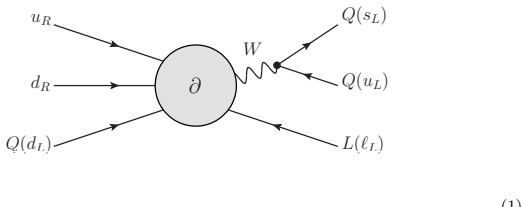
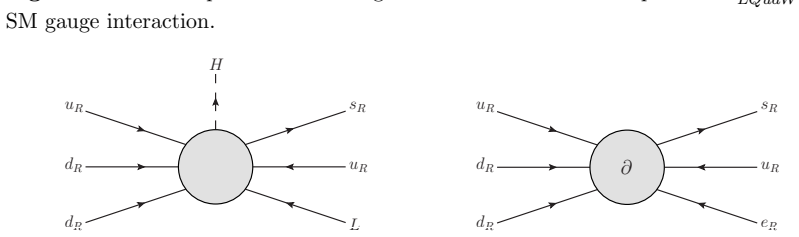
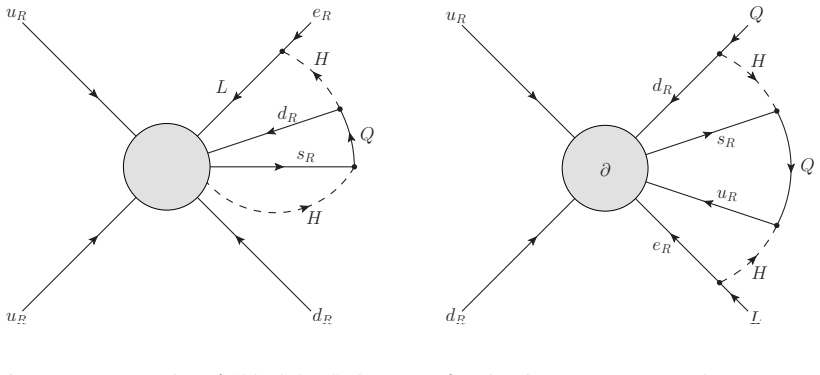
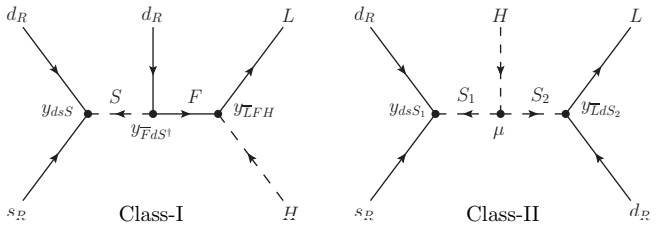
In SMEFT the decay n → K⁺ℓ⁻ arises at dimension seven while the (B-L)-conserving decay n → K⁻ℓ⁺ requires dimension-ten operators that would be accompanied by lower-dimensional (B+L)-violating decay modes. An observation of n → Kℓ in the absence of other modes such as p → π⁰ℓ⁺ would therefore strongly suggest that (B-L) is violated.
What carries the argument
Differing minimal operator dimensions in SMEFT for (B-L)-violating versus (B-L)-conserving n → Kℓ decays.
If this is right
- An isolated n → Kℓ signal would indicate that B-L is violated.
- Such a signal would carry direct implications for the origin of the baryon asymmetry.
- It would constrain the scale and structure of any (B-L)-violating interactions.
Where Pith is reading between the lines
- The argument supplies an experimental handle on B-L violation that does not require charge identification of the lepton.
- It links nucleon decay searches to cosmological constraints on the baryon asymmetry through a single observable channel.
- Similar operator-dimension comparisons could be applied to other rare decay final states in effective field theory.
Load-bearing premise
That no dimension-seven or dimension-eight operators allow a (B-L)-conserving n → K⁻ℓ⁺ decay without accompanying lower-dimensional (B+L)-violating modes.
What would settle it
Observation of n → Kℓ accompanied by modes such as p → π⁰ℓ⁺ would remove the indication that B-L is violated.
Figures
read the original abstract
The observed baryon asymmetry (BAU) of the universe puts strong constraints on any $(B-L)$-violating interaction. An observation of a $(B-L)$-violating nucleon decay channel would therefore have profound implications for our understanding of the BAU. Here we point out that the observation of the final state with a kaon and a charged lepton in a future nucleon decay experiment would hint at $(B-L)$ violation even if the charge of the lepton is not determined experimentally. In SMEFT, this follows from the fact that $n \to K^+\ell^-$ arises already at dimension seven, while the $(B-L)$-conserving decay $n \to K^-\ell^+$ requires dimension-ten operators that, in addition, would be accompanied by lower-dimensional $(B+L)$-violating decay modes. An observation of $n \to K\ell$ in the absence of other modes such as $p \to \pi^0\ell^+$, would then strongly suggest that $(B-L)$ is violated.
Editorial analysis
A structured set of objections, weighed in public.
Referee Report
Summary. The paper claims that in SMEFT, the decay mode n → K⁺ℓ⁻ is generated by dimension-7 operators, whereas the (B-L)-conserving mode n → K⁻ℓ⁺ requires dimension-10 operators that necessarily induce lower-dimensional (B+L)-violating channels such as p → π⁰ℓ⁺. Consequently, an experimental observation of n → Kℓ (without charge identification) in the absence of those other modes would indicate (B-L) violation, with implications for the baryon asymmetry of the universe.
Significance. If the dimension assignments and completeness of the operator list hold, the result offers a practical experimental handle on (B-L) violation relevant to baryogenesis without requiring lepton charge measurement. The argument rests on standard SMEFT power counting and operator classification, which is a strength when the underlying basis is complete.
major comments (1)
- [Abstract] Abstract (and the SMEFT analysis paragraph): the central claim that (B-L)-conserving n → K⁻ℓ⁺ first appears at dimension 10 (accompanied by lower-dimensional (B+L)-violating modes) and that no dimension-7 or -8 operators permit this channel without those modes is asserted without an explicit operator basis, field-content counting, or symmetry argument demonstrating the absence of ΔB=1, ΔL=−1 operators with the required flavor structure below dimension 10. This assumption is load-bearing for the implication that n → Kℓ without accompanying modes signals (B-L) violation.
Simulated Author's Rebuttal
We thank the referee for their careful reading of the manuscript and for highlighting the need for greater explicitness in the SMEFT operator analysis. We address the single major comment below.
read point-by-point responses
-
Referee: [Abstract] Abstract (and the SMEFT analysis paragraph): the central claim that (B-L)-conserving n → K⁻ℓ⁺ first appears at dimension 10 (accompanied by lower-dimensional (B+L)-violating modes) and that no dimension-7 or -8 operators permit this channel without those modes is asserted without an explicit operator basis, field-content counting, or symmetry argument demonstrating the absence of ΔB=1, ΔL=−1 operators with the required flavor structure below dimension 10. This assumption is load-bearing for the implication that n → Kℓ without accompanying modes signals (B-L) violation.
Authors: We agree that the manuscript would be strengthened by an explicit demonstration. In the revised version we will add a dedicated appendix that (i) lists all possible ΔB=1 SMEFT operators up to dimension 9 with the relevant field content and hypercharge assignments, (ii) shows why none of these operators can produce the (B-L)-conserving n → K⁻ℓ⁺ final state without simultaneously generating lower-dimensional (B+L)-violating channels such as p → π⁰ℓ⁺, and (iii) identifies the lowest-dimensional operators that do allow n → K⁻ℓ⁺ (which appear at dimension 10 and necessarily induce the accompanying modes). This will rest on standard SMEFT power counting and the requirement that the operators respect the SM gauge symmetries and the flavor structure needed for the kaon-lepton final state. revision: yes
Circularity Check
No significant circularity; central claim rests on external SMEFT operator counting
full rationale
The paper states that its implication for (B-L) violation follows from the established fact in SMEFT that n → K⁺ℓ⁻ appears at dimension seven while n → K⁻ℓ⁺ requires dimension-ten operators accompanied by lower-dimensional (B+L)-violating modes. No equations, fitted parameters, self-definitions, or load-bearing self-citations are present in the provided text; the dimension counting is an external mathematical result about effective operators that can be verified independently of this paper. The derivation chain does not reduce to its own inputs by construction.
Axiom & Free-Parameter Ledger
axioms (2)
- domain assumption SMEFT provides the complete low-energy description of nucleon decays up to the relevant dimensions.
- ad hoc to paper No additional operators at dimension seven or eight permit (B-L)-conserving n → K⁻ℓ⁺ without also generating lower-dimensional (B+L)-violating modes.
Reference graph
Works this paper leans on
-
[1]
Georgi and S.L
H. Georgi and S.L. Glashow, Unity of All Elementary Particle Forces, Phys. Rev. Lett.32 (1974) 438
1974
-
[2]
P. Nath and P. Fileviez Perez, Proton stability in grand unified theories, in strings and in branes, Phys. Rept.441(2007) 191 [hep-ph/0601023]
Pith/arXiv arXiv 2007
-
[3]
K.S. Babu and R.N. Mohapatra, B-L Violating Proton Decay Modes and New Baryogenesis Scenario in SO(10), Phys. Rev. Lett.109(2012) 091803 [1207.5771]
Pith/arXiv arXiv 2012
-
[4]
G. Isidori, F. Wilsch and D. Wyler, The standard model effective field theory at work, Rev. Mod. Phys.96(2024) 015006 [2303.16922]
arXiv 2024
-
[5]
J. Aebischer, A.J. Buras and J. Kumar, SMEFT ATLAS: The Landscape Beyond the Standard Model,2507.05926
-
[6]
J.P. Bowes, R. Foot and R.R. Volkas, Electric charge quantization from gauge invariance of a Lagrangian: A Catalog of baryon number violating scalar interactions, Phys. Rev. D54(1996) 6936 [hep-ph/9609290]
Pith/arXiv arXiv 1996
-
[7]
S. Kovalenko and I. Schmidt, Proton stability in leptoquark models, Phys. Lett. B562 (2003) 104 [hep-ph/0210187]. – 15 –
Pith/arXiv arXiv 2003
-
[8]
A. de Gouvea, J. Herrero-Garcia and A. Kobach, Neutrino Masses, Grand Unification, and Baryon Number Violation, Phys. Rev. D90 (2014) 016011 [1404.4057]
Pith/arXiv arXiv 2014
-
[9]
Kobach, Baryon Number, Lepton Number, and Operator Dimension in the Standard Model, Phys
A. Kobach, Baryon Number, Lepton Number, and Operator Dimension in the Standard Model, Phys. Lett. B758(2016) 455 [1604.05726]
Pith/arXiv arXiv 2016
-
[10]
N. Assad, B. Fornal and B. Grinstein, Baryon Number and Lepton Universality Violation in Leptoquark and Diquark Models, Phys. Lett. B777(2018) 324 [1708.06350]
Pith/arXiv arXiv 2018
-
[11]
T. Hambye and J. Heeck, Proton decay into charged leptons, Phys. Rev. Lett.120(2018) 171801 [1712.04871]
Pith/arXiv arXiv 2018
-
[12]
R.M. Fonseca, M. Hirsch and R. Srivastava, ∆L= 3 processes: Proton decay and the LHC, Phys. Rev. D97(2018) 075026 [1802.04814]
Pith/arXiv arXiv 2018
-
[13]
J.C. Helo, M. Hirsch and T. Ota, Proton decay at one loop, Phys. Rev. D99(2019) 095021 [1904.00036]
Pith/arXiv arXiv 2019
-
[14]
J. Heeck and V. Takhistov, Inclusive Nucleon Decay Searches as a Frontier of Baryon Number Violation, Phys. Rev. D 101(2020) 015005 [1910.07647]
arXiv 2020
-
[15]
N. Chamoun, F. Domingo and H.K. Dreiner, Nucleon decay in the R-parity violating MSSM, Phys. Rev. D104(2021) 015020 [2012.11623]
arXiv 2021
-
[16]
I. Dorˇ sner, S. Fajfer and O. Sumensari, Triple-leptoquark interactions for tree- and loop-level proton decays, JHEP05(2022) 183 [2202.08287]
arXiv 2022
-
[17]
A.B. Beneito, I, J. Gargalionis, J. Herrero-Garcia, A. Santamaria and M.A. Schmidt, An EFT approach to baryon number violation: lower limits on the new physics scale and correlations between nucleon decay modes, JHEP07(2024) 004 [2312.13361]
arXiv 2024
-
[18]
J. Gargalionis, J. Herrero-Garc´ ıa and M.A. Schmidt, Model-independent estimates for loop-induced baryon-number-violating nucleon decays, JHEP06(2024) 182 [2401.04768]
arXiv 2024
-
[19]
J. Heeck and D. Watkins, Baryon number violation involving tau leptons, JHEP07(2024) 170 [2405.18478]
arXiv 2024
-
[20]
K. Hamaguchi, S. Hor, N. Nagata and H. Takahashi, Exploring chirality structure in nucleon decay, JHEP01(2025) 175 [2409.08747]
arXiv 2025
-
[21]
W.-Q. Fan, Y. Liao, X.-D. Ma and H.-L. Wang, Baryon number violating hydrogen decay, Phys. Lett. B862(2025) 139335 [2412.20774]
arXiv 2025
-
[22]
A.B. I Beneito, J. Gargalionis, J. Herrero-Garcia and M.A. Schmidt, Squeezing proton decay and neutrino masses: upper bounds on standard model extensions, JHEP10(2025) 083 [2503.20928]
arXiv 2025
-
[23]
Y. Liao, X.-D. Ma and H.-L. Wang, – 16 – New Chiral Structures for Baryon Number Violating Nucleon Decays, Phys. Rev. Lett.135 (2025) 161801 [2504.14855]
arXiv 2025
-
[24]
J. Heeck and D. Sokhashvili, Revisiting the connection of baryon number, lepton number, and operator dimension, Phys. Lett. B868(2025) 139791 [2505.06172]
arXiv 2025
-
[25]
Y. Liao, X.-D. Ma and H.-L. Wang, Chiral perturbation theory for baryon-number-violating nucleon decay into a vector meson, Phys. Rev. D112(2025) L031704 [2506.05052]
arXiv 2025
-
[26]
J. Chen, Y. Liao, X.-D. Ma and H.-L. Wang, Nucleon decays into three leptons: Noncontact contributions, Phys. Lett. B876(2026) 140401 [2512.02692]
Pith/arXiv arXiv 2026
- [27]
-
[28]
Y. Liao, X.-D. Ma and X. Zhao, Renormalization-group-improved constraints on dimension-7 baryon-number-violating operators, 2604.00952
-
[29]
W.-Q. Fan, Y. Liao and X.-D. Ma, Nucleon decays into one lepton plus two non-strange mesons,2604.24613
-
[30]
J. Heeck and B.B. Le, Basis for non-derivative baryon-number-violating operators, 2604.25134
-
[31]
W.-Q. Fan, Y. Liao and X.-D. Ma, Comprehensive investigation of nucleon decays into one lepton plus two mesons, 2605.17525
-
[32]
Weinberg, Baryon and Lepton Nonconserving Processes, Phys
S. Weinberg, Baryon and Lepton Nonconserving Processes, Phys. Rev. Lett.43(1979) 1566
1979
-
[33]
Wilczek and A
F. Wilczek and A. Zee, Operator Analysis of Nucleon Decay, Phys. Rev. Lett.43(1979) 1571
1979
-
[34]
Weldon and A
H.A. Weldon and A. Zee, Operator Analysis of New Physics, Nucl. Phys. B173(1980) 269
1980
-
[35]
Weinberg, Varieties of Baryon and Lepton Nonconservation, Phys
S. Weinberg, Varieties of Baryon and Lepton Nonconservation, Phys. Rev. D22(1980) 1694
1980
-
[36]
Abbott and M.B
L.F. Abbott and M.B. Wise, The Effective Hamiltonian for Nucleon Decay, Phys. Rev. D 22(1980) 2208
1980
-
[37]
M.B. Wise, R. Blankenbecler and L.F. Abbott, Three-body Decays of the Proton, Phys. Rev. D23(1981) 1591
1981
-
[38]
Claudson, M.B
M. Claudson, M.B. Wise and L.J. Hall, Chiral Lagrangian for Deep Mine Physics, Nucl. Phys. B195(1982) 297
1982
-
[39]
Rao and R.E
S. Rao and R.E. Shrock, Six Fermion (B−L) Violating Operators of Arbitrary Generational Structure, Nucl. Phys. B232(1984) 143. – 17 –
1984
-
[40]
Davoudiasl, Nucleon Decay into a Dark Sector, Phys
H. Davoudiasl, Nucleon Decay into a Dark Sector, Phys. Rev. Lett.114(2015) 051802 [1409.4823]
Pith/arXiv arXiv 2015
-
[41]
J.C. Helo, M. Hirsch and T. Ota, Proton decay and light sterile neutrinos, JHEP06(2018) 047 [1803.00035]
Pith/arXiv arXiv 2018
-
[42]
S. Fajfer and D. Susiˇ c,Colored scalar mediated nucleon decays to an invisible fermion, Phys. Rev. D103(2021) 055012 [2010.08367]
arXiv 2021
- [43]
-
[44]
K. Fridell, C. Hati and V. Takhistov, Noncanonical nucleon decays as window into light new physics, Phys. Rev. D110(2024) L031701 [2312.13740]
arXiv 2024
-
[45]
F. Domingo, H.K. Dreiner, D. K¨ ohler, S. Nangia and A. Shah, A novel proton decay signature at DUNE, JUNO, and Hyper-K, JHEP05(2024) 258 [2403.18502]
arXiv 2024
-
[46]
T. Li, M.A. Schmidt and C.-Y. Yao, Baryon-number-violating nucleon decays in ALP effective field theories, JHEP08(2024) 221 [2406.11382]
arXiv 2024
-
[47]
T. Li, M.A. Schmidt and C.-Y. Yao, Baryon-number-violating nucleon decays in sterile neutrino effective field theories, JHEP 06(2025) 077 [2502.14303]
arXiv 2025
-
[48]
J. Heeck and I.M. Shoemaker, Nucleon Decays into Light New Particles in Neutrino Detectors, Phys. Rev. Lett.135 (2025) 111804 [2506.08090]
arXiv 2025
-
[49]
W.-Q. Fan, Y. Liao, X.-D. Ma and H.-L. Wang, Comprehensive investigation on baryon number violating nucleon decays involving an axion-like particle*, Chin. Phys. C50(2026) 033103 [2507.11844]
arXiv 2026
-
[50]
J.C. Helo, T. Ota and M. Hirsch, Invisible neutron decay and light BSM particles, Phys. Rev. D113(2026) 035002 [2510.14940]
arXiv 2026
-
[51]
X.-D. Ma, M.A. Schmidt and W. Zhang, Baryon-number-violating nucleon decays in SMEFT extended with a light scalar, JHEP02 (2026) 175 [2511.02169]
arXiv 2026
-
[52]
P. Adolf, C. Hati, M. Hirsch and V. Takhistov, Echoes of Nucleon Decay from Long-Lived Particles,2605.21583
-
[53]
Sakharov, Violation of CP Invariance, C asymmetry, and baryon asymmetry of the universe, Pisma Zh
A.D. Sakharov, Violation of CP Invariance, C asymmetry, and baryon asymmetry of the universe, Pisma Zh. Eksp. Teor. Fiz.5(1967) 32
1967
-
[54]
Manton, Topology in the Weinberg-Salam Theory, Phys
N.S. Manton, Topology in the Weinberg-Salam Theory, Phys. Rev. D28(1983) 2019
1983
-
[55]
Klinkhamer and N.S
F.R. Klinkhamer and N.S. Manton, A Saddle Point Solution in the Weinberg-Salam Theory, Phys. Rev. D30(1984) 2212
1984
-
[56]
Kuzmin, V.A
V.A. Kuzmin, V.A. Rubakov and M.E. Shaposhnikov, – 18 – On the Anomalous Electroweak Baryon Number Nonconservation in the Early Universe, Phys. Lett. B155(1985) 36
1985
-
[57]
Fukugita and T
M. Fukugita and T. Yanagida, Baryogenesis Without Grand Unification, Phys. Lett. B174 (1986) 45
1986
-
[58]
M. Flanz, E.A. Paschos and U. Sarkar, Baryogenesis from a lepton asymmetric universe, Phys. Lett. B345(1995) 248 [hep-ph/9411366]
Pith/arXiv arXiv 1995
-
[59]
L. Covi, E. Roulet and F. Vissani, CP violating decays in leptogenesis scenarios, Phys. Lett. B384(1996) 169 [hep-ph/9605319]
Pith/arXiv arXiv 1996
-
[60]
Pilaftsis, CP violation and baryogenesis due to heavy Majorana neutrinos, Phys
A. Pilaftsis, CP violation and baryogenesis due to heavy Majorana neutrinos, Phys. Rev. D 56(1997) 5431 [hep-ph/9707235]
Pith/arXiv arXiv 1997
-
[61]
S. Enomoto and N. Maekawa, Baryogenesis by B - L generation due to superheavy particle decay, Phys. Rev. D84 (2011) 096007 [1107.3713]
Pith/arXiv arXiv 2011
-
[62]
K.S. Babu and R.N. Mohapatra, B-L Violating Nucleon Decay and GUT Scale Baryogenesis in SO(10), 2012. 10.1103/PhysRevD.86.035018
-
[63]
C. Hati and U. Sarkar, B−Lviolating nucleon decays as a probe of leptoquarks and implications for baryogen esis, Nucl. Phys. B954(2020) 114985 [1805.06081]
arXiv 2020
-
[64]
H.K. Dreiner and G.G. Ross, Sphaleron erasure of primordial baryogenesis, Nucl. Phys. B 410(1993) 188 [hep-ph/9207221]
Pith/arXiv arXiv 1993
-
[65]
A. Abada, S. Davidson, F.-X. Josse-Michaux, M. Losada and A. Riotto, Flavor issues in leptogenesis, JCAP04(2006) 004 [hep-ph/0601083]
Pith/arXiv arXiv 2006
-
[66]
A. Abada, S. Davidson, A. Ibarra, F.X. Josse-Michaux, M. Losada and A. Riotto, Flavour Matters in Leptogenesis, JHEP09(2006) 010 [hep-ph/0605281]
Pith/arXiv arXiv 2006
-
[67]
E. Nardi, Y. Nir, E. Roulet and J. Racker, The Importance of flavor in leptogenesis, JHEP 01(2006) 164 [hep-ph/0601084]. [68]Hyper-Kamiokandecollaboration, Hyper-Kamiokande Design Report,1805.04163. [69]DUNEcollaboration, Deep Underground Neutrino Experiment (DUNE), Far Detector Technical Design Report, Volume I Introduction to DUNE, JINST15(2020) T08008 ...
Pith/arXiv arXiv 2006
-
[68]
McGrew et al., Search for nucleon decay using the IMB-3 detector, Phys
C. McGrew et al., Search for nucleon decay using the IMB-3 detector, Phys. Rev. D59 (1999) 052004. [73]Frejuscollaboration, – 19 – Lifetime limits on (B-L) violating nucleon decay and dinucleon decay modes from the Frejus experiment, Phys. Lett. B269(1991) 227
1999
-
[69]
Cohen, D.B
A.G. Cohen, D.B. Kaplan and A.E. Nelson, WEAK SCALE BARYOGENESIS, Phys. Lett. B245(1990) 561
1990
-
[70]
Cohen, D.B
A.G. Cohen, D.B. Kaplan and A.E. Nelson, Baryogenesis at the weak phase transition, Nucl. Phys. B349(1991) 727
1991
-
[71]
Buchmuller and D
W. Buchmuller and D. Wyler, Effective Lagrangian Analysis of New Interactions and Flavor Conservation, Nucl. Phys. B 268(1986) 621
1986
-
[72]
B. Grzadkowski, M. Iskrzynski, M. Misiak and J. Rosiek, Dimension-Six Terms in the Standard Model Lagrangian, JHEP10(2010) 085 [1008.4884]
Pith/arXiv arXiv 2010
-
[73]
L. Lehman, Extending the Standard Model Effective Field Theory with the Complete Set of Dimension-7 Operators, Phys. Rev. D90(2014) 125023 [1410.4193]
Pith/arXiv arXiv 2014
-
[74]
Y. Liao and X.-D. Ma, Renormalization Group Evolution of Dimension-seven Baryon- and Lepton-number-violating Operators, JHEP11(2016) 043 [1607.07309]
Pith/arXiv arXiv 2016
-
[75]
C.W. Murphy, Dimension-8 operators in the Standard Model Effective Field Theory, JHEP 10(2020) 174 [2005.00059]
arXiv 2020
-
[76]
H.-L. Li, Z. Ren, J. Shu, M.-L. Xiao, J.-H. Yu and Y.-H. Zheng, Complete set of dimension-eight operators in the standard model effective field theory, Phys. Rev. D104(2021) 015026 [2005.00008]
arXiv 2021
-
[77]
H.-L. Li, Z. Ren, M.-L. Xiao, J.-H. Yu and Y.-H. Zheng, Complete set of dimension-nine operators in the standard model effective field theory, Phys. Rev. D104(2021) 015025 [2007.07899]
arXiv 2021
-
[78]
Y. Liao and X.-D. Ma, An explicit construction of the dimension-9 operator basis in the standard model effective field theory, JHEP11(2020) 152 [2007.08125]
arXiv 2020
-
[79]
R.V. Harlander, T. Kempkens and M.C. Schaaf, Standard model effective field theory up to mass dimension 12, Phys. Rev. D108(2023) 055020 [2305.06832]
arXiv 2023
-
[80]
J. de Blas, J.C. Criado, M. Perez-Victoria and J. Santiago, Effective description of general extensions of the Standard Model: the complete tree-level dictionary, JHEP03(2018) 109 [1711.10391]
Pith/arXiv arXiv 2018
discussion (0)
Sign in with ORCID, Apple, or X to comment. Anyone can read and Pith papers without signing in.