GCVE: A Decentralized Model for Vulnerability Identification, Publication, and Operational Enrichment
Pith reviewed 2026-06-28 18:27 UTC · model grok-4.3
The pith
GCVE proposes autonomous numbering authorities that assign globally unique vulnerability identifiers while letting participants publish according to local operational needs.
A machine-rendered reading of the paper's core claim, the machinery that carries it, and where it could break.
Core claim
GCVE is a socio-technical standardization effort that relies on autonomous GCVE Numbering Authorities, lightweight allocation rules, distributed publication, open Best Current Practices, and reference implementations to keep vulnerability identifiers globally unique while allowing participants to publish according to their operational needs; the model explicitly widens vulnerability records to encompass assignments, disclosures, sightings, rejected identifiers, observations, exploited vulnerability information, and enrichment records.
What carries the argument
Autonomous GCVE Numbering Authorities paired with lightweight allocation rules that together enforce global uniqueness.
If this is right
- Participants publish vulnerability data according to their own operational needs while identifiers remain globally unique.
- Vulnerability records expand to include disclosures, sightings, rejected identifiers, observations, exploited information, and enrichment records.
- Technical interoperability is maintained through the GCVE BCP process even as operational practices evolve.
- AI-oriented extensions can be added to the standard without requiring central approval or control.
- Reference implementations aggregate sources and produce automatically enriched vulnerability data streams.
Where Pith is reading between the lines
- The model could reduce single points of failure if multiple independent authorities successfully operate in parallel.
- It may enable tighter integration between vulnerability data and other distributed security information platforms.
- Domain-specific authorities could form for specialized vulnerability classes such as industrial control systems or cloud services.
- Adoption would be testable by measuring collision rates and cross-implementation interoperability in early deployments.
Load-bearing premise
Autonomous GCVE Numbering Authorities will emerge and coordinate sufficiently to maintain uniqueness and interoperability without central control.
What would settle it
Two or more independent GCVE authorities publish the same identifier for different vulnerabilities and no reconciliation mechanism resolves the collision.
Figures
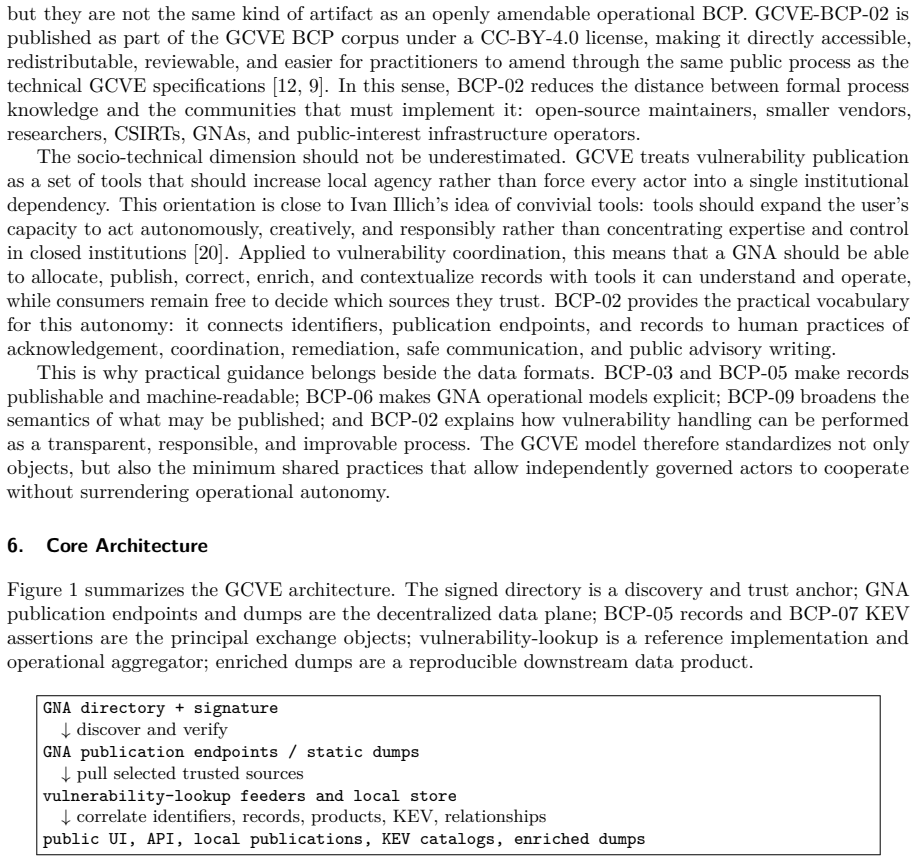
read the original abstract
The Global CVE initiative (GCVE) proposes a decentralized, open, and extensible model for vulnerability identification, publication, and enrichment. It addresses a gap in today's vulnerability ecosystem: centralized systems provide rigorous control and widely recognized identifiers, while many producers publish advisories independently without a shared fabric for discovery, correlation, enrichment, and reuse. This paper presents GCVE as a socio-technical standardization effort combining autonomous GCVE Numbering Authorities, lightweight allocation rules, distributed publication, open Best Current Practices, and practical reference implementations. The model preserves global uniqueness while allowing participants to publish according to their operational needs. It also broadens the concept of a vulnerability record to cover assignments, disclosures, sightings, rejected identifiers, observations, exploited vulnerability information, and enrichment records. The paper describes how the GCVE BCP process supports technical interoperability and amendable operational practice, including practical guidance for vulnerability handling and disclosure. It also examines the extension mechanism, including AI-oriented extensions, as a way to evolve the standard without centralizing control. A particular focus is placed on vulnerability-lookup as the reference implementation. It aggregates multiple sources, supports GCVE publication and consumption, implements distributed Known Exploited Vulnerability data, and enables automatically enriched vulnerability data streams. Building on lessons from the MISP ecosystem, GCVE frames vulnerability coordination not only as identifier allocation, but as open infrastructure for collective security knowledge production.
Editorial analysis
A structured set of objections, weighed in public.
Referee Report
Summary. The manuscript proposes GCVE as a decentralized, open, and extensible model for vulnerability identification, publication, and enrichment. It combines autonomous GCVE Numbering Authorities with lightweight allocation rules, distributed publication, open Best Current Practices (BCP), and a reference implementation called vulnerability-lookup to preserve global uniqueness while allowing operational flexibility and broadening vulnerability records to include various types like assignments, sightings, and enrichments.
Significance. If the proposed socio-technical framework successfully enables coordination among independent authorities without central control, it could address limitations in current centralized vulnerability systems like CVE by fostering broader participation and interoperability, drawing from MISP ecosystem lessons for collective security knowledge production.
major comments (2)
- [socio-technical standardization effort] The central claim that autonomous GCVE Numbering Authorities will allocate identifiers without duplication using only lightweight rules and BCP (as described in the socio-technical standardization effort) is load-bearing for the uniqueness and interoperability guarantees, yet the manuscript supplies no formal allocation protocol, conflict-resolution procedure, or incentive analysis to demonstrate that uniqueness is preserved when authorities operate independently and asynchronously.
- [reference implementation] The reference implementation (vulnerability-lookup) is presented as aggregating sources, supporting GCVE publication, and enabling enriched data streams, but no evaluation, simulation, or empirical data is provided to substantiate that it achieves the claimed technical interoperability or operational enrichment in a decentralized setting.
minor comments (1)
- [abstract] The abstract and introduction could more explicitly separate the novel GCVE model from the MISP ecosystem it builds upon to clarify the incremental contribution.
Simulated Author's Rebuttal
We thank the referee for the constructive review and the opportunity to clarify and strengthen the manuscript. We respond to each major comment below.
read point-by-point responses
-
Referee: [socio-technical standardization effort] The central claim that autonomous GCVE Numbering Authorities will allocate identifiers without duplication using only lightweight rules and BCP (as described in the socio-technical standardization effort) is load-bearing for the uniqueness and interoperability guarantees, yet the manuscript supplies no formal allocation protocol, conflict-resolution procedure, or incentive analysis to demonstrate that uniqueness is preserved when authorities operate independently and asynchronously.
Authors: We agree that the uniqueness claim is central and that the manuscript would be improved by greater formality. The current text relies on the BCP and lightweight rules drawn from MISP practice, but does not supply an explicit protocol. In revision we will add a dedicated subsection that specifies a timestamp-ordered allocation rule, a simple conflict-resolution procedure (first-seen wins with authority notification via the BCP channel), and a brief discussion of incentives based on operational reputation and reduced duplication costs observed in comparable open ecosystems. A full game-theoretic treatment remains outside the scope of this proposal paper. revision: partial
-
Referee: [reference implementation] The reference implementation (vulnerability-lookup) is presented as aggregating sources, supporting GCVE publication, and enabling enriched data streams, but no evaluation, simulation, or empirical data is provided to substantiate that it achieves the claimed technical interoperability or operational enrichment in a decentralized setting.
Authors: We accept that the manuscript presents the reference implementation descriptively without accompanying evaluation. In the revised version we will insert a short evaluation subsection that reports results from controlled simulations involving multiple independent GCVE authorities exercising the vulnerability-lookup tool; these simulations demonstrate basic uniqueness preservation, publication interoperability, and automated enrichment under asynchronous operation. Comprehensive longitudinal data from a live multi-authority deployment is not yet obtainable, as the model is newly proposed and requires community uptake. revision: yes
- A complete formal game-theoretic incentive analysis for independent authorities
Circularity Check
No circularity: descriptive proposal without derivation chain
full rationale
The paper is a socio-technical proposal describing a decentralized GCVE model, autonomous numbering authorities, lightweight allocation rules, and a reference implementation (vulnerability-lookup). It contains no equations, fitted parameters, predictions, or mathematical derivations. No load-bearing steps reduce by construction to self-definitions, self-citations, or imported uniqueness theorems. Central claims rest on architectural description and operational practices rather than any closed-loop reasoning, so the circularity score is zero and steps is empty.
Axiom & Free-Parameter Ledger
Reference graph
Works this paper leans on
-
[1]
2026.url: https://www.cve.org/ (visited on 05/30/2026)
CVE Program.Common Vulnerabilities and Exposures (CVE). 2026.url: https://www.cve.org/ (visited on 05/30/2026)
2026
-
[2]
CVEProgram.CVE Numbering Authorities (CNAs).2026.url:https://www.cve.org/ProgramOrganization/ CNAs (visited on 05/30/2026)
2026
-
[3]
2026.url: https://www.cve
CVE Program.CVE Numbering Authority (CNA) Operational Rules. 2026.url: https://www.cve. org/ResourcesSupport/AllResources/CNARules (visited on 05/30/2026)
2026
-
[4]
2026.url: https://github.com/gcve-eu/gcve-enriched-dumps (visited on 05/30/2026)
GCVE EU.gcve-enriched-dumps. 2026.url: https://github.com/gcve-eu/gcve-enriched-dumps (visited on 05/30/2026)
2026
-
[5]
GCVE Initiative.GCVE - Global CVE Allocation System Announced. Apr. 16, 2025.url: https: //gcve.eu/2025/04/16/gcve-allocation-announced/ (visited on 05/30/2026)
2025
-
[6]
2026.url: https://gcve.eu/about/ (visited on 05/30/2026)
GCVE Initiative.GCVE - Global CVE Allocation System: About. 2026.url: https://gcve.eu/about/ (visited on 05/30/2026)
2026
-
[7]
GCVE Initiative.GCVE Announces the Launch of db.gcve.eu: A New Open Public Vulnerability Advisory Database. Jan. 7, 2026.url: https://gcve.eu/2026/01/07/gcve-db-announce/ (visited on 05/30/2026)
2026
-
[8]
May 25, 2026.url: https://gcve.eu/2026/05/25/gcve-recent-activities/ (visited on 05/30/2026)
GCVE Initiative.GCVE recent activities: building a decentralised and operational vulnerability ecosystem. May 25, 2026.url: https://gcve.eu/2026/05/25/gcve-recent-activities/ (visited on 05/30/2026). 12
2026
-
[9]
2026.url: https://gcve.eu/bcp/ (visited on 05/30/2026)
GCVE Initiative.GCVE.eu - Best Current Practice (BCP). 2026.url: https://gcve.eu/bcp/ (visited on 05/30/2026)
2026
-
[10]
May 18, 2026.url: https://gcve.eu/bcp/extension/gcve-bcp-05-x-01/ (visited on 05/30/2026)
GCVE Working Group.GCVE BCP-05-X-01 - AI-Assisted Vulnerability Information Annotation. May 18, 2026.url: https://gcve.eu/bcp/extension/gcve-bcp-05-x-01/ (visited on 05/30/2026)
2026
-
[11]
GCVE Working Group.GCVE-BCP-01 - Signature Verification of the Directory File. Mar. 10, 2026.url: https://gcve.eu/bcp/gcve-bcp-01/ (visited on 05/30/2026)
2026
-
[12]
May 2, 2026.url: https://gcve.eu/bcp/gcve-bcp-02/ (visited on 05/30/2026)
GCVE Working Group.GCVE-BCP-02 - Practical Guide to Vulnerability Handling and Disclosure. May 2, 2026.url: https://gcve.eu/bcp/gcve-bcp-02/ (visited on 05/30/2026)
2026
-
[13]
GCVE Working Group.GCVE-BCP-03 - Decentralized Publication Standard. Mar. 25, 2026.url: https://gcve.eu/bcp/gcve-bcp-03/ (visited on 05/30/2026)
2026
-
[14]
GCVE Working Group.GCVE-BCP-04 - Recommendations and Best Practices for ID Allocation. Mar. 10, 2026.url: https://gcve.eu/bcp/gcve-bcp-04/ (visited on 05/30/2026)
2026
-
[15]
GCVE Working Group.GCVE-BCP-05 - GCVE Vulnerability Format (Updated CVE Record Format). Mar. 10, 2026.url: https://gcve.eu/bcp/gcve-bcp-05/ (visited on 05/30/2026)
2026
-
[16]
GCVE Working Group.GCVE-BCP-06 - Requirements and Evaluation Criteria for GCVE Num- bering Authorities (GNAs). Mar. 10, 2026.url: https://gcve.eu/bcp/gcve-bcp-06/ (visited on 05/30/2026)
2026
-
[17]
GCVE Working Group.GCVE-BCP-07 - Known Exploited Vulnerability - KEV Assertion Format. Mar. 10, 2026.url: https://gcve.eu/bcp/gcve-bcp-07/ (visited on 05/30/2026)
2026
-
[18]
May 20, 2026.url: https: //gcve.eu/bcp/gcve-bcp-09/ (visited on 05/30/2026)
GCVE Working Group.GCVE-BCP-09 - Scope of a GCVE Record. May 20, 2026.url: https: //gcve.eu/bcp/gcve-bcp-09/ (visited on 05/30/2026)
2026
-
[19]
GCVE Working Group.GCVE-BCP-10 - Improved Common Platform Enumeration for GCVE. Apr. 29, 2026.url: https://gcve.eu/bcp/gcve-bcp-10/ (visited on 05/30/2026)
2026
-
[20]
New York: Harper & Row, 1973.url: https://unesdoc.unesco
Ivan Illich.Tools for Conviviality. New York: Harper & Row, 1973.url: https://unesdoc.unesco. org/ark:/48223/pf0000008452 (visited on 05/30/2026)
1973
-
[21]
2018.url: https://www.iso.org/standard/72311.html (visited on 05/30/2026)
International Organization for Standardization.ISO/IEC 29147:2018 Information technology – Security techniques – Vulnerability disclosure. 2018.url: https://www.iso.org/standard/72311.html (visited on 05/30/2026)
2018
-
[22]
2019.url: https://www.iso.org/standard/ 69725.html (visited on 05/30/2026)
International Organization for Standardization.ISO/IEC 30111:2019 Information technology – Security techniques – Vulnerability handling processes. 2019.url: https://www.iso.org/standard/ 69725.html (visited on 05/30/2026)
2019
-
[23]
2026.url: https: //www.misp-project.org/datamodels/ (visited on 05/30/2026)
MISP Project.MISP data models - MISP core format - MISP taxonomies. 2026.url: https: //www.misp-project.org/datamodels/ (visited on 05/30/2026)
2026
-
[24]
2026.url: https://www.misp-standard.org/ (visited on 05/30/2026)
MISP Standard.MISP Standard. 2026.url: https://www.misp-standard.org/ (visited on 05/30/2026)
2026
-
[25]
2026.url: https://cfp.pass-the-salt.org/pts2026/talk/QNGYSR/ (visited on 05/30/2026)
Pass the SALT Conference.GCVE: Rebooting Vulnerability Tracking for an Open Security Ecosystem. 2026.url: https://cfp.pass-the-salt.org/pts2026/talk/QNGYSR/ (visited on 05/30/2026)
2026
-
[26]
2026.url: https://2026.pass-the-salt.org/ (visited on 05/30/2026)
Pass the SALT Conference.Pass the SALT 2026. 2026.url: https://2026.pass-the-salt.org/ (visited on 05/30/2026)
2026
-
[27]
2026.url: https://www.vulnerability- lookup.org/user-manual/gcve/ (visited on 05/30/2026)
Vulnerability-Lookup Project.User Manual: GCVE. 2026.url: https://www.vulnerability- lookup.org/user-manual/gcve/ (visited on 05/30/2026)
2026
-
[28]
2026.url: https://www.vulnerability-lookup
Vulnerability-Lookup Project.Vulnerability-Lookup. 2026.url: https://www.vulnerability-lookup. org/ (visited on 05/30/2026)
2026
-
[29]
Vulnerability-Lookup Project.Vulnerability-Lookup 3.0.0 Released: GCVE-BCP-07 - A Distributed Approach to Known Exploited Vulnerabilities. Feb. 2, 2026.url: https://www.vulnerability- lookup.org/2026/02/02/vulnerability-lookup-3-0-0/ (visited on 05/30/2026)
2026
-
[30]
May 29, 2026.url: https://www.vulnerability-lookup.org/ 2026/05/29/vulnerability-lookup-5-0-0/ (visited on 05/30/2026)
Vulnerability-Lookup Project.Vulnerability-Lookup 5.0 Released: Making Coordinated Vulnerability Disclosure Easier for GCVE GNAs. May 29, 2026.url: https://www.vulnerability-lookup.org/ 2026/05/29/vulnerability-lookup-5-0-0/ (visited on 05/30/2026)
2026
-
[31]
2026.url: https://github.com/vulnerability-lookup/ vulnerability-lookup (visited on 05/30/2026)
Vulnerability-Lookup Project.vulnerability-lookup: Vulnerability-Lookup facilitates quick correlation of vulnerabilities from various sources. 2026.url: https://github.com/vulnerability-lookup/ vulnerability-lookup (visited on 05/30/2026). 13
2026
-
[32]
Cynthia Wagner, Alexandre Dulaunoy, Gerard Wagener, and Andras Iklody. “MISP: The Design and Implementation of a Collaborative Threat Intelligence Sharing Platform”. In:Proceedings of the 2016 ACM Workshop on Information Sharing and Collaborative Security. WISCS ’16. Association for Computing Machinery, 2016.doi: 10.1145/2994539.2994542.url: https://doi.o...
discussion (0)
Sign in with ORCID, Apple, or X to comment. Anyone can read and Pith papers without signing in.