REVIEW 2 major objections 2 minor 1 cited by
Hypothesis Testing for a Functional Parameter via Self-normalization
T0 review · 2 major / 2 minor · reviewed 2026-06-28 · grok-4.3
Pith's one-line read Sample splitting extends self-normalization to hypothesis tests on functional parameters in time series.
desk verdict The paper gives a sample-splitting route to tuning-free self-normalization for functional parameters in time series, with derived limits and some simulation backing. read the letter →
The pith
A machine-rendered reading of the paper's core claim, the machinery that carries it, and where it could break.
The reading
What carries the argument
Sample splitting combined with self-normalization (SS-SN), which splits the series to form a statistic whose normalization cancels nuisance dependence terms and yields a pivotal limit.
What would settle it
Empirical rejection rates under the null that deviate substantially from nominal levels in finite samples for the SS-SN statistic applied to marginal CDF testing or spectral change-point detection would falsify the pivotal limit claim.
Extended reading notes
Core claim
By splitting the sample into two parts, the authors construct self-normalized test statistics for functional parameters that possess pivotal limiting distributions under the null hypothesis, both simple and composite, and they obtain the limiting power under local alternatives. This removes the need for bandwidth selection while maintaining validity for dependent time series data.
Load-bearing premise
The sample splitting step preserves the asymptotic validity of self-normalization when the parameter is functional rather than finite-dimensional, under the temporal dependence conditions of the time series.
Signed reviews
Editorial analysis
A structured set of objections, weighed in public.
Referee Report
Summary. The manuscript proposes a sample-splitting self-normalization (SS-SN) method to extend tuning-parameter-free self-normalization to hypothesis testing for functional parameters (e.g., marginal CDF, time-reversibility, spectral distribution change points) in time series. It claims to derive the pivotal limiting distributions of the SS-SN statistics under both simple and composite nulls as well as the limiting power functions under local alternatives, and reports simulation evidence of accurate size and competitive power relative to existing methods.
Significance. If the derivations hold under appropriate conditions, the approach supplies a bandwidth-free alternative to block bootstrap and subsampling for functional inference under dependence, which is a meaningful methodological advance given the sensitivity of finite-sample performance to bandwidth choice in the classical methods.
major comments (2)
- [Abstract] Abstract: the central claim that the SS-SN statistic yields pivotal limits under the null for functional parameters requires the two subsamples to be asymptotically independent so that the self-normalizer consistently estimates the long-run variance operator. The abstract states the derivations but leaves unspecified the precise mixing rates or moment conditions needed to guarantee vanishing cross-covariance between splits; this assumption is load-bearing for the functional (as opposed to finite-dimensional) case and must be stated explicitly with the corresponding rates.
- [Theoretical results] Theoretical results section (where the limiting distributions are derived): the proof that the SS-SN statistic remains pivotal after sample splitting for composite nulls must verify that the self-normalizer constructed from the second subsample is consistent for the long-run variance of the functional estimator from the first subsample; without an explicit argument controlling the dependence between splits, the extension from the finite-dimensional SN case is not yet established.
minor comments (2)
- The abstract alternates between 'self normalization' and 'self-normalization'; adopt a single hyphenated form throughout.
- The simulation study would be strengthened by reporting Monte Carlo standard errors or confidence bands around the reported empirical sizes and powers.
Simulated Author's Rebuttal
We thank the referee for the careful reading and constructive comments on our manuscript. We address each major comment point by point below. The requested clarifications can be incorporated by expanding the abstract and adding explicit steps to the proofs, without changing the main results.
read point-by-point responses
-
Referee: [Abstract] Abstract: the central claim that the SS-SN statistic yields pivotal limits under the null for functional parameters requires the two subsamples to be asymptotically independent so that the self-normalizer consistently estimates the long-run variance operator. The abstract states the derivations but leaves unspecified the precise mixing rates or moment conditions needed to guarantee vanishing cross-covariance between splits; this assumption is load-bearing for the functional (as opposed to finite-dimensional) case and must be stated explicitly with the corresponding rates.
Authors: We agree that the abstract should explicitly reference the mixing and moment conditions that ensure asymptotic independence of the subsamples. These conditions appear in Assumption 2.1 (alpha-mixing with rate O(k^{-r}), r>1, and 2+delta moments). In the revision we will add a concise clause to the abstract stating the conditions under which the cross-covariance vanishes, making the pivotal limit claim self-contained. revision: yes
-
Referee: [Theoretical results] Theoretical results section (where the limiting distributions are derived): the proof that the SS-SN statistic remains pivotal after sample splitting for composite nulls must verify that the self-normalizer constructed from the second subsample is consistent for the long-run variance of the functional estimator from the first subsample; without an explicit argument controlling the dependence between splits, the extension from the finite-dimensional SN case is not yet established.
Authors: The proof of Theorem 3.2 already bounds the cross-covariance between the two split-based estimators using the alpha-mixing coefficients and the fixed splitting proportion (n1/n -> lambda in (0,1)). However, we accept that the argument would be clearer if isolated. We will insert a short auxiliary lemma that explicitly shows consistency of the second-subsample self-normalizer for the long-run variance operator of the first subsample, thereby making the extension from the scalar case fully transparent. revision: partial
Circularity Check
No circularity: new limiting distributions derived for SS-SN on functional parameters
full rationale
The paper introduces sample splitting to extend the SN method to functional parameters (CDF, time-reversibility, spectral distribution) and derives the pivotal limiting distributions of the resulting SS-SN statistics under simple/composite nulls plus local alternatives. These are presented as new asymptotic results rather than reductions of fitted quantities or self-citations. No equations or steps are shown to be equivalent by construction to inputs; the derivation chain relies on standard time-series asymptotics applied to the split estimator and normalizer, which is independent of the target result. Self-citations to prior SN work (if present) are not load-bearing for the functional extension.
Assumptions & free parameters
assumptions (1)
- domain assumption The time series satisfies mixing or weak dependence conditions sufficient for the self-normalized statistics to converge to pivotal limits after sample splitting.
Cite this review
Pith. "Pith review of Hypothesis Testing for a Functional Parameter via Self-normalization." pith.science (2026). https://pith.science/paper/EDITMYUX
@misc{pith2026260600887,
  author       = {Pith},
  title        = {Pith review of: Hypothesis Testing for a Functional Parameter via Self-normalization},
  year         = {2026},
  howpublished = {\url{https://pith.science/paper/EDITMYUX}},
  note         = {Machine review of arXiv:2606.00887}
}
read the original abstract
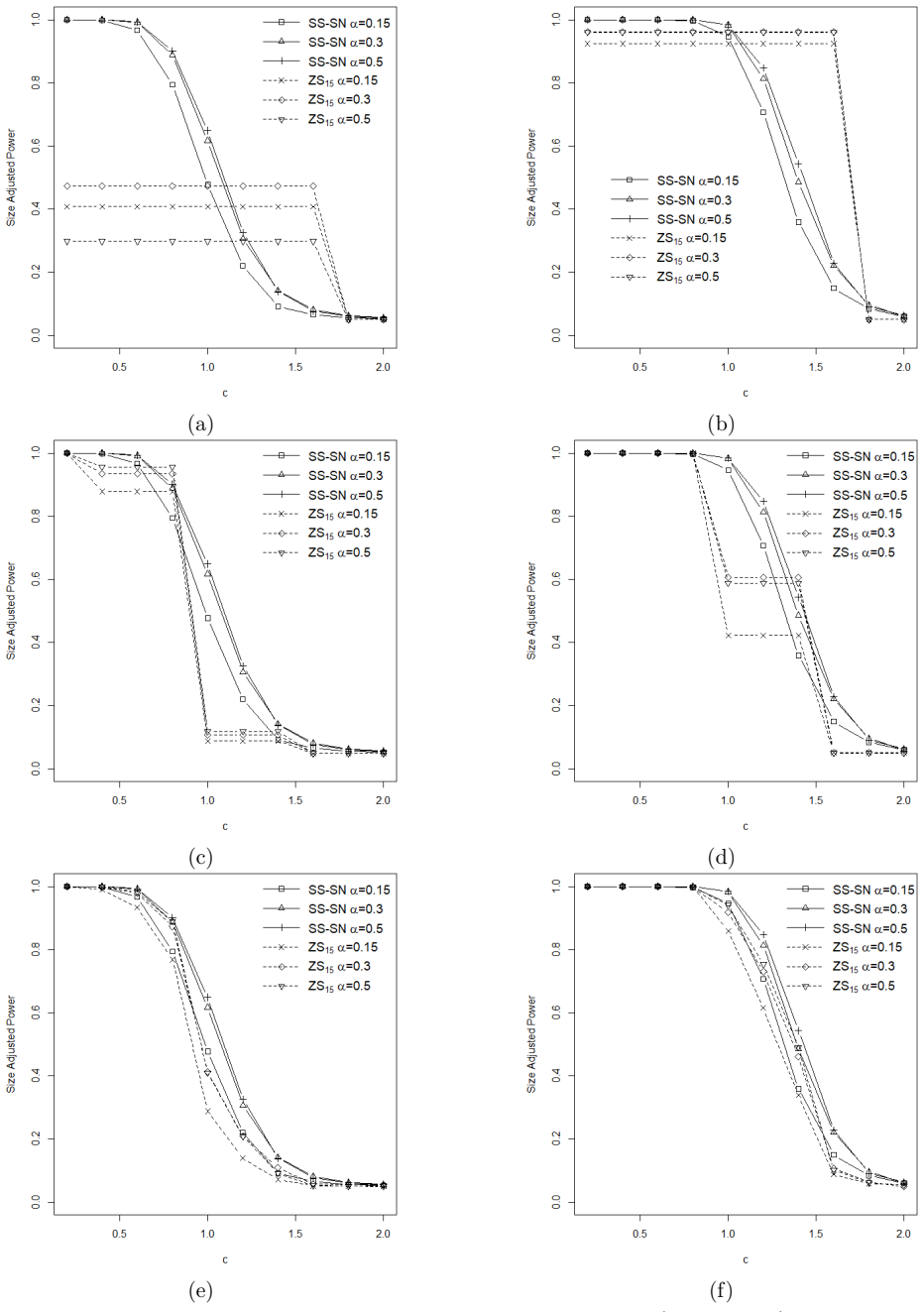
Testing simple or composite hypothesis on a functional parameter has attracted considerable attention in time series analysis. To accommodate for the unknown temporal dependence, classical nonparametric approaches such as block bootstrapping and subsampling all involve a bandwidth parameter, the choice of which can substantially affect the finite sample performance. The self normalization (SN) method is tuning parameter free when applied to the inference of a finite-dimensional parameter but its applicability to a functional parameter is unknown. In this paper, we propose a sample splitting based approach to generalize the SN method to hypothesis testing of a functional parameter. Our SS-SN (sample splitting plus self-normalization) idea is broadly applicable to many testing problems for functional parameters, including testing for simple/composite hypothesis on marginal cumulative distribution function, testing for time-reversibility and testing for a change point on the spectral distribution of a multivariate time series. Specifically, we derive the pivotal limiting distributions of our SS-SN test statistics under the null for both simple and composite null hypothesis, and derive the limiting power function under the local alternatives. Numerical simulations show that our new tests tend to yield accurate size with competitive power performance as compared to many existing ones.
Figures


Figures from the paper (9 more)


Forward citations
Cited by 1 Pith paper
-
Selfnormalization for relevant inference with supremum-type statistics
A bias-corrected, selfnormalized statistic based on a log-sum-exp smoothing of the supremum norm yields an asymptotically pivotal test for relevant changes in functional time series.
Reference graph
Works this paper leans on
-
[1]
Journal of the American Statistical Association , volume=
Inference for autocorrelations under weak assumptions , author=. Journal of the American Statistical Association , volume=
-
[2]
Journal of the American Statistical Association , volume=
Hypothesis testing in time series via the empirical characteristic function: a generalized spectral density approach , author=. Journal of the American Statistical Association , volume=
-
[3]
Advances in Applied Probability , volume=
Testing and Estimating Change-Points in Time Series , author=. Advances in Applied Probability , volume=
-
[4]
Bernoulli , volume=
The Multiple Change-Points Problem for the Spectral Distribution , author=. Bernoulli , volume=
-
[5]
Journal of the American Statistical Association , volume=
A likelihood ratio approach to sequential change point detection , author=. Journal of the American Statistical Association , volume=
-
[6]
Bernoulli , volume=
Dimension-agnostic inference using cross U-statistics , author=. Bernoulli , volume=
-
[7]
https://arxiv.org/abs/2303.10808 , year=
Dimension-agnostic change point detection , author=. https://arxiv.org/abs/2303.10808 , year=
-
[8]
Annals of Statistics , volume=
Large Sample Confidence Regions Based on Subsamples under Minimal Assumptions , author=. Annals of Statistics , volume=
Show all 80 references
-
[9]
Computational and Statistical Data Analysis , volume=
Testing the martingale difference hypothesis using integrated regression functions , author=. Computational and Statistical Data Analysis , volume=
-
[10]
Electronic Journal of Statistics , volume=
A general approach to the joint asymptotic analysis of statistics from sub-samples , author=. Electronic Journal of Statistics , volume=
-
[11]
Journal of the Royal Statistical Society: Series B (Statistical Methodology) , volume=
Fixed b subsampling and the block bootstrap: improved confidence sets based on p-value calibration , author=. Journal of the Royal Statistical Society: Series B (Statistical Methodology) , volume=. 2013 , publisher=
2013
-
[12]
Journal of the American Statistical Association , volume=
Testing for change points in time series , author=. Journal of the American Statistical Association , volume=. 2010 , publisher=
2010
-
[13]
arXiv preprint arXiv:2002.06633 , year=
Seeded binary segmentation: A general methodology for fast and optimal change point detection , author=. arXiv preprint arXiv:2002.06633 , year=
2002
-
[14]
Journal of the Royal Statistical Society: Series B (Statistical Methodology) , volume=
Narrowest-over-threshold detection of multiple change points and change-point-like features , author=. Journal of the Royal Statistical Society: Series B (Statistical Methodology) , volume=. 2019 , publisher=
2019
-
[15]
Journal of the American Statistical Association , volume=
Unsupervised self-normalized change-point testing for time series , author=. Journal of the American Statistical Association , volume=. 2018 , publisher=
2018
-
[16]
Journal of the American Statistical Association , volume=
Detection of multiple structural breaks in multivariate time series , author=. Journal of the American Statistical Association , volume=. 2015 , publisher=
2015
-
[17]
Journal of Time Series Analysis , volume=
Spectral analysis with tapered data , author=. Journal of Time Series Analysis , volume=. 1983 , publisher=
1983
-
[18]
Lithuanian Mathematical Journal , volume=
Functional CLT for nonparametric estimates of the spectrum and change-point problem for a spectral function , author=. Lithuanian Mathematical Journal , volume=. 1990 , publisher=
1990
-
[19]
Journal of the American Statistical Association , volume=
Testing that a dependent process is uncorrelated , author=. Journal of the American Statistical Association , volume=. 2001 , publisher=
2001
-
[20]
Econometrica , volume=
Simple robust testing of regression hypotheses , author=. Econometrica , volume=. 2000 , publisher=
2000
-
[21]
Journal of the Royal Statistical Society: Series B (Statistical Methodology) , volume=
A self-normalized approach to confidence interval construction in time series , author=. Journal of the Royal Statistical Society: Series B (Statistical Methodology) , volume=. 2010 , publisher=
2010
-
[22]
Journal of Econometrics , volume=
Bootstrapping the Box--Pierce Q test: a robust test of uncorrelatedness , author=. Journal of Econometrics , volume=. 2006 , publisher=
2006
-
[23]
Journal of Econometrics , volume=
Properties of moments of a family of GARCH processes , author=. Journal of Econometrics , volume=. 1999 , publisher=
1999
-
[24]
2013 , publisher=
Convergence of Probability Measures , author=. 2013 , publisher=
2013
-
[25]
Econometrica , volume=
Optimal bandwidth selection in heteroskedasticity--autocorrelation robust testing , author=. Econometrica , volume=. 2008 , publisher=
2008
-
[26]
The Annals of Statistics , pages=
The jackknife and the bootstrap for general stationary observations , author=. The Annals of Statistics , pages=. 1989 , publisher=
1989
-
[27]
Exploring the Limits of Bootstrap , year=
Moving Blocks Jackknife and Bootstrap Capture Weak Dependence , author=. Exploring the Limits of Bootstrap , year=
-
[28]
1999 , publisher=
Subsampling , author=. 1999 , publisher=
1999
-
[29]
Econometrica , volume=
Heteroskedasticity and autocorrelation consistent covariance matrix estimation , author=. Econometrica , volume=. 1991 , publisher=
1991
-
[30]
Journal of Econometrics , volume=
Sources of nonmonotonic power when testing for a shift in mean of a dynamic time series , author=. Journal of Econometrics , volume=. 1999 , publisher=
1999
-
[31]
Journal of the American Statistical Association , volume=
Self-normalization for time series: a review of recent developments , author=. Journal of the American Statistical Association , volume=. 2015 , publisher=
2015
-
[32]
Econometric Theory , volume=
Edgeworth expansions for spectral density estimates and studentized sample mean , author=. Econometric Theory , volume=. 2001 , publisher=
2001
-
[33]
Econometrica , volume=
An improved heteroskedasticity and autocorrelation consistent covariance matrix estimator , author=. Econometrica , volume=. 1992 , publisher=
1992
-
[34]
2009 , publisher=
Nonlinear Statistical Models , author=. 2009 , publisher=
2009
-
[35]
Econometrica , volume=
Consistent covariance matrix estimation for dependent heterogeneous processes , author=. Econometrica , volume=. 1992 , publisher=
1992
-
[36]
Newey and Kenneth D
Whitney K. Newey and Kenneth D. West , journal =. A Simple, Positive Semi-Definite, Heteroskedasticity and Autocorrelation Consistent Covariance Matrix , urldate =
-
[37]
Econometrica , pages=
Automatic frequency domain inference on semiparametric and nonparametric models , author=. Econometrica , pages=. 1991 , publisher=
1991
-
[38]
Econometrica , volume=
Inference-without-smoothing in the presence of nonparametric autocorrelation , author=. Econometrica , volume=. 1998 , publisher=
1998
-
[39]
Journal of Business Economic Statistics , volume=
HAC corrections for strongly autocorrelated time series , author=. Journal of Business Economic Statistics , volume=. 2014 , publisher=
2014
-
[40]
HAC Corrections for Strongly Autocorrelated Time Series
Comment on “HAC Corrections for Strongly Autocorrelated Time Series" , author=. Journal of Business & Economic Statistics , volume=
-
[41]
FIXED-SMOOTHING ASYMPTOTICS IN A TWO-STEP GENERALIZED METHOD OF MOMENTS FRAMEWORK , urldate =
Yixiao Sun , journal =. FIXED-SMOOTHING ASYMPTOTICS IN A TWO-STEP GENERALIZED METHOD OF MOMENTS FRAMEWORK , urldate =
-
[42]
Journal of Econometrics , volume=
Asymptotic F and t Tests in an Efficient GMM Setting , author=. Journal of Econometrics , volume=. 2017 , publisher=
2017
-
[43]
Journal of Time Series Analysis , volume=
An asymptotic F test for uncorrelatedness in the presence of time series dependence , author=. Journal of Time Series Analysis , volume=. 2020 , publisher=
2020
-
[44]
Econometric Theory , volume=
A new asymptotic theory for heteroskedasticity-autocorrelation robust tests , author=. Econometric Theory , volume=. 2005 , publisher=
2005
-
[45]
Econometrica , volume=
Tests for parameter instability and structural change with unknown change point , author=. Econometrica , volume=. 1993 , publisher=
1993
-
[46]
Stochastic Processes and Their Applications , volume=
Asymptotic results for the empirical process of stationary sequences , author=. Stochastic Processes and Their Applications , volume=. 2009 , publisher=
2009
-
[47]
Stochastics , volume=
A weak convergence result for sequential empirical processes under weak dependence , author=. Stochastics , volume=. 2020 , publisher=
2020
-
[48]
International Statistical Review/Revue Internationale de Statistique , pages=
An introduction to functional central limit theorems for dependent stochastic processes , author=. International Statistical Review/Revue Internationale de Statistique , pages=. 1994 , publisher=
1994
-
[49]
Journal of the American Statistical Association , volume=
Robust M tests without consistent estimation of the asymptotic covariance matrix , author=. Journal of the American Statistical Association , volume=. 2006 , publisher=
2006
-
[50]
The Annals of Statistics , volume=
The integrated copula spectrum , author=. The Annals of Statistics , volume=. 2022 , publisher=
2022
-
[51]
2003 , publisher=
Nonlinear Time Series: Nonparametric and Parametric Methods , author=. 2003 , publisher=
2003
-
[52]
Computational Statistics & Data Analysis , volume=
Testing the martingale difference hypothesis using integrated regression functions , author=. Computational Statistics & Data Analysis , volume=. 2006 , publisher=
2006
-
[53]
Journal of Econometrics , volume=
Generalized spectral test for the martingale difference hypothesis , author=. Journal of Econometrics , volume=. 2006 , publisher=
2006
-
[54]
Instituto Technologico Autonomo de Mexico, Technical Notes , year=
Size corrected power for bootstrap tests , author=. Instituto Technologico Autonomo de Mexico, Technical Notes , year=
-
[55]
Journal of Econometrics , volume=
A bootstrap-assisted spectral test of white noise under unknown dependence , author=. Journal of Econometrics , volume=. 2011 , publisher=
2011
-
[56]
Journal of Econometrics , volume=
Specification tests of parametric dynamic conditional quantiles , author=. Journal of Econometrics , volume=. 2010 , publisher=
2010
-
[57]
The Annals of Statistics , volume=
Distribution free goodness-of-fit tests for linear processes , author=. The Annals of Statistics , volume=. 2005 , publisher=
2005
-
[58]
Projection test for high-dimensional mean vectors with optimal direction , author=. Ph.D. dissertation, Department of Statistics, The Pennsylvania State University at University Park. , year=
-
[59]
2019 , publisher=
High-Dimensional Statistics: A Non-Asymptotic Viewpoint , author=. 2019 , publisher=
2019
-
[60]
The Annals of Statistics , number =
Yuichi Kitamura , title =. The Annals of Statistics , number =. 1997 , doi =
1997
-
[61]
2003 , publisher=
Resampling Methods for Dependent Data , author=. 2003 , publisher=
2003
-
[62]
The Annals of Statistics , volume=
Hypothesis Testing for High-Dimensional Time Series via Self-Normalization , author=. The Annals of Statistics , volume=. 2020 , publisher=
2020
-
[63]
The Annals of Statistics , volume=
Inference for Change Points in High Dimensional Data via Self-Normalization , author=. The Annals of Statistics , volume=. 2022 , publisher=
2022
-
[64]
Journal of the Royal Statistical Society: Series B (Statistical Methodology) , volume=
Another look at bandwidth-free inference: a sample splitting approach , author=. Journal of the Royal Statistical Society: Series B (Statistical Methodology) , volume=. 2024 , publisher=
2024
-
[65]
Lithuanian Mathematical Journal , volume=
Testing and estimating in the change-point problem of the spectral function , author=. Lithuanian Mathematical Journal , volume=. 1992 , publisher=
1992
-
[66]
Journal of Time Series Analysis , volume=
Least-squares estimation of an unknown number of shifts in a time series , author=. Journal of Time Series Analysis , volume=. 2000 , publisher=
2000
-
[67]
On the Bahadur Representation of Sample Quantiles for Dependent Sequences , urldate =
Wei Biao Wu , journal =. On the Bahadur Representation of Sample Quantiles for Dependent Sequences , urldate =
-
[68]
Journal of the American Statistical Association , volume=
Adaptive inference for change-points in high-dimensional data , author=. Journal of the American Statistical Association , volume=
-
[69]
Wellner , title =
Leah Jager and Jon A. Wellner , title =. The Annals of Statistics , number =. 2007 , doi =
2007
-
[70]
Journal of Nonparametric Statistics , volume=
Bootstrapping covariance operators of functional time series , author=. Journal of Nonparametric Statistics , volume=. 2020 , publisher=
2020
-
[71]
Journal of the American Statistical Association , volume=
Diagnostic checking in ARMA models with uncorrelated errors , author=. Journal of the American Statistical Association , volume=
-
[72]
Econometric Theory , volume=
Testing for white noise under unknown dependence and its applications to goodness-of-fit for time series models , author=. Econometric Theory , volume=
-
[73]
Journal of the American Statistical Association , volume=
iagnostic Checking in Multivariate ARMA Models With Dependent Errors Using Normalized Residual Autocorrelations , author=. Journal of the American Statistical Association , volume=
-
[74]
Journal of Royal Statistical Society, Series B , volume=
Segmenting time series via self-normalization , author=. Journal of Royal Statistical Society, Series B , volume=
-
[75]
Journal of Money, Credit and Banking , volume=
Time irreversibility and business cycle asymmetry , author=. Journal of Money, Credit and Banking , volume=. 1996 , publisher=
1996
-
[76]
Journal of Applied Probability , volume=
Time-reversibility of linear stochastic processes , author=. Journal of Applied Probability , volume=. 1975 , publisher=
1975
-
[77]
Journal of Econometrics , volume=
Testing time reversibility without moment restrictions , author=. Journal of Econometrics , volume=. 2000 , publisher=
2000
-
[78]
1990 , publisher=
Non-linear time series: a dynamical system approach , author=. 1990 , publisher=
1990
-
[79]
Journal of Time Series Analysis , volume=
Assessing time-reversibility under minimal assumptions , author=. Journal of Time Series Analysis , volume=. 2008 , publisher=
2008
-
[80]
G. E. P. Box and David A. Pierce , journal =. Distribution of Residual Autocorrelations in Autoregressive-Integrated Moving Average Time Series Models , volume =
Reviewed June 28, 2026 · model on record in the stance chip above.
Discussion (0). Continue with ORCID to comment.