Machine Learning Surrogate Modeling for Homogenization of Hyperelastic Materials with Boolean Microstructures
Pith reviewed 2026-06-28 16:37 UTC · model grok-4.3
The pith
Neural networks trained on τ and S2(r) predict effective Lamé parameters for hyperelastic Boolean microstructures with good accuracy and generalization to unseen grains.
A machine-rendered reading of the paper's core claim, the machinery that carries it, and where it could break.
Core claim
A neural network predictor trained with the shape descriptor τ and the two-point correlation function S2(r) achieves good quantitative accuracy for effective Lamé parameters and exhibits regular dense response behavior across the parameter space. Incorporating the lineal-path function ℓ(z) in addition reduces the error at the available data points, although this does not automatically ensure physically admissible outputs between those points.
What carries the argument
Neural network surrogate trained on scalar and curve-valued statistical descriptors (area fraction, τ, S2(r), ℓ(z)) extracted from Boolean-model microstructures.
If this is right
- A predictor using τ and S2(r) supplies a compact representation with good quantitative accuracy and regular dense response behavior.
- Adding the lineal-path function ℓ(z) further reduces error at the sampled data points.
- Leave-one-grain-type-out cross-validation quantifies generalization to grain geometries absent from training.
- Extra limiting-case data incorporated during training improves stability and extrapolation.
- Improved pointwise accuracy does not guarantee physically admissible behavior between sampled points, indicating the need for constrained loss functions or bounded output parametrizations.
Where Pith is reading between the lines
- Curve-valued descriptors such as S2(r) and ℓ(z) may benefit from functional representations that preserve their structure rather than simple concatenation with scalars.
- The same descriptor set could be tested on microstructures generated by other random models to check whether the observed accuracy patterns persist.
- Physically admissible surrogates may require explicit constraints on the network output or loss term rather than relying on data density alone.
- Systematic encoding of curve descriptors could support transfer to three-dimensional microstructures or other constitutive models.
Load-bearing premise
The chosen statistical descriptors together with the training distribution are sufficient to generalize to unseen grain geometries while producing physically admissible effective properties across the full parameter space.
What would settle it
A dense post-training sweep of the surrogate across the parameter space that produces regions where the predicted effective Lamé parameters violate physical constraints such as positive definiteness or monotonic dependence on phase contrast.
Figures
read the original abstract
Data-driven surrogate models are an alternative to numerical homogenization of heterogeneous materials. In this contribution, a supervised learning approach is presented for predicting effective Lam\'e parameters of hyperelastic composites from low-dimensional microstructural descriptors. The data set is based on previously published numerical homogenization results for ensembles of two-phase stochastic microstructures generated by planar Boolean models, covering variations of inclusion shape, phase contrast, and area fraction; see Br\"andel, Brands, Maike, Rheinbach, Schr\"oder, Schwarz and Stoyan (2022). A neural network is trained on combinations of scalar and curve-valued statistical descriptors, including the area fraction, a derived scalar shape descriptor $\tau$, the two-point correlation function $S_2(r)$, and the lineal-path function $\ell(z)$. Additional data representing limiting cases of the parameter space are incorporated to stabilize training and improve extrapolation behavior. The surrogate is evaluated by leave-one-grain-type-out cross-validation in order to assess generalization to unseen grain geometries. Numerical results demonstrate that additional descriptors can reduce relative errors. A predictor trained with $\tau$ and $S_2(r)$ provides a compact representation with good quantitative accuracy and regular dense response behavior. Adding the lineal-path function $\ell(z)$ further reduces the error at the available data points, indicating that it is a promising additional descriptor; however, dense post-training response evaluations show that improved pointwise accuracy does not automatically guarantee physically admissible behavior between sampled parameter values. This motivates future work on physically constrained surrogate models, loss formulations, bounded output parametrizations, and a more systematic representation of curve-valued geometric descriptors.
Editorial analysis
A structured set of objections, weighed in public.
Referee Report
Summary. The manuscript develops a neural-network surrogate for predicting effective Lamé parameters of hyperelastic two-phase composites whose microstructures are generated by planar Boolean models. Training data come from prior numerical homogenization results (Brändel et al. 2022) that vary inclusion shape, phase contrast, and area fraction. The network is fed low-dimensional descriptors (area fraction, scalar shape descriptor τ, two-point correlation S₂(r), and lineal-path function ℓ(z)); leave-one-grain-type-out cross-validation is used to test generalization to unseen grain geometries. Results indicate that adding descriptors reduces pointwise error and that a τ + S₂(r) model already yields compact, regular dense response surfaces, while inclusion of ℓ(z) further improves accuracy at sampled points. The authors explicitly note that pointwise gains do not automatically ensure physically admissible behavior between sampled parameter values.
Significance. If the reported generalization behavior and the observed improvement with additional descriptors hold under quantitative scrutiny, the work supplies a concrete, low-dimensional feature set that can serve as a surrogate for expensive homogenization calculations in hyperelastic design. The explicit identification of the gap between pointwise accuracy and dense admissibility is a constructive contribution that frames a clear research direction (physically constrained losses, bounded parametrizations). The reliance on an existing data set limits the novelty of the microstructures themselves but focuses attention on descriptor utility.
major comments (2)
- [Abstract / Numerical results] Abstract and Numerical-results section: the statements that “additional descriptors can reduce relative errors” and that ℓ(z) “further reduces the error at the available data points” are presented without any numerical error values, baseline comparisons, or tabulated metrics. Because the central claim concerns the sufficiency of the chosen descriptor set, the absence of these quantities prevents assessment of whether the observed reductions are practically meaningful or merely marginal.
- [Cross-validation and dense-response evaluation] Evaluation protocol: although leave-one-grain-type-out cross-validation is performed, the manuscript does not report whether the resulting effective Lamé parameters remain positive-definite (or satisfy other hyperelastic admissibility constraints) for the held-out grain types, nor does it quantify the fraction of the parameter space that produces inadmissible dense-response surfaces. This verification is load-bearing for the claim that the descriptor combination is “sufficient to generalize … while producing physically admissible effective properties.”
minor comments (2)
- [Abstract] The abstract mentions “regular dense response behavior” for the τ + S₂(r) model; a brief quantitative characterization (e.g., maximum violation of monotonicity or convexity in the interpolated surfaces) would strengthen this claim.
- [Methods / Descriptor definitions] Notation for the lineal-path function is introduced as ℓ(z); consistency with the earlier Brändel et al. (2022) reference should be checked and, if different, explained.
Simulated Author's Rebuttal
We thank the referee for the constructive review and for recognizing the potential utility of the descriptor set. We address the two major comments point by point below.
read point-by-point responses
-
Referee: [Abstract / Numerical results] Abstract and Numerical-results section: the statements that “additional descriptors can reduce relative errors” and that ℓ(z) “further reduces the error at the available data points” are presented without any numerical error values, baseline comparisons, or tabulated metrics. Because the central claim concerns the sufficiency of the chosen descriptor set, the absence of these quantities prevents assessment of whether the observed reductions are practically meaningful or merely marginal.
Authors: We agree that quantitative metrics are needed to substantiate the claims. In the revised manuscript we will add a table in the Numerical results section that reports relative errors (with standard deviations) for each descriptor combination, together with a simple baseline (area fraction only) to allow readers to judge the practical magnitude of the improvements. revision: yes
-
Referee: [Cross-validation and dense-response evaluation] Evaluation protocol: although leave-one-grain-type-out cross-validation is performed, the manuscript does not report whether the resulting effective Lamé parameters remain positive-definite (or satisfy other hyperelastic admissibility constraints) for the held-out grain types, nor does it quantify the fraction of the parameter space that produces inadmissible dense-response surfaces. This verification is load-bearing for the claim that the descriptor combination is “sufficient to generalize … while producing physically admissible effective properties.”
Authors: The manuscript already states that pointwise accuracy does not guarantee admissibility between sampled points. However, we did not explicitly report positive-definiteness checks on the held-out predictions or quantify the fraction of inadmissible dense surfaces. In the revision we will add these verifications: sign checks on the predicted Lamé parameters for all held-out grain types and a quantification (via dense sampling) of the fraction of the parameter space that yields inadmissible responses. revision: yes
Circularity Check
No significant circularity identified
full rationale
The paper's workflow trains a neural network on combinations of microstructural descriptors (area fraction, τ, S2(r), ℓ(z)) to predict effective Lamé parameters of hyperelastic composites. All training targets are taken from independent numerical homogenization computations published in the cited prior work Brändel et al. (2022); the present manuscript performs no re-derivation or fitting of those targets. Evaluation proceeds via standard leave-one-grain-type-out cross-validation on held-out grain geometries, with no equations inside the paper that reduce the reported surrogate outputs to quantities defined or fitted by construction within this work. The single self-citation serves only as data provenance and carries no load-bearing uniqueness theorem, ansatz, or self-referential prediction step.
Axiom & Free-Parameter Ledger
axioms (2)
- domain assumption Effective Lamé parameters of hyperelastic composites can be predicted from combinations of area fraction, τ, S2(r), and ℓ(z) without needing the full microstructure geometry.
- domain assumption Leave-one-grain-type-out cross-validation adequately tests generalization to unseen inclusion shapes.
Reference graph
Works this paper leans on
-
[1]
Ohser and F
J. Ohser and F. Mücklich, Statistical Analysis of Microstructures in Materials Science (Wiley, Chichester, 2000)
2000
-
[2]
S. Torquato, Random Heterogeneous Materials: Microstructure and Macroscopic Properties (Springer, New York, 2002). https://doi.org/10.1115/1.1483342
-
[3]
Kanit, S
T. Kanit, S. Forest, I. Galliet, V. Mounoury, and D. Jeulin, Determination of the size of the representative volume element for random composites: statistical and numerical approach, Int. J. Solids Struct. 40(13–14), 3647–3679 (2003). https://doi.org/10. 1016/S0020-7683(03)00143-4
2003
-
[4]
F. Willot and D. Jeulin, Elastic behavior of composites containing Boolean random sets of inhomogeneities, Int. J. Eng. Sci. 47(2), 313–324 (2009). https://doi.org/ 10.1016/j.ijengsci.2008.09.016
-
[5]
S. N. Chiu, D. Stoyan, W. S. Kendall, and J. Mecke, Stochastic Geometry and its Applications , 3rd ed. (Wiley, Chichester, 2013). https://doi.org/10.1002/ 9781118658222 12
2013
-
[6]
Willot and D
F. Willot and D. Jeulin, The nonlinear response of Boolean models: elasticity and conductivity, in: Physics & Mechanics of Random Media: from Morphology to Ma- terial Properties (Presses des Mines, Paris, 2018), p. 181. https://hal.science/ hal-01856565
2018
-
[7]
R. Hatano, S. Matsubara, S. Moriguchi, K. Terada, and J. Yvonnet, FE r method with surrogate localization model for hyperelastic composite materials, Adv. Model. Simul. Eng. Sci. 7, 39 (2020). https://doi.org/10.1186/s40323-020-00175-0
-
[8]
J. R. Mianroodi, N. H. Siboni, and D. Raabe, Teaching solid mechanics to artificial intelligencea fast solver for heterogeneous materials, npj Comput. Mater. 7, 99 (2021). https://doi.org/10.1038/s41524-021-00571-z
-
[9]
M. Brändel, D. Brands, S. Maike, O. Rheinbach, J. Schröder, A. Schwarz, and D. Stoyan, Effective hyperelastic material parameters from microstructures con- structed using the planar Boolean model, Comput. Mech. 69(6), 1295–1321 (2022). https://doi.org/10.1007/s00466-022-02142-5
-
[10]
Brändel, Effective hyperelastic material parameters from microstructures con- structed using the planar Boolean model, Ph.D
M. Brändel, Effective hyperelastic material parameters from microstructures con- structed using the planar Boolean model, Ph.D. thesis, Technische Universität Bergakademie Freiberg, Freiberg (2023). https://nbn-resolving.org/urn:nbn: de:bsz:105-qucosa2-855093
2023
-
[11]
Eidel, Deep CNNs as universal predictors of elasticity tensors in homogenization, Comput
B. Eidel, Deep CNNs as universal predictors of elasticity tensors in homogenization, Comput. Methods Appl. Mech. Eng. 403, 115741 (2023). https://doi.org/10.1016/ j.cma.2022.115741
arXiv 2023
-
[12]
J. Ansel et al., PyTorch 2: Faster Machine Learning Through Dynamic Python Byte- code Transformation and Graph Compilation, in: Proceedings of the 29th ACM Inter- national Conference on Architectural Support for Programming Languages and Oper- ating Systems, Volume 2 (ASPLOS ’24) (ACM, 2024). https://doi.org/10.1145/ 3620665.3640366
arXiv 2024
-
[13]
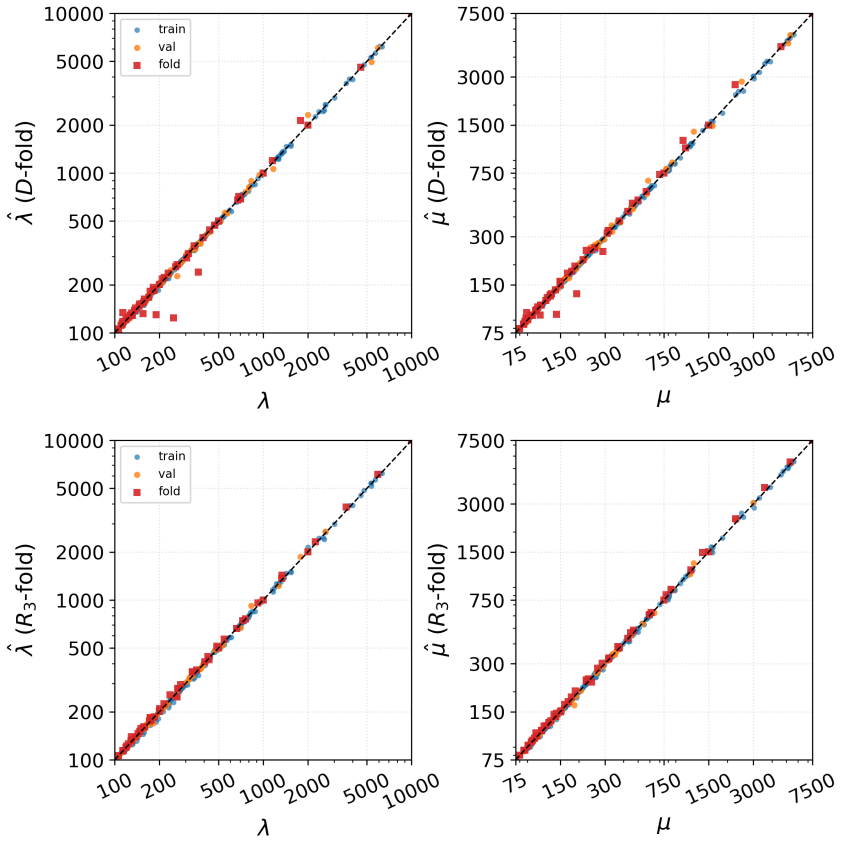
A. Klawonn, M. Lanser, L. Mager, and A. Rege, Computational homogenization for aerogel-like polydisperse open-porous materials using neural network-based surrogate models on the microscale, Computational Mechanics 77(1), 297–317 (2026). https: //doi.org/10.1007/s00466-024-02588-9 13 Figure 5: Parity plots for the predicted and reference Lamé parameters λ ...
-
[14]
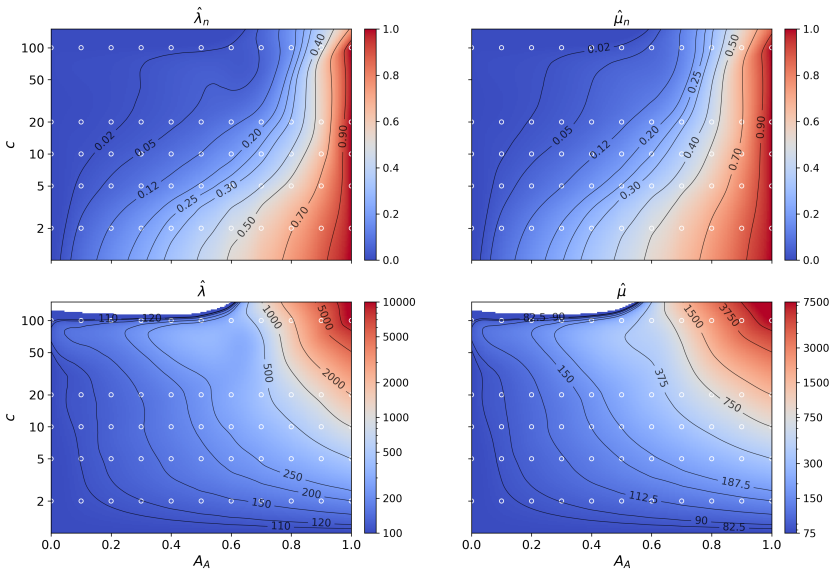
195), while the lower pair shows the better-performing R3-fold ( P95 = 0. 066). Blue and orange markers denote training and validation samples, respectively. Red markers denote the held-out grain type of the corresponding fold, i. e., D on the top and R3 on the bottom. The dashed line indicates perfect prediction. 14 Figure 6: Predicted response surfaces ...
discussion (0)
Sign in with ORCID, Apple, or X to comment. Anyone can read and Pith papers without signing in.