Programmable site-selective spin control in rotating Penning-trap ion crystals
Pith reviewed 2026-06-28 17:32 UTC · model grok-4.3
The pith
Synchronized laser beam steering enables programmable site-selective spin control across large rotating ion crystals in Penning traps.
A machine-rendered reading of the paper's core claim, the machinery that carries it, and where it could break.
Core claim
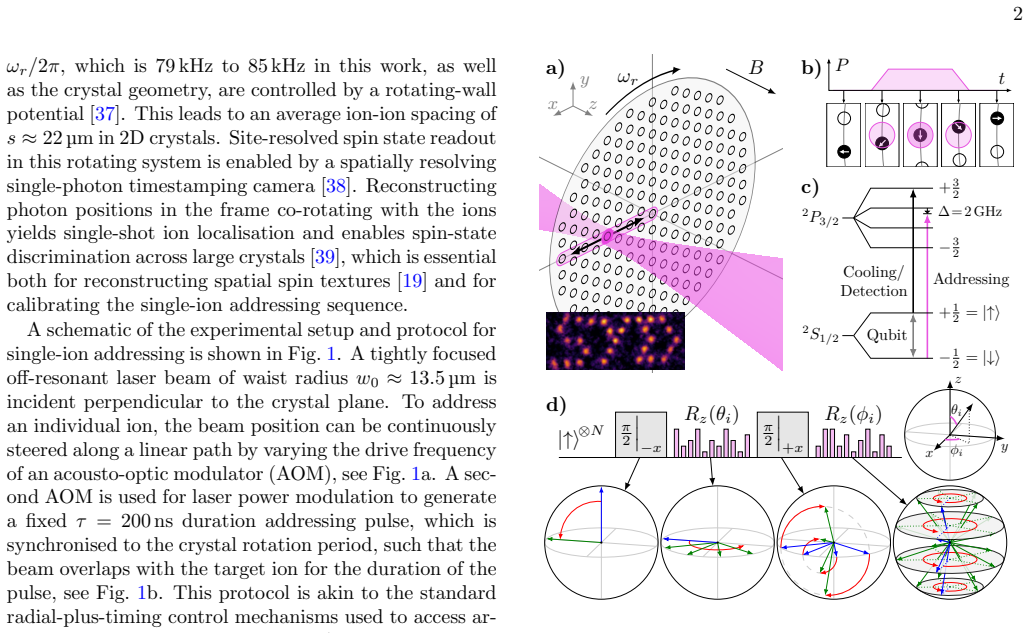
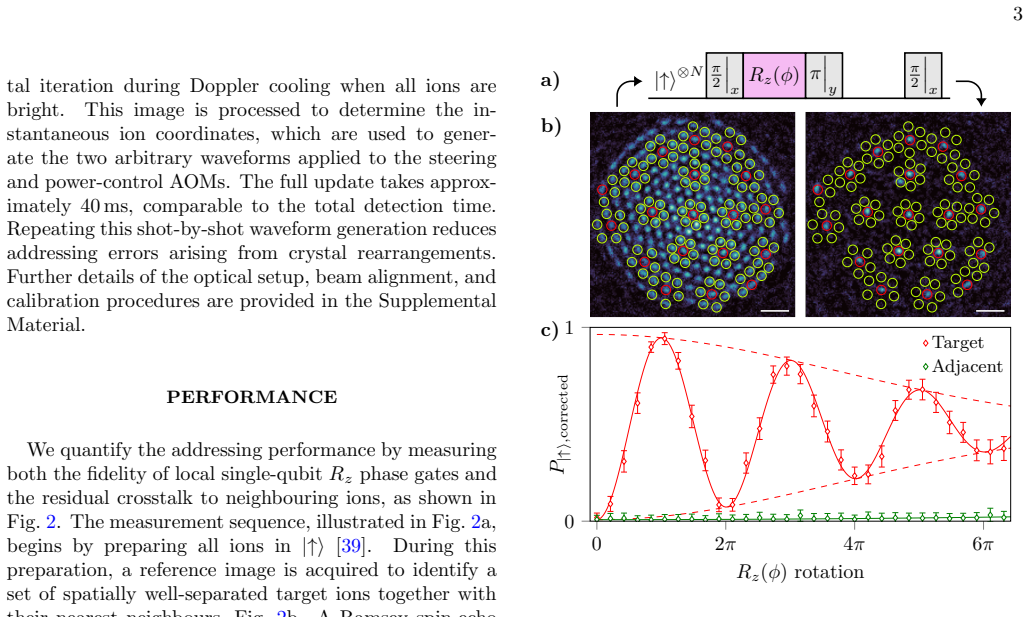
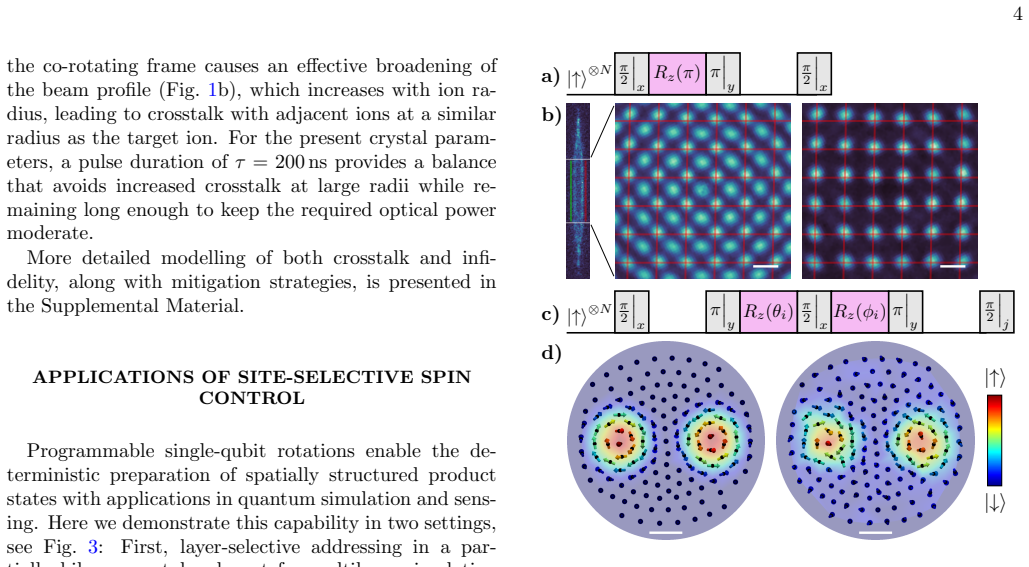
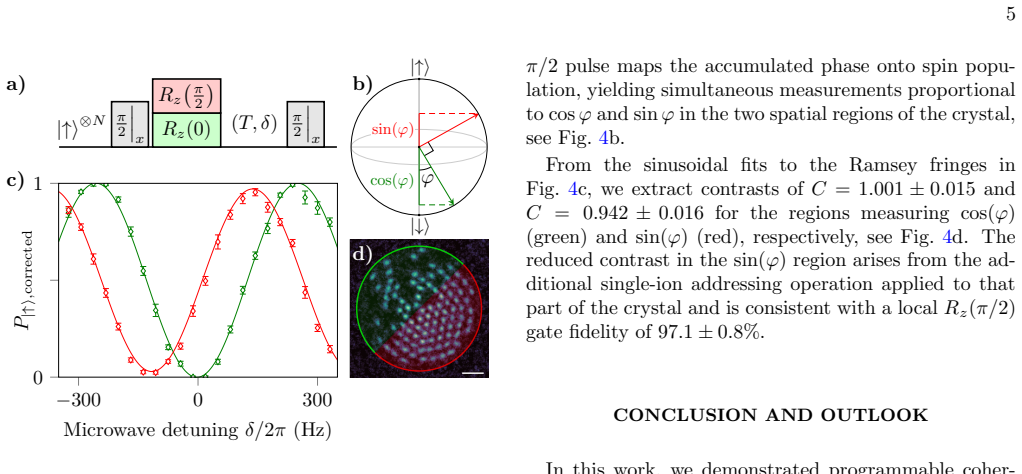
Beam steering synchronised with crystal rotation enables addressing of arbitrary ions throughout the crystal. Ramsey-based characterisation shows Rz(π) gate fidelity of 94.6% and nearest-neighbour crosstalk of 1.2%. This capability is used to prepare spatially structured spin patterns, generating a biskyrmion spin texture in a single-layer crystal, then extending the method to bilayer crystals to perform layer-selective addressing operations. Dual-quadrature Ramsey sensing is demonstrated by imprinting a relative π/2 phase shift between spatial sub-ensembles, enabling simultaneous measurement of orthogonal spin components within a single experimental realisation.
What carries the argument
Beam steering synchronised with crystal rotation, which positions a tightly focused off-resonant laser to address arbitrary ions via differential AC Stark shifts.
If this is right
- Arbitrary ions throughout large rotating crystals can be individually addressed.
- Spatially structured spin patterns such as biskyrmion textures can be prepared in single-layer crystals.
- Layer-selective addressing operations become possible in bilayer crystals.
- Dual-quadrature Ramsey sensing enables simultaneous measurement of orthogonal spin components in one realization.
Where Pith is reading between the lines
- The technique could extend to crystals with hundreds of ions for quantum simulation tasks requiring local control.
- Structured spin states prepared this way may connect to studies of topological textures in other spin systems.
- Dual-quadrature sensing could be adapted to measure additional observables in rotating trapped-ion platforms.
Load-bearing premise
Residual beam-position jitter, intensity fluctuations, and motional heating during synchronized steering do not degrade gate fidelity or crosstalk when the crystal contains hundreds of ions.
What would settle it
An experiment on a crystal with hundreds of ions that measures Rz(π) fidelity significantly below 94.6% or nearest-neighbour crosstalk above 1.2% under the reported steering conditions would falsify effective programmable control.
Figures
read the original abstract
Large ion crystals in Penning traps provide a platform for quantum simulation and sensing with hundreds of spins, but their continuous rigid-body rotation has so far limited flexible local qubit control. Here we demonstrate programmable site-selective spin control across large rotating ${}^{9}\mathrm{Be}^{+}$ crystals in a Penning trap. A tightly focused off-resonant laser beam drives local $R_z$ phase rotations via differential AC Stark shifts. Beam steering synchronised with crystal rotation enables addressing of arbitrary ions throughout the crystal. Ramsey-based characterisation shows $R_z(\pi)$ gate fidelity of 94.6% and nearest-neighbour crosstalk of 1.2%. We use this capability to prepare spatially structured spin patterns, generating a biskyrmion spin texture in a single-layer crystal, then extending the method to bilayer crystals we perform layer-selective addressing operations. We further demonstrate dual-quadrature Ramsey sensing by imprinting a relative $\pi/2$ phase shift between spatial sub-ensembles, enabling simultaneous measurement of orthogonal spin components within a single experimental realisation. These results establish programmable local control in large rotating ion crystals, opening new routes for engineering spatially structured quantum states in multidimensional trapped-ion systems.
Editorial analysis
A structured set of objections, weighed in public.
Referee Report
Summary. The manuscript reports an experimental demonstration of programmable site-selective spin control in large rotating 9Be+ ion crystals in a Penning trap. A tightly focused off-resonant laser beam is steered in synchronization with the crystal's rigid-body rotation to drive local Rz phase rotations via differential AC Stark shifts on arbitrary ions. Ramsey-based characterization yields an Rz(π) gate fidelity of 94.6% and nearest-neighbour crosstalk of 1.2%. The technique is applied to prepare a biskyrmion spin texture in a single-layer crystal, extended to layer-selective addressing in bilayer crystals, and used for dual-quadrature Ramsey sensing by imprinting relative π/2 phase shifts between spatial sub-ensembles.
Significance. If the reported fidelities and crosstalk hold, the work provides a practical route to flexible local qubit control in continuously rotating Penning-trap crystals containing hundreds of spins, removing a long-standing barrier to quantum simulation and sensing in these systems. The concrete measured values, together with the demonstrations of spatially structured states, bilayer operations, and simultaneous orthogonal-component sensing, constitute direct experimental evidence rather than parameter-fitted predictions. The approach is experimentally grounded and opens clear pathways for multidimensional trapped-ion quantum states.
major comments (2)
- [Abstract] Abstract (Ramsey-based characterisation paragraph): the central claim that synchronized beam steering enables arbitrary-ion addressing 'throughout the crystal' with the stated 94.6% fidelity and 1.2% crosstalk even for hundreds of ions is load-bearing, yet the text supplies no crystal-size dependence of Ramsey contrast, no error-budget breakdown isolating beam-position jitter, intensity fluctuations, and motional heating from intrinsic gate error, and no scaling data; any of these technical sources would compound with N and rotation period.
- [Abstract] Abstract (applications paragraph): the extension to bilayer crystals and biskyrmion textures is presented as evidence of the method's utility, but without quantitative fidelity or crosstalk figures for the bilayer or multi-layer cases it is unclear whether the single-layer numbers remain representative when the addressing protocol is applied across layers.
minor comments (3)
- [Abstract] The abstract would be clearer if it stated the typical ion number (or range) in the crystals for which the 94.6% fidelity and 1.2% crosstalk were measured.
- Notation for the dual-quadrature sensing protocol could be made more explicit (e.g., how the relative π/2 phase is imprinted and read out) to aid readers unfamiliar with Penning-trap rotation synchronisation.
- A brief statement on the rotation frequency and beam-steering bandwidth used would help assess the technical demands of the synchronisation.
Simulated Author's Rebuttal
We thank the referee for their thoughtful review and constructive comments on our manuscript. We address each major comment below, indicating where revisions will be made to strengthen the presentation.
read point-by-point responses
-
Referee: [Abstract] Abstract (Ramsey-based characterisation paragraph): the central claim that synchronized beam steering enables arbitrary-ion addressing 'throughout the crystal' with the stated 94.6% fidelity and 1.2% crosstalk even for hundreds of ions is load-bearing, yet the text supplies no crystal-size dependence of Ramsey contrast, no error-budget breakdown isolating beam-position jitter, intensity fluctuations, and motional heating from intrinsic gate error, and no scaling data; any of these technical sources would compound with N and rotation period.
Authors: The reported fidelity and crosstalk values were obtained via Ramsey measurements on addressed ions within the rotating crystals used in the experiment (up to the sizes demonstrated, consistent with the rigid-body rotation regime). The synchronization protocol relies on the crystal's rigid rotation, which holds across a range of N, and the local AC Stark shift addressing is performed independently on each target ion. We agree that an explicit error budget and scaling analysis would better support extrapolation to hundreds of ions. In the revised manuscript we will add a dedicated paragraph in the main text (and update the abstract) that (i) breaks down the dominant technical contributions (beam-position jitter, intensity noise, residual motional heating) based on auxiliary measurements, (ii) explains why these contributions remain independent of N under rigid rotation, and (iii) notes the absence of direct scaling data while providing the physical argument that the per-ion error does not compound with crystal size or rotation period. revision: yes
-
Referee: [Abstract] Abstract (applications paragraph): the extension to bilayer crystals and biskyrmion textures is presented as evidence of the method's utility, but without quantitative fidelity or crosstalk figures for the bilayer or multi-layer cases it is unclear whether the single-layer numbers remain representative when the addressing protocol is applied across layers.
Authors: The biskyrmion texture was prepared in a single-layer crystal using the same addressing parameters characterized in the Ramsey experiments. The bilayer demonstrations apply the identical beam-steering and synchronization protocol but target ions in separate layers via axial focusing; the local Rz operations are therefore expected to retain the same per-ion fidelity and nearest-neighbour crosstalk. We acknowledge that separate quantitative Ramsey data for the bilayer configuration were not reported. In the revised manuscript we will add a clarifying sentence in the applications section stating that the single-layer characterization applies directly to the bilayer case (because the laser-ion interaction is local and layer selection is achieved by axial positioning rather than altered radial addressing), and we will include any supplementary bilayer contrast data that can be extracted from the existing datasets. revision: partial
Circularity Check
No circularity: experimental measurements of fidelity and crosstalk are direct observations, not derived quantities.
full rationale
The paper is an experimental demonstration of beam-steering control in rotating Penning-trap crystals. Reported values (94.6% Rz(π) fidelity, 1.2% crosstalk) come from Ramsey characterization on the physical apparatus; they are measured outcomes, not outputs of any equation, fit, or self-citation chain that reduces to the inputs by construction. No theoretical derivation, parameter fitting to predict results, or load-bearing self-citation is present in the abstract or described claims. The work is self-contained against external benchmarks (direct experimental readout).
Axiom & Free-Parameter Ledger
Reference graph
Works this paper leans on
-
[1]
C. D. Bruzewicz, J. Chiaverini, R. McConnell, and J. M. Sage, Applied Physics Reviews6, 021314 (2019)
2019
-
[2]
Monroe, W
C. Monroe, W. C. Campbell, L.-M. Duan, Z.-X. Gong, A. V. Gorshkov, P. W. Hess, R. Islam, K. Kim, N. M. Linke, G. Pagano, P. Richerme, C. Senko, and N. Y. Yao, Reviews of Modern Physics93, 025001 (2021)
2021
-
[3]
K. A. Gilmore, M. Affolter, R. J. Lewis-Swan, D. Barber- ena, E. Jordan, A. M. Rey, and J. J. Bollinger, Science 373, 673 (2021)
2021
-
[4]
R. J. Lewis-Swan, A. Safavi-Naini, A. M. Kaufman, and A. M. Rey, Nature Reviews Physics (2019), 10.1038/s42254-019-0090-y
-
[5]
Debnath, N
S. Debnath, N. M. Linke, C. Figgatt, K. A. Landsman, K. Wright, and C. Monroe, Nature536, 63 (2016)
2016
-
[6]
Kokail, C
C. Kokail, C. Maier, R. van Bijnen, T. Brydges, M. K. Joshi, P. Jurcevic, C. A. Muschik, P. Silvi, R. Blatt, C. F. Roos, and P. Zoller, Nature569, 355 (2019)
2019
-
[7]
Quantum repeaters based on concatenated bosonic and discrete-variable quantum codes,
Y. Nam, J.-S. Chen, N. C. Pisenti, K. Wright, C. Delaney, D. Maslov, K. R. Brown, S. Allen, J. M. Amini, J. Apis- dorf, K. M. Beck, A. Blinov, V. Chaplin, M. Chmielewski, C. Collins, S. Debnath, K. M. Hudek, A. M. Ducore, M. Keesan, S. M. Kreikemeier, J. Mizrahi, P. Solomon, M. Williams, J. D. Wong-Campos, D. Moehring, C. Mon- roe, and J. Kim, npj Quantum...
-
[8]
Foss-Feig, G
M. Foss-Feig, G. Pagano, A. C. Potter, and N. Y. Yao, Annu. Rev. Conden. Ma. P.16, 145 (2025)
2025
-
[9]
D’Onofrio, Y
M. D’Onofrio, Y. Xie, A. J. Rasmusson, E. Wolanski, J. Cui, and P. Richerme, Phys. Rev. Lett.127, 020503 (2021)
2021
-
[10]
Kiesenhofer, H
D. Kiesenhofer, H. Hainzer, A. Zhdanov, P. C. Holz, M. Bock, T. Ollikainen, and C. F. Roos, PRX Quan- tum4, 020317 (2023)
2023
-
[11]
S.-A. Guo, Y.-K. Wu, J. Ye, L. Zhang, W.-Q. Lian, R. Yao, Y. Wang, R.-Y. Yan, Y.-J. Yi, Y.-L. Xu, B.-W. Li, Y.-H. Hou, Y.-Z. Xu, W.-X. Guo, C. Zhang, B.-X. Qi, Z.-C. Zhou, L. He, and L.-M. Duan, Nature (2024), 10.1038/s41586-024-07459-0
-
[12]
M. Qiao, Z. Cai, Y. Wang, B. Du, N. Jin, W. Chen, P. Wang, C. Luan, E. Gao, X. Sun, H. Tian, J. Zhang, and K. Kim, Nat. Phys.20, 623 (2024)
2024
-
[13]
Z. Sun, Y. H. Teoh, F. Rajabi, and R. Islam, Physical Review A109, 032426 (2024)
2024
-
[14]
Y.-H. Hou, Y.-J. Yi, Y.-K. Wu, Y.-Y. Chen, L. Zhang, Y. Wang, Y.-L. Xu, C. Zhang, Q.-X. Mei, H.-X. Yang, J.-Y. Ma, S.-A. Guo, J. Ye, B.-X. Qi, Z.-C. Zhou, P.- Y. Hou, and L.-M. Duan, Nat. Commun.15(2024), 10.1038/s41467-024-53405-z
-
[15]
Mitchell, J
T. Mitchell, J. Bollinger, D. Dubin, X.-P. Huang, W. Itano, and R. Baughman, Science282, 1290 (1998)
1998
-
[16]
J. W. Britton, B. C. Sawyer, A. C. Keith, C.-C. J. Wang, J. K. Freericks, H. Uys, M. J. Biercuk, and J. J. Bollinger, Nature484, 489 (2012)
2012
-
[17]
Safavi-Naini, R
A. Safavi-Naini, R. J. Lewis-Swan, J. G. Bohnet, M. G¨ arttner, K. A. Gilmore, J. E. Jordan, J. Cohn, J. K. Freericks, A. M. Rey, and J. J. Bollinger, Phys. Rev. Lett.121, 040503 (2018)
2018
-
[18]
B. Bullock, S. R. Muleady, J. F. Lilieholm, Y. Zhang, A. Safavi-Naini, R. J. Lewis-Swan, J. J. Bollinger, A. M. Rey, and A. L. Carter, (2026), 10.48550/ARXIV.2602.06114, arXiv:2602.06114 [quant- ph]
-
[19]
J. Y. Z. Jee, N. Makadia, J. H. Pham, G. C. de Miranda, M. J. Biercuk, A. Shankar, and R. N. Wolf, (2026), 10.48550/ARXIV.2604.13872, arXiv:2604.13872 [quant- ph]
work page internal anchor Pith review Pith/arXiv arXiv doi:10.48550/arxiv.2604.13872 2026
-
[20]
Hawaldar, P
S. Hawaldar, P. Shahi, A. L. Carter, A. M. Rey, J. J. Bollinger, and A. Shankar, Phys. Rev. X14, 031030 (2024)
2024
-
[21]
A. L. Carter, S. R. Muleady, A. Shankar, J. F. Lilieholm, B. B. Bullock, M. Affolter, A. M. Rey, and J. J. Bollinger, Phys. Rev. A107, 042618 (2023)
2023
-
[22]
D. P. DiVincenzo and IBM, quant-ph/0002077v3 10.1002/1521-3978(200009)48:9/11¡771::AID- PROP771¿3.0.CO;2-E, quant-ph/0002077v3
work page internal anchor Pith review Pith/arXiv arXiv doi:10.1002/1521-3978(200009)48:9/11
-
[23]
Shankar, E
A. Shankar, E. A. Yuzbashyan, V. Gurarie, P. Zoller, J. J. Bollinger, and A. M. Rey, PRX Quantum3, 040324 (2022)
2022
-
[24]
arXiv preprint arXiv:2512.02202 (2025) https: //doi.org/10.48550/arXiv.2512.02202
R. Kaubruegger and A. M. Kaufman, (2025), 10.48550/ARXIV.2512.02202, arXiv:2512.02202 [quant- ph]
-
[25]
A. M. Polloreno, A. M. Rey, and J. J. Bollinger, Physical Review Research4, 033076 (2022)
2022
-
[26]
Carter et al., in preparation
A. Carter et al., in preparation
-
[27]
B. J. McMahon, K. R. Brown, C. D. Herold, and B. C. Sawyer, Phys. Rev. Lett.133, 173201 (2024)
2024
-
[28]
Kaneda and H
T. Kaneda and H. Saito, Phys. Rev. A93, 033611 (2016)
2016
-
[29]
S. Shengbin, Y. Zhao, S. Jiajun, X. Hou, H. Zhou, and J. Wang, New Journal of Physics25(2023), 10.1088/1367-2630/aceff5
-
[30]
Psaroudaki and C
C. Psaroudaki and C. Panagopoulos, Phys. Rev. Lett. 127, 067201 (2021)
2021
-
[31]
Koshibae, Y
W. Koshibae, Y. Kaneko, J. Iwasaki, M. Kawasaki, Y. Tokura, and N. Nagaosa, Japanese Journal of Ap- plied Physics54, 053001 (2015)
2015
-
[32]
Luo and L
S. Luo and L. You, APL Materials9, 050901 (2021)
2021
-
[33]
W. Li, S. Wu, A. Smerzi, and L. Pezz` e, Physical Review A105, 053116 (2022)
2022
-
[34]
Zheng, J
X. Zheng, J. Dolde, and S. Kolkowitz, Physical Review X14, 011006 (2024). 7
2024
-
[35]
H. Ball, C. D. Marciniak, R. N. Wolf, A. T.-H. Hung, K. Pyka, and M. J. Biercuk, Rev. Sci. Instrum.90, 053103 (2019)
2019
-
[36]
J. H. Pham, J. Y. Z. Jee, A. Rischka, M. J. Biercuk, and R. N. Wolf, Adv. Quantum Technol.2024, 2400086 (2024)
2024
-
[37]
Huang, J
X.-P. Huang, J. J. Bollinger, T. B. Mitchell, and W. M. Itano, Phys. Rev. Lett.80, 73 (1998)
1998
-
[38]
Nomerotski, I
A. Nomerotski, I. Chakaberia, M. Fisher-Levine, Z. Janoska, P. Takacs, and T. Tsang, J. Instrum.12, C01017 (2017)
2017
-
[39]
R. N. Wolf, J. H. Pham, J. Y. Z. Jee, A. Rischka, and M. J. Biercuk, Phys. Rev. Applied21, 054067 (2024)
2024
-
[40]
Sinanan-Singh, G
J. Sinanan-Singh, G. L. Mintzer, I. L. Chuang, and Y. Liu, Quantum8, 1427 (2024)
2024
-
[41]
Budker, P
D. Budker, P. W. Graham, H. Ramani, F. Schmidt-Kaler, C. Smorra, and S. Ulmer, PRX Quantum3, 010330
-
[42]
Carney, H
D. Carney, H. Haeffner, D. C. Moore, and J. M. Taylor, Phys. Rev. Lett.127, 061804
-
[43]
C. D. Marciniak, H. B. Ball, A. T.-H. Hung, and M. J. Biercuk, Opt. Express25, 15643 (2017)
2017
-
[44]
B. C. Sawyer, J. G. Bohnet, J. W. Britton, and J. J. Bollinger, Physical Review A91, 011401(R) (2015)
2015
-
[45]
D. H. E. Dubin, Phys. Rev. A88, 013403 (2013)
2013
-
[46]
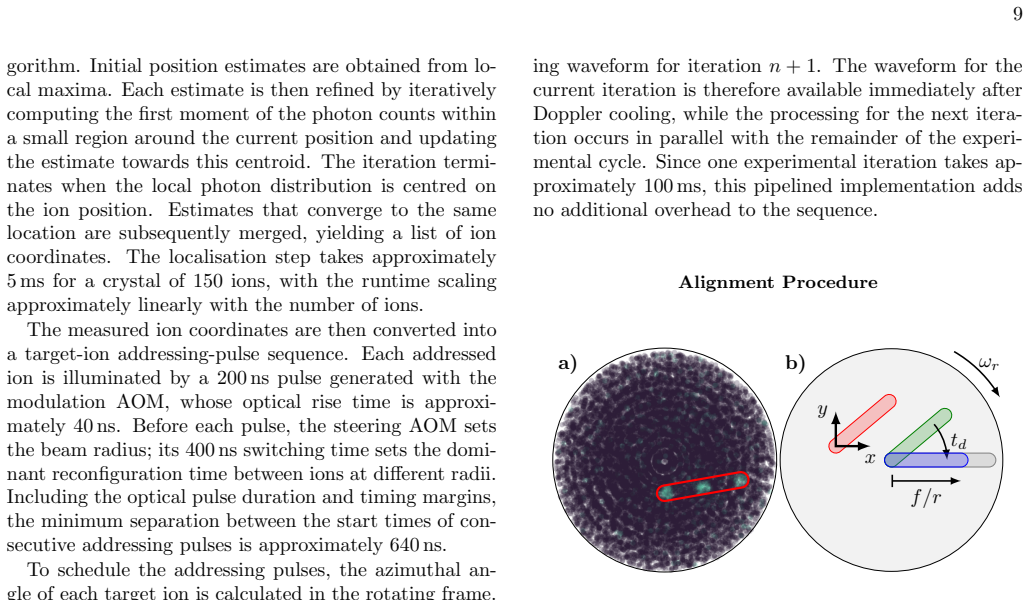
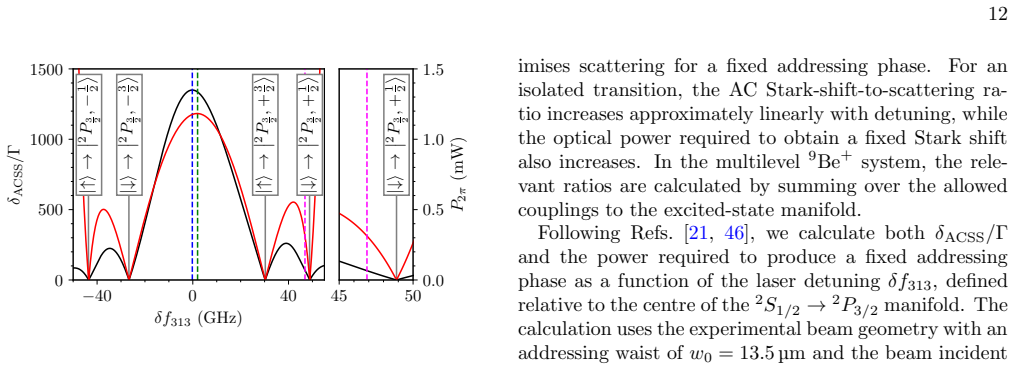
H. Uys, M. J. Biercuk, A. VanDevender, C. Ospelkaus, D. Meiser, R. Ozeri, and J. J. Bollinger, Phys. Rev. Lett. 105, 200401 (2010). SUPPLEMENTAL MATERIAL EXPERIMENTAL SETUP The addressing implementation for single-qubit phase gates relies on three technical advances compared to our previous setup for radius-selective optical pumping, de- scribed in Ref. [...
2010
-
[47]
Geometric models for addressing crosstalk and target-ion infidelity.a)Crosstalk model
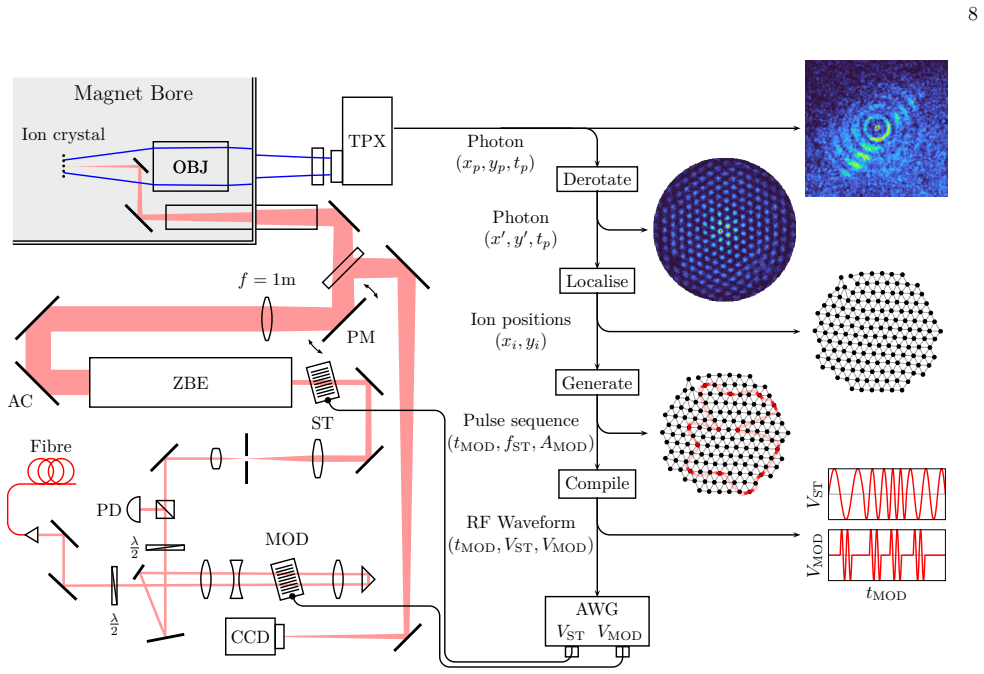
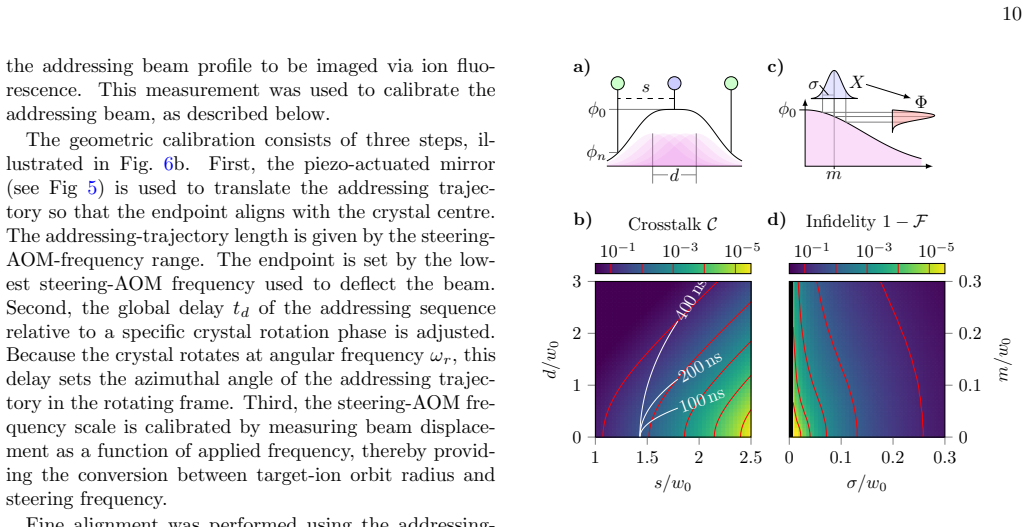
3 σ/w 0 m/w 0 10−1 10−3 10−5 Infidelity 1 − F Figure 7. Geometric models for addressing crosstalk and target-ion infidelity.a)Crosstalk model. During a finite ad- dressing pulse, the ion moves relative to the addressing beam in the co-rotating frame, so that the accumulated phase is de- termined by the time-integrated beam intensity. For a pulse in which ...
discussion (0)
Sign in with ORCID, Apple, or X to comment. Anyone can read and Pith papers without signing in.