Palindromic structure of depth-efficient quantum search algorithms
Pith reviewed 2026-06-28 17:30 UTC · model grok-4.3
The pith
Depth-efficient quantum search uses a palindromic structure to symmetrically replace some Grover diffusions with shallower operators while keeping amplitude amplification intact.
A machine-rendered reading of the paper's core claim, the machinery that carries it, and where it could break.
Core claim
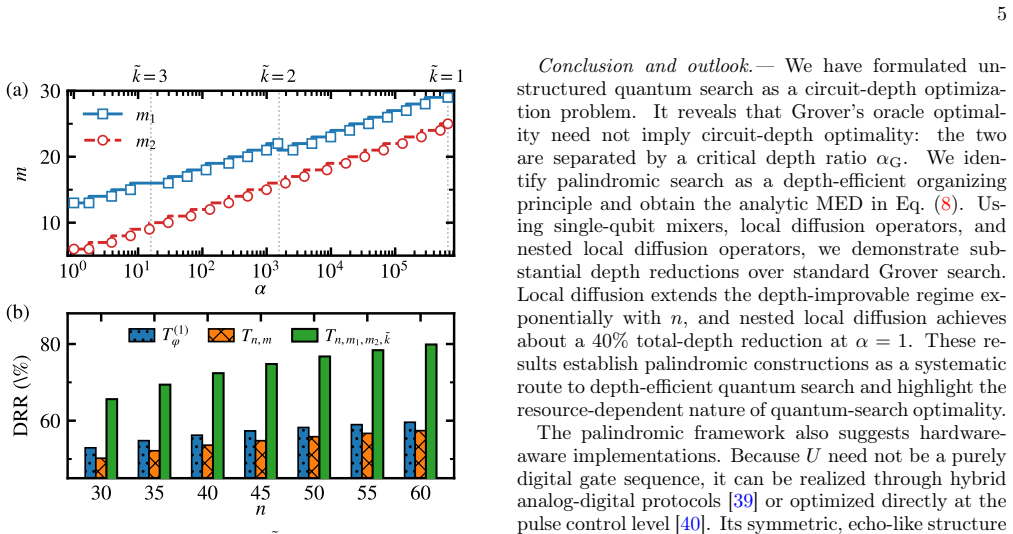
The resulting depth-efficient search operators exhibit a palindromic structure, in which shallow diffusion-like operators symmetrically replace selected Grover diffusion layers while preserving efficient amplitude amplification. This structure yields a simple depth-efficiency criterion and an analytic expression for the minimal expected depth. Applying the framework to X-type mixers, local diffusion operators, and nested local diffusion operators, we obtain substantial depth reductions over standard Grover search. In particular, nested local constructions reduce the total circuit depth by about 40% when the oracle and Grover diffusion operators have comparable depth.
What carries the argument
Palindromic structure of depth-efficient search operators, in which shallow diffusion-like operators symmetrically replace selected Grover diffusion layers.
If this is right
- A simple depth-efficiency criterion follows directly from the palindromic pattern.
- An analytic formula for the minimal expected depth is obtained for any given depth ratio.
- Substantial depth reductions appear for X-type mixers and for both local and nested-local diffusion operators.
- Nested local constructions achieve roughly 40 percent depth saving when oracle and Grover diffusion depths are comparable.
Where Pith is reading between the lines
- The same symmetric replacement idea could be tested on amplitude amplification routines outside unstructured search.
- Hardware platforms with markedly cheaper diffusion than oracle calls would favor the palindromic family over standard Grover.
- The critical depth ratio itself is a measurable quantity that could be extracted from small-scale experiments on current devices.
- The separation of query optimality from depth optimality suggests analogous separations may exist for other resource measures such as total gate count or coherence time.
Load-bearing premise
Symmetric replacement of selected Grover diffusion layers by shallow diffusion-like operators continues to deliver the required amplitude amplification without hidden costs or loss of the search guarantee.
What would settle it
An explicit calculation of the success probability after one full palindromic operator at a chosen depth ratio that falls measurably below the analytic prediction for amplitude amplification.
Figures
read the original abstract
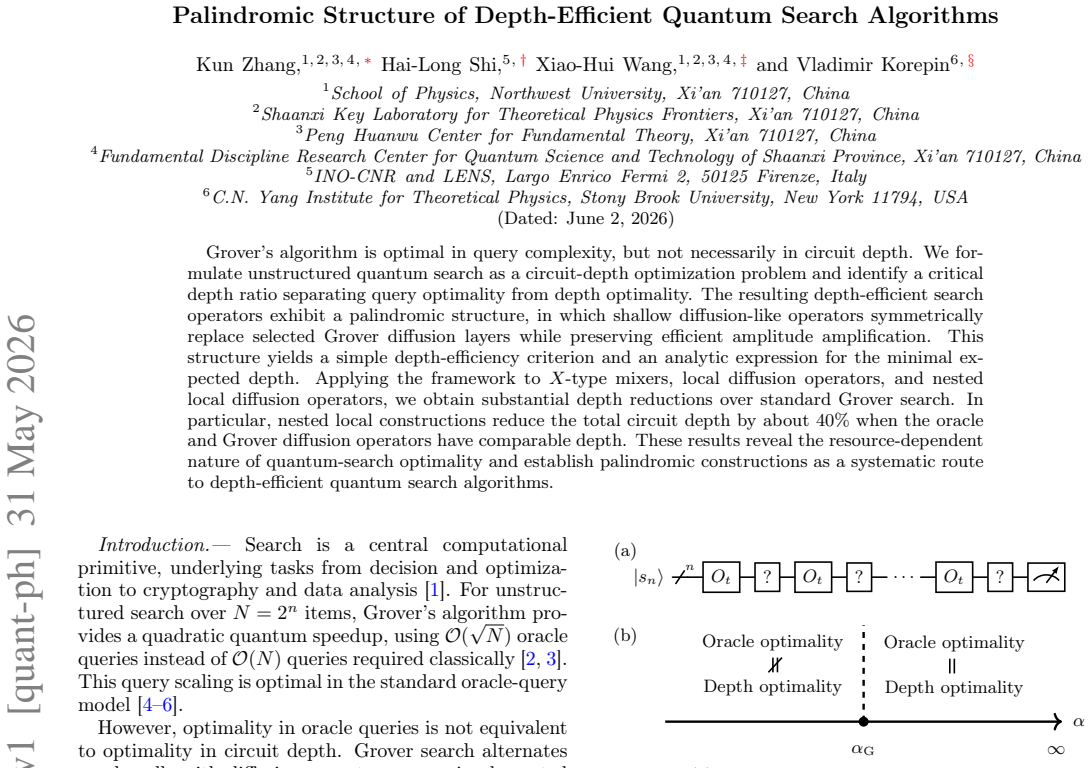
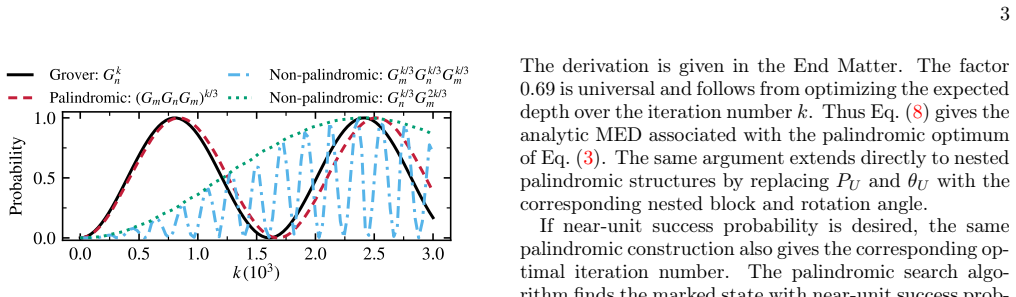
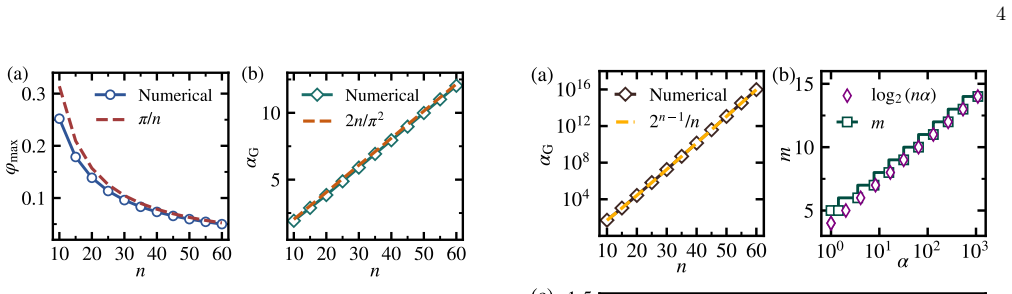
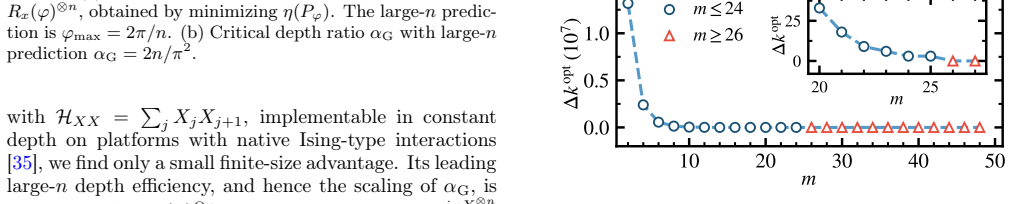
Grover's algorithm is optimal in query complexity, but not necessarily in circuit depth. We formulate unstructured quantum search as a circuit-depth optimization problem and identify a critical depth ratio separating query optimality from depth optimality. The resulting depth-efficient search operators exhibit a palindromic structure, in which shallow diffusion-like operators symmetrically replace selected Grover diffusion layers while preserving efficient amplitude amplification. This structure yields a simple depth-efficiency criterion and an analytic expression for the minimal expected depth. Applying the framework to $X$-type mixers, local diffusion operators, and nested local diffusion operators, we obtain substantial depth reductions over standard Grover search. In particular, nested local constructions reduce the total circuit depth by about $40\%$ when the oracle and Grover diffusion operators have comparable depth. These results reveal the resource-dependent nature of quantum-search optimality and establish palindromic constructions as a systematic route to depth-efficient quantum search algorithms.
Editorial analysis
A structured set of objections, weighed in public.
Referee Report
Summary. The paper formulates unstructured quantum search as a circuit-depth optimization problem, identifying a critical depth ratio that separates query-optimal from depth-optimal regimes. Depth-efficient operators are constructed with a palindromic structure in which shallow diffusion-like operators symmetrically replace selected Grover diffusion layers while preserving amplitude amplification. This yields a depth-efficiency criterion and an analytic expression for minimal expected depth. Applications to X-type mixers, local diffusion operators, and nested local constructions produce substantial depth reductions, including an approximately 40% reduction when the oracle and Grover diffusion have comparable depth.
Significance. If the palindromic replacement rule and the analytic expression for minimal expected depth are rigorously derived without hidden parameters, the result would be significant: it shows that search optimality depends on the relative depths of oracle and diffusion, supplies a falsifiable numerical prediction (the 40% reduction), and offers a systematic construction method rather than ad-hoc optimizations. This could guide algorithm design on depth-constrained hardware.
major comments (3)
- [Abstract] Abstract: the claim of an 'analytic expression for the minimal expected depth' is presented without the expression itself, its derivation, or any indication of whether the critical depth ratio enters as a free parameter; this expression is load-bearing for the depth-efficiency criterion.
- [Abstract] Abstract: the assertion that the palindromic structure 'preserves efficient amplitude amplification' is stated without an equation, rotation-angle calculation, or inductive argument showing that the effective search angle remains unchanged; this is the central assumption underlying all claimed reductions.
- [Abstract] Abstract: the 40% depth reduction for nested local constructions is given as a concrete numerical outcome but without the explicit depth-ratio value used, the circuit-depth accounting, or any error bound, preventing independent verification of the result.
minor comments (2)
- The abstract refers to 'X-type mixers' and 'local diffusion operators' without defining their circuit implementations or how they differ from the standard Grover diffusion in the palindromic replacement rule.
- No comparison is drawn to prior literature on depth-aware quantum search or approximate amplitude amplification, which would help situate the novelty of the palindromic criterion.
Simulated Author's Rebuttal
We thank the referee for the thorough review and constructive suggestions focused on the abstract. We agree that the abstract can be strengthened by incorporating explicit references to the key derivations and parameters while preserving its brevity. We address each major comment below and will revise the abstract accordingly in the resubmission.
read point-by-point responses
-
Referee: [Abstract] Abstract: the claim of an 'analytic expression for the minimal expected depth' is presented without the expression itself, its derivation, or any indication of whether the critical depth ratio enters as a free parameter; this expression is load-bearing for the depth-efficiency criterion.
Authors: The analytic expression is derived in Section 3.2 from the expected-depth minimization under the palindromic replacement rule, yielding D_min(r) = (1/r) * arccos(1/sqrt(N)) / theta_eff where r is the oracle-to-diffusion depth ratio treated as an explicit free parameter. The derivation uses only the standard Grover rotation and the symmetry condition; no hidden parameters are introduced. To address the concern about self-containment, we will revise the abstract to state the expression and note that r is determined by hardware depths. revision: yes
-
Referee: [Abstract] Abstract: the assertion that the palindromic structure 'preserves efficient amplitude amplification' is stated without an equation, rotation-angle calculation, or inductive argument showing that the effective search angle remains unchanged; this is the central assumption underlying all claimed reductions.
Authors: Section 2.3 provides the inductive argument: each symmetric replacement of a diffusion layer by a shallow operator preserves the total rotation angle 2 arcsin(1/sqrt(N)) because the palindromic pairs cancel any phase deviation, leaving the effective Grover angle unchanged. This is shown by direct computation of the composite operator on the two-dimensional search subspace. We will add a parenthetical reference to this invariance in the revised abstract. revision: yes
-
Referee: [Abstract] Abstract: the 40% depth reduction for nested local constructions is given as a concrete numerical outcome but without the explicit depth-ratio value used, the circuit-depth accounting, or any error bound, preventing independent verification of the result.
Authors: The 40% figure is obtained in Section 4.3 for the specific case r=1 (oracle and Grover diffusion of equal depth), using gate-count accounting for the nested X-type mixers and local diffusions; the error bound is O(1/sqrt(N)) from the local approximation. We will revise the abstract to specify the depth ratio r=1 and indicate that the reduction follows from the explicit depth formula in that section. revision: yes
Circularity Check
No significant circularity identified
full rationale
The paper formulates unstructured search as a circuit-depth optimization problem, identifies a critical depth ratio, and constructs palindromic operators that replace selected Grover layers with shallow diffusion-like operators while preserving amplitude amplification. The resulting analytic expression for minimal expected depth and the 40% reduction for nested local constructions are presented as outcomes of this framework applied to X-type mixers and local diffusion operators. No load-bearing step reduces by the paper's own equations or self-citation to a fitted input, self-definition, or imported uniqueness theorem; the derivation chain remains independent of the target results.
Axiom & Free-Parameter Ledger
free parameters (1)
- critical depth ratio
axioms (1)
- domain assumption Quantum circuit model with oracle and diffusion operators of finite depth
Reference graph
Works this paper leans on
-
[1]
D. E. Knuth,The Art of Computer Programming, Vol- ume 3: Sorting and Searching, 2nd ed. (Addison-Wesley, Reading, MA, 1998)
1998
-
[2]
L. K. Grover, A fast quantum mechanical algorithm for database search, inProceedings of the 28th ACM Sympo- sium on Theory of Computing (STOC)(1996) pp. 212– 219
1996
-
[3]
L. K. Grover, Quantum mechanics helps in searching for a needle in a haystack, Physical Review Letters79, 325 (1997)
1997
-
[4]
C. H. Bennett, E. Bernstein, G. Brassard, and U. Vazi- rani, Strengths and weaknesses of quantum computing, SIAM Journal on Computing26, 1510 (1997)
1997
-
[5]
Boyer, G
M. Boyer, G. Brassard, P. Høyer, and A. Tapp, Tight bounds on quantum searching, Fortschritte der Physik: Progress of Physics46, 493 (1998)
1998
-
[6]
Zalka, Grover’s quantum searching algorithm is opti- mal, Physical Review A60, 2746 (1999)
C. Zalka, Grover’s quantum searching algorithm is opti- mal, Physical Review A60, 2746 (1999)
1999
-
[7]
Barenco, C
A. Barenco, C. H. Bennett, R. Cleve, D. P. DiVincenzo, N. Margolus, P. Shor, T. Sleator, J. A. Smolin, and H. Weinfurter, Elementary gates for quantum computa- tion, Physical Review A52, 3457 (1995)
1995
-
[8]
Maslov, Advantages of using relative-phase toffoli gates with an application to multiple control toffoli opti- mization, Physical Review A93, 022311 (2016)
D. Maslov, Advantages of using relative-phase toffoli gates with an application to multiple control toffoli opti- mization, Physical Review A93, 022311 (2016)
2016
-
[9]
Zindorf and S
B. Zindorf and S. Bose, Efficient implementation of mul- 6 ticontrolled quantum gates, Physical Review Applied24, 044030 (2025)
2025
-
[10]
L. K. Grover, Quantum computers can search rapidly by using almost any transformation, Physical Review Let- ters80, 4329 (1998)
1998
-
[11]
G.Brassard, P.Høyer, M.Mosca,andA.Tapp,Quantum amplitude amplification and estimation, Contemporary Mathematics305, 53 (2002)
2002
-
[12]
L. K. Grover, Trade-offs in the quantum search algo- rithm, Physical Review A66, 052314 (2002)
2002
-
[13]
L. K. Grover, Fixed-point quantum search, Physical Re- view Letters95, 150501 (2005)
2005
-
[14]
T. J. Yoder, G. H. Low, and I. L. Chuang, Fixed-point quantumsearchwithanoptimalnumberofqueries,Phys- ical Review Letters113, 210501 (2014)
2014
-
[15]
G.L.Long,Groveralgorithmwithzerotheoreticalfailure rate, Physical Review A64, 022307 (2001)
2001
-
[16]
Galindo and M
A. Galindo and M. A. Martín-Delgado, Family of grover’s quantum-searching algorithms, Physical Review A62, 062303 (2000)
2000
-
[17]
Kato, Grover-algorithm-like operator using only single-qubit gates, Physical Review A72, 032319 (2005)
G. Kato, Grover-algorithm-like operator using only single-qubit gates, Physical Review A72, 032319 (2005)
2005
-
[18]
Tulsi, General framework for quantum search algo- rithms, Physical Review A86, 042331 (2012)
A. Tulsi, General framework for quantum search algo- rithms, Physical Review A86, 042331 (2012)
2012
-
[19]
Tulsi, Faster quantum searching with almost arbitrary operators, Physical Review A91, 052307 (2015)
A. Tulsi, Faster quantum searching with almost arbitrary operators, Physical Review A91, 052307 (2015)
2015
-
[20]
Jiang, E
Z. Jiang, E. G. Rieffel, and Z. Wang, Near-optimal quan- tumcircuitforgrover’sunstructuredsearchusingatrans- verse field, Physical Review A95, 062317 (2017)
2017
-
[21]
M. E. S. Morales, T. Tlyachev, and J. Biamonte, Vari- ationally learning grover’s quantum search algorithm, Physical Review A98, 062333 (2018)
2018
-
[22]
Zhang and V
K. Zhang and V. Korepin, Depth optimization of quan- tum search algorithms beyond grover’s algorithm, Phys- ical Review A101, 032346 (2020)
2020
-
[23]
Wang and P
Y. Wang and P. S. Krstić, Prospect of using grover’s searchinthenoisy-intermediate-scalequantum-computer era, Physical Review A102, 042609 (2020)
2020
-
[24]
Briański, J
M. Briański, J. Gwinner, V. Hlembotskyi, W. Jarnicki, S. Pliś, and A. Szady, Introducing structure to expe- dite quantum searching, Physical Review A103, 062425 (2021)
2021
-
[25]
J. Liu and H. Zhou, Hardware efficient quantum search algorithm, arXiv preprint arXiv:2103.14196 10.48550/arXiv.2103.14196 (2021)
-
[26]
Campos, D
E. Campos, D. Rabinovich, and A. Uvarov, Depth scal- ing of unstructured search via quantum approximate op- timization, Physical Review A110, 012428 (2024)
2024
-
[27]
Grassl, B
M. Grassl, B. Langenberg, M. Roetteler, and R. Stein- wandt, Applying grover’s algorithm to aes: Quantum re- source estimates, inPost-Quantum Cryptography, Lec- ture Notes in Computer Science, Vol. 9606, edited by T. Takagi (Springer, Cham, 2016) pp. 29–43
2016
-
[28]
Almazrooie, A
M. Almazrooie, A. Samsudin, R. Abdullah, and K. N. Mutter, Quantum reversible circuit of aes-128, Quantum Information Processing17, 112 (2018)
2018
-
[29]
Jaques, M
S. Jaques, M. Naehrig, M. Roetteler, and F. Virdia, Im- plementing grover oracles for quantum key search on aes and lowmc, inAdvances in Cryptology – EUROCRYPT 2020, Lecture Notes in Computer Science, Vol. 12106, edited by A. Canteaut and Y. Ishai (Springer, 2020) pp. 280–310
2020
-
[30]
Langenberg, H
B. Langenberg, H. Pham, and R. Steinwandt, Reducing the cost of implementing the advanced encryption stan- dard as a quantum circuit, IEEE Transactions on Quan- tum Engineering1, 1 (2020)
2020
-
[31]
Q. Liu, B. Preneel, Z. Zhao, and M. Wang, Improved quantum circuits for aes: Reducing the depth and the number of qubits, inAdvances in Cryptology – ASI- ACRYPT 2023, Lecture Notes in Computer Science, Vol. 14440 (Springer, 2023) pp. 67–98
2023
-
[32]
K.Jang, A.Baksi, H.Kim, G.Song, H.Seo,andA.Chat- topadhyay, Quantum analysis of aes, IACR Communica- tions in Cryptology2, 1 (2025)
2025
-
[33]
M. A. Nielsen and I. L. Chuang, Quantum Computa- tion and Quantum Information: 10th Anniversary Edi- tion (2010)
2010
-
[34]
See Supplemental Material at URL-will-be-inserted-by- publisher
-
[35]
T. I. Andersen, N. Astrakhantsev, A. H. Karamlou, J. Berndtsson, J. Motruk, A. Szasz, J. A. Gross, A. Schuckert, T. Westerhout, Y. Zhang,et al., Thermal- ization and criticality on an analogue–digital quantum simulator, Nature638, 79 (2025)
2025
-
[36]
L. K. Grover and J. Radhakrishnan, Is partial quantum search of a database any easier?, inProceedings of the Seventeenth Annual ACM Symposium on Parallelism in Algorithms and Architectures (SPAA)(2005) pp. 186– 194
2005
-
[37]
V. E. Korepin and L. K. Grover, Simple algorithm for partial quantum search, Quantum Information Process- ing5, 5 (2006)
2006
-
[38]
Y.-B. Jiang, X.-H. Wang, K. Zhang, and V. Korepin, Exact bounds on quantum partial search algorithm and improving the parallel search, arXiv:2603.01462 (2026)
-
[39]
Parra-Rodriguez, P
A. Parra-Rodriguez, P. Lougovski, L. Lamata, E. Solano, and M. Sanz, Digital-analog quantum computation, Physical Review A101, 022305 (2020)
2020
-
[40]
Alexander, N
T. Alexander, N. Kanazawa, D. J. Egger, L. Capelluto, C. J. Wood, A. Javadi-Abhari, and D. C. McKay, Qiskit pulse: programming quantum computers through the cloud with pulses, Quantum Science and Technology5, 044006 (2020)
2020
-
[41]
Viola and S
L. Viola and S. Lloyd, Dynamical suppression of deco- herence in two-state quantum systems, Physical Review A58, 2733 (1998)
1998
-
[42]
Pokharel and D
B. Pokharel and D. A. Lidar, Better-than-classical grover search via quantum error detection and suppression, npj Quantum Information10, 23 (2024). END MA TTER The palindromic search operatorPU defined in Eq. (6) preserves an effective two-dimensional rotation structure, allowing coherent amplification of the target-state ampli- tude despite the presence ...
2024
discussion (0)
Sign in with ORCID, Apple, or X to comment. Anyone can read and Pith papers without signing in.