Fundamental Limit for One versus Two Point Sources Detection using Direct Imaging
Pith reviewed 2026-06-28 16:55 UTC · model grok-4.3
The pith
The Bhattacharyya distance for one versus two point source detection via direct imaging has a leading term whose scaling with separation depends on whether the amplitude spread function has zeros.
A machine-rendered reading of the paper's core claim, the machinery that carries it, and where it could break.
Core claim
For ideal direct imaging of weak incoherent sources, the leading term of the Bhattacharyya distance in the sub-Rayleigh regime scales as a specific power of θ that differs according to whether the amplitude spread function has zeros; this completes the analysis for arbitrary ASF and corrects earlier scaling reports.
What carries the argument
The Bhattacharyya distance computed from the Poisson statistics of photon counts on an ideal focal plane array, expanded to leading order in small source separation θ.
If this is right
- The performance of direct imaging can now be compared precisely to other schemes for any given ASF.
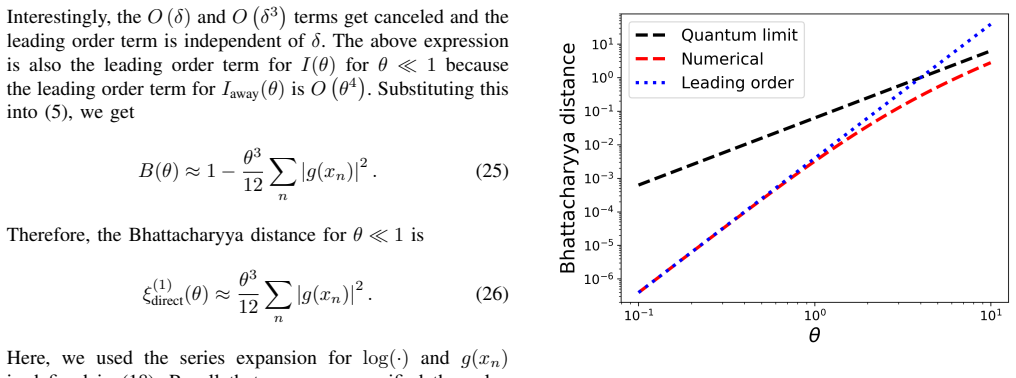
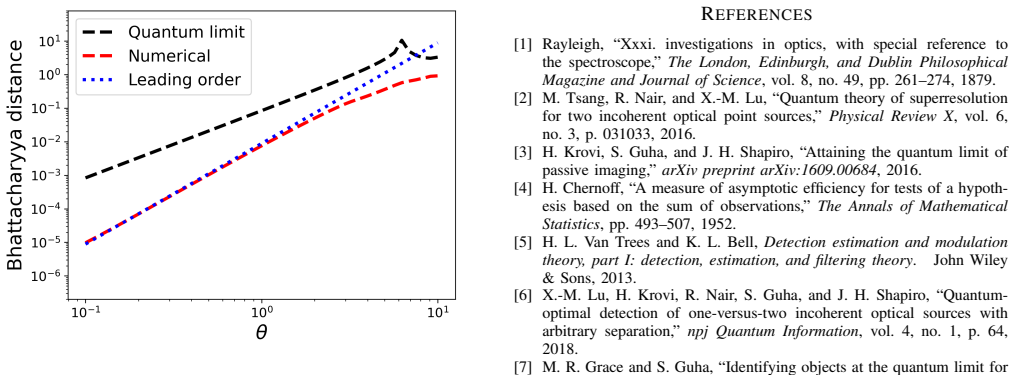
- Gaussian and Sinc ASFs show good agreement between the analytic leading term and numerical results.
- The same ASF-dependent scaling appears in separation estimation and change detection tasks.
- Results apply specifically in the sub-Rayleigh regime for weak sources.
Where Pith is reading between the lines
- Similar scaling distinctions may appear in other quantum optical detection tasks when the measurement is intensity-based.
- Extending the analysis to non-ideal detectors or coherent sources could reveal further dependencies.
- Testing the predicted scalings with actual optical setups would validate the small-θ approximation.
Load-bearing premise
The sources must be weak and mutually incoherent so that the intensity pattern is a simple sum and photon arrivals follow independent Poisson statistics.
What would settle it
Numerical computation of the Bhattacharyya distance for a specific ASF with a zero, at very small θ, should match the predicted leading power of θ rather than the power for a zero-free ASF.
Figures
read the original abstract
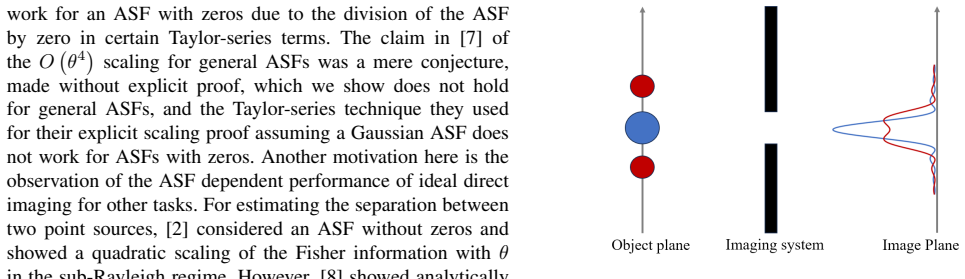
We consider the task of distinguishing between a single weak incoherent optical point source and two weak incoherent optical point sources located symmetrically about the first source. $\theta$ is the separation between the two point sources scaled to the Point Spread Function (PSF) width in the image plane. Using an ideal focal plane array of intensity detectors (ideal direct imaging), we quantify the performance using the Bhattacharyya distance and find the scaling of its leading order term in terms of $\theta$ in the sub-Rayleigh regime. A suite of previous analyses of this problem lacked a comprehensive analysis for when the amplitude spread function (ASF) of the imaging system has zeros and reported a scaling that we find to be incorrect. We complete this analysis by explicitly calculating the leading order term of the Bhattacharyya distance for ideal direct imaging with any ASF, for small $\theta$ and show the difference in scaling based on the presence or absence of zeros in the ASF. This is similar to the ASF dependent performance in the task of estimating the separation between the two point sources and the task of detecting a change to an object. We then apply our results to the specific example of a Gaussian and a Sinc ASF and show good agreement with numerical calculations. Our results allow the accurate comparison of other measurement schemes with ideal direct imaging, and to the quantum limit.
Editorial analysis
A structured set of objections, weighed in public.
Referee Report
Summary. The manuscript analyzes the binary hypothesis test of distinguishing one versus two weak incoherent point sources separated by scaled distance θ using ideal direct imaging (focal-plane intensity detection). It derives the leading-order term in the small-θ expansion of the Bhattacharyya distance for arbitrary amplitude spread functions (ASFs), demonstrating that the scaling differs according to the presence or absence of zeros in the ASF. The general result is specialized to Gaussian (zero-free) and Sinc (with zeros) ASFs and shown to agree with numerical evaluation; the work positions the result as a benchmark against other schemes and the quantum limit.
Significance. If the central derivation holds, the paper supplies an explicit, ASF-general leading-order expression that corrects an incomplete scaling reported in prior work and parallels ASF-dependent behavior already known for separation estimation. The closed-form result plus numerical confirmation for two representative ASFs constitutes a concrete, usable benchmark for comparing direct imaging to quantum-optimal or other measurement strategies in the sub-Rayleigh regime.
minor comments (3)
- [Abstract] The abstract refers to 'a suite of previous analyses' that reported an incorrect scaling; adding the specific citations in the introduction would allow readers to locate the discrepancy immediately.
- In the derivation of the Bhattacharyya distance, state the precise order of the retained term (e.g., O(θ^4) or O(θ^2)) immediately after the general expression so that the claimed difference in scaling is unambiguous without consulting the appendix.
- Figure captions for the numerical comparisons should explicitly note the value of the source strength parameter and the range of θ over which the leading-order analytic curve is plotted.
Simulated Author's Rebuttal
We thank the referee for their positive assessment of the manuscript, including the recognition that the central derivation supplies an explicit ASF-general leading-order expression and serves as a usable benchmark. We are pleased that the work is recommended for acceptance.
Circularity Check
No significant circularity; derivation is direct from Bhattacharyya definition and Taylor expansion
full rationale
The central result is an explicit leading-order calculation of the Bhattacharyya distance between the one-source and two-source hypotheses under the standard weak-incoherent Poisson imaging model. The paper applies the Bhattacharyya distance definition to the intensity pattern, performs a small-θ expansion, and obtains closed-form scalings that differ according to whether the ASF has zeros. This chain begins from the model equations and the distance definition; no step reduces by construction to a fitted parameter, a self-citation, or an ansatz imported from prior work by the same authors. The numerical checks for Gaussian and Sinc ASFs are independent verifications of the analytic expressions rather than the source of the result. The paper corrects earlier scalings in the literature rather than relying on them.
Axiom & Free-Parameter Ledger
axioms (1)
- standard math Bhattacharyya distance quantifies distinguishability between two hypotheses for the observed intensity pattern
Reference graph
Works this paper leans on
-
[1]
Xxxi. investigations in optics, with special reference to the spectroscope,
Rayleigh, “Xxxi. investigations in optics, with special reference to the spectroscope,”The London, Edinburgh, and Dublin Philosophical Magazine and Journal of Science, vol. 8, no. 49, pp. 261–274, 1879
-
[2]
Quantum theory of superresolution for two incoherent optical point sources,
M. Tsang, R. Nair, and X.-M. Lu, “Quantum theory of superresolution for two incoherent optical point sources,”Physical Review X, vol. 6, no. 3, p. 031033, 2016
2016
-
[3]
Attaining the quantum limit of passive imaging
H. Krovi, S. Guha, and J. H. Shapiro, “Attaining the quantum limit of passive imaging,”arXiv preprint arXiv:1609.00684, 2016
work page internal anchor Pith review Pith/arXiv arXiv 2016
-
[4]
A measure of asymptotic efficiency for tests of a hypoth- esis based on the sum of observations,
H. Chernoff, “A measure of asymptotic efficiency for tests of a hypoth- esis based on the sum of observations,”The Annals of Mathematical Statistics, pp. 493–507, 1952
1952
-
[5]
H. L. Van Trees and K. L. Bell,Detection estimation and modulation theory, part I: detection, estimation, and filtering theory. John Wiley & Sons, 2013
2013
-
[6]
Quantum- optimal detection of one-versus-two incoherent optical sources with arbitrary separation,
X.-M. Lu, H. Krovi, R. Nair, S. Guha, and J. H. Shapiro, “Quantum- optimal detection of one-versus-two incoherent optical sources with arbitrary separation,”npj Quantum Information, vol. 4, no. 1, p. 64, 2018
2018
-
[7]
Identifying objects at the quantum limit for superresolution imaging,
M. R. Grace and S. Guha, “Identifying objects at the quantum limit for superresolution imaging,”Physical Review Letters, vol. 129, no. 18, p. 180502, 2022
2022
-
[8]
Reading out fisher information from the zeros of the point spread function,
M. Paúr, B. Stoklasa, D. Koutn `y, J. ˇReháˇcek, Z. Hradil, J. Grover, A. Krzic, and L. Sánchez-Soto, “Reading out fisher information from the zeros of the point spread function,”Optics letters, vol. 44, no. 12, pp. 3114–3117, 2019
2019
-
[9]
Detecting changes to sub- diffraction objects with quantum-optimal speed and accuracy,
M. R. Grace, S. Guha, and Z. Dutton, “Detecting changes to sub- diffraction objects with quantum-optimal speed and accuracy,”arXiv preprint arXiv:2308.07262, 2023
-
[10]
On a measure of divergence between two multino- mial populations,
A. Bhattacharyya, “On a measure of divergence between two multino- mial populations,”Sankhy ¯a: the indian journal of statistics, pp. 401–406, 1946
1946
-
[11]
The divergence and bhattacharyya distance measures in signal selection,
T. Kailath, “The divergence and bhattacharyya distance measures in signal selection,”IEEE transactions on communication technology, vol. 15, no. 1, pp. 52–60, 1967
1967
-
[12]
On the chernoff bound for efficiency of quantum hypothesis testing,
V . Kargin, “On the chernoff bound for efficiency of quantum hypothesis testing,”The Annals of Statistics, vol. 33, no. 2, pp. 959–976, 2005
2005
-
[13]
Quantum limits and optimal receivers for passive sub- diffraction imaging,
M. R. Grace, “Quantum limits and optimal receivers for passive sub- diffraction imaging,” Ph.D. dissertation, University of Arizona, 2022
2022
-
[14]
This work is submitted to the IEEE Information Theory Workshop 2026
2026
discussion (0)
Sign in with ORCID, Apple, or X to comment. Anyone can read and Pith papers without signing in.