Large Language Models in Transportation Systems Management and Operations: From Text Reasoning to Multi-modal Decision Support
Pith reviewed 2026-06-28 17:33 UTC · model grok-4.3
The pith
LLMs serve best as a decision-support layer in transportation by integrating text, visual, and sensor inputs.
A machine-rendered reading of the paper's core claim, the machinery that carries it, and where it could break.
Core claim
Using a PRISMA-guided screening of studies, the survey finds that LLM-based systems appear most promising as a decision-support layer, with multi-modal LLMs offering particular value when heterogeneous text, visual, and sensor inputs must be integrated.
What carries the argument
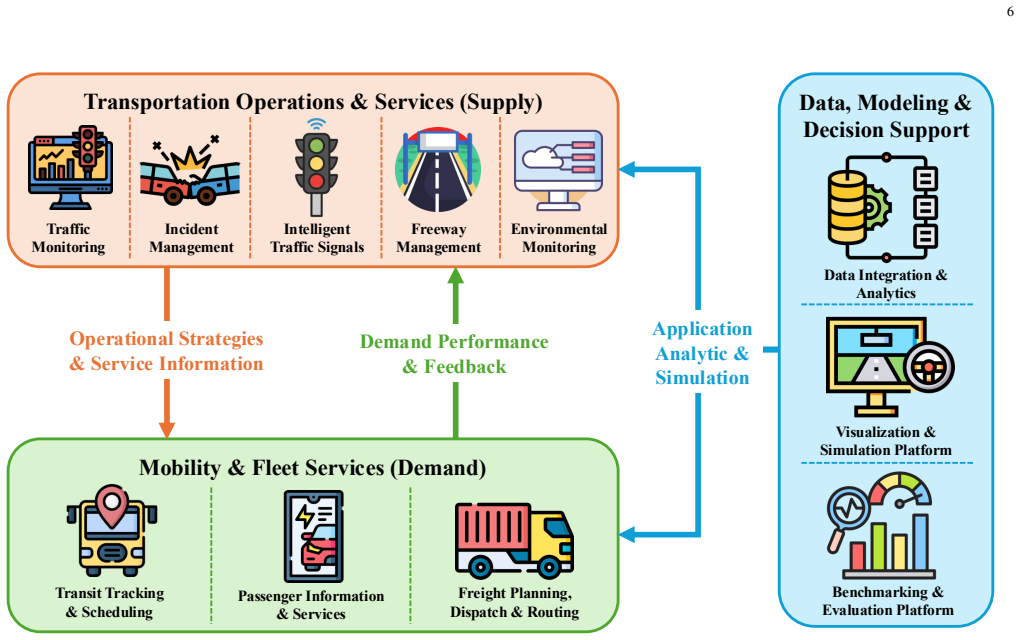
PRISMA-guided screening that categorizes applications into supply-side operations, demand-side mobility services, and data/modeling decision support while separating deployed uses from prototypes.
If this is right
- Operators gain a unified interface for incident reports, camera feeds, and sensor streams without custom integration code for each modality.
- Real-time inference constraints and governance requirements become the primary barriers to scaling beyond pilot projects.
- Localized model adaptation and edge deployment are required before cross-agency data sharing can expand the training base.
Where Pith is reading between the lines
- Benchmarking suites focused on transportation-specific multi-modal tasks could accelerate identification of which model sizes deliver acceptable latency on roadside hardware.
- Explainability tools developed for general LLMs may need domain-specific extensions to satisfy traffic operator audit requirements.
- The same fusion capability that aids incident response could be tested on predictive fleet maintenance schedules using combined maintenance logs and vehicle telemetry.
Load-bearing premise
The PRISMA screening process captured a representative and unbiased sample of existing studies on LLM applications in transportation.
What would settle it
Discovery of a substantial body of operational LLM deployments in TSMO that were missed by the screening would show the synthesis does not reflect current practice.
Figures
read the original abstract
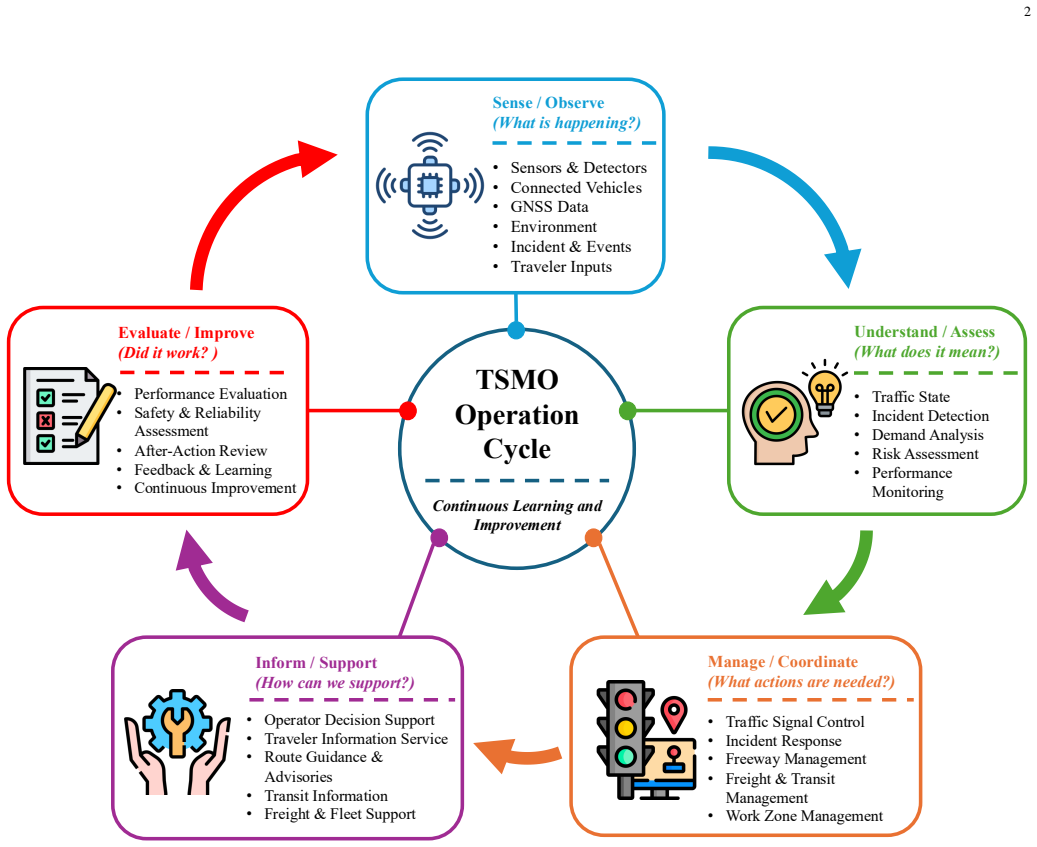
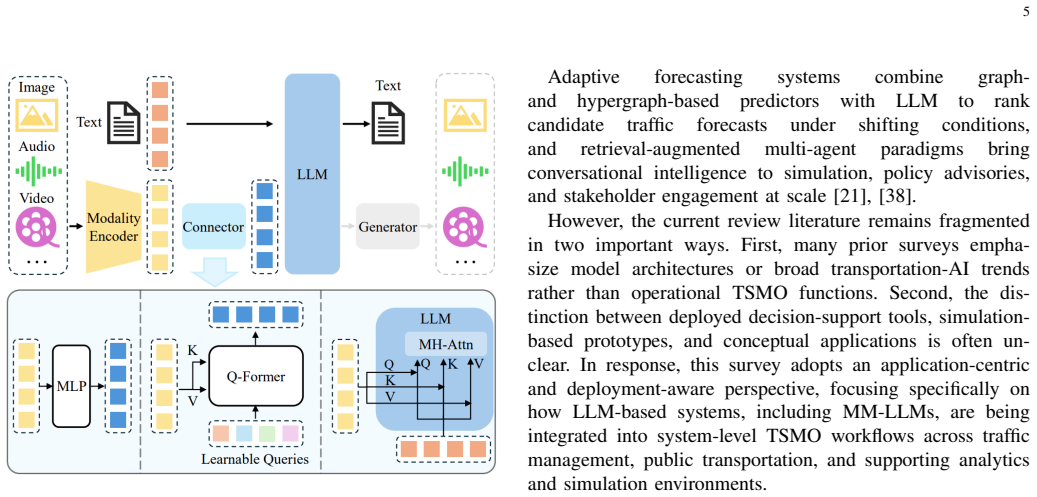
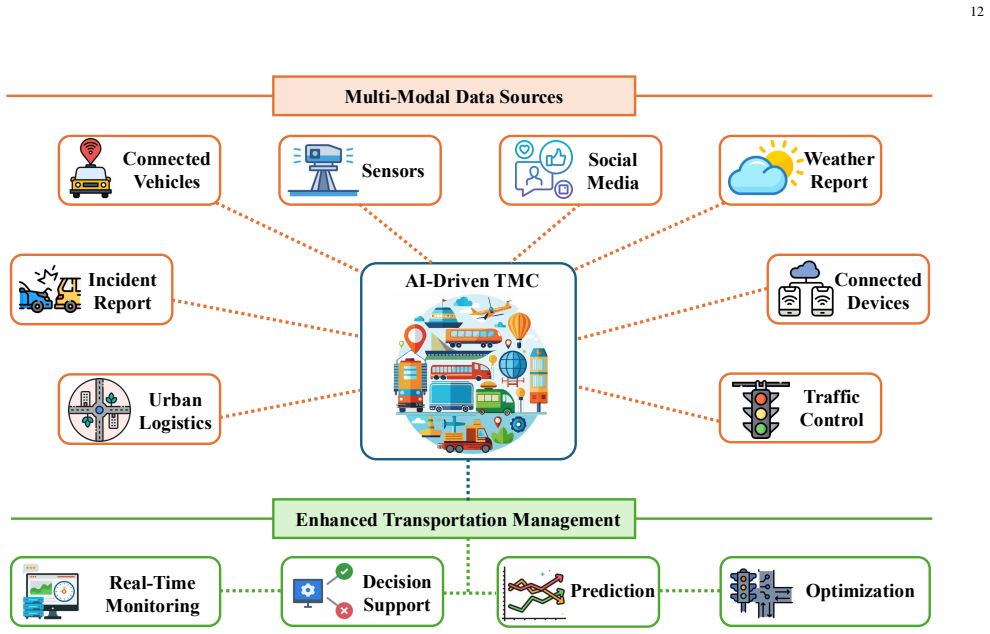
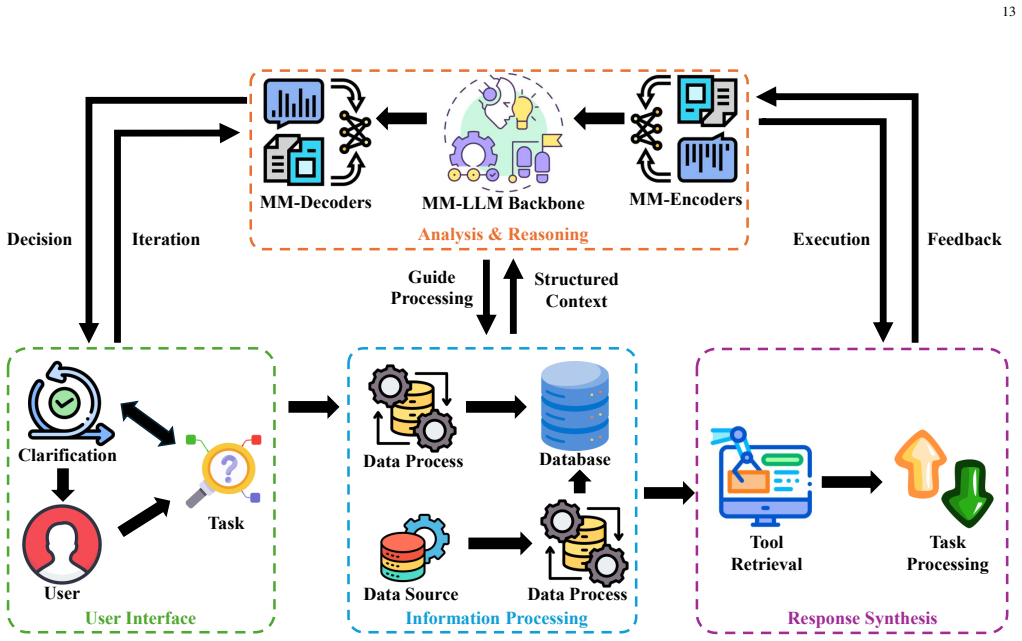
Transportation systems management and operations (TSMO) increasingly depends on timely interpretation of heterogeneous data, from various sensor streams, incident reports, traveler feedback, and visual observations. Large language models (LLMs), including emerging multi-modal large language models (MM-LLMs), provide a new mechanism for integrating these structured and unstructured inputs into operator-facing decision support. This survey paper reviews LLM- and MM-LLM-based applications in TSMO across three domains: transportation operations & services (supply), mobility & fleet services (demand), and data, modeling & decision support. Using a PRISMA-guided screening process, we synthesize current studies while distinguishing operationally oriented applications from prototype and emerging concepts. We further identify recurring challenges in data heterogeneity, real-time inference, explainability, multi-modal fusion, and governance. Finally, we outline existing gaps and future directions in localized adaptation, edge deployment, benchmarking, and cross-agency collaboration. Overall, LLM-based systems appear most promising as a decision-support layer, with MM-LLMs offering particular value when heterogeneous text, visual, and sensor inputs must be integrated.
Editorial analysis
A structured set of objections, weighed in public.
Referee Report
Summary. This survey paper reviews LLM- and MM-LLM-based applications in transportation systems management and operations (TSMO) across three domains (transportation operations & services, mobility & fleet services, and data/modeling/decision support). Using a PRISMA-guided screening process, it synthesizes studies while distinguishing operational applications from prototypes, identifies recurring challenges (data heterogeneity, real-time inference, explainability, multi-modal fusion, governance), outlines gaps and future directions (localized adaptation, edge deployment, benchmarking, cross-agency collaboration), and concludes that LLM-based systems appear most promising as a decision-support layer with MM-LLMs particularly valuable for integrating heterogeneous text, visual, and sensor inputs.
Significance. If the screened literature is representative, the paper provides a timely structured synthesis of an emerging intersection between large language models and transportation engineering. The explicit separation of operational versus prototype work and the enumeration of concrete challenges and gaps could usefully orient future research on edge deployment and benchmarking.
major comments (1)
- [Abstract] Abstract (and any dedicated Methods section): The PRISMA-guided screening process is invoked but supplies no search strings, databases queried, inclusion/exclusion criteria, or PRISMA flow numbers (studies screened, duplicates removed, full-text assessed, included). This information is required to evaluate whether the sample is representative and unbiased; its absence directly undermines the load-bearing claim that LLM-based systems 'appear most promising as a decision-support layer.'
Simulated Author's Rebuttal
We thank the referee for the constructive comment on methodological transparency. We address the point below and will revise accordingly.
read point-by-point responses
-
Referee: [Abstract] Abstract (and any dedicated Methods section): The PRISMA-guided screening process is invoked but supplies no search strings, databases queried, inclusion/exclusion criteria, or PRISMA flow numbers (studies screened, duplicates removed, full-text assessed, included). This information is required to evaluate whether the sample is representative and unbiased; its absence directly undermines the load-bearing claim that LLM-based systems 'appear most promising as a decision-support layer.'
Authors: We agree that the PRISMA details were omitted from the original submission, which limits the ability to assess representativeness. In the revised manuscript we will insert a dedicated Methods section (and update the abstract if needed) that explicitly reports the search strings, databases queried, inclusion/exclusion criteria, and a complete PRISMA flow diagram with the relevant counts. This addition will directly support the synthesis and the concluding claim by documenting the systematic selection process. The claim itself rests on patterns observed across the included studies (operational vs. prototype applications); supplying the screening details will strengthen rather than alter that assessment. revision: yes
Circularity Check
No circularity: literature review with no derivations
full rationale
This is a PRISMA-guided survey paper synthesizing existing LLM/MM-LLM studies in TSMO across three domains. It contains no equations, fitted parameters, predictions, uniqueness theorems, or derivation chains of any kind. The central claim that LLM-based systems appear most promising as a decision-support layer is an interpretive synthesis of reviewed literature rather than a result derived from the paper's own inputs or self-citations. No load-bearing step reduces to a self-definition or fitted input by construction.
Axiom & Free-Parameter Ledger
Reference graph
Works this paper leans on
-
[1]
A survey of intelligent transportation systems,
S. H. An, B. H. Lee, and D. R. Shin, “A survey of intelligent transportation systems,”Proceedings - 3rd International Conference on Computational Intelligence, Communication Systems and Networks, CICSyN 2011, pp. 332–337, 2011
2011
-
[2]
Advanced Learning Technologies for Intelligent Trans- portation Systems: Prospects and Challenges,
R. A. Khalil, Z. Safelnasr, N. Yemane, M. Kedir, A. Shafiqurrahman, and N. Saeed, “Advanced Learning Technologies for Intelligent Trans- portation Systems: Prospects and Challenges,”IEEE Open Journal of Vehicular Technology, vol. 5, pp. 397–427, 2024
2024
-
[3]
Metaverse for Intelligent Transportation Systems (ITS): A Comprehensive Review of Technologies, Applications, Implications, Challenges and Future Directions,
D. S. Sarwatt, Y . Lin, J. Ding, Y . Sun, and H. Ning, “Metaverse for Intelligent Transportation Systems (ITS): A Comprehensive Review of Technologies, Applications, Implications, Challenges and Future Directions,”IEEE Transactions on Intelligent Transportation Systems, vol. 25, no. 7, pp. 6290–6308, 2024
2024
-
[4]
Transportation Systems Manage- ment and Operations (TSMO)-Emphasis on Data-Driven Transportation Decisions Using Performance Measures,
K. A. Abedi, J. A. Codjoe, J. Lee, M. J. Khattak, X. Sun, S. Mensah, I. A. Stantec, and M. Farmer-Kaiser, “Transportation Systems Manage- ment and Operations (TSMO)-Emphasis on Data-Driven Transportation Decisions Using Performance Measures,” 2024
2024
-
[5]
Language Models are Few-Shot Learners,
T. B. Brown, B. Mann, N. Ryder, M. Subbiah, J. Kaplan, P. Dhariwal, A. Neelakantan, P. Shyam, G. Sastry, A. Askell, S. Agarwal, A. Herbert-V oss, G. Krueger, T. Henighan, R. Child, A. Ramesh, D. M. Ziegler, J. Wu, C. Winter, C. Hesse, M. Chen, E. Sigler, M. Litwin, S. Gray, B. Chess, J. Clark, C. Berner, S. McCandlish, A. Radford, I. Sutskever, and D. Amo...
Pith/arXiv arXiv 2020
-
[6]
Exploring the Potential of Large Language Models in Public Transportation: San Antonio Case Study,
R. Jonnala, G. Liang, J. Yang, and I. Alsmadi, “Exploring the Potential of Large Language Models in Public Transportation: San Antonio Case Study,” 1 2025. [Online]. Available: http://arxiv.org/abs/2501.03904
arXiv 2025
-
[7]
Transportation Systems Management and Operations Strategies — Organizing and Planning for Operations - FHW A Office of Operations,
U. D. o. T. Federal Highway Administration, “Transportation Systems Management and Operations Strategies — Organizing and Planning for Operations - FHW A Office of Operations,” 5
-
[8]
Available: https://ops.fhwa.dot.gov/plan4ops/focus areas/integrating/operations strategies.htm
[Online]. Available: https://ops.fhwa.dot.gov/plan4ops/focus areas/integrating/operations strategies.htm
-
[9]
The PRISMA 2020 statement: an updated guideline for reporting systematic reviews,
M. J. Page, J. E. McKenzie, P. M. Bossuyt, I. Boutron, T. C. Hoffmann, C. D. Mulrow, L. Shamseer, J. M. Tetzlaff, E. A. Akl, S. E. Brennan, R. Chou, J. Glanville, J. M. Grimshaw, A. Hr ´objartsson, M. M. Lalu, T. Li, E. W. Loder, E. Mayo-Wilson, S. McDonald, L. A. McGuinness, L. A. Stewart, J. Thomas, A. C. Tricco, V . A. Welch, P. Whiting, and D. Moher, ...
2020
-
[10]
The Handbook of Computational Linguistics and Natural Language Processing,
A. Clark, C. Fox, and S. Lappin, “The Handbook of Computational Linguistics and Natural Language Processing,”The Handbook of Computational Linguistics and Natural Language Processing, 6 2010. [Online]. Available: https://onlinelibrary.wiley.com/doi/book/10.1002/ 9781444324044
2010
-
[11]
LA VIS: A Library for Language-Vision Intelligence,
D. Li, J. Li, H. Le, G. Wang, S. Savarese, and S. C. H. Hoi, “LA VIS: A Library for Language-Vision Intelligence,” 9 2022. [Online]. Available: http://arxiv.org/abs/2209.09019
arXiv 2022
-
[12]
A. Vaswani, G. Brain, N. Shazeer, N. Parmar, J. Uszkoreit, L. Jones, A. N. Gomez, Ł. Kaiser, and I. Polosukhin, “Attention Is All You Need,” p. 1, 6 2017. [Online]. Available: https: //arxiv.org/pdf/1706.03762
Pith/arXiv arXiv 2017
-
[13]
How Well Do LLMs Predict Prerequisite Skills? Zero-Shot Comparison to Expert-Defined Concepts,
N. L. Le and M.-H. Abel, “How Well Do LLMs Predict Prerequisite Skills? Zero-Shot Comparison to Expert-Defined Concepts,” 7 2025. [Online]. Available: http://arxiv.org/abs/2507.18479
arXiv 2025
-
[14]
BERT: Pre-training of Deep Bidirectional Transformers for Language Understanding,
J. Devlin, M. W. Chang, K. Lee, and K. Toutanova, “BERT: Pre-training of Deep Bidirectional Transformers for Language Understanding,” NAACL HLT 2019 - 2019 Conference of the North American Chapter of the Association for Computational Linguistics: Human Language Technologies - Proceedings of the Conference, vol. 1, pp. 4171–4186, 10 2018. [Online]. Availab...
Pith/arXiv arXiv 2019
-
[15]
LLaMA: Open and Efficient Foundation Language Models,
H. Touvron, T. Lavril, G. Izacard, X. Martinet, M.-A. Lachaux, T. Lacroix, B. Rozi `ere, N. Goyal, E. Hambro, F. Azhar, A. Rodriguez, A. Joulin, E. Grave, and G. Lample, “LLaMA: Open and Efficient Foundation Language Models,” 2 2023. [Online]. Available: https://arxiv.org/pdf/2302.13971
Pith/arXiv arXiv 2023
-
[16]
Mamba: Linear-Time Sequence Modeling with Selective State Spaces,
A. Gu and T. Dao, “Mamba: Linear-Time Sequence Modeling with Selective State Spaces,” 12 2023. [Online]. Available: https: //arxiv.org/pdf/2312.00752 15
Pith/arXiv arXiv 2023
-
[17]
Llama 2: Open Foundation and Fine-Tuned Chat Models,
H. Touvron, L. Martin, K. Stone, P. Albert, A. Almahairi, Y . Babaei, N. Bashlykov, S. Batra, P. Bhargava, S. Bhosale, D. Bikel, L. Blecher, C. C. Ferrer, M. Chen, G. Cucurull, D. Esiobu, J. Fernandes, J. Fu, W. Fu, B. Fuller, C. Gao, V . Goswami, N. Goyal, A. Hartshorn, S. Hosseini, R. Hou, H. Inan, M. Kardas, V . Kerkez, M. Khabsa, I. Kloumann, A. Koren...
Pith/arXiv arXiv 2023
-
[18]
A Survey of Large Language Models,
W. X. Zhao, K. Zhou, J. Li, T. Tang, X. Wang, Y . Hou, Y . Min, B. Zhang, J. Zhang, Z. Dong, Y . Du, C. Yang, Y . Chen, Z. Chen, J. Jiang, R. Ren, Y . Li, X. Tang, Z. Liu, P. Liu, J.-Y . Nie, and J.-R. Wen, “A Survey of Large Language Models,” arXiv preprint arXiv:2303.18223, 3 2023. [Online]. Available: https://arxiv.org/pdf/2303.18223
Pith/arXiv arXiv 2023
-
[19]
A Survey on Multimodal Large Language Models,
S. Yin, C. Fu, S. Zhao, K. Li, X. Sun, T. Xu, and E. Chen, “A Survey on Multimodal Large Language Models,”National Science Review, vol. 11, no. 12, 6 2023. [Online]. Available: https://arxiv.org/pdf/2306.13549
Pith/arXiv arXiv 2023
-
[20]
A Comprehensive Overview of Large Language Models,
H. Naveed, A. U. Khan, S. Qiu, M. Saqib, S. Anwar, M. Usman, N. Akhtar, N. Barnes, and A. Mian, “A Comprehensive Overview of Large Language Models,”ACM Transactions on Intelligent Systems and Technology, vol. 16, no. 5, 8 2025. [Online]. Available: /doi/pdf/10.1145/3744746?download=true
-
[21]
Transformers are SSMs: Generalized Models and Efficient Algorithms Through Structured State Space Duality,
T. Dao and A. Gu, “Transformers are SSMs: Generalized Models and Efficient Algorithms Through Structured State Space Duality,” 5
-
[22]
Available: http://arxiv.org/abs/2405.21060
[Online]. Available: http://arxiv.org/abs/2405.21060
-
[23]
Embracing Large Language Models in Traffic Flow Forecasting,
Y . Zhao, X. Luo, H. Wen, Z. Xiao, W. Ju, and M. Zhang, “Embracing Large Language Models in Traffic Flow Forecasting,” 12 2024. [Online]. Available: http://arxiv.org/abs/2412.12201
arXiv 2024
-
[24]
Casscetta,Transportation Systems Analysis: Models and Applications, 2009, vol
E. Casscetta,Transportation Systems Analysis: Models and Applications, 2009, vol. 2. [Online]. Available: https://books.google.com/books?hl=en&lr=&id=AbU69bKmVScC& oi=fnd&pg=PR5&dq=transportation+systems+management+and+ operations&ots=wUu7rUkBUl&sig=VnAmoO3lkP-Ed0UuE0i3rKc tSs#v=onepage&q=transportation%20systems%20management% 20and%20operations&f=false
2009
-
[25]
Intelligent transportation systems: Systems based on cognitive networking principles and man- agement functionality,
G. Dimitrakopoulos and P. Demestichas, “Intelligent transportation systems: Systems based on cognitive networking principles and man- agement functionality,”IEEE Vehicular Technology Magazine, vol. 5, no. 1, pp. 77–84, 3 2010
2010
-
[26]
Applying Transportation Systems Management and Operations (TSMO) to Rural Areas,
E. Birriel, D. Mitchell, V . Sullivan, J. Peters, I. Leidos, and D. Associates, “Applying Transportation Systems Management and Operations (TSMO) to Rural Areas,” 10 2022. [Online]. Available: https://rosap.ntl.bts.gov/view/dot/64640
2022
-
[27]
Transportation Systems Management and Operations (TSMO) in Smart Connected Communi- ties,
U. D. o. T. Federal Highway Administration, “Transportation Systems Management and Operations (TSMO) in Smart Connected Communi- ties,” Tech. Rep., 12 2018
2018
-
[28]
Large models in transportation infrastructure: a perspective,
Y . Du, “Large models in transportation infrastructure: a perspective,” Intelligent Transportation Infrastructure, vol. 3, 2024
2024
-
[29]
Integrating LLMs with ITS: Recent Advances, Potentials, Challenges, and Future Directions,
D. Mahmud, H. Hajmohamed, S. Almentheri, S. Alqaydi, L. Aldhaheri, R. A. Khalil, and N. Saeed, “Integrating LLMs with ITS: Recent Advances, Potentials, Challenges, and Future Directions,” 1 2025. [Online]. Available: http://arxiv.org/abs/2501.04437
arXiv 2025
-
[30]
Large Language Models for Intelligent Transportation: A Review of the State of the Art and Challenges,
S. Wandelt, C. Zheng, S. Wang, Y . Liu, and X. Sun, “Large Language Models for Intelligent Transportation: A Review of the State of the Art and Challenges,” 9 2024
2024
-
[31]
Large models for intelligent transportation systems and autonomous vehicles: A survey,
L. Gan, W. Chu, G. Li, X. Tang, and K. Li, “Large models for intelligent transportation systems and autonomous vehicles: A survey,” 10 2024
2024
-
[32]
A Survey on the Ap- plications of Frontier AI, Foundation Models, and Large Language Models to Intelligent Transportation Systems,
M. R. Shoaib, H. M. Emara, and J. Zhao, “A Survey on the Ap- plications of Frontier AI, Foundation Models, and Large Language Models to Intelligent Transportation Systems,” inICCA 2023 - 2023 5th International Conference on Computer and Applications, Proceedings. Institute of Electrical and Electronics Engineers Inc., 2023
2023
-
[33]
Visual Mamba: A Survey and New Outlooks,
R. Xu, S. Yang, Y . Wang, Y . Cai, B. Du, and H. Chen, “Visual Mamba: A Survey and New Outlooks,” 11 2024. [Online]. Available: http://arxiv.org/abs/2404.18861
arXiv 2024
-
[34]
Multimodal LLM for Intelligent Transportation Systems,
D. Le, A. Yunusoglu, K. Tiwari, M. Isik, and I. C. Dikmen, “Multimodal LLM for Intelligent Transportation Systems,” 12 2024. [Online]. Available: http://arxiv.org/abs/2412.11683
arXiv 2024
-
[35]
LLM4Drive: A Survey of Large Language Models for Autonomous Driving,
Z. Yang, X. Jia, H. Li, and J. Yan, “LLM4Drive: A Survey of Large Language Models for Autonomous Driving,” 8 2024. [Online]. Available: http://arxiv.org/abs/2311.01043
arXiv 2024
-
[36]
A Survey on Multimodal Large Language Models for Autonomous Driving,
C. Cui, Y . Ma, X. Cao, W. Ye, Y . Zhou, K. Liang, J. Chen, J. Lu, Z. Yang, K.-D. Liao, T. Gao, E. Li, K. Tang, Z. Cao, T. Zhou, A. Liu, X. Yan, S. Mei, J. Cao, Z. Wang, and C. Zheng, “A Survey on Multimodal Large Language Models for Autonomous Driving,” 11
-
[37]
Available: http://arxiv.org/abs/2311.12320
[Online]. Available: http://arxiv.org/abs/2311.12320
-
[38]
Generative AI for Autonomous Driving: Frontiers and Opportunities,
Y . Wang, S. Xing, C. Can, R. Li, H. Hua, K. Tian, Z. Mo, X. Gao, K. Wu, S. Zhou, H. You, J. Peng, J. Zhang, Z. Wang, R. Song, M. Yan, W. Zimmer, X. Zhou, P. Li, Z. Lu, C.-J. Chen, Y . Huang, R. A. Rossi, L. Sun, H. Yu, Z. Fan, F. H. Yang, Y . Kang, R. Greer, C. Liu, E. H. Lee, X. Di, X. Ye, L. Ren, A. Knoll, X. Li, S. Ji, M. Tomizuka, M. Pavone, T. Yang,...
arXiv 2025
-
[39]
Evaluating and Enhancing Trustworthiness of LLMs in Perception Tasks,
M. A. M. Dona, B. Cabrero-Daniel, Y . Yu, and C. Berger, “Evaluating and Enhancing Trustworthiness of LLMs in Perception Tasks,” 7
-
[40]
Available: http://arxiv.org/abs/2408.01433
[Online]. Available: http://arxiv.org/abs/2408.01433
-
[41]
Can ChatGPT Enable ITS? The Case of Mixed Traffic Control via Reinforcement Learning,
M. Villarreal, B. Poudel, and W. Li, “Can ChatGPT Enable ITS? The Case of Mixed Traffic Control via Reinforcement Learning,”IEEE Conference on Intelligent Transportation Systems, Proceedings, ITSC, pp. 3749–3755, 6 2023. [Online]. Available: https://arxiv.org/pdf/2306.08094
arXiv 2023
-
[42]
H. Xu, J. Yuan, A. Zhou, G. Xu, W. Li, X. Ban, and X. Ye, “GenAI-powered Multi-Agent Paradigm for Smart Urban Mobility: Opportunities and Challenges for Integrating Large Language Models (LLMs) and Retrieval-Augmented Generation (RAG) with Intelligent Transportation Systems,” 9 2024. [Online]. Available: http://arxiv.org/abs/2409.00494
arXiv 2024
-
[43]
Open-ti: open traffic intelligence with augmented language model,
L. Da, K. Liou, T. Chen, X. Zhou, X. Luo, Y . Yang, and H. Wei, “Open-ti: open traffic intelligence with augmented language model,” International Journal of Machine Learning and Cybernetics, vol. 15, no. 10, pp. 4761–4786, 10 2024
2024
-
[44]
Traffic accident detection and condition analysis based on social networking data,
F. Ali, A. Ali, M. Imran, R. A. Naqvi, M. H. Siddiqi, and K. S. Kwak, “Traffic accident detection and condition analysis based on social networking data,”Accident Analysis & Prevention, vol. 151, p. 105973, 3 2021. [Online]. Available: https: //www.sciencedirect.com/science/article/abs/pii/S000145752100004X
2021
-
[45]
Empowering real- time traffic reporting systems with NLP-Processed social media data,
X. Wan, M. C. Lucic, H. Ghazzai, and Y . Massoud, “Empowering real- time traffic reporting systems with NLP-Processed social media data,” IEEE Open Journal of Intelligent Transportation Systems, vol. 1, pp. 159–175, 2020
2020
-
[46]
B. Wang, Z. Cai, M. M. Karim, C. Liu, and Y . Wang, “Traffic Performance GPT (TP-GPT): Real-Time Data Informed Intelligent ChatBot for Transportation Surveillance and Management,” 5 2024. [Online]. Available: https://arxiv.org/pdf/2405.03076v1
arXiv 2024
-
[47]
AI-Integrated Traffic Information System: A Synergistic Approach of Physics Informed Neural Network and GPT-4 for Traffic Estimation and Real-Time Assistance,
T. Syum Gebre, L. Beni, E. Tsehaye Wasehun, and F. Elikem Dorbu, “AI-Integrated Traffic Information System: A Synergistic Approach of Physics Informed Neural Network and GPT-4 for Traffic Estimation and Real-Time Assistance,”IEEE Access, vol. 12, pp. 65 869–65 882, 2024
2024
-
[48]
Strada-LLM: Graph LLM for traffic prediction,
S. M. Moghadas, Y . Lyu, B. Cornelis, A. Alahi, and A. Munteanu, “Strada-LLM: Graph LLM for traffic prediction,” 2 2025. [Online]. Available: http://arxiv.org/abs/2410.20856
arXiv 2025
-
[49]
Towards Explainable Traffic Flow Prediction with Large Language Models,
X. Guo, Q. Zhang, J. Jiang, M. Peng, H. Yang, and M. Zhu, “Towards Explainable Traffic Flow Prediction with Large Language Models,” 9
-
[50]
Available: https://arxiv.org/pdf/2404.02937v3
[Online]. Available: https://arxiv.org/pdf/2404.02937v3
-
[51]
TrafficGPT: Viewing, processing and interacting with traffic foundation models,
S. Zhang, D. Fu, W. Liang, Z. Zhang, B. Yu, P. Cai, and B. Yao, “TrafficGPT: Viewing, processing and interacting with traffic foundation models,”Transport Policy, vol. 150, pp. 95–105, 5 2024. [Online]. Available: https://www.sciencedirect.com/science/article/abs/ pii/S0967070X24000726
2024
-
[52]
Spatial- Temporal Large Language Model for Traffic Prediction,
C. Liu, S. Yang, Q. Xu, Z. Li, C. Long, Z. Li, and R. Zhao, “Spatial- Temporal Large Language Model for Traffic Prediction,”Proceedings - IEEE International Conference on Mobile Data Management, pp. 31–40, 1 2024. [Online]. Available: https://arxiv.org/pdf/2401.10134
arXiv 2024
-
[53]
TransGPT: Multi-modal Generative Pre-trained Transformer for Transportation,
P. Wang, X. Wei, F. Hu, and W. Han, “TransGPT: Multi-modal Generative Pre-trained Transformer for Transportation,”Proceedings - 2024 International Conference on Computational Linguistics and Natural Language Processing, CLNLP 2024, pp. 96–100, 2 2024. [Online]. Available: https://arxiv.org/pdf/2402.07233
arXiv 2024
-
[54]
H. Zhen, Y . Shi, Y . Huang, J. J. Yang, and N. Liu, “Leveraging Large Language Models with Chain-of-Thought and Prompt Engineering for Traffic Crash Severity Analysis and Inference,” 8 2024. [Online]. Available: https://arxiv.org/pdf/2408.04652 16
arXiv 2024
-
[55]
IncidentResponseGPT: Generating Traffic Incident Response Plans with Generative Artificial Intelligence,
A. Grigorev, A.-S. M. K. Saleh, and Y . Ou, “IncidentResponseGPT: Generating Traffic Incident Response Plans with Generative Artificial Intelligence,” 4 2024. [Online]. Available: https://arxiv.org/pdf/2404. 18550
2024
-
[56]
L. Wang, Y . Ren, H. Jiang, P. Cai, D. Fu, T. Wang, Z. Cui, H. Yu, X. Wang, H. Zhou, H. Huang, and Y . Wang, “AccidentGPT: Accident Analysis and Prevention from V2X Environmental Perception with Multi-modal Large Model,” 12 2023. [Online]. Available: https://arxiv.org/pdf/2312.13156
arXiv 2023
-
[57]
O. Zheng, M. Abdel-Aty, D. Wang, C. Wang, and S. Ding, “TrafficSafetyGPT: Tuning a Pre-trained Large Language Model to a Domain-Specific Expert in Transportation Safety,” 7 2023. [Online]. Available: https://arxiv.org/pdf/2307.15311
arXiv 2023
-
[58]
Gen-AI for TSMO Knowledge Management,
S. Somvanshi, J. Liu, and S. Das, “Gen-AI for TSMO Knowledge Management,” 12 2024. [Online]. Available: https://papers.ssrn.com/ abstract=5049945
2024
-
[59]
S. Masri, H. I. Ashqar, and M. Elhenawy, “Leveraging Large Language Models (LLMs) for Traffic Management at Urban Intersections: The Case of Mixed Traffic Scenarios,” 8 2024. [Online]. Available: https://arxiv.org/pdf/2408.00948
arXiv 2024
-
[60]
A. Pang, M. Wang, M.-O. Pun, C. S. Chen, and X. Xiong, “iLLM-TSC: Integration reinforcement learning and large language model for traffic signal control policy improvement,” 7 2024. [Online]. Available: https://arxiv.org/pdf/2407.06025
arXiv 2024
-
[61]
LLMLight: Large Language Models as Traffic Signal Control Agents,
S. Lai, Z. Xu, W. Zhang, H. Liu, and H. Xiong, “LLMLight: Large Language Models as Traffic Signal Control Agents,” 12 2024. [Online]. Available: https://arxiv.org/pdf/2312.16044v1
arXiv 2024
-
[62]
Large Language Models as Urban Residents: An LLM Agent Framework for Personal Mobility Generation,
J. Wang, R. Jiang, C. Yang, Z. Wu, M. Onizuka, R. Shibasaki, N. Koshizuka, and C. Xiao, “Large Language Models as Urban Residents: An LLM Agent Framework for Personal Mobility Generation,”Advances in Neural Information Processing Systems, vol. 37, 2 2024. [Online]. Available: https://arxiv.org/pdf/2402.14744
arXiv 2024
-
[63]
Exploring traffic accident locations from natural language based on spatial information retrieval,
S. Wang, H. Dong, Y . Zhou, L. Jia, and Y . Qin, “Exploring traffic accident locations from natural language based on spatial information retrieval,”Proceedings of the 29th Chinese Control and Decision Conference, CCDC 2017, pp. 3490–3495, 7 2017
2017
-
[64]
WEDGE: A multi-weather autonomous driving dataset built from generative vision- language models,
A. Marathe, D. Ramanan, R. Walambe, and K. Kotecha, “WEDGE: A multi-weather autonomous driving dataset built from generative vision- language models,”IEEE Computer Society Conference on Computer Vision and Pattern Recognition Workshops, vol. 2023-June, pp. 3318– 3327, 5 2023. [Online]. Available: https://arxiv.org/pdf/2305.07528
arXiv 2023
-
[65]
K. Yin, C. Liu, A. Mostafavi, and X. Hu, “CrisisSense-LLM: Instruction Fine-Tuned Large Language Model for Multi-label Social Media Text Classification in Disaster Informatics,” 6 2024. [Online]. Available: https://arxiv.org/pdf/2406.15477
arXiv 2024
-
[66]
Y . Yan, Y . Liao, G. Xu, R. Yao, H. Fan, J. Sun, X. Wang, J. Sprinkle, Z. An, M. Ma, X. Cheng, T. Liu, Z. Ke, B. Zou, M. Barth, and Y .-H. Kuo, “Large Language Models for Traffic and Transportation Research: Methodologies, State of the Art, and Future Opportunities,” 3 2025. [Online]. Available: https://arxiv.org/pdf/2503.21330
arXiv 2025
-
[67]
A. Grigorev, K. Saleh, Y . Ou, and A.-S. Mihaita, “Enhancing Traffic Incident Management with Large Language Models: A Hybrid Machine Learning Approach for Severity Classification,” 4 2024. [Online]. Available: http://arxiv.org/abs/2403.13547
arXiv 2024
-
[68]
Automating the loop in traffic incident management on highway,
M. Cercola, N. Gatti, P. Huertas Leyva, B. Carambia, and S. Formentin SIMONEFORMENTIN, “Automating the loop in traffic incident management on highway,”Proceedings of Machine Learning Research, vol. vvv, pp. 1–13, 3 2025. [Online]. Available: https://arxiv.org/pdf/2503.12085v1
arXiv 2025
-
[69]
T. Cai, Y . Liu, Z. Zhou, H. Ma, S. Z. Zhao, Z. Wu, and J. Ma, “Driving with Regulation: Interpretable Decision-Making for Autonomous Vehicles with Retrieval-Augmented Reasoning via LLM,” 3 2025. [Online]. Available: http://arxiv.org/abs/2410.04759
arXiv 2025
-
[70]
Driving Everywhere with Large Language Model Policy Adaptation,
B. Li, Y . Wang, J. Mao, B. Ivanovic, S. Veer, K. Leung, and M. Pavone, “Driving Everywhere with Large Language Model Policy Adaptation,”Proceedings of the IEEE Computer Society Conference on Computer Vision and Pattern Recognition, pp. 14 948–14 957, 2
-
[71]
Available: https://arxiv.org/pdf/2402.05932
[Online]. Available: https://arxiv.org/pdf/2402.05932
-
[72]
C. Chen, Y . He, H. Wang, J. Chen, and Q. Luo, “DelayPTC- LLM: Metro Passenger Travel Choice Prediction under Train Delays with Large Language Models,” 9 2024. [Online]. Available: https://arxiv.org/pdf/2410.00052
arXiv 2024
-
[73]
ORLM: A Customizable Framework in Training Large Models for Automated Optimization Modeling,
C. Huang, Z. Tang, S. Hu, R. Jiang, X. Zheng, D. Ge, B. Wang, and Z. Wang, “ORLM: A Customizable Framework in Training Large Models for Automated Optimization Modeling,”Operations Research, 5 2024. [Online]. Available: https://arxiv.org/pdf/2405.17743
arXiv 2024
-
[74]
TraveLLM: Could you plan my new public transit route in face of a network disruption?
B. Fang, Z. Yang, S. Wang, and X. Di, “TraveLLM: Could you plan my new public transit route in face of a network disruption?” 7 2024. [Online]. Available: http://arxiv.org/abs/2407.14926
arXiv 2024
-
[75]
Beyond Words: Evaluating Large Language Models in Transportation Planning,
S. Ying, Z. Li, and M. Yu, “Beyond Words: Evaluating Large Language Models in Transportation Planning,” 9 2024. [Online]. Available: https://arxiv.org/pdf/2409.14516
arXiv 2024
-
[76]
S. Devunuri and L. Lehe, “TransitGPT: A Generative AI-based framework for interacting with GTFS data using Large Language Models,” 12 2024. [Online]. Available: https://arxiv.org/pdf/2412.06831
arXiv 2024
-
[77]
Tupayachi, H
J. Tupayachi, H. Xu, O. A. Omitaomu, M. C. Camur, A. Sharmin, and X. Li, “Towards Next-Generation Urban Decision Support Systems through AI-Powered Construction of Scientific Ontology Using Large Language Models—A Case in Optimizing Intermodal Freight Transportation,”Smart Cities 2024, Vol. 7, Pages 2392-2421, vol. 7, no. 5, pp. 2392–2421, 8 2024. [Online...
2024
-
[78]
T. Nie, J. He, Y . Mei, G. Qin, G. Li, J. Sun, and W. Ma, “Joint estimation and prediction of city-wide delivery demand: A large language model empowered graph-based learning approach,” Transportation Research Part E: Logistics and Transportation Review, vol. 197, p. 104075, 5 2025. [Online]. Available: https: //doi.org/10.1609/aaai.v34i04.5716
-
[79]
Fine-Tuning Pre-Trained Large Language Models for Price Prediction on Network Freight Platforms,
P. Lu, P. Zhang, J. Wu, X. Wu, Y . Mao, and T. Liu, “Fine-Tuning Pre-Trained Large Language Models for Price Prediction on Network Freight Platforms,”Mathematics 2025, Vol. 13, Page 2504, vol. 13, no. 15, p. 2504, 8 2025. [Online]. Available: https://www.mdpi.com/2227-7390/13/15/2504/ htmhttps://www.mdpi.com/2227-7390/13/15/2504
2025
-
[80]
Smart Routing for Sustainable Supply Chain Networks: An AI and Knowledge Graph Driven Approach,
M. Felder, M. De Marchi, P. Dallasega, and E. Rauch, “Smart Routing for Sustainable Supply Chain Networks: An AI and Knowledge Graph Driven Approach,”Applied Sciences 2025, Vol. 15, Page 8001, vol. 15, no. 14, p. 8001, 7
2025
discussion (0)
Sign in with ORCID, Apple, or X to comment. Anyone can read and Pith papers without signing in.