Electronic Hall viscosity: hidden indicator for antiferromagnets
Pith reviewed 2026-06-28 16:52 UTC · model grok-4.3
The pith
Electronic Hall viscosity characterizes antiferromagnetic ordering via symmetry when anomalous Hall conductivity vanishes.
A machine-rendered reading of the paper's core claim, the machinery that carries it, and where it could break.
Core claim
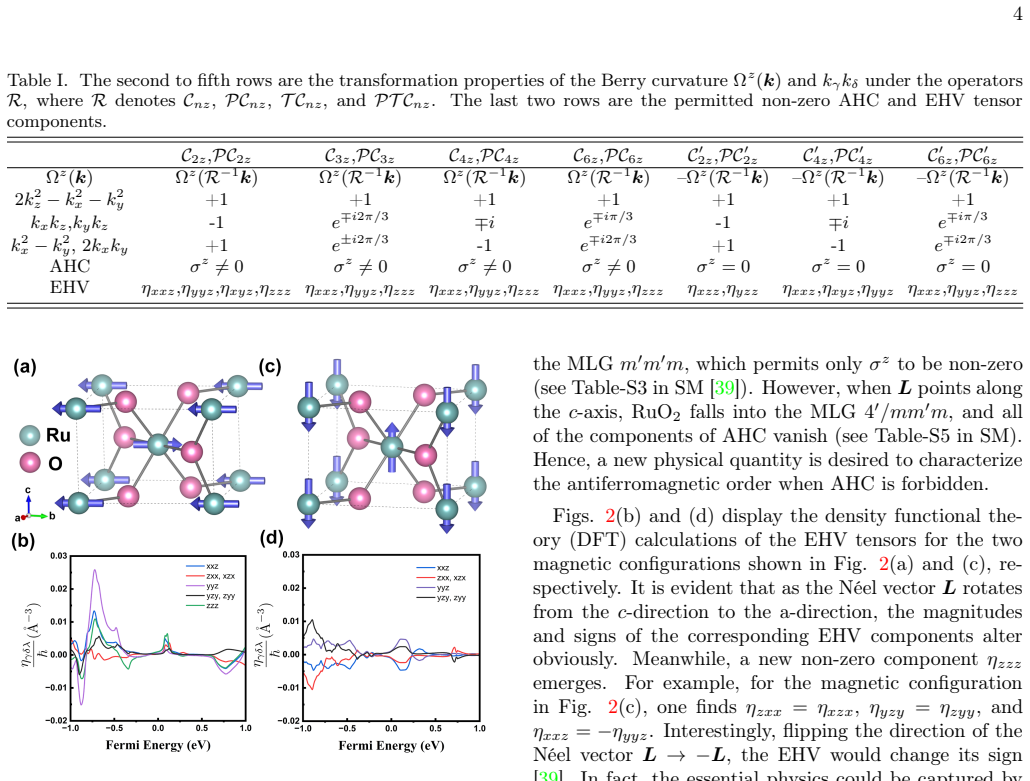
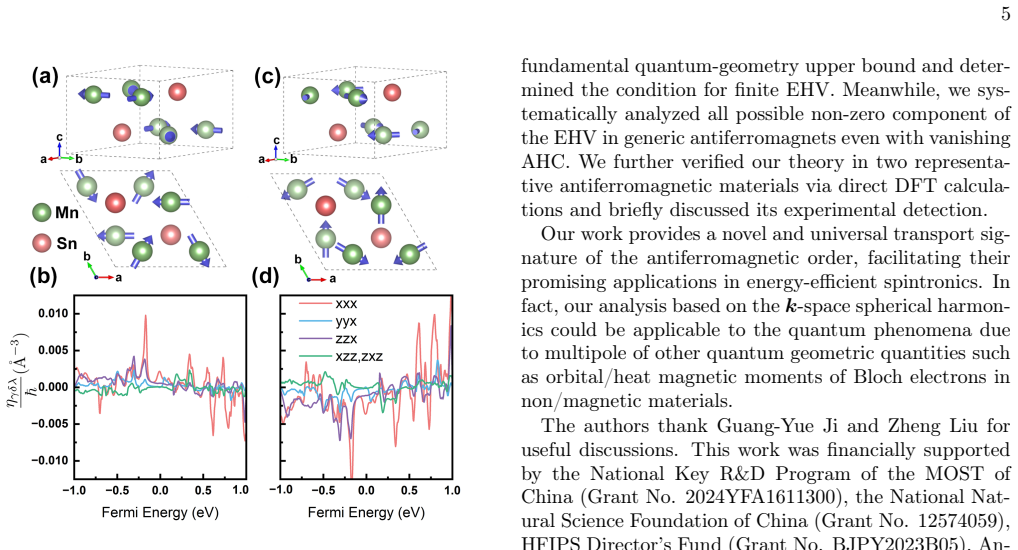
The electronic Hall viscosity is closely related to the quadruple Berry curvature of Bloch bands and is bounded by the d-orbit factor modulated second moment of the quantum volume. The symmetry requirement for nonzero electronic Hall viscosity could characterize antiferromagnetic ordering even when the linear anomalous Hall response gets forbidden. These findings are examined in two archetypal antiferromagnets, the d-wave altermagnet RuO2 and noncollinear Mn3Sn, through direct first-principle calculations.
What carries the argument
Electronic Hall viscosity arising from quadruple Berry curvature, subject to symmetry constraints that identify antiferromagnetic order.
If this is right
- Nonzero Hall viscosity can appear in antiferromagnets where symmetry forbids linear anomalous Hall conductivity.
- The viscosity obeys a bound set by the d-orbit factor and quantum-volume second moment.
- The same symmetry rules apply to both d-wave altermagnets like RuO2 and noncollinear structures like Mn3Sn.
- The quantity supplies a design handle for antiferromagnetic spintronics devices that rely on hidden Berry curvature.
Where Pith is reading between the lines
- Experimental setups that measure shear viscosity in current-carrying antiferromagnetic films could directly test the symmetry prediction.
- The relation between higher-order Berry curvature and transport coefficients may extend to other response functions in magnetic materials.
- Materials with similar crystal symmetries but different orbital character could be screened for large Hall viscosity using the same bound.
Load-bearing premise
The symmetry requirement and its link to quadruple Berry curvature hold generally, and first-principles calculations on RuO2 and Mn3Sn accurately capture the electronic Hall viscosity without missing terms.
What would settle it
A calculation or measurement on RuO2 or Mn3Sn that yields electronic Hall viscosity inconsistent with the quadruple Berry curvature relation or that violates the derived symmetry condition for nonzero value.
Figures
read the original abstract
The antiferromagnets with negligible stray fields and ultrafast spin dynamics play a crucial role in the fields of energy-efficient spintronics and topological electronics. However, the detection and control of the underlying nontrivial Berry curvature become extremely limited by the vanishing magnetization and anomalous Hall conductivity. Here, we show the electronic Hall viscosity is closely related to the quadruple Berry curvature of Bloch bands and is bounded by the $d$-orbit factor modulated second moment of the quantum volume. Moreover, we derive the symmetry requirement for nonzero electronic Hall viscosity that could characterize antiferromagnetic ordering even when the linear anomalous Hall response gets forbidden. We further examine our key findings in two archetypal antiferromagnets: $d$-wave altermagnet $\mathrm{RuO}_{2}$, and noncollinear $\mathrm{Mn_{3}Sn}$ through direct first-principle calculations. Thus, our work reveals a new and fundamental quantum geometry quantity of generic antiferromagnets and offers a broadly applicable way to design antiferromagnetic spintronics devices via unconventional Hall viscosity.
Editorial analysis
A structured set of objections, weighed in public.
Referee Report
Summary. The manuscript claims that electronic Hall viscosity is closely related to the quadruple Berry curvature of Bloch bands and bounded by the d-orbit factor modulated second moment of the quantum volume. It derives a symmetry requirement for nonzero electronic Hall viscosity that can characterize antiferromagnetic ordering even when the linear anomalous Hall effect is forbidden by symmetry. These findings are examined via first-principles calculations on the d-wave altermagnet RuO2 and the noncollinear antiferromagnet Mn3Sn.
Significance. If the claimed relations hold without extraneous contributions, the work identifies a new quantum-geometric quantity that could serve as a probe for antiferromagnetic order in systems where conventional anomalous Hall conductivity vanishes, with potential implications for antiferromagnetic spintronics.
major comments (3)
- [Derivation of viscosity-Berry curvature relation] The Kubo-type response formula used to relate electronic Hall viscosity to quadruple Berry curvature (likely in the derivation section following the abstract) must be shown to exclude additional interband or orbital-moment contributions beyond the fourth-order geometric term; otherwise the direct proportionality does not hold.
- [Symmetry analysis] The magnetic space-group analysis deriving the symmetry requirement for nonzero Hall viscosity must exhaustively enumerate all allowed tensor components without implicit assumptions on spin-orbit coupling strength or specific lattice symmetries; this is load-bearing for the claim that the viscosity uniquely signals AF order when linear AHE is forbidden.
- [First-principles calculations section] In the first-principles calculations on RuO2 and Mn3Sn, the implementation of the viscosity (via Berry-phase or finite-difference methods) must be shown to reproduce the analytic relation to quadruple Berry curvature without post-processing adjustments; otherwise the numerical results do not validate the central claims.
minor comments (1)
- Notation for the 'quantum volume' and 'd-orbit factor' should be defined explicitly at first use with reference to the relevant equations.
Simulated Author's Rebuttal
We thank the referee for the detailed and constructive report. The comments identify areas where additional rigor will strengthen the manuscript. We address each major comment below and indicate the revisions planned.
read point-by-point responses
-
Referee: [Derivation of viscosity-Berry curvature relation] The Kubo-type response formula used to relate electronic Hall viscosity to quadruple Berry curvature (likely in the derivation section following the abstract) must be shown to exclude additional interband or orbital-moment contributions beyond the fourth-order geometric term; otherwise the direct proportionality does not hold.
Authors: We agree that explicit exclusion of extraneous terms is necessary for the claimed direct relation. Our Kubo derivation isolates the fourth-order geometric contribution by taking the appropriate frequency and wave-vector limits and subtracting the conventional orbital-moment and interband polarization terms. To make this transparent, we will add an appendix deriving the subtracted terms and confirming they vanish in the static, long-wavelength limit relevant to Hall viscosity. This constitutes a partial revision. revision: partial
-
Referee: [Symmetry analysis] The magnetic space-group analysis deriving the symmetry requirement for nonzero Hall viscosity must exhaustively enumerate all allowed tensor components without implicit assumptions on spin-orbit coupling strength or specific lattice symmetries; this is load-bearing for the claim that the viscosity uniquely signals AF order when linear AHE is forbidden.
Authors: The symmetry analysis in the manuscript is performed for the magnetic space groups of RuO2 and Mn3Sn, which are representative of d-wave altermagnets and noncollinear antiferromagnets. We acknowledge that a broader enumeration of allowed tensor components across common antiferromagnetic space groups would make the uniqueness claim more general. We will expand the symmetry section with a table listing the independent components of the Hall-viscosity tensor for the 36 magnetic point groups that permit antiferromagnetic order but forbid linear AHE. This is a yes revision. revision: yes
-
Referee: [First-principles calculations section] In the first-principles calculations on RuO2 and Mn3Sn, the implementation of the viscosity (via Berry-phase or finite-difference methods) must be shown to reproduce the analytic relation to quadruple Berry curvature without post-processing adjustments; otherwise the numerical results do not validate the central claims.
Authors: The viscosity values reported are obtained directly from the Berry-phase formula implemented in the Wannier-interpolated band structure without additional fitting or post-processing. We have already verified numerically that the computed viscosity matches the quadruple Berry curvature integral within numerical precision for both materials. To address the concern explicitly, we will add a supplementary figure comparing the two quantities side-by-side for representative k-points. This is a yes revision. revision: yes
Circularity Check
No circularity: claims presented without equations or self-referential reductions in available text
full rationale
The abstract and provided excerpts state that electronic Hall viscosity 'is closely related to the quadruple Berry curvature' and that symmetry requirements are 'derived,' but contain no equations, no fitted parameters renamed as predictions, and no self-citations invoked as load-bearing uniqueness theorems. Without explicit formulas showing reduction (e.g., viscosity defined via the same quadruple curvature it claims to predict), no self-definitional, fitted-input, or ansatz-smuggling steps can be exhibited. First-principles checks on RuO2 and Mn3Sn are described as direct examinations rather than post-hoc fits. The derivation chain is therefore self-contained against the given material.
Axiom & Free-Parameter Ledger
Reference graph
Works this paper leans on
-
[1]
Néel, Science174, 985 (1971)
L. Néel, Science174, 985 (1971)
1971
-
[2]
Baltz, A
V. Baltz, A. Manchon, M. Tsoi, T. Moriyama, T. Ono, and Y. Tserkovnyak, Rev. Mod. Phys.90, 015005 (2018)
2018
-
[3]
Jungwirth, X
T. Jungwirth, X. Marti, P. Wadley, and J. Wunderlich, Nature Nanotechnology11, 231 (2016)
2016
-
[4]
Nagaosa, J
N. Nagaosa, J. Sinova, S. Onoda, A. H. MacDonald, and N. P. Ong, Rev. Mod. Phys.82, 1539 (2010)
2010
-
[5]
Y.Tokura, K.Yasuda,andA.Tsukazaki,NatureReviews Physics1, 126 (2019)
2019
-
[6]
Auerbach,Interacting Electrons and Quantum Mag- netism(Springer-Verlag, Cambridge, 1994)
A. Auerbach,Interacting Electrons and Quantum Mag- netism(Springer-Verlag, Cambridge, 1994)
1994
-
[7]
J. P. Provost and G. Vallee, Communications in Mathe- matical Physics76, 289 (1980)
1980
-
[8]
Y.-Q. Ma, S. Chen, H. Fan, and W.-M. Liu, Phys. Rev. B81, 245129 (2010)
2010
-
[9]
J. E. Avron, R. Seiler, and P. G. Zograf, Phys. Rev. Lett. 75, 697 (1995)
1995
-
[10]
Xiao, M.-C
D. Xiao, M.-C. Chang, and Q. Niu, Rev. Mod. Phys.82, 1959 (2010)
1959
-
[11]
I. V. Tokatly and G. Vignale, Phys. Rev. B76, 161305 (2007)
2007
-
[12]
F. D. M. Haldane, Phys. Rev. Lett.107, 116801 (2011)
2011
-
[13]
Read and E
N. Read and E. H. Rezayi, Phys. Rev. B84, 085316 (2011)
2011
-
[14]
T. L. Hughes, R. G. Leigh, and E. Fradkin, Phys. Rev. Lett.107, 075502 (2011)
2011
-
[15]
Shapourian, T
H. Shapourian, T. L. Hughes, and S. Ryu, Phys. Rev. B 92, 165131 (2015). 6
2015
-
[16]
Rao and B
P. Rao and B. Bradlyn, Phys. Rev. X10, 021005 (2020)
2020
-
[17]
Hoyos and D
C. Hoyos and D. T. Son, Phys. Rev. Lett.108, 066805 (2012)
2012
-
[18]
Kozii, A
V. Kozii, A. Avdoshkin, S. Zhong, and J. E. Moore, Phys. Rev. Lett.126, 156602 (2021)
2021
-
[19]
Barkeshli, S
M. Barkeshli, S. B. Chung, and X.-L. Qi, Phys. Rev. B 85, 245107 (2012)
2012
-
[20]
Liu and J
D. Liu and J. Shi, Phys. Rev. Lett.119, 075301 (2017)
2017
- [21]
-
[22]
we choose the electron-phonon coupling, which can be cast into a vector coupling form asˆHe−ph =g ˆv· ˆA[u], wheregis the coupling constant, ˆvis the electron ve- locity, and ˆA[u]is the vector potential due to strain u[82–86]
-
[23]
Nakahara,Geometry, Topology and Physics, 2nd ed
M. Nakahara,Geometry, Topology and Physics, 2nd ed. (CRC Press, Boca Raton, 2003)
2003
-
[24]
Zhang and Q
L. Zhang and Q. Niu, Phys. Rev. Lett.115, 115502 (2015)
2015
-
[25]
Saparov, B
D. Saparov, B. Xiong, Y. Ren, and Q. Niu, Phys. Rev. B 105, 064303 (2022)
2022
-
[26]
Zhang and S
T. Zhang and S. Murakami, Phys. Rev. Res.4, L012024 (2022)
2022
-
[27]
Y.Chen, W.Qin, S.Zhang, P.Cui, Q.Niu,andZ.Zhang, Phys. Rev. Lett.135, 126608 (2025)
2025
- [28]
-
[29]
H. Chen, W. Chen, K. Yang, T. Cao, and D. Xiao, arXiv: 2605.06983 (2026)
work page internal anchor Pith review Pith/arXiv arXiv 2026
-
[30]
Onishi and L
Y. Onishi and L. Fu, Phys. Rev. X14, 011052 (2024)
2024
-
[31]
Pai and F
P. Pai and F. Zhang, Phys. Rev. Lett.136, 116601 (2026)
2026
-
[32]
The Cauchy-Schwarz inequality for the bounded and summable functionsf 1 (x)andf 2 (x)has the formR f1 (x)f 2 (x)dx 2 ≤ R f 2 1 (x)dx × R f 2 2 (x)dx [87]
-
[33]
Roy, Phys
R. Roy, Phys. Rev. B90, 165139 (2014)
2014
-
[34]
Ozawa and B
T. Ozawa and B. Mera, Phys. Rev. B104, 045103 (2021)
2021
-
[35]
Julku, S
A. Julku, S. Peotta, T. I. Vanhala, D.-H. Kim, and P. Törmä, Phys. Rev. Lett.117, 045303 (2016)
2016
-
[36]
Santini, S
P. Santini, S. Carretta, G. Amoretti, R. Caciuffo, N. Magnani, and G. H. Lander, Rev. Mod. Phys.81, 807 (2009)
2009
-
[37]
J. J. Sakurai and J. Napolitano,Modern Quantum Me- chanics, 3rd ed. (Cambridge University Press, 2020)
2020
-
[38]
Tahir and H
M. Tahir and H. Chen, Phys. Rev. Lett.131, 106701 (2023)
2023
-
[39]
See Supplemental Material for details of multipole expan- sionofBerrycurvature, symmetrypropertiesofEHVand AHC for all 10 MLGs and model calculations
-
[40]
M.-T.Suzuki, T.Koretsune, M.Ochi,andR.Arita,Phys. Rev. B95, 094406 (2017)
2017
-
[41]
J. Cao, W. Jiang, X.-P. Li, D. Tu, J. Zhou, J. Zhou, and Y. Yao, Phys. Rev. Lett.130, 166702 (2023)
2023
-
[42]
Kurumaji, Phys
T. Kurumaji, Phys. Rev. Res.5, 023138 (2023)
2023
-
[43]
W. H. Kleiner, Phys. Rev.142, 318 (1966)
1966
-
[44]
J.Zhou, W.Zhang, Y.-C.Lin, J.Cao, Y.Zhou, W.Jiang, H. Du, B. Tang, J. Shi, B. Jiang, X. Cao, B. Lin, Q. Fu, C. Zhu, W. Guo, Y. Huang, Y. Yao, S. S. P. Parkin, J. Zhou, Y. Gao, Y. Wang, Y. Hou, Y. Yao, K. Suenaga, X. Wu, and Z. Liu, Nature609, 46 (2022)
2022
-
[45]
M.Seemann, D.Ködderitzsch, S.Wimmer,andH.Ebert, Phys. Rev. B92, 155138 (2015)
2015
-
[46]
L. M. Sandratskii, R. F. Egorov, and A. A. Berdyshev, physica status solidi (b)104, 103 (1981)
1981
-
[47]
C. Wu, K. Sun, E. Fradkin, and S.-C. Zhang, Phys. Rev. B75, 115103 (2007)
2007
-
[48]
L.-D. Yuan, Z. Wang, J.-W. Luo, E. I. Rashba, and A. Zunger, Phys. Rev. B102, 014422 (2020)
2020
-
[49]
Šmejkal, R
L. Šmejkal, R. González-Hernández, T. Jungwirth, and J. Sinova, Science Advances6, eaaz8809 (2020)
2020
-
[50]
H.-Y. Ma, M. Hu, N. Li, J. Liu, W. Yao, J.-F. Jia, and J. Liu, Nature Communications12, 2846 (2021)
2021
-
[51]
Šmejkal, J
L. Šmejkal, J. Sinova, and T. Jungwirth, Phys. Rev. X 12, 031042 (2022)
2022
-
[52]
Mazin, Phys
I. Mazin, Phys. Rev. X12, 040002 (2022)
2022
-
[53]
L. Bai, W. Feng, S. Liu, L. Šmejkal, Y. Mokrousov, and Y. Yao, Advanced Functional Materials34, 2409327 (2024)
2024
-
[54]
C. Song, H. Bai, Z. Zhou, L. Han, H. Reichlova, J. H. Dil, J. Liu, X. Chen, and F. Pan, Nature Reviews Materials 10, 473 (2025)
2025
-
[55]
Altermagnetism: An unconventional spin- ordered phase of matter,
T. Jungwirth, R. M. Fernandes, E. Fradkin, A. H. MacDonald, J. Sinova, and L. Šmejkal, Newton1, 10.1016/j.newton.2025.100162 (2025)
-
[56]
P. Liu, J. Li, J. Han, X. Wan, and Q. Liu, Phys. Rev. X 12, 021016 (2022)
2022
-
[57]
Z. Xiao, J. Zhao, Y. Li, R. Shindou, and Z.-D. Song, Phys. Rev. X14, 031037 (2024)
2024
-
[58]
R.-C. Xiao, H. Li, H. Han, W. Gan, M. Yang, D.-F. Shao, S.-H. Zhang, Y. Gao, M. Tian, and J. Zhou, SCIENCE CHINA Physics, Mechanics and Astronomy69, 217511 (2026)
2026
-
[59]
H. Bai, L. Han, X. Y. Feng, Y. J. Zhou, R. X. Su, Q. Wang, L. Y. Liao, W. X. Zhu, X. Z. Chen, F. Pan, X. L. Fan, and C. Song, Phys. Rev. Lett.128, 197202 (2022)
2022
-
[60]
Hiraishi, H
M. Hiraishi, H. Okabe, A. Koda, R. Kadono, T. Muroi, D. Hirai, and Z. Hiroi, Phys. Rev. Lett.132, 166702 (2024)
2024
-
[61]
Fedchenko, J
O. Fedchenko, J. Minár, A. Akashdeep, S. W. D’Souza, D. Vasilyev, O. Tkach, L. Odenbreit, Q. Nguyen, D. Kut- nyakhov, N. Wind, L. Wenthaus, M. Scholz, K. Ross- nagel, M. Hoesch, M. Aeschlimann, B. Stadtmüller, M. Kläui, G. Schönhense, T. Jungwirth, A. B. Hellenes, G. Jakob, L. Šmejkal, J. Sinova, and H.-J. Elmers, Sci- ence Advances10, eadj4883 (2024)
2024
-
[62]
H. Chen, P. Qin, Z. Meng, G. Zhao, K. Chen, C. Xi, X. Wang, L. Liu, Z. Duan, S. Jiang, J. Li, X. Tan, J. Liu, J. Wang, H. Liu, C. Jiang, and Z. Liu, Nature Nanotech- nology 10.1038/s41565-026-02159-4 (2026)
-
[63]
X. Zhou, W. Feng, R.-W. Zhang, L. Šmejkal, J. Sinova, Y. Mokrousov, and Y. Yao, Phys. Rev. Lett.132, 056701 (2024)
2024
-
[64]
Bhowal and N
S. Bhowal and N. A. Spaldin, Phys. Rev. X14, 011019 (2024)
2024
-
[65]
Reichlova, R
H. Reichlova, R. Lopes Seeger, R. González-Hernández, I. Kounta, R. Schlitz, D. Kriegner, P. Ritzinger, M. Lammel, M. Leiviskä, A. Birk Hellenes, K. Olejník, V. Petřiček, P. Doležal, L. Horak, E. Schmoranzerova, A. Badura, S. Bertaina, A. Thomas, V. Baltz, L. Michez, J. Sinova, S. T. B. Goennenwein, T. Jungwirth, and L. Šmejkal, Nature Communications15, 4...
2024
-
[66]
Jiang, M
B. Jiang, M. Hu, J. Bai, Z. Song, C. Mu, G. Qu, W. Li, W. Zhu, H. Pi, Z. Wei, Y.-J. Sun, Y. Huang, X. Zheng, Y. Peng, L. He, S. Li, J. Luo, Z. Li, G. Chen, H. Li, H. Weng, and T. Qian, Nature Physics21, 754 (2025)
2025
-
[67]
H. Chen, Q. Niu, and A. H. MacDonald, Phys. Rev. Lett. 112, 017205 (2014). 7
2014
-
[68]
Nakatsuji, N
S. Nakatsuji, N. Kiyohara, and T. Higo, Nature527, 212 (2015)
2015
-
[69]
Liu and L
J. Liu and L. Balents, Phys. Rev. Lett.119, 087202 (2017)
2017
-
[70]
X. Li, L. Xu, L. Ding, J. Wang, M. Shen, X. Lu, Z. Zhu, and K. Behnia, Phys. Rev. Lett.119, 056601 (2017)
2017
-
[71]
Kimata, H
M. Kimata, H. Chen, K. Kondou, S. Sugimoto, P. K. Muduli, M. Ikhlas, Y. Omori, T. Tomita, A. H. Mac- Donald, S. Nakatsuji, and Y. Otani, Nature565, 627 (2019)
2019
-
[72]
H. Tsai, T. Higo, K. Kondou, T. Nomoto, A. Sakai, A. Kobayashi, T. Nakano, K. Yakushiji, R. Arita, S. Miwa, Y. Otani, and S. Nakatsuji, Nature580, 608 (2020)
2020
-
[73]
Mokrousov, Phys
D.Go, M.Sallermann, F.R.Lux, S.Blügel, O.Gomonay, and Y. Mokrousov, Phys. Rev. Lett.129, 097204 (2022)
2022
-
[74]
H. Tsai, T. Matsuda, K. Kondou, K. Shimizu, T. Nomoto, T. Higo, T. Matsuo, Y. Tsushima, M. Asakura, H. Peng, D. Nishio-Hamane, S. Yamada, R. Tang, T. Iizuka, S. Miwa, R. Arita, M. Takenaka, and S. Nakatsuji, Science392, 761 (2026)
2026
-
[75]
B. H. Rimmler, B. Pal, and S. S. P. Parkin, Nature Re- views Materials10, 109 (2025)
2025
- [76]
-
[77]
DFT calculations reveal that the energy difference between these configu- rations is vanishingly small–degenerate within computa- tional uncertainty [76]
Both structures permit multiple magnetic domains, with complex domain-wall configurations further complicating the interpretation of diffraction data. DFT calculations reveal that the energy difference between these configu- rations is vanishingly small–degenerate within computa- tional uncertainty [76]
-
[78]
Z. Liu, Y. Gao, and Q. Niu, Phys. Rev. Lett.136, 026703 (2026)
2026
-
[79]
A. I. Berdyugin, S. G. Xu, F. M. D. Pellegrino, R. K. Ku- mar, A. Principi, I. Torre, M. B. Shalom, T. Taniguchi, K. Watanabe, I. V. Grigorieva, M. Polini, A. K. Geim, and D. A. Bandurin, Science364, 162 (2019)
2019
-
[80]
Levitov and G
L. Levitov and G. Falkovich, Nature Physics12, 672 (2016)
2016
discussion (0)
Sign in with ORCID, Apple, or X to comment. Anyone can read and Pith papers without signing in.