REVIEW 2 major objections 2 minor 1 cited by
Pressure-driven elasto-viscoplastic channel flows are linearly unstable at zero Reynolds number.
Reviewed by Pith at T0; open to challenge. T0 means a machine referee read the full paper against a public rubric. the ladder, T0–T4 →
T0 review · grok-4.3
2026-06-28 16:50 UTC pith:ORVX77TF
load-bearing objection The paper reports zero-Re linear instability in elasto-viscoplastic channel flow, with high-k modes localizing near yield surfaces, using finite-time IVP followed by jump-conditioned normal modes. the 2 major comments →
Start-up and inertialess instability of elasto-viscoplastic channel flow
The pith
A machine-rendered reading of the paper's core claim, the machinery that carries it, and where it could break.
Core claim
Regardless of whether the base flows contain true plugs or pseudo-plugs, the base states are found to be linearly unstable at zero Reynolds number. The most unstable perturbations possess the highest streamwise wavenumbers and become spatially localized to the regions where stresses lie close to the yield stress.
What carries the argument
Normal-mode analysis of the final base states that incorporates jump conditions across yield surfaces.
Load-bearing premise
The linear initial-value problem and normal-mode analysis with jump conditions across yield surfaces fully capture the stability of the discontinuous final states.
What would settle it
A numerical simulation of the full nonlinear equations at zero Reynolds number in which the base state remains unperturbed after arbitrarily long times would falsify the instability claim.
If this is right
- The instability exists for both true plugs and pseudo-plugs produced by different initial stress configurations.
- Perturbations with the highest streamwise wavenumbers grow fastest.
- Unstable modes localize spatially where the stress is near the yield stress.
- Finite-time initial-value analysis avoids the need to resolve infinite-time discontinuities.
Where Pith is reading between the lines
- The result implies that start-up transients in elasto-viscoplastic channel flows cannot settle into steady states at long times even without inertia.
- Nonlinear saturation of the localized high-wavenumber modes may produce sustained unsteadiness or secondary flows near the yield surfaces.
- Analogous instabilities could appear in pipe flows or other pressure-driven geometries once the same constitutive law is used.
Editorial analysis
A structured set of objections, weighed in public.
Referee Report
Summary. The manuscript investigates the start-up and linear stability of pressure-driven channel flow of an elasto-viscoplastic fluid obeying Saramito's constitutive law. Streamwise-uniform base states are non-unique and develop discontinuities in normal stresses and shear rate at yield surfaces over infinite time; these can be avoided via extensional pre-stress, yielding pseudo-plugs instead of true plugs. Stability is examined first via the linear initial-value problem (IVP) evolved alongside the base states at finite times (keeping states continuous) and then via normal-mode analysis of the final discontinuous states that incorporates jump conditions at yield surfaces. The central result is that all such base states are linearly unstable at Re=0, with the most unstable perturbations occurring at the largest streamwise wavenumbers and localizing where stresses approach the yield stress.
Significance. If the result holds, the work establishes the existence of inertialess linear instabilities in elasto-viscoplastic channel flows driven by the coupling of elasticity and yield-surface dynamics. This has potential implications for the initiation and control of flows in applications involving yield-stress materials. The dual IVP-plus-normal-mode strategy is a methodological strength that directly addresses the continuous-to-discontinuous transition.
major comments (2)
- [Abstract; stability-analysis section] Abstract and stability-analysis section: the reported unbounded growth toward highest streamwise wavenumbers (with localization precisely at future discontinuity sites) is obtained from normal-mode analysis that inserts jump conditions. The manuscript states that the IVP already detects instability while states remain continuous, yet no quantitative comparison is given between late-time IVP growth rates and the normal-mode dispersion relation at large k. This leaves open whether the short-wave behavior is altered by the jump conditions.
- [Normal-mode analysis] Normal-mode formulation: because the base states become discontinuous only at t=∞, the jump conditions are applied to states that are formally the infinite-time limit. It is not shown that the resulting eigenvalue problem remains well-posed or that the growth rate remains finite when the same continuous base state is used in the IVP at successively later (but finite) times.
minor comments (2)
- [Base-flow section] The distinction between true plugs and pseudo-plugs is introduced in the abstract and base-flow section but would benefit from an explicit equation or diagram showing the stress and velocity profiles in each case.
- Notation for the yield surfaces and jump conditions should be defined once in a dedicated subsection rather than introduced piecemeal.
Simulated Author's Rebuttal
We thank the referee for their thorough review and valuable feedback on our manuscript concerning the start-up and inertialess instability of elasto-viscoplastic channel flow. We address the major comments point by point below, providing clarifications and indicating where revisions will be made to strengthen the presentation.
read point-by-point responses
-
Referee: [Abstract; stability-analysis section] Abstract and stability-analysis section: the reported unbounded growth toward highest streamwise wavenumbers (with localization precisely at future discontinuity sites) is obtained from normal-mode analysis that inserts jump conditions. The manuscript states that the IVP already detects instability while states remain continuous, yet no quantitative comparison is given between late-time IVP growth rates and the normal-mode dispersion relation at large k. This leaves open whether the short-wave behavior is altered by the jump conditions.
Authors: We agree that providing a quantitative comparison between the growth rates obtained from the late-time IVP and those from the normal-mode analysis at large wavenumbers would better demonstrate that the short-wave instability is intrinsic to the continuous base states and not introduced by the jump conditions. In the revised version, we will include such a comparison, for example by plotting the maximum growth rate as a function of wavenumber from both methods at selected late times, showing convergence of the IVP results toward the normal-mode dispersion relation as the base state approaches its asymptotic form. revision: yes
-
Referee: [Normal-mode analysis] Normal-mode formulation: because the base states become discontinuous only at t=∞, the jump conditions are applied to states that are formally the infinite-time limit. It is not shown that the resulting eigenvalue problem remains well-posed or that the growth rate remains finite when the same continuous base state is used in the IVP at successively later (but finite) times.
Authors: The normal-mode analysis is applied to the limiting discontinuous states, with jump conditions obtained by integrating the linearized equations across the yield surfaces. While a rigorous mathematical proof of well-posedness is not provided, the numerical eigenvalue problem is well-behaved and produces finite growth rates. To address the concern, we will add in the revision a demonstration that the growth rates extracted from the IVP remain finite and approach the normal-mode values as time increases and the base state develops sharper gradients near the yield surfaces. This numerical evidence supports that the instability persists without the growth rate becoming unbounded in the continuous regime. revision: partial
Circularity Check
No circularity: instability derived from linearized IVP and normal-mode analysis of continuous-to-discontinuous states
full rationale
The derivation solves the linear initial-value problem on finite-time continuous base states (no discontinuities yet) and then performs normal-mode analysis on the final states with explicit jump conditions. The instability result (Re=0, high-k most unstable, localized near yield stress) is reported as the output of these calculations rather than being presupposed by parameter fitting, self-definition, or load-bearing self-citation. No equations reduce the claimed growth rates or localization to the input assumptions by construction. The analysis is self-contained against the stated constitutive law and boundary conditions.
Axiom & Free-Parameter Ledger
axioms (2)
- domain assumption Saramito's constitutive law accurately describes the elasto-viscoplastic response.
- domain assumption Linear stability analysis with jump conditions across yield surfaces is sufficient to determine instability of the final discontinuous states.
read the original abstract
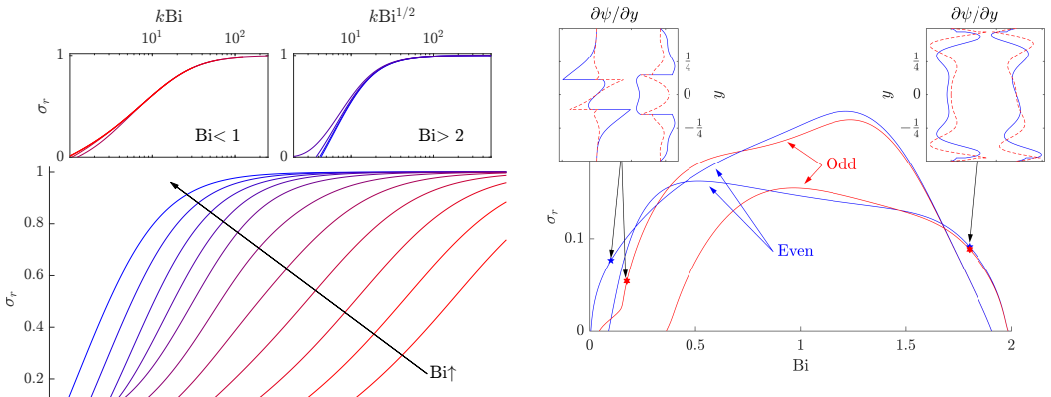
An exploration is presented of the start-up and linear stability of pressure-driven channel flow of an elasto-viscoplastic fluid described by Saramito's constitutive law. Streamwise uniform base states are non-unique, depending on the initial stress configuration, and develop discontinuities in the normal stresses and shear rate at the yield surfaces over infinite times. Such stress discontinuities can be eliminated by introducing a sufficient extensional pre-stress; true plugs bordered by stress jumps then become replaced by marginally yielded, plug-like flow, or pseudo-plugs. To examine the stability of all of these state, the linear initial-value problem is solved along with the evolving base states. Because this analysis is performed for finite times, the base states remain continuous and there is no need to perturb any stress discontinuities. Armed with the insights provided, stability is then analyzed as a normal-mode problem for the final states, building in perturbations to the stress discontinuities via certain jump conditions across any yield surfaces. Regardless of whether the base flows contain true plugs or pseudo-plugs, the base states are found to be linearly unstable at zero Reynolds number. The most unstable perturbations possess the highest streamwise wavenumbers and become spatially localized to the regions where stresses lie close to the yield stress.
Figures



Forward citations
Cited by 1 Pith paper
-
A transition to elasto-viscoplastic turbulence in inertialess channel flow?
Numerical simulations show linear instability causing spatio-temporal complexity in inertialess elasto-viscoplastic channel flow at Weissenberg numbers of order unity and higher.
Reference graph
Works this paper leans on
-
[1]
Saramito, A new constitutive equation for elastovis- coplastic fluid flows, J
P. Saramito, A new constitutive equation for elastovis- coplastic fluid flows, J. Non-Newton. Fluid Mech. 145 (1) (2007) 1–14
2007
-
[2]
Saramito, A new elastoviscoplastic model based on theHerschel–Bulkleyviscoplasticmodel,J.Non-Newton
P. Saramito, A new elastoviscoplastic model based on theHerschel–Bulkleyviscoplasticmodel,J.Non-Newton. Fluid Mech. 158 (1-3) (2009) 154–161. 18 -2 -1 0 <r -1 0 <i Figure E.18: Example of the linear eigenspectrum for the Saramito model with (𝑘,Bi, 𝛿, 𝛽, 𝑎 0 )=(10, 1 2 ,0, 1 2 , 1 2 ). Thelighter(red)starsshowthecomputed eigenvalues on a grid with 1000 poi...
2009
-
[3]
D.Fraggedakis,Y.Dimakopoulos,J.Tsamopoulos,Yield- ingtheyield-stressanalysis: astudyfocusedontheeffects of elasticity on the settling of a single spherical particle in simple yield-stress fluids, Soft matter 12 (24) (2016) 5378–5401
2016
-
[4]
Moschopoulos, A
P. Moschopoulos, A. Spyridakis, S. Varchanis, Y. Di- makopoulos,J.Tsamopoulos,Theconceptofelasto-visco- plasticity and its application to a bubble rising in yield stress fluids, J. Non-Newton. Fluid Mech. 297 (2021) 104670
2021
-
[5]
H. L. França, M. Jalaal, C. M. Oishi, Elasto-viscoplastic spreading: From plastocapillarity to elastocapillarity, Phys. Rev. Research 6 (1) (2024) 013226
2024
-
[6]
Zakeri, P
P. Zakeri, P. Moschopoulos, Y. Dimakopoulos, J. Tsamopoulos, Scaling analysis and self-similarity near breakup of elasto-viscoplastic liquid threads under creep- ing flow, J. Fluid Mech. 1020 (2025) A37
2025
-
[7]
Tsamopoulos, Dynamics of elastoviscoplastic filament stretching, Soft Matter 19 (25) (2023) 4717–4736
P.Moschopoulos,E.Kouni,K.Psaraki,Y.Dimakopoulos, J. Tsamopoulos, Dynamics of elastoviscoplastic filament stretching, Soft Matter 19 (25) (2023) 4717–4736
2023
-
[8]
Chaparian, O
E. Chaparian, O. Tammisola, An adaptive finite element method for elastoviscoplastic fluid flows, J. Non-Newton. Fluid Mech. 271 (2019) 104148
2019
-
[9]
Chaparian, M
E. Chaparian, M. N. Ardekani, L. Brandt, O. Tammisola, Particle migration in channel flow of an elastoviscoplastic fluid, J. Non-Newton. Fluid Mech. 284 (2020) 104376
2020
-
[10]
Cheddadi, P
I. Cheddadi, P. Saramito, F. Graner, Steady couette flows ofelastoviscoplasticfluidsarenonunique,J.Rheol.56(1) (2012) 213–239
2012
-
[11]
Cheddadi, P
I. Cheddadi, P. Saramito, C. Raufaste, P. Marmottant, F. Graner, Numerical modelling of foam couette flows, Eur. Phys. J. E 27 (2) (2008) 123–133
2008
-
[12]
Fluid Mech
I.C.Walton,S.H.Bittleston,TheaxialflowofaBingham plastic in a narrow eccentric annulus, J. Fluid Mech. 222 (1991) 39–60
1991
-
[13]
Chen, Interfacial instability due to elastic stratification inconcentriccoextrusionoftwoviscoelasticfluids,J.Non- Newton
K. Chen, Interfacial instability due to elastic stratification inconcentriccoextrusionoftwoviscoelasticfluids,J.Non- Newton. Fluid Mech. 40 (2) (1991) 155–175
1991
-
[14]
E. J. Hinch, O. Harris, J. M. Rallison, The instability mechanism for two elastic liquids being co-extruded, J. Non-Newton. Fluid Mech. 43 (2-3) (1992) 311–324
1992
-
[15]
H. A. Castillo, M. R. Jovanović, S. Kumar, A. Morozov, V.Shankar,G.Subramanian,H.J.Wilson,Understanding viscoelastic flow instabilities: Oldroyd-B and beyond, J. Non-Newton. Fluid Mech. 302 (2022) 104742
2022
-
[16]
S.Fielding,Linearinstabilityofplanarshearbandedflow, Phys. Rev. Lett. 95 (13) (2005) 134501
2005
-
[17]
S. S. Datta, A. M. Ardekani, P. E. Arratia, A. N. Beris, I. Bischofberger, G. H. McKinley, J. G. Eggers, J. E. López-Aguilar, S. M. Fielding, A. Frishman, et al., Per- spectives on viscoelastic flow instabilities and elastic tur- bulence, Phys. Rev. Fluids 7 (8) (2022) 080701
2022
-
[18]
H. J. Wilson, J. M. Rallison, Instability of channel flow of a shear-thinning White–Metzner fluid, J. Non-Newton. Fluid Mech. 87 (1) (1999) 75–96
1999
-
[19]
H. J. Wilson, V. Loridan, Linear instability of a highly shear-thinningfluidinchannelflow,J.Non-Newton.Fluid Mech. 223 (2015) 200–208
2015
-
[20]
H. A. Castillo, H. J. Wilson, Elastic instabilities in pressure-driven channel flow of thixotropic-viscoelasto- plastic fluids, J. Non-Newton. Fluid Mech. 261 (2018) 10–24
2018
-
[21]
Bodiguel, J
H. Bodiguel, J. Beaumont, A. Machado, L. Martinie, H. Kellay, A. Colin, Flow enhancement due to elastic tur- bulence in channel flows of shear thinning fluids, Phys. Rev. Lett. 114 (2) (2015) 028302
2015
-
[22]
Poole, Elastic instabilities in parallel shear flows of a viscoelastic shear-thinning liquid, Phys
R. Poole, Elastic instabilities in parallel shear flows of a viscoelastic shear-thinning liquid, Phys. Rev. Fluids 1 (4) (2016) 041301
2016
-
[23]
Patne, Yield stress destabilizes viscoelastic fluid flow, Phys
R. Patne, Yield stress destabilizes viscoelastic fluid flow, Phys. Fluids 37 (4)
-
[24]
Non-Newton
Y.L.Zhang,O.K.Matar,R.V.Craster,Surfactantspread- ing on a thin weakly viscoelastic film, J. Non-Newton. Fluid Mech. 105 (1) (2002) 53–78
2002
-
[25]
Ahmed, L
H. Ahmed, L. Biancofiore, A new approach for modeling viscoelastic thin film lubrication, J. Non-Newton. Fluid Mech. 292 (2021) 104524
2021
-
[26]
Fluid Mech
J.Hinch,E.Boyko,H.A.Stone,FastflowofanOldroyd-B model fluid through a narrow slowly varying contraction, J. Fluid Mech. 988 (2024) A11. 19
2024
-
[27]
Boyko, J
E. Boyko, J. Hinch, H. A. Stone, Flow of an Oldroyd-B fluid in a slowly varying contraction: theoretical results for arbitrary values of deborah number in the ultra-dilute limit, J. Fluid Mech. 988 (2024) A10
2024
-
[28]
Renardy, M
Y. Renardy, M. Renardy, Stability of shear banded flow foraviscoelasticconstitutivemodelwiththixotropicyield stress behavior, J. Non-Newton. Fluid Mech. 244 (2017) 57–74
2017
-
[29]
M.Khalid,V.Shankar,G.Subramanian,Continuouspath- waybetweentheelasto-inertialandelasticturbulentstates in viscoelastic channel flow, Phys. Rev. Lett. 127 (13) (2021) 134502
2021
-
[30]
Burghelea, M
T. Burghelea, M. Moyers-González, Elasticity mediated yielding of an elasto-viscoplastic fluid in a plane channel flow, Theor. Comp. Fluid Dyn. 39 (5) (2025) 43. 20
2025
discussion (0)
Sign in with ORCID, Apple, or X to comment. Anyone can read and Pith papers without signing in.