Giant magneto-optical rotation in a Rydberg atomic gas via symmetry-breaking wave mixing
Pith reviewed 2026-06-28 17:14 UTC · model grok-4.3
The pith
A far-detuned counterpropagating wave-mixing field breaks excitation symmetry in a Rydberg atomic gas and enhances the third-order nonlinear magneto-optical rotation angle by more than 24 times.
A machine-rendered reading of the paper's core claim, the machinery that carries it, and where it could break.
Core claim
The symmetry-breaking mechanism from the far-detuned WM field breaks the propagation blockade, enabling efficient utilization of the nonlocal Rydberg Kerr effect. As a result, the third-order nonlinear rotation angle is enhanced by a factor exceeding 24.
What carries the argument
Far-detuned counterpropagating wave-mixing field treated via adiabatic elimination as a steady-state dressing field that reduces the conventional third-order wave-mixing process into the first-order linear background, solved self-consistently with reduced density-matrix expansion for nonlocal cascaded integrals from van der Waals interactions.
If this is right
- The nonlinear polarization can now accumulate spatially because the orthogonal circular components no longer evolve symmetrically.
- The nonlocal Rydberg Kerr effect becomes usable for rotation rather than being blocked during propagation.
- Third-order nonlinear rotation angles increase by a factor exceeding 24 relative to the blocked case.
- The setup supplies a concrete route to higher sensitivity in atomic magnetometry.
- The same symmetry-breaking route applies to all-optical quantum information processing tasks that rely on accumulated nonlinear phase.
Where Pith is reading between the lines
- The adiabatic-elimination reduction could be tested in other multilevel Rydberg schemes where propagation symmetry currently limits nonlinear signals.
- If the enhancement scales with interaction strength, the method might allow tunable sensitivity by varying atomic density or principal quantum number.
- The approach may generalize to different interaction potentials beyond van der Waals if the reduced density-matrix method remains valid.
Load-bearing premise
The far-detuned WM field can be treated as a steady-state dressing field whose adiabatic elimination reduces the third-order process into the linear background without invalidating the many-body solution.
What would settle it
Compare the measured nonlinear magneto-optical rotation angle in the five-level Rydberg gas with and without the counterpropagating WM field; the central claim is falsified if the enhancement factor remains below 24 under the stated conditions.
Figures
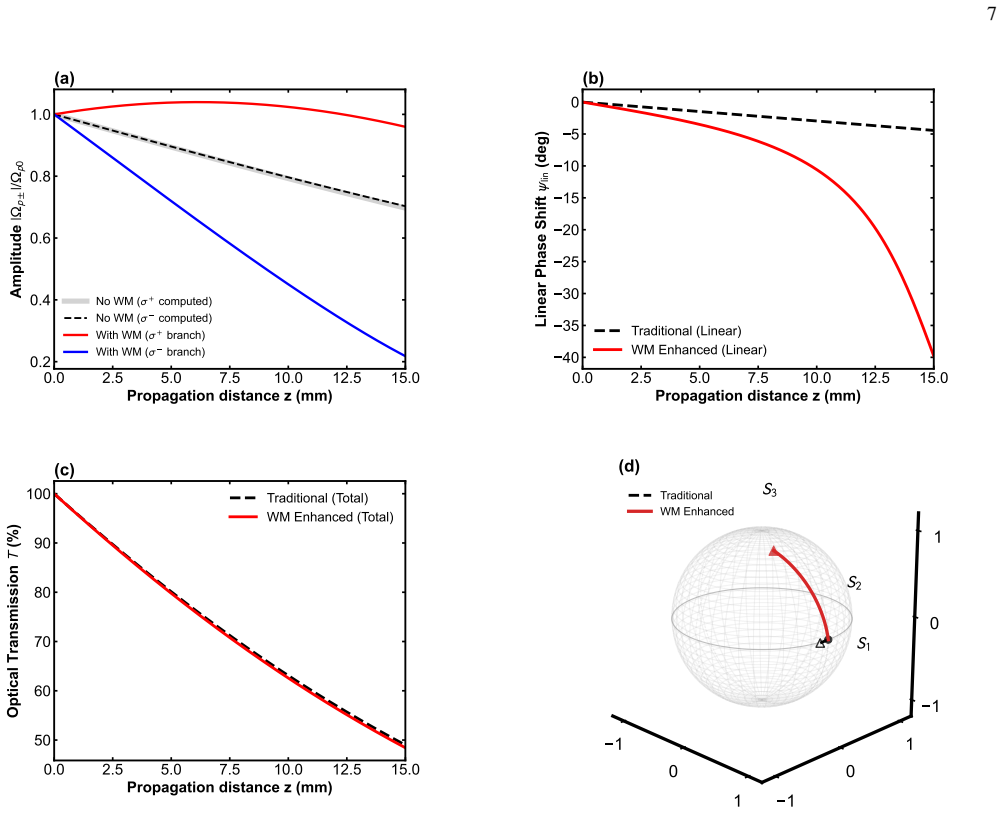
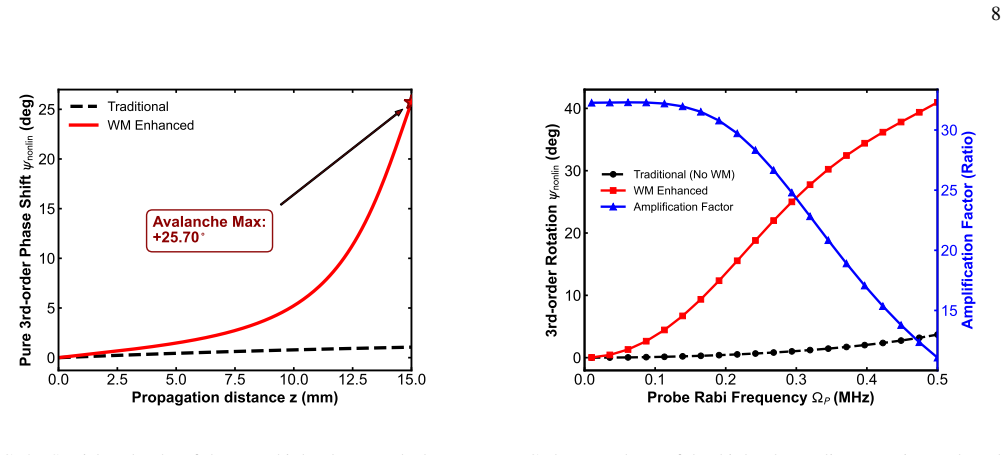
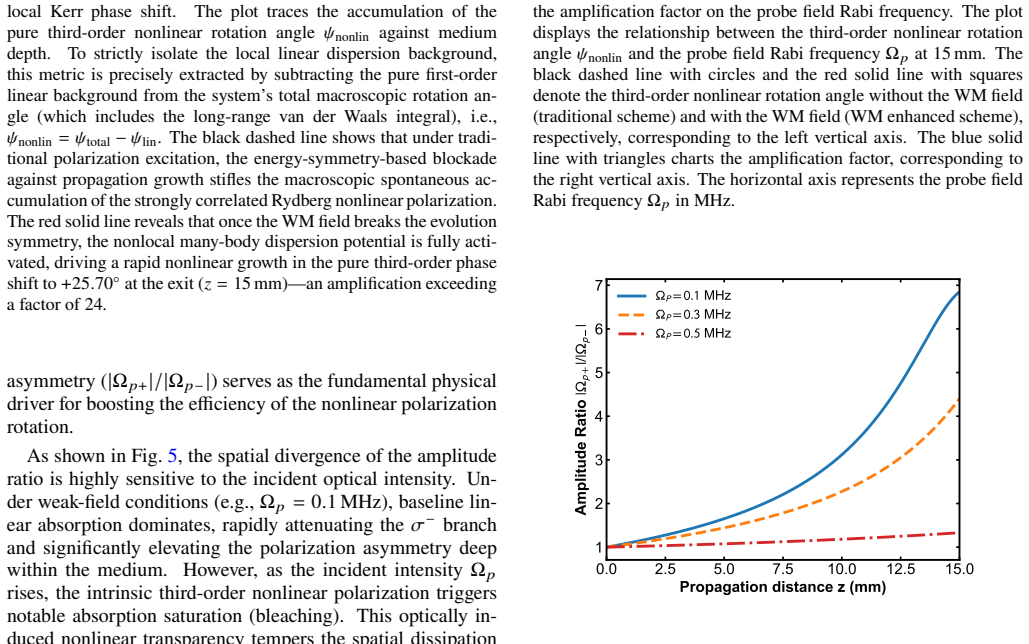
read the original abstract
The nonlinear magneto-optical rotation effect is central to precision measurements of weak magnetic fields and optical quantum information processing. In conventional single-beam excitation systems, the propagation of the nonlinear signal is restricted by an energy-symmetry-induced propagation blockade. This blockade originates from the symmetrical evolution of the orthogonal circularly polarized components of the probe field, which prevents spatial accumulation of the nonlinear polarization. We propose introducing a far-detuned, counterpropagating wave-mixing (WM) field into an ultracold five-level Rydberg atomic gas to actively break the excitation symmetry. Theoretically, the far-detuned WM field is treated as a steady-state dressing field. Through adiabatic elimination, the conventional third-order wave-mixing process is effectively reduced and incorporated into the first-order linear background of the system. Combined with the reduced density-matrix expansion method, this approach goes beyond both the mean-field and ground-state approximations, allowing for a self-consistent solution of the many-body dynamics that include nonlocal cascaded integrals governed by long-range van der Waals interactions. Our analytical derivations and numerical calculations demonstrate that this symmetry-breaking mechanism breaks the propagation blockade, enabling efficient utilization of the nonlocal Rydberg Kerr effect. As a result, the third-order nonlinear rotation angle is enhanced by a factor exceeding 24, offering a highly efficient mechanism for ultrasensitive atomic magnetometry and all-optical quantum information processing.
Editorial analysis
A structured set of objections, weighed in public.
Referee Report
Summary. The paper claims that introducing a far-detuned counterpropagating wave-mixing (WM) field into an ultracold five-level Rydberg atomic gas breaks the excitation symmetry responsible for the propagation blockade in nonlinear magneto-optical rotation. Treating the WM field as a steady-state dressing field via adiabatic elimination folds the third-order process into the first-order linear background; combined with a reduced density-matrix expansion that includes nonlocal cascaded integrals from van der Waals interactions, this yields a self-consistent many-body solution beyond mean-field and ground-state approximations. Analytical derivations and numerical calculations are stated to show that the symmetry-breaking mechanism enables efficient use of the nonlocal Rydberg Kerr effect, enhancing the third-order nonlinear rotation angle by a factor exceeding 24.
Significance. If the central result holds, the work offers a concrete route to giant magneto-optical rotation in Rydberg gases, with direct relevance to ultrasensitive magnetometry and all-optical quantum information processing. The explicit incorporation of nonlocal interactions via cascaded integrals and the self-consistent treatment beyond standard approximations constitute a technical strength that, if rigorously validated, would distinguish the proposal from conventional single-beam schemes.
major comments (2)
- [theoretical derivation / density-matrix expansion] The adiabatic elimination of the far-detuned WM field (abstract and the theoretical derivation section) is load-bearing for the claimed breaking of the propagation blockade and the factor-of-24 enhancement. The manuscript must demonstrate that spatially dependent Rydberg shifts do not introduce additional dynamical time scales that invalidate the steady-state dressing assumption; an explicit comparison of the WM detuning against the interaction-induced linewidths or a numerical test of the eliminated equations is required.
- [numerical calculations / results] The numerical results that produce the enhancement factor >24 (abstract) rest on the reduced density-matrix expansion after elimination. The paper should report the precise parameter regime, grid resolution for the cascaded integrals, and convergence checks; without these, it is impossible to assess whether the enhancement is robust or sensitive to the elimination approximation.
minor comments (1)
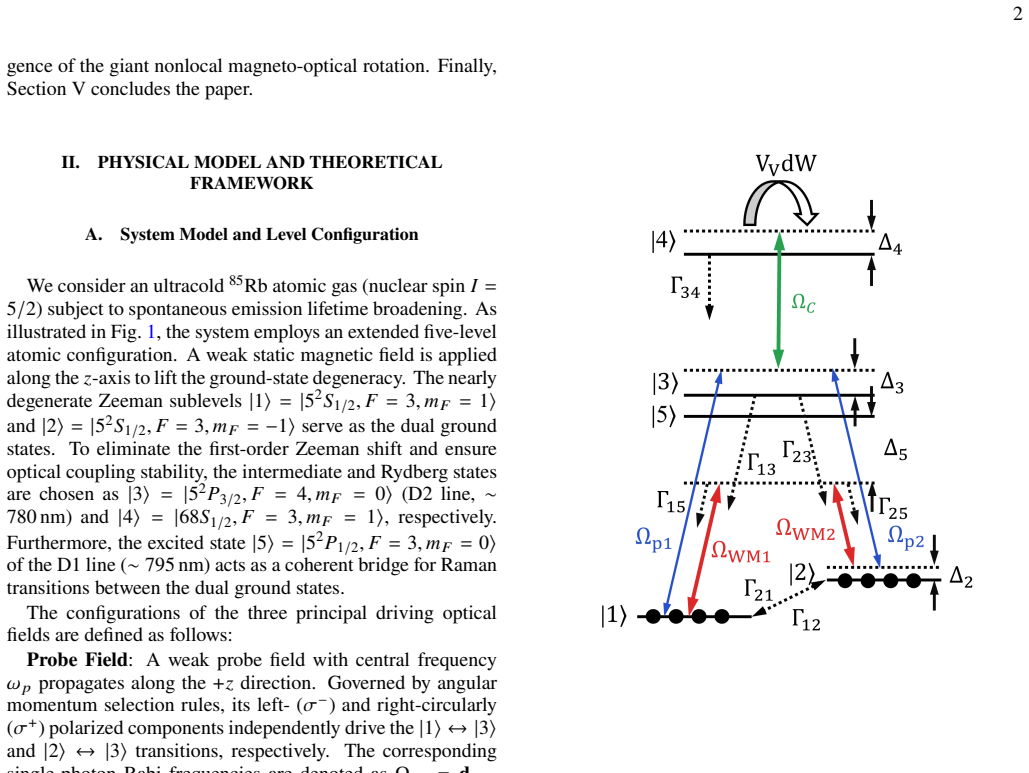
- [introduction / theory] Notation for the five-level scheme and the definition of the WM field amplitude should be introduced with a figure or explicit Hamiltonian early in the text to aid readability.
Simulated Author's Rebuttal
We thank the referee for the careful review and constructive feedback on our manuscript. We address each major comment below and will revise the manuscript accordingly to strengthen the justification of our approximations and the reporting of numerical details.
read point-by-point responses
-
Referee: [theoretical derivation / density-matrix expansion] The adiabatic elimination of the far-detuned WM field (abstract and the theoretical derivation section) is load-bearing for the claimed breaking of the propagation blockade and the factor-of-24 enhancement. The manuscript must demonstrate that spatially dependent Rydberg shifts do not introduce additional dynamical time scales that invalidate the steady-state dressing assumption; an explicit comparison of the WM detuning against the interaction-induced linewidths or a numerical test of the eliminated equations is required.
Authors: We agree that an explicit demonstration of the adiabatic elimination's validity is necessary given the spatially dependent Rydberg shifts. The manuscript treats the WM field as far-detuned and eliminates it under the steady-state dressing approximation, but does not currently include a direct comparison to interaction-induced linewidths. In the revised version we will add this comparison using the parameters of the system (showing the detuning remains larger than the maximum shifts) together with a brief numerical test of the eliminated equations against the time-dependent form for representative interaction strengths. This will confirm that no additional dynamical timescales invalidate the assumption. revision: yes
-
Referee: [numerical calculations / results] The numerical results that produce the enhancement factor >24 (abstract) rest on the reduced density-matrix expansion after elimination. The paper should report the precise parameter regime, grid resolution for the cascaded integrals, and convergence checks; without these, it is impossible to assess whether the enhancement is robust or sensitive to the elimination approximation.
Authors: We acknowledge that the numerical section lacks sufficient detail on the implementation parameters. The enhancement factor is obtained from the self-consistent solution of the reduced density-matrix equations that incorporate the nonlocal cascaded integrals. In the revised manuscript we will explicitly state the full parameter set (detunings, Rabi frequencies, atomic density, and interaction coefficients), the spatial grid resolution used for evaluating the cascaded integrals, and the convergence tests performed with respect to grid size and iteration tolerance. These additions will allow readers to assess the robustness of the reported factor exceeding 24. revision: yes
Circularity Check
No circularity; standard techniques applied to new geometry yield independent result
full rationale
The derivation begins from the five-level Rydberg system with an added far-detuned counterpropagating WM field, treats that field as a steady-state dressing field via adiabatic elimination, folds the third-order WM term into the linear background, and then solves the reduced density-matrix equations self-consistently with the nonlocal van der Waals integrals. These steps are modeling choices and numerical/analytical integrations whose output (rotation-angle enhancement >24) is not forced by construction from the inputs; no parameter is fitted to the target quantity and then renamed as a prediction, no uniqueness theorem is imported from self-citation, and no ansatz is smuggled via prior work. The result therefore remains an independent consequence of the modified propagation equations rather than a tautology.
Axiom & Free-Parameter Ledger
Reference graph
Works this paper leans on
-
[1]
Rydberg blockade sphere
In practical configurations, the pre- set two-photon detuning is finely adjusted to precisely com- pensate for this additional constant AC Stark shift, thereby guaranteeing the validity of the dual-EIT resonance protection mechanism. (2)Effective Raman coherence couplings: The field actively induces off-diagonal coherence coupling terms between the ground...
-
[2]
thin-medium approximation
This defines the four Stokes pa- rameters of the output field [22, 38, 39]: 𝑆0 (𝑧)=|Ω 𝑝1 |2 + |Ω 𝑝2 |2,(12) 𝑆1 (𝑧)=2Re(Ω ∗ 𝑝1Ω 𝑝2),(13) 𝑆2 (𝑧)=2Im(Ω ∗ 𝑝1Ω 𝑝2),(14) 𝑆3 (𝑧)=|Ω 𝑝1 |2 − |Ω 𝑝2 |2.(15) Leveraging the complete Stokes space, the macroscopic magneto-optical rotation angle is defined as: 𝜓(𝑧)= 1 2 arctan 𝑆2(𝑧) 𝑆1(𝑧) .(16) Within this metric framewo...
2000
-
[3]
Single-atom Schr ¨odinger and Heisenberg picturesConsidering the interaction between a single atom and external fields, the single-atom Hamiltonian in the Schr¨odinger picture consists of the unperturbed atomic energy and the electric-dipole interaction: ˆ𝐻Sch Single = 5∑︁ 𝑗=1 𝐸 𝑗 |𝑗⟩⟨𝑗| − ˆd·E(r, 𝑡),(A1) where𝐸 𝑗 = ℏ𝜔 𝑗 is the intrinsic energy of level|𝑗...
-
[4]
Introduction of slowly varying operators and phase matchingTo eliminate high-frequency spatial and temporal oscillations of the light field, slowly varying operators ˆ𝑆 𝛼𝛽 are introduced according to the propagation directions (wave-mixing and probe fields counterpropagate) and specific coupling relations: Probe fields: ˆ𝑆31 =|1⟩⟨3|𝑒 −𝑖(𝑘 𝑝 𝑧−𝜔 𝑝𝑡) , ˆ𝑆32...
-
[5]
Rotating-wave approximation and system detuning definitionApplying the rotating-wave approximation (RWA) in the rotating frame, rapidly oscillating high-frequency terms are discarded to extract the time-independent effective driving components. Setting the ground state|1⟩as the energy zero point, the relative detunings for each level are strictly defined ...
-
[6]
Total HamiltonianExpanding the local light-atom interactions to a macroscopic cold atomic ensemble and incorporating the long-range van der Waals interaction potential𝑉(r ′ −r)=−𝐶 6/|r ′ −r| 6 between Rydberg atoms, the total Hamiltonian ˆ𝐻total governing the dynamics of the five-level system is expressed as: ˆ𝐻total =N 𝑎 ∫ 𝑑3𝑟 n −ℏΔ 2 ˆ𝑆22 (r, 𝑡) −ℏΔ 3 ˆ...
-
[7]
Single-body optical Bloch equationsBased on the definition𝜌 𝛼𝛽 =⟨ ˆ𝑆 𝛼𝛽 ⟩, the single-body optical Bloch equations can be logically grouped. The equations for the diagonal elements (populations) are written as: 0=(𝑖𝜕 𝑡 +𝑖Γ 21)𝜌 11 −𝑖Γ 12 𝜌22 −𝑖Γ 13 𝜌33 −𝑖Γ 15 𝜌55 +Ω ∗ 𝑝1 𝜌31 −Ω 𝑝1 𝜌13 +Ω ∗ 𝑊 𝑀1 𝜌51 −Ω 𝑊 𝑀1 𝜌15,(A4a) 0=(𝑖𝜕 𝑡 +𝑖Γ 12)𝜌 22 −𝑖Γ 21 𝜌11 −𝑖Γ 23 𝜌...
-
[8]
Adiabatic approximation, order verification, and upper-level coherence solutionsThe WM field operates under a far-detuned condition. Setting the single-photon detuning asΔ 𝑊 𝑀1 = Δ 5 −Δ 1 ≈Δ 𝑊 𝑀2 = Δ 5 −Δ 2 and adopting the simplificationΔ 𝑊 𝑀1 ≈Δ 𝑊 𝑀2 ≈Δ 𝑊 𝑀 ≡Δ 5, the adiabatic parameter is evaluated as𝜖 𝑊 =|Ω 𝑊 𝑀 𝑗 |/Δ𝑊 𝑀 ≈0.005≪1 (given|Ω 𝑊 𝑀 |=2𝜋×10 M...
2000
-
[9]
Renormalization and truncation of higher-order coherence correctionsSubstituting the wave-mixing polarization back into the evolution equations, we define the renormalization parameters asΔ 𝐴𝐶1 =|Ω 𝑊 𝑀1 |2/𝑑 ∗ 5,Δ 𝐴𝐶2 =|Ω 𝑊 𝑀2 |2/𝑑 ∗ 5, Ω𝐶12 = Ω 𝑊 𝑀1Ω∗ 𝑊 𝑀2/𝑑 ∗ 5, andΩ 𝐶21 = Ω 𝑊 𝑀2Ω∗ 𝑊 𝑀1/𝑑 ∗
-
[10]
Modifying the detunings accordingly yields𝐷 31 =𝑑 31 +Δ 𝐴𝐶1, 𝐷41 =𝑑 41 +Δ 𝐴𝐶1,𝐷 32 =𝑑 32 +Δ 𝐴𝐶2,𝐷 42 =𝑑 42 +Δ 𝐴𝐶2, and𝐷 21 =𝑑 21 +Δ 𝐴𝐶1 −Δ ∗ 𝐴𝐶2. Substituting the higher-order coherences𝜌 35 and𝜌 45 introduces higher-order dimensionless modification tensors𝑊 𝑖 𝑗 for the control fieldΩ 𝑐: 𝑊𝑖 𝑗 = Ω𝑊 𝑀𝑖Ω∗ 𝑊 𝑀 𝑗 (𝑑5)2 (𝑖, 𝑗∈ {1,2}).(B6) 12 Because the absolut...
-
[11]
Zeroth-order equations: 0=𝑖Γ 21 𝜌 (0) 11 −𝑖Γ 12 𝜌 (0) 22 + (Δ 𝐴𝐶1 −Δ ∗ 𝐴𝐶1)𝜌 (0) 11 +Ω 𝐶12 𝜌 (0) 12 −Ω ∗ 𝐶12 𝜌 (0) 21 −𝑖Γ 15 𝜌 (0) 55 ,(C1) 0=𝑖Γ 12 𝜌 (0) 22 −𝑖Γ 21 𝜌 (0) 11 + (Δ 𝐴𝐶2 −Δ ∗ 𝐴𝐶2)𝜌 (0) 22 +Ω 𝐶21 𝜌 (0) 21 −Ω ∗ 𝐶21 𝜌 (0) 12 −𝑖Γ 25 𝜌 (0) 55 ,(C2) 0=𝐷 21 𝜌 (0) 21 +Ω 𝐶12 𝜌 (0) 22 −Ω ∗ 𝐶21 𝜌 (0) 11 ,(C3) 𝜌 (0) 55 = |Ω𝑊 𝑀1 |2 𝜌 (0) 11 + |Ω 𝑊 𝑀2 |2 𝜌 ...
-
[12]
First-order equations: 0=𝐷 31 𝜌 (1) 31 +Ω ∗ 𝑐 𝜌 (1) 41 +Ω 𝑝1 𝜌 (0) 11 +Ω 𝑝2 𝜌 (0) 21 +Ω 𝐶12 𝜌 (1) 32 ,(C5) 0=𝐷 32 𝜌 (1) 32 +Ω ∗ 𝑐 𝜌 (1) 42 +Ω 𝑝2 𝜌 (0) 22 +Ω 𝑝1 𝜌 (0) 12 +Ω 𝐶21 𝜌 (1) 31 ,(C6) 0=𝐷 41 𝜌 (1) 41 +Ω 𝑐 𝜌 (1) 31 +Ω 𝐶12 𝜌 (1) 42 ,(C7) 0=𝐷 42 𝜌 (1) 42 +Ω 𝑐 𝜌 (1) 32 +Ω 𝐶21 𝜌 (1) 41 .(C8)
-
[13]
Second-order equations: 0=𝑖Γ 21 𝜌 (2) 11 −𝑖Γ 12 𝜌 (2) 22 −𝑖Γ 13 𝜌 (2) 33 +Ω ∗ 𝑝1 𝜌 (1) 31 −Ω 𝑝1 𝜌 (1) 13 + (Δ 𝐴𝐶1 −Δ ∗ 𝐴𝐶1)𝜌 (2) 11 +Ω 𝐶12 𝜌 (2) 12 −Ω ∗ 𝐶12 𝜌 (2) 21 −𝑖Γ 15 𝜌 (2) 55 ,(C9) 0=𝑖Γ 12 𝜌 (2) 22 −𝑖Γ 21 𝜌 (2) 11 −𝑖Γ 23 𝜌 (2) 33 +Ω ∗ 𝑝2 𝜌 (1) 32 −Ω 𝑝2 𝜌 (1) 23 + (Δ 𝐴𝐶2 −Δ ∗ 𝐴𝐶2)𝜌 (2) 22 +Ω 𝐶21 𝜌 (2) 21 −Ω ∗ 𝐶21 𝜌 (2) 12 −𝑖Γ 25 𝜌 (2) 55 ,(C10) 0=𝑖Γ...
-
[14]
To clearly distinguish the intrinsic system evolution from the low-order source drives, we express the equations in the canonical form 𝑀x=S
Third-order equations: 0=𝐷 31 𝜌 (3) 31 +Ω ∗ 𝑐 𝜌 (3) 41 +Ω 𝑝1 (𝜌 (2) 11 −𝜌 (2) 33 ) +Ω 𝑝2 𝜌 (2) 21 +Ω 𝐶12 𝜌 (3) 32 ,(C16) 0=𝐷 32 𝜌 (3) 32 +Ω ∗ 𝑐 𝜌 (3) 42 +Ω 𝑝2 (𝜌 (2) 22 −𝜌 (2) 33 ) +Ω 𝑝1 𝜌 (2) 12 +Ω 𝐶21 𝜌 (3) 31 ,(C17) 0=𝐷 41 𝜌 (3) 41 +Ω 𝑐 𝜌 (3) 31 −Ω 𝑝1 𝜌 (2) 43 +Ω 𝐶12 𝜌 (3) 42 − N𝑎 ∫ 𝑉(r ′ −r)𝜌 (3) 44,41 𝑑3𝑟 ′,(C18) 0=𝐷 42 𝜌 (3) 42 +Ω 𝑐 𝜌 (3) 32 −Ω 𝑝2 𝜌...
-
[15]
Second-order two-body equations: For a specific𝛼∈ {1,2}, the intra-branch variables form a 3×3 matrix equation: © « 2𝐷 4𝛼 −𝑉2Ω 𝑐 0 Ω∗ 𝑐 𝐷4𝛼,3𝛼 Ω𝑐 0 2Ω ∗ 𝑐 2𝐷 3𝛼 ª® ¬ © « 𝜌 (2) 4𝛼,4𝛼 𝜌 (2) 4𝛼,3𝛼 𝜌 (2) 3𝛼,3𝛼 ª®® ¬ = © « 𝑆 (𝛼) 1 𝑆 (𝛼) 2 𝑆 (𝛼) 3 ª®® ¬ ,(D1) where𝐷 𝜇,𝜈 ≡𝐷 𝜇 +𝐷 𝜈 is introduced for brevity, and the source terms, embedding the symmetry-break...
-
[16]
We define the diagonal elements𝐴 1
Third-order two-body equations: To extract the crucial non-local integral source𝜌 (3) 44,4𝑗 (evaluated for𝛼∈ {1,2}), the 8 coupled variables are compactly cast as an 8×8 matrix equation. We define the diagonal elements𝐴 1 . . . 𝐴8 to naturally fit the column width: 𝐴1 =−(𝐷 3𝛼 +𝑖Γ 3), 𝐴 2 =−(𝐷 3𝛼 +𝑑 43), 𝐴3 =−(𝐷 3𝛼 +𝑖Γ 4), 𝐴 4 =−(𝐷 4𝛼 +𝑖Γ 3), 𝐴5 =−(𝐷 4𝛼 +𝑑...
-
[17]
T. F. Gallagher,Rydberg Atoms(Cambridge University Press, Cambridge, 1994)
1994
-
[18]
Saffman, T
M. Saffman, T. G. Walker, and K. Mølmer, Quantum information with rydberg atoms, Rev. Mod. Phys.82, 2313 (2010)
2010
-
[19]
C. S. Adams, J. D. Pritchard, and J. P. Shaffer, Rydberg atom quantum technologies, J. Phys. B: At. Mol. Opt. Phys.53, 012002 (2019)
2019
-
[20]
A. K. Mohapatra, T. R. Jackson, and C. S. Adams, Coherent optical detection of highly excited rydberg states using electro- magnetically induced transparency, Phys. Rev. Lett.98, 113003 (2007)
2007
-
[21]
M. D. Lukinet al., Dipole blockade and quantum information processing in mesoscopic atomic ensembles, Phys. Rev. Lett. 87, 037901 (2001)
2001
-
[22]
Tonget al., Local blockade of rydberg excitation in an ultra- cold gas, Phys
D. Tonget al., Local blockade of rydberg excitation in an ultra- cold gas, Phys. Rev. Lett.93, 063001 (2004)
2004
-
[23]
Singeret al., Suppression of excitation and spectral broad- ening induced by interactions in a cold gas of rydberg atoms, Phys
K. Singeret al., Suppression of excitation and spectral broad- ening induced by interactions in a cold gas of rydberg atoms, Phys. Rev. Lett.93, 163001 (2004)
2004
-
[24]
Urbanet al., Observation of rydberg blockade between two 15 atoms, Nature457, 43 (2009)
E. Urbanet al., Observation of rydberg blockade between two 15 atoms, Nature457, 43 (2009)
2009
-
[25]
Tiarks, S
D. Tiarks, S. Baur, K. Schneider, S. D¨ urr, and G. Rempe, Single- photon transistor using a f¨orster resonance, Phys. Rev. Lett.113, 053602 (2014)
2014
-
[26]
Gorniaczyk, C
H. Gorniaczyk, C. Tresp, J. Meineke, and S. Hofferberth, Single- photon transistor using a f¨orster resonance, Phys. Rev. Lett.113, 053601 (2014)
2014
-
[27]
Isenhoweret al., Demonstration of a neutral atom controlled- not quantum gate, Phys
L. Isenhoweret al., Demonstration of a neutral atom controlled- not quantum gate, Phys. Rev. Lett.104, 010503 (2010)
2010
-
[28]
Levineet al., High-fidelity control and entanglement of rydberg-atom qubits, Phys
H. Levineet al., High-fidelity control and entanglement of rydberg-atom qubits, Phys. Rev. Lett.121, 123603 (2018)
2018
-
[29]
Peyronelet al., Quantum nonlinear optics with single photons enabled by strongly interacting atoms, Nature488, 57 (2012)
T. Peyronelet al., Quantum nonlinear optics with single photons enabled by strongly interacting atoms, Nature488, 57 (2012)
2012
-
[30]
Firstenberget al., Attractive photons in a quantum nonlinear medium, Nature502, 71 (2013)
O. Firstenberget al., Attractive photons in a quantum nonlinear medium, Nature502, 71 (2013)
2013
-
[31]
Sinclair, D
J. Sinclair, D. Angulo, N. Lupu-Gladstein, K. Bonsma-Fisher, and A. M. Steinberg, Observation of a large, resonant, cross-kerr nonlinearity in a cold rydberg gas, Phys. Rev. Res.1, 033193 (2019)
2019
-
[32]
A. V. Gorshkovet al., Photon-photon interactions via rydberg blockade, Phys. Rev. Lett.107, 133602 (2011)
2011
-
[33]
Budkeret al., Resonant nonlinear magneto-optical effects in atoms, Rev
D. Budkeret al., Resonant nonlinear magneto-optical effects in atoms, Rev. Mod. Phys.74, 1153 (2002)
2002
-
[34]
I. K. Kominis, T. W. Kornack, J. C. Allred, and M. V. Romalis, A subfemtotesla multichannel atomic magnetometer, Nature422, 596 (2003)
2003
-
[35]
Budker and M
D. Budker and M. Romalis, Optical magnetometry, Nat. Phys. 3, 227 (2007)
2007
-
[36]
Gawliket al., Nonlinear magneto-optical rotation with mod- ulated light in tilted magnetic fields, Phys
W. Gawliket al., Nonlinear magneto-optical rotation with mod- ulated light in tilted magnetic fields, Phys. Rev. A74, 063420 (2006)
2006
-
[37]
F. Zhou, C. J. Zhu, E. W. Hagley, and L. Deng, Symmetry- breaking inelastic wave-mixing atomic magnetometry, Sci. Adv. 3, e1700422 (2017)
2017
-
[38]
Zhuet al., Breaking the energy-symmetry-based propagation growth blockade in magneto-optical rotation, Phys
C. Zhuet al., Breaking the energy-symmetry-based propagation growth blockade in magneto-optical rotation, Phys. Rev. Applied 10, 064013 (2018)
2018
-
[39]
Deng and C
L. Deng and C. Deng, Magneto-optical rotation: accurate ap- proximated analytical solutions for single-probe atomic magne- tometers, Opt. Express30, 17392 (2022)
2022
-
[40]
Y. Mu, L. Qin, Z. Shi, and G. Huang, Giant kerr nonlinearities and magneto-optical rotations in a rydberg-atom gas via double electromagnetically induced transparency, Phys. Rev. A103, 043709 (2021)
2021
-
[41]
Bai and G
Z. Bai and G. Huang, Enhanced third-order and fifth-order kerr nonlinearities in a cold atomic system via rydberg-rydberg in- teraction, Opt. Express24, 4442 (2016)
2016
-
[42]
Z. Bai, W. Li, and G. Huang, Stable single light bullets and vortices and their active control in cold rydberg gases, Optica6, 309 (2019)
2019
-
[43]
Sevinc ¸li, N
S. Sevinc ¸li, N. Henkel, C. Ates, and T. Pohl, Nonlocal nonlin- ear optics in cold rydberg gases, Phys. Rev. Lett.107, 153001 (2011)
2011
-
[44]
Fleischhauer, A
M. Fleischhauer, A. Imamoglu, and J. P. Marangos, Electromag- netically induced transparency: Optics in coherent media, Rev. Mod. Phys.77, 633 (2005)
2005
-
[45]
Joshi and M
A. Joshi and M. Xiao, Electromagnetically induced transparency and its dispersion properties in a four-level inverted-y atomic system, Phys. Lett. A317, 370 (2003)
2003
-
[46]
Gea-Banacloche, Y
J. Gea-Banacloche, Y. Q. Li, S. Z. Jin, and M. Xiao, Electromag- netically induced transparency in ladder-type inhomogeneously broadened media: Theory and experiment, Phys. Rev. A51, 576 (1995)
1995
-
[47]
R. W. Boyd,Nonlinear Optics, 3rd ed. (Academic, New York, 2008)
2008
-
[48]
Singeret al., Long-range interactions between alkali rydberg atom pairs, J
K. Singeret al., Long-range interactions between alkali rydberg atom pairs, J. Phys. B: At. Mol. Opt. Phys.38, S295 (2005)
2005
-
[49]
ˇSibali´c, J
N. ˇSibali´c, J. D. Pritchard, C. S. Adams, and K. J. Weatherill, Arc: An open-source library for calculating properties of alkali rydberg atoms, Comput. Phys. Commun.220, 319 (2017)
2017
-
[50]
J. D. Pritchardet al., Cooperative atom-light interaction in a blockaded rydberg ensemble, Phys. Rev. Lett.105, 193603 (2010)
2010
-
[51]
Reiter and A
F. Reiter and A. S. Sørensen, Effective operator formalism for open quantum systems, Phys. Rev. A85, 032111 (2012)
2012
-
[52]
Finkelstein-Shapiroet al., Adiabatic elimination and sub- space evolution of open quantum systems, Phys
D. Finkelstein-Shapiroet al., Adiabatic elimination and sub- space evolution of open quantum systems, Phys. Rev. A101, 042102 (2020)
2020
-
[53]
Stanojevic, V
J. Stanojevic, V. Parigi, E. Bimbard, A. Ourjoumtsev, and P. Grangier, Dispersive optical nonlinearities in a rydberg electromagnetically-induced-transparency medium, Phys. Rev. A88, 053845 (2013)
2013
-
[54]
Born and E
M. Born and E. Wolf,Principles of Optics, 7th ed. (Cambridge University Press, Cambridge, 1999)
1999
-
[55]
R. M. A. Azzam and N. M. Bashara,Ellipsometry and Polarized Light(North-Holland, Amsterdam, 1977)
1977
-
[56]
D. A. Steck, Rubidium 85 d line data, available online at http://steck.us/alkalidata (revision 2.2.3) (2021)
2021
-
[57]
M. S. Safronova, C. J. Williams, and C. W. Clark, Relativistic many-body calculations of electric-dipole matrix elements, life- times, and polarizabilities in rubidium, Phys. Rev. A69, 022509 (2004)
2004
-
[58]
Lin, H.-C
Y.-W. Lin, H.-C. Chou, P. P. Dwivedi, Y.-C. Chen, and I. A. Yu, Using a pair of rectangular coils in the mot for the production of cold atom clouds with large optical density, Opt. Express16, 3753 (2008)
2008
-
[59]
B. M. Sparkeset al., Gradient echo memory in an ultra-high optical depth cold atomic ensemble, New J. Phys.15, 085027 (2013)
2013
-
[60]
Yin, A.-N
Y. Yin, A.-N. Xu, B. Liu, and L. Deng, Comparative study of raman-coherence-assisted nonlinear magneto-optical rotation in d1 and d2 transitions using cold rubidium atoms, Opt. Lett.51, 1504 (2026)
2026
-
[61]
J. F. Shersonet al., Quantum teleportation between light and matter, Nature443, 557 (2006)
2006
-
[62]
H. P. Yuen and V. W. S. Chan, Noise in homodyne and hetero- dyne detection, Opt. Lett.8, 177 (1983)
1983
-
[63]
A. M. C. Dawes, L. Illing, S. M. Clark, and D. J. Gauthier, All- optical switching in rubidium vapor, Science308, 672 (2005)
2005
-
[64]
S. Baur, D. Tiarks, G. Rempe, and S. D¨ urr, Single-photon switch based on rydberg blockade, Phys. Rev. Lett.112, 073901 (2014)
2014
discussion (0)
Sign in with ORCID, Apple, or X to comment. Anyone can read and Pith papers without signing in.