A tunable feedback-controlled magnetic trap for a magnet in free fall
Pith reviewed 2026-06-28 16:14 UTC · model grok-4.3
The pith
A feedback-controlled magnetic trap levitates a ferromagnetic particle stably through microgravity shocks while allowing near-free motion.
A machine-rendered reading of the paper's core claim, the machinery that carries it, and where it could break.
Core claim
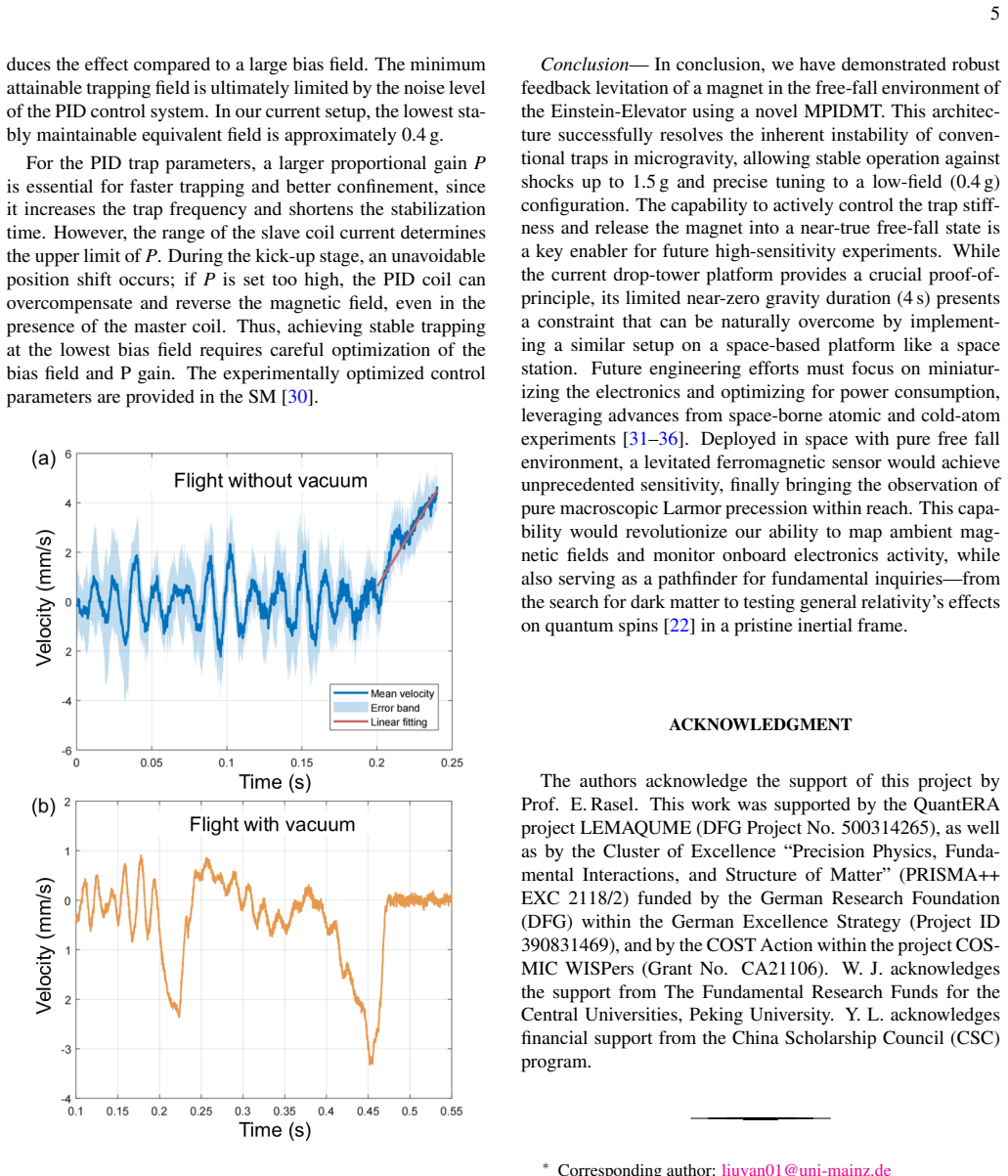
The MPIDMT system stably levitates a ferromagnetic particle against shock accelerations up to 1.5 g in microgravity and resolves its motion both in a low-field (0.4 g) configuration and in pure free fall.
What carries the argument
The master proportional-integral-differential magnetic trap (MPIDMT), which uses a PID-controlled coil system combined with a master control coil system to deliver tunable feedback.
If this is right
- Enables direct observation of pure Larmor precession in a macroscopic ferromagnetic particle.
- Supports free-fall ferromagnetic magnetometry free of clamping losses.
- Provides a platform for space-based tests of relativistic effects and dark-matter interactions.
Where Pith is reading between the lines
- The same control architecture could be adapted to suppress residual accelerations below current drop-tower levels for longer observation times.
- Motion resolution achieved here may allow quantitative comparison of observed precession rates against zero-field predictions.
- Extension to multi-particle or spinning ensembles could test predicted gyroscopic behavior under true free fall.
Load-bearing premise
A single tunable trap design can be made weak enough for near-free particle evolution while remaining robust enough to handle launch and release disturbances without losing control.
What would settle it
The particle loses levitation or exhibits clear trap-induced motion systematics during the pure free-fall segment of the drop-tower run.
Figures
read the original abstract
Ferromagnets in free space are predicted to exhibit pure Larmor precession at near-zero magnetic fields and provide exceptional sensitivity for magnetometry and gyroscopy. Notably, pure Larmor precession has not been observed in a macroscopic ferromagnetic particle, despite its fundamental importance and potential for probing relativistic effects and dark-matter interactions. Realizing such dynamics requires true free fall to eliminate clamping losses and trap-induced systematics. A central challenge is designing a tunable trap that is weak enough to permit near-free evolution yet robust enough to withstand the disturbances of launch and release. Here, we propose and demonstrate a novel master proportional-integral-differential magnetic trap (MPIDMT) combining a PID-controlled coil system with a master control coil system. Implemented in the third-generation drop tower - Einstein-Elevator, during the microgravity phase the system stably levitates a ferromagnetic particle against shock accelerations up to 1.5 g and resolves its motion in both a low-field (0.4 g) configuration and in pure free fall. These results represent a key step toward free-fall ferromagnetic magnetometry, the long-sought direct observation of macroscopic Larmor precession, and future space-based experiments.
Editorial analysis
A structured set of objections, weighed in public.
Referee Report
Summary. The manuscript proposes and claims to demonstrate a master proportional-integral-differential magnetic trap (MPIDMT) that combines PID-controlled coils with a master coil system. Implemented in the Einstein-Elevator drop tower, it asserts stable levitation of a ferromagnetic particle against up to 1.5 g shock accelerations during microgravity and resolution of particle motion in both a 0.4 g low-field mode and pure free fall, as a step toward observing macroscopic Larmor precession.
Significance. If the experimental claims are substantiated, the work would provide a practical solution to the long-standing challenge of creating a tunable magnetic trap that is robust to launch/release transients yet weak enough to permit near-free evolution of a macroscopic ferromagnet. This would open a path to free-fall magnetometry and direct tests of pure Larmor precession, with potential relevance to relativistic effects and dark-matter searches.
major comments (2)
- [Abstract] Abstract: the central performance claims (stable levitation to 1.5 g shocks and motion resolution in pure free fall) are stated without any accompanying methods description, raw data, error bars, exclusion criteria, or figures, rendering it impossible to evaluate whether the MPIDMT actually achieves the required operating point.
- [Abstract] Abstract: no quantitative bounds are supplied on residual field strength, feedback gain settings, or measured particle acceleration residuals in the pure free-fall configuration; without these, the load-bearing tunability assumption (trap weak enough for near-free dynamics yet robust to 1.5 g disturbances) remains unverified.
Simulated Author's Rebuttal
We thank the referee for their positive assessment of the significance of our work and for the detailed comments on the abstract. We respond to each major comment below, noting that abstracts are concise summaries by design while the supporting data and methods appear in the main text.
read point-by-point responses
-
Referee: [Abstract] Abstract: the central performance claims (stable levitation to 1.5 g shocks and motion resolution in pure free fall) are stated without any accompanying methods description, raw data, error bars, exclusion criteria, or figures, rendering it impossible to evaluate whether the MPIDMT actually achieves the required operating point.
Authors: Abstracts serve as high-level overviews and conventionally omit detailed methods, raw data, error bars, or figures; these are fully documented in the manuscript body (experimental methods, data analysis, and figures). The claims are substantiated by the results presented therein, including successful levitation under the stated conditions. We do not consider expansion of the abstract with such elements appropriate or necessary. revision: no
-
Referee: [Abstract] Abstract: no quantitative bounds are supplied on residual field strength, feedback gain settings, or measured particle acceleration residuals in the pure free-fall configuration; without these, the load-bearing tunability assumption (trap weak enough for near-free dynamics yet robust to 1.5 g disturbances) remains unverified.
Authors: The abstract reports the primary performance metrics (1.5 g shocks and 0.4 g low-field mode). Quantitative details on residual field strength, gain settings, and acceleration residuals in free-fall mode are provided in the results section of the manuscript, where the tunability is demonstrated through experimental operation. The abstract accurately reflects these achievements at the summary level. revision: no
Circularity Check
No circularity: experimental instrumentation report with no derivation chain
full rationale
The paper is an experimental report on a magnetic trap implementation in a drop tower. The abstract and described content contain no equations, fitted parameters, predictions, or self-citations that reduce a claimed result to its own inputs by construction. The central demonstration (stable levitation and motion resolution) rests on direct observation during microgravity phases rather than any mathematical derivation or ansatz. This matches the default expectation of no significant circularity for non-theoretical papers.
Axiom & Free-Parameter Ledger
Reference graph
Works this paper leans on
-
[1]
E. Boto, N. Holmes, J. Leggett, G. Roberts, V . Shah, S. S. Meyer, L. D. Mu ˜noz, K. J. Mullinger, T. M. Tierney, S. Best- mann, et al., Nature555, 657 (2018)
2018
-
[2]
Cohen, Science175, 664 (1972)
D. Cohen, Science175, 664 (1972)
1972
-
[3]
Aslam, H
N. Aslam, H. Zhou, E. K. Urbach, M. J. Turner, R. L. Walsworth, M. D. Lukin, and H. Park, Nature Reviews Physics 5, 157 (2023). 6
2023
-
[4]
K. Wei, T. Zhao, X. Fang, Z. Xu, C. Liu, Q. Cao, A. Wicken- brock, Y . Hu, W. Ji, J. Fang,et al., Physical Review Letters130, 063201 (2023)
2023
-
[5]
Z. Xu, X. Ma, K. Wei, Y . He, X. Heng, X. Huang, T. Ai, J. Liao, W. Ji, J. Liu, et al., Communications Physics7, 226 (2024)
2024
-
[6]
W. Ji, Y . Chen, C. Fu, M. Ding, J. Fang, Z. Xiao, K. Wei, and H. Yan, Physical review letters121, 261803 (2018)
2018
-
[7]
L. Cong, W. Ji, P. Fadeev, F. Ficek, M. Jiang, V . V . Flambaum, H. Guan, D. F. Jackson Kimball, M. G. Kozlov, Y . V . Stadnik, et al., Reviews of Modern Physics97, 025005 (2025)
2025
-
[8]
D. F. J. Kimball, A. O. Sushkov, and D. Budker, Physical re- view letters116, 190801 (2016)
2016
-
[9]
Y . Band, Y . Avishai, and A. Shnirman, Physical Review Letters 121, 160801 (2018)
2018
-
[10]
Vinante, C
A. Vinante, C. Timberlake, D. Budker, D. F. J. Kimball, A. O. Sushkov, and H. Ulbricht, Physical Review Letters127, 070801 (2021)
2021
-
[11]
X. Ni, Z. Zou, R. Lecamwasam, A. Vinante, D. Budker, P. K. Lam, T. Wang, and J. Gong, Physical Review Research7, 043120 (2025)
2025
-
[12]
W. Ji, C. Xu, G. Qu, and D. Budker, arXiv preprint arXiv:2504.21524 (2025)
arXiv 2025
-
[13]
Allred, R
J. Allred, R. Lyman, T. Kornack, and M. V . Romalis, Physical review letters89, 130801 (2002)
2002
-
[14]
Clarke and A
J. Clarke and A. I. Braginski, The SQUID handbook: Applications of SQUIDs and SQUID systems (John Wiley & Sons, 2006)
2006
-
[15]
T. Wang, S. Lourette, S. R. O’Kelley, M. Kayci, Y . Band, D. F. J. Kimball, A. O. Sushkov, and D. Budker, Physical Re- view Applied11, 044041 (2019)
2019
-
[16]
Vinante, P
A. Vinante, P. Falferi, G. Gasbarri, A. Setter, C. Timberlake, and H. Ulbricht, Physical Review Applied13, 064027 (2020)
2020
- [17]
-
[18]
Simon, L
M. Simon, L. Heflinger, and A. Geim, American journal of physics69, 702 (2001)
2001
-
[19]
Y . Leng, Y . Chen, R. Li, L. Wang, H. Wang, L. Wang, H. Xie, C.-K. Duan, P. Huang, and J. Du, Physical Review Letters132, 123601 (2024)
2024
-
[20]
Perdriat, C
M. Perdriat, C. Pellet-Mary, T. Copie, and G. H ´etet, Physical Review Research5, L032045 (2023)
2023
-
[21]
Fadeev, C
P. Fadeev, C. Timberlake, T. Wang, A. Vinante, Y . B. Band, D. Budker, A. O. Sushkov, H. Ulbricht, and D. F. J. Kimball, Quantum Science and Technology6, 024006 (2021)
2021
-
[22]
Fadeev, T
P. Fadeev, T. Wang, Y . Band, D. Budker, P. W. Graham, A. O. Sushkov, and D. F. J. Kimball, Physical Review D103, 044056 (2021)
2021
- [23]
-
[24]
Domcke, S
V . Domcke, S. A. R. Ellis, and N. L. Rodd, Phys. Rev. Lett. 134, 231401 (2025)
2025
-
[25]
Yadav, S
S. Yadav, S. Verma, and S. Nagar, Ifac-PapersOnLine49, 778 (2016)
2016
-
[26]
El Hajjaji and M
A. El Hajjaji and M. Ouladsine, IEEE Transactions on industrial Electronics48, 831 (2002)
2002
-
[27]
Saitoh, M
H. Saitoh, M. Stoneking, and T. S. Pedersen, Review of Scien- tific Instruments91(2020)
2020
-
[28]
Morikawa, K
J. Morikawa, K. Ohkuni, D. Hori, S. Yamakoshi, T. Goto, Y . Ogawa, N. Yanagi, and T. Mito, Teion Kogaku39(2004)
2004
-
[29]
Lotz, Doctoral dissertation (2022)
C. Lotz, Doctoral dissertation (2022)
2022
-
[30]
Supplementary materials,
“Supplementary materials,” Materials and methods, supple- mentary text, figures, and tables are available as supplementary materials
-
[31]
Liang, L
L. Liang, L. De-Sheng, C. Wei-Biao, L. Tang, Q. Qiu-Zhi, W. Bin, L. Lin, R. Wei, D. Zuo-Ren, and Z. Jian-Bo, Nature Communications9, 2760 (2018)
2018
-
[32]
Cacciapuoti, A
L. Cacciapuoti, A. Busso, R. Jansen, S. Pataraia, T. Peignier, S. Weinberg, P. Crescence, A. Helm, J. Kehrer, S. Koller,et al., in Journal of Physics: Conference Series, V ol. 2889 (IOP Pub- lishing, 2024) p. 012005
2024
-
[33]
D. C. Aveline, J. R. Williams, E. R. Elliott, C. Dutenhoffer, J. R. Kellogg, J. M. Kohel, N. E. Lay, K. Oudrhiri, R. F. Shotwell, N. Yu, et al., Nature582, 193 (2020)
2020
-
[34]
E. R. Elliott, M. C. Krutzik, J. R. Williams, R. J. Thompson, and D. C. Aveline, npj Microgravity4, 16 (2018)
2018
-
[35]
J. Li, X. Chen, D. Zhang, W. Wang, Y . Zhou, M. He, J. Fang, L. Zhou, C. He, J. Jiang, et al., National Science Review12, nwaf012 (2025)
2025
-
[36]
M. He, X. Chen, J. Fang, Q. Chen, H. Sun, Y . Wang, J. Zhong, L. Zhou, C. He, J. Li, et al., npj Microgravity9, 58 (2023)
2023
discussion (0)
Sign in with ORCID, Apple, or X to comment. Anyone can read and Pith papers without signing in.