A literature-grounded scientific reasoning framework for defect-engineered TiO₂ photocatalysts
Pith reviewed 2026-06-28 17:08 UTC · model grok-4.3
The pith
A literature-grounded LLM framework turns inconsistent TiO2 defect papers into explainable recommendations for optimal hydrogenation conditions.
A machine-rendered reading of the paper's core claim, the machinery that carries it, and where it could break.
Core claim
The literature-grounded LLM-assisted scientific reasoning framework integrates curated experimental descriptors from hydrogen-evolution defect-engineering papers, semantic retrieval, and encoded mechanistic rules to generate explainable, confidence-aware recommendations for defect-engineering conditions in TiO2 photocatalysts.
What carries the argument
The literature-grounded LLM-assisted scientific reasoning framework that combines a harmonized database of polymorph behavior, hydrogenation conditions, Ti3+ states, oxygen vacancies, and activity metrics with mechanistic rule extraction and retrieval-augmented inference.
If this is right
- The framework produces recommendations supported by mechanistic evidence rather than statistical correlation alone.
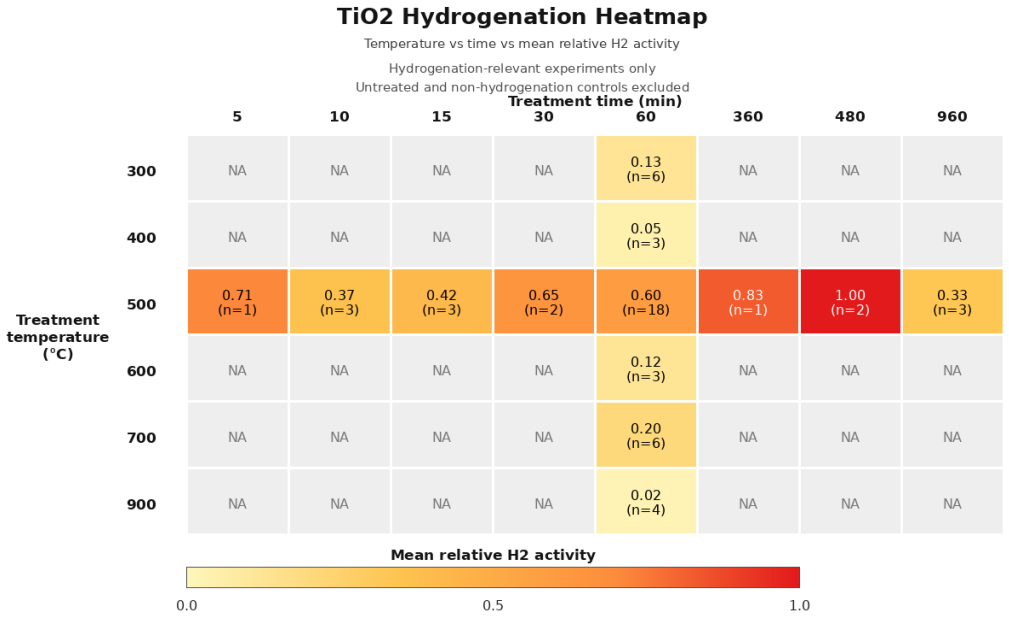
- It identifies consistent optimal conditions across heterogeneous literature, such as the anatase hydrogenation window at approximately 500 °C.
- The approach enables confidence-aware inference that flags when recommendations rest on limited or conflicting reports.
Where Pith is reading between the lines
- The same rule-extraction and retrieval structure could be applied to defect engineering in other oxide photocatalysts to test transferability.
- Standardizing the minimal set of descriptors required for inclusion in the database might indirectly improve future experimental reporting practices.
- Running the framework on an expanded or differently curated corpus would show whether the 500 °C optimum persists or shifts with additional papers.
Load-bearing premise
The selected publications and extracted mechanistic sentences form a representative and unbiased basis for rule encoding that supports generalizable recommendations beyond the curated set.
What would settle it
A new set of experiments that hydrogenates anatase TiO2 at 500 °C for one hour under H2 and measures no improvement in photocatalytic hydrogen evolution rate relative to other temperatures or times, or that finds no correlation between balanced Ti3+/oxygen-vacancy populations and activity.
Figures
read the original abstract
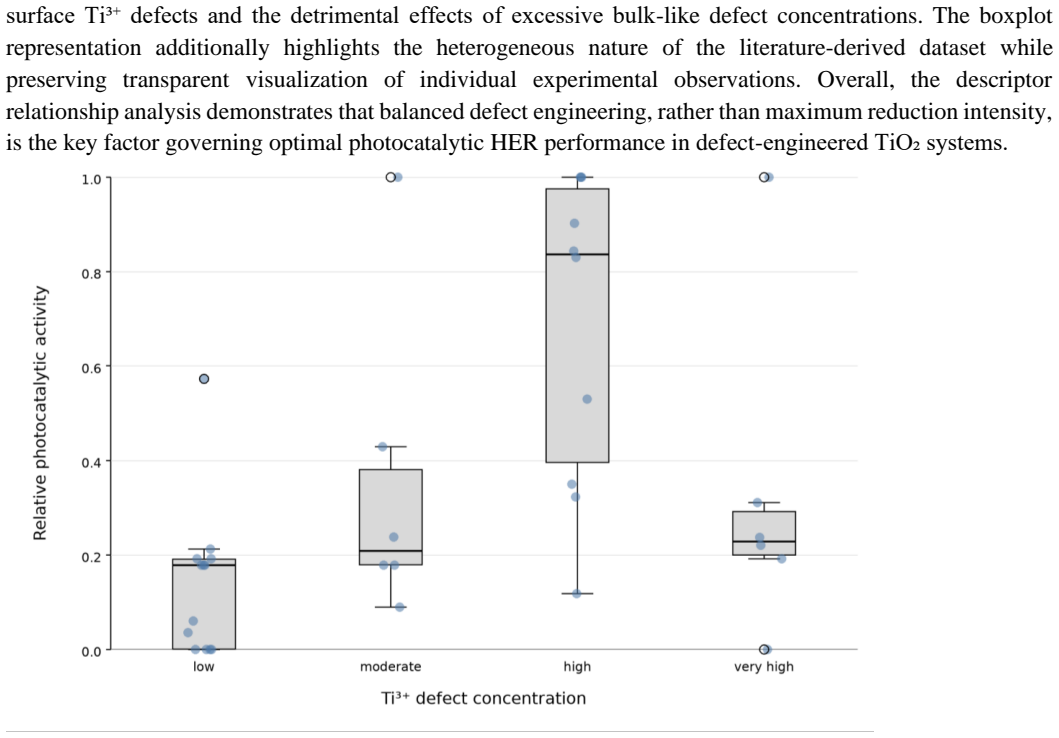
Defect-engineered TiO$_2$ photocatalysts are extensively investigated for photocatalytic hydrogen evolution; however, the highly heterogeneous nature of the literature, including inconsistent descriptors, diverse synthesis protocols, non-uniform activity metrics, and incomplete mechanistic reporting, limits the applicability of conventional machine-learning approaches based solely on statistical regression. Here, we present a literature-grounded large language model (LLM)-assisted scientific reasoning framework for defect-engineered TiO$_2$ photocatalysts integrating curated literature data, mechanistic rule extraction, and retrieval-augmented reasoning. A harmonized database was constructed from experimentally relevant publications specifically selected for hydrogen-evolution-related defect engineering in TiO$_2$, covering polymorph-dependent behavior, hydrogenation conditions, Ti$^{3+}$ defect states, oxygen vacancies, illumination conditions, and photocatalytic activity descriptors. In parallel, mechanistic evidence sentences and publications-defined scientific rules were encoded into a structured reasoning layer enabling explainable inference beyond black-box prediction. The resulting framework combines structured experimental descriptors, semantic literature retrieval, and mechanistic interpretation to generate confidence-aware recommendations for optimal defect-engineering conditions. For example, the AI agent identified a consistent optimal anatase hydrogenation window centered at ~500 $\deg$C under H$_2$-containing atmospheres for approximately 1 h, supported by mechanistic evidence linking balanced Ti$^{3+}$/oxygen-vacancy populations with enhanced photocatalytic hydrogen evolution.
Editorial analysis
A structured set of objections, weighed in public.
Referee Report
Summary. The manuscript presents a literature-grounded LLM-assisted scientific reasoning framework for defect-engineered TiO₂ photocatalysts. It constructs a harmonized database from experimentally relevant publications selected for hydrogen-evolution-related defect engineering (covering polymorphs, hydrogenation conditions, Ti³⁺ states, oxygen vacancies, and activity metrics), encodes mechanistic evidence sentences and publications-defined rules into a structured reasoning layer, and combines these with semantic retrieval to generate confidence-aware recommendations for optimal defect-engineering conditions. An example output is the identification of a consistent optimal anatase hydrogenation window centered at ~500 °C under H₂-containing atmospheres for ~1 h, linked to balanced Ti³⁺/oxygen-vacancy populations enhancing photocatalytic hydrogen evolution.
Significance. If the framework's recommendations prove reproducible and generalizable beyond the input corpus, the approach could address limitations of purely statistical ML on heterogeneous materials literature by adding mechanistic interpretability and explainable inference, offering a template for literature-driven hypothesis generation in photocatalysis and related fields.
major comments (2)
- [Abstract] Abstract: The central claim that the AI agent 'identified a consistent optimal anatase hydrogenation window' is advanced without any reported validation metrics, quantitative consistency measures, error analysis, hold-out testing, or details on rule extraction/testing procedures. This directly undermines the demonstrated support for the framework's utility.
- [Abstract] Abstract (paragraph on database construction): Publications are described as 'specifically selected' for hydrogen-evolution-related defect engineering, but no inclusion/exclusion criteria, number of papers screened versus retained, or assessment of selection bias are supplied. This is load-bearing for the generalizability claim, as the optimal condition and mechanistic linkage could be an artifact of curation rather than an emergent property of the broader literature.
Simulated Author's Rebuttal
We thank the referee for the detailed and constructive report. We address each major comment below. Where the concerns identify gaps in the current presentation, we have revised the manuscript to incorporate the requested details while preserving the core contributions of the framework.
read point-by-point responses
-
Referee: [Abstract] Abstract: The central claim that the AI agent 'identified a consistent optimal anatase hydrogenation window' is advanced without any reported validation metrics, quantitative consistency measures, error analysis, hold-out testing, or details on rule extraction/testing procedures. This directly undermines the demonstrated support for the framework's utility.
Authors: We agree that the abstract, as a concise summary, does not itself contain the supporting validation details. The main text describes the rule extraction from mechanistic evidence sentences, the structured reasoning layer, and the confidence scoring mechanism used to generate recommendations. To address this concern directly, the revised abstract will be expanded to reference the specific quantitative consistency measures and rule-validation procedures reported in the methods and results sections. We will also add a short error analysis summary to the abstract. revision: yes
-
Referee: [Abstract] Abstract (paragraph on database construction): Publications are described as 'specifically selected' for hydrogen-evolution-related defect engineering, but no inclusion/exclusion criteria, number of papers screened versus retained, or assessment of selection bias are supplied. This is load-bearing for the generalizability claim, as the optimal condition and mechanistic linkage could be an artifact of curation rather than an emergent property of the broader literature.
Authors: We acknowledge that transparent reporting of curation criteria is essential for assessing potential bias and generalizability. The revised manuscript will add an explicit subsection detailing the inclusion/exclusion criteria, the total number of publications screened and retained, and a brief assessment of selection bias. These additions will be cross-referenced in the abstract to clarify that the reported optimal window emerges from the encoded mechanistic rules applied to the curated corpus. revision: yes
Axiom & Free-Parameter Ledger
axioms (2)
- domain assumption Selected publications on hydrogen-evolution-related defect engineering in TiO2 are representative and sufficient for rule extraction
- domain assumption Mechanistic evidence sentences can be reliably translated into structured scientific rules that support inference
Reference graph
Works this paper leans on
-
[1]
U. Diebold. The surface science of titanium dioxide. Surf. Sci. Rep. 48 (2003), 53
2003
-
[2]
Fujishima, X
A. Fujishima, X. Zhang, D. Tryk. TiO2 photocatalysis and related surface phenomena. Surf. Sci. Rep. 63 (2008), 515
2008
-
[3]
Schneider, M
J. Schneider, M. Matsuoka, M. Takeuchi et al. Understanding TiO2 Photocatalysis: Mechanisms and Materials. Chem. Rev. 114 (2014), 9919
2014
-
[4]
Wierzbicka, M
E. Wierzbicka, M. Altomare, M. Wu et al. Reduced grey brookite for noble metal free photocatalytic H2 evolution. J. Mater. Chem. A 9 (2021), 1168 13
2021
-
[5]
J. Will, E. Wierzbicka, M. Wu et al. Hydrogenated anatase TiO2 single crystals: defects formation and structural changes as microscopic origin of co -catalyst free photocatalytic H2 evolution activity. J. Mater. Chem. A 9 (2021), 24932
2021
-
[6]
N. Liu, X. Zhou, N. Truong Nguyen et al. Black Magic in Gray Titania: Noble-Metal-Free Photocatalytic H2 Evolution from Hydrogenated Anatase. ChemSusChem 10 (2017), 62
2017
-
[7]
Mohajernia, P
S. Mohajernia, P. Andryskova, G. Zoppellaro et al. Influence of Ti3+ defect-type on heterogeneous photocatalytic H2 evolution activity of TiO2. Mater. Chem. A 8 (2020), 1432
2020
-
[8]
Haghshenas, W
Y. Haghshenas, W. Ping Wong, D. Gunawan et al. Predicting the rates of photocatalytic hydrogen evolution over cocatalyst-deposited TiO2 using machine learning with active photon flux as a unifying feature. EES Catal. 2 (2024), 612
2024
-
[9]
N. Liu, H. Steinrück, A. Osvet et al. Noble metal free photocatalytic H2 generation on black TiO2: On the influence of crystal facets vs. crystal damage. Appl. Phys. Lett. 110 (2017), 072102
2017
-
[10]
S. M. Hejazi, M. Shahrezaei, P. Błonski. Defect engineering over anisotropic brookite toward substrate- specific photo-oxidation of alcohols. Chem Catalysis 2 (2022), 1177
2022
-
[11]
Tam Nguyen
T. Tam Nguyen. K. Edalati. Brookite TiO2 as an active photocatalyst for photoconversion of plastic wastes to acetic acid and simultaneous hydrogen production: Comparison with anatase and rutile. Chomosphere 355 (2024), 141785
2024
-
[12]
Katai, P
M. Katai, P. Edalati, J. Hidalgo -Jimenez et al. Black brookite rich in oxygen vacancies as an active photocatalyst for CO2 conversion: experiments and first -principles calculations. Journal of Photochemistry and Photobiology A 449 (2024), 115409
2024
-
[13]
Dillon, I
Ji Bong Joo, R. Dillon, I. Lee et al. Promotion of atomic hydrogen recombination as an alternative to electron trapping for the role of metals in the photocatalytic production of H2. Proc. Natl. Acad. Sci. U.S.A. 111 (2014) 7942
2014
-
[14]
Wajid Shah, Y
M. Wajid Shah, Y. Zhu, X. Fan et al. Facile Synthesis of Defective TiO2−x Nanocrystals with High Surface Area and Tailoring Bandgap for Visible -light Photocatalysis. Sci Rep 5 (2015), 15804
2015
-
[15]
F. Zuo, L. Wang, T. Wu et al. Self-Doped Ti3+ Enhanced Photocatalyst for Hydrogen Production under Visible Light. J. Am. Chem. Soc. 132 (2010), 11856
2010
-
[16]
Naldoni, M
A. Naldoni, M. Altomare, G. Zoppellaro et al. Photocatalysis with Reduced TiO2: From Black TiO2 to Cocatalyst-Free Hydrogen Production. ACS Catal. 9 (2019), 345
2019
-
[17]
X. Zhou, E. Wierzbicka, N. Liu et al. Black and White Anatase, Rutile and Mixed Forms: Band -Edges and Photocatalytic Activity. Chem. Commun. 55 (2019), 533
2019
-
[18]
N. Liu, C. Schneider, D. Freitag et al. Hydrogenated anatase: Strong photocatalytic H2 evolution without the use of a co-catalyst. Angew. Chem. Int. Ed., 53 (2014), 14201
2014
-
[19]
Zheng, B
Z. Zheng, B. Huang, J. Lu et al. Hydrogenated titania: synergy of surface modification and morphology improvement for enhanced photocatalytic activity. Chem. Commun. 48 (2012), 5733
2012
-
[20]
X. Pan, M. Yang, X. Fu et al. Defective TiO2 with oxygen vacancies: synthesis, properties and photocatalytic applications. Nanoscale 5 (2013), 3601
2013
-
[21]
A. S. Hainer, J. S. Hodgins, V. Sandre et al. Photocatalytic Hydrogen Generation Using Metal-Decorated TiO2: Sacrificial Donors vs True Water Splitting. ACS Energy Letters 3 (2018), 542
2018
-
[22]
D. A. Boiko, R. MacKnight, B. Kline, G. Gomes. Autonomous chemical research with large language models. Nature 624 (2023), 570
2023
-
[23]
From Papers to Property Tables: A Priority-Based LLM Workflow for Materials Data Extraction
K. Rameshbabu, J. Luo, A. Shargh, K. A. El -Awady, J. A. El-Awady. From Papers to Property Tables: A Priority-Based LLM Workflow for Materials Data Extraction. arXiv:2604.07584
work page internal anchor Pith review Pith/arXiv arXiv
-
[24]
Mammadli, C
B. Mammadli, C. Yazici, M. Gürbüz, İ. Kocaman, F. J. Domínguez-Gutiérrez, F. M. Özkal. A data-driven machine learning approach for predicting axial load capacity in steel storage rack columns. Results in Engineering 28 (2025), 107475
2025
-
[25]
C. Bone, M. Walker, K. Leng, L. M. Antunes, R. Grau-Crespo et al. Discovery and recovery of crystalline materials with property-conditioned transformers. arXiv:2511.21299 14
work page internal anchor Pith review Pith/arXiv arXiv
-
[26]
Bran, Sam Cox, Oliver Schilter, Carlo Baldassari, Andrew D
Andres M. Bran, Sam Cox, Oliver Schilter, Carlo Baldassari, Andrew D. White & Philippe Schwaller. Augmenting large language models with chemistry tools. Nat Mach Intell 6 (2024), 525
2024
-
[27]
J. G. Meyer, R. J. Urbanowicz, P. C. N. Martin, K. O’Connor, R. Li et al. ChatGPT and large language models in academia: opportunities and challenges. BioData Mining 16 (2023), 20
2023
-
[28]
Salas, A
M. Salas, A. Singh, C. Pignataro, L. Pal. AI-powered open-source infrastructure for accelerating materials discovery and advanced manufacturing. Communications Materials 7 (2026), 65
2026
-
[29]
Peivaste, S
I. Peivaste, S. Belouettar, F. Mercuri, N. Fantuzzi, H. Dehghani et al. Artificial intelligence in materials science and engineering: Current landscape, key challenges, and future trajectories. Composite Structures 372 (2025), 119419
2025
discussion (0)
Sign in with ORCID, Apple, or X to comment. Anyone can read and Pith papers without signing in.