Temporal Evidence Routing with Structured Visual Evidence for TimeLogicQA
Pith reviewed 2026-06-28 17:42 UTC · model grok-4.3
The pith
A visual evidence routing pipeline achieves 81.8 average accuracy on TimeLogicQA by separating perception from symbolic temporal reasoning.
A machine-rendered reading of the paper's core claim, the machinery that carries it, and where it could break.
Core claim
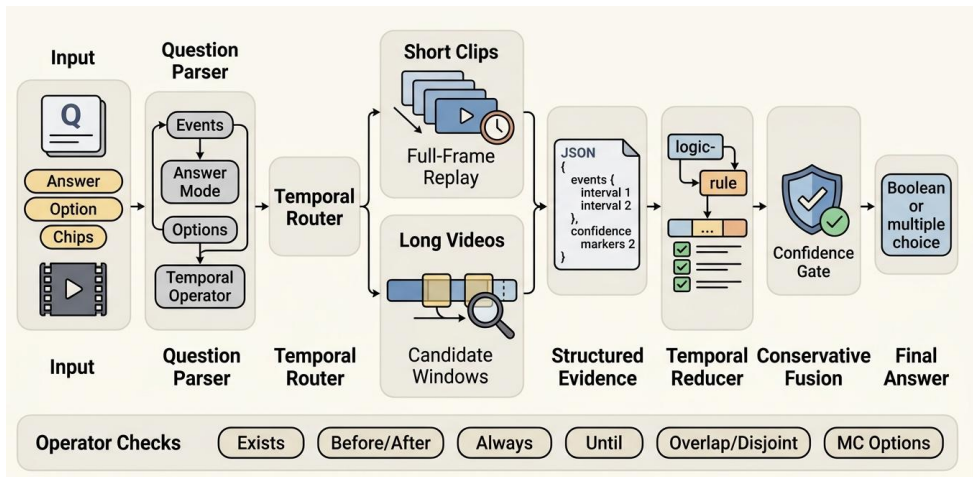
On the official test evaluation, the final system achieves an AvgAcc of 81.8 through a visual evidence routing pipeline that separates perception from symbolic temporal reasoning. The pipeline parses each question into event targets, answer mode, candidate options, and temporal operators, routes videos by duration and operator difficulty, obtains structured visual evidence from a multimodal large language model, recovers dense action intervals with programmatic verifiers, applies operator-specific temporal rules via a deterministic reducer, and accepts an answer only when visual evidence, temporal program, and confidence checks align.
What carries the argument
Visual evidence routing pipeline that parses questions, routes videos by duration and operator, generates structured visual evidence with a multimodal model, recovers intervals programmatically, applies deterministic temporal rules, and uses conservative fusion to accept answers.
If this is right
- Conservative fusion reduces noisy answer flips by accepting an answer only when visual evidence, temporal program, and confidence checks agree.
- Routing uses ordered full-frame evidence for short clips and event-focused candidate windows for long videos.
- Programmatic verifiers recover dense action intervals to support reliable application of temporal operators.
Where Pith is reading between the lines
- The separation of perception and reasoning could apply to other multimodal tasks that admit formal temporal or logical rules after initial evidence extraction.
- If the structured evidence is reliable, the method indicates that explicit routing and verification steps can improve consistency on structured reasoning benchmarks compared with fully integrated models.
Load-bearing premise
The multimodal large language model produces accurate structured visual evidence for the relevant events that the downstream verifiers can trust without further correction.
What would settle it
Replace the structured visual evidence with deliberately incorrect or random event descriptions and measure whether average accuracy on the official test set falls substantially below 81.8.
Figures
read the original abstract
TimeLogicQA evaluates whether video question answering systems can reason over temporal relations such as event existence, ordering, persistence, boundary conditions, and overlap. We address this task with a visual evidence routing pipeline that separates perception from symbolic temporal reasoning. The system first parses each question into event targets, answer mode, candidate options, and temporal operators. It then routes videos according to duration and operator difficulty, using ordered full-frame evidence for short clips and event-focused candidate windows for long videos. A multimodal large language model produces structured visual evidence for the relevant events, while programmatic verifiers recover dense action intervals and a deterministic reducer applies operator-specific temporal rules to produce the final answer. Conservative fusion accepts an answer only when the visual evidence, temporal program, and confidence checks agree, reducing noisy answer flips. On the official test evaluation, our final system achieves an AvgAcc of 81.8.
Editorial analysis
A structured set of objections, weighed in public.
Referee Report
Summary. The paper presents a visual evidence routing pipeline for TimeLogicQA that parses questions into event targets and temporal operators, routes videos by duration and difficulty, employs an MLLM to produce structured visual evidence, recovers action intervals via programmatic verifiers, and applies a deterministic reducer with conservative fusion to answer queries on event existence, ordering, persistence, boundaries, and overlap. The system reports an AvgAcc of 81.8 on the official test evaluation.
Significance. If the performance claim holds, the work demonstrates the utility of separating MLLM-based perception from symbolic temporal rules and conservative fusion in video reasoning tasks. The explicit isolation of perception from deterministic verification and the conservative acceptance criterion are strengths that could improve reliability over end-to-end neural methods.
major comments (1)
- [Abstract] Abstract: The central claim of 81.8 AvgAcc on the official test is reported as a single aggregate value with no error bars, ablation studies, or description of test-set construction and handling. This directly affects assessment of whether the result is robust or sensitive to post-hoc choices.
Simulated Author's Rebuttal
We thank the referee for the detailed review and the recognition of the separation between perception and symbolic reasoning as a strength. We address the single major comment below.
read point-by-point responses
-
Referee: [Abstract] Abstract: The central claim of 81.8 AvgAcc on the official test is reported as a single aggregate value with no error bars, ablation studies, or description of test-set construction and handling. This directly affects assessment of whether the result is robust or sensitive to post-hoc choices.
Authors: We agree that the abstract reports only the aggregate 81.8 AvgAcc. The evaluation uses the official TimeLogicQA test set released by the benchmark authors; its construction and handling are described in the TimeLogicQA reference paper and are not re-derived by us. Ablation studies on routing, verifier components, and fusion thresholds, together with analysis of sensitivity to design choices, appear in Sections 4 and 5 of the manuscript. Because the pipeline after MLLM evidence extraction is deterministic (programmatic verifiers and rule-based reducer), we did not compute statistical error bars across random seeds. To address the concern, we will revise the abstract to explicitly state that results are on the official test split and to point readers to the main text for ablations and evaluation protocol. revision: partial
Circularity Check
No significant circularity; empirical pipeline with no derivation chain
full rationale
The paper presents an engineering pipeline (question parsing, video routing, MLLM evidence extraction, programmatic interval recovery, deterministic temporal rules, and conservative fusion) evaluated on an official test set to report 81.8 AvgAcc. No equations, predictions, or first-principles derivations are claimed that could reduce to fitted parameters or self-citations by construction. The performance metric is external and falsifiable; the system separates perception from symbolic rules without internal reduction. This matches the default expectation of a non-circular empirical system.
Axiom & Free-Parameter Ledger
Reference graph
Works this paper leans on
-
[1]
Proceedings of the 33rd ACM International Conference on Multimedia , pages=
Multi-agent system for comprehensive soccer understanding , author=. Proceedings of the 33rd ACM International Conference on Multimedia , pages=
-
[2]
Gemini: A Family of Highly Capable Multimodal Models
Gemini: a family of highly capable multimodal models , author=. arXiv preprint arXiv:2312.11805 , year=
work page internal anchor Pith review Pith/arXiv arXiv
-
[3]
Proceedings of the IEEE conference on computer vision and pattern recognition , pages=
You only look once: Unified, real-time object detection , author=. Proceedings of the IEEE conference on computer vision and pattern recognition , pages=
-
[4]
2026 , url =
The 1st BlackSwan Challenge: Evaluating Abductive and Defeasible Reasoning in Unpredictable Events , author =. 2026 , url =
2026
-
[5]
Proceedings of the IEEE/CVF Conference on Computer Vision and Pattern Recognition (CVPR) , month =
Chinchure, Aditya and Ravi, Sahithya and Ng, Raymond and Shwartz, Vered and Li, Boyang and Sigal, Leonid , title =. Proceedings of the IEEE/CVF Conference on Computer Vision and Pattern Recognition (CVPR) , month =. 2025 , pages =
2025
-
[6]
International conference on machine learning , pages=
Learning transferable visual models from natural language supervision , author=. International conference on machine learning , pages=. 2021 , organization=
2021
-
[7]
Proceedings of the IEEE/CVF international conference on computer vision , pages=
Sigmoid loss for language image pre-training , author=. Proceedings of the IEEE/CVF international conference on computer vision , pages=
-
[8]
Sirnam et al.TimeLogic: A Temporal Logic Benchmark for Video QA
Timelogic: A temporal logic benchmark for video qa , author=. arXiv preprint arXiv:2501.07214 , year=
discussion (0)
Sign in with ORCID, Apple, or X to comment. Anyone can read and Pith papers without signing in.