Ground-state phase diagram of Rydberg atoms in a triangular-prism array
Pith reviewed 2026-06-28 16:25 UTC · model grok-4.3
The pith
Rydberg atoms in a triangular-prism array form multiple density-wave phases that break translational and D3 rotational symmetries.
A machine-rendered reading of the paper's core claim, the machinery that carries it, and where it could break.
Core claim
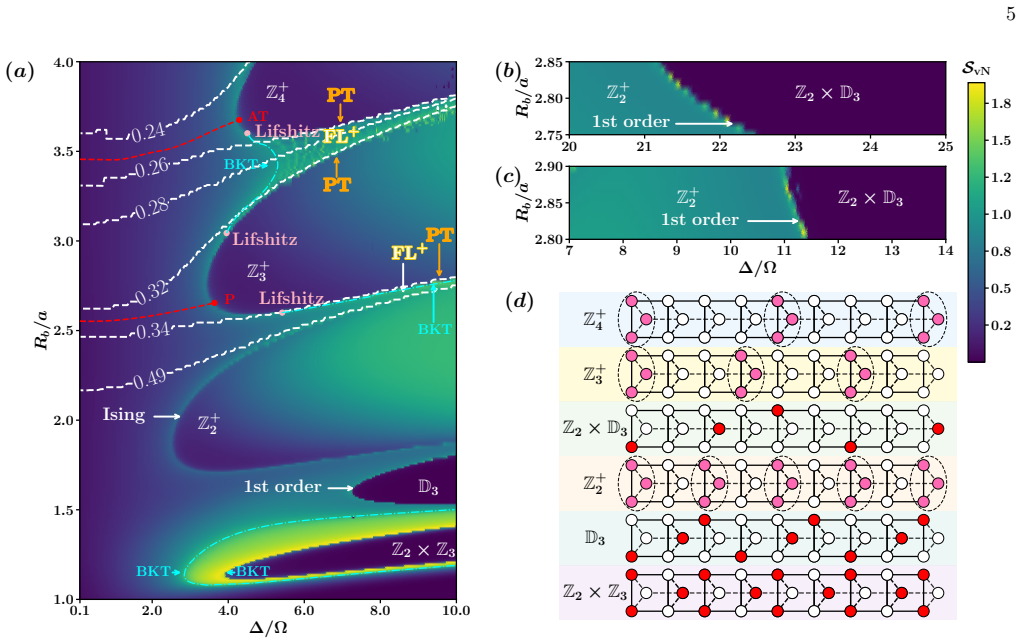
By tuning the detuning-to-Rabi-frequency ratio and the Rydberg blockade radius, the triangular-prism array realizes density-wave phases with spontaneous breaking of Z2 translational and Z3 rotational symmetry while preserving rung reflection symmetry; these phases melt either through two BKT transitions separated by a Z6-clock critical phase or via first-order transitions, and at still larger blockade a D3-broken phase appears directly from the disordered regime. Rung-trimerized states of different periods also appear and melt according to Ising, chiral, Potts or Ashkin-Teller criticality depending on the commensurability of the period.
What carries the argument
The triangular-prism lattice geometry with D3 symmetry, whose Hamiltonian is solved by DMRG to obtain the ground-state phase diagram as a function of detuning-to-Rabi ratio and blockade radius.
If this is right
- At moderate blockade an alternating double-single occupancy phase appears at large detuning and melts via two BKT transitions.
- At larger blockade a one-excitation-per-triangle phase with broken D3 symmetry enters by a direct first-order transition.
- Rung-trimerized density waves of period 2, 3 and 4 melt along Ising or chiral critical lines, with Potts and Ashkin-Teller points only on commensurate lines.
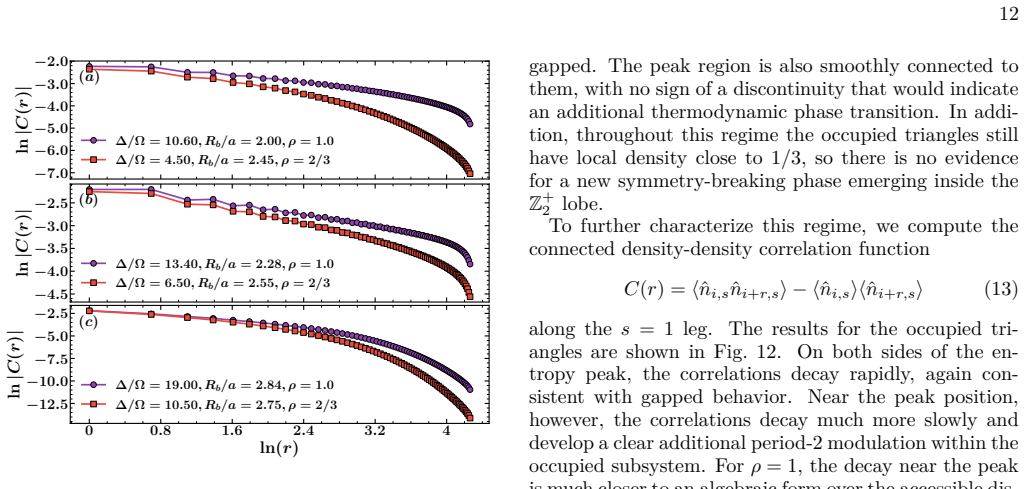
- An entanglement-entropy peak inside the Z2 trimerized phase marks a crossover to enhanced period-2 modulation before a first-order transition to a Z2 times D3 phase.
- Floating incommensurate phases separate trimerized states of different periods.
Where Pith is reading between the lines
- The richer phase structure suggests that any atomic array whose unit cell has rotational symmetry higher than Z2 will generically support additional broken-symmetry states and multicritical points.
- The reported BKT and chiral critical lines could be tested by measuring correlation-length exponents or central-charge values in larger prism arrays.
- The same symmetry-breaking mechanism may appear in other long-range interacting systems whose geometry respects D3, such as certain ion chains or polar-molecule lattices.
Load-bearing premise
Finite-size DMRG on short prisms already captures the correct sequence of phases and the nature of the transitions that survive in the thermodynamic limit.
What would settle it
An experiment that measures the structure factor or entanglement entropy while scanning detuning at fixed blockade radius and observes either the predicted intermediate critical phase with Z6 clock scaling or the absence of the reported first-order jump between trimerized states.
Figures
read the original abstract
We study the ground-state phase diagram of Rydberg atoms in a triangular-prism optical tweezer array using the density matrix renormalization group. By tuning the detuning-to-Rabi-frequency ratio and the Rydberg blockade radius, the system realizes several density-wave phases with spontaneous breaking of translational and leg-exchange symmetries. Unlike two-leg Rydberg ladders with $\mathbb{Z}_2$ leg-exchange symmetry, the triangular prism has $\mathbb{D}_3$ symmetry, leading to a richer set of ordered phases and transitions. For blockade radius moderately larger than the lattice spacing, a phase with alternating double and single Rydberg occupancy appears at large detuning. It breaks $\mathbb{Z}_2$ translational and $\mathbb{Z}_3$ rotational symmetry while preserving a rung reflection symmetry. Upon decreasing detuning, it melts through two Berezinskii-Kosterlitz-Thouless transitions with an intermediate critical phase described by a $\mathbb{Z}_6$ clock model. At larger blockade radius, a phase with one Rydberg excitation per triangle and broken $\mathbb{D}_3$ symmetry appears through a first-order transition. When double occupation of neighboring triangles is suppressed, rung-trimerized density waves develop as detuning increases from the disordered phase. Their melting follows the same structure as in Rydberg chains and two-leg ladders: the $\mathbb{Z}_2$ case has Ising critical lines, while the $\mathbb{Z}_3$ and $\mathbb{Z}_4$ cases have chiral critical lines, with Potts and Ashkin-Teller points only on the corresponding commensurate lines. Inside the $\mathbb{Z}_2$ rung-trimerized phase, an entanglement-entropy peak signals a crossover regime with enhanced period-2 density modulation before a first-order transition into a $\mathbb{Z}_2\times\mathbb{D}_3$ phase. Floating phases with incommensurate quasi-long-range order appear between trimerized states of different periods.
Editorial analysis
A structured set of objections, weighed in public.
Referee Report
Summary. The manuscript maps the ground-state phase diagram of Rydberg atoms in a triangular-prism geometry via DMRG, as a function of detuning-to-Rabi-frequency ratio and blockade radius. It reports multiple density-wave phases that spontaneously break Z2 translational symmetry together with Z3 rotational or full D3 symmetry, including an alternating double-single occupancy phase that melts via two BKT transitions through an intermediate Z6 clock-model critical phase, first-order transitions to D3-broken phases at larger blockade radius, rung-trimerized phases whose melting follows Ising or chiral critical lines depending on commensurability, and intervening floating phases with incommensurate quasi-long-range order.
Significance. If the finite-size extrapolations hold, the work supplies a concrete microscopic realization of Z6 clock-model criticality and chiral transitions in a Rydberg platform whose D3 symmetry produces a richer set of ordered phases and transition types than the Z2 ladders studied previously. The approach is a direct numerical scan of the microscopic Hamiltonian with no fitted parameters re-derived, which is a methodological strength.
major comments (3)
- [Abstract and Numerical Methods] The abstract states that the central claims rest on DMRG output, yet neither the abstract nor the methods description supplies system sizes L, bond dimensions χ, discarded weight, or any convergence checks. Because the identification of BKT transitions and the Z6 clock phase (moderate blockade-radius regime) requires extrapolation of diverging correlation lengths, the absence of these diagnostics makes the thermodynamic-limit conclusions load-bearing but unverifiable from the presented data.
- [Results, moderate blockade radius] In the section describing the alternating double-single occupancy phase and its melting, the two BKT transitions and intervening Z6 phase are asserted on the basis of finite-size DMRG. Without reported scaling of the entanglement entropy S(L), the central charge, or the structure-factor peaks versus 1/L (or versus the correlation length), it is not possible to exclude a weakly first-order scenario or a different universality class.
- [Results, rung-trimerized and floating phases] The claims of floating phases with incommensurate quasi-long-range order between trimerized states of different periods (final paragraph of results) likewise depend on distinguishing incommensurability from locking on finite ladders. The manuscript should provide the largest L employed and any explicit incommensurability diagnostic (e.g., wave-vector drift with L) to support the thermodynamic-limit statement.
minor comments (2)
- [Figures] Figure captions should explicitly state the system sizes and bond dimensions used for each panel so that readers can assess the finite-size data directly.
- [Model] The notation for the D3 symmetry operations and the distinction between Z3 rotational and full D3 breaking could be clarified with a short symmetry table in the model section.
Simulated Author's Rebuttal
We thank the referee for the careful reading and constructive comments. We appreciate the positive assessment of the work's significance regarding the D3 symmetry and richer phase structure. We address each major comment below and will revise the manuscript to incorporate the requested numerical details and supporting diagnostics.
read point-by-point responses
-
Referee: [Abstract and Numerical Methods] The abstract states that the central claims rest on DMRG output, yet neither the abstract nor the methods description supplies system sizes L, bond dimensions χ, discarded weight, or any convergence checks. Because the identification of BKT transitions and the Z6 clock phase (moderate blockade-radius regime) requires extrapolation of diverging correlation lengths, the absence of these diagnostics makes the thermodynamic-limit conclusions load-bearing but unverifiable from the presented data.
Authors: We agree that these parameters are necessary for verifying the DMRG-based conclusions. In the revised manuscript we will expand the Numerical Methods section to report the system sizes employed (L ranging from 12 to 48), maximum bond dimensions (χ up to 2000), discarded weights (below 10^{-8}), and explicit convergence checks with respect to χ and L. A brief reference to these details will also be added near the abstract or in the introduction. revision: yes
-
Referee: [Results, moderate blockade radius] In the section describing the alternating double-single occupancy phase and its melting, the two BKT transitions and intervening Z6 phase are asserted on the basis of finite-size DMRG. Without reported scaling of the entanglement entropy S(L), the central charge, or the structure-factor peaks versus 1/L (or versus the correlation length), it is not possible to exclude a weakly first-order scenario or a different universality class.
Authors: We acknowledge the value of additional scaling data to strengthen the identification of the BKT transitions and Z6 clock phase. In the revision we will add plots and analysis of the entanglement entropy S(L) for central-charge extraction, together with the scaling of structure-factor peaks versus 1/L and correlation length, to support the two BKT transitions and to help distinguish the critical phase from a weakly first-order scenario. revision: yes
-
Referee: [Results, rung-trimerized and floating phases] The claims of floating phases with incommensurate quasi-long-range order between trimerized states of different periods (final paragraph of results) likewise depend on distinguishing incommensurability from locking on finite ladders. The manuscript should provide the largest L employed and any explicit incommensurability diagnostic (e.g., wave-vector drift with L) to support the thermodynamic-limit statement.
Authors: We agree that explicit incommensurability diagnostics are required. In the revised manuscript we will state the largest system sizes used (L up to 60) and include the wave-vector position as a function of L to demonstrate the drift that supports incommensurate quasi-long-range order in the floating phases, thereby distinguishing them from commensurate locking on finite ladders. revision: yes
Circularity Check
Direct numerical DMRG scan of microscopic Hamiltonian exhibits no circularity
full rationale
The paper reports ground-state phases obtained by applying standard DMRG to the Rydberg Hamiltonian on finite triangular-prism ladders. No quantities are defined in terms of other quantities that are then re-derived; no parameters are fitted to a subset of data and then called predictions; no uniqueness theorems or ansatze are imported via self-citation to force the central claims. The symmetry-breaking patterns and transition characters are simulation outputs, not inputs. The study is therefore self-contained against external benchmarks.
Axiom & Free-Parameter Ledger
free parameters (2)
- detuning-to-Rabi-frequency ratio
- Rydberg blockade radius
axioms (2)
- domain assumption The Rydberg interaction is accurately captured by a hard blockade radius cutoff.
- domain assumption DMRG on finite cylinders yields the correct thermodynamic-limit phases and transition universality classes for the prism geometry.
Reference graph
Works this paper leans on
-
[1]
This is also con- sistent with the presence of an extended commensurate regime withk/2π= 1/2in the phase diagram
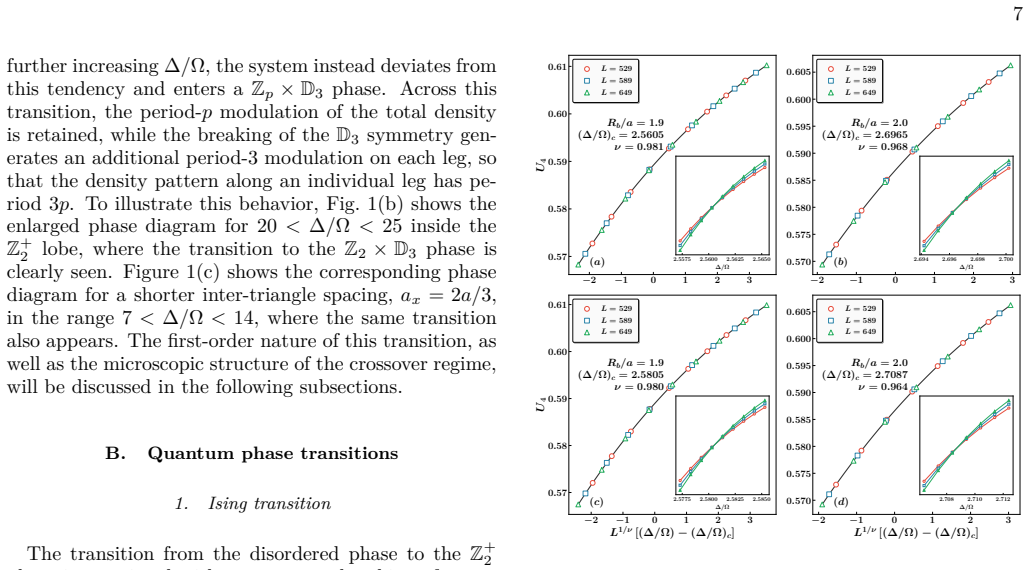
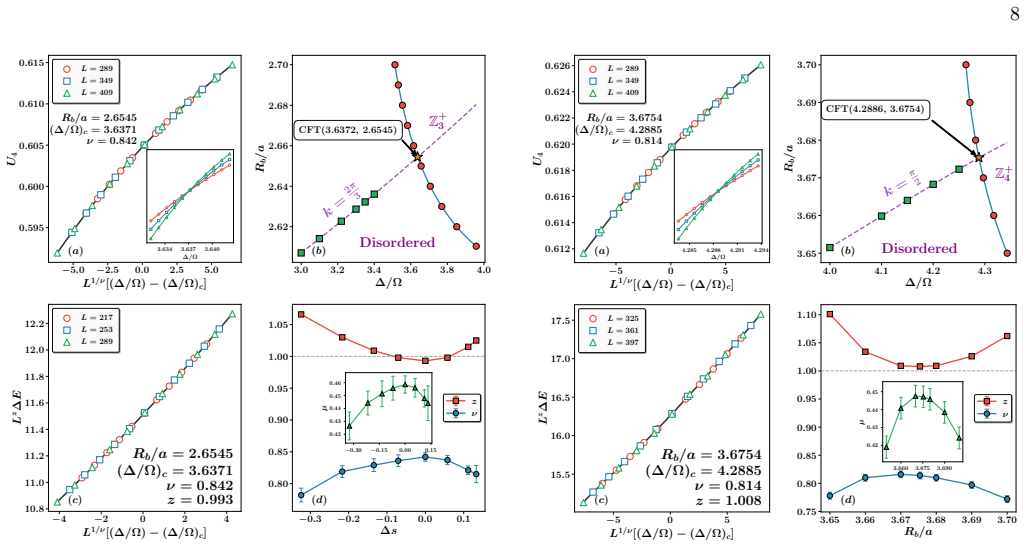
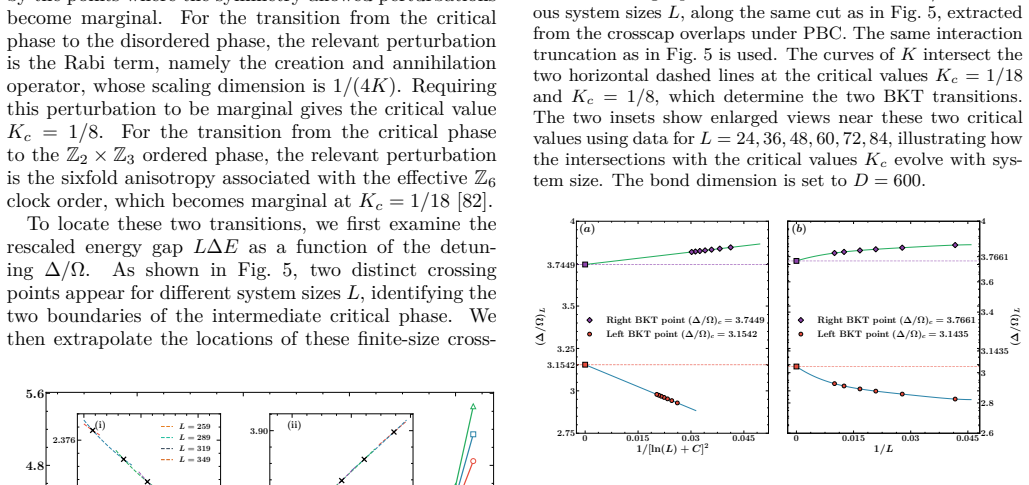
Ising transition The transition from the disordered phase to theZ + 2 phase is associated with spontaneous breaking of trans- lationalZ 2 symmetry, and is therefore expected to be- long to the Ising universality class. This is also con- sistent with the presence of an extended commensurate regime withk/2π= 1/2in the phase diagram. To de- termine the criti...
-
[2]
As discussed in Sec
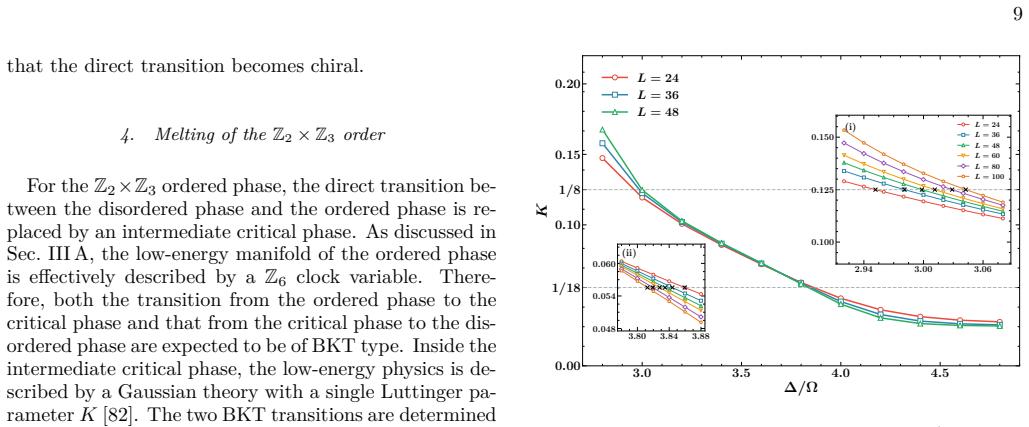
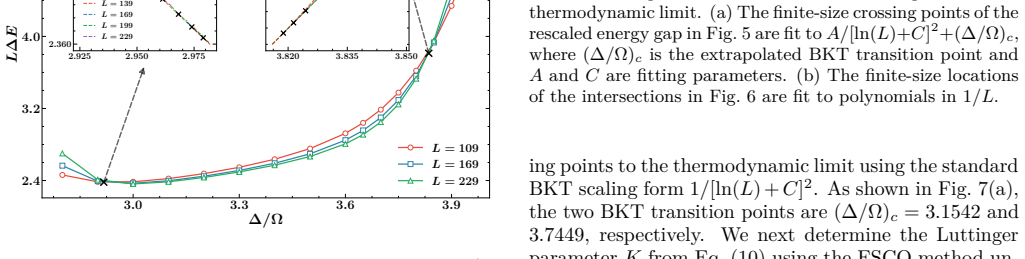
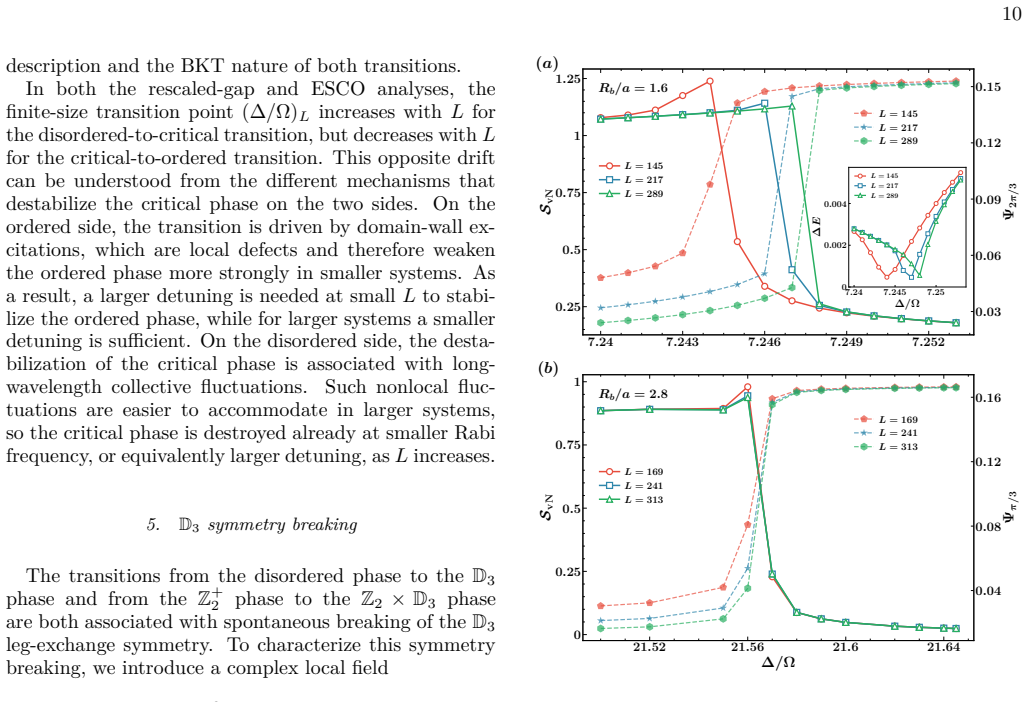
Melting of theZ 2×Z3 order For theZ2×Z3 ordered phase, the direct transition be- tween the disordered phase and the ordered phase is re- placed by an intermediate critical phase. As discussed in Sec. IIIA, the low-energy manifold of the ordered phase is effectively described by aZ 6 clock variable. There- fore, both the transition from the ordered phase t...
-
[3]
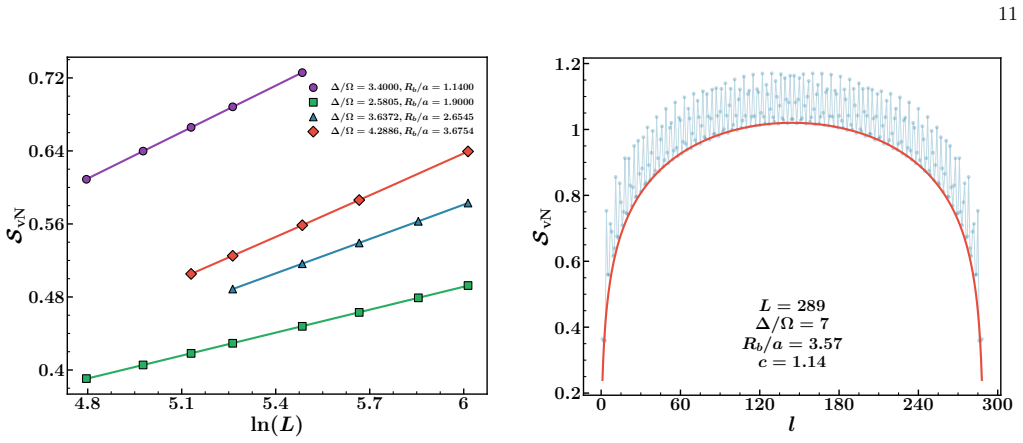
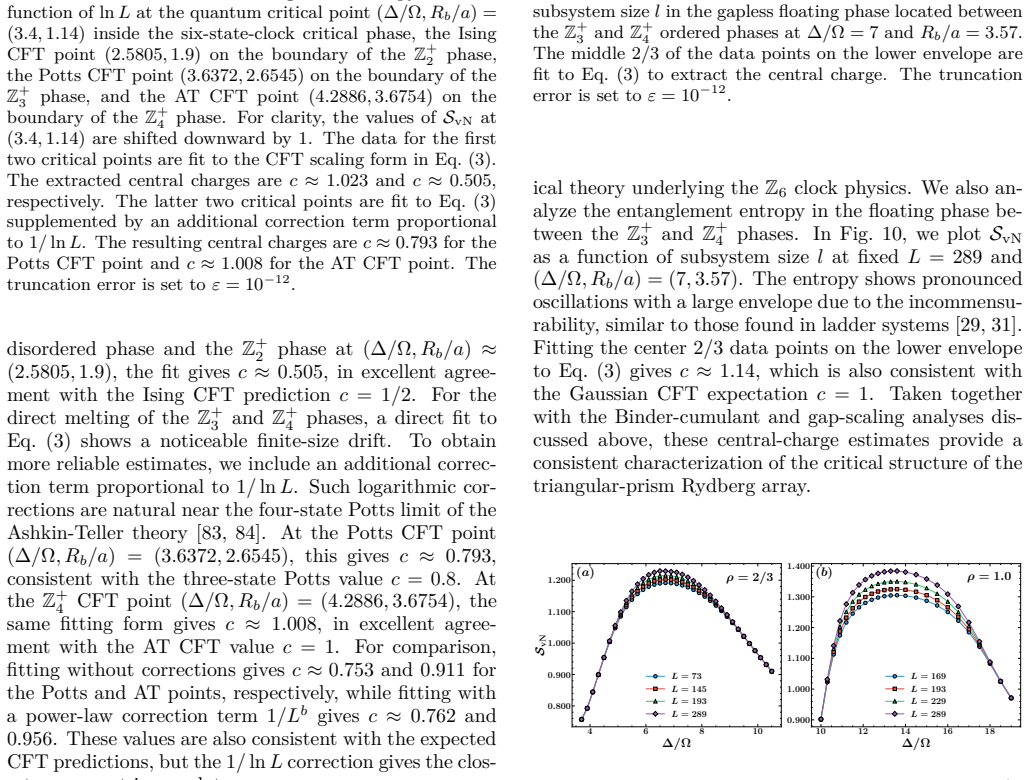
Central charges at critical points and gapless phases To further confirm the universality classes of the con- tinuous phase transitions in the triangular-prism Ryd- berg array, we analyze the scaling of the von Neumann entanglement entropySvN and extract the central charge by fitting the center-cut entropy to Eq. (3). The results for representative critic...
-
[4]
Labuhn, D
H. Labuhn, D. Barredo, S. Ravets, S. de Léséleuc, T. Macrì, T. Lahaye, and A. Browaeys, Nature534, 667 (2016)
2016
-
[5]
Bernien, S
H. Bernien, S. Schwartz, A. Keesling, H. Levine, A. Om- ran, H. Pichler, S. Choi, A. S. Zibrov, M. Endres, M. Greiner, V. Vuletić, and M. D. Lukin, Nature551, 579 (2017)
2017
-
[6]
Keesling, A
A. Keesling, A. Omran, H. Levine, H. Bernien, H. Pich- ler, S. Choi, R. Samajdar, S. Schwartz, P. Silvi, S. Sachdev, P. Zoller, M. Endres, M. Greiner, V. Vuletić, and M. D. Lukin, Nature568, 207 (2019)
2019
-
[7]
de Léséleuc, V
S. de Léséleuc, V. Lienhard, P. Scholl, D. Barredo, S. Weber, N. Lang, H. P. Büchler, T. Lahaye, and A. Browaeys, Science365, 775 (2019)
2019
-
[8]
Semeghini, H
G. Semeghini, H. Levine, A. Keesling, S. Ebadi, T. T. Wang, D. Bluvstein, R. Verresen, H. Pichler, M. Kali- nowski, R. Samajdar, A. Omran, S. Sachdev, A. Vish- wanath, M. Greiner, V. Vuletić, and M. D. Lukin, Sci- ence374, 1242 (2021)
2021
-
[9]
Ebadi, T
S. Ebadi, T. T. Wang, H. Levine, A. Keesling, G. Se- meghini, A. Omran, D. Bluvstein, R. Samajdar, H. Pich- ler, W. W. Ho, S. Choi, S. Sachdev, M. Greiner, V. Vuletić, and M. D. Lukin, Nature595, 227 (2021)
2021
-
[10]
Scholl, M
P. Scholl, M. Schuler, H. J. Williams, A. A. Eberharter, D. Barredo, K.-N. Schymik, V. Lienhard, L.-P. Henry, T. C. Lang, T. Lahaye, A. M. Läuchli, and A. Browaeys, Nature595, 233 (2021)
2021
-
[11]
C. Chen, G. Bornet, M. Bintz, G. Emperauger, L. Leclerc, V. S. Liu, P. Scholl, D. Barredo, J. Hauschild, S. Chatterjee, M. Schuler, A. M. Läuchli, M. P. Zaletel, T. Lahaye, N. Y. Yao, and A. Browaeys, Nature616, 691 (2023)
2023
-
[12]
Y. O. Dudin, L. Li, F. Bariani, and A. Kuzmich, Nature Physics8, 790 (2012)
2012
-
[13]
Šibalić and C
N. Šibalić and C. S. Adams,Rydberg Physics, 2399-2891 (IOP Publishing, 2018)
2018
-
[14]
Browaeys and T
A. Browaeys and T. Lahaye, Nature Physics16, 132 (2020)
2020
-
[15]
Fendley, K
P. Fendley, K. Sengupta, and S. Sachdev, Phys. Rev. B 69, 075106 (2004)
2004
-
[16]
Chepiga and F
N. Chepiga and F. Mila, Phys. Rev. Lett.122, 017205 (2019)
2019
-
[17]
Chepiga and F
N. Chepiga and F. Mila, Phys. Rev. Res.3, 023049 (2021)
2021
-
[18]
Chepiga and F
N. Chepiga and F. Mila, Nature Communications12, 414 (2021)
2021
-
[19]
I. A. Maceira, N. Chepiga, and F. Mila, Phys. Rev. Res. 4, 043102 (2022)
2022
-
[20]
S. Guo, J. Huang, J. Hu, and Z.-X. Li, Phys. Rev. A 108, 053314 (2023)
2023
-
[21]
Chepiga, Phys
N. Chepiga, Phys. Rev. Lett.132, 076505 (2024)
2024
-
[22]
Samajdar, W
R. Samajdar, W. W. Ho, H. Pichler, M. D. Lukin, and S. Sachdev, Phys. Rev. Lett.124, 103601 (2020)
2020
-
[23]
R. Samajdar, W. W. Ho, H. Pichler, M. D. Lukin, and S. Sachdev, Proceedings of the Na- tional Academy of Sciences118, e2015785118 (2021), https://www.pnas.org/doi/pdf/10.1073/pnas.2015785118
-
[24]
C.-X. Li, S. Yang, and J.-B. Xu, Opt. Lett.47, 1093 (2022)
2022
-
[25]
Yan, Y.-C
Z. Yan, Y.-C. Wang, R. Samajdar, S. Sachdev, and Z. Y. Meng, Phys. Rev. Lett.130, 206501 (2023)
2023
-
[26]
Bombieri, T
L. Bombieri, T. V. Zache, G. Calliari, M. D. Lukin, H. Pichler, and D. González-Cuadra, Phys. Rev. Lett. 135, 233602 (2025)
2025
-
[27]
Homeier, S
L. Homeier, S. Hollerith, S. Geier, N.-C. Chiu, A. Browaeys, and L. Pollet, Phys. Rev. A111, L011305 14 (2025)
2025
-
[28]
Fromholz, M
P. Fromholz, M. Tsitsishvili, M. Votto, M. Dalmonte, A. Nersesyan, and T. Chanda, Phys. Rev. B106, 155411 (2022)
2022
-
[29]
Tsitsishvili, T
M. Tsitsishvili, T. Chanda, M. Votto, P. Fromholz, M. Dalmonte, and A. Nersesyan, Phys. Rev. B105, 155159 (2022)
2022
-
[30]
Eck and P
L. Eck and P. Fendley, Phys. Rev. B108, 125135 (2023)
2023
-
[31]
Zhang, S.-W
J. Zhang, S.-W. Tsai, and Y. Meurice, Phys. Rev. D 110, 034513 (2024)
2024
-
[32]
Zhang, S
J. Zhang, S. H. Cantú, F. Liu, A. Bylinskii, B. Braver- man, F. Huber, J. Amato-Grill, A. Lukin, N. Gemelke, A. Keesling, S.-T. Wang, Y. Meurice, and S.-W. Tsai, Nature Communications16, 712 (2025)
2025
-
[33]
J.Soto-GarciaandN.Chepiga,Phys.Rev.Res.7,013215 (2025)
2025
-
[34]
S.-A. Liao, J. Zhang, and L.-P. Yang, Phys. Rev. B111, 165154 (2025)
2025
-
[35]
Verresen, M
R. Verresen, M. D. Lukin, and A. Vishwanath, Phys. Rev. X11, 031005 (2021)
2021
-
[36]
Samajdar, D
R. Samajdar, D. G. Joshi, Y. Teng, and S. Sachdev, Phys. Rev. Lett.130, 043601 (2023)
2023
-
[37]
Verresen and A
R. Verresen and A. Vishwanath, Phys. Rev. X12, 041029 (2022)
2022
-
[38]
Slagle, Y
K. Slagle, Y. Liu, D. Aasen, H. Pichler, R. S. K. Mong, X. Chen, M. Endres, and J. Alicea, Phys. Rev. B106, 115122 (2022)
2022
-
[39]
Kornjača, R
M. Kornjača, R. Samajdar, T. Macrì, N. Gemelke, S.- T. Wang, and F. Liu, Communications Physics6, 358 (2023)
2023
-
[40]
J. Shah, G. Nambiar, A. V. Gorshkov, and V. Galitski, Phys. Rev. X15, 011025 (2025)
2025
-
[41]
Zhang and Z
T. Zhang and Z. Cai, Phys. Rev. Lett.132, 206503 (2024)
2024
-
[42]
F. M. Surace, P. P. Mazza, G. Giudici, A. Lerose, A. Gambassi, and M. Dalmonte, Phys. Rev. X10, 021041 (2020)
2020
-
[43]
A. Celi, B. Vermersch, O. Viyuela, H. Pichler, M. D. Lukin, and P. Zoller, Phys. Rev. X10, 021057 (2020)
2020
-
[44]
Notarnicola, M
S. Notarnicola, M. Collura, and S. Montangero, Phys. Rev. Res.2, 013288 (2020)
2020
-
[45]
E. C. Domanti, D. Zappalà, A. Bermudez, and L. Amico, Phys. Rev. Res.6, L022059 (2024)
2024
-
[46]
Cheng and H
Y. Cheng and H. Zhai, Nature Reviews Physics6, 566 (2024)
2024
-
[47]
González-Cuadra, M
D. González-Cuadra, M. Hamdan, T. V. Zache, B. Braverman, M. Kornjača, A. Lukin, S. H. Cantú, F. Liu, S.-T. Wang, A. Keesling, M. D. Lukin, P. Zoller, and A. Bylinskii, Nature642, 321 (2025)
2025
-
[48]
Z. Zhou, Z. Yan, C. Liu, Y. Chen, and X.-F. Zhang, Chinese Physics Letters42, 053705 (2025)
2025
-
[49]
Xu and X.-F
W. Xu and X.-F. Zhang, Phys. Rev. B113, L020408 (2026)
2026
-
[50]
Zhang, H
T. Zhang, H. Wang, W. Zhang, Y. Wang, A. Du, Z. Li, Y. Wu, C. Li, J. Hu, H. Zhai, and W. Chen, Phys. Rev. Lett.135, 093403 (2025)
2025
-
[51]
H. Wang, X. Li, and C. Li, Nature Communications16, 10584 (2025)
2025
-
[52]
Bluvstein, A
D. Bluvstein, A. Omran, H. Levine, A. Keesling, G. Se- meghini, S. Ebadi, T. T. Wang, A. A. Michailidis, N. Maskara, W. W. Ho, S. Choi, M. Serbyn, M. Greiner, V. Vuletić, and M. D. Lukin, Science371, 1355 (2021)
2021
-
[53]
M. Pal, M. Sarkar, K. Sengupta, and A. Sen, Phys. Rev. B111, L161101 (2025)
2025
-
[54]
Liang, Z
X. Liang, Z. Yue, Y.-X. Chao, Z.-X. Hua, Y. Lin, M. K. Tey, and L. You, Phys. Rev. Lett.135, 050201 (2025)
2025
-
[55]
Proximate integrability and exact revivals in staggered rydberg ladders,
M. Pal and T. Banerjee, “Proximate integrability and exact revivals in staggered rydberg ladders,” (2025), arXiv:2504.15230 [quant-ph]
arXiv 2025
-
[56]
H. Wang, C. Li, X. Li, Y. Gu, and S. Liu, Phys. Rev. B 112, 205103 (2025)
2025
-
[57]
M. Qiao, G. Emperauger, C. Chen, L. Homeier, S. Hol- lerith, G. Bornet, R. Martin, B. Gély, L. Klein, D. Barredo, S. Geier, N.-C. Chiu, F. Grusdt, A. Bohrdt, T. Lahaye, and A. Browaeys, Nature644, 889 (2025)
2025
-
[58]
J. Wang, C. Liu, Y.-C. Wang, and Z. Yan, Phys. Rev. A112, 053305 (2025)
2025
-
[59]
Yang and J.-B
S. Yang and J.-B. Xu, Phys. Rev. E106, 034121 (2022)
2022
-
[60]
Sarkar, M
M. Sarkar, M. Pal, A. Sen, and K. Sengupta, SciPost Phys.14, 004 (2023)
2023
-
[61]
Eck and P
L. Eck and P. Fendley, SciPost Phys.16, 127 (2024)
2024
-
[62]
B. M. L. Rivière and N. Chepiga, SciPost Phys.17, 144 (2024)
2024
-
[63]
S. R. White, Phys. Rev. Lett.69, 2863 (1992)
1992
-
[64]
S. R. White, Phys. Rev. B48, 10345 (1993)
1993
-
[65]
V. L. Berezinsky, Sov. Phys. JETP32, 493 (1971)
1971
-
[66]
J. M. Kosterlitz and D. J. Thouless, Journal of Physics C: Solid State Physics6, 1181 (1973)
1973
-
[67]
J.M.Kosterlitz,JournalofPhysicsC:SolidStatePhysics 7, 1046 (1974)
1974
-
[68]
Ortiz, E
G. Ortiz, E. Cobanera, and Z. Nussinov, Nuclear Physics B854, 780 (2012)
2012
-
[69]
Holzhey, F
C. Holzhey, F. Larsen, and F. Wilczek, Nuclear Physics B424, 443 (1994)
1994
-
[70]
Vidal, J
G. Vidal, J. I. Latorre, E. Rico, and A. Kitaev, Phys. Rev. Lett.90, 227902 (2003)
2003
-
[71]
Calabrese and J
P. Calabrese and J. Cardy, Journal of Statistical Mechan- ics: Theory and Experiment2004, P06002 (2004)
2004
-
[72]
Calabrese and J
P. Calabrese and J. Cardy, Journal of Physics A: Math- ematical and Theoretical42, 504005 (2009)
2009
-
[73]
Eisert, M
J. Eisert, M. Cramer, and M. B. Plenio, Rev. Mod. Phys. 82, 277 (2010)
2010
-
[74]
Binder, J
K. Binder, J. Comput. Phys.59, 1
-
[75]
B.-Y. Tan, Y. Zhang, H.-C. Zhang, W. Tang, L. Wang, H.-H. Tu, and Y.-H. Wu, Phys. Rev. Lett.134, 076501
-
[76]
Östlund and S
S. Östlund and S. Rommer, Phys. Rev. Lett.75, 3537 (1995)
1995
-
[77]
Fishman, S
M. Fishman, S. R. White, and E. M. Stoudenmire, Sci- Post Phys. Codebases , 4 (2022)
2022
-
[78]
D. A. Huse and M. E. Fisher, Phys. Rev. Lett.49, 793 (1982)
1982
-
[79]
V. L. Pokrovsky and A. L. Talapov, Phys. Rev. Lett.42, 65 (1979)
1979
-
[80]
Whitsitt, R
S. Whitsitt, R. Samajdar, and S. Sachdev, Phys. Rev. B 98, 205118
discussion (0)
Sign in with ORCID, Apple, or X to comment. Anyone can read and Pith papers without signing in.