pcbGPT: Automatic PCB Schematic Synthesis from Natural Language Requirements
Pith reviewed 2026-06-28 16:27 UTC · model grok-4.3
The pith
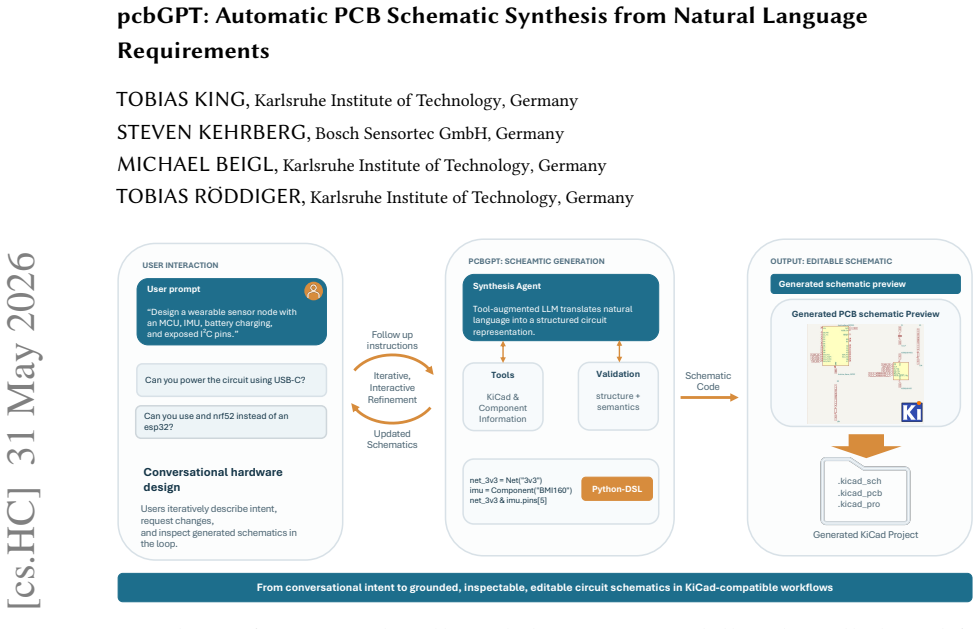
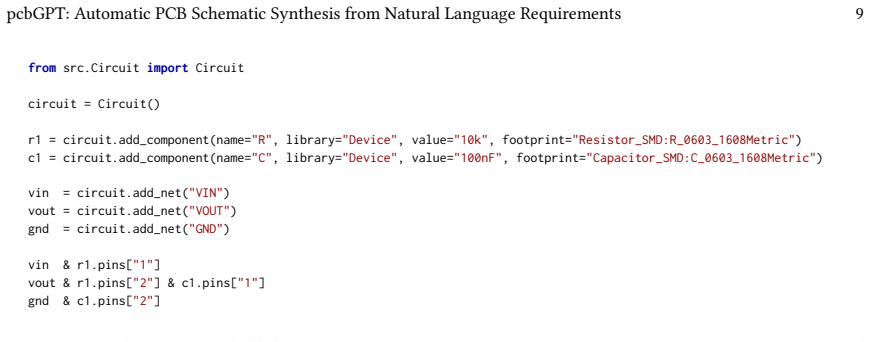
pcbGPT converts natural-language hardware requirements into editable KiCad schematics using a Python DSL and multi-stage validation.
A machine-rendered reading of the paper's core claim, the machinery that carries it, and where it could break.
Core claim
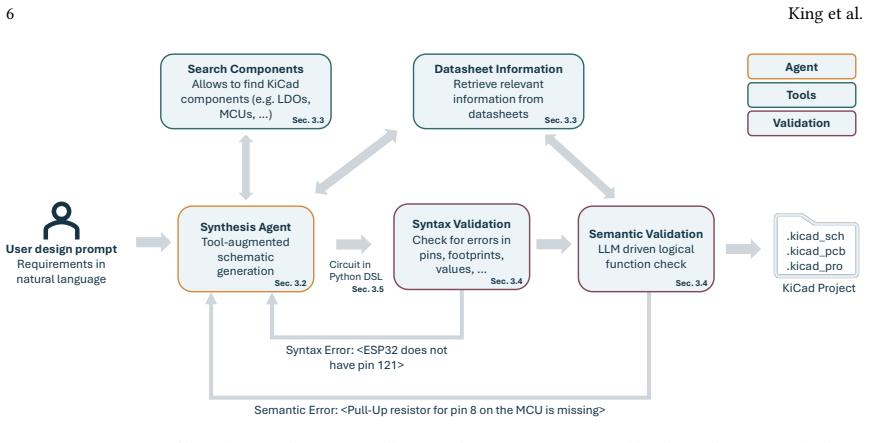
pcbGPT represents circuits in a Python DSL and applies tool-augmented synthesis, library search, datasheet-grounded rules, execution-based checking, and structural-semantic validation to produce KiCad schematics directly from natural-language requirements. On twenty embedded tasks that include required components and interface constraints, the best model records pass@1 of 0.90 and pass@5 of 1.00, with per-difficulty rates of 1.00 on basic and easy tasks, 0.91 on medium tasks, and 0.72 on hard tasks. These outcomes, together with failure analysis, indicate the system can already supply reviewable first-draft schematics for early prototyping.
What carries the argument
A Python DSL for circuit representation together with tool-augmented synthesis, component-library search, datasheet knowledge, execution checking, and structural-semantic validation steps.
If this is right
- Designers receive reviewable first-draft schematics without starting from blank sheets.
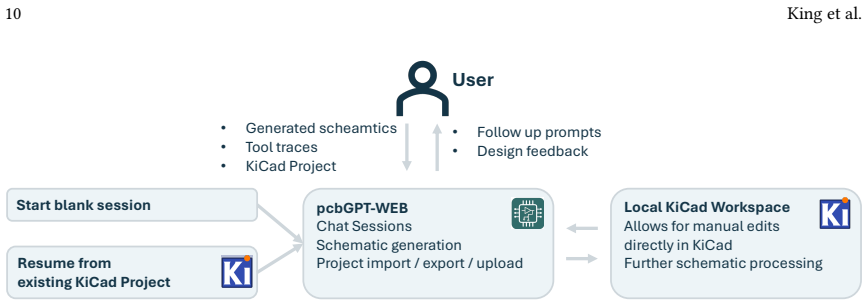
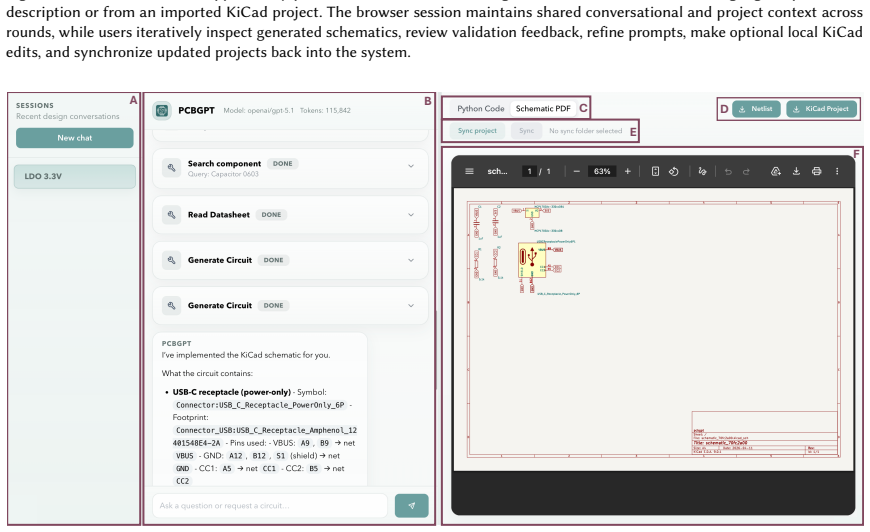
- An interactive web workflow supports iterative refinement and direct synchronization with existing KiCad projects.
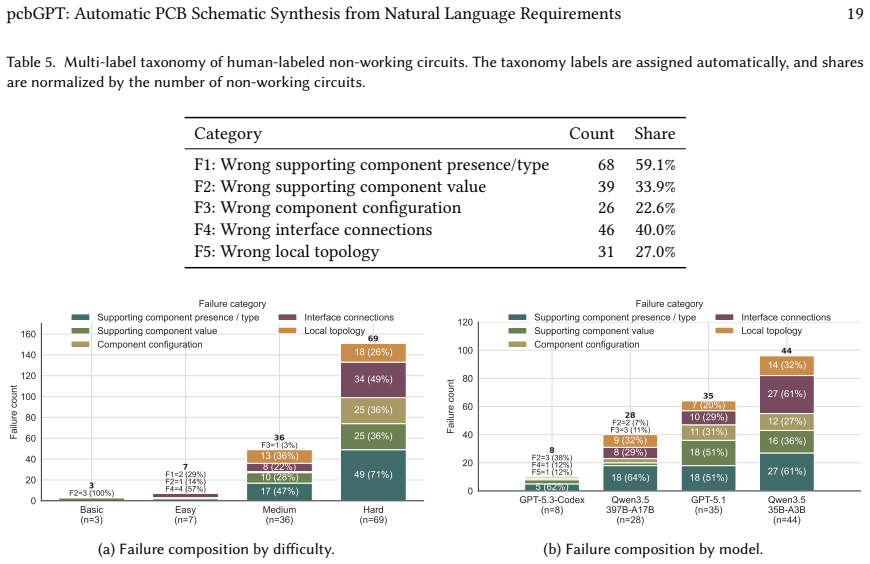
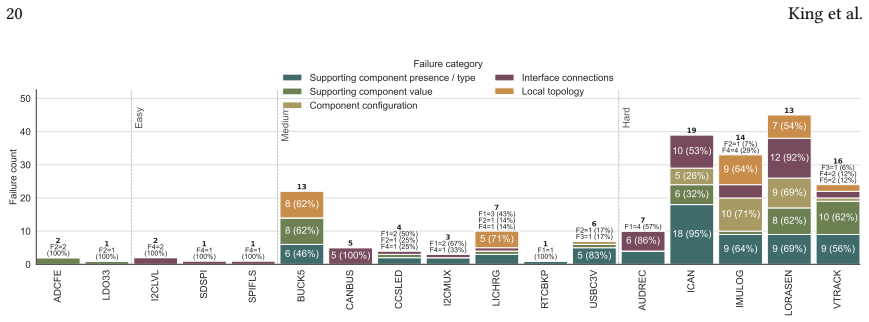
- Performance remains high on basic and medium tasks but declines on hard tasks that involve complex interface constraints.
- The generated outputs are editable and can be validated further through layout and prototyping stages.
Where Pith is reading between the lines
- The same DSL-plus-validation pattern could be tested on other EDA tools beyond KiCad.
- Failure cases on hard tasks point to specific gaps in interface handling that future extensions might target.
- If the reference tasks prove narrower than full industrial designs, success rates on novel projects would likely drop.
- Integration with simulation tools after schematic generation could provide an additional automatic check layer.
Load-bearing premise
The twenty embedded tasks with reference implementations are representative of real design work and automatic comparison to those references accurately measures schematic correctness and completeness.
What would settle it
Apply the system to a fresh natural-language specification for a PCB outside the original twenty tasks and compare the generated schematic against an independently expert-designed reference for functional equivalence and completeness.
Figures
read the original abstract
Translating natural-language hardware requirements into correct printed circuit board (PCB) schematics remains difficult in embedded, IoT, and wearable development. Designers must choose compatible components, interpret datasheets, add support circuitry, and expose correct interfaces before layout and prototyping can begin, while many such circuits cannot be validated through straightforward simulation. We present pcbGPT, a grounded system for generating editable KiCad schematics from natural-language specifications. pcbGPT represents circuits in a Python DSL and combines tool-augmented synthesis with component-library search, datasheet-grounded design knowledge, execution-based checking, structural and semantic validation, and an interactive web workflow that supports iterative refinement and synchronization with KiCad projects. We evaluate the system on 20 embedded schematic-generation tasks with reference implementations, required components, and interface constraints that enable automatic comparison. The best model reaches overall pass@1 of 0.90 and pass@5 of 1.00; pass@1 is 1.00 on basic and easy tasks, 0.91 on medium tasks, and 0.72 on hard tasks. These results, together with failure analysis, show that pcbGPT can already generate useful, reviewable first-draft schematics for early prototyping, but is not yet reliable enough to replace expert review.
Editorial analysis
A structured set of objections, weighed in public.
Referee Report
Summary. The paper presents pcbGPT, a grounded system for generating editable KiCad PCB schematics from natural-language requirements. It represents circuits via a Python DSL and integrates tool-augmented synthesis, component-library search, datasheet-grounded knowledge, execution-based checking, structural/semantic validation, and an interactive web workflow. The system is evaluated on 20 embedded schematic-generation tasks with reference implementations, reporting overall pass@1 of 0.90 and pass@5 of 1.00 (with per-difficulty breakdowns: 1.00 basic/easy, 0.91 medium, 0.72 hard), plus failure analysis, to argue that it produces useful first-draft schematics for early prototyping.
Significance. If the evaluation holds, the work offers a concrete demonstration of combining LLMs with execution checking and library grounding to automate an early stage of embedded hardware design. The interactive refinement loop and explicit failure analysis are practical strengths that could inform tool-building in HCI and systems research. The empirical focus on pass rates across difficulty levels provides a clear, if preliminary, benchmark for future schematic-generation systems.
major comments (2)
- [Evaluation section] Evaluation section (and abstract): the central performance claims (pass@1 = 0.90 overall, 0.72 on hard tasks) rest on automatic comparison to 20 reference implementations, yet the manuscript supplies no information on how those references were authored, what exact criteria define a 'pass,' or the validation procedures used. Without these details the reported rates cannot be independently assessed.
- [Benchmark/tasks description] Benchmark/tasks description: no evidence or discussion is provided that the 20 tasks are representative of typical embedded/IoT schematic work, nor that structural/semantic match to the chosen references is a faithful proxy for functional correctness and completeness. Functionally equivalent but topologically different schematics would be scored as failures, introducing potential selection bias and overstatement of reliability.
minor comments (1)
- [Abstract and Evaluation] The abstract and evaluation could more explicitly state the total number of models or prompting variants tested to reach the 'best model' figures.
Simulated Author's Rebuttal
We thank the referee for the constructive feedback on the evaluation and benchmark sections. We will revise the manuscript to provide the requested details and address the concerns about task selection and evaluation metrics.
read point-by-point responses
-
Referee: [Evaluation section] Evaluation section (and abstract): the central performance claims (pass@1 = 0.90 overall, 0.72 on hard tasks) rest on automatic comparison to 20 reference implementations, yet the manuscript supplies no information on how those references were authored, what exact criteria define a 'pass,' or the validation procedures used. Without these details the reported rates cannot be independently assessed.
Authors: We agree with this observation. The current manuscript does not provide sufficient details on the reference implementations. In the revised version, we will include a new subsection in the Evaluation section detailing: how the reference schematics were created by experienced embedded systems designers based on the natural language requirements; the precise definition of a 'pass' which requires exact matching of components, their connections, and specified interfaces in the Python DSL; and the automated validation procedures used to compare generated schematics against references. This will enable independent verification of the reported pass@1 and pass@5 rates. revision: yes
-
Referee: [Benchmark/tasks description] Benchmark/tasks description: no evidence or discussion is provided that the 20 tasks are representative of typical embedded/IoT schematic work, nor that structural/semantic match to the chosen references is a faithful proxy for functional correctness and completeness. Functionally equivalent but topologically different schematics would be scored as failures, introducing potential selection bias and overstatement of reliability.
Authors: The referee correctly identifies a limitation in our presentation. While the tasks were designed to include varying levels of difficulty and specific interface constraints to enable automatic evaluation, we did not discuss their representativeness of the broader embedded/IoT domain or the potential for the metric to penalize functionally equivalent but structurally different designs. We will revise the Benchmark section to: describe the task selection process and criteria; explicitly discuss the limitations of using structural/semantic match as a proxy for functional correctness; and note that the system aims to produce useful initial drafts rather than claiming complete reliability. This will provide a more balanced view and mitigate concerns of overstatement. revision: yes
Circularity Check
No circularity: empirical system evaluation only
full rationale
The paper describes an empirical AI system (pcbGPT) for generating KiCad schematics from natural language and reports pass rates on a fixed set of 20 reference-based tasks. No derivation chain, equations, fitted parameters, or first-principles claims exist that could reduce to inputs by construction. Performance numbers are direct measurements against the chosen references; no self-citation is used to justify uniqueness or forbid alternatives. The work is therefore self-contained as a system description and benchmark result.
Axiom & Free-Parameter Ledger
Reference graph
Works this paper leans on
-
[1]
Fraser Anderson, Tovi Grossman, and George Fitzmaurice. 2017. Trigger-Action-Circuits: Leveraging Generative Design to Enable Novices to Design and Build Circuitry. InProceedings of the 30th Annual ACM Symposium on User Interface Software and Technology (UIST ’17). Association for Computing Machinery, New York, NY, USA, 331–342. doi:10.1145/3126594.3126637
-
[2]
Anthropic. 2026. Claude Code by Anthropic | AI Coding Agent, Terminal, IDE. https://claude.com/product/claude-code
2026
-
[3]
Atophile. 2026. Introduction - Atopile. https://docs.atopile.io/atopile-0.14.x/introduction
2026
-
[4]
Jason Blocklove, Siddharth Garg, Ramesh Karri, and Hammond Pearce. 2023. Chip-Chat: Challenges and Opportunities in Conversational Hardware Design. In2023 ACM/IEEE 5th Workshop on Machine Learning for CAD (MLCAD). 1–6. arXiv:2305.13243 [cs] doi:10.1109/MLCAD58807.2023.10299874
-
[5]
Kaiyan Chang, Ying Wang, Haimeng Ren, Mengdi Wang, Shengwen Liang, Yinhe Han, Huawei Li, and Xiaowei Li. 2023. ChipGPT: How Far Are We from Natural Language Hardware Design. arXiv:2305.14019
arXiv 2023
-
[6]
Mark Chen, Jerry Tworek, Heewoo Jun, Qiming Yuan, Henrique Ponde de Oliveira Pinto, Jared Kaplan, Harri Edwards, Yuri Burda, Nicholas Joseph, Greg Brockman, Alex Ray, Raul Puri, Gretchen Krueger, Michael Petrov, Heidy Khlaaf, Girish Sastry, Pamela Mishkin, Brooke Chan, Scott Gray, Nick Ryder, Mikhail Pavlov, Alethea Power, Lukasz Kaiser, Mohammad Bavarian...
work page internal anchor Pith review Pith/arXiv arXiv doi:10.48550/arxiv.2107.03374 2021
-
[7]
Xinyun Chen, Maxwell Lin, Nathanael Schärli, and Denny Zhou. 2023. Teaching Large Language Models to Self-Debug. arXiv:2304.05128 [cs.CL]
Pith/arXiv arXiv 2023
-
[8]
Luyu Gao, Aman Madaan, Shuyan Zhou, Uri Alon, Pengfei Liu, Yiming Yang, Jamie Callan, and Graham Neubig. 2023. PAL: Program-aided Language Models. arXiv:2211.10435 [cs.CL]
Pith/arXiv arXiv 2023
-
[9]
Jorge Garza and Steven Swanson. 2025. TypedSchematics: A Block-Based PCB Design Tool with Real-Time Detection of Common Connection Errors. arXiv:2509.14576 [cs.HC]
arXiv 2025
-
[10]
Lee Jones, Sara Nabil, Amanda McLeod, and Audrey Girouard. 2020. Wearable Bits: Scaffolding Creativity with a Prototyping Toolkit for Wearable E-textiles. InProceedings of the Fourteenth International Conference on Tangible, Embedded, and Embodied Interaction (TEI ’20). Association for Computing Machinery, New York, NY, USA, 165–177. doi:10.1145/3374920.3374954
-
[11]
KiCad. 2026. KiCad - Schematic Capture & PCB Design Software. https://www.kicad.org/ [Online; accessed 2026-03-31]
2026
-
[12]
Pin-Sung Ku, Kunpeng Huang, Nancy Wang, Boaz Ng, Alicia Chu, and Hsin-Liu Cindy Kao. 2023. SkinLink: On-body Construction and Prototyping of Reconfigurable Epidermal Interfaces.Proc. ACM Interact. Mob. Wearable Ubiquitous Technol.7, 2 (June 2023), 62:1–62:27. doi:10.1145/3596241
-
[13]
Yao Lai, Sungyoung Lee, Guojin Chen, Souradip Poddar, Mengkang Hu, David Z. Pan, and Ping Luo. 2025. AnalogCoder: Analog Circuit Design via Training-Free Code Generation.Proceedings of the AAAI Conference on Artificial Intelligence39, 1 (April 2025), 379–387. doi:10.1609/aaai.v39i1.32016
-
[14]
Mannu Lambrichts, Raf Ramakers, Steve Hodges, James Devine, Lorraine Underwood, and Joe Finney. 2023. CircuitGlue: A Software Configurable Converter for Interconnecting Multiple Heterogeneous Electronic Components.Proc. ACM Interact. Mob. Wearable Ubiquitous Technol.7, 2 (June 2023), 63:1–63:30. doi:10.1145/3596265
-
[15]
Philipp Lepold, Tobias Röddiger, and Michael Beigl. 2026. HARNode: A Time-Synchronised, Open-Source, Multi-Device, Wearable System for Ad Hoc Field Studies. InCompanion of the 2025 ACM International Joint Conference on Pervasive and Ubiquitous Computing (UbiComp Companion ’25). Association for Computing Machinery, New York, NY, USA, 1283–1289. doi:10.1145...
-
[16]
Haiyun Li, Jixin Zhang, Ning Xu, and Mingyu Liu. 2023. FanoutNet: A Neuralized PCB Fanout Automation Method Using Deep Reinforcement Learning.Proceedings of the AAAI Conference on Artificial Intelligence37, 7 (June 2023), 8554–8561. doi:10.1609/aaai.v37i7.26030
-
[17]
Richard Lin, Rohit Ramesh, Connie Chi, Nikhil Jain, Ryan Nuqui, Prabal Dutta, and Björn Hartmann. 2020. Polymorphic Blocks: Unifying High-level Specification and Low-level Control for Circuit Board Design. InProceedings of the 33rd Annual ACM Symposium on User Interface Software and Technology (UIST ’20). Association for Computing Machinery, New York, NY,...
-
[18]
Richard Lin, Rohit Ramesh, Nikhil Jain, Josephine Koe, Ryan Nuqui, Prabal Dutta, and Bjoern Hartmann. 2021. Weaving Schematics and Code: Interactive Visual Editing for Hardware Description Languages. InThe 34th Annual ACM Symposium on User Interface Software and Technology (UIST ’21). Association for Computing Machinery, New York, NY, USA, 1039–1049. doi:...
-
[19]
Jo-Yu Lo, Da-Yuan Huang, Tzu-Sheng Kuo, Chen-Kuo Sun, Jun Gong, Teddy Seyed, Xing-Dong Yang, and Bing-Yu Chen. 2019. AutoFritz: Autocomplete for Prototyping Virtual Breadboard Circuits. InProceedings of the 2019 CHI Conference on Human Factors in Computing Systems (CHI ’19). Association for Computing Machinery, New York, NY, USA, 1–13. doi:10.1145/3290605.3300633
-
[20]
Aman Madaan, Niket Tandon, Prakhar Gupta, Skyler Hallinan, Luyu Gao, Sarah Wiegreffe, Uri Alon, Nouha Dziri, Shrimai Prabhumoye, Yiming Yang, Shashank Gupta, Bodhisattwa Prasad Majumder, Katherine Hermann, Sean Welleck, Amir Yazdanbakhsh, and Peter Clark. 2023. Self-Refine: Iterative Refinement with Self-Feedback. arXiv:2303.17651 [cs.CL]
Pith/arXiv arXiv 2023
-
[21]
OpenAI. 2026. GPT-5.1 Model | OpenAI API. https://developers.openai.com/api/docs/models/gpt-5.1 [Online; accessed 2026-04-20]
2026
-
[22]
OpenAI. 2026. GPT-5.3-Codex Model | OpenAI API. https://developers.openai.com/api/docs/models/gpt-5.3-codex [Online; accessed 2026-04-20]
2026
-
[23]
Qwen Team. 2026. Qwen3.5: Towards Native Multimodal Agents. https://qwen.ai/blog?id=qwen3.5
2026
-
[24]
Rohit Ramesh, Richard Lin, Antonio Iannopollo, Alberto Sangiovanni-Vincentelli, Björn Hartmann, and Prabal Dutta. 2017. Turning Coders into Makers: The Promise of Embedded Design Generation. InProceedings of the 1st Annual ACM Symposium on Computational Fabrication (SCF ’17). Association for Computing Machinery, New York, NY, USA, 1–10. doi:10.1145/308315...
-
[25]
Paradiso, Christopher Clarke, and Michael Beigl
Tobias Röddiger, Michael Küttner, Philipp Lepold, Tobias King, Dennis Moschina, Oliver Bagge, Joseph A. Paradiso, Christopher Clarke, and Michael Beigl. 2025. OpenEarable 2.0: Open-Source Earphone Platform for Physiological Ear Sensing.Proc. ACM Interact. Mob. Wearable Ubiquitous Technol. 9, 1 (March 2025), 16:1–16:33. doi:10.1145/3712069
-
[26]
Fabrice Salvaire. 2026. PySpice 1.4.2 Documentation. https://pyspice.fabrice-salvaire.fr/releases/v1.4/overview.html
2026
-
[27]
Timo Schick, Jane Dwivedi-Yu, Roberto Dessì, Roberta Raileanu, Maria Lomeli, Luke Zettlemoyer, Nicola Cancedda, and Thomas Scialom. 2023. Toolformer: Language Models Can Teach Themselves to Use Tools. arXiv:2302.04761 [cs] doi:10.48550/arXiv.2302.04761
work page internal anchor Pith review Pith/arXiv arXiv doi:10.48550/arxiv.2302.04761 2023
-
[28]
Jinyi Shen, Zihao Chen, Ji Zhuang, Jiangli Huang, Fan Yang, Li Shang, Zhaori Bi, Changhao Yan, Dian Zhou, and Xuan Zeng. 2024. Atelier: An Automated Analog Circuit Design Framework via Multiple Large Language Model-based Agents. doi:10.36227/techrxiv.172668168.88938111/v1
-
[29]
Jiankai Tang, Zhe He, Mingyu Zhang, Wei Geng, Chengchi Zhou, Weinan Shi, Yuanchun Shi, and Yuntao Wang. 2025. 𝜏-Ring: A Smart Ring Platform for Multimodal Physiological and Behavioral Sensing. arXiv:2508.00778 [cs] doi:10.48550/arXiv.2508.00778
-
[30]
Dave Vandenbout. 2026. SKiDL — SKiDL. https://devbisme.github.io/skidl/
2026
-
[31]
Prashanth Vijayaraghavan, Luyao Shi, Ehsan Degan, Vandana Mukherjee, and Xin Zhang. 2025. AUTOCIRCUIT-RL: Reinforcement Learning-Driven LLM for Automated Circuit Topology Generation. arXiv:2506.03122 [cs] doi:10.48550/arXiv.2506.03122
-
[32]
Guanyun Wang, Fang Qin, Haolin Liu, Ye Tao, Yang Zhang, Yongjie Jessica Zhang, and Lining Yao. 2020. MorphingCircuit: An Integrated Design, Simulation, and Fabrication Workflow for Self-morphing Electronics.Proc. ACM Interact. Mob. Wearable Ubiquitous Technol.4, 4 (Dec. 2020), 157:1–157:26. doi:10.1145/3432232
-
[33]
Hanrui Wang, Jiacheng Yang, Hae-Seung Lee, and Song Han. 2020. Learning to Design Circuits. arXiv:1812.02734 [cs] doi:10.48550/arXiv.1812.02734
-
[34]
Shunyu Yao, Jeffrey Zhao, Dian Yu, Nan Du, Izhak Shafran, Karthik Narasimhan, and Yuan Cao. 2023. ReAct: Synergizing Reasoning and Acting in Language Models. arXiv:2210.03629 [cs] doi:10.48550/arXiv.2210.03629 A Benchmark Inventory A.1 Basic ADCFE ADC front-end conditioning Prompt Create a resistor-divider circuit that maps a 0-5 V analog sensor signal to...
work page internal anchor Pith review Pith/arXiv arXiv doi:10.48550/arxiv.2210.03629 2023
discussion (0)
Sign in with ORCID, Apple, or X to comment. Anyone can read and Pith papers without signing in.