PSF-like Alpha-Particle Events in LSST Images
Pith reviewed 2026-06-28 16:17 UTC · model grok-4.3
The pith
A broadness statistic from fourth-order moments separates alpha-particle charge clusters from stellar PSFs in LSST images.
A machine-rendered reading of the paper's core claim, the machinery that carries it, and where it could break.
Core claim
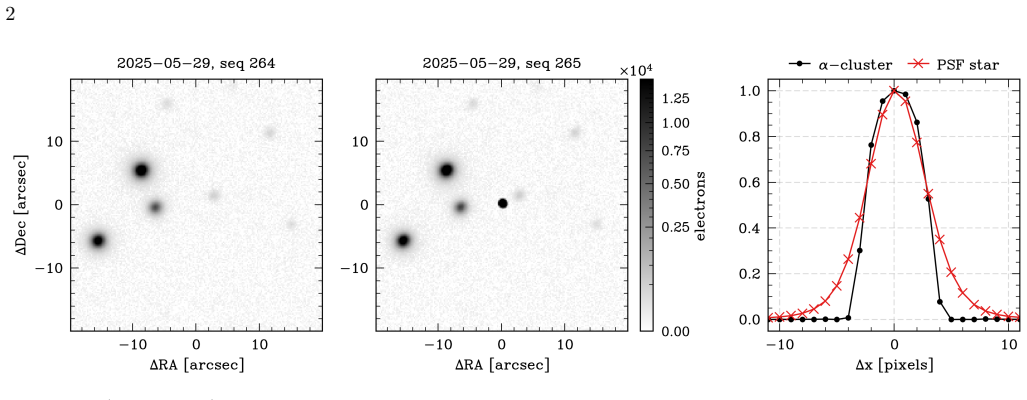
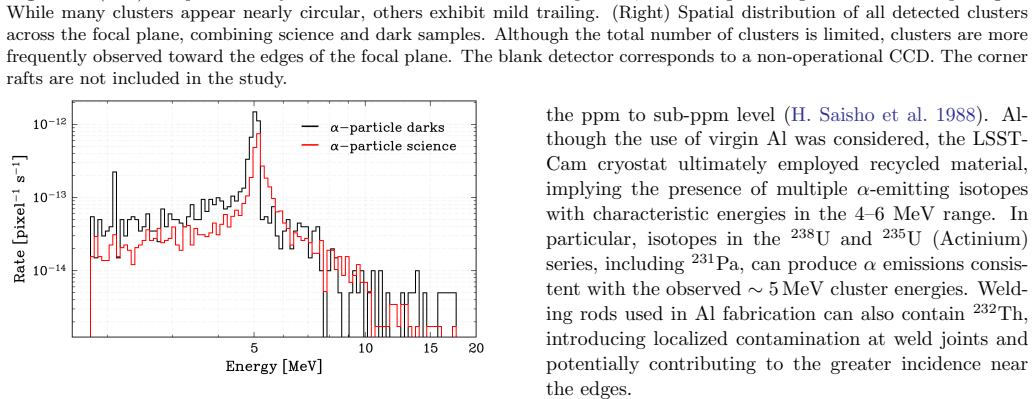
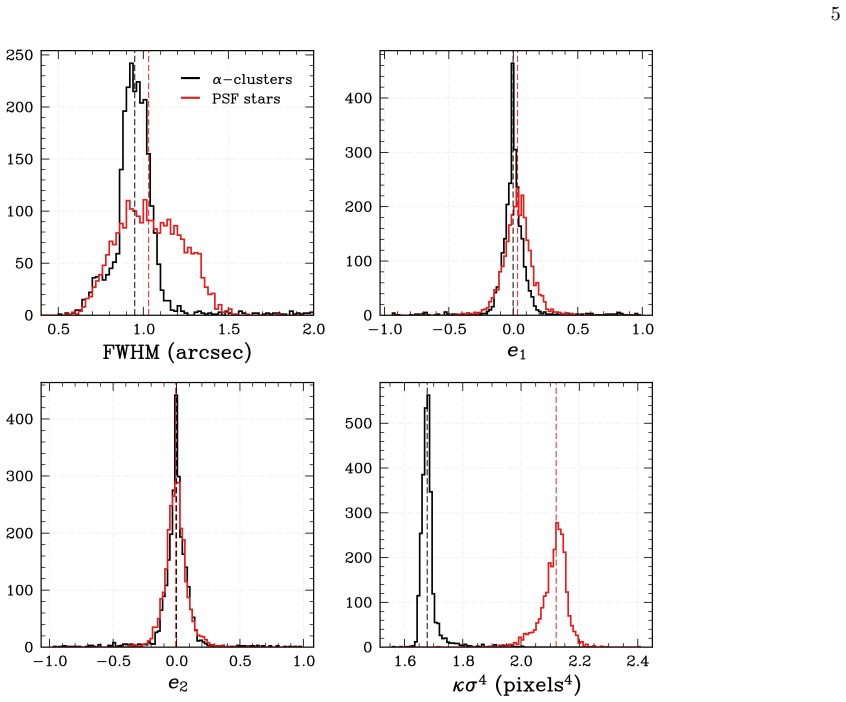
Rare α-particle-induced charge clusters appear in LSST images as compact, PSF-like sources with a median FWHM of 0.95 arcsec and median ellipticity consistent with zero. These events are detected in both dark and science exposures at a rate of approximately 10^{-12} pixel^{-1} s^{-1}. Their collected charge and morphology are consistent with energy deposition from ~5 MeV α-particles in silicon CCDs. A simple broadness statistic based on fourth-order moments cleanly separates these events from stellar PSFs, enabling efficient rejection in coadded images and real-time alert streams. Such charge clusters do not impose an intrinsic bright-end contamination floor for Rubin transient searches, as
What carries the argument
The broadness statistic computed from fourth-order moments of the charge distribution, which quantifies excess spread to flag alpha-induced clusters versus true stellar PSFs.
If this is right
- The statistic allows rejection of the clusters in both stacked images and live alert pipelines without removing real sources.
- No bright-end contamination floor arises for transient searches from these events.
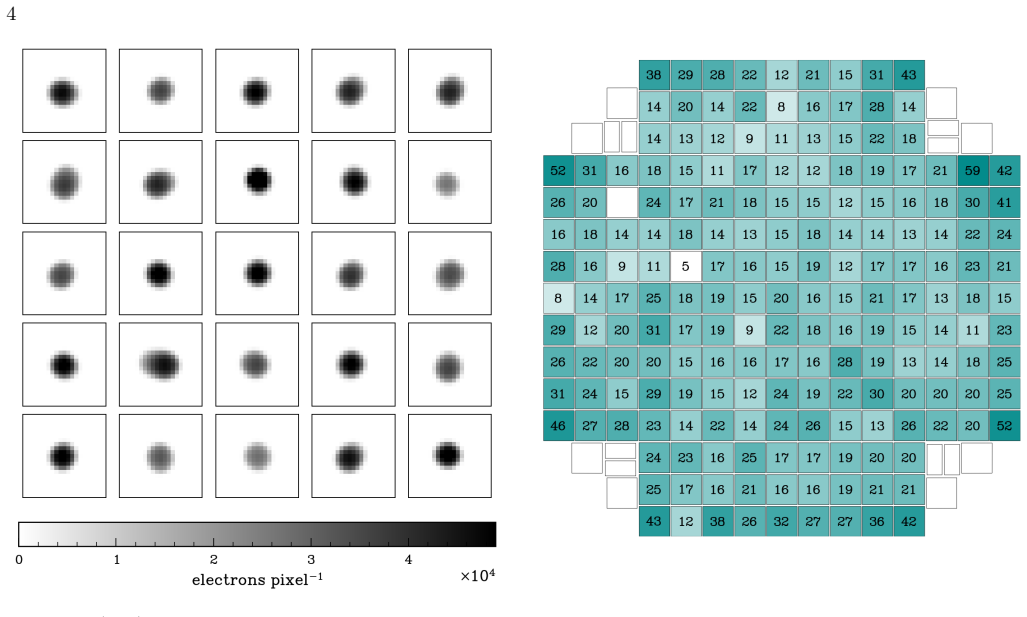
- The rate and spatial pattern point to a localized origin in cryostat materials rather than a uniform focal-plane effect.
- The same fourth-order approach can be applied directly to future LSST data releases for automated cleaning.
Where Pith is reading between the lines
- Similar moment-based filters could be tested on other silicon-based imagers to check for comparable contamination.
- If the alpha rate varies with temperature or voltage, that dependence could be used to confirm the particle origin experimentally.
- Adding the statistic as a real-time veto might reduce the volume of alerts that require human review.
Load-bearing premise
Genuine fast astrophysical events would exhibit characteristically different morphological signatures from the alpha-particle clusters.
What would settle it
Detection of a confirmed fast astrophysical transient whose fourth-order moment broadness value falls inside the same range as the alpha-particle clusters.
Figures
read the original abstract
Rare $\alpha$-particle-induced charge clusters appear in LSST images as compact, PSF-like sources with a median FWHM of $0.\!\!^{\prime\prime}95$ and median ellipticity consistent with zero, closely resembling unresolved astrophysical point sources. These events are detected in both dark and science exposures at a rate of approximately $10^{-12}\ \mathrm{pixel}^{-1}\ \mathrm{s}^{-1}$. Their collected charge and morphology are consistent with energy deposition from $\sim$5 MeV $\alpha$-particles in silicon CCDs, and their spatial distribution across the focal plane suggests a localized material origin, plausibly associated with trace radioactive contamination in the cryostat aluminum. Despite their deceptive appearance, we demonstrate that a simple broadness statistic based on fourth-order moments cleanly separates these events from stellar PSFs, enabling efficient rejection in coadded images and real-time alert streams. Such charge clusters do not impose an intrinsic bright-end contamination floor for Rubin transient searches, as genuine fast astrophysical events would exhibit characteristically different morphological signatures.
Editorial analysis
A structured set of objections, weighed in public.
Referee Report
Summary. The paper reports the detection of rare α-particle-induced charge clusters in LSST images that appear as compact, PSF-like sources (median FWHM 0.95″, ellipticity consistent with zero) at a rate of ~10^{-12} pixel^{-1} s^{-1}. These events are shown to be consistent with ~5 MeV α-particles from trace radioactive contamination in the cryostat. The central claim is that a simple broadness statistic derived from fourth-order moments cleanly separates these clusters from stellar PSFs, enabling rejection in coadds and alert streams, and that they therefore impose no intrinsic bright-end contamination floor for Rubin transient searches because genuine fast astrophysical transients would exhibit different morphological signatures.
Significance. If the fourth-order moment separation from stellar PSFs is robustly validated and the assumption regarding transient morphologies holds, the result would be significant for LSST data processing pipelines and transient alert systems. It supplies an empirical rate measurement and a practical rejection statistic that could be implemented in real-time streams, directly addressing a potential source of false positives at the bright end of transient searches. The work is grounded in empirical measurements rather than parameter fitting.
major comments (1)
- [Abstract] Abstract (final sentence): The assertion that 'genuine fast astrophysical events would exhibit characteristically different morphological signatures' is presented without any comparison, distribution, or application of the fourth-order moment statistic to actual or simulated transients. This untested assumption is load-bearing for the conclusion that the clusters 'do not impose an intrinsic bright-end contamination floor.'
minor comments (1)
- [Abstract] Abstract: No sample sizes, validation metrics (e.g., separation efficiency, false-positive rates), error bars, or explicit exclusion criteria are supplied for the claimed clean separation, which limits immediate evaluation of the statistic's performance.
Simulated Author's Rebuttal
We thank the referee for their thoughtful review and for highlighting this important point regarding the abstract. We address the major comment below.
read point-by-point responses
-
Referee: [Abstract] Abstract (final sentence): The assertion that 'genuine fast astrophysical events would exhibit characteristically different morphological signatures' is presented without any comparison, distribution, or application of the fourth-order moment statistic to actual or simulated transients. This untested assumption is load-bearing for the conclusion that the clusters 'do not impose an intrinsic bright-end contamination floor.'
Authors: We agree that the manuscript does not include any direct application or distribution of the fourth-order moment statistic to actual or simulated astrophysical transients, and that the statement in the abstract therefore rests on an untested assumption. The work focuses on empirical separation from stellar PSFs and the physical origin of the clusters; the implication for transients follows from the expectation that genuine fast events (e.g., trailed asteroids or variable/extended sources) would not produce identical static, compact morphologies. To address the referee's concern, we will revise the abstract to remove the load-bearing claim about transients and instead limit the conclusion to the demonstrated separation from stellar PSFs and the resulting practical utility for rejection in coadds and alert streams. revision: yes
Circularity Check
No circularity; empirical statistic and external assumption stand independently
full rationale
The paper reports direct measurements of alpha-particle charge clusters in LSST data, their rate, morphology, and spatial distribution, then states that a fourth-order moment broadness statistic separates them from stellar PSFs. This separation is presented as demonstrated by observation rather than by any equation that reduces to a fitted input by construction. The decisive claim that genuine fast astrophysical transients would show different signatures is an external assumption, not a derivation internal to the paper's equations or self-citations. No self-definitional loops, fitted parameters renamed as predictions, or load-bearing self-citation chains appear; the work is self-contained against external benchmarks.
Axiom & Free-Parameter Ledger
axioms (1)
- domain assumption Collected charge and morphology of clusters are consistent with ~5 MeV alpha particles in silicon
Reference graph
Works this paper leans on
-
[1]
2015, Journal of Instrumentation, 10, P08014–P08014, doi: 10.1088/1748-0221/10/08/p08014
Aguilar-Arevalo, A., Amidei, D., Bertou, X., et al. 2015, Journal of Instrumentation, 10, P08014–P08014, doi: 10.1088/1748-0221/10/08/p08014
-
[2]
Estrada, J., Molina, J., Blostein, J., & Fern´ andez, G. 2011, Nuclear Instruments and Methods in Physics Research Section A: Accelerators, Spectrometers, Detectors and Associated Equipment, 665, 90–93, doi: 10.1016/j.nima.2011.10.060
-
[3]
Gobeli, G. W. 1956, Phys. Rev., 103, 275, doi: 10.1103/PhysRev.103.275
-
[4]
A., Nomerotski, A., & Collaboration, T
Grosson, T. A., Nomerotski, A., & Collaboration, T. L. D. E. S. 2023, Journal of Astronomical Telescopes, Instruments, and Systems, 9, doi: 10.1117/1.jatis.9.2.028006
-
[5]
doi:10.1046/j.1365-8711.2003.06653.x , eprint =
Hirata, C., & Seljak, U. 2003, MNRAS, 343, 459, doi: 10.1046/j.1365-8711.2003.06683.x Ivezi´ c,ˇZ., Kahn, S. M., Tyson, J. A., et al. 2019, ApJ, 873, 111, doi: 10.3847/1538-4357/ab042c
-
[6]
2024, Flares from Space Debris in LSST Images, https://arxiv.org/abs/2401.15697
Loeb, A. 2024, Flares from Space Debris in LSST Images, https://arxiv.org/abs/2401.15697
-
[7]
Lupton, R. H., Ivezic, Z., Gunn, J. E., et al. 2002, in Survey and Other Telescope Technologies and Discoveries, ed. J. A. Tyson & S. Wolff, Vol. 4836, International Society for Optics and Photonics (SPIE), 350 – 356, doi: 10.1117/12.457307
-
[8]
Mandelbaum, R., Hirata, C. M., Seljak, U., et al. 2005, Monthly Notices of the Royal Astronomical Society, 361, 1287, doi: 10.1111/j.1365-2966.2005.09282.x 7
-
[9]
McKay, K. G., & McAfee, K. B. 1953, Phys. Rev., 91, 1079, doi: 10.1103/PhysRev.91.1079 Megias Homar, G., Meyers, J. M., & Kahn, S. M. 2023, ApJ, 950, 21, doi: 10.3847/1538-4357/accb93 Plazas Malag´ on, A. A., Waters, C., Broughton, A., et al. 2025, Journal of Astronomical Telescopes, Instruments, and Systems, 11, 011209, doi: 10.1117/1.JATIS.11.1.011209 R...
-
[10]
doi:10.71929/rubin/2571927 , url =
Saisho, H., Tanaka, M., Nakamura, K., & Mori, E. 1988, Journal of Research of the National Bureau of Standards, 93, 398 . https://api.semanticscholar.org/CorpusID:61954985 SLAC National Accelerator Laboratory, & NSF-DOE Vera C. Rubin Observatory. 2025, The LSST Camera (LSSTCam), SLAC National Accelerator Laboratory (SLAC), Menlo Park, CA (United States), ...
-
[11]
Tanaka, M., Takahashi, I., Yoshida, N., et al. 2025, Second-timescale Glints from Satellites and Space Debris Detected with Tomo-e Gozen, https://arxiv.org/abs/2509.25947
-
[12]
A., Snyder, A., Polin, D., Rawls, M
Tyson, J. A., Snyder, A., Polin, D., Rawls, M. L., & Ivezic, Z. 2024, Expected Impact of Glints from Space Debris in the LSST, https://arxiv.org/abs/2403.04942
discussion (0)
Sign in with ORCID, Apple, or X to comment. Anyone can read and Pith papers without signing in.