Entangled Two-Photon Absorption in Cesium Atoms and the Limitations of the Far-Off-Resonance Approximation
Pith reviewed 2026-06-28 16:45 UTC · model grok-4.3
The pith
Without the far-off-resonance approximation the entangled two-photon absorption enhancement factor in cesium atoms oscillates with entanglement time and reaches a maximum near 500.
A machine-rendered reading of the paper's core claim, the machinery that carries it, and where it could break.
Core claim
The ETPA cross section is evaluated with and without the far-off-resonance approximation using the joint spectral amplitude of SPDC photon pairs. The enhancement factor stays constant at 36 pi when the approximation is used. Without the approximation the enhancement factor oscillates as a function of entanglement time and reaches a maximum value of approximately 500.
What carries the argument
The joint spectral amplitude of photon pairs from spontaneous parametric down-conversion, used to compute the ETPA rate with and without the far-off-resonance approximation while summing over intermediate states.
If this is right
- The far-off-resonance approximation underestimates the largest achievable ETPA enhancement.
- Discrepancies between calculated and measured ETPA cross sections can arise from near-resonance contributions omitted by the approximation.
- The computed peak value of ~500 supplies a target for experiments that tune entanglement time in cesium.
- Decoherence must be retained in any quantitative model if the oscillation is to be observed.
Where Pith is reading between the lines
- The same calculation framework could be applied to other alkali atoms to identify transitions where the enhancement peak is even larger.
- Tuning the entanglement time experimentally could serve as a control knob to maximize absorption rates beyond the constant value given by the approximation.
- The oscillation may appear in other processes that use entangled light with atoms when intermediate states lie near the photon frequencies.
Load-bearing premise
The quantum state of the light is correctly captured by the joint spectral amplitude of the SPDC photon pairs and the model includes all relevant intermediate atomic states plus decoherence.
What would settle it
Measure the ETPA rate in cesium while scanning the entanglement time of the photon pairs; a constant rate independent of entanglement time would falsify the oscillation claim.
Figures
read the original abstract
The discrepancies between theoretical and experimental results in the process of entangled two-photon absorption (ETPA) are not fully understood. Atomic systems are a promising alternative for investigating this process without the systematic effects present in molecules. We present a theoretical study of the ETPA process in cesium atoms, focusing on the 6S1/2 --> 8S1/2 transition. The ETPA cross section is evaluated both with and without the far-off-resonance (FOR) approximation, including the contributions from intermediate atomic states and decoherence effects. The quantum state of light considered is described by the joint spectral amplitude of photon-pairs produced by the spontaneous parametric down-conversion process. When the FOR approximation is applied, the enhancement factor is constant (36*pi). In contrast, without this approximation the enhancement factor oscillates with the entanglement time, and achieves a maximum value of ~500. These results show the limitations of approximations when calculating the ETPA cross section and contribute to the understanding of the discrepancies between theoretical and experimental values for the ETPA cross section in different samples. The numbers presented in this work can be a starting point for designing experiments aimed at measuring ETPA cross sections in alkali atoms.
Editorial analysis
A structured set of objections, weighed in public.
Referee Report
Summary. The manuscript claims that for the entangled two-photon absorption process in cesium atoms on the 6S1/2 to 8S1/2 transition, the enhancement factor remains constant at 36π when the far-off-resonance (FOR) approximation is applied, but oscillates with entanglement time and reaches a maximum of approximately 500 when the approximation is dropped. The calculation incorporates contributions from intermediate atomic states, decoherence effects, and the joint spectral amplitude of photon pairs generated by spontaneous parametric down-conversion.
Significance. If the non-FOR result holds after verification, the work would be significant for demonstrating concrete limitations of the FOR approximation in ETPA calculations for atomic systems. It could help account for theory-experiment discrepancies and supply numerical targets for designing measurements in alkali atoms. The explicit comparison of the two regimes and inclusion of decoherence are strengths.
major comments (2)
- [Abstract] Abstract: The evaluation with and without the FOR approximation is described, but no derivation steps, error analysis, or explicit checks against the paper's own equations are supplied; the support for the stated maximum of ~500 therefore cannot be verified from the given text.
- [Results] The central claim that the non-FOR enhancement reaches ~500 and oscillates rests on the specific joint spectral amplitude and the truncation/parameterization of intermediate states plus decoherence rates. No sensitivity analysis or robustness checks are indicated, so shifts in these inputs could alter or eliminate the reported peak and oscillation.
Simulated Author's Rebuttal
We thank the referee for their thorough review and valuable comments on our manuscript. We address each of the major comments point by point below, providing clarifications and indicating where revisions will be made.
read point-by-point responses
-
Referee: [Abstract] Abstract: The evaluation with and without the FOR approximation is described, but no derivation steps, error analysis, or explicit checks against the paper's own equations are supplied; the support for the stated maximum of ~500 therefore cannot be verified from the given text.
Authors: The abstract is intended as a concise summary and does not include detailed derivations or error analyses, consistent with standard journal formatting. The derivations of the ETPA enhancement factor with and without the FOR approximation are provided in full in the main text, specifically in the sections detailing the theoretical model and numerical results. The value of ~500 is obtained from direct numerical integration of the relevant expression using the joint spectral amplitude and atomic parameters specified in the paper. To improve verifiability, we will revise the abstract to include a brief reference to the key equations supporting the reported maximum. revision: partial
-
Referee: [Results] The central claim that the non-FOR enhancement reaches ~500 and oscillates rests on the specific joint spectral amplitude and the truncation/parameterization of intermediate states plus decoherence rates. No sensitivity analysis or robustness checks are indicated, so shifts in these inputs could alter or eliminate the reported peak and oscillation.
Authors: We agree that the reported oscillation and maximum value depend on the specific form of the joint spectral amplitude and the selection of intermediate states along with their decoherence rates. The manuscript employs a commonly used Gaussian approximation for the JSA corresponding to SPDC photon pairs and includes the dominant intermediate states with decoherence rates taken from standard atomic data. Although a comprehensive sensitivity study was not presented in the original submission to maintain focus on the primary comparison, we recognize its importance for robustness. In the revised manuscript, we will include an analysis of how variations in the JSA bandwidth, entanglement time sampling, and the number of included intermediate states affect the enhancement factor, confirming that the oscillatory behavior and peak value around 500 persist under reasonable parameter changes. revision: yes
Circularity Check
No significant circularity detected
full rationale
The paper performs an explicit theoretical evaluation of the ETPA cross section by integrating the atomic response (including intermediate states and decoherence) over the joint spectral amplitude of SPDC photon pairs. The constant 36*pi enhancement under FOR and the oscillating ~500 maximum without FOR are direct numerical outputs of that integration; neither quantity is obtained by fitting a parameter to a data subset and relabeling it a prediction, nor does any load-bearing step reduce to a self-citation, imported ansatz, or self-definitional relation. The derivation therefore remains independent of its own inputs.
Axiom & Free-Parameter Ledger
free parameters (1)
- decoherence rates
axioms (1)
- domain assumption The joint spectral amplitude of photon-pairs produced by spontaneous parametric down-conversion describes the quantum state of the light.
Reference graph
Works this paper leans on
-
[1]
Quantum state of photon pairs produced by SPDC In this appendix, the biphoton state,|Ψ⟩, and the field correlation function,CF (t1, t2, t3, t4), of the down-converted photons is presented, following the references [35, 39]. The quantum state of the entangled-photon pairs produced in the SPDC process can be written as |Ψ⟩=exp 1 iℏ Z t t0 dt′ ˆHSP DC(t′) |0...
-
[2]
(C14) it is necessary to write the wave numbers in terms of the frequenciesω s,ω i andω p
Computation of the JSA Function To compute the JSA functionΦ(ωs, ωi)in Eq. (C14) it is necessary to write the wave numbers in terms of the frequenciesω s,ω i andω p. Due to the dispersion of the photon pairs in the crystal, the wavenumbers are expanded in a Taylor series around the central frequencies,ω0 and2ω 0 (Eq. (C10)). If the entangled-photon pairs ...
-
[3]
(13): CF (t1, t2, t3, t4) =⟨Ψ| ˆE(−)(t1) ˆE(−)(t2)|0⟩⟨0| ˆE(+)(t3) ˆE(+)(t4)|Ψ⟩.(C43) 16 Writing the temporal component of the electric field operator in Eq
Calculation of the field correlation function Once the biphoton state|Ψ⟩is computed, the field correlation function can be calculated according to Eq. (13): CF (t1, t2, t3, t4) =⟨Ψ| ˆE(−)(t1) ˆE(−)(t2)|0⟩⟨0| ˆE(+)(t3) ˆE(+)(t4)|Ψ⟩.(C43) 16 Writing the temporal component of the electric field operator in Eq. (C5), the inner products can be computed as foll...
-
[4]
17 Appendix D: ETPA Cross-Section
Also, we can define the flux of photon pairs in a timeTproduced by the SPDC process asϕ= 2|ε| 2/A0T, where the factor of2comes from the fact that we have photon pairs. 17 Appendix D: ETPA Cross-Section
-
[5]
ETPA probability The ETPA probability in Eq. (8) can be written as pg→f = 1 ℏ4 Z t −∞ dt4 Z t4 −∞ dt3 Z t3 −∞ dt2 Z t2 −∞ dt1CF (t1, t2, t3, t4)CA(t1, t2, t3, t4) +c.c..(D1) The time integrals are performed considering the expressions for the correlation functions in Eqs. (12) and (21). The ETPA probability can be expressed as follows considering the chan...
-
[6]
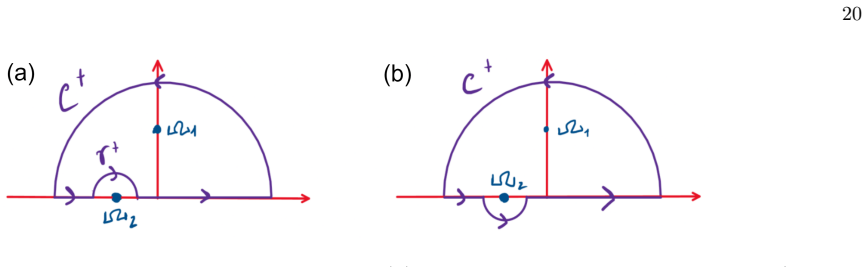
ETPA Cross-Section in the Far-Off-Resonance Approximation In this section we compute the integrals in Eq. (D2) considering the Far-Off-Resonance approximation, therefore, Ie,e′ = 1 (−ωf e′ +ω 0)(ωeg −ω 0) Z ∞ −∞ dω′ s Z ∞ −∞ dωs Z ∞ −∞ dωi ˜Φ∗(ω′ s, ω′ i)˜Φ(ωs, ωi) γf g −iω f g +iω s +iω i +c.c.(D4) Considering the sum with complex conjugate term and the ...
-
[7]
ETPA Cross Section without the Far-Off resonance approximation In this section we compute integrals in Eq. (D2) such thatIe,e′ is Ie,e′ = Z ∞ −∞ dω′ s Z ∞ −∞ dωs Z ∞ −∞ dωp ˜Φ∗(ω′ s, ωp −ω ′ s)˜Φ(ωs, ωp −ω s) [γf e′ +i(ω p −ω s −ω f e′)][γf g +i(ω p −ω f g)][γeg +i(ω ′s −ω eg)] +c.c.(D15) In order to simplify the integral, we write it in terms of the detu...
-
[8]
Varnavski, S
O. Varnavski, S. K. Giri, T.-M. Chiang, C. J. I. Zeman, G. C. Schatz, and T. I. Goodson, Colors of entangled two-photon absorption, Proceedings of the National Academy of Sciences120, e2307719120 (2023)
2023
-
[9]
K. E. Dorfman, F. Schlawin, and S. Mukamel, Nonlinear optical signals and spectroscopy with quantum light, Reviews of Modern Physics88, 045008 (2016)
2016
-
[10]
F.Schlawin, K.E.Dorfman,andS.Mukamel,Entangledtwo-photonabsorptionspectroscopy,Accountsofchemicalresearch 51, 2207 (2018)
2018
-
[11]
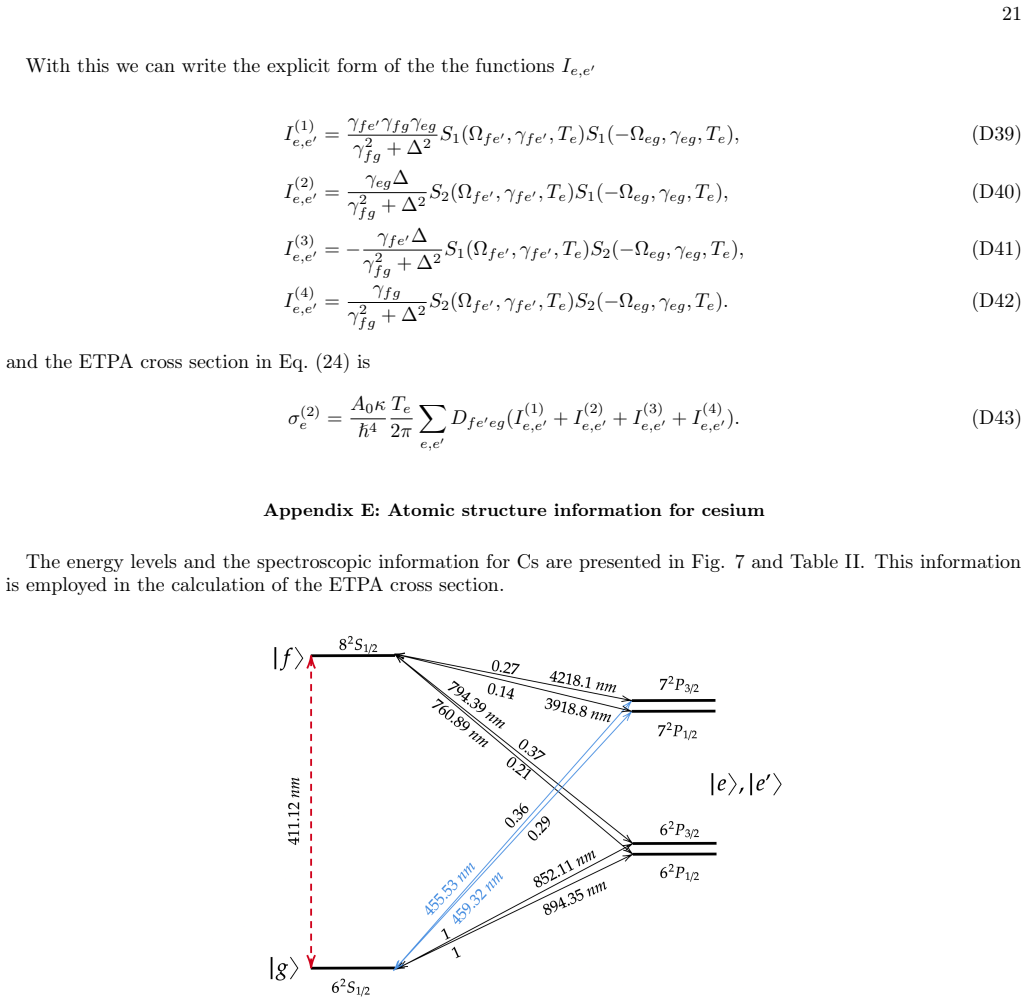
M. Gilaberte Basset, F. Setzpfandt, F. Steinlechner, E. Beckert, T. Pertsch, and M. Gräfe, Perspectives for applications of quantum imaging, Laser & Photonics Reviews13, 1900097 (2019). 22 Transition Frequency [THz] dij [10−10 m] Branching Ratio Ref. Decay Rate ×106[rad/s] Ref. 6S1/2 →6P 1/2 335.116048807(41) 1.6840 1 [40, 41]2π·4.5612[41] 6S1/2 →6P 3/2 3...
arXiv 2019
-
[12]
Szoke, H
S. Szoke, H. Liu, B. P. Hickam, M. He, and S. K. Cushing, Entangled light–matter interactions and spectroscopy, Journal of Materials Chemistry C8, 10732 (2020)
2020
-
[13]
Varnavski and T
O. Varnavski and T. Goodson III, Two-photon fluorescence microscopy at extremely low excitation intensity: The power of quantum correlations, Journal of the American Chemical Society142, 12966 (2020)
2020
-
[14]
R. B. K. C., D. R. Graupner, N. Fedik, S. Tretiak, D. Ryan, and J. Werner, Entangled two-photon absorption cross-section measurements for biologically important fluorophores, inProceedings of SPIE, Quantum Communications and Quantum Imaging XXIII, Vol. 13618 (SPIE, 2025) p. 136180B
2025
-
[15]
Schlawin, Two-photon absorption cross sections of pulsed entangled beams, The Journal of Chemical Physics160, 144117 (2024)
F. Schlawin, Two-photon absorption cross sections of pulsed entangled beams, The Journal of Chemical Physics160, 144117 (2024)
2024
-
[16]
J. P. Villabona-Monsalve, O. Calderón-Losada, M. Nuñez Portela, and A. Valencia, Entangled two photon absorption cross section on the 808 nm region for the common dyes zinc tetraphenylporphyrin and rhodamine b, The Journal of Physical Chemistry A121, 7869 (2017)
2017
-
[17]
J. P. Villabona-Monsalve, O. Varnavski, B. A. Palfey, and T. G. III, Two-photon excitation of flavins and flavoproteins with classical and quantum light, Journal of the American Chemical Society140, 14562 (2018)
2018
-
[18]
Corona-Aquino, O
S. Corona-Aquino, O. Calderón-Losada, M. Y. Li-Gómez, H. Cruz-Ramirez, V. Álvarez-Venicio, M. d. P. Carreón-Castro, R. de J. León-Montiel, and A. B. U’Ren, Experimental study of the validity of entangled two-photon absorption measure- ments in organic compounds, The Journal of Physical Chemistry A126, 2185 (2022), pMID: 35383460
2022
-
[19]
Tabakaev, M
D. Tabakaev, M. Montagnese, G. Haack, L. Bonacina, J.-P. Wolf, H. Zbinden, and R. Thew, Energy-time-entangled two-photon molecular absorption, Physical Review A103, 033701 (2021)
2021
-
[20]
Tabakaev, A
D. Tabakaev, A. Djorović, L. La Volpe, G. Gaulier, S. Ghosh, L. Bonacina, J.-P. Wolf, H. Zbinden, and R. Thew, Spatial properties of entangled two-photon absorption, Physical Review Letters129, 183601 (2022)
2022
-
[21]
M. He, B. P. Hickam, N. Harper, and S. K. Cushing, Experimental upper bounds for resonance-enhanced entangled two-photon absorption cross section of indocyanine green, The Journal of Chemical Physics160, 094305 (2024)
2024
-
[22]
K. M. Parzuchowski, A. Mikhaylov, M. D. Mazurek, R. N. Wilson, D. J. Lum, T. Gerrits, C. H. Camp Jr, M. J. Stevens, and R. Jimenez, Setting bounds on entangled two-photon absorption cross sections in common fluorophores, Physical Review Applied15, 044012 (2021)
2021
-
[23]
B. P. Hickam, M. He, N. Harper, S. Szoke, and S. K. Cushing, Single-photon scattering can account for the discrepancies among entangled two-photon measurement techniques, The Journal of Physical Chemistry Letters13, 4934 (2022)
2022
-
[24]
Landes, B
T. Landes, B. J. Smith, and M. G. Raymer, Limitations in fluorescence-detected entangled two-photon-absorption experi- ments: Exploring the low-to high-gain squeezing regimes, Physical Review A110, 033708 (2024)
2024
-
[25]
H.-B. Fei, B. M. Jost, S. Popescu, B. E. Saleh, and M. C. Teich, Entanglement-induced two-photon transparency, Physical review letters78, 1679 (1997)
1997
-
[26]
Landes, M
T. Landes, M. G. Raymer, M. Allgaier, S. Merkouche, B. J. Smith, and A. H. Marcus, Quantifying the enhancement of two-photon absorption due to spectral-temporal entanglement, Optics Express29, 20022 (2021)
2021
-
[27]
Rodríguez-Camargo, H
C. Rodríguez-Camargo, H. Gestsson, C. Nation, A. Jones, and A. Olaya-Castro, Perturbation-theory approach for predict- ing vibronic selectivity by entangled-photon-pair absorption, Physical Review A111, 063101 (2025)
2025
-
[28]
R. K. Burdick, O. Varnavski, A. Molina, P. M. Zimmerman, L. Upton, and T. G. III, Predicting and controlling entangled two-photon absorption in diatomic molecules, The Journal of Physical Chemistry A122, 8198 (2018)
2018
-
[29]
M. G. Raymer, T. Landes, M. Allgaier, S. Merkouche, B. J. Smith, and A. H. Marcus, How large is the quantum enhance- ment of two-photon absorption by time-frequency entanglement of photon pairs?, Optica8, 757 (2021)
2021
-
[30]
Drago and J
C. Drago and J. Sipe, Aspects of two-photon absorption of squeezed light: The continuous-wave limit, Physical Review A 106, 023115 (2022)
2022
-
[31]
Dayan, A
B. Dayan, A. Pe’Er, A. A. Friesem, and Y. Silberberg, Two photon absorption and coherent control with broadband down-converted light, Physical review letters93, 023005 (2004). 23
2004
-
[32]
N. P. Georgiades, E. Polzik, K. Edamatsu, H. Kimble, and A. Parkins, Nonclassical excitation for atoms in a squeezed vacuum, Physical review letters75, 3426 (1995)
1995
-
[33]
Dayan, Theory of two-photon interactions with broadband down-converted light and entangled photons, Physical Review A—Atomic, Molecular, and Optical Physics76, 043813 (2007)
B. Dayan, Theory of two-photon interactions with broadband down-converted light and entangled photons, Physical Review A—Atomic, Molecular, and Optical Physics76, 043813 (2007)
2007
-
[34]
de J León-Montiel, J
R. de J León-Montiel, J. Svozilik, L. Salazar-Serrano, and J. P. Torres, Role of the spectral shape of quantum correlations in two-photon virtual-state spectroscopy, New Journal of Physics15, 053023 (2013)
2013
-
[35]
Du, Atomic-resonance-enhanced nonlinear optical frequency conversion with entangled photon pairs, Physical Review A83, 033807 (2011)
S. Du, Atomic-resonance-enhanced nonlinear optical frequency conversion with entangled photon pairs, Physical Review A83, 033807 (2011)
2011
-
[36]
M. C. Núñez, M. A. Gonzalez, and M. N. Portela, Theoretical and experimental study of the 6s-8s two-photon absorption cross-section in cesium atoms, Opt. Express31, 31749 (2023)
2023
-
[37]
M. G. Raymer, T. Landes, and A. H. Marcus, Entangled two-photon absorption by atoms and molecules: A quantum optics tutorial, The Journal of Chemical Physics155, 10.1063/5.0049338 (2021), 081501
-
[38]
Loudon,The quantum theory of light(OUP Oxford, 2000)
R. Loudon,The quantum theory of light(OUP Oxford, 2000)
2000
-
[39]
Kubo, A stochastic theory of line shape, inAdvances in Chemical Physics, Vol
R. Kubo, A stochastic theory of line shape, inAdvances in Chemical Physics, Vol. 15, edited by K. E. Shuler (John Wiley & Sons, New York, 1969) pp. 101–127
1969
-
[40]
Javanainen and P
J. Javanainen and P. L. Gould, Linear intensity dependence of a two-photon transition rate, Physical Review A41, 5088 (1990)
1990
-
[41]
R. W. Boyd,Nonlinear optics, 4th ed. (Academic Press, 2020)
2020
-
[42]
Shih, Entangled biphoton source - property and preparation, Reports on Progress in Physics66, 1009 (2003)
Y. Shih, Entangled biphoton source - property and preparation, Reports on Progress in Physics66, 1009 (2003)
2003
-
[43]
Couteau, Spontaneous parametric down-conversion, Contemporary Physics59, 291 (2018)
C. Couteau, Spontaneous parametric down-conversion, Contemporary Physics59, 291 (2018)
2018
-
[44]
C. C. Gerry and P. L. Knight,Introductory Quantum Optics Christopher Gerry; Peter Knight(Cambridge Univ. Press, 2005)
2005
-
[45]
K. J. Blow, R. Loudon, S. J. D. Phoenix, and T. J. Shepherd, Continuum fields in quantum optics, Phys. Rev. A42, 4102 (1990)
1990
-
[46]
W. P. Grice and I. A. Walmsley, Spectral information and distinguishability in type-ii down-conversion with a broadband pump, Physical Review A56, 1627 (1997)
1997
-
[47]
T. Udem, J. Reichert, R. Holzwarth, and T. W. Hänsch, Absolute Optical Frequency Measurement of the CesiumD1 Line with a Mode-Locked Laser, Phys. Rev. Lett.82, 3568 (1999)
1999
-
[48]
Steck, Cesium D line data (1998)
D. Steck, Cesium D line data (1998)
1998
-
[49]
T. Udem, J. Reichert, T. W. Hänsch, and M. Kourogi, Absolute optical frequency measurement of the cesiumD2 line, Phys. Rev. A62, 031801 (2000)
2000
-
[50]
J. E. Sansonetti, Wavelengths, transition probabilities, and energy levels for the spectra of cesium (csi–cslv), Journal of Physical and Chemical Reference Data38, 761 (2009)
2009
-
[51]
Antypas and D
D. Antypas and D. S. Elliott, Measurement of the radial matrix elements of the6s2S1/2 →7p 2PJ transitions in atomic cesium, Phys. Rev. A88, 052516 (2013)
2013
-
[52]
G.Toh, N.Chalus, A.Burgess, A.Damitz, P.Imany, D.E.Leaird, A.M.Weiner, C.E.Tanner,andD.Elliott,Measurement of the lifetimes of the 7 p 2 p 3/2 and 7 p 2 p 1/2 states of atomic cesium, Physical Review A100, 052507 (2019)
2019
-
[53]
Gunawardena, D
M. Gunawardena, D. S. Elliott, M. S. Safronova, and U. Safronova, Determination of the static polarizability of the8s2S1/2 state of atomic cesium, Phys. Rev. A75, 022507 (2007)
2007
-
[54]
Horbatsch, E
M. Horbatsch, E. Hessels, and M. Horbatsch, Classical calculation of the lifetimes and branching ratios for radiative decays of hydrogenic atoms, Physical Review A—Atomic, Molecular, and Optical Physics71, 020501 (2005)
2005
-
[55]
Alessandretti, F
G. Alessandretti, F. Chiarini, G. Gorini, and F. Petrucci, Measurement of the Cs 8S-level lifetime, Optics Communications 20, 289 (1977)
1977
-
[56]
Wu, T.-W
C.-M. Wu, T.-W. Liu, M.-H. Wu, R.-K. Lee, and W.-Y. Cheng, Absolute frequency of cesium 6S-8S 822 nm two-photon transition by a high-resolution scheme, Opt. Lett.38, 3186 (2013)
2013
-
[57]
Corney,Atomic and laser spectroscopy(Clarendon Press Oxford, 1978)
A. Corney,Atomic and laser spectroscopy(Clarendon Press Oxford, 1978)
1978
-
[58]
Foot, Atomic physics (Oxford University Press, 2005) Chap
C. Foot, Atomic physics (Oxford University Press, 2005) Chap. 7
2005
-
[59]
Téllez, Métodos matemáticos, Ediciones Uniandes , 67 (2004)
G. Téllez, Métodos matemáticos, Ediciones Uniandes , 67 (2004)
2004
-
[60]
Krstić, T
A. Krstić, T. B. Gäbler, N. Jain, P. Then, V. F. Gili, S. Saravi, F. Setzpfandt, C. Eggeling, and M. Gräfe, Enhancing entangled two-photon absorption of nile red via temperature-controlled spdc, APL Quantum2, 016108 (2024)
2024
-
[61]
Krauss-Kodytek, C
L. Krauss-Kodytek, C. Ruppert, and M. Betz, Near-infrared non-degenerate two-photon absorption coefficients of bulk gaas and si, Opt. Express29, 34522 (2021)
2021
-
[62]
Á.Martínez-Tapia, S.Corona-Aquino, F.Triana-Arango, C.You, R.-B.Jin, O.S.Magaña-Loaiza, S.-H.Dong, A.B.U’Ren, and R. d. J. León-Montiel, Witnessing entangled two-photon absorption via quantum interferometry, APL Photonics8, 036104 (2023)
2023
-
[63]
Mikhaylov, R
A. Mikhaylov, R. N. Wilson, K. M. Parzuchowski, M. D. Mazurek, C. H. Camp Jr, M. J. Stevens, and R. Jimenez, Hot-band absorption can mimic entangled two-photon absorption, The Journal of Physical Chemistry Letters13, 1489 (2022)
2022
-
[64]
H. Oka, Two-photon absorption by spectrally shaped entangled photons, Physical Review A97, 10.1103/Phys- RevA.97.033814 (2018)
- [65]
-
[66]
Peřina Jr, B
J. Peřina Jr, B. E. A. Saleh, and M. C. Teich, Multiphoton absorption cross section and virtual-state spectroscopy for the entangledn-photon state, Physical Review A57, 3972 (1998). 24
1998
-
[67]
B. E. Saleh, B. M. Jost, H.-B. Fei, and M. C. Teich, Entangled-photon virtual-state spectroscopy, Physical review letters 80, 3483 (1998)
1998
-
[68]
Schlawin, K
F. Schlawin, K. Dorfman, and S. Mukamel, Pump-probe spectroscopy using quantum light with two-photon coincidence detection, Physical Review A93, 023807 (2016)
2016
-
[69]
Upton, M
L. Upton, M. Harpham, O. Suzer, M. Richter, S. Mukamel, and T. Goodson III, Optically excited entangled states in organic molecules illuminate the dark, The Journal of Physical Chemistry Letters4, 2046 (2013)
2046
discussion (0)
Sign in with ORCID, Apple, or X to comment. Anyone can read and Pith papers without signing in.