Learning-based Directed Graph Abstraction of Combinatorial Spaces for Order-Preserving Search in Mixed-Combinatorial Nonlinear Optimization
Pith reviewed 2026-06-28 17:20 UTC · model grok-4.3
The pith
A graph neural network learns directed improvement directions over combinatorial spaces to support order-preserving search in mixed nonlinear optimization.
A machine-rendered reading of the paper's core claim, the machinery that carries it, and where it could break.
Core claim
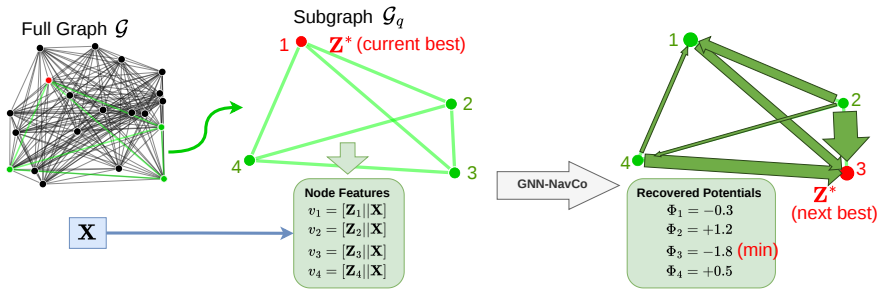
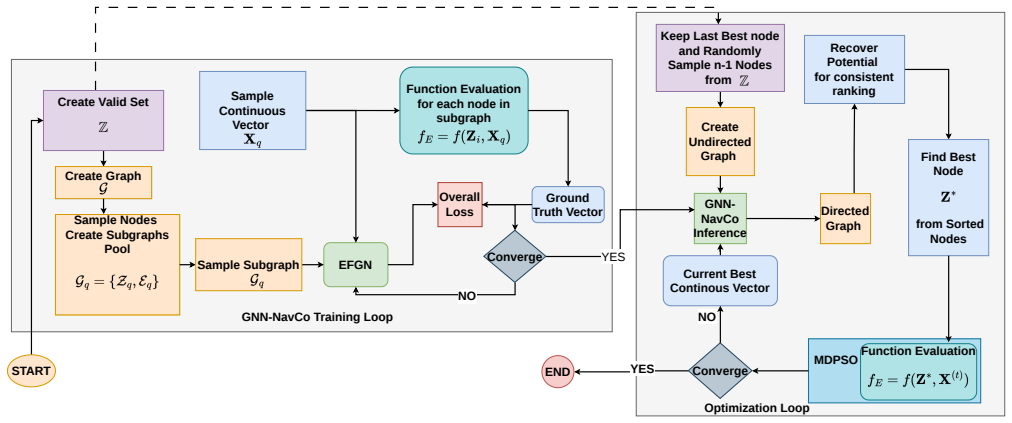
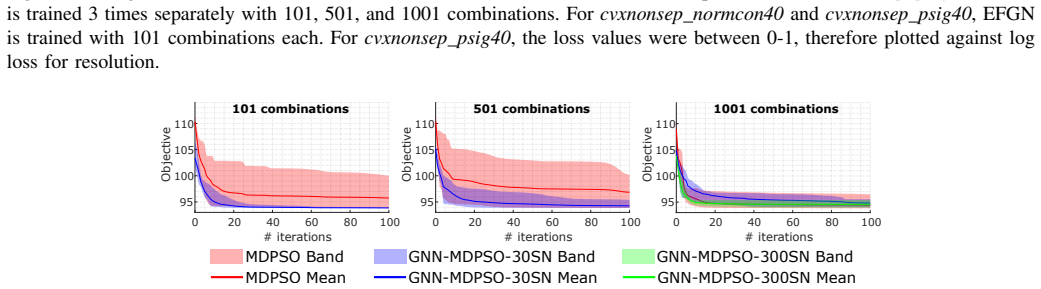
An Edge Field Graph Network learns a mapping from an undirected fully connected graph of all feasible combinations to a directed graph whose arcs point toward improving combinations; when this model is inserted into a framework that searches only over continuous variables and queries the graph model for the matching combination, the combined procedure yields better mean optimum values and greater robustness than baseline solvers that encode combinations by index.
What carries the argument
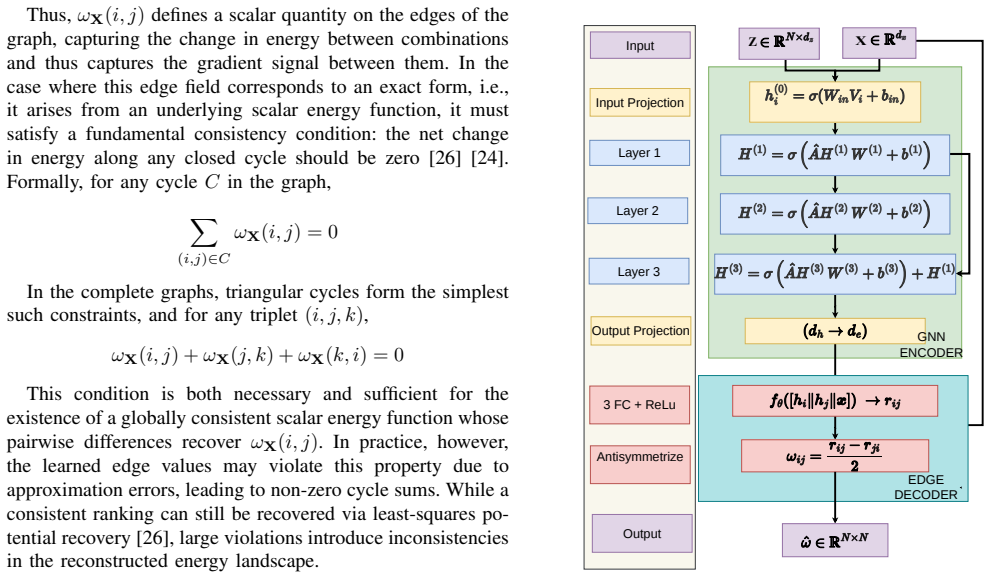
Edge Field Graph Network (EFGN) that maps an undirected fully connected graph of combinations onto a directed graph of improvement directions
If this is right
- The directed abstraction supplies combinations without requiring additional compatibility constraints beyond those already encoded in the graph.
- Retrieval of combinations becomes more scalable because the model operates on the learned directed structure rather than exhaustive enumeration.
- The same abstraction can be paired with any continuous-variable optimizer that returns a candidate design point and requests a matching combination.
- Interpretability increases because the directed edges explicitly indicate which combinations improve upon others.
Where Pith is reading between the lines
- If the learned directions remain reliable on problems whose combinatorial cardinality is orders of magnitude larger than the benchmarks, the method could replace explicit enumeration in high-dimensional design spaces.
- The directed-graph representation may transfer to other mixed discrete-continuous domains such as joint task-motion planning where order-preserving retrieval of discrete modes is also required.
- Training the EFGN on a modest subset of combinations and then querying it for unseen points could reduce the data cost of building the abstraction.
Load-bearing premise
The combinatorial space can be faithfully represented as an undirected fully connected graph from which a directed graph of improvement directions can be learned while preserving order and compatibility information.
What would settle it
Repeated runs on the three benchmark problems in which the GNN recommender fails to produce higher mean optimum values or lower variance than the indexified-combination baselines would falsify the performance claim.
Figures

read the original abstract
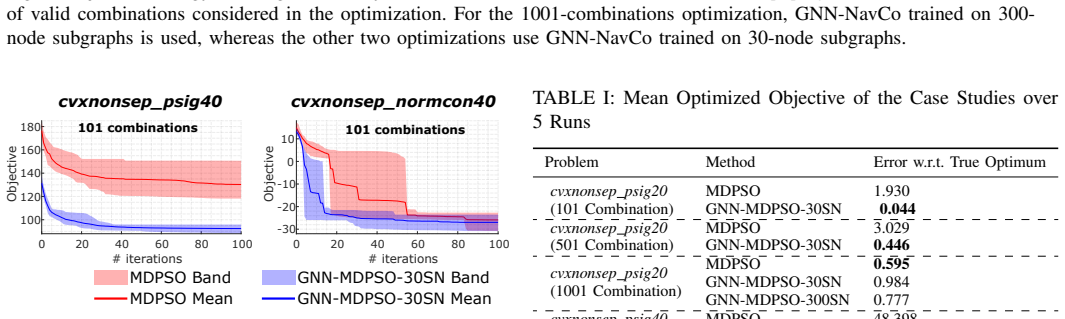
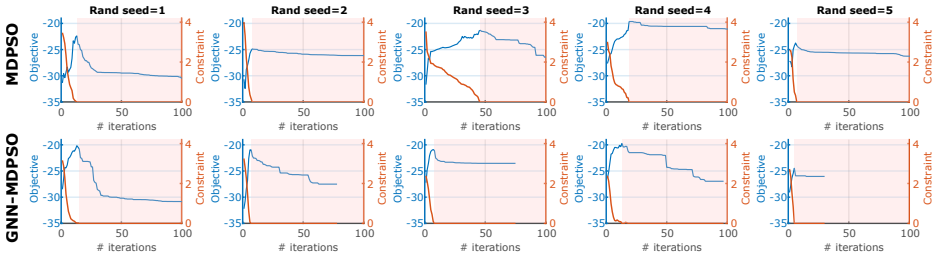
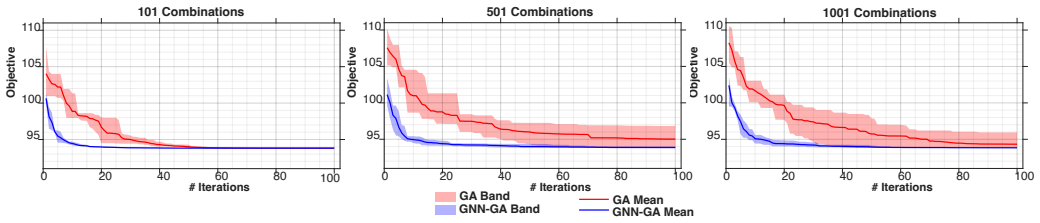
Mixed-combinatorial nonlinear programming (MCNLP) problems arise in many engineering design and planning applications, e.g., due to categorical, component, and geometric design choices, as well as joint task and motion planning. Traditional representations of combinatorial spaces, such as integer or binary encoding, often introduce spurious relations, increase dimensionality, and require additional compatibility constraints. Instead, this paper draws on recent developments in robot planning and vehicle/network routing domains that aim to learn search heuristics over combinatorial spaces using graph neural networks (GNNs). More specifically, this paper presents a first-of-its-kind structured abstraction of the combinatorial space by learning a mapping from an undirected fully connected graph of combinations to a directed graph indicating improvement directions using an Edge Field Graph Network (EFGN). To demonstrate the utility of this new way of abstracting the combinatorial space in solving MCNLPs, we adopt a recent optimization framework that purely searches over the non-combinatorial (e.g., continuous) variables and retrieves the best-suited combination for each candidate design by using the abstraction model, akin to a recommender system. The presented direction-aware abstraction model provides a potentially more scalable and interpretable retrieval of combinations compared to the original recommendation system in that framework. For evaluation, the proposed method is integrated with a well-known particle swarm optimization and genetic algorithm solvers on three benchmark nonlinear problems with varying numbers of combinations and variables. Compared to baseline solvers using indexified combinations, the GNN-based recommender consistently achieves better mean optimum values and robustness across multiple runs.
Editorial analysis
A structured set of objections, weighed in public.
Referee Report
Summary. The manuscript proposes learning a directed-graph abstraction of combinatorial spaces for mixed-combinatorial nonlinear programs by training an Edge Field Graph Network (EFGN) to map an undirected fully-connected graph of combinations onto directed improvement edges. The resulting model is used as a recommender inside PSO and GA solvers that optimize only the continuous variables; the authors report that this GNN-based recommender yields better mean optima and greater robustness than indexified baselines on three benchmark MCNLP instances.
Significance. If the learned directed graph faithfully encodes true improvement directions while respecting all compatibility constraints, the approach would supply a more structured and potentially more scalable alternative to index-based enumeration in MCNLP. The work extends recent GNN-based search heuristics from robot planning into nonlinear optimization and supplies an explicit direction-aware abstraction, which is a clear methodological contribution.
major comments (3)
- [§3] §3 (EFGN construction): the manuscript states that the EFGN learns a mapping 'indicating improvement directions' but supplies neither the procedure used to generate supervision labels nor the loss term that enforces order preservation. Without these details it is impossible to verify that the directed edges avoid spurious relations between incompatible combinations or that critical compatibility information is retained.
- [§5] §5 (experimental evaluation): the claim that the GNN recommender 'consistently achieves better mean optimum values and robustness across multiple runs' is presented without statistical tests, error bars, or a description of the training/validation split and hyper-parameter selection procedure. The reported performance difference therefore cannot be assessed as evidence for the abstraction itself rather than for other implementation choices.
- [§4.1] §4.1 (integration with solvers): the optimization framework 'purely searches over the non-combinatorial variables and retrieves the best-suited combination' via the learned model; no analysis is given of how the recommender is queried inside the inner loop or how its output is guaranteed to remain feasible with respect to the original combinatorial constraints.
minor comments (2)
- [§3] Notation for the edge-field update rule is introduced without an explicit equation number; readers must infer the precise message-passing form from surrounding prose.
- [Introduction] The abstract and introduction cite 'recent developments in robot planning' but do not list the specific prior GNN papers being extended.
Simulated Author's Rebuttal
We thank the referee for their constructive comments, which have helped us identify areas for improvement in the manuscript. We provide point-by-point responses below and will incorporate revisions as indicated.
read point-by-point responses
-
Referee: [§3] §3 (EFGN construction): the manuscript states that the EFGN learns a mapping 'indicating improvement directions' but supplies neither the procedure used to generate supervision labels nor the loss term that enforces order preservation. Without these details it is impossible to verify that the directed edges avoid spurious relations between incompatible combinations or that critical compatibility information is retained.
Authors: We agree that these details are missing from the current manuscript. We will revise §3 to supply the procedure used to generate supervision labels, the loss term that enforces order preservation, and an explanation of how compatibility is handled. revision: yes
-
Referee: [§5] §5 (experimental evaluation): the claim that the GNN recommender 'consistently achieves better mean optimum values and robustness across multiple runs' is presented without statistical tests, error bars, or a description of the training/validation split and hyper-parameter selection procedure. The reported performance difference therefore cannot be assessed as evidence for the abstraction itself rather than for other implementation choices.
Authors: The referee correctly identifies that statistical rigor is lacking in the experimental section. We will add error bars representing standard deviation over multiple runs, perform appropriate statistical tests to assess significance of differences, and provide details on the train/validation split and hyperparameter tuning procedure. Revised tables, figures, and text will be included in §5. revision: yes
-
Referee: [§4.1] §4.1 (integration with solvers): the optimization framework 'purely searches over the non-combinatorial variables and retrieves the best-suited combination' via the learned model; no analysis is given of how the recommender is queried inside the inner loop or how its output is guaranteed to remain feasible with respect to the original combinatorial constraints.
Authors: We acknowledge the need for a more explicit description of the integration mechanism. We will add a detailed description and pseudocode in §4.1 explaining how the recommender is queried within the solver's inner loop and provide an argument for why the output combinations remain feasible with respect to the combinatorial constraints, based on the construction of the input graph from only valid combinations. revision: yes
Circularity Check
No circularity: empirical learning method validated on benchmarks without self-referential reduction
full rationale
The paper describes a GNN-based (EFGN) mapping from an undirected fully-connected combination graph to a directed improvement graph, then integrates it as a recommender inside PSO/GA solvers for MCNLP problems. The central claim is an empirical performance comparison (better mean optima and robustness vs. indexified baselines) on three benchmark problems. No equations, fitted parameters renamed as predictions, or self-citation chains are present in the provided text that would reduce the abstraction or the performance result to a tautology by construction. The derivation chain is a standard supervised learning pipeline whose outputs are externally falsifiable on the benchmarks; therefore the result is self-contained.
Axiom & Free-Parameter Ledger
Reference graph
Works this paper leans on
-
[1]
Mixed discrete- continuous heuristic generative planning based on flow tubes,
E. Fern ´andez-Gonz´alez, E. Karpas, and B. C. Williams, “Mixed discrete- continuous heuristic generative planning based on flow tubes,” inPro- ceedings of the 24th International Conference on Artificial Intelligence, ser. IJCAI’15. AAAI Press, 2015, p. 1565–1572
2015
-
[2]
Efficient de- sign optimization over mixed-combinatorial spaces enabled by graph- learning,
F. Liu, S. Chowdhury, A. Boonrath, and E. M. Botta, “Efficient de- sign optimization over mixed-combinatorial spaces enabled by graph- learning,” inASME 2025 International Design Engineering Technical Conferences and Computers and Information in Engineering Confer- ence, 08 2025, p. V03AT03A021
2025
-
[3]
Concurrent design optimization of tether-net system and actions for reliable space-debris capture,
C. Zeng, G. R. Hecht, S. Chowdhury, and E. M. Botta, “Concurrent design optimization of tether-net system and actions for reliable space-debris capture,”Journal of Spacecraft and Rockets, vol. 0, no. 0, pp. 1–11, 0. [Online]. Available: https://doi.org/10.2514/1.A35812
-
[4]
A new concept of semistrict quasiconvexity for vector functions
V . Nikitina, S. Rogovs, and M. Gerdts, “Piecewise linear value function approximations in nonlinear dynamic scheduling problems with vtols,” Optimization, vol. 74, no. 5, pp. 1081–1103, 2025. [Online]. Available: https://doi.org/10.1080/02331934.2024.2444614
-
[5]
Efficient concurrent design of the morphology of unmanned aerial systems and their collective-search behavior,
C. Zeng, P. KrisshnaKumar, J. Witter, and S. Chowdhury, “Efficient concurrent design of the morphology of unmanned aerial systems and their collective-search behavior,” in2022 IEEE/RSJ International Conference on Intelligent Robots and Systems (IROS), 2022, pp. 388– 393. 11
2022
-
[6]
H. Lemos, M. O. R. Prates, P. H. C. Avelar, and L. C. Lamb, “Graph colouring meets deep learning: Effective graph neural network models for combinatorial problems,”CoRR, vol. abs/1903.04598, 2019. [Online]. Available: http://arxiv.org/abs/1903.04598
arXiv 1903
-
[7]
Review of combinatorial optimization methods in the intelligent era,
J. Liang, “Review of combinatorial optimization methods in the intelligent era,” inProceedings of the 2025 International Conference on Software Engineering and Computer Applications, ser. SECA ’25. New York, NY , USA: Association for Computing Machinery, 2025, p. 128–134. [Online]. Available: https://doi.org/10.1145/3747912.3747933
-
[8]
Bayesian optimization over mixed type inputs with encoding methods,
Z. Liu, W. Ou, S. Wang, T. Ide, W.-C. Peng, and H. Kashima, “Bayesian optimization over mixed type inputs with encoding methods,” inAD- VANCES IN KNOWLEDGE DISCOVERY AND DATA MINING, PAKDD 2023, PT II, ser. Lecture Notes in Computer Science. Switzerland: Springer, 2023, vol. 13936, pp. 203–215
2023
-
[9]
Mixed integer programming modeling for the satellite three-dimensional com- ponent assignment and layout optimization problem,
Y . Xia, X. Chen, Z. Liu, W. Zhou, W. Yao, and Z. Zhang, “Mixed integer programming modeling for the satellite three-dimensional com- ponent assignment and layout optimization problem,”Chinese Journal of Aeronautics, p. 103415, 2025
2025
-
[10]
Efficient partition of integer optimization problems with one-hot encoding,
S. Okada, M. Ohzeki, and S. Taguchi, “Efficient partition of integer optimization problems with one-hot encoding,”Scientific reports, vol. 9, no. 1, pp. 13 036–12, 2019
2019
-
[11]
Nowak,Relaxation and Decomposition Methods for Mixed Integer Nonlinear Programming (International Series of Numerical Mathemat- ics)
I. Nowak,Relaxation and Decomposition Methods for Mixed Integer Nonlinear Programming (International Series of Numerical Mathemat- ics). Birkhauser, 2005
2005
-
[12]
Undecidability and hardness in mixed-integer nonlinear programming,
Liberti, Leo, “Undecidability and hardness in mixed-integer nonlinear programming,”RAIRO-Oper. Res., vol. 53, no. 1, pp. 81–109, 2019. [Online]. Available: https://doi.org/10.1051/ro/2018036
-
[13]
J. C. Culberson and J. Schaeffer, “Pattern databases,”Computational Intelligence, vol. 14, no. 3, pp. 318–334, 1998. [Online]. Available: https://onlinelibrary.wiley.com/doi/abs/10.1111/0824-7935.00065
-
[14]
Combinatorial optimization with policy adaptation using latent space search,
F. Chalumeau, S. Surana, C. Bonnet, N. Grinsztajn, A. Pretorius, A. Laterre, and T. D. Barrett, “Combinatorial optimization with policy adaptation using latent space search,” inProceedings of the 37th International Conference on Neural Information Processing Systems, ser. NIPS ’23. Red Hook, NY , USA: Curran Associates Inc., 2023
2023
-
[15]
State abstraction in maxq hierarchical reinforcement learning,
T. G. Dietterich, “State abstraction in maxq hierarchical reinforcement learning,” inProceedings of the 13th International Conference on Neural Information Processing Systems, ser. NIPS’99. Cambridge, MA, USA: MIT Press, 1999, p. 994–1000
1999
-
[16]
C. Oh, J. M. Tomczak, E. Gavves, and M. Welling,Combinatorial Bayesian optimization using the graph cartesian product. Red Hook, NY , USA: Curran Associates Inc., 2019
2019
-
[17]
Categorical reparameterization with gumbel-softmax,
E. Jang, S. Gu, and B. Poole, “Categorical reparameterization with gumbel-softmax,” 2017. [Online]. Available: https://arxiv.org/abs/1611. 01144
2017
-
[18]
Ant colony sampling with gflownets for combinatorial optimization,
M. Kim, S. Choi, H. Kim, J. Son, J. Park, and Y . Bengio, “Ant colony sampling with gflownets for combinatorial optimization,” 2025. [Online]. Available: https://arxiv.org/abs/2403.07041
arXiv 2025
-
[19]
Learning to allocate time-bound and dynamic tasks to multiple robots using covariant attention neural net- works,
S. Paul and S. Chowdhury, “Learning to allocate time-bound and dynamic tasks to multiple robots using covariant attention neural net- works,”Journal of Computing and Information Science in Engineering, vol. 24, no. 9, p. 091005, 08 2024
2024
-
[20]
Learning scalable policies over graphs for multi-robot task allocation using capsule attention net- works,
S. Paul, P. Ghassemi, and S. Chowdhury, “Learning scalable policies over graphs for multi-robot task allocation using capsule attention net- works,” in2022 International Conference on Robotics and Automation (ICRA), 2022, pp. 8815–8822
2022
-
[21]
Real-time outage management in active distribution networks using reinforcement learning over graphs,
R. A. Jacob, S. Paul, S. Chowdhury, Y . R. Gel, and J. Zhang, “Real-time outage management in active distribution networks using reinforcement learning over graphs,”Nature Communications, vol. 15, no. 1, p. 4766, Jun 2024
2024
-
[22]
Statistical ranking and combinatorial hodge theory
X. Jiang, L.-H. Lim, Y . Yao, and Y . Ye, “Statistical ranking and combinatorial hodge theory,”Mathematical Programming, vol. 127, no. 1, pp. 203–244, Mar 2011. [Online]. Available: https: //doi.org/10.1007/s10107-010-0419-x
-
[23]
A tutorial on energy-based learning,
Y . LeCun, S. Chopra, R. Hadsell, A. Ranzato, and F. J. Huang, “A tutorial on energy-based learning,” inA Tutorial on Energy-Based Learning, 2006. [Online]. Available: https://api.semanticscholar.org/ CorpusID:8531544
2006
-
[24]
Crane,Discrete Differential Geometry: An Applied Introduction,
K. Crane,Discrete Differential Geometry: An Applied Introduction,
-
[25]
Available: https://www.cs.cmu.edu/ ∼kmcrane/Projects/ DDG/paper.pdf
[Online]. Available: https://www.cs.cmu.edu/ ∼kmcrane/Projects/ DDG/paper.pdf
-
[26]
Discrete exterior calculus,
M. Desbrun, A. N. Hirani, M. Leok, and J. E. Marsden, “Discrete exterior calculus,” 2005. [Online]. Available: https://arxiv.org/abs/math/ 0508341
2005
-
[27]
Least squares ranking on graphs,
A. N. Hirani, K. Kalyanaraman, and S. Watts, “Least squares ranking on graphs,” 2011. [Online]. Available: https://arxiv.org/abs/1011.1716
Pith/arXiv arXiv 2011
-
[28]
M. Tynes, W. Gao, D. J. Burrill, E. R. Batista, D. Perez, P. Yang, and N. Lubbers, “Pairwise difference regression: A machine learning meta-algorithm for improved prediction and uncertainty quantification in chemical search,”Journal of Chemical Information and Modeling, vol. 61, no. 8, pp. 3846–3857, 2021, pMID: 34347460. [Online]. Available: https://doi....
-
[29]
A mixed- discrete particle swarm optimization algorithm with explicit diversity- preservation,
S. Chowdhury, W. Tong, A. Messac, and J. Zhang, “A mixed- discrete particle swarm optimization algorithm with explicit diversity- preservation,”Structural and Multidisciplinary Optimization, vol. 47, pp. 367–388, 2013
2013
-
[30]
Convex minlp test problems with non-separable nonlinear functions,
T. W. Jan Kronqvist, Andreas Lundell, “Convex minlp test problems with non-separable nonlinear functions,” accessed: August 15, 2017. [Online]. Available: https://www.minlplib.org/docs/cvxnonsep.pdf
2017
-
[31]
Madhu, F
G. Madhu, F. Liu, and S. Chowdhury, “Supplementary repository for the paper – learning-based directed graph abstraction of combinatorial spaces for order-preserving search in mixed-combinatorial nonlinear optimization,” https://github.com/adamslab-ub/GNN-ReCo-Benchmark/ tree/GNN NavCo/IDETC 2026, 2026. 12
2026
discussion (0)
Sign in with ORCID, Apple, or X to comment. Anyone can read and Pith papers without signing in.