Towards Heisenberg Scaling: Measurement-Efficient Non-Orthogonal Quantum Eigensolver
Pith reviewed 2026-06-28 14:36 UTC · model grok-4.3
The pith
Reformulating NOQE matrix-element estimation as amplitude estimation tasks yields near-Heisenberg O(1/ε) query scaling.
A machine-rendered reading of the paper's core claim, the machinery that carries it, and where it could break.
Core claim
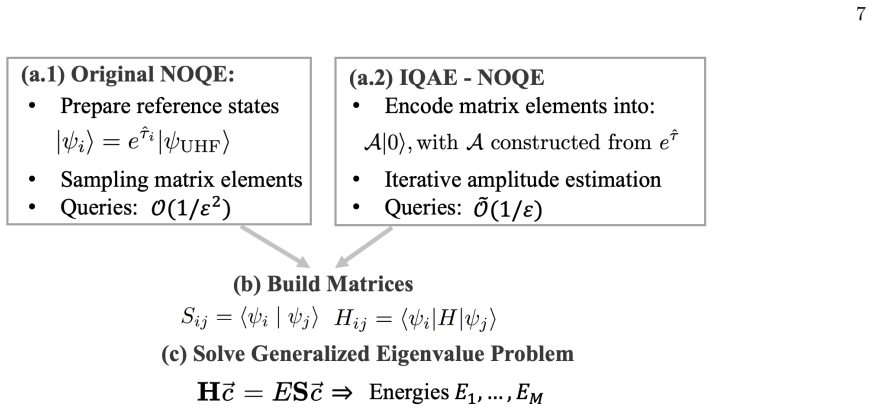
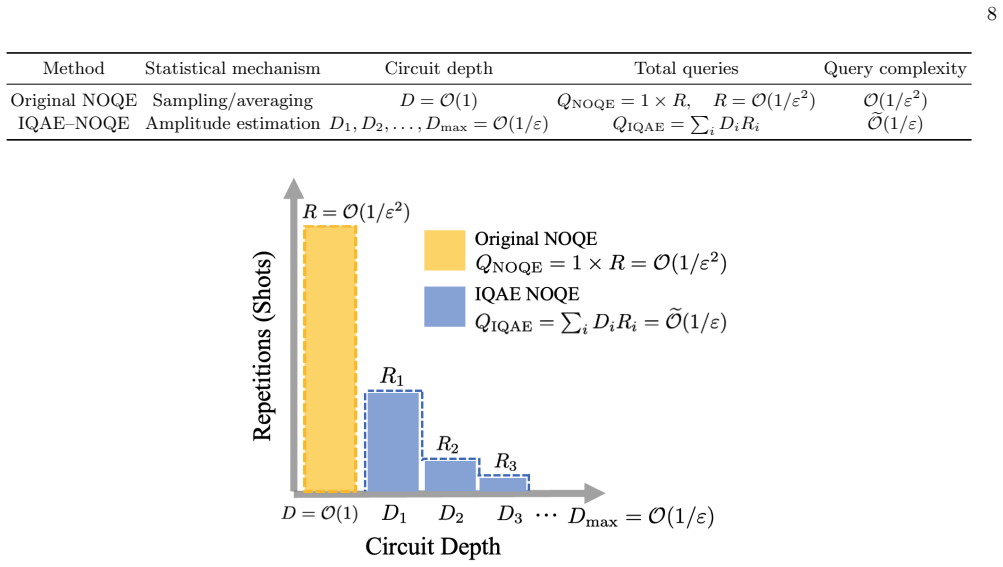
The central claim is that the matrix-element estimation step in NOQE can be reformulated as a collection of amplitude-estimation tasks; integrating iterative quantum amplitude estimation then replaces statistical averaging with coherent amplitude amplification, producing a protocol whose query complexity for these tasks is near-Heisenberg, specifically O(1/ε).
What carries the argument
Iterative quantum amplitude estimation applied to the collection of matrix-element estimation tasks inside the NOQE workflow.
If this is right
- High-precision energy estimation in NOQE becomes possible with substantially fewer total circuit repetitions.
- Chemical accuracy for molecular ground states can be reached at lower measurement cost than the original sampling protocol.
- The same coherent-amplification approach supplies a systematic route to reduce measurement overhead in other sampling-limited quantum chemistry algorithms.
Where Pith is reading between the lines
- The reformulation technique may extend to other variational quantum eigensolvers whose cost is dominated by overlap or Hamiltonian sampling.
- For larger molecules the reduction in query count could shift the dominant error source from measurement noise to circuit depth or decoherence.
- Hardware implementations would need to verify that the added controlled operations in amplitude estimation do not introduce error rates that offset the query savings.
Load-bearing premise
Matrix-element estimation in NOQE can be recast as amplitude-estimation tasks that fit into the existing workflow without prohibitive extra circuit depth or new error sources.
What would settle it
A controlled experiment on a quantum processor that measures the total number of circuit executions required to reach a fixed energy precision ε for a small molecule and checks whether the observed scaling is closer to 1/ε or 1/ε².
Figures
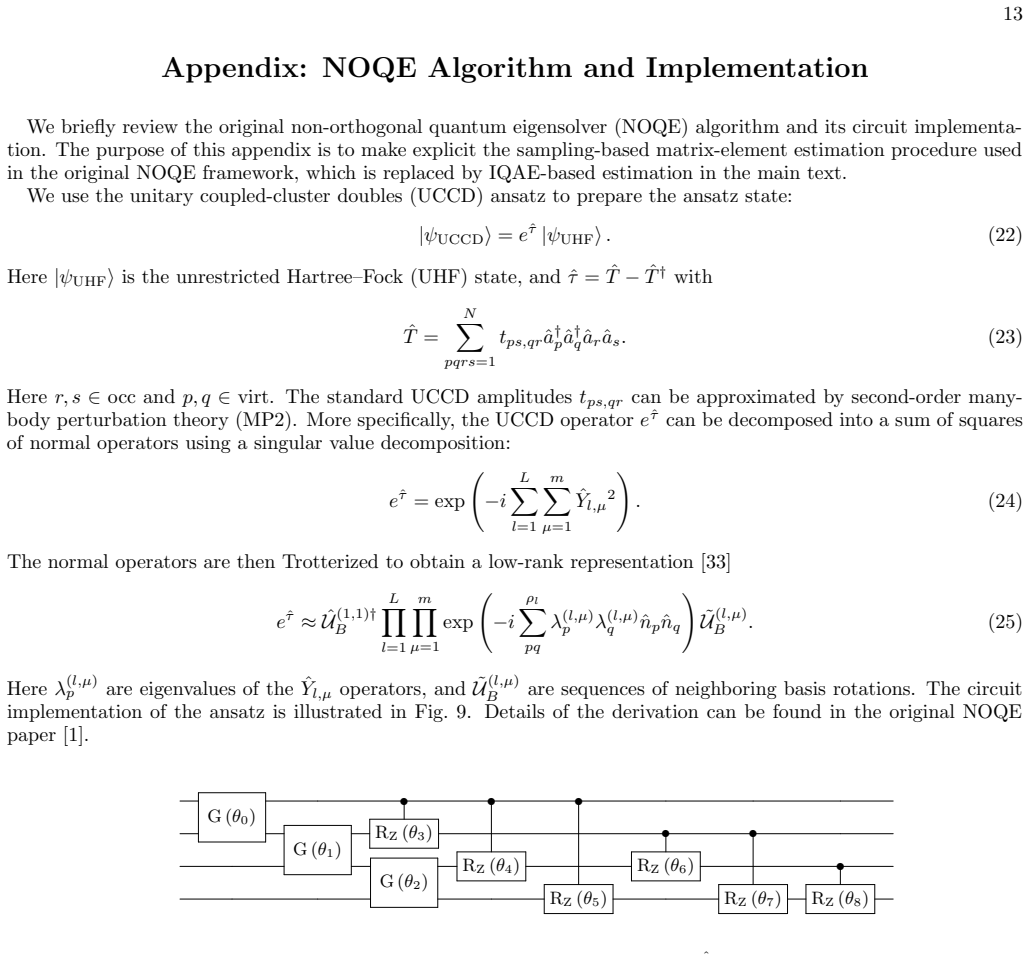
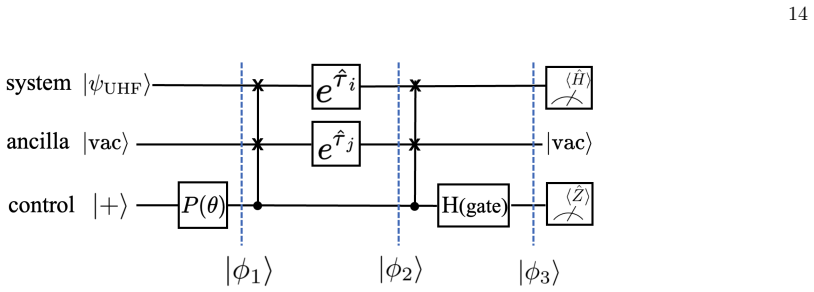
read the original abstract
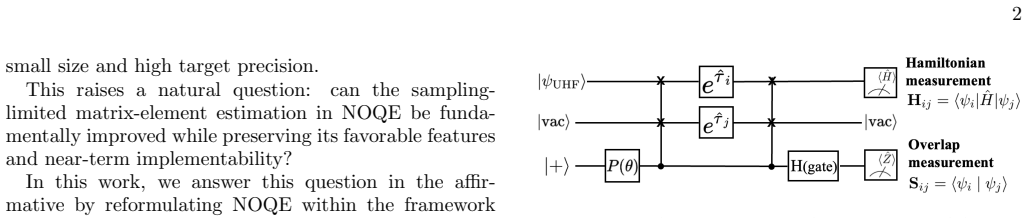
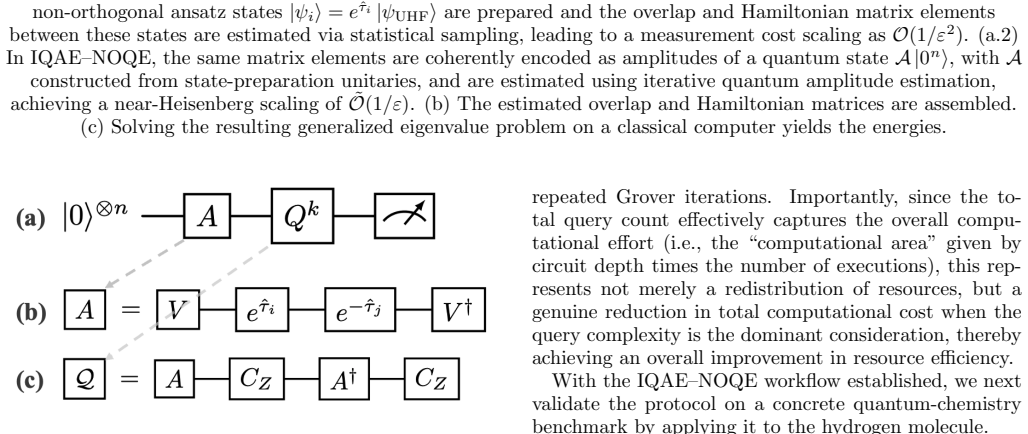
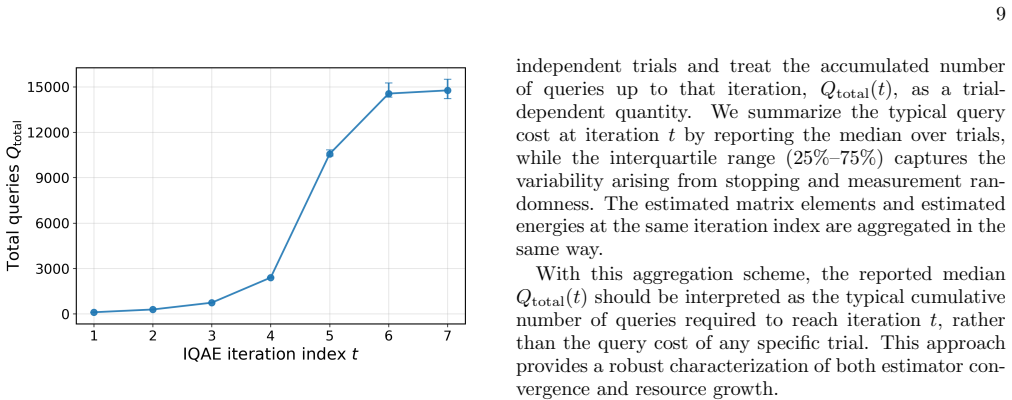
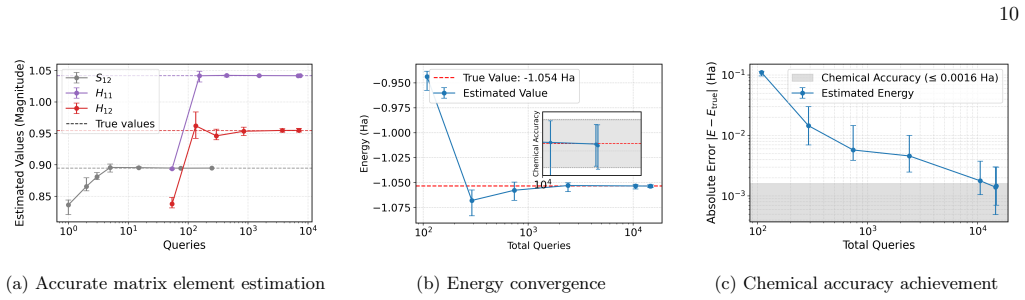
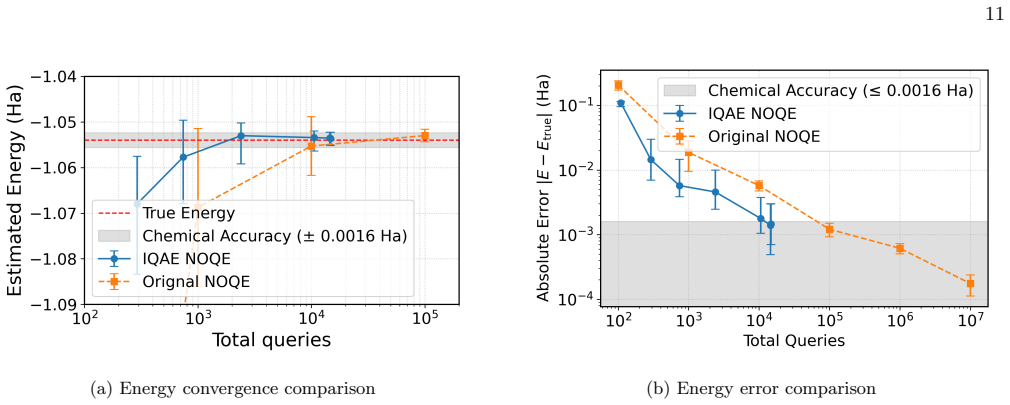
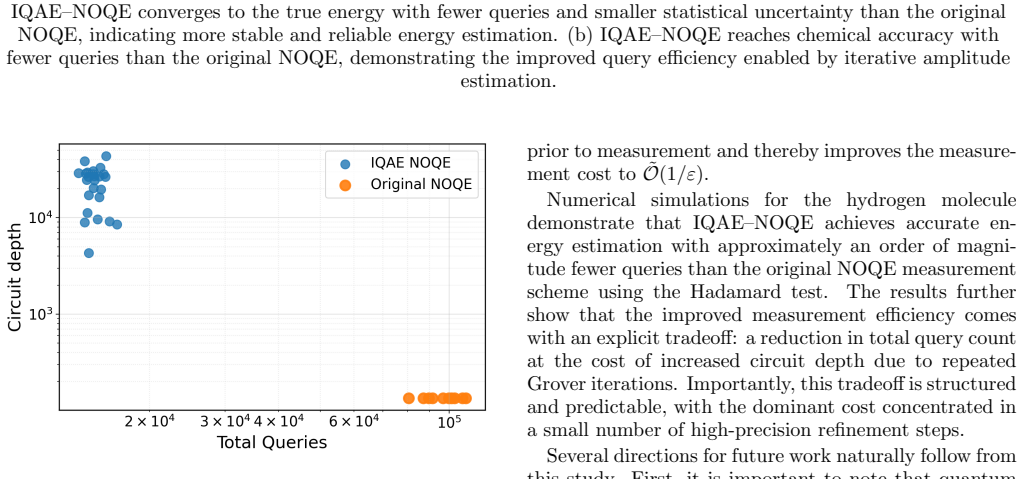
The Non-Orthogonal Quantum Eigensolver (NOQE) provides an accurate framework for electronic-structure calculations, but the estimation of its Hamiltonian and overlap matrix elements relies on sampling and requires $O(1/\varepsilon^2)$ circuit repetitions to achieve additive precision $\varepsilon$. Here, we reformulate this matrix-element estimation step as a collection of amplitude-estimation tasks and integrate iterative quantum amplitude estimation into the NOQE workflow. The resulting protocol achieves near-Heisenberg query complexity $O(1/\varepsilon)$ for these estimation tasks, by replacing incoherent statistical averaging with coherent amplitude amplification. We present explicit circuit constructions and the corresponding implementation procedure. Numerical simulations for the electronic states of the hydrogen molecule show that the proposed method reaches chemical accuracy with substantially fewer total queries than the original sampling-based protocol. Overall, this work provides a measurement-efficient route to high-precision energy estimation and illustrates how sampling-limited quantum algorithms can be systematically reformulated to leverage quantum coherence and achieve lower measurement costs.
Editorial analysis
A structured set of objections, weighed in public.
Referee Report
Summary. The paper claims that the Non-Orthogonal Quantum Eigensolver (NOQE) matrix-element estimation, originally requiring O(1/ε²) samples, can be reformulated as amplitude-estimation tasks. Integrating iterative quantum amplitude estimation yields near-Heisenberg query complexity O(1/ε) via coherent amplification. Explicit circuit constructions and an implementation procedure are presented, with numerical simulations on H2 showing chemical accuracy reached with substantially fewer total queries than the sampling protocol.
Significance. If the reformulation achieves the stated query reduction without prohibitive additional circuit depth or error sources, the work would meaningfully advance measurement-efficient variational quantum algorithms for quantum chemistry. The systematic replacement of incoherent averaging with amplitude amplification is a constructive approach that could apply more broadly. However, the absence of detailed error analysis, circuit-overhead bounds, and explicit baselines in the abstract limits immediate assessment of practical impact.
major comments (2)
- The central claim of O(1/ε) query complexity rests on the assumption that matrix-element estimation (<ψ_i|H|ψ_j> and overlaps) can be expressed as amplitudes of unitary oracles whose controlled versions incur no depth overhead that scales with the original variational circuit size. The skeptic's note correctly identifies that controlled-SWAP or Hadamard-test constructions for non-unitary state preparations generally insert ancillae and controlled gates whose depth grows with the preparation circuit; if this depth multiplies the number of amplitude-estimation iterations, total physical resources may exceed the claimed savings. No section or equation in the manuscript bounds this overhead or demonstrates that it remains sub-dominant to the query reduction.
- [Abstract] Abstract and numerical section: the claim that simulations reach chemical accuracy with fewer queries lacks reported error bars, circuit-depth accounting, or direct comparison to standard sampling baselines and to other amplitude-estimation variants. Without these, the numerical evidence cannot confirm that the protocol delivers the advertised measurement efficiency under realistic gate-error models.
minor comments (1)
- Notation for the iterative amplitude-estimation subroutine and its integration into the NOQE workflow should be introduced with explicit pseudocode or a numbered algorithm box to improve readability.
Simulated Author's Rebuttal
We thank the referee for their constructive comments on our manuscript. We address each major comment below and indicate the revisions we will make to strengthen the presentation.
read point-by-point responses
-
Referee: The central claim of O(1/ε) query complexity rests on the assumption that matrix-element estimation (<ψ_i|H|ψ_j> and overlaps) can be expressed as amplitudes of unitary oracles whose controlled versions incur no depth overhead that scales with the original variational circuit size. The skeptic's note correctly identifies that controlled-SWAP or Hadamard-test constructions for non-unitary state preparations generally insert ancillae and controlled gates whose depth grows with the preparation circuit; if this depth multiplies the number of amplitude-estimation iterations, total physical resources may exceed the claimed savings. No section or equation in the manuscript bounds this overhead or demonstrates that it remains sub-dominant to the query reduction.
Authors: We thank the referee for this important observation. The O(1/ε) scaling we report is the query complexity in the standard quantum query model (number of calls to the state-preparation oracle U_ψ). We agree that a complete resource count must address the depth of the controlled oracles used in amplitude estimation. In the revised manuscript we will add an explicit subsection that bounds the additional depth incurred by the controlled-SWAP and controlled-Hadamard-test constructions in terms of the depth of the original variational circuit, and we will show that this overhead remains sub-dominant to the quadratic reduction in query count for the precision targets of interest. revision: yes
-
Referee: Abstract and numerical section: the claim that simulations reach chemical accuracy with fewer queries lacks reported error bars, circuit-depth accounting, or direct comparison to standard sampling baselines and to other amplitude-estimation variants. Without these, the numerical evidence cannot confirm that the protocol delivers the advertised measurement efficiency under realistic gate-error models.
Authors: We agree that the numerical evidence would be more convincing with these additions. In the revised version we will (i) report error bars obtained from repeated simulation runs, (ii) tabulate circuit-depth estimates for both the original sampling protocol and the amplitude-estimation protocol, (iii) include direct numerical comparisons against the sampling baseline and against standard quantum amplitude estimation, and (iv) add a brief discussion of the ideal-circuit assumption and its implications for noisy hardware. revision: yes
Circularity Check
No circularity: direct reformulation of estimation task using standard amplitude estimation
full rationale
The paper describes a reformulation of NOQE matrix-element estimation into amplitude-estimation tasks to achieve O(1/ε) query complexity. No equations or claims in the provided abstract reduce any result to a fitted parameter, self-citation chain, or input by construction. The protocol is presented as an integration of known coherent amplitude amplification techniques into the existing workflow. The derivation is self-contained against external benchmarks for amplitude estimation and does not invoke load-bearing self-citations or ansatzes that collapse the central claim.
Axiom & Free-Parameter Ledger
axioms (1)
- domain assumption Quantum amplitude estimation can be applied to the matrix-element estimation tasks without introducing unaccounted overheads or violating standard quantum circuit assumptions.
Reference graph
Works this paper leans on
-
[1]
U. Baek, D. Hait, J. Shee, O. Leimkuhler, W. J. Huggins, T. F. Stetina, M. Head-Gordon, and K. B. Whaley, Say no to optimization: A nonorthogonal quantum eigensolver, PRX Quantum4, 030307 (2023)
2023
-
[2]
McArdle, S
S. McArdle, S. Endo, A. Aspuru-Guzik, S. C. Benjamin, and X. Yuan, Quantum computational chemistry, Reviews of Modern Physics92, 015003 (2020)
2020
-
[3]
Bauer, S
B. Bauer, S. Bravyi, M. Motta, and G. K.-L. Chan, Quantum algorithms for quantum chemistry and quantum materials science, Chemical reviews120, 12685 (2020)
2020
-
[4]
Motta and J
M. Motta and J. E. Rice, Emerging quantum computing algorithms for quantum chemistry, Wiley Interdisciplinary Reviews: Computational Molecular Science12, e1580 (2022)
2022
-
[5]
Lewalle, Y
P. Lewalle, Y. Zhang, and K. B. Whaley, Optimal zeno dragging for quantum control: A shortcut to zeno with action-based scheduling optimization, PRX Quantum5, 020366 (2024)
2024
- [6]
-
[7]
Zhang, P
Y. Zhang, P. Lewalle, and K. B. Whaley, Solving k–sat problems with generalized quantum measurement, npj Quantum Information11, 170 (2025)
2025
-
[8]
Cerezo, A
M. Cerezo, A. Arrasmith, R. Babbush, S. C. Benjamin, S. Endo, K. Fujii, J. R. McClean, K. Mitarai, X. Yuan, L. Cincio, et al., Variational quantum algorithms, Nature Reviews Physics3, 625 (2021)
2021
-
[9]
Tilly, H
J. Tilly, H. Chen, S. Cao, D. Picozzi, K. Setia, Y. Li, E. Grant, L. Wossnig, I. Rungger, G. H. Booth,et al., The variational quantum eigensolver: a review of methods and best practices, Physics Reports986, 1 (2022)
2022
-
[10]
W. J. Huggins, J. R. McClean, N. C. Rubin, Z. Jiang, N. Wiebe, K. B. Whaley, and R. Babbush, Efficient and noise resilient measurements for quantum chemistry on near-term quantum computers, npj Quantum Information7, 23 (2021)
2021
-
[11]
Patel, P
S. Patel, P. Jayakumar, T.-C. Yen, and A. F. Izmaylov, Quantum measurement for quantum chemistry on a quantum computer, Chemical Reviews125, 7490 (2025)
2025
-
[12]
A. Y. Kitaev, Quantum measurements and the abelian stabilizer problem, arXiv preprint quant-ph/9511026 (1995)
Pith/arXiv arXiv 1995
-
[13]
O. Leimkuhler and K. B. Whaley, Exponential quantum speedups for near-term molecular electronic structure methods, arXiv preprint arXiv:2503.21041 (2025)
arXiv 2025
-
[14]
H. Ren, Y. Zhang, W. M. Billings, R. Tomann, N. V. Tkachenko, M. Kang, M. Head-Gordon, and K. B. Whaley, Error- mitigated nonorthogonal quantum eigensolver via shadow tomography, Physical Review Research8, 013268 (2026)
2026
-
[15]
Grinko, J
D. Grinko, J. Gacon, C. Zoufal, and S. Woerner, Iterative quantum amplitude estimation, npj Quantum Information7, 52 (2021)
2021
-
[16]
G. W. Pratt Jr, Unrestricted hartree-fock method, Physical Review102, 1303 (1956)
1956
-
[17]
Aaronson and P
S. Aaronson and P. Rall, Quantum approximate counting, simplified, inSymposium on simplicity in algorithms(SIAM,
-
[18]
Fukuzawa, C
S. Fukuzawa, C. Ho, S. Irani, and J. Zion, Modified iterative quantum amplitude estimation is asymptotically optimal, in 2023 proceedings of the symposium on algorithm engineering and experiments (ALENEX)(SIAM, 2023) pp. 135–147
2023
-
[19]
A. Callison and D. E. Browne, Improved maximum-likelihood quantum amplitude estimation, arXiv preprint arXiv:2209.03321 (2022)
arXiv 2022
-
[20]
Giurgica-Tiron, I
T. Giurgica-Tiron, I. Kerenidis, F. Labib, A. Prakash, and W. Zeng, Low depth algorithms for quantum amplitude estimation, Quantum6, 745 (2022)
2022
-
[21]
J. D. Whitfield, J. Biamonte, and A. Aspuru-Guzik, Simulation of electronic structure hamiltonians using quantum com- puters, Molecular Physics109, 735 (2011)
2011
-
[22]
Jordan and E
P. Jordan and E. Wigner, ¨Uber das paulische ¨ aquivalenzverbot, Zeitschrift f¨ ur Physik47, 631 (1928)
1928
-
[23]
B. Zindorf and S. Bose, Efficient implementation of multi-controlled quantum gates, arXiv preprint arXiv:2404.02279 (2024)
arXiv 2024
-
[24]
C. A. Coulson and I. Fischer, Xxxiv. notes on the molecular orbital treatment of the hydrogen molecule, The London, Edinburgh, and Dublin Philosophical Magazine and Journal of Science40, 386 (1949)
1949
-
[25]
W. J. Hehre, R. F. Stewart, and J. A. Pople, Self-consistent molecular-orbital methods. i. use of gaussian expansions of slater-type atomic orbitals, The Journal of Chemical Physics51, 2657 (1969). 16
1969
-
[26]
A. Javadi-Abhari, M. Treinish, K. Krsulich, C. J. Wood, J. Lishman, J. Gacon, S. Martiel, P. D. Nation, L. S. Bishop, A. W. Cross, B. R. Johnson, and J. M. Gambetta, Quantum computing with Qiskit (2024), arXiv:2405.08810 [quant-ph]
Pith/arXiv arXiv 2024
-
[27]
Z. Cai, R. Babbush, S. C. Benjamin, S. Endo, W. J. Huggins, Y. Li, J. R. McClean, and T. E. O’Brien, Quantum error mitigation, Rev. Mod. Phys.95, 045005 (2023)
2023
-
[28]
H. Ren, Y. Zhang, Z. Zheng, C. Ying, L. Xu, M. Rahmani, and K. B. Whaley, Error mitigated metasurface-based ran- domized measurement schemes, Physical Review Research6, 033310 (2024)
2024
-
[29]
Yoshioka, H
N. Yoshioka, H. Hakoshima, Y. Matsuzaki, Y. Tokunaga, Y. Suzuki, and S. Endo, Generalized quantum subspace expansion, Physical Review Letters129, 020502 (2022)
2022
-
[30]
G. Lee, D. Lee, and J. Huh, Sampling error analysis in quantum krylov subspace diagonalization, Quantum8, 1477 (2024)
2024
-
[31]
E. N. Epperly, L. Lin, and Y. Nakatsukasa, A theory of quantum subspace diagonalization, SIAM Journal on Matrix Analysis and Applications43, 1263 (2022)
2022
-
[32]
H. Ren, Data of towards heisenberg scaling: Measurement-efficient non-orthogonal quantum eigensolver (2026),GitHub Repository,https://github.com/HangRen0/Data-of-measurement-efficient-non-orthogonal-quantum-eigensolver
2026
-
[33]
Motta, E
M. Motta, E. Ye, J. R. McClean, Z. Li, A. J. Minnich, R. Babbush, and G. K. Chan, Low rank representations for quantum simulation of electronic structure, npj Quantum Information7, 1 (2021)
2021
discussion (0)
Sign in with ORCID, Apple, or X to comment. Anyone can read and Pith papers without signing in.