Signatures of Accreting Black Holes in Line Intensity Mapping
Pith reviewed 2026-06-28 14:14 UTC · model grok-4.3
The pith
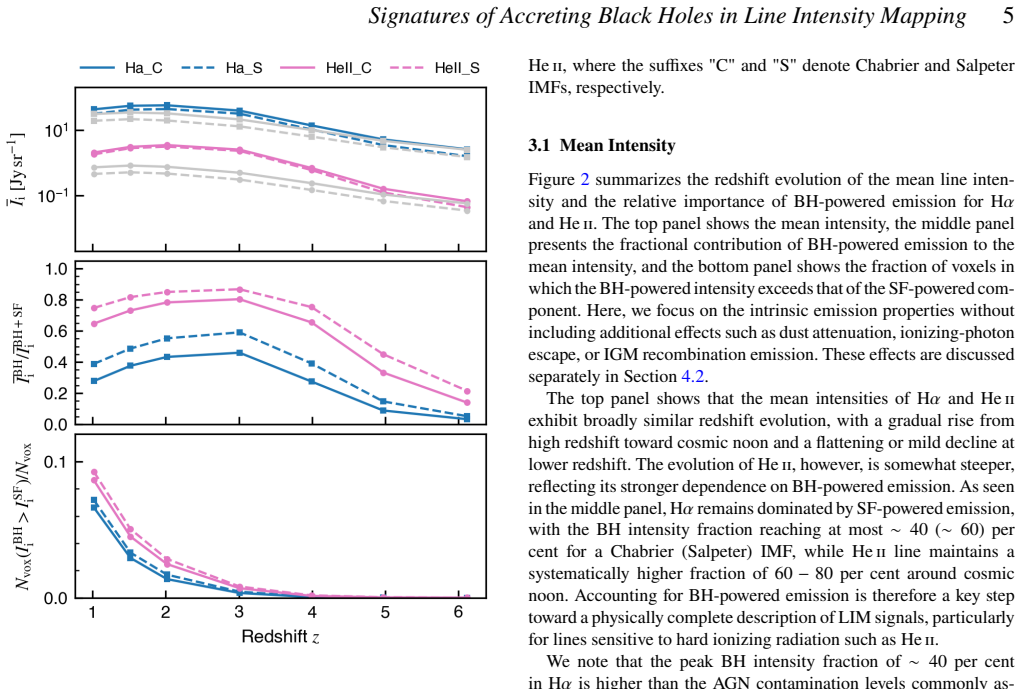
Accreting black holes supply 40-60% of Hα and 60-80% of He II line intensity around cosmic noon.
A machine-rendered reading of the paper's core claim, the machinery that carries it, and where it could break.
Core claim
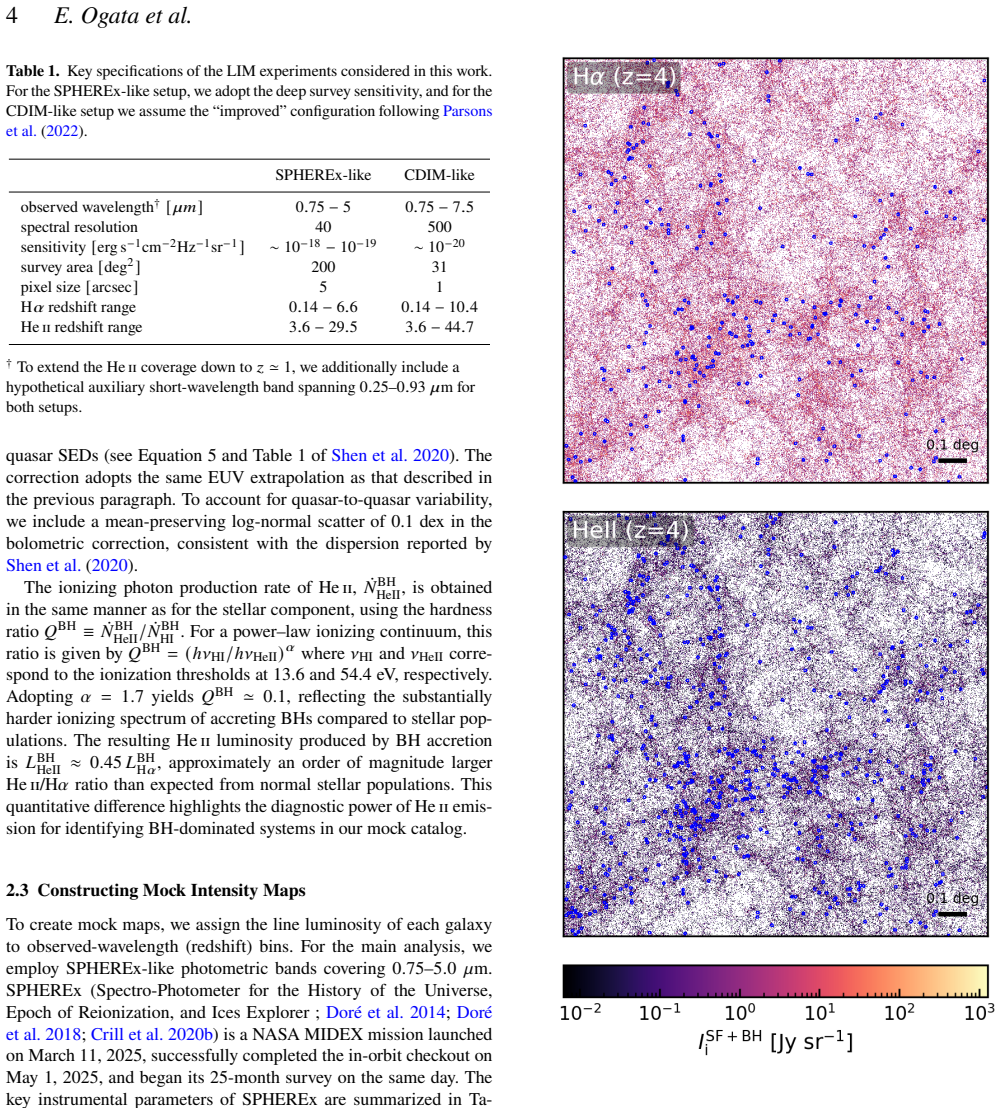
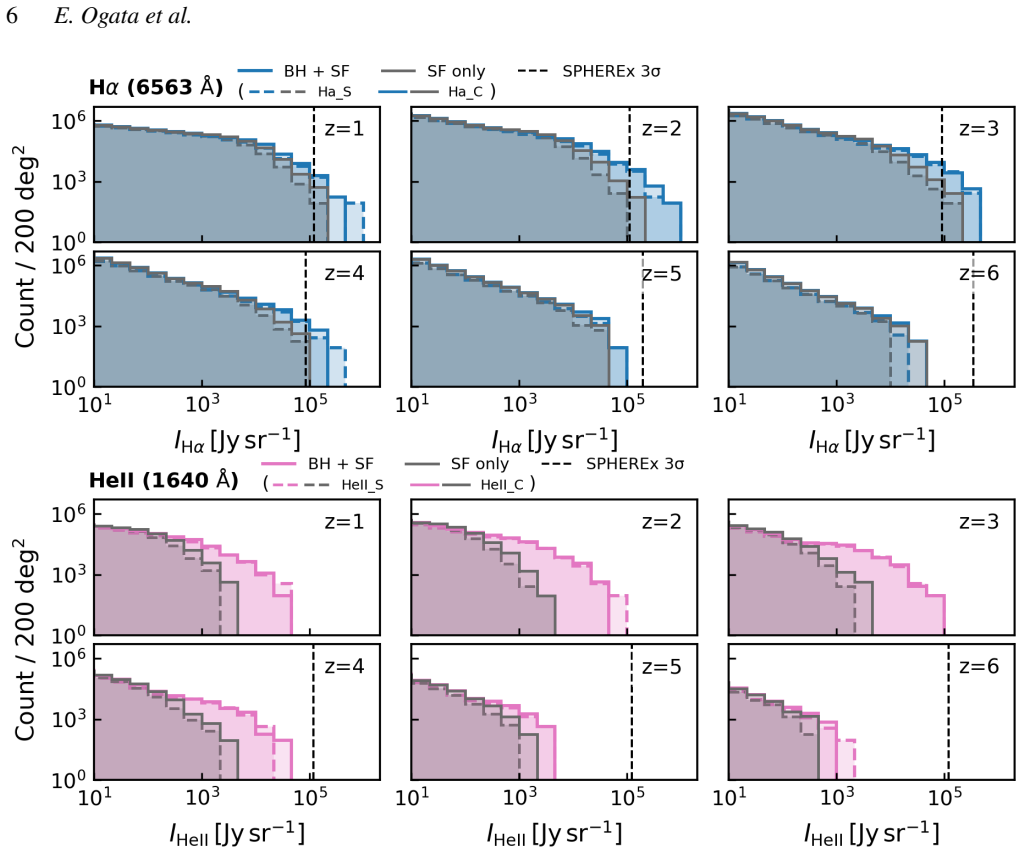
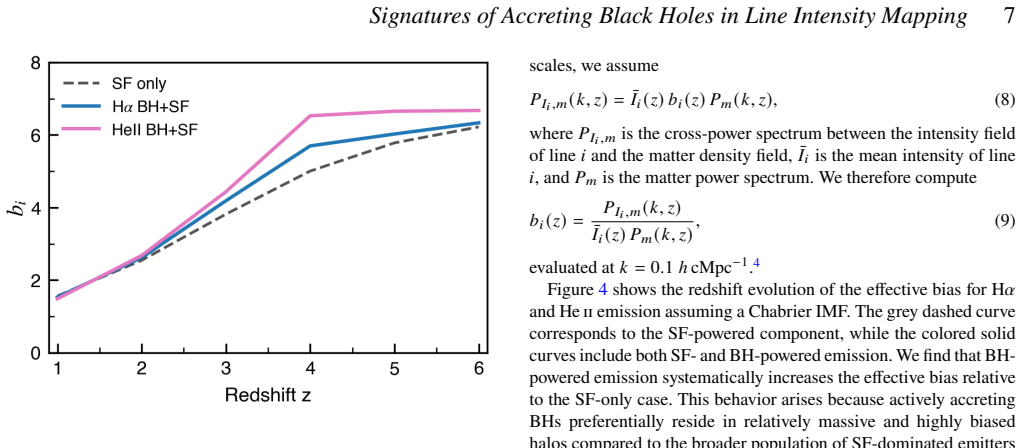
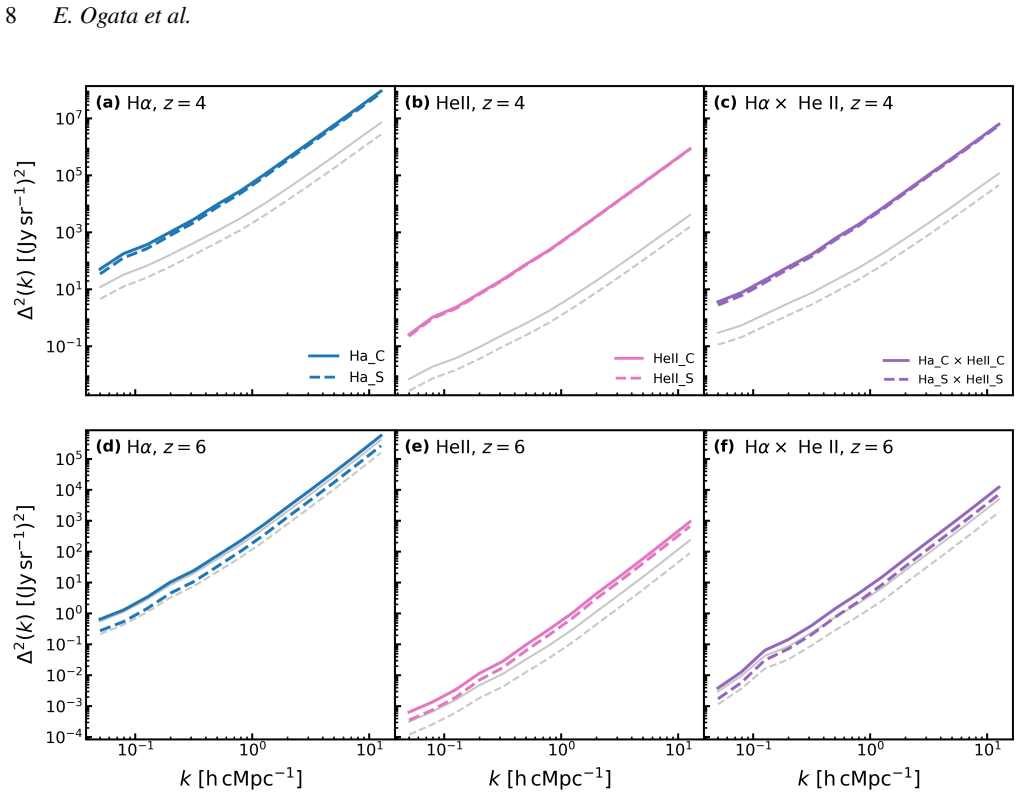
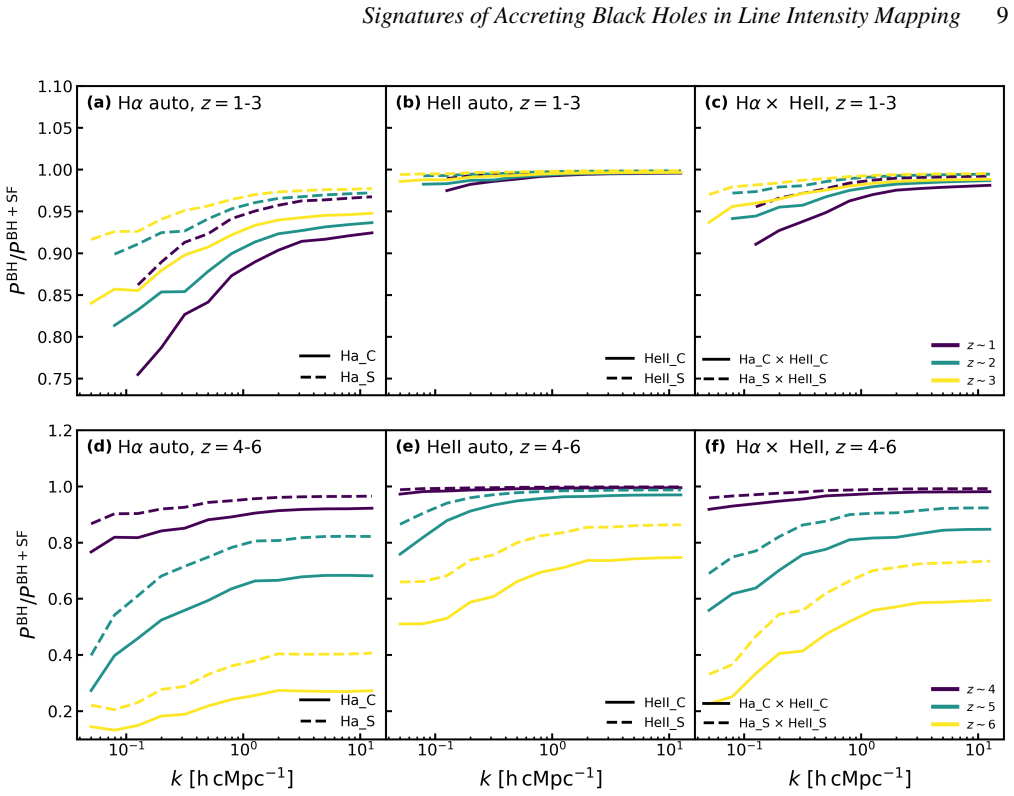
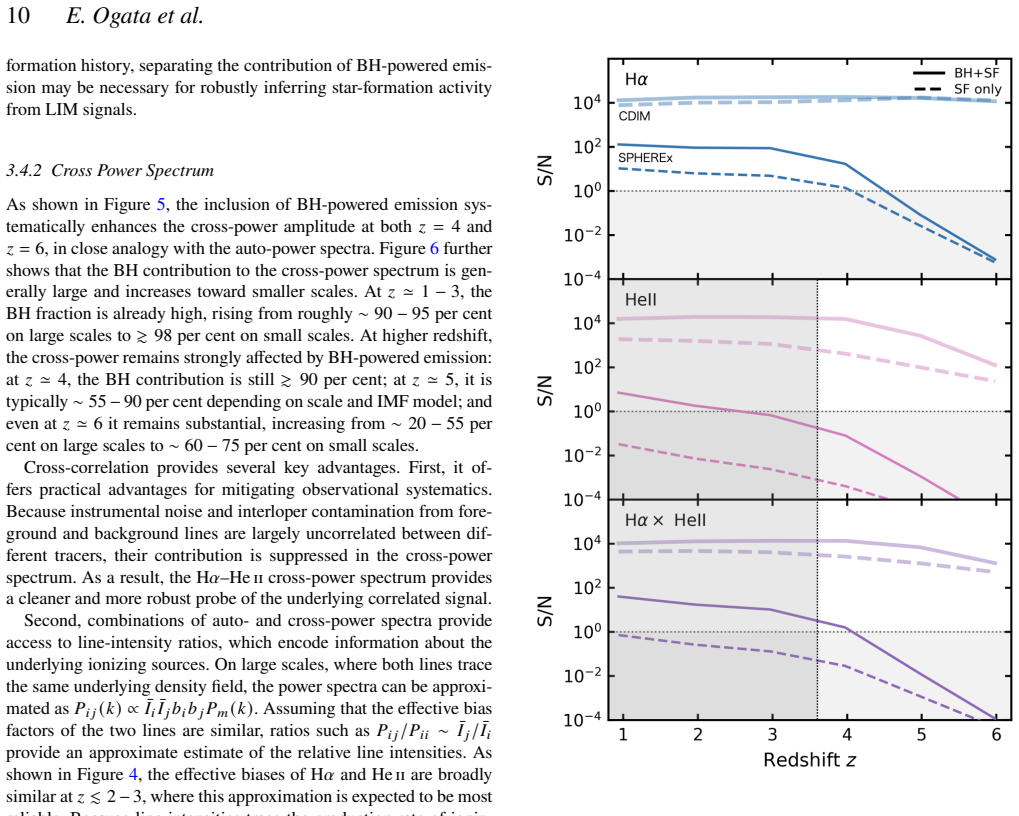
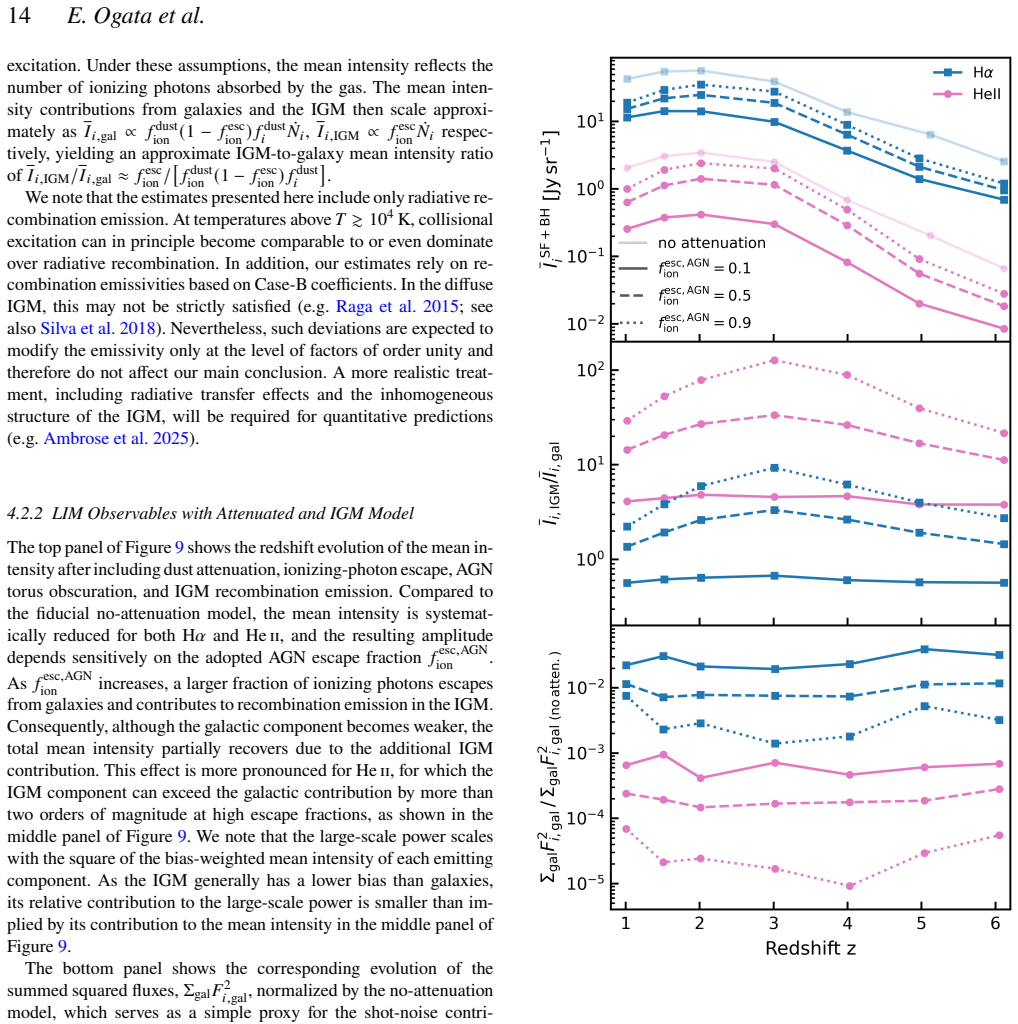
Mock Hα and He II intensity maps built from the IllustrisTNG simulation that include both star-formation and black-hole accretion show that accreting black holes contribute 40-60 per cent of the mean Hα intensity and 60-80 per cent of the mean He II intensity near cosmic noon. Because black-hole-powered sources are rare yet luminous, they dominate the shot-noise term of the power spectrum and raise the small-scale clustering amplitude, most strongly for He II. The same maps indicate that a SPHEREx-like survey can reach the black-hole-influenced bright end of the Hα voxel intensity distribution at z ≲ 4 while a CDIM-like experiment can access the black-hole-dominated regime of He II.
What carries the argument
The sub-grid black-hole accretion model and the associated Hα and He II line-emission prescriptions applied to the IllustrisTNG simulation, which assign luminosities to both star-forming galaxies and accreting black holes.
If this is right
- Black-hole emission supplies 40-60 per cent of the mean Hα intensity and 60-80 per cent of the mean He II intensity around cosmic noon.
- Black-hole sources dominate the shot-noise component of the power spectrum for both lines.
- Black-hole emission raises the small-scale clustering amplitude, especially for He II.
- SPHEREx can measure the black-hole-influenced bright tail of the Hα voxel intensity distribution at redshifts below 4.
- A CDIM-like experiment can reach the black-hole-dominated portion of the He II maps.
Where Pith is reading between the lines
- Omitting black holes from LIM models would lead to overestimates of the cosmic star-formation rate density inferred from the same lines.
- Other rest-frame optical or UV lines that are bright in active galactic nuclei may show analogous black-hole dominance once modeled.
- Joint analysis of multiple lines could separate the black-hole and star-formation contributions without relying solely on the simulation.
Load-bearing premise
The simulation's sub-grid rules for how black holes accrete and how much Hα and He II light they produce at the bright end match what happens in real galaxies.
What would settle it
A measured Hα or He II voxel intensity distribution or power spectrum from SPHEREx or a comparable survey that lies outside the range predicted when black-hole accretion is included but inside the range predicted when it is omitted.
Figures
read the original abstract
Line-intensity mapping (LIM) has attracted growing attention as a powerful technique for probing the large-scale distribution of galaxies and the cosmic history of star formation through unresolved line emission. Existing LIM models for galaxy-associated lines, such as H$\alpha$, often assume that the dominant contribution to observed emission arises from star-forming activity, while the role of accreting black holes (BHs) remains largely unexplored. In this study, we use the IllustrisTNG cosmological hydrodynamical simulation to construct mock intensity maps of H$\alpha$ and He II, including contributions from both star formation and BH accretion. We show that the BH contribution to the mean intensity is significant, reaching $\sim$40--60 per cent for H$\alpha$ and $\sim$60--80 per cent for He II around cosmic noon. Owing to the large luminosity weight of rare, bright sources, BH-powered emission dominates the shot-noise component of the power spectrum and significantly boosts the small-scale clustering amplitude, particularly for He II. We assess the implications for forthcoming LIM surveys and show that SPHEREx can probe the BH-influenced bright end of the H$\alpha$ voxel intensity distribution (VID) at $z\lesssim4$, and a CDIM-like experiment can further access the BH-dominated regime of He II. Our results demonstrate that accreting BHs represent an essential component of LIM signals, which was previously underappreciated. We thus conclude that accurately modeling the BH contribution is crucial for a physically complete interpretation of future LIM observations.
Editorial analysis
A structured set of objections, weighed in public.
Referee Report
Summary. The paper uses the IllustrisTNG hydrodynamical simulation to generate mock Hα and He II intensity maps that include both star-formation and black-hole accretion contributions. It reports that accreting BHs supply 40–60% of the mean Hα intensity and 60–80% of the mean He II intensity near cosmic noon, dominate the shot-noise term of the power spectrum, and boost small-scale clustering; the work then discusses detectability of these effects with SPHEREx and a CDIM-like experiment.
Significance. If the simulation results are robust, the finding that BH accretion is a major, previously under-appreciated contributor to LIM signals would require revisions to existing star-formation-only models and would affect the design and interpretation of forthcoming intensity-mapping surveys. The simulation-based approach supplies concrete, falsifiable predictions for the voxel intensity distribution and power-spectrum shape that can be tested by future data.
major comments (2)
- [Section 3] Section 3 (line-emission modeling): the quoted 40–60% and 60–80% mean-intensity fractions are obtained by post-processing IllustrisTNG halos with a specific sub-grid BH accretion prescription and line-luminosity scaling; no error bars, parameter-variation tests, or direct comparison to observed Hα/He II luminosity functions at the bright end (where the VID and shot-noise term are dominated) are provided, rendering the central quantitative claims sensitive to an unvalidated modeling choice.
- [Section 4.2] Section 4.2 (power-spectrum results): the claim that BH emission dominates the shot-noise component and boosts small-scale clustering rests on the same unvalidated bright-end luminosity function; if the simulated AGN number density at high L is systematically high, both the reported fractions and the clustering boost are overstated by construction.
minor comments (2)
- [Figure 3] Figure 3 caption: the color scale for the VID panels is not labeled with units, making quantitative comparison to the text fractions difficult.
- [Section 2.3] Section 2.3: the precise definition of the BH versus star-formation luminosity cut (e.g., Eddington ratio threshold) is stated only qualitatively; an explicit equation would improve reproducibility.
Simulated Author's Rebuttal
We thank the referee for the detailed and constructive report. The comments highlight important aspects of model validation that we will strengthen in the revised manuscript. Below we respond point by point to the major comments.
read point-by-point responses
-
Referee: [Section 3] Section 3 (line-emission modeling): the quoted 40–60% and 60–80% mean-intensity fractions are obtained by post-processing IllustrisTNG halos with a specific sub-grid BH accretion prescription and line-luminosity scaling; no error bars, parameter-variation tests, or direct comparison to observed Hα/He II luminosity functions at the bright end (where the VID and shot-noise term are dominated) are provided, rendering the central quantitative claims sensitive to an unvalidated modeling choice.
Authors: We agree that the quantitative fractions depend on the specific sub-grid accretion model and line-luminosity relations adopted from IllustrisTNG. While the simulation itself has been calibrated to a broad set of observational constraints, we did not include direct comparisons to observed Hα or He II luminosity functions at the bright end in the original submission. In the revised manuscript we will add such comparisons using available observational data, include a brief discussion of modeling uncertainties, and note the absence of a full parameter-variation study as a limitation of the current work. revision: yes
-
Referee: [Section 4.2] Section 4.2 (power-spectrum results): the claim that BH emission dominates the shot-noise component and boosts small-scale clustering rests on the same unvalidated bright-end luminosity function; if the simulated AGN number density at high L is systematically high, both the reported fractions and the clustering boost are overstated by construction.
Authors: We concur that the shot-noise dominance and small-scale power boost are sensitive to the bright-end AGN number density. The revisions described in response to the first comment—specifically the addition of luminosity-function comparisons—will directly test whether the simulated bright-end densities are consistent with observations. If discrepancies are found, we will qualify the power-spectrum claims accordingly in the revised text. revision: yes
Circularity Check
No significant circularity; simulation outputs are independent computed quantities
full rationale
The paper's central results (BH fractions of mean intensity and shot-noise dominance) are obtained by direct post-processing of IllustrisTNG halo catalogs with fixed sub-grid accretion rates and line-luminosity prescriptions. No derivation chain, equation, or self-citation reduces the reported percentages to a fit or tautology; the outputs are model-evaluated quantities rather than re-expressions of the inputs. Self-citations, if present, are not load-bearing for the headline claims. This is a standard simulation study whose conclusions stand or fall on the fidelity of the underlying sub-grid model, not on any internal circular reduction.
Axiom & Free-Parameter Ledger
Reference graph
Works this paper leans on
-
[1]
Ambrose and Eli Visbal and Mihir Kulkarni and Matthew McQuinn , doi =
Abigail E. Ambrose and Eli Visbal and Mihir Kulkarni and Matthew McQuinn , doi =. Radiative transfer simulations of Lyα intensity mapping during cosmic reionization including sources from galaxies and the intergalactic medium , volume =. JCAP , keywords =
-
[2]
OBSCURATION-DEPENDENT EVOLUTION OF ACTIVE GALACTIC NUCLEI , volume =
Johannes Buchner and Antonis Georgakakis and Kirpal Nandra and Murray Brightman and Marie Luise Menzel and Zhu Liu and Li Ting Hsu and Mara Salvato and Cyprian Rangel and James Aird and Andrea Merloni and Nicholas Ross , doi =. OBSCURATION-DEPENDENT EVOLUTION OF ACTIVE GALACTIC NUCLEI , volume =. ApJ , keywords =
-
[3]
Tinker and Brant E
Jeremy L. Tinker and Brant E. Robertson and Andrey V. Kravtsov and Anatoly Klypin and Michael S. Warren and Gustavo Yepes and Stefan Gottlober , doi =. The Large Scale Bias of Dark Matter Halos: Numerical Calibration and Model Tests , volume =. AJ , keywords =
-
[4]
Inoue , doi =
Akio K. Inoue , doi =. Lyman Continuum Extinction by Dust in H \ ii\ Regions of Galaxies , volume =. AJ , keywords =
-
[5]
LIMFAST. IV. Learning high-redshift galaxy formation from multiline intensity mapping with implicit likelihood inference. , keywords =. doi:10.1088/1475-7516/2026/02/008 , archivePrefix =. 2509.07060 , primaryClass =
-
[6]
Large scale simulations of H and He reionization and heating driven by stars and more energetic sources , volume =
Marius B Eide and Benedetta Ciardi and Luca Graziani and Philipp Busch and Yu Feng and Tiziana Di Matteo , journal =. Large scale simulations of H and He reionization and heating driven by stars and more energetic sources , volume =
-
[7]
Measuring the Mean Free Path of H I Ionizing Photons at 3.2 z 4.6 with DESI Y1 Quasars. , keywords =. doi:10.3847/2041-8213/adb48f , archivePrefix =. 2411.15838 , primaryClass =
-
[8]
Planck 2018 results. VI. Cosmological parameters , volume =. 2018 , url =. doi:10.1051/0004-6361/201833910 , journal =
-
[9]
The American Astronomical Society
Piero Madau and Avery Meiksin1 and Martin J Rees , journal =. The American Astronomical Society. All rights reserved , volume =
-
[10]
The First Cosmic Structures and their Effects , volume =
Benedetta Ciardi and Andrea Ferrara , doi =. The First Cosmic Structures and their Effects , volume =. Space Sci. Rev. , month =
-
[11]
Lyman Alpha Emitting Galaxies as a Probe of Reionization , volume =
Mark Dijkstra , doi =. Lyman Alpha Emitting Galaxies as a Probe of Reionization , volume =. PASA , keywords =
-
[12]
Evolution of the Intergalactic Opacity: Implications for the Ionizing Background, Cosmic Star Formation, and Quasar Activity , volume =
Claude‐André Faucher‐Giguère and Adam Lidz and Lars Hernquist and Matias Zaldarriaga , doi =. Evolution of the Intergalactic Opacity: Implications for the Ionizing Background, Cosmic Star Formation, and Quasar Activity , volume =. ApJ , keywords =
-
[13]
R. J. Assef and D. Stern and G. Noirot and H. D. Jun and R. M. Cutri and P. R. M. Eisenhardt , doi =. The WISE AGN Catalog , volume =. ApJ , keywords =
-
[14]
Alexander and Jinyi Yang and Steven Ahlen and Stephen Bailey and David Brooks and Zheng Cai and Solène Chabanier and Tamara M
Edmond Chaussidon and Christophe Yèche and Nathalie Palanque-Delabrouille and David M. Alexander and Jinyi Yang and Steven Ahlen and Stephen Bailey and David Brooks and Zheng Cai and Solène Chabanier and Tamara M. Davis and Kyle Dawson and Axel de laMacorra and Arjun Dey and Biprateep Dey and Sarah Eftekharzadeh and Daniel J. Eisenstein and Kevin Fanning ...
-
[15]
A Catalog of Quasar Properties from Sloan Digital Sky Survey Data Release 16 , volume =
Qiaoya Wu and Yue Shen , doi =. A Catalog of Quasar Properties from Sloan Digital Sky Survey Data Release 16 , volume =. ApJ , keywords =
-
[16]
Lyke and Alexandra N
Brad W. Lyke and Alexandra N. Higley and J. N. McLane and Danielle P. Schurhammer and Adam D. Myers and Ashley J. Ross and Kyle Dawson and Solène Chabanier and Paul Martini and Nicolás G. Busca and Hélion du Mas des Bourboux and Mara Salvato and Alina Streblyanska and Pauline Zarrouk and Etienne Burtin and Scott F. Anderson and Julian Bautista and Dmitry ...
-
[17]
Wright and Peter R.M
Edward L. Wright and Peter R.M. Eisenhardt and Amy K. Mainzer and Michael E. Ressler and Roc M. Cutri and Thomas Jarrett and J. Davy Kirkpatrick and Deborah Padgett and Robert S. McMillan and Michael Skrutskie and S. A. Stanford and Martin Cohen and Russell G. Walker and John C. Mather and David Leisawitz and Thomas N. Gautier and Ian McLean and Dominic B...
-
[18]
Allen and Carlos Allende Prieto and James Annis and Stephen Bailey and Christophe Balland and Otger Ballester and Charles Baltay and Lucas Beaufore and Chris Bebek and Timothy C
DESI-Collaboration and Amir Aghamousa and Jessica Aguilar and Steve Ahlen and Shadab Alam and Lori E. Allen and Carlos Allende Prieto and James Annis and Stephen Bailey and Christophe Balland and Otger Ballester and Charles Baltay and Lucas Beaufore and Chris Bebek and Timothy C. Beers and Eric F. Bell and José Luis Bernal and Robert Besuner and Florian B...
-
[19]
York and J
Donald G. York and J. Adelman and John E. Anderson, Jr. and Scott F. Anderson and James Annis and Neta A. Bahcall and J. A. Bakken and Robert Barkhouser and Steven Bastian and Eileen Berman and William N. Boroski and Steve Bracker and Charlie Briegel and John W. Briggs and J. Brinkmann and Robert Brunner and Scott Burles and Larry Carey and Michael A. Car...
-
[20]
Salvato and J
M. Salvato and J. Wolf and T. Dwelly and A. Georgakakis and M. Brusa and A. Merloni and T. Liu and Y. Toba and K. Nandra and G. Lamer and J. Buchner and C. Schneider and S. Freund and A. Rau and A. Schwope and A. Nishizawa and M. Klein and R. Arcodia and J. Comparat and B. Musiimenta and T. Nagao and H. Brunner and A. Malyali and A. Finoguenov and S. Ande...
-
[21]
Brunner and T
H. Brunner and T. Liu and G. Lamer and A. Georgakakis and A. Merloni and M. Brusa and E. Bulbul and K. Dennerl and S. Friedrich and A. Liu and C. Maitra and K. Nandra and M. E. Ramos-Ceja and J. S. Sanders and I. M. Stewart and T. Boller and J. Buchner and N. Clerc and J. Comparat and T. Dwelly and D. Eckert and A. Finoguenov and M. Freyberg and V. Ghirar...
-
[22]
Teng Liu and Johannes Buchner and Kirpal Nandra and Andrea Merloni and Tom Dwelly and Jeremy S. Sanders and Mara Salvato and Riccardo Arcodia and Marcella Brusa and Julien Wolf and Antonis Georgakakis and Thomas Boller and Mirko Krumpe and Georg Lamer and Sophia Waddell and Tanya Urrutia and Axel Schwope and Jan Robrade and Jörn Wilms and Thomas Dauser an...
-
[23]
eROSITA Science Book: Mapping the Structure of the Energetic Universe
eROSITA Science Book: Mapping the Structure of the Energetic Universe. arXiv e-prints , keywords =. doi:10.48550/arXiv.1209.3114 , archivePrefix =. 1209.3114 , primaryClass =
work page internal anchor Pith review Pith/arXiv arXiv doi:10.48550/arxiv.1209.3114
-
[24]
Eldridge and Elizabeth R
Jan J. Eldridge and Elizabeth R. Stanway , doi =. New Insights into the Evolution of Massive Stars and Their Effects on Our Understanding of Early Galaxies , volume =. A&A R , keywords =
-
[25]
Wechsler and Andrew P
Peter Behroozi and Risa H. Wechsler and Andrew P. Hearin and Charlie Conroy , doi =. UniverseMachine: The correlation between galaxy growth and dark matter halo assembly from z = 0−10 , volume =. MNRAS , keywords =
-
[26]
Behroozi and Risa H
Peter S. Behroozi and Risa H. Wechsler and Charlie Conroy , doi =. The Average Star Formation Histories of Galaxies in Dark Matter Halos from z=0-8 , volume =. ApJ , keywords =
-
[27]
Simpson and Rahul Kannan and Volker Springel , doi =
Rüdiger Pakmor and Christoph Pfrommer and Christine M. Simpson and Rahul Kannan and Volker Springel , doi =. Semi-implicit anisotropic cosmic ray transport on an unstructured moving mesh , volume =. MNRAS , keywords =
-
[28]
Magnetohydrodynamics on an unstructured moving grid , volume =
Ruediger Pakmor and Andreas Bauer and Volker Springel , doi =. Magnetohydrodynamics on an unstructured moving grid , volume =. MNRAS , keywords =
-
[29]
Haehnelt and Piero Madau , doi =
Ewald Puchwein and Francesco Haardt and Martin G. Haehnelt and Piero Madau , doi =. Consistent modelling of the meta-galactic UV background and the thermal/ionization history of the intergalactic medium , volume =. MNRAS , keywords =
-
[30]
Constraints on QSO emissivity using H i and He ii Lyman α forest , volume =
Vikram Khaire , doi =. Constraints on QSO emissivity using H i and He ii Lyman α forest , volume =. MNRAS , keywords =
-
[31]
Prochaska and Adam Lidz and Lars Hernquist and Matias Zaldarriaga , doi =
Claude‐André Faucher‐Giguère and Jason X. Prochaska and Adam Lidz and Lars Hernquist and Matias Zaldarriaga , doi =. A Direct Precision Measurement of the Intergalactic Lyα Opacity at 2 ≤ z ≤ 4.2 , volume =. ApJ , keywords =
-
[32]
Sheth and Mark SubbaRao and Gordon T
Mariangela Bernardi and Ravi K. Sheth and Mark SubbaRao and Gordon T. Richards and Scott Burles and Andrew J. Connolly and Joshua Frieman and Robert Nichol and Joop Schaye and Donald P. Schneider and Daniel E. Vanden Berk and Donald G. York and J. Brinkmann and Don Q. Lamb , doi =. A Feature at z ∼ 3.2 inthe Evolution of the Lyα Forest OpticalDepth , volu...
-
[33]
Roy Choudhury and Andrea Ferrara , doi =
Sourav Mitra and T. Roy Choudhury and Andrea Ferrara , doi =. Cosmic reionization after Planck II: contribution from quasars , volume =. MNRAS , keywords =
-
[34]
Santos , doi =
Sultan Hassan and Romeel Davé and Sourav Mitra and Kristian Finlator and Benedetta Ciardi and Mario G. Santos , doi =. Constraining the contribution of active galactic nuclei to reionization , volume =. MNRAS , keywords =
-
[35]
Mutch and Gregory B
Yuxiang Qin and Simon J. Mutch and Gregory B. Poole and Chuanwu Liu and Paul W. Angel and Alan R. Duffy and Paul M. Geil and Andrei Mesinger and J. Stuart B. Wyithe , doi =. Dark-ages reionization and galaxy formation simulation - X. The small contribution of quasars to reionization , volume =. MNRAS , keywords =
-
[36]
Shapiro , doi =
Anson D'Aloisio and Phoebe R.Upton Sanderbeck and Matthew McQuinn and Hy Trac and Paul R. Shapiro , doi =. On the contribution of active galactic nuclei to the high-redshift metagalactic ionizing background , volume =. MNRAS , keywords =
-
[37]
Cosmic reionization after planck: Could quasars do it all? , volume =
Piero Madau and Francesco Haardt , doi =. Cosmic reionization after planck: Could quasars do it all? , volume =. ApJL , keywords =
-
[38]
Mapping the low-surface brightness Universe in the UV band with Lyα emission from IGM filaments , volume =
Marta B Silva and Robin Kooistra and Saleem Zaroubi , doi =. Mapping the low-surface brightness Universe in the UV band with Lyα emission from IGM filaments , volume =. MNRAS , keywords =
-
[39]
Silva and Mario G
Marta B. Silva and Mario G. Santos and Yan Gong and Asantha Cooray and James Bock , doi =. INTENSITY MAPPING OF Lyα EMISSION DURING THE EPOCH OF REIONIZATION , volume =. ApJ , keywords =
-
[40]
A. C. Raga and A. Castellanos-Ramírez and A. Esquivel and A. Rodríguez-González and P. F. Velázquez and A. C. Raga and A. Castellanos-Ramírez and A. Esquivel and A. Rodríguez-González and P. F. Velázquez , issn =. Recombination and collisionally excited Balmer lines , volume =. RMxAA , keywords =
-
[41]
R. E. Mostardi and A. E. Shapley and D. B. Nestor and C. C. Steidel and N. A. Reddy and R. F. Trainor , doi =. Narrowband LYMAN-continuum imaging of galaxies at z ∼ 2.85 , volume =. ApJ , keywords =
-
[42]
Grazian and E
A. Grazian and E. Giallongo and K. Boutsia and S. Cristiani and E. Vanzella and C. Scarlata and P. Santini and L. Pentericci and E. Merlin and N. Menci and F. Fontanot and A. Fontana and F. Fiore and F. Civano and M. Castellano and M. Brusa and A. Bonchi and R. Carini and F. Cusano and M. Faccini and B. Garilli and A. Marchetti and A. Rossi and R. Spezial...
-
[43]
Menci and F
N. Menci and F. Fiore and C. Feruglio and A. Lamastra and F. Shankar and E. Piconcelli and E. Giallongo and A. Grazian , doi =. Outflows in the Disks of Active Galaxies , volume =. ApJ , keywords =
-
[44]
Penny and Karen L
Samantha J. Penny and Karen L. Masters and Rebecca Smethurst and Robert C. Nichol and Coleman M. Krawczyk and Dmitry Bizyaev and Olivia Greene and Charles Liu and Mariarosa Marinelli and Sandro B. Rembold and Rogemar A. Riffel and Gabriele da Silva Ilha and Dominika Wylezalek and Brett H. Andrews and Kevin Bundy and Niv Drory and Daniel Oravetz and Kaike ...
-
[45]
Mamon and Yohan Dubois and Tilman Hartwig , doi =
Gohar Dashyan and Joseph Silk and Gary A. Mamon and Yohan Dubois and Tilman Hartwig , doi =. AGN feedback in dwarf galaxies? , volume =. MNRAS , keywords =
-
[46]
Giallongo and N
E. Giallongo and N. Menci and F. Fiore and M. Castellano and A. Fontana and A. Grazian and L. Pentericci , doi =. ACTIVE GALACTIC NUCLEI AS MAIN CONTRIBUTORS TO THE ULTRAVIOLET IONIZING EMISSIVITY AT HIGH REDSHIFTS: PREDICTIONS FROM A Λ-CDM MODEL WITH LINKED AGN/GALAXY EVOLUTION , volume =. ApJ , keywords =
-
[47]
Menci and F
N. Menci and F. Fiore and S. Puccetti and A. Cavaliere , doi =. The Blast Wave Model for AGN Feedback: Effects on AGN Obscuration , volume =. ApJ , keywords =
-
[48]
Type 1 AGN at low z
Jonathan Stern and Ari Laor , doi =. Type 1 AGN at low z. II. The relative strength of narrow lines and the nature of intermediate type AGN , volume =. MNRAS , keywords =
-
[49]
Yoshiki Toba and Yoshihiro Ueda and Poshak Gandhi and Claudio Ricci and Denis Burgarella and Veronique Buat and Tohru Nagao and Shinki Oyabu and Hideo Matsuhara and Bau-Ching Hsieh , doi =. How Does the Polar Dust Affect the Correlation between Dust Covering Factor and Eddington Ratio in Type 1 Quasars Selected from the Sloan Digital Sky Survey Data Relea...
-
[50]
The effect of partial obscuration on the luminosity dependence of the obscured fraction in active galactic nuclei , volume =
Jack H Mayo and Andy Lawrence , doi =. The effect of partial obscuration on the luminosity dependence of the obscured fraction in active galactic nuclei , volume =. MNRAS , keywords =
-
[51]
Misaligned Disks as Obscurers in Active Galaxies , volume =
Andy Lawrence and Martin Elvis , doi =. Misaligned Disks as Obscurers in Active Galaxies , volume =. ApJ , keywords =
-
[52]
Malizia and L
A. Malizia and L. Bassani and A. Bazzano and A. J. Bird and N. Masetti and F. Panessa and J. B. Stephen and P. Ubertini , doi =. The INTEGRAL/IBIS AGN catalogue - I. X-ray absorption properties versus optical classification , volume =. MNRAS , keywords =
-
[53]
Hasinger , doi =
G. Hasinger , doi =. Absorption properties and evolution of active galactic nuclei , volume =. A&A , keywords =
-
[54]
Gilli and A
R. Gilli and A. Comastri and G. Hasinger , doi =. The synthesis of the cosmic X-ray background in the Chandra and XMM-Newton era , volume =. A&A , keywords =
-
[55]
Cosmological Evolution of the Hard X-ray AGN Luminosity Function and the Origin of the Hard X-ray Background , volume =
Yoshihiro Ueda and Masayuki Akiyama and Kouji Ohta and Takamitsu Miyaji , doi =. Cosmological Evolution of the Hard X-ray AGN Luminosity Function and the Origin of the Hard X-ray Background , volume =. ApJ , keywords =
-
[56]
Ricci and S
C. Ricci and S. Paltani and H. Awaki and P. O. Petrucci and Y. Ueda and M. Brightman , doi =. Luminosity-dependent unification of active galactic nuclei and the X-ray Baldwin effect , volume =. A&A , keywords =
-
[57]
An XMM–Newton spectral survey of 12 μm selected galaxies – I
Murray Brightman and Kirpal Nandra , doi =. An XMM–Newton spectral survey of 12 μm selected galaxies – I. X-ray data , volume =. MNRAS , keywords =
-
[58]
Yaqoob and K
T. Yaqoob and K. D. Murphy and L. Miller and T. J. Turner , doi =. On the efficiency of production of the Fe Kα emission line in neutral matter , volume =. MNRAS , keywords =
-
[59]
STUDY ON X-RAY SPECTRA OF OBSCURED ACTIVE GALACTIC NUCLEI BASED ON MONTE CARLO SIMULATION—AN INTERPRETATION OF OBSERVED WIDE-BAND SPECTRA , volume =
Shinya Ikeda and Hisamitu Awaki and Yuichi Terashima , doi =. STUDY ON X-RAY SPECTRA OF OBSCURED ACTIVE GALACTIC NUCLEI BASED ON MONTE CARLO SIMULATION—AN INTERPRETATION OF OBSERVED WIDE-BAND SPECTRA , volume =. ApJ , keywords =
-
[60]
The evolution of the Compton thick fraction and the nature of obscuration for active galactic nuclei in the Chandra Deep Field South , volume =
Murray Brightman and Yoshihiro Ueda , doi =. The evolution of the Compton thick fraction and the nature of obscuration for active galactic nuclei in the Chandra Deep Field South , volume =. MNRAS , keywords =
-
[61]
New Type
Yoshihiro Ueda and Satoshi Eguchi and Yuichi Terashima and Richard Mushotzky and Jack Tueller and Craig Markwardt and Neil Gehrels and Yasuhiro Hashimoto and Stephen Potter , doi =. Suzaku Observations of Active Galactic Nuclei Detected in the Swift/BAT Survey: Discovery of "New Type" of Buried Supermassive Black Holes , volume =. ApJL , keywords =
-
[62]
Lusso and J
E. Lusso and J. F. Hennawi and A. Comastri and G. Zamorani and G. T. Richards and C. Vignali and E. Treister and K. Schawinski and M. Salvato and R. Gilli , doi =. THE OBSCURED FRACTION OF ACTIVE GALACTIC NUCLEI IN THE XMM-COSMOS SURVEY: A SPECTRAL ENERGY DISTRIBUTION PERSPECTIVE , volume =. ApJ , keywords =
-
[63]
IR-derived covering factors for a large sample of quasars from WISE-UKIDSS-SDSS , volume =
I G Roseboom and A Lawrence and M Elvis and S Petty and Yue Shen and H Hao , doi =. IR-derived covering factors for a large sample of quasars from WISE-UKIDSS-SDSS , volume =. MNRAS , keywords =
-
[64]
Hot graphite dust and the infrared spectral energy distribution of active galactic nuclei , volume =
Rivay Mor and Hagai Netzer , doi =. Hot graphite dust and the infrared spectral energy distribution of active galactic nuclei , volume =. MNRAS , keywords =
-
[65]
HOT-DUST CLOUDS WITH PURE-GRAPHITE COMPOSITION AROUND TYPE-I ACTIVE GALACTIC NUCLEI , volume =
Rivay Mor and Benny Trakhtenbrot , doi =. HOT-DUST CLOUDS WITH PURE-GRAPHITE COMPOSITION AROUND TYPE-I ACTIVE GALACTIC NUCLEI , volume =. ApJL , keywords =
-
[66]
Krolik and Cornelis Dullemond , doi =
Ezequiel Treister and Julian H. Krolik and Cornelis Dullemond , doi =. Measuring the Fraction of Obscured Quasars by the Infrared Luminosity of Unobscured Quasars , volume =. ApJ , keywords =
-
[67]
Astrophysics Dust covering factor, silicate emission, and star formation in luminous QSOs , volume =
R Maiolino and O Shemmer and M Imanishi and H Netzer and E Oliva and D Lutz and E Sturm , doi =. Astrophysics Dust covering factor, silicate emission, and star formation in luminous QSOs , volume =. A&A , keywords =
-
[68]
Sirocky and Robert Nikutta and Željko Ivezić and Moshe Elitzur , doi =
Maia Nenkova and Matthew M. Sirocky and Robert Nikutta and Željko Ivezić and Moshe Elitzur , doi =. AGN Dusty Tori. II. Observational Implications of Clumpiness , volume =. ApJ , keywords =
-
[69]
Spectropolarimetry and the nature of NGC 1068
R R J Antonucci and National Radio and Astronomy Observatory and Charlottesville And and J S Miller , doi =. Spectropolarimetry and the nature of NGC 1068. , volume =. ApJ , keywords =
-
[70]
Revisiting the unified model of active galactic nuclei , volume =
Hagai Netzer , doi =. Revisiting the unified model of active galactic nuclei , volume =. ARA&A , keywords =
-
[71]
Unified models for active galactic nuclei and quasars
Robert Antonucci and Antonucci and Robert , doi =. Unified models for active galactic nuclei and quasars. , volume =. ARA&A , keywords =
-
[72]
Line-Intensity Mapping. arXiv e-prints , keywords =. doi:10.48550/arXiv.2602.03011 , archivePrefix =. 2602.03011 , primaryClass =
-
[73]
Miguel Mas-Hesse and Hakim Atek and Daniel Kunth , doi =
Matthew Hayes and Daniel Schaerer and Göran Stlin and J. Miguel Mas-Hesse and Hakim Atek and Daniel Kunth , doi =. ON THE REDSHIFT EVOLUTION OF THE Lyα ESCAPE FRACTION AND THE DUST CONTENT OF GALAXIES , volume =. ApJ , keywords =
-
[74]
González-Díaz and J
R. González-Díaz and J. M. Vílchez and C. Kehrig and I. Del Moral-Castro and J. Iglesias-Páramo , doi =. He II emitters at cosmic noon and beyond - Characterising the He II λ1640 emission with MUSE and JWST/NIRSpec , volume =. A&A , keywords =
-
[75]
Bohlin and Anne L
Daniela Calzetti and Lee Armus and Ralph C. Bohlin and Anne L. Kinney and Jan Koornneef and Thaisa Storchi‐Bergmann , doi =. The Dust Content and Opacity of Actively Star‐forming Galaxies , volume =. ApJ , keywords =
-
[76]
ON REMOVING INTERLOPER CONTAMINATION FROM INTENSITY MAPPING POWER SPECTRUM MEASUREMENTS , volume =
Adam Lidz and Jessie Taylor , doi =. ON REMOVING INTERLOPER CONTAMINATION FROM INTENSITY MAPPING POWER SPECTRUM MEASUREMENTS , volume =. ApJ , keywords =
-
[77]
Santos , doi =
Yan Gong and Marta Silva and Asantha Cooray and Mario G. Santos , doi =. FOREGROUND CONTAMINATION IN Lyα INTENSITY MAPPING DURING THE EPOCH OF REIONIZATION , volume =. ApJ , keywords =
-
[78]
Matt Bradford and Asantha Cooray , doi =
Yun-Ting Cheng and Tzu-Ching Chang and James Bock and C. Matt Bradford and Asantha Cooray , doi =. SPECTRAL LINE DE-CONFUSION IN AN INTENSITY MAPPING SURVEY , volume =. ApJ , keywords =
-
[79]
Phase-space Spectral Line Deconfusion in Intensity Mapping. , keywords =. doi:10.3847/1538-4357/abb023 , archivePrefix =. 2005.05341 , primaryClass =
-
[81]
The most luminous Hα emitters at z ∼ 0.8-2.23 from HiZELS: evolution of AGN and star-forming galaxies , volume =
David Sobral and Saul A Kohn and Philip N Best and Ian Smail and Chris M Harrison and John Stott and João Calhau and Jorryt Matthee , doi =. The most luminous Hα emitters at z ∼ 0.8-2.23 from HiZELS: evolution of AGN and star-forming galaxies , volume =. MNRAS , keywords =
discussion (0)
Sign in with ORCID, Apple, or X to comment. Anyone can read and Pith papers without signing in.