Self-Regulating Annealing in Heavy-Tailed Diffusion Models
Pith reviewed 2026-06-28 13:03 UTC · model grok-4.3
The pith
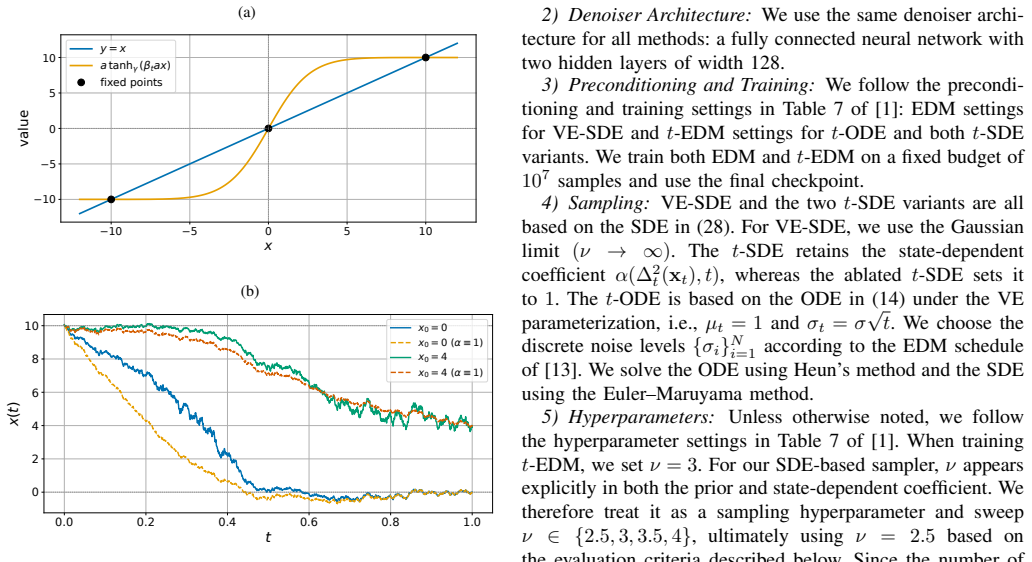
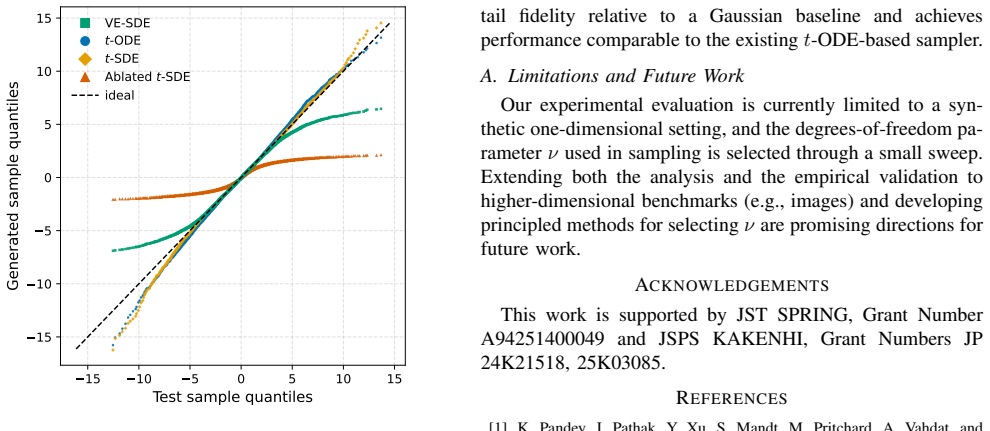
A state-dependent diffusion coefficient in SDE sampling for heavy-tailed diffusion models induces self-regulating annealing that is necessary to reproduce samples from heavy-tailed distributions.
A machine-rendered reading of the paper's core claim, the machinery that carries it, and where it could break.
Core claim
In heavy-tailed diffusion models that replace Gaussian noise with a Student's t-distribution, an SDE-based sampler that incorporates a state-dependent diffusion coefficient induces a self-regulating annealing mechanism by adaptively modulating the effective noise scale, and this mechanism is necessary for reproducing samples from a heavy-tailed distribution.
What carries the argument
State-dependent diffusion coefficient in the SDE sampler, which adaptively modulates the effective noise scale to produce self-regulating annealing.
If this is right
- SDE samplers that lack state dependence in the diffusion coefficient cannot accurately reproduce heavy-tailed target distributions even when the forward process uses Student's t noise.
- The induced self-regulating annealing automatically adjusts noise scale according to the current state without requiring an external schedule.
- Tail fidelity in generated samples improves once the state-dependent coefficient is included.
- The same mechanism explains why earlier SDE attempts on HTDMs fell short.
Where Pith is reading between the lines
- The same state-dependent construction could be tested on other non-Gaussian base distributions beyond Student's t.
- If the mechanism generalizes, manual annealing schedules might become unnecessary for a wider class of diffusion models.
- The sampler's behavior on real data with outliers, such as financial time series, would be a direct next measurement.
Load-bearing premise
The state dependence in the diffusion coefficient is the decisive factor that enables accurate reproduction of heavy-tailed distributions rather than other parts of the HTDM formulation or sampling procedure.
What would settle it
A controlled comparison on a known heavy-tailed target distribution in which the proposed sampler with state-dependent diffusion is run side-by-side with an otherwise identical sampler that uses a constant diffusion coefficient; failure of the constant-coefficient version to match the target tails would support the claim.
Figures
read the original abstract
Diffusion models have emerged as a leading framework for deep generative modeling. While the standard Gaussian formulation is theoretically convenient, its suitability for heavy-tailed datasets remains unclear. To address this, heavy-tailed diffusion models (HTDMs) extend the standard formulation by replacing the Gaussian distribution with a Student's t-distribution, thereby improving tail fidelity on heavy-tailed datasets. Although stochastic differential equation (SDE)-based sampling is possible in HTDMs, it has not been fully explored. In this paper, we propose an SDE-based sampler for HTDMs that explicitly incorporates a state-dependent diffusion coefficient. This state dependence naturally induces a self-regulating annealing mechanism by adaptively modulating the effective noise scale. We theoretically explore this mechanism and experimentally verify its necessity for reproducing samples from a heavy-tailed distribution.
Editorial analysis
A structured set of objections, weighed in public.
Referee Report
Summary. The paper proposes an SDE-based sampler for heavy-tailed diffusion models (HTDMs) that replaces the Gaussian with a Student's t-distribution and incorporates a state-dependent diffusion coefficient. This state dependence is claimed to induce a self-regulating annealing mechanism that adaptively modulates the effective noise scale. The authors theoretically explore the mechanism and experimentally verify that it is necessary for accurately reproducing samples from heavy-tailed distributions.
Significance. If the theoretical derivation of the self-regulating mechanism is rigorous and the experiments include proper controls isolating the state-dependent term from other HTDM choices, the result would be significant for extending diffusion models beyond light-tailed data, offering a principled adaptive annealing approach rather than hand-tuned schedules.
major comments (2)
- [Abstract / Experimental verification] Abstract and experimental section: The central necessity claim (that the state-dependent diffusion coefficient is required, not merely sufficient, for heavy-tailed fidelity) is load-bearing, yet the provided description supplies no information on the constant-diffusion SDE baseline run on the identical HTDM, other annealing schedules tested, or the specific quantitative tail metrics (kurtosis, extreme-value statistics, or tail-index estimates) used to declare failure of the non-state-dependent variant. Without these controls the necessity inference cannot be isolated from other modeling choices.
- [Theoretical exploration] Theoretical exploration section: The claim that the state dependence 'naturally induces' self-regulating annealing should be accompanied by an explicit derivation showing how the state-dependent term produces the adaptive noise modulation; if this reduces to a reparameterization of an existing schedule, the novelty of the mechanism requires clarification.
minor comments (2)
- [Method] Notation for the state-dependent diffusion coefficient should be introduced with a clear equation reference and distinguished from the standard constant-diffusion case.
- [Introduction] The abstract states that SDE sampling 'has not been fully explored' in HTDMs; a brief literature pointer to prior SDE work on non-Gaussian diffusions would help situate the contribution.
Simulated Author's Rebuttal
We thank the referee for their constructive comments, which highlight important areas for strengthening the claims in our manuscript. We address each major comment below and commit to revisions that provide the requested controls and derivations.
read point-by-point responses
-
Referee: [Abstract / Experimental verification] Abstract and experimental section: The central necessity claim (that the state-dependent diffusion coefficient is required, not merely sufficient, for heavy-tailed fidelity) is load-bearing, yet the provided description supplies no information on the constant-diffusion SDE baseline run on the identical HTDM, other annealing schedules tested, or the specific quantitative tail metrics (kurtosis, extreme-value statistics, or tail-index estimates) used to declare failure of the non-state-dependent variant. Without these controls the necessity inference cannot be isolated from other modeling choices.
Authors: We agree that the necessity claim requires stronger isolation from other modeling choices. In the revised manuscript we will add a constant-diffusion SDE baseline run on the identical HTDM, comparisons against alternative annealing schedules, and explicit reporting of quantitative tail metrics (kurtosis, extreme-value statistics, and tail-index estimates) to demonstrate where the non-state-dependent variant fails. revision: yes
-
Referee: [Theoretical exploration] Theoretical exploration section: The claim that the state dependence 'naturally induces' self-regulating annealing should be accompanied by an explicit derivation showing how the state-dependent term produces the adaptive noise modulation; if this reduces to a reparameterization of an existing schedule, the novelty of the mechanism requires clarification.
Authors: We will expand the theoretical section with an explicit, step-by-step derivation that starts from the SDE with state-dependent diffusion under the Student's t forward process and shows how the state dependence produces adaptive noise modulation. The derivation will also clarify why the resulting schedule is not equivalent to a simple reparameterization of existing annealing methods. revision: yes
Circularity Check
No significant circularity detected
full rationale
The provided abstract and claims introduce a new SDE sampler with state-dependent diffusion for HTDMs, assert that this induces self-regulating annealing, and state that the mechanism is theoretically explored and experimentally verified as necessary. No equations, derivations, or self-citations appear in the text that reduce any claimed result to its inputs by construction (e.g., no fitted parameter renamed as prediction, no self-definitional loop, no load-bearing self-citation of a uniqueness theorem). The central claims rest on asserted theoretical analysis and experiments rather than tautological re-labeling, making the derivation self-contained against the listed circularity patterns.
Axiom & Free-Parameter Ledger
axioms (1)
- domain assumption SDE-based sampling is feasible in HTDMs
invented entities (1)
-
self-regulating annealing mechanism
no independent evidence
Reference graph
Works this paper leans on
-
[1]
Heavy-tailed diffusion models,
K. Pandey, J. Pathak, Y . Xu, S. Mandt, M. Pritchard, A. Vahdat, and M. Mardani, “Heavy-tailed diffusion models,” arXiv:2410.14171, 2024, arXiv preprint
-
[2]
Deep unsupervised learning using nonequilibrium thermodynamics,
J. Sohl-Dickstein, E. Weiss, N. Maheswaranathan, and S. Ganguli, “Deep unsupervised learning using nonequilibrium thermodynamics,” in International conference on machine learning. pmlr, 2015, pp. 2256– 2265
2015
-
[3]
Diffusion models: A comprehensive survey of methods and applications,
L. Yang, Z. Zhang, Y . Song, S. Hong, R. Xu, Y . Zhao, W. Zhang, B. Cui, and M.-H. Yang, “Diffusion models: A comprehensive survey of methods and applications,”ACM computing surveys, vol. 56, no. 4, pp. 1–39, 2023
2023
-
[4]
Denoising diffusion probabilistic models,
J. Ho, A. Jain, and P. Abbeel, “Denoising diffusion probabilistic models,” Advances in neural information processing systems, vol. 33, pp. 6840– 6851, 2020
2020
-
[5]
Score-Based Generative Modeling through Stochastic Differential Equations
Y . Song, J. Sohl-Dickstein, D. P. Kingma, A. Kumar, S. Ermon, and B. Poole, “Score-based generative modeling through stochastic differ- ential equations,”arXiv preprint arXiv:2011.13456, 2020
work page internal anchor Pith review Pith/arXiv arXiv 2011
-
[6]
Score-based generative mod- els with l ´evy processes,
E. B. Yoon, K. Park, S. Kim, and S. Lim, “Score-based generative mod- els with l ´evy processes,”Advances in Neural Information Processing Systems, vol. 36, pp. 40 694–40 707, 2023
2023
-
[7]
L. Ambrogioni, “The statistical thermodynamics of generative diffusion models: Phase transitions, symmetry breaking and critical instability,” arXiv preprint arXiv:2310.17467, 2023
-
[8]
Spontaneous symmetry breaking in generative diffusion models,
G. Raya and L. Ambrogioni, “Spontaneous symmetry breaking in generative diffusion models,”Journal of Statistical Mechanics: Theory and Experiment, vol. 2024, no. 10, p. 104025, 2024
2024
-
[9]
In search of dispersed memories: Generative diffusion models are associative memory networks,
L. Ambrogioni, “In search of dispersed memories: Generative diffusion models are associative memory networks,”Entropy, vol. 26, no. 5, p. 381, 2024
2024
-
[10]
B. Hoover, H. Strobelt, D. Krotov, J. Hoffman, Z. Kira, and D. H. Chau, “Memory in plain sight: Surveying the uncanny resemblances of associa- tive memories and diffusion models,”arXiv preprint arXiv:2309.16750, 2023
-
[11]
Explo- sive neural networks via higher-order interactions in curved statistical manifolds,
M. Aguilera, P. A. Morales, F. E. Rosas, and H. Shimazaki, “Explo- sive neural networks via higher-order interactions in curved statistical manifolds,”Nature Communications, vol. 16, no. 1, p. 6511, 2025
2025
-
[12]
Understanding diffusion models: A unified perspective,
C. Luo, “Understanding diffusion models: A unified perspective,”arXiv preprint arXiv:2208.11970, 2022
-
[13]
Elucidating the design space of diffusion-based generative models,
T. Karras, M. Aittala, T. Aila, and S. Laine, “Elucidating the design space of diffusion-based generative models,”Advances in neural infor- mation processing systems, vol. 35, pp. 26 565–26 577, 2022
2022
-
[14]
On the conditional distribution of the multivariate t distribu- tion,
P. Ding, “On the conditional distribution of the multivariate t distribu- tion,”The American Statistician, vol. 70, no. 3, pp. 293–295, 2016
2016
-
[15]
Chapter 2 - pythagoras theorem in information geometry and applications to generalized linear models,
S. Eguchi, “Chapter 2 - pythagoras theorem in information geometry and applications to generalized linear models,” inInformation Geometry, ser. Handbook of Statistics, A. Plastino, A. S. R. S. Rao, and C. R. Rao, Eds. Elsevier, 2021, vol. 45, pp. 15–42. [Online]. Available: https://www.sciencedirect.com/science/article/pii/S0169716121000225
2021
-
[16]
t 3-variational autoencoder: Learning heavy-tailed data with student’s t and power divergence,
J. Kim, J. Kwon, M. Cho, H. Lee, and J.-H. Won, “t 3-variational autoencoder: Learning heavy-tailed data with student’s t and power divergence,”arXiv preprint arXiv:2312.01133, 2023
discussion (0)
Sign in with ORCID, Apple, or X to comment. Anyone can read and Pith papers without signing in.