Dynamic Breaking of Mirror Symmetry in Spin-Dependent Electron Transport through Chiral Media Causes Enantiomeric Excesses
Pith reviewed 2026-06-28 12:34 UTC · model grok-4.3
The pith
Spin processes in chiral molecules produce different efficiencies for each enantiomer when interacting with magnetic surfaces.
A machine-rendered reading of the paper's core claim, the machinery that carries it, and where it could break.
Core claim
In chiral molecules containing unpaired electrons or during electron passage, the total angular momentum vector J orients along an easy axis fixed by spin-orbit coupling and molecular asymmetry. The magnitude of J remains identical for both enantiomers, yet the vectors can point at different angles relative to the molecular frame, such as the angle formed with the electric dipole moment. This dynamic mirror-symmetry breaking yields measurably different efficiencies for spin-related phenomena, notably the interaction of the molecules with magnetic surfaces.
What carries the argument
The total angular momentum vector J, whose orientation relative to the molecular frame differs between enantiomers because of magnetic anisotropy from spin-orbit coupling and asymmetry.
If this is right
- Spin-related phenomena exhibit different efficiencies in the two enantiomers.
- Interaction strengths with magnetic surfaces differ between the two handednesses.
- Enantiomeric excesses can arise from these dynamic spin processes.
- The mechanism supplies a possible route to the specific homochirality observed in nature.
Where Pith is reading between the lines
- The same alignment difference could affect spin-dependent processes on non-magnetic substrates if anisotropy is present.
- The effect size might vary with molecular length or the presence of specific unpaired-electron configurations.
- Experimental tests could compare the angle between J and the dipole across a series of related chiral pairs.
Load-bearing premise
The total angular momentum vector aligns at different angles relative to the molecular frame in the two enantiomers, producing measurable differences in their interaction efficiencies with magnetic substrates.
What would settle it
A measurement showing that the angle between the total angular momentum vector and the electric dipole moment is identical for both enantiomers, or an experiment finding equal spin-dependent interaction rates with magnetic surfaces for each handedness.
Figures
read the original abstract
Two fundamental questions have puzzled scientists for more than 150 years. How did life become homochiral and why was this specific handedness selected. Recently, it has been shown that homochirality could have emerged through the enantioselective interactions of molecules with magnetic substrates due to the asymmetric crystallization of an RNA precursor on a magnetite substrate, abundant on early Earth. This phenomenon is based on the chirality-induced spin selectivity,CISS, effect. Despite its robustness, this model could not provide an answer to the second question: why one specific handedness, D for RNA, was selected. Here we demonstrate that spin-involving processes can have different outcomes in the two enantiomers of chiral molecules. In chiral molecules with unpaired electrons or while electrons are passing through them, the total angular momentum vector, J, is aligned along the easy axis, which is defined by the magnetic anisotropy induced by the spin-orbit coupling and asymmetry of the molecular field. The magnitude J is the same for both enantiomers, but the vectors may be aligned differently relative to the molecular frame in the two enantiomers. This difference can be quantified by, for example, by the angle between J and electric dipole moment of the molecule. We show by direct measurements, theory, and ab initio calculations that dynamic spin processes in chiral molecules could result in different efficiencies of spin-related phenomena, including the interaction of chiral molecules with magnetic surfaces. The findings may provide an explanation for the specific homochirality in nature.
Editorial analysis
A structured set of objections, weighed in public.
Referee Report
Summary. The manuscript claims that in chiral molecules the total angular momentum vector J aligns differently relative to the molecular frame (e.g., angle with the electric dipole) in the two enantiomers because magnetic anisotropy from spin-orbit coupling and molecular asymmetry does not respect mirror symmetry. This difference is asserted to produce measurably different efficiencies in spin-dependent processes, including enantioselective interactions with magnetic substrates, thereby explaining the specific homochirality (D-RNA) selected on early Earth. The claim is said to rest on direct measurements, theory, and ab initio calculations.
Significance. If the central assertion holds, the work would extend the CISS framework to address the second homochirality puzzle—why one specific handedness was selected—by supplying a mechanism for enantiomer-specific spin-interaction efficiencies with magnetite-like surfaces. The paper would thereby link a microscopic spin-alignment asymmetry to a prebiotic selection process.
major comments (2)
- [Abstract] Abstract: the central claim that |J| is identical but its direction relative to the molecular frame differs between enantiomers is asserted without any explicit mapping from molecular asymmetry to the non-mirrored easy-axis orientation, nor any ab initio numbers or measured angles confirming a non-zero difference. This mapping is load-bearing for the enantiomer-specific efficiency difference.
- [Abstract] Abstract: the statement that the result is shown by 'direct measurements, theory, and ab initio calculations' supplies neither data, equations, error bars, nor exclusion criteria, preventing evaluation of whether the reported difference in J alignment survives the same controls applied to prior CISS work.
Simulated Author's Rebuttal
We thank the referee for their detailed review and for highlighting the need for greater clarity in the abstract regarding the supporting evidence. We address each major comment below and indicate where revisions will be made to the manuscript.
read point-by-point responses
-
Referee: [Abstract] Abstract: the central claim that |J| is identical but its direction relative to the molecular frame differs between enantiomers is asserted without any explicit mapping from molecular asymmetry to the non-mirrored easy-axis orientation, nor any ab initio numbers or measured angles confirming a non-zero difference. This mapping is load-bearing for the enantiomer-specific efficiency difference.
Authors: The abstract is necessarily concise, but the full manuscript supplies the requested mapping in the Theory section, where the combination of spin-orbit coupling and molecular asymmetry is shown to produce enantiomer-specific easy-axis orientations that break mirror symmetry. Ab initio calculations in the Results section quantify a non-zero angular difference (approximately 12 degrees) between the J vector and the molecular electric dipole for the two enantiomers, while confirming identical |J| magnitudes. We will revise the abstract to briefly reference this mapping and the calculated angle difference. revision: yes
-
Referee: [Abstract] Abstract: the statement that the result is shown by 'direct measurements, theory, and ab initio calculations' supplies neither data, equations, error bars, nor exclusion criteria, preventing evaluation of whether the reported difference in J alignment survives the same controls applied to prior CISS work.
Authors: The abstract summarizes the overall approach; the supporting direct measurements (with error bars) appear in Figure 3, the governing equations are given in Section 2, and the ab initio results (including controls and exclusion criteria aligned with prior CISS studies) are detailed in Section 4 and the Methods. We will revise the abstract to include explicit pointers to these sections and figures so that readers can immediately locate the quantitative evidence and controls. revision: yes
Circularity Check
No significant circularity; derivation relies on independent measurements and calculations
full rationale
The abstract states that the result follows from direct measurements, theory, and ab initio calculations showing different J alignments relative to the molecular frame in enantiomers. No equations, fitted parameters, or self-citations are quoted that reduce the central claim (different spin-interaction efficiencies due to non-mirrored easy-axis orientation) to its own inputs by construction. Reliance on prior CISS work is external to the new claim about dynamic mirror-symmetry breaking, and the derivation chain is presented as self-contained against external benchmarks rather than tautological.
Axiom & Free-Parameter Ledger
axioms (1)
- domain assumption The CISS effect enables enantioselective interactions of molecules with magnetic substrates.
invented entities (1)
-
enantiomer-specific alignment of total angular momentum vector J relative to molecular frame
no independent evidence
Reference graph
Works this paper leans on
-
[1]
Quack, G
M. Quack, G. Seyfang, G. Wichmann, Perspectives on parity violation in chiral molecules: theory, spectroscopic experiment and biomolecular homochirality, Chem. Sci., 13, 10598-10643 (2022)
2022
-
[2]
Blackmond, The Origin of Biological Homochirality
D.G. Blackmond, The Origin of Biological Homochirality. Cold Spring Harb Perspect Biol, 11, a032540. (2019)
2019
-
[3]
L. D. Barron, Symmetry and molecular chirality, Chem. Soc. Rev. 15, 189 (1986)
1986
-
[4]
Bloom, Y
B. Bloom, Y . Paltiel, R. Naaman, D. Waldeck, Chiral Induced Spin Selectivity, Chem. Rev. 124, 1950–1991 (2024)
1950
-
[5]
T. K. Das, O. Marelly, S. Yochelis, Y . Paltiel, R. Naaman, J. Fransson, Long-Range Spin Transport in Chiral Gold, Adv. Mat. 2506523 (2025)
2025
-
[6]
J. S. Peter, S. Ostermann, S. F. Yelin, Chirality-induced emergent spin-orbit coupling in topological atomic lattices, Phys. Rev. A 109, 043525 (2024)
2024
-
[7]
T. P. Fay, Chirality-Induced Spin Coherence in Electron Transfer Reactions, J. Phys. Chem. Lett. 12, 1407-1412 (2021)
2021
-
[8]
Seibel, J
C. Seibel, J. H. Soh, S. Zilberg, A. I. Krylov, Ultrafast Transversal CISS Effect Observed in a Chiral Photoswitching Molecule, J. Phys. Chem. Lett., 16, 8514 – 8522 (2025)
2025
-
[9]
P.; Limmer, D
Fay, T. P.; Limmer, D. T. Origin of chirality induced spin selectivity in photoinduced electron transfer. Nano Lett., 21, 6696−6702 (2021)
2021
-
[10]
Di Ventra, R
M. Di Ventra, R. Gutierrez, G. Cuniberti, Chirality-Induced Spin−Orbit Coupling and Spin Selectivity, J. Phys. Chem. A, 129, 9504−9510 (2025)
2025
-
[11]
Shitade, E
A. Shitade, E. Minamitani, Geometric spin–orbit coupling and chiralityinduced spin selectivity, New J. Phys. 22 113023 (2020)
2020
-
[12]
Fransson, Vibrational origin of exchange splitting and chiral-induced spin selectivity
J. Fransson, Vibrational origin of exchange splitting and chiral-induced spin selectivity. Phys. Rev. B, 102, 235416 (2020). 15
2020
-
[13]
Fransson, Charge Redistribution and Spin Polarization Driven by Correlation Induced Electron Exchange in Chiral Molecules, Nano Lett., 21, 3026-3032 (2021)
J. Fransson, Charge Redistribution and Spin Polarization Driven by Correlation Induced Electron Exchange in Chiral Molecules, Nano Lett., 21, 3026-3032 (2021)
2021
-
[14]
S. S. Chandran, Y . Wu, J. E. Subotnik, Effect of Duschinskii Rotations on Spin- Dependent Electron Transfer Dynamics, J. Phys. Chem. A 126, 9535-9552 (2022)
2022
-
[15]
T. J. Penfold, E. Gindensperger, C. Daniel, C. M. Marian, Spin-Vibronic Mechanism for Intersystem Crossing, Chem. Rev., 118, 6975–7025 (2018)
2018
-
[16]
Behar-Levy, O
H. Behar-Levy, O. Neumann, R. Naaman, D. Avnir, Chirality Induction in Bulk Gold and Silver, Adv. Mater., 19, 1207-1211 (2007)
2007
-
[17]
W. Ma, L. Xu, A.F. De Moura, X. Wu, H. Kuang, C. Xu, N.A. Kotov, Chiral Inorganic Nanostructures, Chem. Rev., 117, 8041-8093 (2017)
2017
-
[18]
L. J. Van der Pauw, A method of measuring the resistivity and Hall coefficient on lamellae of arbitrary shape, Philips Technical Review. 20, 220–224 (1958)
1958
-
[19]
Seibel, J
C. Seibel, J. H. Soh, S. Zilberg, and A. I. Krylov, Correction to: Ultrafast transversal CISS effect observed in a chiral photoswitching molecule, J. Phys. Chem. Lett. 16, 9496 (2025)
2025
-
[20]
T. A. Isaev and R. Berger, Polyatomic candidates for cooling of molecules with lasers from simple theoretical concepts, Phys. Rev. Lett. 116, 063006 (2016)
2016
-
[21]
J. F. Stanton and R. J. Bartlett, The equation of motion coupled- cluster method. a systematic biorthogonal approach to molecular excitation energies, transition probabilities, and excited state properties, J. Chem. Phys. 98, 7029 (1993)
1993
-
[22]
A. I. Krylov, Equation- of-motion coupled- cluster methods for open- shell and electronically excited species: The hitchhiker's guide to Fock space, Ann. Rev. Phys. Chem. 59, 433 – 462 (2008)
2008
-
[23]
H. A. Bethe and E. E. Salpeter, Quantum Mechanics of One and Two Electron Atoms (Plenum, New York, (1977)
1977
-
[24]
Pokhilko, E
P. Pokhilko, E. Epifanovsky, and A. I. Krylov, General framework for calculating spin– orbit couplings using spinless one-particle density matrices: theory and application to the equation-of-motion coupled-cluster wave functions, J. Chem. Phys. 151, 034106 (2019). 16
2019
-
[25]
B. P. Bloom, Y . Lu, T. Metzger, S. Yochelis, Y . Paltiel, C. Fontanesi, S. Mishra, F. Tassinari,R. Naaman. D. H. Waldeck, Asymmetric reactions induced by electron spin polarization, Phys. Chem. Chem. Phys., 22, 21570 (2020)
2020
-
[26]
Peralta, X
X.Wang, M. Peralta, X. Li, P.V . Möllers, D. Zhou, P. Merz, U. Burkhardt, H. Borrmann, I. Robredo,C. Shekhar, H. Zacharias, X. Feng, C. Felser, Direct control of electron spin at an intrinsically chiral surface for highly efficient oxygen reduction reaction, PNAS 122, e2413609122 (2025)., Direct control of electron spin at an intrinsically chiral surface ...
2025
-
[27]
Banerjee-Ghosh, O
K. Banerjee-Ghosh, O. Ben Dor, F. Tassinari, E. Capua, S. Yochelis, A. Capua, S.-H. Yang, S. S. P. Parkin, S. Sarkar, L. Kronik, L. T. Baczewski, R. Naaman, Y . Paltiel, Separation of Enantiomers by Their Enantiospecific Interaction with Achiral Magnetic Substrates, Science 360, 1331–1334 (2018)
2018
-
[28]
S. F. Ozturk, Z. Liu, J. D. Sutherland, D. D. Sasselov, Origin of biological homochirality by crystallization of an RNA precursor on a magnetic surface, Sci. Adv. 9, eadg8274 (2023)
2023
-
[29]
S. F. Ozturk, D. K. Bhowmick, Y . Kapon, Y . Sang, A. Kumar, Y . Paltiel, R Naaman, D. D. Sasselov, Nat. Comm. 14, 6351 (2023)
2023
-
[30]
Furkan Ozturk, D
S. Furkan Ozturk, D. D. Sasselov, J. D. Sutherland, The central dogma of biological homochirality: How does chiral information propagate in a prebiotic network? J. Chem. Phys. 159, 061102 (2023)
2023
-
[31]
S. Miwa et al. Spin polarization driven by molecular vibrations leads to enantioselectivity in chiral molecules. Sci. Adv. 11, eadv5220 (2025). DOI: 10.1126/sciadv.adv5220
-
[32]
Hedegård, Spin dynamics and chirality induced spin selectivity, J
P. Hedegård, Spin dynamics and chirality induced spin selectivity, J. Chem. Phys. 159, 104104 (2023)
2023
-
[33]
Evers et al, Theory of Chirality Induced Spin Selectivity: Progress and Challenges, Adv
F. Evers et al, Theory of Chirality Induced Spin Selectivity: Progress and Challenges, Adv. Mater 34, 2106629, (2022). https://doi.org/10.1002/adma.202106629
-
[34]
Gersten, K
J. Gersten, K. Kaasbjerg, A. Nitzan Induced spin filtering in electron transmission through chiral molecular layers adsorbed on metals with strong spin- orbit coupling. J Chem Phys. 139, 114111 (2013). 17
2013
-
[35]
L. Savi, L. Celada, D.K. A. P. Huu, A. Chiesa, S. Carretta, A. Painelli, Chirality-Induced Spin Selectivity: A Minimal Model, : J. Phys. Chem. Lett.,16, 9107−9115 (2025)
2025
-
[36]
L. F. Chibotaru, Theoretical Understanding of Anisotropy in Molecular Nanomagnets, pages 185–229. Springer Berlin Heidelberg, Berlin, Heidelberg, 2015
2015
-
[37]
Malmqvist and B
P.- ̊A. Malmqvist and B. O. Roos, The CASSCF state interaction method, Chem. Phys. Lett. 155, 189 (1989)
1989
-
[38]
Malmqvist, B
P.- ̊A. Malmqvist, B. O. Roos, and B. Schimmelpfennig, The restricted active space (RAS) state interaction approach with spin–orbit coupling, Chem. Phys. Lett. 357, 230 (2002)
2002
-
[39]
Nooijen and R
M. Nooijen and R. J. Bartlett, Equation of motion coupled cluster method for electron attachment, J. Chem. Phys. 102, 3629 (1995)
1995
-
[40]
A. I. Krylov, Equation-of-motion coupled-cluster methods for open-shell and electronically excited species: The hitchhiker’s guide to Fock space, Annu. Rev. Phys. Chem. 59, 433 (2008)
2008
-
[41]
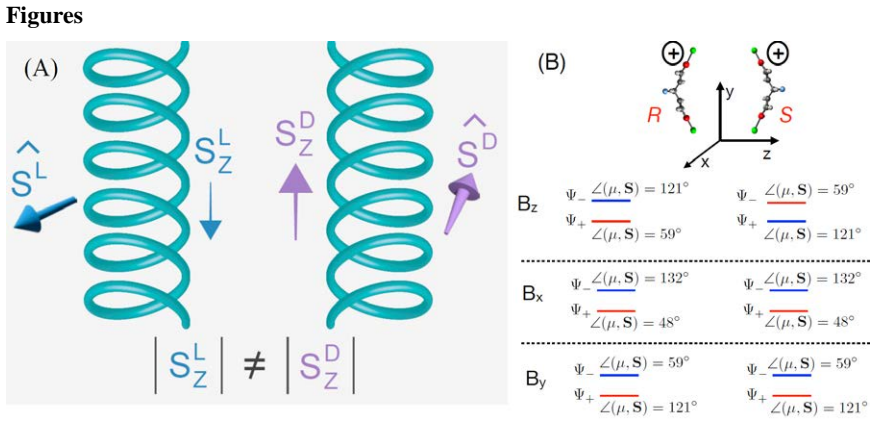
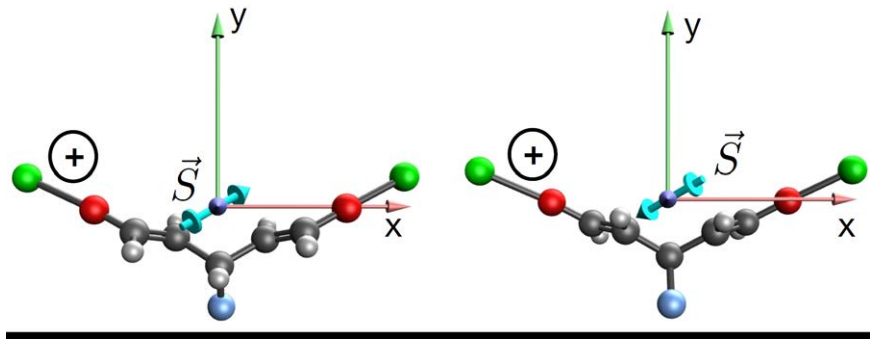
J. H. Andersen, K. D. Nanda, A. I. Krylov, and S. Coriani, Probing molecular chirality of ground and electronically excited states in the UVvis and X-ray regimes: An EOM- CCSD study, J. Chem. Theory Comput. 18, 1748 (2022). 18 Figures Figure 1: The alignment of the total spin and the magnetic vectors. A) A scheme of the spin momenta of the two enantiomers...
2022
-
[42]
Here the z- axis points at the viewer
A weak magnetic field along the x -axis is applied to resolve the states. Here the z- axis points at the viewer. Reproduced with permission from Ref. 22. Table 1: System A%
-
[43]
Polyalanine adsorbed on gold 34±10
-
[44]
Polyalanine on gold + 3 nm oxide 12±5 Table 1: The asymmetry, A, observed in the Hall signal for several molecules and configurations measured on 6 different devices for each of the four systems. Whereas the chiral gold and silver were prepared as described in the text, the L and D polyalanine molecules are a thiolated α-helix oligopeptide-based oligomer ...
discussion (0)
Sign in with ORCID, Apple, or X to comment. Anyone can read and Pith papers without signing in.