Control of protein activity by photoinduced spin polarized charge reorganization
Pith reviewed 2026-06-28 12:31 UTC · model grok-4.3
The pith
Photoinduced spin-polarized charge reorganization suppresses enzymatic activity of PGK by up to a factor of three.
A machine-rendered reading of the paper's core claim, the machinery that carries it, and where it could break.
Core claim
Illumination with left but not right circularly polarized light suppresses the enzymatic activity of PGK by a factor as large as three and increases antibody binding twofold when charge is injected from a site-specifically attached ruthenium photosensitizer. The responses are sensitive to the photosensitizer position on the protein. This indicates that the electrons involved are spin polarized due to spin filtration by protein chiral structures, directly establishing the contribution of electrical polarization as an allosteric signal within proteins.
What carries the argument
Site-specific phototriggered charge injection from a ruthenium photosensitizer combined with circular-polarization selectivity that reveals spin filtration by the protein's chiral structure.
Load-bearing premise
The observed activity changes and left-circular polarization selectivity arise specifically from spin-polarized charge reorganization rather than heating, direct photochemical damage, or attachment artifacts.
What would settle it
Equivalent activity suppression under right-circularly polarized light or in an achiral protein mutant would falsify the spin-filtration interpretation.
Figures
read the original abstract
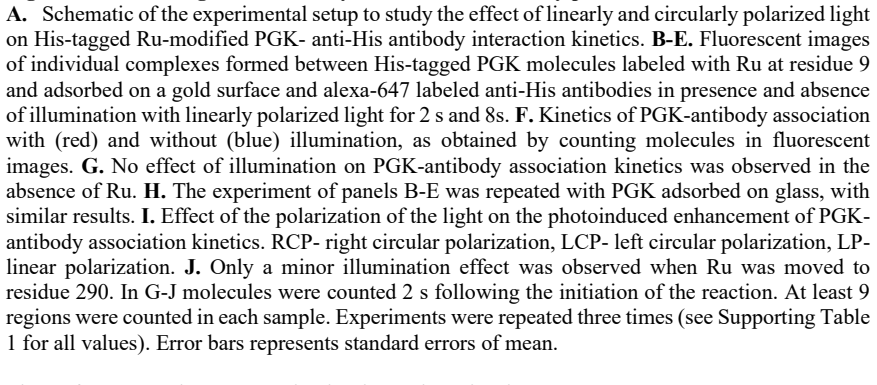
Considerable electric fields are present within living cells, and the role of bioelectricity has been well established at the organismal level. Yet little is known about electric-field effects on protein function. Here we use phototriggered charge injection from a site-specifically attached ruthenium photosensitizer to directly demonstrate the effects of charge redistribution within a protein. We find that binding of an antibody to phosphoglycerate kinase (PGK) is increased two folds under illumination. Remarkably, illumination is found to suppress the enzymatic activity of PGK by a factor as large as three. These responses are sensitive to the photosensitizer position on the protein. Surprisingly, left (but not right) circularly polarized light elicits these responses, indicating that the electrons involved in the observed dynamics are spin polarized, due to spin filtration by protein chiral structures. Our results directly establish the contribution of electrical polarization as an allosteric signal within proteins. Future experiments with phototriggered charge injection will allow delineation of charge rearrangement pathways within proteins and will further depict their effects on protein function.
Editorial analysis
A structured set of objections, weighed in public.
Referee Report
Summary. The paper claims that site-specific attachment of a ruthenium photosensitizer to phosphoglycerate kinase (PGK) enables phototriggered charge injection, resulting in a two-fold increase in antibody binding and up to three-fold suppression of enzymatic activity under illumination. These effects depend on the attachment position and are selective for left (but not right) circularly polarized light, which the authors attribute to spin-polarized electrons arising from chirality-induced spin filtration; the work concludes that this establishes electrical polarization as an allosteric signal in proteins.
Significance. If the central observations are robustly supported by data and controls, the approach of using phototriggered charge injection to modulate protein function could provide a valuable tool for probing bioelectric effects and allosteric mechanisms. The reported polarization selectivity would, if confirmed, add to evidence for CISS in proteins, with potential implications for understanding charge reorganization pathways.
major comments (2)
- [Abstract] Abstract: the quantitative claims of a two-fold binding increase and up to three-fold activity suppression are stated without reference to supporting figures, tables, error bars, replicate numbers, or statistical tests, preventing assessment of whether the reported magnitudes are load-bearing for the allosteric interpretation.
- [Abstract] Abstract and results sections: the attribution of effects specifically to spin-polarized charge reorganization propagating as an allosteric electrical signal assumes that L-CPL selectivity and position dependence exclude photochemical, thermal, or attachment-induced artifacts; however, no direct measurements of internal charge redistribution (e.g., via Stark shifts) or spin character are described to secure this mechanism over local alternatives.
minor comments (1)
- [Abstract] The abstract refers to 'future experiments' but does not clarify whether the current manuscript already includes the full dataset or methods needed to support the claims.
Simulated Author's Rebuttal
We thank the referee for their constructive comments, which help clarify the presentation of our quantitative results and the strength of our mechanistic claims. We address each major comment point by point below.
read point-by-point responses
-
Referee: [Abstract] Abstract: the quantitative claims of a two-fold binding increase and up to three-fold activity suppression are stated without reference to supporting figures, tables, error bars, replicate numbers, or statistical tests, preventing assessment of whether the reported magnitudes are load-bearing for the allosteric interpretation.
Authors: We agree that the abstract would benefit from clearer linkage to the underlying data. In the revised manuscript we will add explicit references to the relevant figures and tables within the abstract text and will ensure the results section fully reports error bars, replicate numbers, and statistical tests for the reported fold changes. This addresses the concern directly while preserving the abstract's brevity. revision: yes
-
Referee: [Abstract] Abstract and results sections: the attribution of effects specifically to spin-polarized charge reorganization propagating as an allosteric electrical signal assumes that L-CPL selectivity and position dependence exclude photochemical, thermal, or attachment-induced artifacts; however, no direct measurements of internal charge redistribution (e.g., via Stark shifts) or spin character are described to secure this mechanism over local alternatives.
Authors: The position dependence and strict selectivity for left (but not right) circularly polarized light constitute built-in controls that are difficult to reconcile with non-specific photochemical, thermal, or attachment artifacts, which lack such chirality and site specificity. While this work does not include direct spectroscopic measurements of internal charge redistribution or spin character, the functional readouts (antibody binding and enzymatic activity) tied to these controls support the interpretation of spin-polarized charge reorganization as an allosteric signal. In revision we will expand the discussion to explicitly compare the controls against plausible local alternatives and to note the interpretive nature of the mechanism. revision: partial
Circularity Check
No circularity: experimental observations with no derivation chain
full rationale
This is an experimental paper reporting direct measurements of illumination effects on PGK enzymatic activity and antibody binding, including position sensitivity and left-circularly polarized light selectivity. No equations, fitted parameters, or mathematical derivations are present that could reduce any claim to its own inputs by construction. The central results are empirical outcomes from assays, not predictions derived from self-citations or ansatzes. Self-citations to prior CISS work (if present) serve as background context rather than load-bearing justification for the reported data. The paper is self-contained as an experimental report against external benchmarks.
Axiom & Free-Parameter Ledger
axioms (2)
- domain assumption Protein chiral structures filter electron spins during charge transport
- domain assumption Charge redistribution within the protein directly modulates binding and enzymatic activity
Reference graph
Works this paper leans on
-
[1]
J. M. Kralj, D. R. Hochbaum, A. D. Douglass, A. E. Cohen, Electrical Spiking in Escherichia coli Probed with a Fluorescent Voltage-Indicating Protein. Science 333, 345-348 (2011)
2011
-
[2]
Levin, C
M. Levin, C. J. Martyniuk, The bioelectric code: An ancient computational medium for dynamic control of growth and form. Biosystems 164, 76-93 (2018)
2018
-
[3]
Warshel, J
A. Warshel, J. Aqvist, Electrostatic energy and macromolecular function. Annu Rev Biophys Biophys Chem 20, 267-298 (1991)
1991
-
[4]
Schreiber, G
G. Schreiber, G. Haran, H. X. Zhou, Fundamental Aspects of Protein -Protein Association Kinetics. Chem. Rev. 109, 839-860 (2009)
2009
-
[5]
S. C. Kamerlin, A. Warshel, At the dawn of the 21st century: Is dynamics the missing link for understanding enzyme catalysis? Proteins 78, 1339-1375 (2010)
2010
-
[6]
S. D. Fried, S. G. Boxer, Electric Fields and Enzyme Catalysis. Annu Rev Biochem 86, 387- 415 (2017)
2017
-
[7]
M. Lund, B. Jonsson, Charge regulation in biomolecular solution. Q Rev Biophys 46, 265- 281 (2013)
2013
-
[8]
T. Sato, J. Ohnuki, M. Takano, Long -range coupling between ATP -binding and lever-arm regions in myosin via dielectric allostery. J Chem Phys 147, 215101 (2017)
2017
-
[9]
T. Sato, J. Ohnuki, M. Takano, Dielectric Allostery of Protein: Response of Myosin to ATP Binding. J Phys Chem B 120, 13047-13055 (2016)
2016
-
[10]
Ghosh, K
S. Ghosh, K. Banerjee-Ghosh, D. Levy, I. Riven, R. Naaman, G. Haran, Substrates Modulate Charge-Reorganization Allosteric Effects in Protein-Protein Association. J Phys Chem Lett 12, 2805-2808 (2021)
2021
-
[11]
Banerjee-Ghosh, S
K. Banerjee-Ghosh, S. Ghosh, H. Mazal, I. Riven, G. Haran, R. Naaman, Long-Range Charge Reorganization as an Allosteric Control Signal in Proteins. J Am Chem Soc 142, 20456- 20462 (2020)
2020
-
[12]
Naaman, Y
R. Naaman, Y. Paltiel, D. H. Waldeck, Chiral molecules and the electron spin. Nat Rev Chem 3, 250-260 (2019)
2019
-
[13]
M. E. Ener, H. B. Gray, J. R. Winkler, Hole Hopping through Tryptophan in Cytochrome P450. Biochemistry 56, 3531-3538 (2017)
2017
-
[14]
Y. Sang, S. Mishra, F. Tassinari, S. K. Karuppannan, R. Carmieli, R. D. Teo, A. Migliore, D. N. Beratan, H. B. Gray, I. Pecht, J. Fransson, D. H. Waldeck, R. Naaman, Temperature Dependence of Charge and Spin Transfer in Azurin. J Phys Chem C Nanomater Interfaces 125, 9875-9883 (2021)
2021
-
[15]
Mishra, S
S. Mishra, S. Pirbadian, A. K. Mondal, M. Y. El -Naggar, R. Naaman, Spin -Dependent Electron Transport through Bacterial Cell Surface Multiheme Electron Conduits. J Am Chem Soc 141, 19198-19202 (2019)
2019
-
[16]
N. A. Cherepkov, Spin Polarization of Atomic and Molecular Photo-Electrons. Advances in Atomic and Molecular Physics 19, 395-447 (1983)
1983
-
[17]
G. K. Reddy, V. F. Wendisch, Characterization of 3 -phosphoglycerate kinase from Corynebacterium glutamicum and its impact on amino acid production. BMC Microbiol 14, 54 (2014)
2014
-
[18]
Mishra, A
S. Mishra, A. K. Mondal, S. Pal, T. K. Das, E. Z. B. Smolinsky, G. Siligardi, R. Naaman, Length- Dependent Electron Spin Polarization in Oligopeptides and DNA. The Journal of Physical Chemistry C 124, 10776-10782 (2020). 13
2020
-
[19]
J. A. Lemkul, J. Huang, B. Roux, A. D. MacKerell, Jr., An Empirical Polarizable Force Field Based on the Classical Drude Oscillator Model: Development History and Recent Applications. Chem Rev 116, 4983-5013 (2016)
2016
-
[20]
S. D. Fried, S. Bagchi, S. G. Boxer, Extreme electric fields power catalysis in the active site of ketosteroid isomerase. Science 346, 1510-1514 (2014)
2014
-
[21]
J. Lee, M. Natarajan, V. C. Nashine, M. Socolich, T. Vo, W. P. Russ, S. J. Benkovic, R. Ranganathan, Surface sites for engineering allosteric control in proteins. Science 322, 438- 442 (2008)
2008
-
[22]
Seong, M
J. Seong, M. Z. Lin, Optobiochemistry: Genetically Encoded Control of Protein Activity by Light. Annu Rev Biochem 90, 475-501 (2021)
2021
-
[23]
Henriques, M
R. Henriques, M. Lelek, E. F. Fornasiero, F. Valtorta, C. Zimmer, M. M. Mhlanga, QuickPALM: 3D real -time photoactivation nanoscopy image processing in ImageJ. Nat Methods 7, 339-340 (2010)
2010
-
[24]
Boukobza, A
E. Boukobza, A. Sonnenfeld, G. Haran, Immobilization in Surface -Tethered Lipid Vesicles as a New Tool for Single Biomolecule Spectroscopy. The Journal of Physical Chemistry B 105, 12165-12170 (2001). Figure Legends Figure 1: A. Structure of Phosphoglycerate kinase (3PGK): Red line represents the 6-histidine tag at the C terminus of the protein. The locat...
2001
discussion (0)
Sign in with ORCID, Apple, or X to comment. Anyone can read and Pith papers without signing in.