Quality-Guided Semi-Supervised Learning for Medical Image Segmentation
Pith reviewed 2026-06-28 15:42 UTC · model grok-4.3
The pith
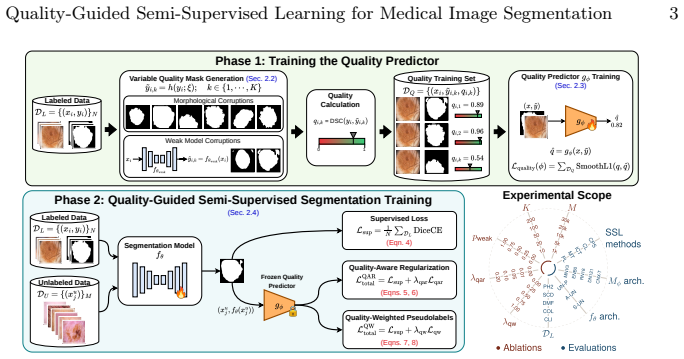
A quality predictor trained on corrupted and partial masks improves semi-supervised medical image segmentation when used for regularization and pseudolabel reweighting.
A machine-rendered reading of the paper's core claim, the machinery that carries it, and where it could break.
Core claim
The paper claims that a dedicated quality estimation network, trained on image-mask pairs whose masks come from synthetic corruptions and from checkpoints of incompletely trained segmenters, can be inserted into any existing semi-supervised segmentation pipeline through a quality-regularized loss and quality-weighted pseudolabel selection, producing higher accuracy than confidence-based or uncertainty-based SSL baselines on multiple medical datasets.
What carries the argument
The quality predictor network that maps an image and its candidate mask to a scalar quality score, trained on variable-quality masks generated by synthetic corruptions plus partial-model outputs.
If this is right
- The quality-guided components act as a drop-in addition to existing SSL frameworks without altering their core training loop.
- Performance gains appear consistently across five different medical image datasets.
- The same quality predictor works with several different segmentation network architectures.
- The approach raises accuracy beyond competing SSL methods that rely only on model confidence or uncertainty.
Where Pith is reading between the lines
- The same quality-prediction idea could be tested in semi-supervised tasks outside medical imaging, such as natural scene segmentation or object detection.
- If the quality scores prove reliable early in training, the method might allow SSL to succeed with even smaller labeled sets than currently demonstrated.
- The quality predictor itself could be used to decide which unlabeled examples deserve human annotation, turning the framework toward active learning.
Load-bearing premise
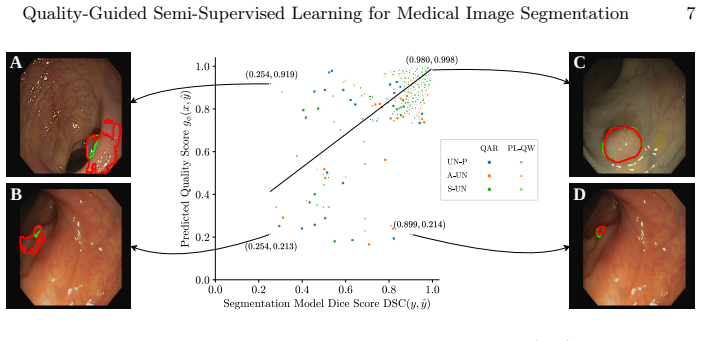
Masks created by synthetic corruptions and by partially trained models produce error patterns that are representative enough for the quality predictor to judge real masks generated during SSL training.
What would settle it
An experiment in which the quality predictor's scores show low or negative correlation with actual segmentation metrics such as Dice on held-out labeled data, or in which adding the quality guidance produces no accuracy gain over the unmodified SSL baseline.
Figures
read the original abstract
Training accurate medical image segmentation models requires large amounts of densely annotated data, which is costly and time-consuming to obtain. Semi-supervised learning (SSL) alleviates this by learning from both abundant unlabeled data and limited labeled data. However, most modern SSL methods rely on pseudolabels for unlabeled data, and typically assess their reliability through model confidence or uncertainty, measures that are self-referential and lack explicit grounding in segmentation quality. Instead, we propose a quality-guided SSL framework that trains a dedicated network to estimate segmentation quality from image-mask pairs. The predictor is trained on variable-quality masks generated through synthetic corruptions augmented with imperfect outputs from partially trained segmentation models, capturing realistic error patterns encountered during training. We integrate the quality predictor into SSL through two complementary mechanisms: a quality-aware regularization loss and a quality-based pseudolabel sample reweighting scheme. We show that our method serves as a drop-in enhancement to existing SSL frameworks. Extensive experiments across five datasets and multiple architectures demonstrate consistent improvements over competing SSL methods, advancing the state-of-the-art in semi-supervised medical image segmentation.
Editorial analysis
A structured set of objections, weighed in public.
Referee Report
Summary. The paper proposes a quality-guided SSL framework for medical image segmentation. A dedicated quality predictor network is trained on variable-quality masks created via synthetic corruptions plus outputs from partially trained segmentation models. This predictor is integrated into existing SSL methods through a quality-aware regularization loss and quality-based pseudolabel reweighting. The method is presented as a drop-in enhancement, with experiments across five datasets and multiple architectures showing consistent gains over competing SSL approaches.
Significance. If the quality estimates prove reliable on actual SSL pseudolabels, the approach offers an explicit, non-self-referential alternative to confidence- or uncertainty-based weighting, which could improve robustness in annotation-scarce medical imaging. The multi-dataset, multi-architecture evaluation and drop-in design are positive features that would support broader adoption if the core assumption holds.
major comments (2)
- [Methods (quality predictor training subsection)] The central claim that the quality predictor produces scores that meaningfully reflect true segmentation quality during SSL training rests on the training data construction (synthetic corruptions + partial-model outputs). No direct validation is provided that the resulting error patterns, spatial distributions, or severity match those of pseudolabels generated in the full SSL loop; without such a calibration or distribution-comparison experiment, gains cannot be confidently attributed to the proposed guidance mechanisms rather than incidental regularization effects.
- [Experiments and results] In the experimental results, consistent improvements are reported over baselines, but the paper does not include an ablation isolating the contribution of the quality predictor's accuracy (e.g., by replacing it with random or oracle scores) or statistical significance tests across the five datasets. This leaves open whether the reported SOTA advances are load-bearing on the quality estimates or on other implementation details.
minor comments (2)
- [Method] Notation for the quality score q and its integration into the loss (e.g., the exact form of the quality-aware regularization term) should be defined with an equation number for clarity.
- [Experiments] Figure captions for the qualitative results should explicitly state the dataset, architecture, and labeled-data ratio used in each panel to aid reproducibility.
Simulated Author's Rebuttal
We thank the referee for the detailed and constructive feedback. We address each major comment below, agreeing where the manuscript can be strengthened through revisions.
read point-by-point responses
-
Referee: [Methods (quality predictor training subsection)] The central claim that the quality predictor produces scores that meaningfully reflect true segmentation quality during SSL training rests on the training data construction (synthetic corruptions + partial-model outputs). No direct validation is provided that the resulting error patterns, spatial distributions, or severity match those of pseudolabels generated in the full SSL loop; without such a calibration or distribution-comparison experiment, gains cannot be confidently attributed to the proposed guidance mechanisms rather than incidental regularization effects.
Authors: We acknowledge that an explicit comparison of error patterns (types, spatial distributions, and severity) between the quality predictor's training data and actual pseudolabels from the SSL training loop would provide stronger support for the claim. Our construction using synthetic corruptions and partial-model outputs is intended to capture common segmentation error modes, but we agree a direct calibration experiment would reduce ambiguity regarding attribution of gains. In the revised manuscript, we will add such an analysis, including quantitative and qualitative comparisons of error distributions. revision: yes
-
Referee: [Experiments and results] In the experimental results, consistent improvements are reported over baselines, but the paper does not include an ablation isolating the contribution of the quality predictor's accuracy (e.g., by replacing it with random or oracle scores) or statistical significance tests across the five datasets. This leaves open whether the reported SOTA advances are load-bearing on the quality estimates or on other implementation details.
Authors: We agree that an ablation study replacing the quality predictor with random scores (or an oracle) would more clearly isolate its contribution, and that statistical significance testing across datasets would strengthen the empirical claims. These elements were not included in the original submission. In the revised manuscript, we will add the requested ablations and report statistical significance (e.g., paired t-tests or Wilcoxon tests with p-values) for the main results. revision: yes
Circularity Check
No circularity; quality predictor trained independently
full rationale
The paper trains a dedicated quality network on masks generated via synthetic corruptions plus outputs from partially trained models, then integrates the resulting scores into existing SSL frameworks via a regularization loss and reweighting. This training occurs prior to and independently of the target SSL loop. Central claims rest on empirical results across five datasets and multiple architectures rather than any definitional loop, fitted parameter renamed as prediction, or load-bearing self-citation. No equations or steps reduce the claimed improvements to the inputs by construction.
Axiom & Free-Parameter Ledger
free parameters (1)
- Quality loss weight
axioms (1)
- domain assumption Synthetic corruptions and partial model outputs produce error patterns representative of those during actual training.
invented entities (1)
-
Dedicated quality predictor network
no independent evidence
Reference graph
Works this paper leans on
-
[1]
Arti- ficial intelligence review54(1), 137–178 (Jun 2021).https://doi.org/10.1007/ s10462-020-09854-1
Asgari Taghanaki, S., Abhishek, K., Cohen, J.P., Cohen-Adad, J., Hamarneh, G.: Deep semantic segmentation of natural and medical images: a review. Arti- ficial intelligence review54(1), 137–178 (Jun 2021).https://doi.org/10.1007/ s10462-020-09854-1
2021
-
[2]
Ballerini, L., Fisher, R.B., Aldridge, B., Rees, J.: A Color and Texture Based Hier- archical K-NN Approach to the Classification of Non-melanoma Skin Lesions. In: Celebi, M.E., Schaefer, G. (eds.) Color Medical Image Analysis. vol. 6, pp. 63–86. Springer Netherlands (2013).https://doi.org/10.1007/978-94-007-5389-1_4
-
[3]
Bernal, J., Sánchez, F.J., Fernández-Esparrach, G., Gil, D., Rodríguez, C., Vilar- iño, F.: Wm-dova maps for accurate polyp highlighting in colonoscopy: Validation vs. saliency maps from physicians. Computerized Medical Imaging and Graphics 43, 99–111 (Jul 2015).https://doi.org/10.1016/j.compmedimag.2015.02.007
-
[4]
Bernal, J., Sánchez, J., Vilarino, F.: Towards automatic polyp detection with a polypappearancemodel.PatternRecognition45(9),3166–3182(Sep2012).https: //doi.org/10.1016/j.patcog.2012.03.002 10 K. Abhishek et al
-
[5]
In: Statistical Atlases and Computational Models of the Heart
Byrne, N., Clough, J.R., Montana, G., King, A.P.: A persistent homology-based topological loss function for multi-class CNN segmentation of cardiac MRI. In: Statistical Atlases and Computational Models of the Heart. M&Ms and EMIDEC Challenges. p. 3–13. Springer International Publishing (2021).https://doi.org/ 10.1007/978-3-030-68107-4_1
-
[6]
In: European Conference on Computer Vision
Cao, H., Wang, Y., Chen, J., Jiang, D., Zhang, X., Tian, Q., Wang, M.: Swin- Unet: Unet-like pure transformer for medical image segmentation. In: European Conference on Computer Vision. pp. 205–218. Springer (2022).https://doi.org/ 10.1007/978-3-031-25066-8_9
-
[7]
Nobile, Paolo Cazzaniga, Daniela Besozzi, Riccardo Colombo, Gi- ancarlo Mauri, and Gabriella Pasi
Chaitanya, K., Erdil, E., Karani, N., Konukoglu, E.: Local contrastive loss with pseudo-label based self-training for semi-supervised medical image segmentation. Medical Image Analysis87, 102792 (Jul 2023).https://doi.org/10.1016/j. media.2023.102792
work page doi:10.1016/j 2023
-
[8]
Journal of Imaging8(5), 121 (Apr 2022).https://doi.org/10.3390/jimaging8050121
Chen, S., Urban, G., Baldi, P.: Weakly supervised polyp segmentation in colonoscopy images using deep neural networks. Journal of Imaging8(5), 121 (Apr 2022).https://doi.org/10.3390/jimaging8050121
-
[9]
In: 2021 IEEE/CVF Conference on Computer Vision and Pattern Recognition (CVPR)
Chen, X., Yuan, Y., Zeng, G., Wang, J.: Semi-Supervised Semantic Segmentation with Cross Pseudo Supervision. In: 2021 IEEE/CVF Conference on Computer Vision and Pattern Recognition (CVPR). pp. 2613–2622. IEEE, Nashville, TN, USA (Jun 2021).https://doi.org/10.1109/CVPR46437.2021.00264
-
[10]
arXiv preprint arXiv:1807.00502 pp
DeVries, T., Taylor, G.W.: Leveraging uncertainty estimates for predicting seg- mentation quality. arXiv preprint arXiv:1807.00502 pp. 1–9 (Jul 2018)
Pith/arXiv arXiv 2018
-
[11]
In: Medical Image Com- puting and Computer Assisted Intervention – MICCAI 2023
Du, S., Bayasi, N., Hamarneh, G., Garbi, R.: MDViT: Multi-domain vision trans- former for small medical image segmentation datasets. In: Medical Image Com- puting and Computer Assisted Intervention – MICCAI 2023. p. 448–458. Springer Nature Switzerland (2023).https://doi.org/10.1007/978-3-031-43901-8_43
-
[12]
Cancers16(6), 1120 (Mar 2024).https://doi.org/10
Dzieniszewska, A., Garbat, P., Piramidowicz, R.: Improving skin lesion segmen- tation with self-training. Cancers16(6), 1120 (Mar 2024).https://doi.org/10. 3390/cancers16061120
2024
-
[13]
In: IEEE/CVF International Conference on Computer Vision (ICCV), pp
Girshick, R.: Fast R-CNN. In: 2015 IEEE International Conference on Computer Vision (ICCV). p. 1440–1448. IEEE (Dec 2015).https://doi.org/10.1109/iccv. 2015.169
-
[14]
IEEE Transactions on Biomedical Engineering60(7), 1873–1883 (Jul 2013)
Glaister, J., Amelard, R., Wong, A., Clausi, D.A.: MSIM: Multistage illumination modeling of dermatological photographs for illumination-corrected skin lesion anal- ysis. IEEE Transactions on Biomedical Engineering60(7), 1873–1883 (Jul 2013). https://doi.org/10.1109/tbme.2013.2244596
-
[15]
In: International Conference on Machine Learning
Guo, C., Pleiss, G., Sun, Y., Weinberger, K.Q.: On calibration of modern neu- ral networks. In: International Conference on Machine Learning. pp. 1321–1330. PMLR (2017)
2017
-
[16]
Nature Methods18(2), 203–211 (Feb 2021).https://doi.org/10.1038/ s41592-020-01008-z
Isensee, F., Jaeger, P.F., Kohl, S.A., Petersen, J., Maier-Hein, K.H.: nnU-Net: a self-configuring method for deep learning-based biomedical image segmenta- tion. Nature Methods18(2), 203–211 (Feb 2021).https://doi.org/10.1038/ s41592-020-01008-z
2021
-
[17]
Kirillov, A., Wu, Y., He, K., Girshick, R.: PointRend: Image segmentation as rendering. In: 2020 IEEE/CVF Conference on Computer Vision and Pattern Recognition(CVPR).p.9796–9805.IEEE(Jun2020).https://doi.org/10.1109/ cvpr42600.2020.00982
arXiv 2020
-
[18]
Kohlberger, T., Singh, V., Alvino, C., Bahlmann, C., Grady, L.: Evaluating Seg- mentation Error without Ground Truth. In: Hutchison, D., Kanade, T., Kit- tler, J., Kleinberg, J.M., Mattern, F., Mitchell, J.C., Naor, M., Nierstrasz, O., Quality-Guided Semi-Supervised Learning for Medical Image Segmentation 11 Pandu Rangan, C., Steffen, B., Sudan, M., Terzo...
-
[19]
In: ICML 2013 Workshop on Challenges in Representation Learning
Lee, D.H.: Pseudo-Label : The Simple and Efficient Semi-Supervised Learning Method for Deep Neural Networks. In: ICML 2013 Workshop on Challenges in Representation Learning. vol. 3 (2), pp. 1–6. Atlanta, Georgia, USA (Jun 2013)
2013
-
[20]
PeerJ Computer Science10, e1935 (Mar 2024).https: //doi.org/10.7717/peerj-cs.1935
Li, Y., Tian, T., Hu, J., Yuan, C.: SUTrans-NET: a hybrid transformer approach to skin lesion segmentation. PeerJ Computer Science10, e1935 (Mar 2024).https: //doi.org/10.7717/peerj-cs.1935
-
[21]
Liang, P., Chen, J., Wu, Y., Wu, R., Chen, Z., Pu, B., Chang, Q., Ran, G.: A multilevel alignment and cross-fusion knowledge distillation framework for vision transformer-based medical image segmentation. Future Generation Computer Sys- tems177, 108228 (Apr 2026).https://doi.org/10.1016/j.future.2025.108228
-
[22]
Medical Image Analysis42, 60–88 (Dec 2017).https: //doi.org/10.1016/j.media.2017.07.005
Litjens, G., Kooi, T., Bejnordi, B.E., Setio, A.A.A., Ciompi, F., Ghafoorian, M., Van Der Laak, J.A., Van Ginneken, B., Sánchez, C.I.: A survey on deep learning in medical image analysis. Medical Image Analysis42, 60–88 (Dec 2017).https: //doi.org/10.1016/j.media.2017.07.005
-
[23]
In: International Conferenceon LearningRepresentations(2019),https://openreview.net/forum? id=Bkg6RiCqY7
Loshchilov, I., Hutter, F.: Decoupled weight decay regularization. In: International Conferenceon LearningRepresentations(2019),https://openreview.net/forum? id=Bkg6RiCqY7
2019
-
[24]
Mehrtash, A., Wells, W.M., Tempany, C.M., Abolmaesumi, P., Kapur, T.: Con- fidence calibration and predictive uncertainty estimation for deep medical image segmentation. IEEE Transactions on Medical Imaging39(12), 3868–3878 (Dec 2020).https://doi.org/10.1109/tmi.2020.3006437
-
[25]
In: IEEE Engineering in Medicine and Biology Society
Mendonça, T., Ferreira, P.M., Marques, J.S., Marcal, A.R.S., Rozeira, J.: PH2 - A dermoscopic image database for research and benchmarking. In: IEEE Engineering in Medicine and Biology Society. pp. 5437–5440 (Jul 2013).https://doi.org/10. 1109/embc.2013.6610779
arXiv 2013
-
[26]
In: Medical Imaging with Deep Learning (2018),https://openreview.net/forum?id=Skft7cijM
Oktay, O., Schlemper, J., Folgoc, L.L., Lee, M., Heinrich, M., Misawa, K., Mori, K., McDonagh, S., Hammerla, N.Y., Kainz, B., Glocker, B., Rueckert, D.: Attention u-net: Learning where to look for the pancreas. In: Medical Imaging with Deep Learning (2018),https://openreview.net/forum?id=Skft7cijM
2018
-
[27]
In: Computer Vision – ECCV 2024 Workshops
Perera, S., Erzurumlu, Y., Gulati, D., Yilmaz, A.: MobileUNETR: A lightweight end-to-end hybrid vision transformer for efficient medical image segmentation. In: Computer Vision – ECCV 2024 Workshops. p. 281–299. Springer Nature Switzer- land (2025).https://doi.org/10.1007/978-3-031-91721-9_18
-
[28]
Qiu, P., Chakrabarty, S., Nguyen, P., Ghosh, S.S., Sotiras, A.: QCResUNet: Joint Subject-Level and Voxel-Level Prediction of Segmentation Quality. In: Greenspan, H., Madabhushi, A., Mousavi, P., Salcudean, S., Duncan, J., Syeda-Mahmood, T., Taylor, R. (eds.) Medical Image Computing and Computer Assisted Intervention – MICCAI2023.vol.14223,pp.173–182.Sprin...
-
[29]
In: International Conference on Machine Learning
Ren,M.,Zeng,W.,Yang,B.,Urtasun,R.:Learningtoreweightexamplesforrobust deep learning. In: International Conference on Machine Learning. pp. 4334–4343. PMLR (2018)
2018
-
[30]
Robinson, R., Oktay, O., Bai, W., Valindria, V.V., Sanghvi, M.M., Aung, N., Paiva, J.M., Zemrak, F., Fung, K., Lukaschuk, E., et al.: Real-time prediction 12 K. Abhishek et al. of segmentation quality. In: International Conference on Medical Image Comput- ing and Computer-Assisted Intervention. pp. 578–585. Springer (2018).https: //doi.org/10.1007/978-3-0...
-
[31]
In: International Conference on Medical image com- puting and computer-assisted intervention
Ronneberger, O., Fischer, P., Brox, T.: U-net: Convolutional networks for biomed- ical image segmentation. In: International Conference on Medical image com- puting and computer-assisted intervention. pp. 234–241. Springer (2015).https: //doi.org/10.1007/978-3-319-24574-4_28
-
[32]
Scientific Data8(1), 34 (Jan 2021).https://doi.org/10.1038/ s41597-021-00815-z
Rotemberg, V., Kurtansky, N., Betz-Stablein, B., Caffery, L., Chousakos, E., Codella, N., Combalia, M., Dusza, S., Guitera, P., Gutman, D., Halpern, A., Helba, B., Kittler, H., Kose, K., Langer, S., Lioprys, K., Malvehy, J., Musthaq, S., Nanda, J., Reiter, O., Shih, G., Stratigos, A., Tschandl, P., Weber, J., Soyer, H.P.: A patient-centric dataset of imag...
2021
-
[33]
arXiv preprint arXiv:2409.14874 pp
Senbi,A.,Huang,T.,Lyu,F.,Li,Q.,Tao,Y.,Shao,W.,Chen,Q.,Wang,C.,Wang, S., Zhou, T., Zhang, Y.: Towards ground-truth-free evaluation of any segmentation in medical images. arXiv preprint arXiv:2409.14874 pp. 1–17 (2024)
arXiv 2024
-
[34]
Advances in Neural Informa- tion Processing Systems32(2019)
Shu, J., Xie, Q., Yi, L., Zhao, Q., Zhou, S., Xu, Z., Meng, D.: Meta-weight-net: Learning an explicit mapping for sample weighting. Advances in Neural Informa- tion Processing Systems32(2019)
2019
-
[35]
Advances in Neural Information Processing Systems 33, 596–608 (2020)
Sohn, K., Berthelot, D., Carlini, N., Zhang, Z., Zhang, H., Raffel, C.A., Cubuk, E.D., Kurakin, A., Li, C.L.: FixMatch: Simplifying semi-supervised learning with consistency and confidence. Advances in Neural Information Processing Systems 33, 596–608 (2020)
2020
-
[36]
Information Fusion131, 104182 (Jul 2026).https: //doi.org/10.1016/j.inffus.2026.104182
Song, P., Wang, Z., Zhang, J., Fu, S., Zhang, Y., Wu, W., Bao, F.: SU-RMT: Toward bridging semantic representation and structural detail modeling for med- ical image segmentation. Information Fusion131, 104182 (Jul 2026).https: //doi.org/10.1016/j.inffus.2026.104182
-
[37]
Taghanaki, S.A., Zheng, Y., Zhou, S.K., Georgescu, B., Sharma, P., Xu, D., Co- maniciu, D., Hamarneh, G.: Combo loss: Handling input and output imbalance in multi-organ segmentation. Computerized Medical Imaging and Graphics75, 24–33 (Jul 2019).https://doi.org/10.1016/j.compmedimag.2019.04.005
-
[38]
Medical image analysis63, 101693 (Jul 2020).https://doi.org/10.1016/ j.media.2020.101693
Tajbakhsh, N., Jeyaseelan, L., Li, Q., Chiang, J.N., Wu, Z., Ding, X.: Embracing imperfect datasets: A review of deep learning solutions for medical image segmen- tation. Medical image analysis63, 101693 (Jul 2020).https://doi.org/10.1016/ j.media.2020.101693
arXiv 2020
-
[39]
In: Guyon, I., Luxburg, U.V., Bengio, S., Wallach, H., Fergus, R., Vishwanathan, S., Garnett, R
Tarvainen, A., Valpola, H.: Mean teachers are better role models: Weight-averaged consistency targets improve semi-supervised deep learning results. In: Guyon, I., Luxburg, U.V., Bengio, S., Wallach, H., Fergus, R., Vishwanathan, S., Garnett, R. (eds.) Advances in Neural Information Processing Systems. vol. 30. Curran Associates, Inc. (2017)
2017
-
[40]
IEEE Transactions on Medi- cal Imaging36(8), 1597–1606 (Aug 2017).https://doi.org/10.1109/TMI.2017
Valindria, V.V., Lavdas, I., Bai, W., Kamnitsas, K., Aboagye, E.O., Rockall, A.G., Rueckert, D., Glocker, B.: Reverse Classification Accuracy: Predicting Segmenta- tion Performance in the Absence of Ground Truth. IEEE Transactions on Medi- cal Imaging36(8), 1597–1606 (Aug 2017).https://doi.org/10.1109/TMI.2017. 2665165
-
[41]
Neural Networks145, 90–106 (Jan 2022).https://doi.org/10.1016/j.neunet.2021
Verma, V., Kawaguchi, K., Lamb, A., Kannala, J., Solin, A., Bengio, Y., Lopez- Paz, D.: Interpolation consistency training for semi-supervised learning. Neural Networks145, 90–106 (Jan 2022).https://doi.org/10.1016/j.neunet.2021. 10.008 Quality-Guided Semi-Supervised Learning for Medical Image Segmentation 13
-
[42]
In: Shen, D., Liu, T., Peters, T.M., Staib, L.H., Essert, C., Zhou, S., Yap, P.T., Khan, A
Yu, L., Wang, S., Li, X., Fu, C.W., Heng, P.A.: Uncertainty-Aware Self-ensembling Model for Semi-supervised 3D Left Atrium Segmentation. In: Shen, D., Liu, T., Peters, T.M., Staib, L.H., Essert, C., Zhou, S., Yap, P.T., Khan, A. (eds.) Medical ImageComputingandComputerAssistedIntervention–MICCAI2019.vol.11765, pp. 605–613. Springer International Publishin...
-
[43]
In: Machine Learning in Medical Imaging
Zheng, Z., Wang, X., Zhang, X., Zhong, Y., Yao, X., Zhang, Y., Wang, Y.: Semi-supervised segmentation with self-training based on quality estimation and refinement. In: Machine Learning in Medical Imaging. p. 30–39. Springer In- ternational Publishing (2020).https://doi.org/10.1007/978-3-030-59861-7_4, http://dx.doi.org/10.1007/978-3-030-59861-7_4
-
[44]
Zhou, Z., Siddiquee, M.M.R., Tajbakhsh, N., Liang, J.: Unet++: Redesigning skip connections to exploit multiscale features in image segmentation. IEEE Transac- tions on Medical Imaging39(6), 1856–1867 (2019).https://doi.org/10.1109/ tmi.2019.2959609
arXiv 2019
discussion (0)
Sign in with ORCID, Apple, or X to comment. Anyone can read and Pith papers without signing in.