Polaron Transport in TiO₂ from Machine Learning Molecular Dynamics
Pith reviewed 2026-06-28 14:03 UTC · model grok-4.3
The pith
Machine learning molecular dynamics shows that electron polarons in rutile TiO2 localize on one Ti atom and hop only along the [001] direction with a 39 meV barrier.
A machine-rendered reading of the paper's core claim, the machinery that carries it, and where it could break.
Core claim
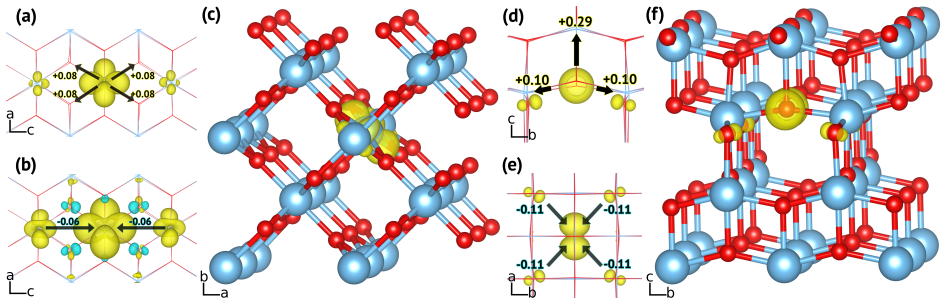
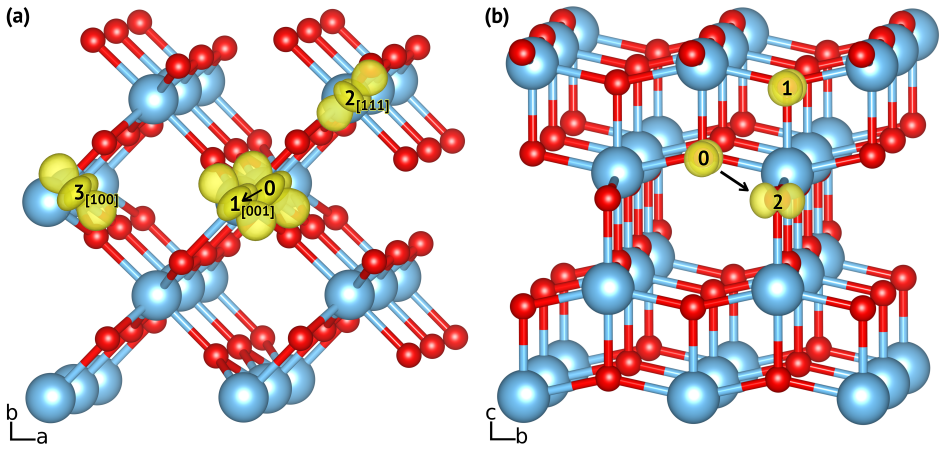
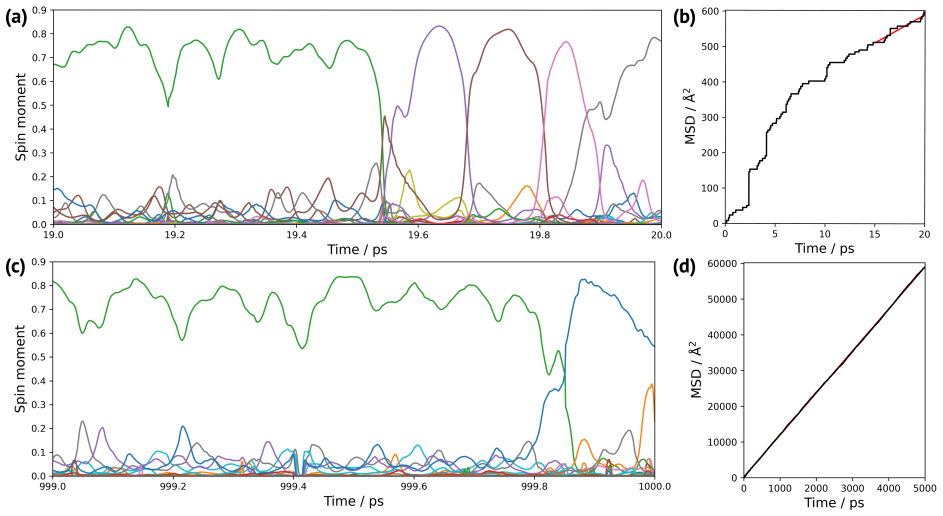
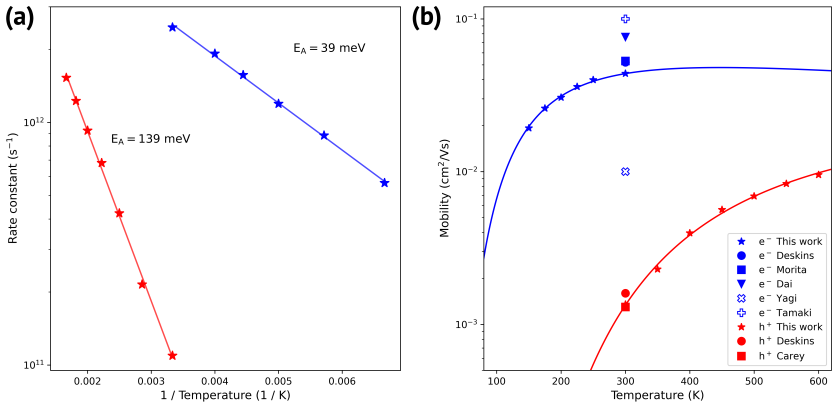
DeepPolaron extends the accessible timescale of adiabatic polaron molecular dynamics by three orders of magnitude while retaining first-principles accuracy. Applied to TiO2, the excess electron in rutile relaxes to a polaron localized predominantly on a single Ti atom whose hops are restricted to the [001] direction, giving an activation energy of 39 meV and room-temperature mobility of 4.4 × 10^{-2} cm²/Vs. The hole polaron in anatase localizes on a single O atom and, owing to poor O 2p overlap with nearest neighbors, transports mainly to second-nearest neighbors with a 139 meV barrier and mobility of 1.4 × 10^{-3} cm²/Vs.
What carries the argument
DeepPolaron, a machine learning framework trained on short DFT trajectories that reproduces adiabatic polaron localization and long-time hopping dynamics.
If this is right
- Electron polarons in rutile TiO2 remain localized on one Ti atom and hop exclusively along the [001] direction.
- The activation energy for this process is 39 meV, producing a room-temperature mobility of 4.4 × 10^{-2} cm²/Vs.
- Hole polarons in anatase localize on one O atom and hop primarily to second-nearest neighbors because of weak orbital overlap.
- The corresponding activation energy is 139 meV and the room-temperature mobility is 1.4 × 10^{-3} cm²/Vs.
- The same machine-learning approach transfers directly to other small-polaron materials and to interfacial charge-transfer processes.
Where Pith is reading between the lines
- Crystal orientation will matter when TiO2 is used in thin-film or nanostructured devices because transport is strongly anisotropic in rutile.
- The method opens the possibility of simulating polaron dynamics at defects or surfaces that were previously inaccessible.
- The large mobility contrast between rutile and anatase supplies a concrete criterion for choosing which phase to employ in a given photocatalyst architecture.
Load-bearing premise
A machine learning model trained on short DFT trajectories reproduces adiabatic polaron localization and long-time hopping dynamics with virtually negligible loss in accuracy over the extended timescales accessed by the method.
What would settle it
An experimental observation of isotropic electron hopping in rutile TiO2 or a room-temperature mobility differing substantially from 4.4 × 10^{-2} cm²/Vs would falsify the reported transport picture.
Figures
read the original abstract
Transition metal oxides have attracted much attention as photo(electrochemical)-catalysts but practical applications are typically hampered by their low and anisotropic charge mobility. A deep understanding of excess charge carrier transport in these materials requires a dynamical treatment of nuclear motion that goes well beyond standard approaches. Here we introduce DeepPolaron, a machine learning framework boosting the accessible time scale of first principles molecular dynamics of adiabatic polaron transport by three orders of magnitude at a virtually negligible loss in accuracy. We apply our method to excess electron and hole transport in titanium dioxide rutile and anatase. We find that the excess electron in rutile relaxes to a polaron predominantly localized on a single Ti atom with hopping occurring only along the [001] direction, associated with an activation energy of 39 meV and a room temperature mobility of $4.4 \times 10^{-2}$ cm$^2$/Vs in good agreement with experiment. In contrast the hole polaron in anatase is localized on a single O atom, and due to poor O 2p orbital overlap with first nearest neighbors charge transport occurs primarily to second nearest neighbors, with a large activation energy of 139 meV resulting in a small room temperature mobility of $1.4 \times 10^{-3}$ cm$^2$/Vs. This work provides a finite temperature first-principles characterization of small polaron transport in rutile and anatase, with a methodology that is directly transferable to other small polaron forming materials and interfacial charge-transfer processes.
Editorial analysis
A structured set of objections, weighed in public.
Referee Report
Summary. The paper introduces DeepPolaron, a machine learning framework that extends first-principles molecular dynamics timescales for adiabatic polaron transport by three orders of magnitude with claimed negligible accuracy loss. Applied to TiO2, it reports that the excess electron in rutile relaxes to a polaron localized predominantly on a single Ti atom with hopping only along the [001] direction (activation energy 39 meV, room-temperature mobility 4.4 × 10^{-2} cm²/Vs, in agreement with experiment). In contrast, the hole polaron in anatase is localized on a single O atom with transport primarily to second-nearest neighbors due to poor orbital overlap (activation energy 139 meV, mobility 1.4 × 10^{-3} cm²/Vs). The work claims a finite-temperature first-principles characterization of small polaron transport and a transferable methodology.
Significance. If the ML model transferability holds, the work provides a dynamical, finite-temperature characterization of anisotropic small-polaron transport in the two TiO2 polymorphs that is directly relevant to photoelectrochemical applications. The reported directional selectivity, activation energies, and mobilities constitute falsifiable predictions that can be tested against experiment or higher-level calculations. The introduction of a scalable MLMD framework for rare-event polaron hopping is a methodological contribution that could be applied to other small-polaron materials.
major comments (2)
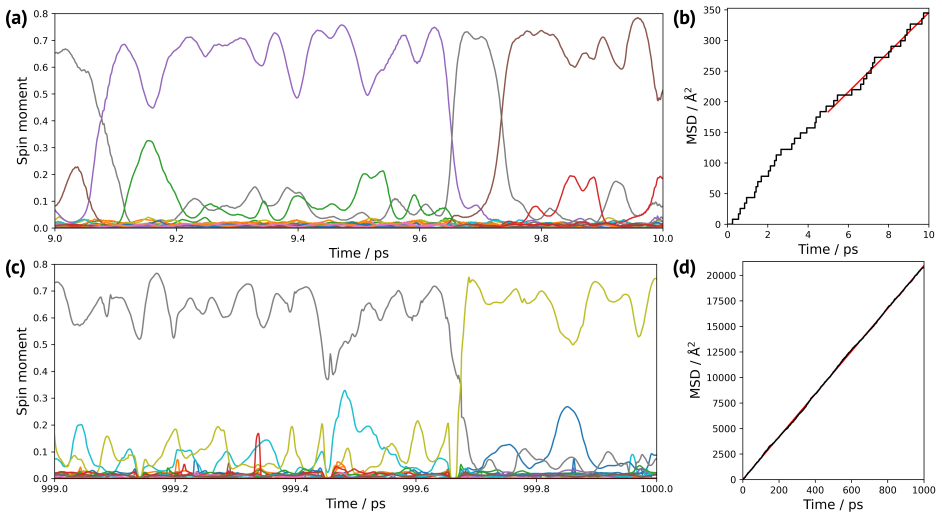
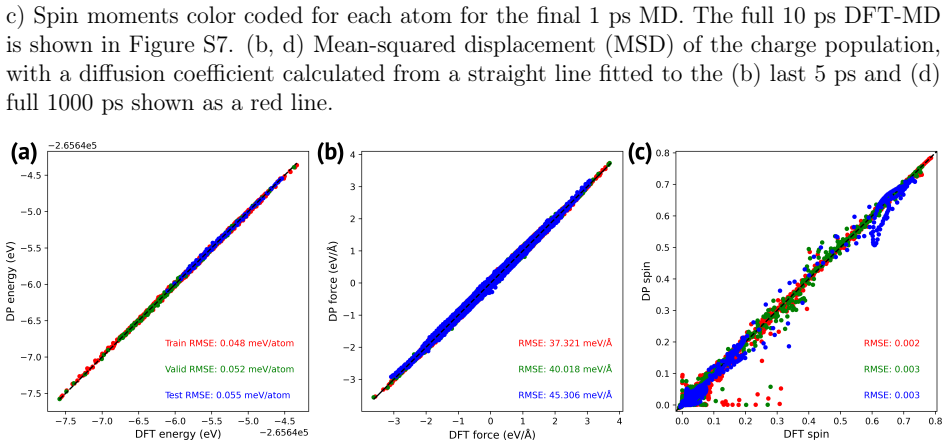
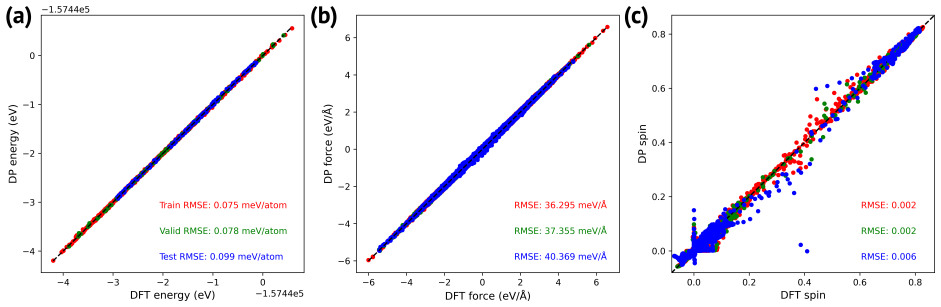
- [Methods] Methods section (DeepPolaron training and validation): The central claim that the model reproduces adiabatic localization and long-time hopping 'with virtually negligible loss in accuracy' over three orders of magnitude in time is load-bearing for all quantitative results (39 meV and 139 meV barriers, reported mobilities). No direct side-by-side comparison of hop frequencies, mean-squared displacements, or diffusion constants between MLMD trajectories and extended DFT runs on any overlapping timescale is presented, leaving the activation energies and mobilities dependent on an untested extrapolation from short-trajectory training data.
- [Results] Results section (rutile electron and anatase hole paragraphs): The reported mobilities and activation energies are given without error bars, standard deviations from multiple independent trajectories, or sensitivity analysis to training-set composition or model hyperparameters. This is load-bearing because the headline numbers (4.4 × 10^{-2} and 1.4 × 10^{-3} cm²/Vs) are compared directly to experiment; absence of uncertainty quantification prevents assessment of whether the agreement is statistically meaningful.
minor comments (2)
- [Abstract] Abstract: The phrase 'good agreement with experiment' for the rutile electron mobility should specify the experimental reference values and temperature range being compared.
- Notation: The definition of the polaron localization (single Ti vs. single O) and the distinction between first- and second-nearest-neighbor hops would benefit from an explicit equation or figure panel showing the relevant Ti–Ti or O–O distances and orbital overlaps.
Simulated Author's Rebuttal
We thank the referee for their detailed and constructive report. We address each major comment below and outline revisions that will strengthen the manuscript.
read point-by-point responses
-
Referee: [Methods] Methods section (DeepPolaron training and validation): The central claim that the model reproduces adiabatic localization and long-time hopping 'with virtually negligible loss in accuracy' over three orders of magnitude in time is load-bearing for all quantitative results (39 meV and 139 meV barriers, reported mobilities). No direct side-by-side comparison of hop frequencies, mean-squared displacements, or diffusion constants between MLMD trajectories and extended DFT runs on any overlapping timescale is presented, leaving the activation energies and mobilities dependent on an untested extrapolation from short-trajectory training data.
Authors: We agree that direct comparison of long-time observables on overlapping timescales would provide stronger evidence for the extrapolation. The current validation focuses on short-trajectory agreement in forces, energies, and instantaneous polaron localization. Extended DFT-MD runs capable of sampling rare hops remain computationally prohibitive, which motivates the ML approach. In the revision we will add short-time mean-squared displacement comparisons between MLMD and DFT where overlap exists, and explicitly discuss the limits of validation for rare-event statistics. revision: yes
-
Referee: [Results] Results section (rutile electron and anatase hole paragraphs): The reported mobilities and activation energies are given without error bars, standard deviations from multiple independent trajectories, or sensitivity analysis to training-set composition or model hyperparameters. This is load-bearing because the headline numbers (4.4 × 10^{-2} and 1.4 × 10^{-3} cm²/Vs) are compared directly to experiment; absence of uncertainty quantification prevents assessment of whether the agreement is statistically meaningful.
Authors: We acknowledge that the absence of uncertainty estimates weakens the comparison to experiment. In the revised manuscript we will report standard deviations obtained from multiple independent MLMD trajectories for both activation energies and mobilities, together with a brief sensitivity analysis to training-set size and key hyperparameters. revision: yes
Circularity Check
No circularity: polaron localization, hop directions, barriers and mobilities are extracted from MLMD trajectories and compared to external experiment
full rationale
The paper trains an ML potential on short DFT trajectories and then runs long MLMD to observe adiabatic localization and rare-event hops. Activation energies (39 meV, 139 meV) and mobilities are computed directly from the resulting trajectories (hop frequencies, diffusion constants) rather than being fitted parameters or self-referenced quantities. Results are validated against independent experimental values rather than against the training data itself. No self-citation is load-bearing for the central claims, no ansatz is smuggled, and no uniqueness theorem is invoked. The derivation chain therefore remains independent of its own inputs.
Axiom & Free-Parameter Ledger
free parameters (1)
- DeepPolaron model parameters
axioms (1)
- domain assumption Polaron transport is adiabatic
invented entities (1)
-
DeepPolaron
no independent evidence
Reference graph
Works this paper leans on
-
[1]
Accelerating Materials Screening with Machine Learning , year = 2018, file =
2018
-
[2]
A Linear Response Approach to the Calculation of the Effective Interaction Parameters in the
-
[3]
Smeagol-1.2.Pdf , file =
-
[4]
Popelier, Paul , doi =
-
[5]
Structural- and Optical-Properties Analysis of Single Crystalline Hematite (
Abdul Rashid, Nur Maisarah and Haw, Choonyian and Chiu, Weesiong and Khanis, Noor Hamizah and Rohaizad, Aliff and Khiew, Poisim and Abdul Rahman, Saadah , year = 2016, journal =. Structural- and Optical-Properties Analysis of Single Crystalline Hematite (. doi:10.1039/c6ce00573j , abstract =
-
[6]
Principles of Dynamic Nuclear Polarisation , author =. Rep. Prog. Phys. , volume =. doi:10.1088/0034-4885/41/3/002 , abstract =
-
[7]
The Journal of Chemical Physics , volume =
Adamo, Carlo and Barone, Vincenzo , year = 1999, journal =. Toward Reliable Density Functional Methods without Adjustable Parameters:. doi:10.1063/1.478522 , abstract =
-
[8]
Adams, George F and Bartlett, Rodney J and Pljrvls, George D , year = 1982, journal =. On the
1982
-
[9]
Density Functional Theory Based Calculation of Small-Polaron Mobility in Hematite , author =. Phys. Rev. B - Condens. Matter Mater. Phys. , volume =. doi:10.1103/PhysRevB.89.245115 , abstract =
-
[10]
and Curtarolo, Stefano and Buongiorno Nardelli, Marco , year = 2015, month = jan, journal =
Agapito, Luis A. and Curtarolo, Stefano and Buongiorno Nardelli, Marco , year = 2015, month = jan, journal =. Reformulation of. doi:10.1103/PhysRevX.5.011006 , urldate =
-
[11]
Finding Reaction Paths Using the Potential Energy as Reaction Coordinate. , author =. J. Chem. Phys. , volume =. doi:10.1063/1.2834930 , abstract =. 18345872 , eprinttype =
-
[12]
Ahart, Christian S. and Rosso, Kevin M. and Blumberger, Jochen , year = 2022, month = mar, journal =. Electron and. doi:10.1021/jacs.1c13507 , urldate =
-
[13]
Ahart, Christian S. and Chulkov, Sergey K. and Cucinotta, Clotilde S. , year = 2024, month = aug, journal =. Enabling. doi:10.1021/acs.jctc.4c00371 , urldate =
-
[14]
Ahart, Christian S. and Rosso, Kevin M. and Blumberger, Jochen , year = 2022, month = jul, journal =. Implementation and. doi:10.1021/acs.jctc.2c00284 , urldate =
-
[15]
Polaronic Structure of Excess Electrons and Holes for a Series of Bulk Iron Oxides , author =. Phys. Chem. Chem. Phys. , volume =. doi:10.1039/c9cp06482f , abstract =
-
[16]
Thesis of
Ahart, Christian , langid =. Thesis of
-
[17]
Ahart, Christian S and Blumberger, Jochen and Rosso, Kevin M , pages =. Supplementary. doi:10.1039/cXCP00000x/neering , file =
-
[18]
Revealing and Exploiting Hierarchical Material Structure through Complex Atomic Networks , author =. Npj Comput. Mater. , volume =. doi:10.1038/s41524-017-0035-x , abstract =
-
[19]
Albanese, Davide and Visintainer, Roberto and Merler, Stefano , eprint =. Mlpy :
-
[20]
Learning
Alber, Maximilian and Sch, Kristof T and Sven, D , year = 2015, eprint =. Learning
2015
-
[21]
Alborzpour, Jonathan P. and Tew, David P. and Habershon, Scott , year = 2016, journal =. Efficient and Accurate Evaluation of Potential Energy Matrix Elements for Quantum Dynamics Using. doi:10.1063/1.4964902 , abstract =
-
[22]
Electron Transport in Pure and Substituted Iron Oxyhydroxides by Small-Polaron Migration , author =. J. Chem. Phys. , volume =. doi:10.1063/1.4882065 , abstract =
-
[23]
Alexandrov, Vitaly and Rosso, Kevin M. , year = 2015, journal =. Ab Initio Modeling of. doi:10.1039/c5cp00921a , abstract =
-
[24]
Silicon-Doped Hafnium Oxide Anti-Ferroelectric Thin Films for Energy Storage , author =. J. Appl. Phys. , volume =. doi:10.1063/1.4989908 , urldate =
-
[25]
Theory and
Almeshal, Abdelkareem Mohammed , langid =. Theory and
-
[26]
Althorpe, Stuart C. and Ananth, Nandini and Angulo, Gonzalo and Astumian, Raymond Dean and Beniwal, Vijay and Blumberger, Jochen and Bolhuis, Peter G. and Ensing, Bernd and Glowacki, David R. and Habershon, Scott and. Non-Adiabatic Reactions:. Faraday Discuss. , volume =. doi:10.1039/c6fd90078j , abstract =
-
[27]
and Rosasco, Lorenzo and Lawrence, Neil D
Alvarez, Mauricio A. and Rosasco, Lorenzo and Lawrence, Neil D. , year = 2011, eprint =. Kernels for. doi:10.1561/2200000036 , abstract =
-
[28]
Optical Properties of Rutile near Its Fundamental Band Gap , author =. Phys. Rev. B , volume =. doi:10.1103/physrevb.51.6842 , urldate =
-
[29]
Anderson, Don O N L O N L and Anderson, Orson L , year = 1970, journal =. Brief Report:. doi:10.1029/JB075i017p03494 , abstract =
-
[30]
Andersson, Y and Langreth, D. and Lundqvist, B. , year = 1996, journal =. Van Der. doi:10.1103/PhysRevLett.76.102 , abstract =
-
[31]
F\"orster interaction induced phase shift in a pair state interferometer
Nuclear Magnetic Resonance Spectra from a Crystal Rotated at High Speed , author =. Nature , volume =. doi:10.1038/1821659a0 , abstract =. arXiv , isbn =:1203.1851v1 , pages =
work page internal anchor Pith review Pith/arXiv arXiv doi:10.1038/1821659a0
-
[32]
Nuclear Magnetic Resonance Spectra of Rapidly-Rotated Solids Containing Reorienting Molecular Groups , author =. J. Phys. Chem. Solid St. Phys. , volume =. doi:10.1088/0022-3719/4/3/014 , file =
-
[33]
Andrew, E. R. , year = 1981, month = mar, journal =. Magic. doi:10.1098/rsta.1981.0032 , urldate =
-
[34]
Anisimov, V. I. and Solovyev, I. V. and Korotin, M. A. and Czy. Density-Functional Theory and. Phys. Rev. B , volume =. doi:10.1103/PhysRevB.48.16929 , urldate =
-
[35]
and Zaanen, Jan and Andersen, Ole K
Anisimov, Vladimir I. and Zaanen, Jan and Andersen, Ole K. , year = 1991, journal =. Band Theory and. doi:10.1103/PhysRevB.44.943 , abstract =
-
[36]
Anisimov, Vladimir I. and Aryasetiawan, F. and Lichtenstein, A. I. , year = 1997, journal =. First-Principles Calculations of the Electronic Structure and Spectra of Strongly Correlated Systems:. doi:10.1088/0953-8984/9/4/002 , abstract =
-
[37]
Anitha, V. C. and Banerjee, Arghya Narayan and Joo, Sang Woo , year = 2015, month = dec, journal =. Recent Developments in. doi:10.1007/s10853-015-9303-7 , urldate =
-
[38]
Journal of Catalysis , volume =
The Design and Development of Highly Reactive Titanium Oxide Photocatalysts Operating under Visible Light Irradiation , author =. Journal of Catalysis , volume =. doi:10.1016/S0021-9517(02)00104-5 , urldate =
-
[39]
Ansari, Narjes and Ulman, Kanchan and Camellone, Matteo Farnesi and Seriani, Nicola and Gebauer, Ralph and Piccinin, Simone , year = 2017, journal =. Hole Localization in. doi:10.1103/PhysRevMaterials.1.035404 , abstract =
-
[40]
Antoniewicz, P. R. and Kleinman, Leonard , year = 1985, journal =. Kohn-. doi:10.1103/PhysRevB.31.6779 , abstract =
-
[41]
Appelbaum, Joel A. and Brinkman, W. F. , year = 1969, month = oct, journal =. Theory of. doi:10.1103/PhysRev.186.464 , urldate =
-
[42]
Arrigoni, Marco and Madsen, Georg K. H. , year = 2020, month = jan, journal =. A Comparative First-Principles Investigation on the Defect Chemistry of. doi:10.1063/1.5138902 , urldate =
-
[43]
J. Chem. Phys. , volume =. doi:10.1063/1.3617244 , urldate =
-
[44]
Machine Learning methods for interatomic potentials: application to boron carbide
Artrith, Nongnuch and Morawietz, Tobias and Behler, J. High-Dimensional Neural-Network Potentials for Multicomponent Systems:. Phys. Rev. B - Condens. Matter Mater. Phys. , volume =. doi:10.1103/PhysRevB.83.153101 , abstract =. arXiv , isbn =:1512.09110 , pages =
work page internal anchor Pith review Pith/arXiv arXiv doi:10.1103/physrevb.83.153101
-
[45]
Asahi, R. and Taga, Y. and Mannstadt, W. and Freeman, A. J. , year = 2000, month = mar, journal =. Electronic and Optical Properties of Anatase. doi:10.1103/PhysRevB.61.7459 , urldate =
-
[46]
Atomic Charges of the Water Molecule and the Water Dimer , author =. J. Phys. Chem. A , volume =. doi:10.1021/jp980574e , abstract =
-
[47]
Ataei, S. Samaneh and Mohammadizadeh, M. Reza and Seriani, Nicola , year = 2016, month = apr, journal =. Ab. doi:10.1021/acs.jpcc.6b00019 , urldate =
-
[48]
and Ren, Xinguo and Rinke, Patrick and Scheffler, Matthias , year = 2016, journal =
Atalla, Viktor and Zhang, Igor Ying and Hofmann, Oliver T. and Ren, Xinguo and Rinke, Patrick and Scheffler, Matthias , year = 2016, journal =. Enforcing the Linear Behavior of the Total Energy with Hybrid Functionals:. doi:10.1103/PhysRevB.94.035140 , abstract =
-
[49]
Polarons in Crystalline and Non-Crystalline Materials , author =. Adv. Phys. , volume =. doi:10.1080/00018736900101267 , urldate =
-
[50]
A Classical Point Charge Model Study of System Size Dependence of Oxidation and Reorganization Free Energies in Aqueous Solution , author =. J. Phys. Chem. B , volume =. doi:10.1021/jp0748516 , abstract =
-
[51]
Rutile, Anatase, Brookite and Titania Thin Film from
Badalov, S V and Bocchini, A and Wilhelm, R and Kozub, A L and Gerstmann, U and Schmidt, W G , year = 2023, month = jul, journal =. Rutile, Anatase, Brookite and Titania Thin Film from. doi:10.1088/2053-1591/ace0fa , urldate =
-
[52]
Koopmans-Compliant Density Functional Framework for Polaron Self-Trapping in Titanate Oxides , author =. npj Comput Mater , issn =. doi:10.1038/s41524-026-02060-7 , urldate =
-
[53]
Bagrets, Alexei , year = 2013, month = jun, journal =. Spin-. doi:10.1021/ct4000263 , urldate =
-
[54]
Current-Induced Phonon Renormalization in Molecular Junctions , author =. Phys. Rev. B , volume =. doi:10.1103/PhysRevB.94.035411 , urldate =
-
[55]
Thesis of
Bailey, Steven , file =. Thesis of
-
[56]
Dynamic Nuclear Polarization at 9
Bajaj, V S and Farrar, C T and Hornstein, M K and Mastovsky, I and Vieregg, J and Bryant, J and El. Dynamic Nuclear Polarization at 9. J. Magn. Reson. , volume =. doi:10.1016/S1090-7807(02)00192-1 , urldate =
-
[57]
Bajaj, Vikram S and Hornstein, Melissa K and Kreischer, Kenneth E and Sirigiri, Jagadishwar R and Woskov, Paul P and Mak, Melody and Herzfeld, Judith and Temkin, Richard J and Griffin, Robert G , year = 2007, journal =. 250
2007
-
[58]
Bak, T. and Nowotny, J. and Rekas, M. and Sorrell, C.C. , year = 2003, month = jul, journal =. Defect Chemistry and Semiconducting Properties of Titanium Dioxide:. doi:10.1016/S0022-3697(02)00481-X , urldate =
-
[59]
Bak, T. and Nowotny, M. K. and Sheppard, L. R. and Nowotny, J. , year = 2008, month = aug, journal =. Mobility of. doi:10.1021/jp801028j , urldate =
-
[60]
Oxide Chemistry and Catalysis , author =. J. Chem. Phys. , volume =. doi:10.1063/5.0021819 , abstract =
-
[61]
Support Vector Machine Regression (
Balabin, Roman M and Lomakina, Ekaterina I , year = 2011, journal =. Support Vector Machine Regression (. doi:10.1039/c1cp00051a , abstract =
-
[62]
Electrical Conductivity in Non-Stoichiometric Titanium Dioxide at Elevated Temperatures , author =. J Mater Sci , volume =. doi:10.1007/BF00547436 , urldate =
-
[63]
Discovery of the Soft Electronic Modes of the Trimeron Order in Magnetite , author =. Nat. Phys. , volume =. doi:10.1038/s41567-020-0823-y , urldate =
-
[64]
Baldini, E. and Chiodo, L. and Dominguez, A. and Palummo, M. and Moser, S. and. Strongly Bound Excitons in Anatase. Nat Commun , volume =. doi:10.1038/s41467-017-00016-6 , urldate =
-
[65]
Balog, M. and Schieber, M. and Michman, M. and Patai, S. , year = 1977, month = mar, journal =. Chemical Vapor Deposition and Characterization of. doi:10.1016/0040-6090(77)90312-1 , urldate =
-
[66]
Baraff, G. A. and Appelbaum, Joel A. and Hamann, D. R. , year = 1977, month = jan, journal =. Self-. doi:10.1103/PhysRevLett.38.237 , urldate =
-
[67]
Contemporary Issues in Electron Transfer Research , author =. J. Phys. Chem. , volume =. doi:10.1021/jp9605663 , abstract =
-
[68]
and Faulkner, Larry R
Bard, Allen J. and Faulkner, Larry R. , year = 2001, edition =. Electrochemical Methods: Fundamentals and Applications , shorttitle =
2001
-
[69]
, year = 1961, month = jan, journal =
Bardeen, J. , year = 1961, month = jan, journal =. Tunnelling from a. doi:10.1103/PhysRevLett.6.57 , urldate =
-
[70]
Barkoutsos, Panagiotis Kl and Gonthier, Jerome F. and Sokolov, Igor and Moll, Nikolaj and Salis, Gian and Fuhrer, Andreas and Ganzhorn, Marc and Egger, Daniel J. and Troyer, Matthias and Mezzacapo, Antonio and Filipp, Stefan and Tavernelli, Ivano , year = 2018, journal =. Quantum Algorithms for Electronic Structure Calculations:. doi:10.1103/PhysRevA.98.0...
-
[71]
Barnett, Robert N. and H. Hydrogen. Nano Lett. , volume =. doi:10.1021/nl049054n , urldate =
-
[72]
Low-Dimensional Semiconductor Structures:
- [73]
-
[74]
Gaussian Approximation Potentials: the accuracy of quantum mechanics, without the electrons
Bart. Gaussian Approximation Potentials:. Phys. Rev. Lett. , volume =. doi:10.1103/PhysRevLett.104.136403 , abstract =. arXiv , isbn =:0910.1019 , pages =
work page internal anchor Pith review Pith/arXiv arXiv doi:10.1103/physrevlett.104.136403
-
[75]
Gaussian Approximation Potentials:
Bart. Gaussian Approximation Potentials:. Int. J. Quantum Chem. , volume =. doi:10.1002/qua.24927 , abstract =. arXiv , isbn =:1502.01366 , pages =
-
[76]
Bart. Machine. Phys. Rev. X , volume =. doi:10.1103/PhysRevX.8.041048 , abstract =. arXiv , keywords =:1805.01568 , pages =
work page internal anchor Pith review Pith/arXiv arXiv doi:10.1103/physrevx.8.041048
-
[77]
Machine-Learning Approach for One- and Two-Body Corrections to Density Functional Theory:
Bart. Machine-Learning Approach for One- and Two-Body Corrections to Density Functional Theory:. Phys. Rev. B - Condens. Matter Mater. Phys. , volume =. doi:10.1103/PhysRevB.88.054104 , abstract =
-
[78]
On Representing Chemical Environments , author =. Phys. Rev. B - Condens. Matter Mater. Phys. , volume =. doi:10.1103/PhysRevB.87.184115 , abstract =. arXiv , isbn =:1209.3140 , pages =
work page internal anchor Pith review Pith/arXiv arXiv doi:10.1103/physrevb.87.184115
-
[79]
Bart. Regularized. J. Chem. Phys. , volume =. doi:10.1063/1.5094646 , abstract =. arXiv , file =:1903.01007 , pages =
-
[80]
Stability of Non-Metal Dopants to Tune the Photo-Absorption of
Basera, Pooja and Saini, Shikha and Arora, Ekta and Singh, Arunima and Kumar, Manish and Bhattacharya, Saswata , year = 2019, month = aug, journal =. Stability of Non-Metal Dopants to Tune the Photo-Absorption of. doi:10.1038/s41598-019-47710-7 , urldate =
discussion (0)
Sign in with ORCID, Apple, or X to comment. Anyone can read and Pith papers without signing in.