Microscopic Theory of the Phonon Thermal Hall Effect in Chiral Mott Insulators
Pith reviewed 2026-06-28 12:46 UTC · model grok-4.3
The pith
The phonon thermal Hall effect arises from an effective Raman interaction proportional to scalar spin chirality in chiral Mott insulators.
A machine-rendered reading of the paper's core claim, the machinery that carries it, and where it could break.
Core claim
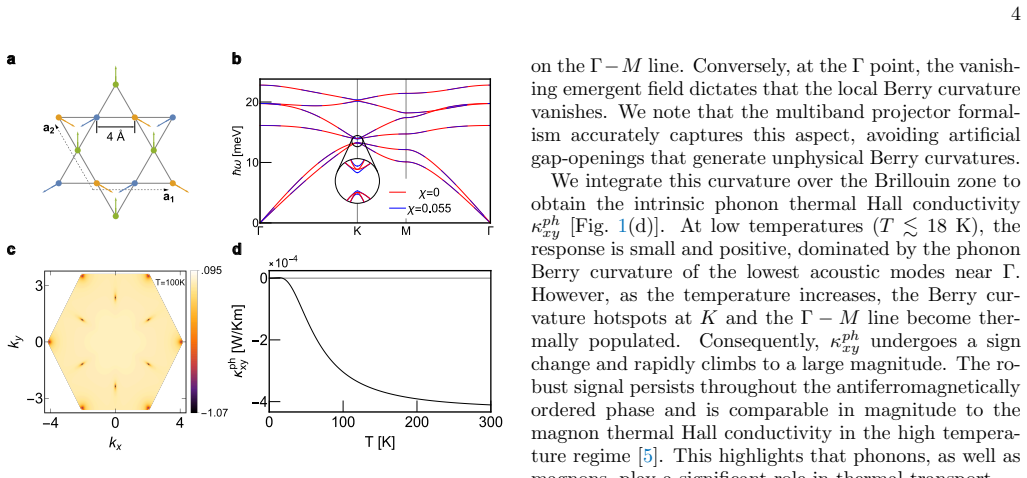
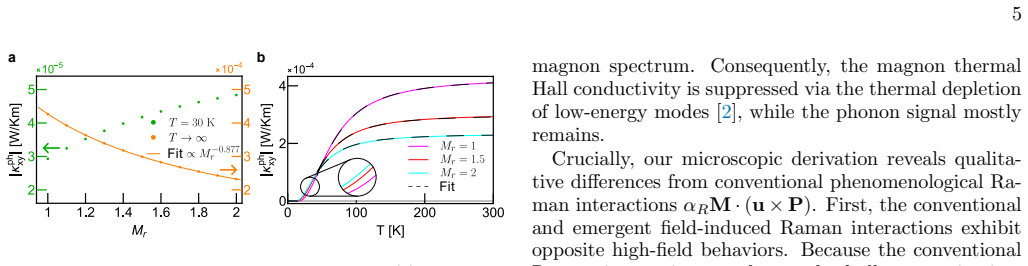
The paper establishes that the effective Raman interaction in half-filled Mott insulators has a strength directly proportional to the scalar spin chirality. This leads to an explicit demonstration of the intrinsic phonon thermal Hall effect on the kagome lattice. The formulation shows a temperature-dependent crossover under isotopic substitution, enabling a scaling law that separates the phonon contribution to the thermal Hall effect from other signals.
What carries the argument
The effective Raman interaction whose strength is directly proportional to the scalar spin chirality, which generates the phonon thermal Hall effect.
If this is right
- The phonon thermal Hall effect can be calculated microscopically from the spin chirality without phenomenological parameters.
- Isotopic substitution produces a temperature-dependent crossover in the thermal transport coefficients.
- A scaling law isolates the phonon contribution to the thermal Hall effect from other background signals.
- The results apply to chiral Mott insulators and provide an experimental standard for identifying microscopic heat carriers.
Where Pith is reading between the lines
- The Raman interaction mechanism could be examined on lattices other than kagome to test generality.
- Measurement of the crossover temperature in real materials could confirm phonon dominance in the thermal Hall signal.
- The scaling law might be applied to reinterpret existing thermal Hall data in other classes of insulators.
Load-bearing premise
The analytic derivation assumes a half-filled Mott insulator model where the Raman interaction strength is directly proportional to scalar spin chirality without higher-order corrections or material-specific parameters.
What would settle it
If experiments on a kagome lattice chiral Mott insulator show no temperature-dependent crossover in thermal Hall conductivity upon isotopic substitution, the predicted scaling law would be falsified.
Figures
read the original abstract
The thermal Hall effect (THE) probes charge-neutral excitations in insulators, where the charge gap blocks electronic transport. Recently, phonons have been shown to induce a THE comparable in magnitude to the spin contribution, underscoring their critical role in thermal transport. Here, we develop a microscopic theory of the phonon thermal Hall effect (PTHE) in chiral Mott insulators. First, we derive the exact analytic form of the effective Raman interaction in half-filled Mott insulators, showing that its strength is directly proportional to the scalar spin chirality. Next, we demonstrate the intrinsic PTHE explicitly on the kagome lattice. Crucially, our formulation reveals a temperature-dependent crossover in the transport behavior under isotopic substitution. Using this result, we establish a scaling law that quantitatively separates the phonon contribution to the THE from other background signals. Our results not only provide the first fully microscopic derivation of the PTHE, but also establish a definitive experimental standard for isolating microscopic heat carriers in chiral Mott insulators.
Editorial analysis
A structured set of objections, weighed in public.
Referee Report
Summary. The manuscript develops a microscopic theory of the phonon thermal Hall effect (PTHE) in chiral Mott insulators. It derives an exact analytic form of the effective Raman interaction in half-filled Mott insulators, with strength directly proportional to scalar spin chirality; uses this to demonstrate the intrinsic PTHE on the kagome lattice; identifies a temperature-dependent crossover under isotopic substitution; and establishes a scaling law to quantitatively separate the phonon contribution to the thermal Hall effect from other signals. The central claims are that this constitutes the first fully microscopic derivation of the PTHE and provides a definitive experimental standard for isolating microscopic heat carriers.
Significance. If the derivation of the Raman interaction and the resulting scaling law hold without unaccounted higher-order corrections, the work would be significant for providing a parameter-free microscopic foundation for PTHE in chiral Mott insulators and a practical experimental protocol via isotopic substitution. The explicit kagome-lattice demonstration and the focus on falsifiable temperature-dependent crossover are strengths that could guide future measurements.
major comments (2)
- [Derivation of effective Raman interaction] Derivation of effective Raman interaction (abstract and main-text section on half-filled Mott insulator model): The claim of an 'exact analytic form' with strength 'directly proportional' to scalar spin chirality is load-bearing for the PTHE and scaling law. The skeptic note correctly flags that standard t/U expansions truncate at second order; fourth-order virtual processes generate ring-exchange and multi-spin terms whose coefficients are not guaranteed to remain strictly proportional to chirality or to share the same temperature dependence. The manuscript must either demonstrate that these corrections vanish identically or explicitly state the order of the approximation and its range of validity.
- [kagome lattice PTHE and isotopic crossover] Intrinsic PTHE on kagome lattice and isotopic-substitution crossover (section deriving the transport behavior): The temperature-dependent crossover and scaling law for isolating the phonon contribution rest on the proportionality established in the Raman interaction. If higher-order terms introduce additional temperature scalings, both the crossover prediction and the quantitative separation protocol become incomplete; a concrete check against the full t-J or Hubbard model at the relevant filling is required.
minor comments (1)
- [Notation] Notation for the effective Raman vertex and its coupling to phonons should be defined with an explicit equation number in the main text rather than only in the abstract.
Simulated Author's Rebuttal
We thank the referee for the careful reading and constructive comments. We address each major comment below.
read point-by-point responses
-
Referee: [Derivation of effective Raman interaction] Derivation of effective Raman interaction (abstract and main-text section on half-filled Mott insulator model): The claim of an 'exact analytic form' with strength 'directly proportional' to scalar spin chirality is load-bearing for the PTHE and scaling law. The skeptic note correctly flags that standard t/U expansions truncate at second order; fourth-order virtual processes generate ring-exchange and multi-spin terms whose coefficients are not guaranteed to remain strictly proportional to chirality or to share the same temperature dependence. The manuscript must either demonstrate that these corrections vanish identically or explicitly state the order of the approximation and its range of validity.
Authors: Our derivation yields an exact closed-form expression for the effective Raman interaction obtained from second-order virtual hopping processes in the half-filled Hubbard model; this term is strictly proportional to the scalar spin chirality by the structure of the perturbation. Fourth-order and higher processes are suppressed by additional factors of (t/U)^2 and lie outside the leading-order effective theory used for the PTHE. We will revise the manuscript to state explicitly that the result is exact within the second-order t/U expansion and to specify the validity range (U/t ≫ 1, temperatures below the charge gap). revision: yes
-
Referee: [kagome lattice PTHE and isotopic crossover] Intrinsic PTHE on kagome lattice and isotopic-substitution crossover (section deriving the transport behavior): The temperature-dependent crossover and scaling law for isolating the phonon contribution rest on the proportionality established in the Raman interaction. If higher-order terms introduce additional temperature scalings, both the crossover prediction and the quantitative separation protocol become incomplete; a concrete check against the full t-J or Hubbard model at the relevant filling is required.
Authors: The crossover and scaling law are derived from the leading Raman term whose proportionality to chirality is exact at the order considered. Subleading corrections from higher-order virtual processes remain parametrically small throughout the Mott regime and do not alter the leading temperature dependence or the functional form of the isotopic scaling. A full numerical diagonalization or quantum Monte Carlo check of the complete Hubbard model is not required to establish the microscopic mechanism or the proposed experimental protocol. revision: no
- Concrete numerical verification of the Raman interaction proportionality in the full t-J or Hubbard model at relevant fillings
Circularity Check
No circularity: microscopic derivation from Mott model presented as independent analytic result
full rationale
The paper states it derives the exact analytic form of the effective Raman interaction from the half-filled Mott insulator Hamiltonian, with the proportionality to scalar spin chirality emerging as a shown result rather than an input definition or fit. This derived interaction is then used to demonstrate the PTHE on the kagome lattice and to obtain a temperature-dependent scaling law under isotopic substitution. No equations, self-citations, or steps are exhibited that reduce the central claims (PTHE or scaling law) to the inputs by construction; the chain is presented as first-principles from the model without load-bearing self-referential elements or renamed empirical patterns.
Axiom & Free-Parameter Ledger
Reference graph
Works this paper leans on
-
[1]
Theory of the thermal hall effect in quantum magnets,
Hosho Katsura, Naoto Nagaosa, and Patrick A Lee, “Theory of the thermal hall effect in quantum magnets,” Physical review letters104, 066403 (2010)
2010
-
[2]
Observation of the magnon hall effect,
Y Onose, T Ideue, H Katsura, Y Shiomi, N Nagaosa, and Y Tokura, “Observation of the magnon hall effect,” Science329, 297–299 (2010)
2010
-
[3]
Rotational mo- tion of magnons and the thermal hall effect,
Ryo Matsumoto and Shuichi Murakami, “Rotational mo- tion of magnons and the thermal hall effect,” Physical Review B—Condensed Matter and Materials Physics84, 184406 (2011)
2011
-
[4]
Thermal hall effect of magnons in magnets with dipolar interaction,
Ryo Matsumoto, Ryuichi Shindou, and Shuichi Mu- rakami, “Thermal hall effect of magnons in magnets with dipolar interaction,” Physical Review B89, 054420 (2014)
2014
-
[5]
Magnon hall effect and topology in kagome lattices: A theoretical investigation,
Alexander Mook, J¨ urgen Henk, and Ingrid Mertig, “Magnon hall effect and topology in kagome lattices: A theoretical investigation,” Physical Review B89, 134409 (2014)
2014
-
[6]
Large thermal hall conductivity of neutral spin excitations in a frustrated quantum magnet,
Max Hirschberger, Jason W Krizan, RJ Cava, and NP Ong, “Large thermal hall conductivity of neutral spin excitations in a frustrated quantum magnet,” Sci- ence348, 106–109 (2015)
2015
-
[7]
Thermal hall effect of spin excitations in a kagome magnet,
Max Hirschberger, Robin Chisnell, Young S Lee, and Nai Phuan Ong, “Thermal hall effect of spin excitations in a kagome magnet,” Physical review letters115, 106603 (2015)
2015
-
[8]
A first theoretical realization of honeycomb topological magnon insulator,
SA Owerre, “A first theoretical realization of honeycomb topological magnon insulator,” Journal of Physics: Con- densed Matter28, 386001 (2016)
2016
-
[9]
Topological thermal hall effect in frus- trated kagome antiferromagnets,
SA Owerre, “Topological thermal hall effect in frus- trated kagome antiferromagnets,” Physical Review B95, 014422 (2017)
2017
-
[10]
Majorana quantization and half-integer thermal quan- tum hall effect in a kitaev spin liquid,
Yuichi Kasahara, Tsuneya Ohnishi, Yuta Mizukami, Os- amu Tanaka, Sixiao Ma, Kaori Sugii, Nobuyuki Kurita, Hidekazu Tanaka, Joji Nasu, Yukitoshi Motome,et al., “Majorana quantization and half-integer thermal quan- tum hall effect in a kitaev spin liquid,” Nature559, 227– 231 (2018)
2018
-
[11]
Magnon ther- mal hall effect in kagome antiferromagnets with dzyaloshinskii-moriya interactions,
Pontus Laurell and Gregory A Fiete, “Magnon ther- mal hall effect in kagome antiferromagnets with dzyaloshinskii-moriya interactions,” Physical Review B 98, 094419 (2018)
2018
-
[12]
Topological mag- netoelastic excitations in noncollinear antiferromagnets,
Sungjoon Park and Bohm-Jung Yang, “Topological mag- netoelastic excitations in noncollinear antiferromagnets,” Physical Review B99, 174435 (2019)
2019
-
[13]
Thermal hall effect induced by magnon-phonon interactions,
Xiaoou Zhang, Yinhan Zhang, Satoshi Okamoto, and Di Xiao, “Thermal hall effect induced by magnon-phonon interactions,” Physical review letters123, 167202 (2019)
2019
-
[14]
Anomalous thermal hall effect in an insulating van der waals magnet,
Heda Zhang, Chunqiang Xu, Caitlin Carnahan, Milos Sretenovic, Nishchay Suri, Di Xiao, and Xianglin Ke, “Anomalous thermal hall effect in an insulating van der waals magnet,” Physical Review Letters127, 247202 (2021)
2021
-
[15]
Topological thermal hall effect of magnons in magnetic skyrmion lat- tice,
Masatoshi Akazawa, Hyun-Yong Lee, Hikaru Takeda, Yuri Fujima, Yusuke Tokunaga, Taka-hisa Arima, Jung Hoon Han, and Minoru Yamashita, “Topological thermal hall effect of magnons in magnetic skyrmion lat- tice,” Physical Review Research4, 043085 (2022)
2022
-
[16]
Thermal hall effects in quantum magnets,
Xiao-Tian Zhang, Yong Hao Gao, and Gang Chen, “Thermal hall effects in quantum magnets,” Physics Re- ports1070, 1–59 (2024)
2024
-
[17]
Phenomeno- logical evidence for the phonon hall effect,
C Strohm, GLJA Rikken, and P Wyder, “Phenomeno- logical evidence for the phonon hall effect,” Physical re- view letters95, 155901 (2005)
2005
-
[18]
Theory of the phonon hall effect in paramagnetic dielectrics,
L Sheng, DN Sheng, and CS Ting, “Theory of the phonon hall effect in paramagnetic dielectrics,” Physical review letters96, 155901 (2006)
2006
-
[19]
On the phonon hall effect in a param- agnetic dielectric,
Alexander Vasil’evich Inyushkin and Alexandr Nikolae- vich Taldenkov, “On the phonon hall effect in a param- agnetic dielectric,” Jetp Letters86, 379–382 (2007)
2007
-
[20]
Anomalous hall effect for the phonon heat conductivity in paramagnetic di- electrics,
Yu Kagan and LA Maksimov, “Anomalous hall effect for the phonon heat conductivity in paramagnetic di- electrics,” Physical review letters100, 145902 (2008)
2008
-
[21]
Phonon hall thermal conductivity from the green-kubo formula,
Jian-Sheng Wang and Lifa Zhang, “Phonon hall thermal conductivity from the green-kubo formula,” Physical Re- view B—Condensed Matter and Materials Physics80, 012301 (2009)
2009
-
[22]
Topological nature of the phonon hall effect,
Lifa Zhang, Jie Ren, Jian-Sheng Wang, and Baowen Li, “Topological nature of the phonon hall effect,” Physical review letters105, 225901 (2010)
2010
-
[23]
Phonon hall effect in ionic crystals in the presence of static magnetic field,
Bijay K Agarwalla, Lifa Zhang, Jian-Sheng Wang, and Baowen Li, “Phonon hall effect in ionic crystals in the presence of static magnetic field,” The European Physical Journal B81, 197–202 (2011)
2011
-
[24]
Berry cur- vature and the phonon hall effect,
Tao Qin, Jianhui Zhou, and Junren Shi, “Berry cur- vature and the phonon hall effect,” Physical Review B—Condensed Matter and Materials Physics86, 104305 (2012)
2012
-
[25]
Origin of the phonon hall effect in rare-earth garnets,
Michiyasu Mori, Alexander Spencer-Smith, Oleg P Sushkov, and Sadamichi Maekawa, “Origin of the phonon hall effect in rare-earth garnets,” Physical review letters113, 265901 (2014)
2014
-
[26]
Giant thermal hall effect in mul- tiferroics,
Toshiya Ideue, Takashi Kurumaji, Shintaro Ishiwata, and Yoshinori Tokura, “Giant thermal hall effect in mul- tiferroics,” Nature materials16, 797–802 (2017)
2017
-
[27]
Unusual phonon heat transport inα- rucl 3: Strong spin-phonon scattering and field-induced spin gap,
Richard Hentrich, Anja UB Wolter, Xenophon Zotos, Wolfram Brenig, Domenic Nowak, Anna Isaeva, Thomas Doert, Arnab Banerjee, Paula Lampen-Kelley, David G Mandrus,et al., “Unusual phonon heat transport inα- rucl 3: Strong spin-phonon scattering and field-induced spin gap,” Physical review letters120, 117204 (2018)
2018
-
[28]
Berry phase of phonons and thermal hall effect in nonmagnetic insulators,
Takuma Saito, Kou Misaki, Hiroaki Ishizuka, and Naoto Nagaosa, “Berry phase of phonons and thermal hall effect in nonmagnetic insulators,” Physical Review Letters123, 255901 (2019)
2019
-
[29]
Giant thermal hall conductivity in the pseudogap phase of cuprate superconductors,
Ga¨ el Grissonnanche, Ana¨ elle Legros, Sven Badoux, Eti- enne Lefran¸ cois, Victor Zatko, Maude Lizaire, Francis Lalibert´ e, Adrien Gourgout, J-S Zhou, Sunseng Pyon, et al., “Giant thermal hall conductivity in the pseudogap phase of cuprate superconductors,” Nature571, 376–380 (2019)
2019
-
[30]
Thermal hall conductivity in the cuprate mott insulators nd2cuo4 and sr2cuo2cl2,
Marie-Eve Boulanger, Ga¨ el Grissonnanche, Sven Badoux, Andr´ eanne Allaire,´Etienne Lefran¸ cois, Ana¨ elle Legros, Adrien Gourgout, Maxime Dion, CH Wang, 7 XH Chen,et al., “Thermal hall conductivity in the cuprate mott insulators nd2cuo4 and sr2cuo2cl2,” Nature communications11, 5325 (2020)
2020
-
[31]
Phonon thermal hall effect in strontium ti- tanate,
Xiaokang Li, Benoˆ ıt Fauqu´ e, Zengwei Zhu, and Kam- ran Behnia, “Phonon thermal hall effect in strontium ti- tanate,” Physical review letters124, 105901 (2020)
2020
-
[32]
Sizable suppression of thermal hall effect upon isotopic substitution in srtio 3,
Sangwoo Sim, Heejun Yang, Ha-Leem Kim, Matthew J Coak, Mitsuru Itoh, Yukio Noda, and Je-Geun Park, “Sizable suppression of thermal hall effect upon isotopic substitution in srtio 3,” Physical Review Letters126, 015901 (2021)
2021
-
[33]
Phonon thermal hall effect in a metallic spin ice,
Taiki Uehara, Takumi Ohtsuki, Masafumi Udagawa, Satoru Nakatsuji, and Yo Machida, “Phonon thermal hall effect in a metallic spin ice,” Nature Communica- tions13, 4604 (2022)
2022
-
[34]
Phonon thermal hall effect in charge-compensated topological insulators,
Rohit Sharma, Mahasweta Bagchi, Yongjian Wang, Yoichi Ando, and Thomas Lorenz, “Phonon thermal hall effect in charge-compensated topological insulators,” Physical Review B109, 104304 (2024)
2024
-
[35]
Planar thermal hall effect from phonons in a kitaev candidate material,
Lu Chen, ´Etienne Lefran¸ cois, Ashvini Vallipuram, Quentin Barth´ elemy, Amirreza Ataei, Weiliang Yao, Yuan Li, and Louis Taillefer, “Planar thermal hall effect from phonons in a kitaev candidate material,” Nature communications15, 3513 (2024)
2024
-
[36]
Phonon thermal hall effect in mott insulators via skew scattering by the scalar spin chirality,
Taekoo Oh and Naoto Nagaosa, “Phonon thermal hall effect in mott insulators via skew scattering by the scalar spin chirality,” Physical Review X15, 011036 (2025)
2025
-
[37]
Spin-phonon coupling and thermal hall effect in the kitaev model,
Taekoo Oh and Naoto Nagaosa, “Spin-phonon coupling and thermal hall effect in the kitaev model,” Physical Review B112, L081104 (2025)
2025
-
[38]
Phonon thermal hall as a lattice aharonov-bohm effect,
Kamran Behnia, “Phonon thermal hall as a lattice aharonov-bohm effect,” SciPost Physics Core8, 061 (2025)
2025
-
[39]
Large phonon thermal hall conductivity in the antiferromagnetic insulator cu3teo6,
Lu Chen, Marie-Eve Boulanger, Zhi-Cheng Wang, Fazel Tafti, and Louis Taillefer, “Large phonon thermal hall conductivity in the antiferromagnetic insulator cu3teo6,” Proceedings of the National Academy of Sciences119, e2208016119 (2022)
2022
-
[40]
The phonon thermal hall angle in black phosphorus,
Xiaokang Li, Yo Machida, Alaska Subedi, Zengwei Zhu, Liang Li, and Kamran Behnia, “The phonon thermal hall angle in black phosphorus,” Nature Communications14, 1027 (2023)
2023
-
[41]
Thermal hall effects due to topological spin fluctuations in ymno3,
Ha-Leem Kim, Takuma Saito, Heejun Yang, Hiroaki Ishizuka, Matthew John Coak, Jun Han Lee, Hasung Sim, Yoon Seok Oh, Naoto Nagaosa, and Je-Geun Park, “Thermal hall effects due to topological spin fluctuations in ymno3,” Nature Communications15, 243 (2024)
2024
-
[42]
Discovery of universal phonon thermal hall effect in crystals,
XB Jin, Xu Zhang, WB Wan, HR Wang, YH Jiao, and SY Li, “Discovery of universal phonon thermal hall effect in crystals,” Physical Review Letters135, 196302 (2025)
2025
-
[43]
Phonon thermal hall ef- fect: the roles of disorder, annealing, and metallic con- tacts,
Qiaochao Xiang, Xiaokang Li, Xiaodong Guo, Kamran Behnia, and Zengwei Zhu, “Phonon thermal hall ef- fect: the roles of disorder, annealing, and metallic con- tacts,” npj Quantum Materials (2026), 10.1038/s41535- 026-00876-6
-
[44]
Phonon hall viscosity and the intrinsic thermal hall effect ofα-rucl3,
Avi Shragai, Ezekiel Horsley, Subin Kim, Young-June Kim, and BJ Ramshaw, “Phonon hall viscosity and the intrinsic thermal hall effect ofα-rucl3,” Nature , 1–7 (2026)
2026
-
[45]
Zur quantenthe- orie der molekeln,
Max Born and Robert Oppenheimer, “Zur quantenthe- orie der molekeln,” Annalen der physik389, 457–484 (1927)
1927
-
[46]
On the determi- nation of born–oppenheimer nuclear motion wave func- tions including complications due to conical intersections and identical nuclei,
C Alden Mead and Donald G Truhlar, “On the determi- nation of born–oppenheimer nuclear motion wave func- tions including complications due to conical intersections and identical nuclei,” The Journal of Chemical Physics 70, 2284–2296 (1979)
1979
-
[47]
The geometric phase in molecular sys- tems,
C Alden Mead, “The geometric phase in molecular sys- tems,” Reviews of modern physics64, 51 (1992)
1992
-
[48]
Berry phase theory of the anomalous hall effect: Application to colossal mag- netoresistance manganites,
Jinwu Ye, Yong Baek Kim, AJ Millis, BI Shraiman, P Majumdar, and Z Teˇ sanovi´ c, “Berry phase theory of the anomalous hall effect: Application to colossal mag- netoresistance manganites,” Physical review letters83, 3737 (1999)
1999
-
[49]
Quantized topological hall effect in skyrmion crystal,
Keita Hamamoto, Motohiko Ezawa, and Naoto Nagaosa, “Quantized topological hall effect in skyrmion crystal,” Physical Review B92, 115417 (2015)
2015
-
[50]
Relation between the anderson and kondo hamiltonians,
John R Schrieffer and Peter A Wolff, “Relation between the anderson and kondo hamiltonians,” Physical Review 149, 491 (1966)
1966
-
[51]
Variational schrieffer-wolff transforma- tions for quantum many-body dynamics,
Jonathan Wurtz, Pieter W Claeys, and Anatoli Polkovnikov, “Variational schrieffer-wolff transforma- tions for quantum many-body dynamics,” Physical Re- view B101, 014302 (2020)
2020
-
[52]
Walter A Harrison,Electronic structure and the proper- ties of solids: the physics of the chemical bond(Courier Corporation, 1989)
1989
-
[53]
Effects of cyclic four-spin exchange on the magnetic properties of the cuo 2 plane,
Y Honda, Y Kuramoto, and T Watanabe, “Effects of cyclic four-spin exchange on the magnetic properties of the cuo 2 plane,” Physical Review B47, 11329 (1993)
1993
-
[54]
Non-fermi-liquid states and pairing instabil- ity of a general model of copper oxide metals,
CM Varma, “Non-fermi-liquid states and pairing instabil- ity of a general model of copper oxide metals,” Physical Review B55, 14554 (1997)
1997
-
[55]
Effects of biquadratic exchange on the spec- trum of elementary excitations in spin ladders,
S Brehmer, H-J Mikeska, M M¨ uller, N Nagaosa, and S Uchida, “Effects of biquadratic exchange on the spec- trum of elementary excitations in spin ladders,” Physical Review B60, 329 (1999)
1999
-
[56]
Detection and implica- tions of a time-reversal breaking state in underdoped cuprates,
ME Simon and CM Varma, “Detection and implica- tions of a time-reversal breaking state in underdoped cuprates,” Physical review letters89, 247003 (2002)
2002
-
[57]
Symmetry considera- tions for the detection of second-harmonic generation in cuprates in the pseudogap phase,
ME Simon and CM Varma, “Symmetry considera- tions for the detection of second-harmonic generation in cuprates in the pseudogap phase,” Physical Review B67, 054511 (2003)
2003
-
[58]
N´ eel order, ring exchange, and charge fluctuations in the half-filled hubbard model,
J-YP Delannoy, MJP Gingras, PCW Holdsworth, and A-MS Tremblay, “N´ eel order, ring exchange, and charge fluctuations in the half-filled hubbard model,” Physical Review B—Condensed Matter and Materials Physics72, 115114 (2005)
2005
-
[59]
Theory of the pseudogap state of the cuprates,
CM Varma, “Theory of the pseudogap state of the cuprates,” Physical Review B—Condensed Matter and Materials Physics73, 155113 (2006)
2006
-
[60]
Emergent loop current order from pair density wave superconductivity,
Daniel F Agterberg, Drew S Melchert, and Manoj K Kashyap, “Emergent loop current order from pair density wave superconductivity,” Physical Review B91, 054502 (2015)
2015
-
[61]
Intertwining topological order and broken symmetry in a theory of fluctuating spin-density waves,
Shubhayu Chatterjee, Subir Sachdev, and Mathias S Scheurer, “Intertwining topological order and broken symmetry in a theory of fluctuating spin-density waves,” Physical review letters119, 227002 (2017)
2017
-
[62]
Loop currents in two-leg ladder cuprates,
Dalila Bounoua, Lucile Mangin-Thro, Jaehong Jeong, Romuald Saint-Martin, Loreynne Pinsard-Gaudart, Yvan Sidis, and Philippe Bourges, “Loop currents in two-leg ladder cuprates,” Communications Physics3, 123 (2020)
2020
-
[63]
Hid- den magnetic texture in the pseudogap phase of high-tc yba2cu3o6. 6,
Dalila Bounoua, Yvan Sidis, Toshinao Loew, Fr´ ed´ eric Bourdarot, Martin Boehm, Paul Steffens, Lucile Mangin- 8 Thro, Victor Bal´ edent, and Philippe Bourges, “Hid- den magnetic texture in the pseudogap phase of high-tc yba2cu3o6. 6,” Communications Physics5, 268 (2022)
2022
-
[64]
Model for a quantum hall effect without landau levels: Condensed-matter realization of the
F Duncan M Haldane, “Model for a quantum hall effect without landau levels: Condensed-matter realization of the” parity anomaly”,” Physical review letters61, 2015 (1988)
2015
-
[65]
Thermal hall effect induced by phonon skew-scattering via orbital magnetiza- tion,
Taekoo Oh, “Thermal hall effect induced by phonon skew-scattering via orbital magnetiza- tion,” arXiv preprint arXiv:2507.22436 (2025), 10.48550/arXiv.2507.22436
-
[66]
Spin chirality on a two-dimensional frustrated lat- tice,
Daniel Grohol, Kittiwit Matan, Jin-Hyung Cho, Seung- Hun Lee, Jeffrey W Lynn, Daniel G Nocera, and Young S Lee, “Spin chirality on a two-dimensional frustrated lat- tice,” Nature Materials4, 323–328 (2005)
2005
-
[67]
[24, 28]
Note that we have corrected a minor sign error in the gen- eral derivation ofκ ph xy present in Refs. [24, 28]. Because the affected topological term vanishes in the systems studied in those works, their physical conclusions remain entirely unaffected. Reconciling the sign here, however, unifies the phonon Hall conductivity formulas across dis- tinct theo...
-
[68]
Theory of spin- space groups,
WF Brinkman and Roger James Elliott, “Theory of spin- space groups,” Proceedings of the Royal Society of Lon- don. Series A. Mathematical and Physical Sciences294, 343–358 (1966)
1966
-
[69]
Spin space groups: Full classification and applications,
Zhenyu Xiao, Jianzhou Zhao, Yanqi Li, Ryuichi Shindou, and Zhi-Da Song, “Spin space groups: Full classification and applications,” Physical Review X14, 031037 (2024)
2024
-
[70]
Enumeration and representation theory of spin space groups,
Xiaobing Chen, Jun Ren, Yanzhou Zhu, Yutong Yu, Ao Zhang, Pengfei Liu, Jiayu Li, Yuntian Liu, Caiheng Li, and Qihang Liu, “Enumeration and representation theory of spin space groups,” Physical Review X14, 031038 (2024)
2024
-
[71]
Enumeration of spin-space groups: Toward a complete description of symmetries of magnetic orders,
Yi Jiang, Ziyin Song, Tiannian Zhu, Zhong Fang, Hong- ming Weng, Zheng-Xin Liu, Jian Yang, and Chen Fang, “Enumeration of spin-space groups: Toward a complete description of symmetries of magnetic orders,” Physical Review X14, 031039 (2024)
2024
-
[72]
Berry curvature and various thermal hall effects,
Lifa Zhang, “Berry curvature and various thermal hall effects,” New Journal of Physics18, 103039 (2016)
2016
-
[73]
Strain engineer- ing of the magnetic multipole moments and anomalous hall effect in pyrochlore iridate thin films,
Woo Jin Kim, Taekoo Oh, Jeongkeun Song, Eun Kyo Ko, Yangyang Li, Junsik Mun, Bongju Kim, Jaeseok Son, Zhuo Yang, Yoshimitsu Kohama,et al., “Strain engineer- ing of the magnetic multipole moments and anomalous hall effect in pyrochlore iridate thin films,” Science Ad- vances6, eabb1539 (2020)
2020
-
[74]
Superfluid weight bounds from symmetry and quantum geometry in flat bands,
Jonah Herzog-Arbeitman, Valerio Peri, Frank Schindler, Sebastian D Huber, and B Andrei Bernevig, “Superfluid weight bounds from symmetry and quantum geometry in flat bands,” Physical review letters128, 087002 (2022)
2022
-
[75]
Gauge theory of the normal state of high-t c superconductors,
Patrick A Lee and Naoto Nagaosa, “Gauge theory of the normal state of high-t c superconductors,” Physical Re- view B46, 5621 (1992)
1992
-
[76]
Stable Wave-Function Zeros Indicate Exciton Topology
Yoonseok Hwang, Henry Davenport, and Frank Schindler, “Stable wave-function zeros indicate exci- ton topology,” arXiv preprint arXiv:2604.21643 (2026), 10.48550/arXiv.2604.21643. 9 Supplemental Material for “ Microscopic Theory of the Phonon Thermal Hall Effect in Chiral Mott Insulators ” CONTENTS S1. Born-Oppenheimer approximation 9 S2. Analytic form of ...
work page internal anchor Pith review Pith/arXiv arXiv doi:10.48550/arxiv.2604.21643 2026
discussion (0)
Sign in with ORCID, Apple, or X to comment. Anyone can read and Pith papers without signing in.