CSST large-scale structure analysis pipeline: IV. Cosmic Voids Identified from Galaxy Group Samples as Probes of the Large-scale Structure
Pith reviewed 2026-06-28 13:21 UTC · model grok-4.3
The pith
Voids found in galaxy group catalogs reproduce the statistics of halo voids even at 40 percent spectroscopic completeness.
A machine-rendered reading of the paper's core claim, the machinery that carries it, and where it could break.
Core claim
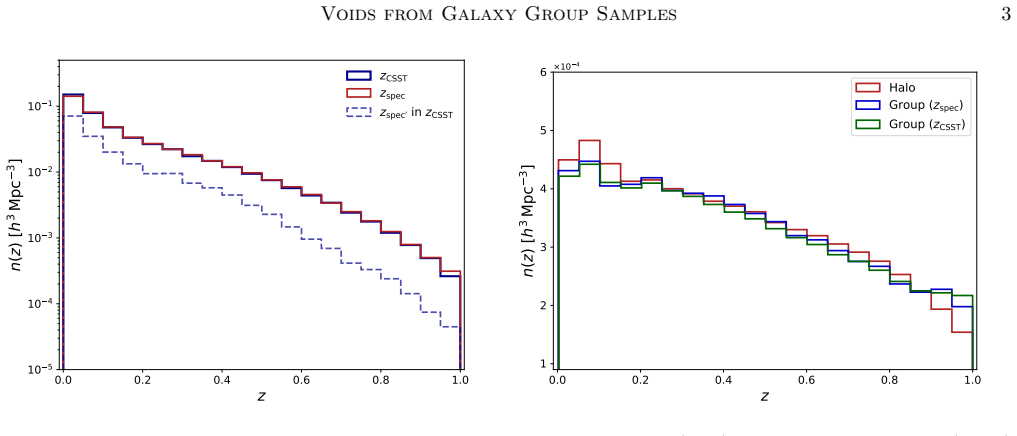
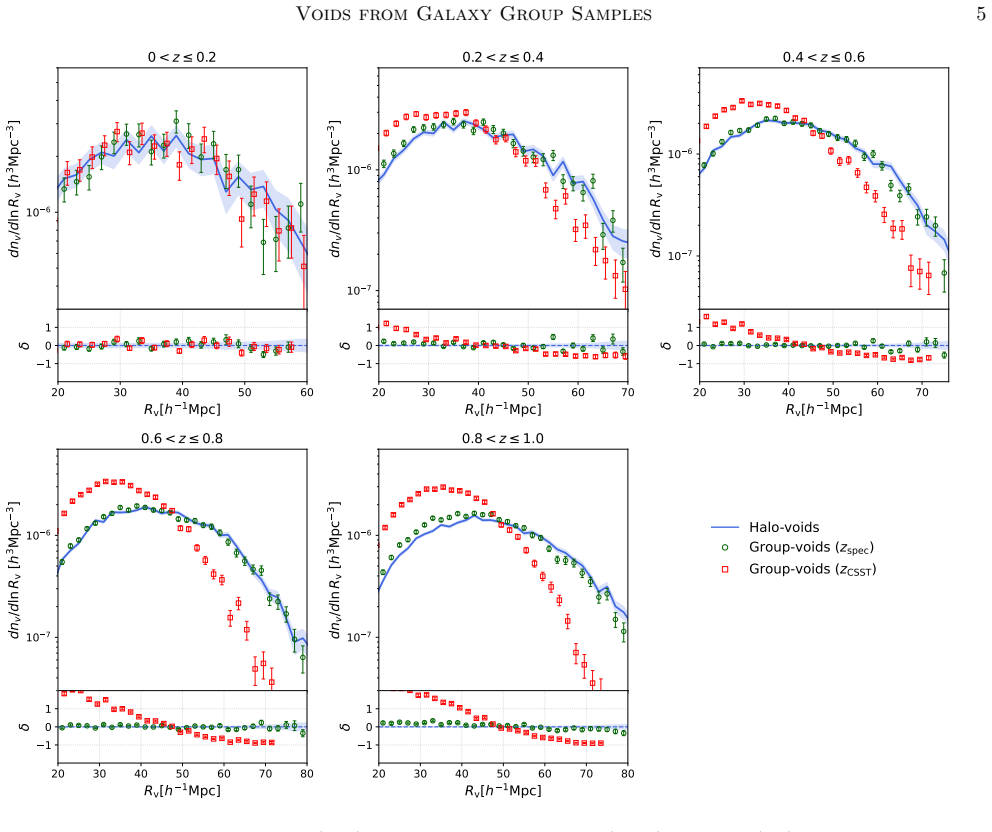
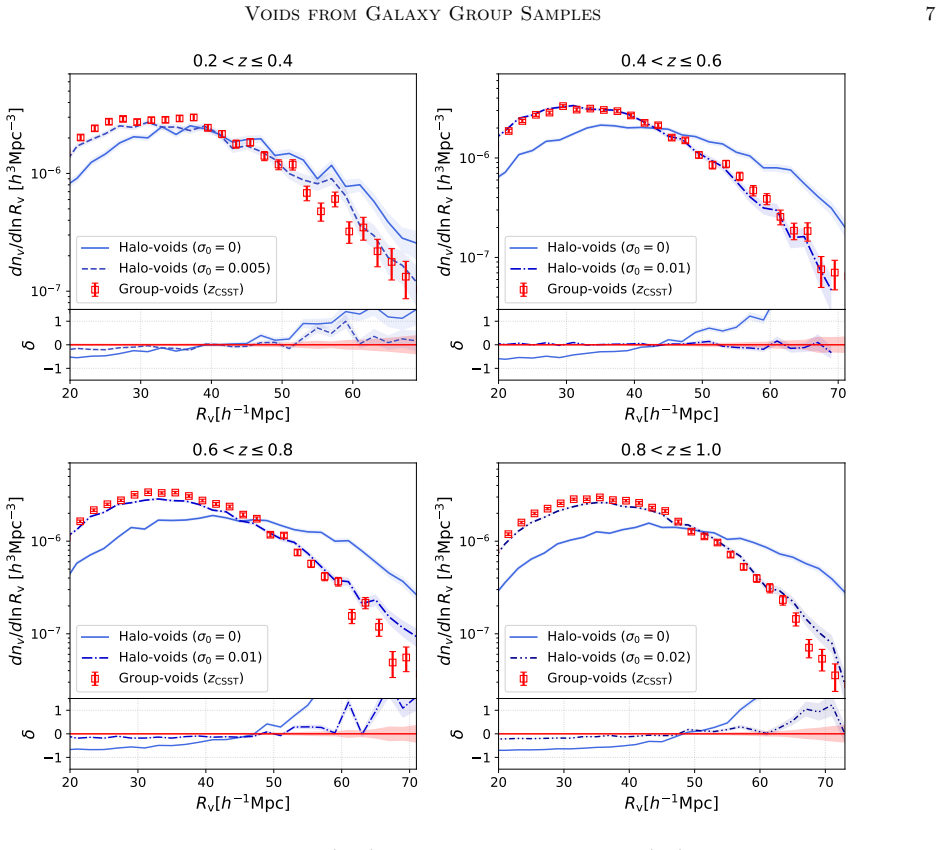
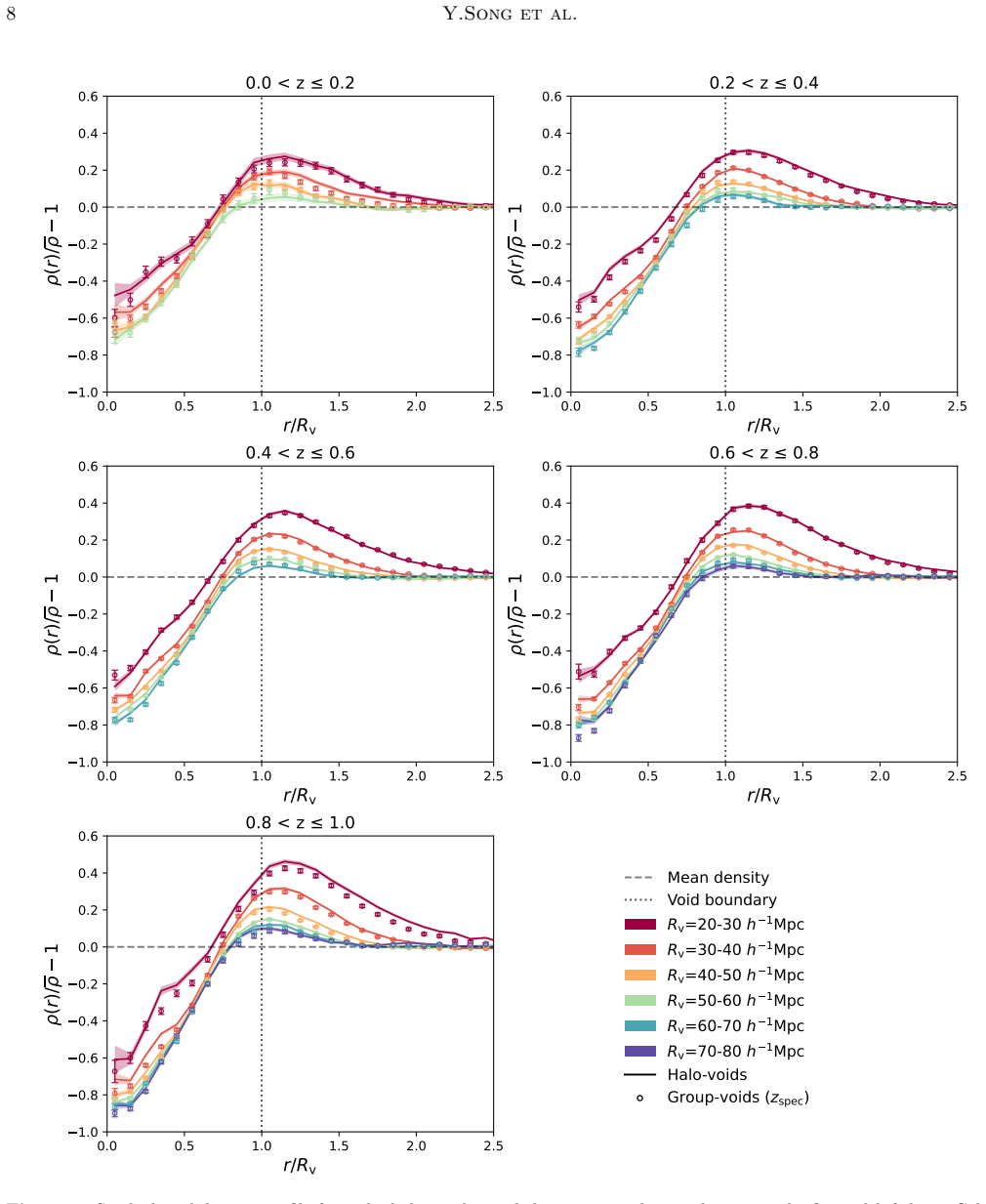
Voids identified in mock galaxy group catalogs with spectroscopic redshift completeness of at least 40 percent produce void size functions and density profiles that faithfully match those measured in the underlying halo catalog; even at 30 percent completeness the match holds once a redshift error term is included. The brightest central galaxy is adopted as the group center to improve void centering accuracy. These results are obtained in five redshift intervals from z=0 to 1.0 using the reference mock galaxy redshift survey for CSST.
What carries the argument
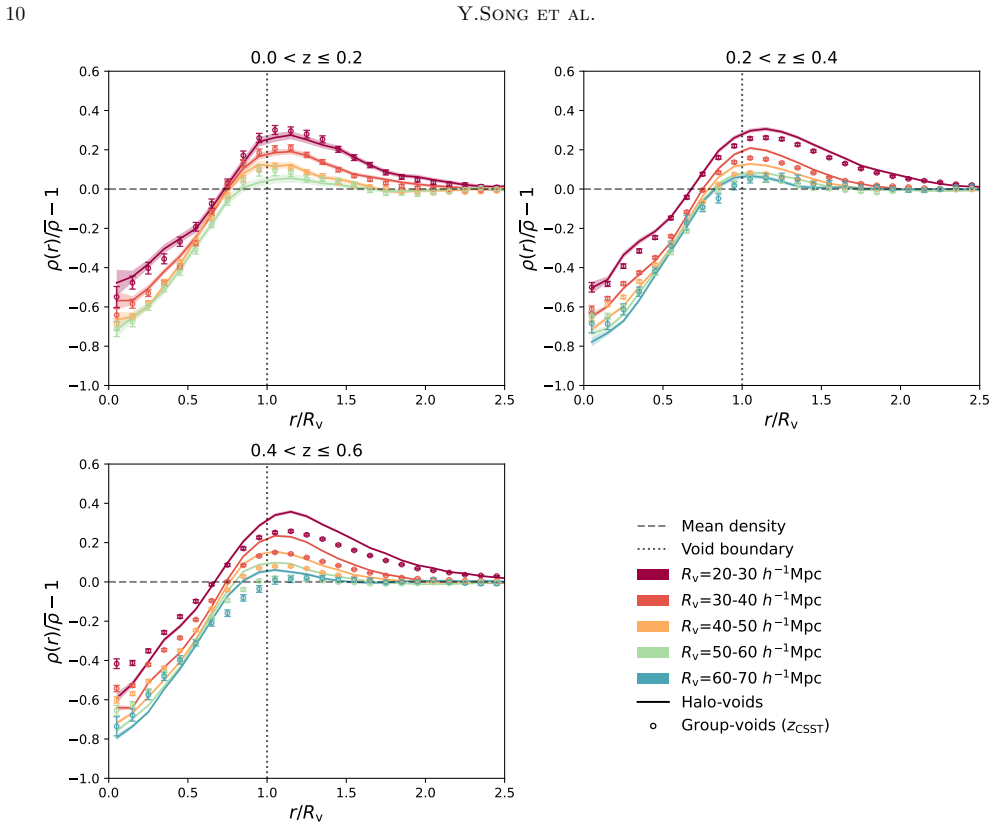
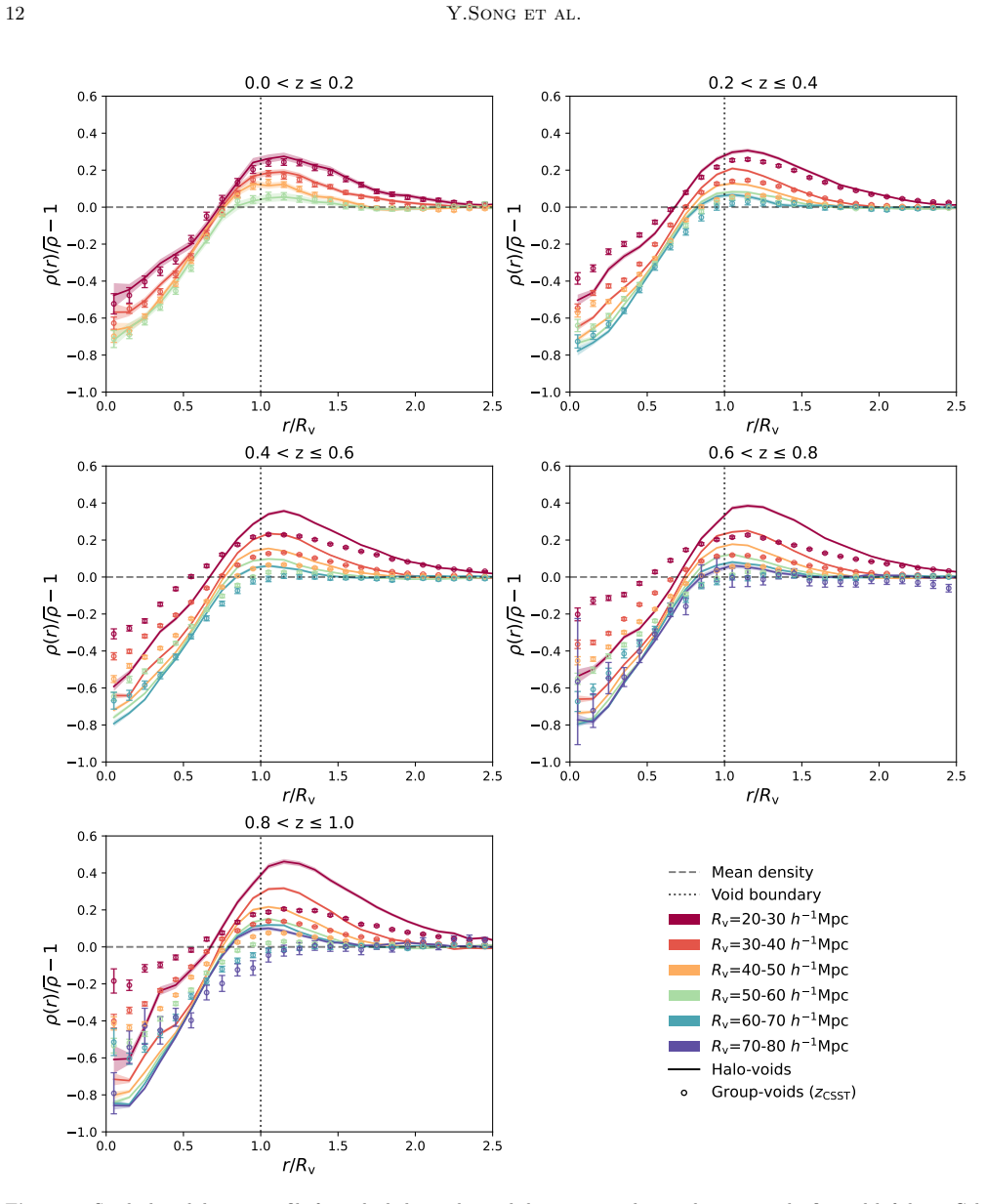
Comparison of the void size function and void density profile measured on voids found in galaxy group catalogs versus the parent halo catalog, with groups centered on brightest central galaxies.
If this is right
- Group-voids permit simpler theoretical modeling of large-scale structure than galaxy-based voids because groups associate directly with halos.
- The approach remains usable down to 30 percent redshift completeness once a redshift error correction is applied.
- Group-void catalogs offer a practical complement to standard void studies for surveys with incomplete spectroscopy.
- The method is especially advantageous for emulator-based cosmological analyses that rely on accurate void statistics.
Where Pith is reading between the lines
- The same group-void approach could be applied to existing or future surveys with similar completeness levels to test consistency with halo-based results.
- If the match holds in real data, void statistics from groups might reduce the need for full halo catalogs in large-volume cosmological forecasts.
- Extending the analysis to cross-correlations between group-voids and other tracers could tighten constraints on void evolution models.
Load-bearing premise
The mock galaxy redshift survey used as reference accurately captures how real galaxies map onto groups and halos and how the void finder behaves on catalogs of varying completeness.
What would settle it
A statistically significant mismatch between group-void and halo-void size functions or density profiles in real CSST data at known completeness above 40 percent would falsify the central claim.
Figures
read the original abstract
Because groups are directly associated with halos, they allow for considerably simpler theoretical modeling than approaches based on individual galaxies. We therefore propose to use voids identified in galaxy group catalogs, referred to as group-voids, to investigate the cosmic large-scale structure (LSS). Using the reference mock galaxy redshift survey (MGRS) designed for the Chinese Space-station Survey Telescope (CSST), we build two galaxy group catalogs representing ideal and conservative scenarios, derived from galaxy samples with 100\% and roughly 30\% spectroscopic redshift completeness, respectively. We then identify voids in these two mock group catalogs, as well as in the underlying halo catalog, and measure two void statistics, the void size function (VSF) and the void density profile, within five redshift intervals spanning $z=0$ to $1.0$. We compare the statistics obtained from two kinds of voids: those defined by galaxy groups (group-voids) and those defined by dark matter halos (halo-voids). In the void-finding process, we adopt the brightest central galaxy (BCG) as the group center to improve the accuracy of the inferred void centers. Our analysis shows that void statistics derived from group-voids with spectroscopic redshift completeness of at least 40\% can faithfully reproduce the corresponding statistics from halo-voids. Even when the redshift completeness of galaxies falls to as low as 30\%, we can still reliably describe group-voids via halo-voids by incorporating a redshift error term. This indicates that group-voids are a promising tool for probing LSS and offer a valuable complement to standard void studies, which is especially advantageous for emulator-based methods.
Editorial analysis
A structured set of objections, weighed in public.
Referee Report
Summary. The manuscript proposes using voids identified in galaxy group catalogs (group-voids) as probes of large-scale structure for the CSST survey. Using a single reference mock galaxy redshift survey (MGRS), it constructs group catalogs at high (100%) and low (~30%) spectroscopic completeness, identifies voids with BCG centering, and compares the void size function (VSF) and density profiles to those from the underlying halo catalog across five redshift bins from z=0 to 1. The central claim is that group-void statistics faithfully reproduce halo-void statistics at >=40% completeness, and remain reliable at 30% completeness when a redshift error term is incorporated.
Significance. If the results generalize beyond the specific MGRS, the approach would enable simpler theoretical modeling of void statistics by directly linking groups to halos, offering a practical complement to galaxy-based void studies. This could be especially advantageous for emulator-based methods in upcoming surveys with incomplete redshift data.
major comments (2)
- [Abstract] Abstract: The reported agreement in VSF and density profiles between group-voids and halo-voids (at >=40% completeness, and at 30% with redshift error term) is measured entirely inside one reference MGRS. No cross-checks against independent simulations, alternative group finders, or different incompleteness models are described. This is load-bearing for the claim that group-voids can be used as halo-void proxies in actual CSST data, as any systematic in the MGRS galaxy-to-group assignment or void-finder response would directly affect the quantitative match.
- [Abstract] Abstract (and associated methods/results sections): The incorporation of a 'redshift error term' to describe group-voids at 30% completeness is presented as a rescue mechanism, but without explicit details on its functional form, derivation, or quantitative impact on the statistics (e.g., how it modifies the VSF or profiles), it is unclear whether this correction is robust or mock-specific.
minor comments (1)
- [Abstract] The abstract states 'roughly 30%' completeness for the conservative catalog; specifying the exact value used in the analysis would improve precision.
Simulated Author's Rebuttal
We thank the referee for the constructive comments. We address each major point below and indicate planned revisions to improve clarity and scope the claims appropriately.
read point-by-point responses
-
Referee: [Abstract] Abstract: The reported agreement in VSF and density profiles between group-voids and halo-voids (at >=40% completeness, and at 30% with redshift error term) is measured entirely inside one reference MGRS. No cross-checks against independent simulations, alternative group finders, or different incompleteness models are described. This is load-bearing for the claim that group-voids can be used as halo-void proxies in actual CSST data, as any systematic in the MGRS galaxy-to-group assignment or void-finder response would directly affect the quantitative match.
Authors: The MGRS is the designated reference mock constructed specifically to replicate CSST survey characteristics, including galaxy selection, redshift distributions, and incompleteness. Our analysis demonstrates the viability of the group-void approach within this controlled and representative framework. We agree that broader validation would be valuable but lies outside the present scope. We will revise the abstract and add a dedicated limitations paragraph in the discussion to explicitly note that results are derived from this single MGRS and to qualify the generalization to actual CSST data. revision: partial
-
Referee: [Abstract] Abstract (and associated methods/results sections): The incorporation of a 'redshift error term' to describe group-voids at 30% completeness is presented as a rescue mechanism, but without explicit details on its functional form, derivation, or quantitative impact on the statistics (e.g., how it modifies the VSF or profiles), it is unclear whether this correction is robust or mock-specific.
Authors: We will expand the methods section with the explicit functional form of the redshift error term, its derivation from the mock redshift uncertainties, and quantitative demonstrations of its effect on both the VSF and stacked density profiles at 30% completeness. These additions will clarify the implementation and its impact within the MGRS. revision: yes
Circularity Check
No circularity detected; validation is a direct mock-internal comparison without reduction to fitted inputs or self-citations
full rationale
The paper constructs group catalogs from a reference MGRS mock at varying completeness levels, identifies voids in both group and halo catalogs using the same void finder, and directly measures VSF and density profiles for comparison. This constitutes an empirical test inside one simulation rather than a derivation that reduces by construction to its own inputs. No equations or steps are shown where a prediction is statistically forced by a prior fit, where an ansatz is smuggled via self-citation, or where a uniqueness theorem from the same authors is invoked to force the result. The central claim (group-voids reproduce halo-voids at >=40% completeness) is therefore a reported measurement outcome, not a tautology. Self-citation of the MGRS design paper, if present, is not load-bearing for the reported agreement itself.
Axiom & Free-Parameter Ledger
axioms (1)
- domain assumption The MGRS mock accurately represents CSST observations and the galaxy-group-halo correspondence.
Reference graph
Works this paper leans on
-
[1]
2022, MNRAS, 513, 186, doi: 10.1093/mnras/stac828
Aubert, M., Cousinou, M.-C., Escoffier, S., et al. 2022, MNRAS, 513, 186, doi: 10.1093/mnras/stac828
-
[2]
2023, A&A, 670, A47, doi: 10.1051/0004-6361/202244445
Bonici, M., Carbone, C., Davini, S., et al. 2023, A&A, 670, A47, doi: 10.1051/0004-6361/202244445
-
[3]
Cai, Y.-C., Taylor, A., Peacock, J. A., & Padilla, N. 2016, MNRAS, 462, 2465, doi: 10.1093/mnras/stw1809
-
[4]
2018, MNRAS, 476, 3195, doi: 10.1093/mnras/sty463
Cautun, M., Paillas, E., Cai, Y.-C., et al. 2018, MNRAS, 476, 3195, doi: 10.1093/mnras/sty463
-
[5]
2021, MNRAS, 504, 5021, doi: 10.1093/mnras/stab1112
Contarini, S., Marulli, F., Moscardini, L., et al. 2021, MNRAS, 504, 5021, doi: 10.1093/mnras/stab1112
-
[6]
2023, ApJ, 953, 46, doi: 10.3847/1538-4357/acde54 —
Contarini, S., Pisani, A., Hamaus, N., et al. 2023, ApJ, 953, 46, doi: 10.3847/1538-4357/acde54 —. 2024, A&A, 682, A20, doi: 10.1051/0004-6361/202347572
-
[7]
2019, MNRAS, 488, 3526, doi: 10.1093/mnras/stz1989
Contarini, S., Ronconi, T., Marulli, F., et al. 2019, MNRAS, 488, 3526, doi: 10.1093/mnras/stz1989
-
[8]
2022, A&A, 667, A162, doi: 10.1051/0004-6361/202244095
Contarini, S., Verza, G., Pisani, A., et al. 2022, A&A, 667, A162, doi: 10.1051/0004-6361/202244095
-
[9]
The DESI Experiment Part I: Science,Targeting, and Survey Design
Correa, C. M., Paz, D. J., S´ anchez, A. G., et al. 2021, MNRAS, 500, 911, doi: 10.1093/mnras/staa3252 CSST Collaboration, Gong, Y., Miao, H., et al. 2026, Science China Physics, Mechanics, and Astronomy, 69, 239501, doi: 10.1007/s11433-025-2809-0 DESI Collaboration, Aghamousa, A., Aguilar, J., et al. 2016, arXiv e-prints, arXiv:1611.00036, doi: 10.48550/...
work page internal anchor Pith review Pith/arXiv arXiv doi:10.1093/mnras/staa3252 2021
-
[10]
2022, The Journal of Open Source Software, 7, 4033, doi: 10.21105/joss.04033
Douglass, K., Veyrat, D., O’Neill, S., et al. 2022, The Journal of Open Source Software, 7, 4033, doi: 10.21105/joss.04033
-
[11]
2019, ApJ, 883, 203, doi: 10.3847/1538-4357/ab391e
Gong, Y., Liu, X., Cao, Y., et al. 2019, ApJ, 883, 203, doi: 10.3847/1538-4357/ab391e
-
[12]
2025, Science China
Gong, Y., Miao, H., Zhou, X., et al. 2025, Science China
2025
-
[13]
Physics, Mechanics, and Astronomy, 68, 280402, doi: 10.1007/s11433-025-2646-2
-
[14]
2024, MNRAS, 529, 4015, doi: 10.1093/mnras/stae762
Gu, Y., Yang, X., Han, J., et al. 2024, MNRAS, 529, 4015, doi: 10.1093/mnras/stae762
-
[15]
2022, A&A, 658, A20, doi: 10.1051/0004-6361/202142073
Hamaus, N., Aubert, M., Pisani, A., et al. 2022, A&A, 658, A20, doi: 10.1051/0004-6361/202142073
-
[16]
2025, Science China
Han, J., Li, M., Jiang, W., et al. 2025, Science China
2025
-
[17]
Physics, Mechanics, and Astronomy, 68, 109511, doi: 10.1007/s11433-025-2712-1
-
[18]
Mauland, R., Elgarøy, Ø., Mota, D. F., & Winther, H. A. 2023, A&A, 674, A185, doi: 10.1051/0004-6361/202346287 12Y.Song et al. 0.0 0.5 1.0 1.5 2.0 2.5 r/Rv 1.0 0.8 0.6 0.4 0.2 0.0 0.2 0.4 0.6 (r)/ 1 0.0 < z 0.2 0.0 0.5 1.0 1.5 2.0 2.5 r/Rv 1.0 0.8 0.6 0.4 0.2 0.0 0.2 0.4 0.6 (r)/ 1 0.2 < z 0.4 0.0 0.5 1.0 1.5 2.0 2.5 r/Rv 1.0 0.8 0.6 0.4 0.2 0.0 0.2 0.4 0...
-
[19]
2023, MNRAS, 519, 1132, doi: 10.1093/mnras/stac3583
Miao, H., Gong, Y., Chen, X., et al. 2023, MNRAS, 519, 1132, doi: 10.1093/mnras/stac3583
-
[20]
Nadathur, S., Carter, P. M., Percival, W. J., Winther, H. A., & Bautista, J. E. 2019, PhRvD, 100, 023504, doi: 10.1103/PhysRevD.100.023504
-
[21]
Nadathur, S., & Percival, W. J. 2019, MNRAS, 483, 3472, doi: 10.1093/mnras/sty3372
-
[22]
Neyrinck, M. C. 2008, MNRAS, 386, 2101, doi: 10.1111/j.1365-2966.2008.13180.x
-
[23]
2023, MNRAS, 522, 152, doi: 10.1093/mnras/stad956
Pelliciari, D., Contarini, S., Marulli, F., et al. 2023, MNRAS, 522, 152, doi: 10.1093/mnras/stad956
-
[24]
Peng, H., Yu, Y., Guo, Y., et al. 2026, arXiv e-prints, arXiv:2601.03883, doi: 10.48550/arXiv.2601.03883
work page internal anchor Pith review Pith/arXiv arXiv doi:10.48550/arxiv.2601.03883 2026
-
[25]
Pisani, A., Sutter, P. M., Hamaus, N., et al. 2015, PhRvD, 92, 083531, doi: 10.1103/PhysRevD.92.083531 Planck Collaboration, Aghanim, N., Akrami, Y., et al. 2020, A&A, 641, A6, doi: 10.1051/0004-6361/201833910
-
[26]
Platen, E., van de Weygaert, R., & Jones, B. J. T. 2007, MNRAS, 380, 551, doi: 10.1111/j.1365-2966.2007.12125.x
-
[27]
2017, MNRAS, 469, 787, doi: 10.1093/mnras/stx785
Pollina, G., Hamaus, N., Dolag, K., et al. 2017, MNRAS, 469, 787, doi: 10.1093/mnras/stx785
-
[28]
2019, MNRAS, 487, 2836, doi: 10.1093/mnras/stz1470 Radinovi´ c, S., Winther, H
Pollina, G., Hamaus, N., Paech, K., et al. 2019, MNRAS, 487, 2836, doi: 10.1093/mnras/stz1470 Radinovi´ c, S., Winther, H. A., Nadathur, S., et al. 2024, A&A, 691, A39, doi: 10.1051/0004-6361/202451358 Radinovi´ c, S., Nadathur, S., Winther, H. A., et al. 2023, A&A, 677, A78, doi: 10.1051/0004-6361/202346121
-
[29]
2019, MNRAS, 488, 5075, doi: 10.1093/mnras/stz2115 S´ anchez, C., Clampitt, J., Kovacs, A., et al
Moscardini, L. 2019, MNRAS, 488, 5075, doi: 10.1093/mnras/stz2115 S´ anchez, C., Clampitt, J., Kovacs, A., et al. 2017, MNRAS, 465, 746, doi: 10.1093/mnras/stw2745
-
[30]
2016, ApJ, 833, 241, doi: 10.3847/1538-4357/833/2/241 —
Shi, F., Yang, X., Wang, H., et al. 2016, ApJ, 833, 241, doi: 10.3847/1538-4357/833/2/241 —. 2018, ApJ, 861, 137, doi: 10.3847/1538-4357/aacb20
-
[31]
2025a, MNRAS, 538, 114, doi: 10.1093/mnras/staf305
Song, Y., Gong, Y., Xiong, Q., et al. 2025a, MNRAS, 538, 114, doi: 10.1093/mnras/staf305
-
[32]
2025b, MNRAS, 540, 2853, doi: 10.1093/mnras/staf918
Song, Y., Gong, Y., Zhou, X., et al. 2025b, MNRAS, 540, 2853, doi: 10.1093/mnras/staf918
-
[33]
2024a, MNRAS, 534, 128, doi: 10.1093/mnras/stae2094 —
Song, Y., Xiong, Q., Gong, Y., et al. 2024a, MNRAS, 534, 128, doi: 10.1093/mnras/stae2094 —. 2024b, MNRAS, 532, 1049, doi: 10.1093/mnras/stae1575 —. 2024c, ApJ, 976, 244, doi: 10.3847/1538-4357/ad8de9
-
[34]
2025, MNRAS, 538, 395, doi: 10.1093/mnras/staf304
Sui, J., Zou, H., Yang, X., et al. 2025, MNRAS, 538, 395, doi: 10.1093/mnras/staf304
-
[35]
M., Lavaux, G., Hamaus, N., et al
Sutter, P. M., Lavaux, G., Hamaus, N., et al. 2015, Astronomy and Computing, 9, 1, doi: 10.1016/j.ascom.2014.10.002
-
[36]
2024, ApJ, 969, 89, doi:10.3847/1538-4357/ad434e
Thiele, L., Massara, E., Pisani, A., et al. 2024, ApJ, 969, 89, doi: 10.3847/1538-4357/ad434e
-
[37]
2024, JCAP, 2024, 079, doi: 10.1088/1475-7516/2024/10/079
Matarrese, S. 2024, JCAP, 2024, 079, doi: 10.1088/1475-7516/2024/10/079
-
[38]
2025, ApJ, 993, 227, doi: 10.3847/1538-4357/ae07d9
Verza, G., Degni, G., Pisani, A., et al. 2025, ApJ, 993, 227, doi: 10.3847/1538-4357/ae07d9
-
[39]
2023, JCAP, 2023, 010, doi: 10.1088/1475-7516/2023/08/010
Baccigalupi, C. 2023, JCAP, 2023, 010, doi: 10.1088/1475-7516/2023/08/010
-
[40]
2021, MNRAS, 500, 464, doi: 10.1093/mnras/staa3231
Vielzeuf, P., Kov´ acs, A., Demirbozan, U., et al. 2021, MNRAS, 500, 464, doi: 10.1093/mnras/staa3231
-
[41]
2022, ApJ, 936, 161, doi: 10.3847/1538-4357/ac8986
Wang, J., Yang, X., Zhang, J., et al. 2022, ApJ, 936, 161, doi: 10.3847/1538-4357/ac8986
-
[42]
The Connection between Galaxies and their Dark Matter Halos
Wechsler, R. H., & Tinker, J. L. 2018, ARA&A, 56, 435, doi: 10.1146/annurev-astro-081817-051756
work page internal anchor Pith review doi:10.1146/annurev-astro-081817-051756 2018
-
[43]
Wen, R., Zheng, X. Z., Han, Y., et al. 2024, MNRAS, 528, 2770, doi: 10.1093/mnras/stae157
-
[44]
Woodfinden, A., Nadathur, S., Percival, W. J., et al. 2022, MNRAS, 516, 4307, doi: 10.1093/mnras/stac2475
-
[45]
Yang, X., Mo, H. J., van den Bosch, F. C., & Jing, Y. P. 2005, MNRAS, 356, 1293, doi: 10.1111/j.1365-2966.2005.08560.x
-
[46]
Yang, X., Mo, H. J., van den Bosch, F. C., et al. 2007, ApJ, 671, 153, doi: 10.1086/522027
-
[47]
2012, ApJ, 752, 41, doi: 10.1088/0004-637X/752/1/41
Han, J. 2012, ApJ, 752, 41, doi: 10.1088/0004-637X/752/1/41
-
[48]
2021, ApJ, 909, 143, doi: 10.3847/1538-4357/abddb2
Yang, X., Xu, H., He, M., et al. 2021, ApJ, 909, 143, doi: 10.3847/1538-4357/abddb2
-
[49]
2021, Chinese Science Bulletin, 66, 1290, doi: 10.1360/TB-2021-0016
Zhan, H. 2021, Chinese Science Bulletin, 66, 1290, doi: 10.1360/TB-2021-0016
-
[50]
2025, MNRAS, 539, 1692, doi: 10.1093/mnras/staf611
Zhang, Y., Yang, X., Guo, H., Wang, P., & Shi, F. 2025, MNRAS, 539, 1692, doi: 10.1093/mnras/staf611
-
[51]
Zhou, R., Newman, J. A., Mao, Y.-Y., et al. 2021, MNRAS, 501, 3309, doi: 10.1093/mnras/staa3764
-
[52]
2024, ApJ, 977, 69, doi: 10.3847/1538-4357/ad8bbf
Zhou, X., Gong, Y., Zhang, X., et al. 2024, ApJ, 977, 69, doi: 10.3847/1538-4357/ad8bbf
discussion (0)
Sign in with ORCID, Apple, or X to comment. Anyone can read and Pith papers without signing in.