Residual Decoder Adapter: ID-Preserving Tokenizer Adaption for Autoregressive Text Rendering
Pith reviewed 2026-06-28 15:36 UTC · model grok-4.3
The pith
A residual decoder adapter upgrades existing visual tokenizers to sharpen text rendering in autoregressive image models without retraining or altering tokens.
A machine-rendered reading of the paper's core claim, the machinery that carries it, and where it could break.
Core claim
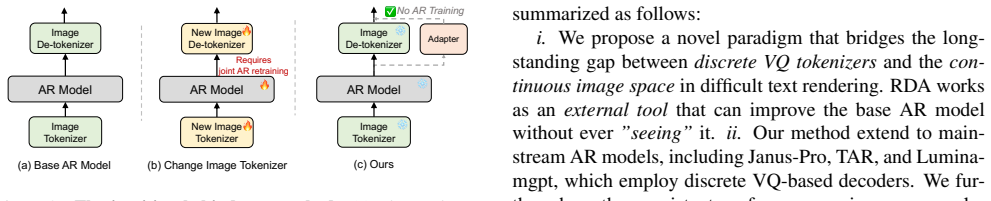
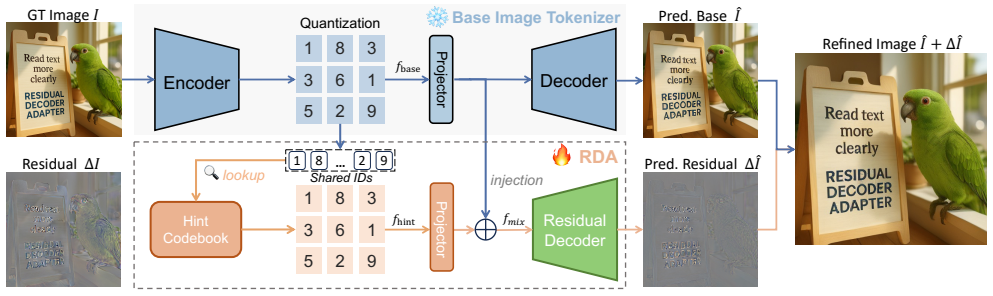
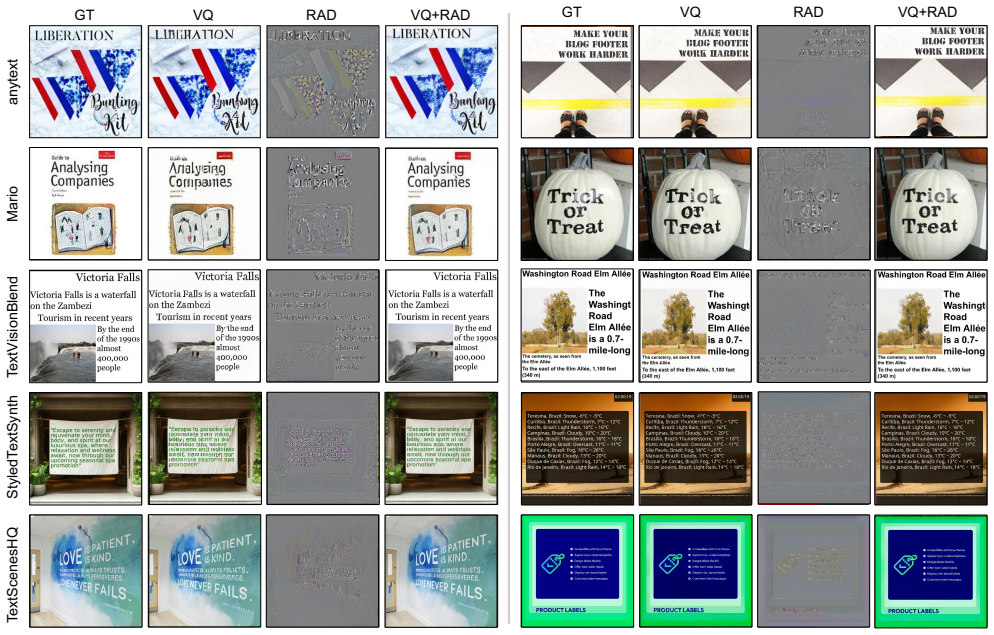
The Residual Decoder Adapter upgrades an existing visual tokenizer post-hoc without changing its token space by introducing a paired codebook that shares the original token distribution and a parallel branch that learns the tiny pixel-space differences between the reconstructed image and ground-truth images. This residual design enhances fine-grained reconstruction for text while preserving full compatibility with prior autoregressive models.
What carries the argument
The Residual Decoder Adapter, built from a paired codebook sharing the original token distribution and a parallel residual branch that corrects decoder output in pixel space.
If this is right
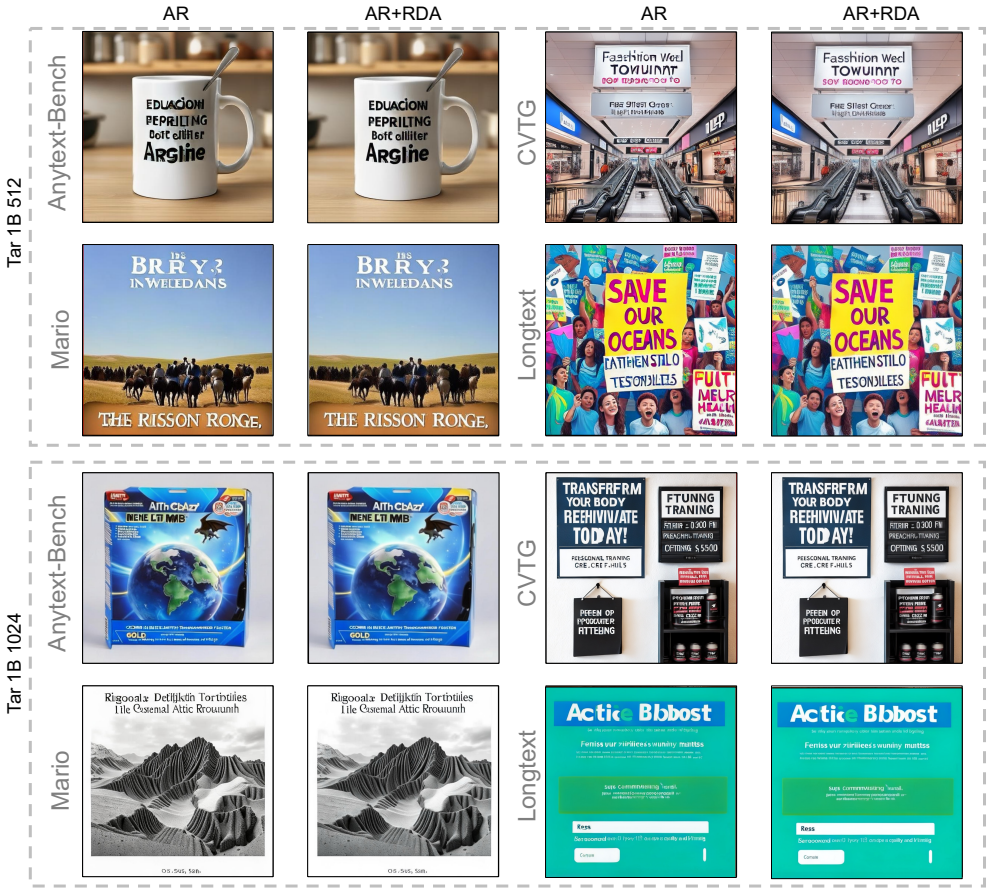
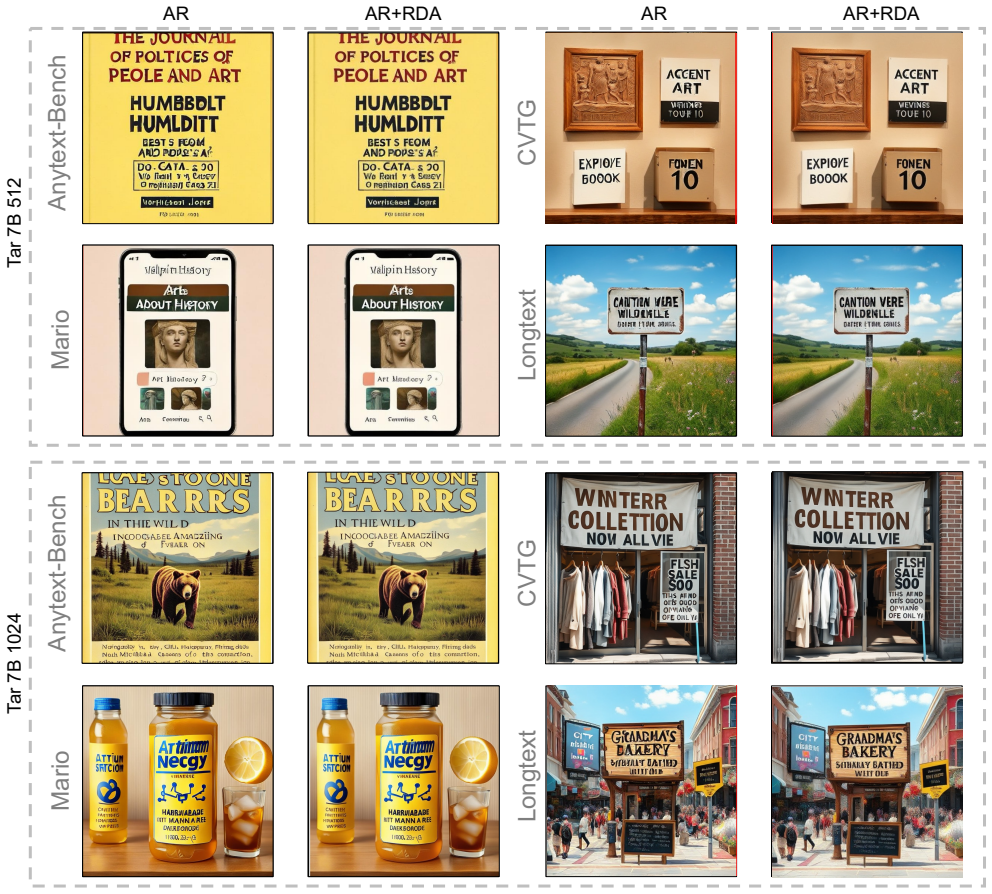
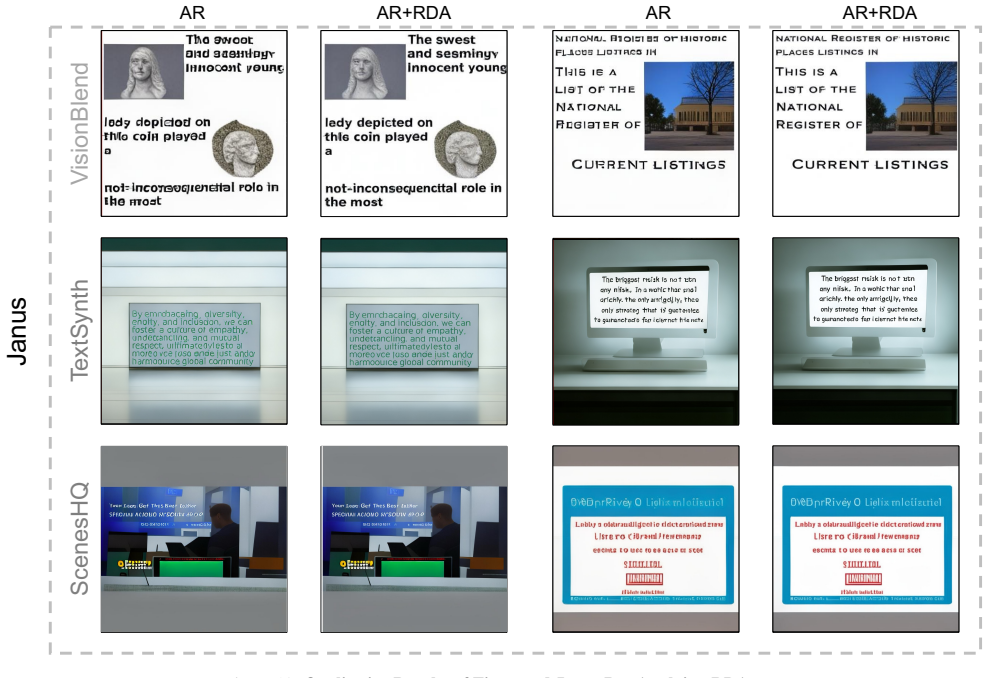
- Finetuned Janus-Pro OCR accuracy on TextVisionBlend rises from 24.52 percent to 58.26 percent.
- OCR accuracy on StyledTextSynth rises from 12.75 percent to 36.81 percent on the TextAtlas benchmark.
- The original token space remains unchanged so prior AR models continue to work without modification.
- Text rendering improves through better reconstruction of fine strokes and letter shapes.
Where Pith is reading between the lines
- The same residual correction could be tested on non-text fine details such as small object textures or facial features.
- Adoption of such adapters would reduce the need to retrain full AR pipelines when adapting to new visual domains.
- The approach might generalize to other autoregressive architectures beyond the ones evaluated here.
Load-bearing premise
A paired codebook sharing the original token distribution plus a parallel residual branch can be trained to correct fine-grained reconstruction errors while leaving the token space and downstream AR model completely unchanged.
What would settle it
Train the RDA on a visual tokenizer, attach it to a finetuned Janus-Pro model, and measure OCR accuracy on the TextVisionBlend subset of TextAtlas; if accuracy stays below 40 percent the improvement claim is falsified.
Figures







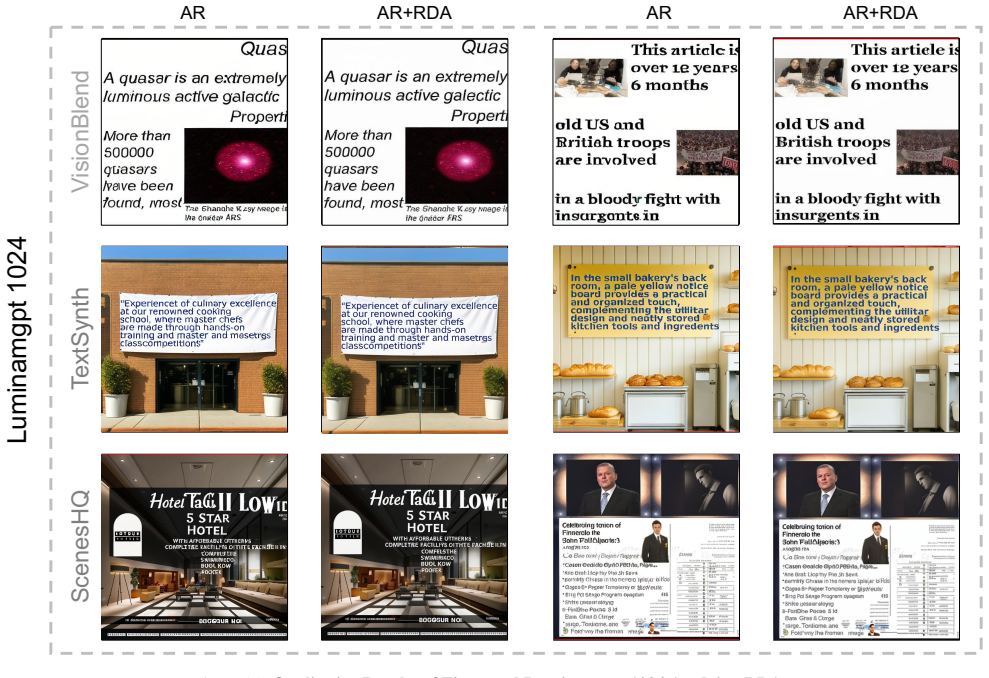
read the original abstract
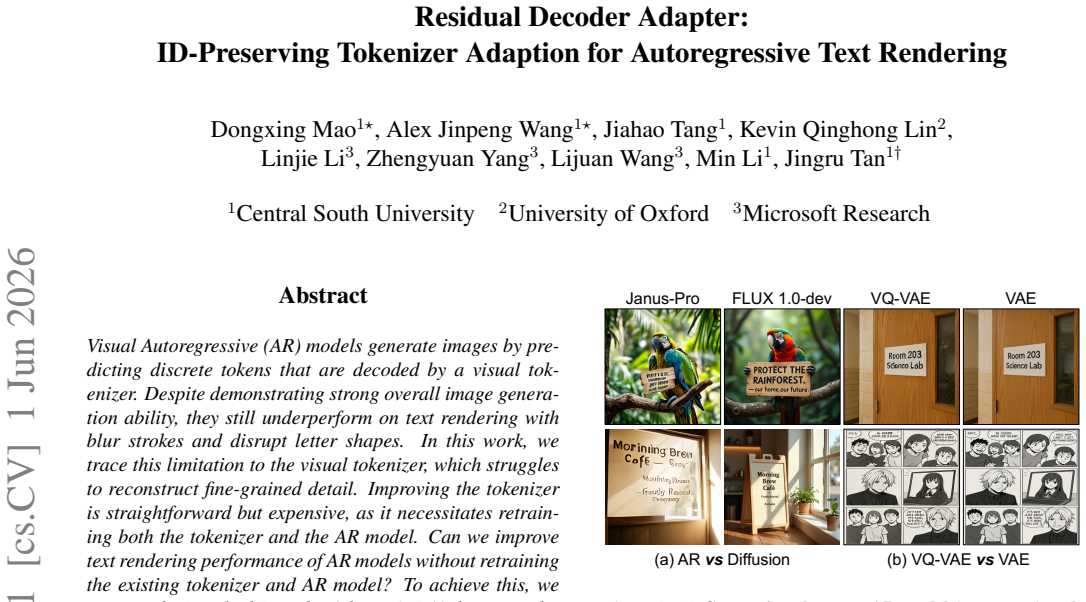
Visual Autoregressive (AR) models generate images by predicting discrete tokens that are decoded by a visual tokenizer. Despite demonstrating strong overall image generation ability, they still underperform on text rendering with blur strokes and disrupt letter shapes. In this work, we trace this limitation to the visual tokenizer, which struggles to reconstruct fine-grained detail. Improving the tokenizer is straightforward but expensive, as it necessitates retraining both the tokenizer and the AR model. Can we improve text rendering performance of AR models without retraining the existing tokenizer and AR model? To achieve this, we propose the Residual Decoder Adapter(RDA) that upgrades an existing tokenizer post-hoc without changing its token space. Specifically, it refines the decoder output of the visual tokenizer by introducing two novel components: (i) a paired codebook that shares the token distribution with the original one; (ii) a parallel branch to learn the tiny differences (residual) between the reconstructed image and the ground-truth images in the pixel space. This residual design allows us to enhance the tokenizer non-invasively while preserving compatibility with prior AR models. RDA substantially improves text rendering significantly by a large margin. For instance, we boost finetuned Janus-Pro OCR accuracy rises from 24.52% to 58.26% (TextVisionBlend), from 12.75% to 36.81% (StyledTextSynth) on competitive TextAtlas benchmark. The code is available at https://github.com/CSU-JPG/RDA
Editorial analysis
A structured set of objections, weighed in public.
Referee Report
Summary. The manuscript proposes the Residual Decoder Adapter (RDA) as a post-hoc module to improve text rendering quality in visual autoregressive (AR) models. RDA attaches to an existing visual tokenizer via a paired codebook (sharing the original token distribution) and a parallel residual branch that learns pixel-space differences between reconstructed and ground-truth images. The design is presented as non-invasive, preserving the original discrete token space and AR model compatibility while delivering large empirical gains, such as raising OCR accuracy on the TextAtlas benchmark from 24.52% to 58.26% (TextVisionBlend) and 12.75% to 36.81% (StyledTextSynth) for finetuned Janus-Pro.
Significance. If the compatibility premise holds and the reported gains are reproducible under the stated protocol, RDA would provide a low-cost route to upgrading deployed AR tokenizers for fine-grained tasks without retraining either the tokenizer or the downstream AR model. The public code release is a clear strength for verification.
major comments (3)
- [§3] §3 (RDA architecture): The paired codebook is described as sharing the token distribution, yet the text does not specify whether the encoder still produces exactly the same discrete indices at inference or whether the residual branch can alter index selection; this mechanism is load-bearing for the central claim of unchanged token space and AR compatibility.
- [§4] §4 (experiments): The OCR accuracy jumps are presented without training details for the adapter (loss terms, optimizer, epochs), number of runs, standard deviations, or controls that isolate the contribution of the paired codebook versus the residual branch; these omissions prevent verification that the gains support the non-invasive upgrade claim.
- [§3.1] §3.1 (paired codebook definition): No equation or pseudocode shows how the paired codebook is queried or combined with the original decoder output while guaranteeing identical token indices; without this, the assertion that the AR model requires “no modification” cannot be evaluated.
minor comments (2)
- [Abstract] Abstract: the sentence “we boost finetuned Janus-Pro OCR accuracy rises from” is grammatically incorrect and should be rephrased for clarity.
- Figure captions and tables lack explicit statements of whether reported OCR numbers use the exact evaluation protocol described in the text or any post-processing.
Simulated Author's Rebuttal
We thank the referee for the constructive feedback on our manuscript. The comments highlight important areas for clarification on the RDA mechanism and experimental reporting. We address each point below and will revise the manuscript accordingly to strengthen the presentation of the non-invasive upgrade claim.
read point-by-point responses
-
Referee: [§3] §3 (RDA architecture): The paired codebook is described as sharing the token distribution, yet the text does not specify whether the encoder still produces exactly the same discrete indices at inference or whether the residual branch can alter index selection; this mechanism is load-bearing for the central claim of unchanged token space and AR compatibility.
Authors: The original encoder remains frozen and unchanged; it produces the discrete indices exactly as before, and these indices are passed directly to both the original decoder and the adapter. The residual branch operates strictly in pixel space on the decoded output and has no access to or influence over the discrete token selection. The paired codebook shares the same distribution but is queried only within the adapter for refinement. We will add explicit text and a flowchart in the revised §3 to make this separation unambiguous. revision: yes
-
Referee: [§4] §4 (experiments): The OCR accuracy jumps are presented without training details for the adapter (loss terms, optimizer, epochs), number of runs, standard deviations, or controls that isolate the contribution of the paired codebook versus the residual branch; these omissions prevent verification that the gains support the non-invasive upgrade claim.
Authors: We agree that additional experimental details are necessary for reproducibility. The revised manuscript will include the complete training protocol for the adapter (loss formulation, optimizer, learning rate schedule, and epochs), results averaged over multiple random seeds with standard deviations, and ablation experiments that separately disable the paired codebook and the residual branch to quantify their individual contributions. revision: yes
-
Referee: [§3.1] §3.1 (paired codebook definition): No equation or pseudocode shows how the paired codebook is queried or combined with the original decoder output while guaranteeing identical token indices; without this, the assertion that the AR model requires “no modification” cannot be evaluated.
Authors: We will insert a precise mathematical formulation and pseudocode in §3.1 that defines the index generation step (unchanged from the original tokenizer) and shows how the paired codebook output is added only at the pixel level after decoding. This will explicitly demonstrate that the AR model continues to operate on the original discrete token sequence without any architectural or input changes. revision: yes
Circularity Check
No circularity: empirical adapter proposal validated on external benchmarks
full rationale
The paper proposes an architectural adapter (paired codebook + residual branch) and reports measured OCR accuracy gains on TextAtlas benchmarks. No equations, parameter-fitting derivations, or load-bearing self-citations appear in the provided text. The compatibility claim (unchanged token space) is an engineering premise tested by downstream AR model reuse rather than a quantity derived from the adapter itself. Improvements are presented as experimental outcomes, not quantities forced by construction from fitted inputs or prior author results. This is a standard self-contained empirical contribution.
Axiom & Free-Parameter Ledger
invented entities (1)
-
Residual Decoder Adapter (RDA)
no independent evidence
Reference graph
Works this paper leans on
-
[1]
Efficient-vqgan: To- wards high-resolution image generation with efficient vision transformers
Shiyue Cao, Yueqin Yin, Lianghua Huang, Yu Liu, Xin Zhao, Deli Zhao, and Kaigi Huang. Efficient-vqgan: To- wards high-resolution image generation with efficient vision transformers. InProceedings of the IEEE/CVF International Conference on Computer Vision, pages 7368–7377, 2023. 2
2023
-
[2]
Huiwen Chang, Han Zhang, Lu Jiang, Ce Liu, and William T. Freeman. Maskgit: Masked generative image transformer, 2022. 2
2022
-
[3]
Softvq-vae: Efficient 1-dimensional contin- uous tokenizer
Hao Chen, Ze Wang, Xiang Li, Ximeng Sun, Fangyi Chen, Jiang Liu, Jindong Wang, Bhiksha Raj, Zicheng Liu, and Emad Barsoum. Softvq-vae: Efficient 1-dimensional contin- uous tokenizer. InProceedings of the Computer Vision and Pattern Recognition Conference, pages 28358–28370, 2025. 2
2025
-
[4]
Textdiffuser: Diffusion models as text painters, 2023
Jingye Chen, Yupan Huang, Tengchao Lv, Lei Cui, Qifeng Chen, and Furu Wei. Textdiffuser: Diffusion models as text painters, 2023. 2, 5
2023
-
[5]
Blip3- o: A family of fully open unified multimodal models- architecture, training and dataset, 2025
Jiuhai Chen, Zhiyang Xu, Xichen Pan, Yushi Hu, Can Qin, Tom Goldstein, Lifu Huang, Tianyi Zhou, Saining Xie, Sil- vio Savarese, Le Xue, Caiming Xiong, and Ran Xu. Blip3- o: A family of fully open unified multimodal models- architecture, training and dataset, 2025. 2
2025
-
[6]
Janus- pro: Unified multimodal understanding and generation with data and model scaling, 2025
Xiaokang Chen, Zhiyu Wu, Xingchao Liu, Zizheng Pan, Wen Liu, Zhenda Xie, Xingkai Yu, and Chong Ruan. Janus- pro: Unified multimodal understanding and generation with data and model scaling, 2025. 1, 2
2025
-
[7]
Paddleocr-vl: Boosting multilingual document parsing via a 0.9b ultra-compact vision-language model, 2025
Cheng Cui, Ting Sun, Suyin Liang, Tingquan Gao, Zelun Zhang, Jiaxuan Liu, Xueqing Wang, Changda Zhou, Hongen Liu, Manhui Lin, Yue Zhang, Yubo Zhang, Handong Zheng, Jing Zhang, Jun Zhang, Yi Liu, Dianhai Yu, and Yanjun Ma. Paddleocr-vl: Boosting multilingual document parsing via a 0.9b ultra-compact vision-language model, 2025. 5
2025
-
[8]
Paddleocr 3.0 technical report, 2025
Cheng Cui, Ting Sun, Manhui Lin, Tingquan Gao, Yubo Zhang, Jiaxuan Liu, Xueqing Wang, Zelun Zhang, Changda Zhou, Hongen Liu, Yue Zhang, Wenyu Lv, Kui Huang, Yichao Zhang, Jing Zhang, Jun Zhang, Yi Liu, Dianhai Yu, and Yanjun Ma. Paddleocr 3.0 technical report, 2025. 5
2025
-
[9]
Emerging properties in unified multimodal pretraining, 2025
Chaorui Deng, Deyao Zhu, Kunchang Li, Chenhui Gou, Feng Li, Zeyu Wang, Shu Zhong, Weihao Yu, Xiaonan Nie, Ziang Song, Guang Shi, and Haoqi Fan. Emerging properties in unified multimodal pretraining, 2025. 1, 2
2025
-
[10]
Cogview: Mastering text-to- image generation via transformers, 2021
Ming Ding, Zhuoyi Yang, Wenyi Hong, Wendi Zheng, Chang Zhou, Da Yin, Junyang Lin, Xu Zou, Zhou Shao, Hongxia Yang, and Jie Tang. Cogview: Mastering text-to- image generation via transformers, 2021. 2
2021
-
[11]
Textcrafter: Accurately rendering multiple texts in complex visual scenes, 2025
Nikai Du, Zhennan Chen, Shan Gao, Zhizhou Chen, Xi Chen, Zhengkai Jiang, Jian Yang, and Ying Tai. Textcrafter: Accurately rendering multiple texts in complex visual scenes, 2025. 2, 5
2025
-
[12]
Taming transformers for high-resolution image synthesis, 2021
Patrick Esser, Robin Rombach, and Bj ¨orn Ommer. Taming transformers for high-resolution image synthesis, 2021. 1, 2
2021
-
[13]
D-ar: Diffusion via au- toregressive models, 2025
Ziteng Gao and Mike Zheng Shou. D-ar: Diffusion via au- toregressive models, 2025. 2
2025
-
[14]
X-omni: Reinforcement learning makes discrete autoregressive image generative models great again, 2025
Zigang Geng, Yibing Wang, Yeyao Ma, Chen Li, Yongming Rao, Shuyang Gu, Zhao Zhong, Qinglin Lu, Han Hu, Xi- aosong Zhang, Linus, Di Wang, and Jie Jiang. X-omni: Reinforcement learning makes discrete autoregressive image generative models great again, 2025. 2, 5
2025
-
[15]
arXiv preprint arXiv:2506.18898 (2025) 11, 12
Jiaming Han, Hao Chen, Yang Zhao, Hanyu Wang, Qi Zhao, Ziyan Yang, Hao He, Xiangyu Yue, and Lu Jiang. Vi- sion as a dialect: Unifying visual understanding and gen- eration via text-aligned representations.arXiv preprint arXiv:2506.18898, 2025. 2, 5
-
[16]
Flowtok: Flowing seamlessly across text and image tokens
Ju He, Qihang Yu, Qihao Liu, and Liang-Chieh Chen. Flow- tok: Flowing seamlessly across text and image tokens.arXiv preprint arXiv:2503.10772, 2025. 2
-
[17]
Rear: Rethinking visual autoregressive models via generator-tokenizer consistency regularization, 2025
Qiyuan He, Yicong Li, Haotian Ye, Jinghao Wang, Xinyao Liao, Pheng-Ann Heng, Stefano Ermon, James Zou, and An- gela Yao. Rear: Rethinking visual autoregressive models via generator-tokenizer consistency regularization, 2025. 3
2025
-
[18]
Plangen: Towards unified layout planning and image generation in auto-regressive vision language models,
Runze He, Bo Cheng, Yuhang Ma, Qingxiang Jia, Shanyuan Liu, Ao Ma, Xiaoyu Wu, Liebucha Wu, Dawei Leng, and Yuhui Yin. Plangen: Towards unified layout planning and image generation in auto-regressive vision language models,
-
[19]
Denoising diffu- sion probabilistic models, 2020
Jonathan Ho, Ajay Jain, and Pieter Abbeel. Denoising diffu- sion probabilistic models, 2020. 2
2020
-
[20]
Flux.https://github.com/ black-forest-labs/flux, 2024
Black Forest Labs. Flux.https://github.com/ black-forest-labs/flux, 2024. 1
2024
-
[21]
Unleashing in-context learning of autoregressive models for few-shot image manipulation
Bolin Lai, Felix Juefei-Xu, Miao Liu, Xiaoliang Dai, Nikhil Mehta, Chenguang Zhu, Zeyi Huang, James M Rehg, Sang- min Lee, Ning Zhang, et al. Unleashing in-context learning of autoregressive models for few-shot image manipulation. InProceedings of the Computer Vision and Pattern Recogni- tion Conference, pages 18346–18357, 2025. 2
2025
-
[22]
Photo-realistic single image super-resolution using a generative adversarial network, 2017
Christian Ledig, Lucas Theis, Ferenc Huszar, Jose Caballero, Andrew Cunningham, Alejandro Acosta, Andrew Aitken, Alykhan Tejani, Johannes Totz, Zehan Wang, and Wenzhe Shi. Photo-realistic single image super-resolution using a generative adversarial network, 2017. 4
2017
-
[23]
Draft-and-revise: Effective image gen- eration with contextual rq-transformer.Advances in Neural Information Processing Systems, 35:30127–30138, 2022
Doyup Lee, Chiheon Kim, Saehoon Kim, Minsu Cho, and WOOK SHIN HAN. Draft-and-revise: Effective image gen- eration with contextual rq-transformer.Advances in Neural Information Processing Systems, 35:30127–30138, 2022. 2
2022
-
[24]
Autoregressive image generation using residual quantization, 2022
Doyup Lee, Chiheon Kim, Saehoon Kim, Minsu Cho, and Wook-Shin Han. Autoregressive image generation using residual quantization, 2022. 2
2022
-
[25]
Vt- bench: Evaluating visual tokenizers for autoregressive image generation, 2025
Huawei Lin, Tong Geng, Zhaozhuo Xu, and Weijie Zhao. Vt- bench: Evaluating visual tokenizers for autoregressive image generation, 2025. 1
2025
-
[26]
Lumina-mgpt: Illuminate flexible photorealistic text- to-image generation with multimodal generative pretraining,
Dongyang Liu, Shitian Zhao, Le Zhuo, Weifeng Lin, Yi Xin, Xinyue Li, Qi Qin, Yu Qiao, Hongsheng Li, and Peng Gao. Lumina-mgpt: Illuminate flexible photorealistic text- to-image generation with multimodal generative pretraining,
-
[27]
Decoupled weight decay regularization, 2019
Ilya Loshchilov and Frank Hutter. Decoupled weight decay regularization, 2019. 5
2019
-
[28]
Open- magvit2: An open-source project toward democratizing auto-regressive visual generation
Zhuoyan Luo, Fengyuan Shi, Yixiao Ge, Yujiu Yang, Limin Wang, and Ying Shan. Open-magvit2: An open-source project toward democratizing auto-regressive visual gener- ation.arXiv preprint arXiv:2409.04410, 2024. 2
-
[29]
Unitok: A uni- 9 fied tokenizer for visual generation and understanding, 2025
Chuofan Ma, Yi Jiang, Junfeng Wu, Jihan Yang, Xin Yu, Ze- huan Yuan, Bingyue Peng, and Xiaojuan Qi. Unitok: A uni- 9 fied tokenizer for visual generation and understanding, 2025. 2, 3, 5, 6
2025
-
[30]
Textground4m: A prompt-aligned dataset for layout-aware text rendering.Proceedings of the AAAI Conference on Artificial Intelligence, 40(10): 7918–7926, 2026
Dongxing Mao, Yilin Wang, Linjie Li, Zhengyuan Yang, and Alex Jinpeng Wang. Textground4m: A prompt-aligned dataset for layout-aware text rendering.Proceedings of the AAAI Conference on Artificial Intelligence, 40(10): 7918–7926, 2026. 2
2026
-
[31]
Hello gpt-4o, 2024
OpenAI. Hello gpt-4o, 2024. Accessed: 2024-09-09. 1
2024
-
[32]
Janus-pro-r1: Ad- vancing collaborative visual comprehension and generation via reinforcement learning, 2025
Kaihang Pan, Yang Wu, Wendong Bu, Kai Shen, Juncheng Li, Yingting Wang, Yunfei Li, Siliang Tang, Jun Xiao, Fei Wu, Hang Zhao, and Yueting Zhuang. Janus-pro-r1: Ad- vancing collaborative visual comprehension and generation via reinforcement learning, 2025. 2
2025
-
[33]
Im- age transformer
Niki Parmar, Ashish Vaswani, Jakob Uszkoreit, Lukasz Kaiser, Noam Shazeer, Alexander Ku, and Dustin Tran. Im- age transformer. InInternational conference on machine learning, pages 4055–4064. PMLR, 2018. 2
2018
-
[34]
Scalable diffusion models with transformers, 2023
William Peebles and Saining Xie. Scalable diffusion models with transformers, 2023. 2
2023
-
[35]
Du, Zehuan Yuan, and Xin- glong Wu
Liao Qu, Huichao Zhang, Yiheng Liu, Xu Wang, Yi Jiang, Yiming Gao, Hu Ye, Daniel K. Du, Zehuan Yuan, and Xin- glong Wu. Tokenflow: Unified image tokenizer for multi- modal understanding and generation, 2025. 2
2025
-
[36]
Zero-shot text-to-image generation, 2021
Aditya Ramesh, Mikhail Pavlov, Gabriel Goh, Scott Gray, Chelsea V oss, Alec Radford, Mark Chen, and Ilya Sutskever. Zero-shot text-to-image generation, 2021. 2
2021
-
[37]
Gener- ating diverse high-fidelity images with vq-vae-2, 2019
Ali Razavi, Aaron van den Oord, and Oriol Vinyals. Gener- ating diverse high-fidelity images with vq-vae-2, 2019. 2
2019
-
[38]
High-resolution image syn- thesis with latent diffusion models, 2022
Robin Rombach, Andreas Blattmann, Dominik Lorenz, Patrick Esser, and Bj¨orn Ommer. High-resolution image syn- thesis with latent diffusion models, 2022. 1, 2
2022
-
[39]
Sara Mahdavi, Rapha Gontijo Lopes, Tim Salimans, Jonathan Ho, David J Fleet, and Mohammad Norouzi
Chitwan Saharia, William Chan, Saurabh Saxena, Lala Li, Jay Whang, Emily Denton, Seyed Kamyar Seyed Ghasemipour, Burcu Karagol Ayan, S. Sara Mahdavi, Rapha Gontijo Lopes, Tim Salimans, Jonathan Ho, David J Fleet, and Mohammad Norouzi. Photorealistic text-to-image diffusion models with deep language understanding, 2022. 2
2022
-
[40]
Very deep convo- lutional networks for large-scale image recognition, 2015
Karen Simonyan and Andrew Zisserman. Very deep convo- lutional networks for large-scale image recognition, 2015. 4
2015
-
[41]
Denois- ing diffusion implicit models, 2022
Jiaming Song, Chenlin Meng, and Stefano Ermon. Denois- ing diffusion implicit models, 2022. 2
2022
-
[42]
Autoregressive model beats diffusion: Llama for scalable image generation, 2024
Peize Sun, Yi Jiang, Shoufa Chen, Shilong Zhang, Bingyue Peng, Ping Luo, and Zehuan Yuan. Autoregressive model beats diffusion: Llama for scalable image generation, 2024. 2, 5, 1
2024
-
[43]
Chameleon: Mixed-modal early-fusion foundation models, 2025
Chameleon Team. Chameleon: Mixed-modal early-fusion foundation models, 2025. 1, 2, 5, 3
2025
-
[44]
Visual autoregressive modeling: Scalable image generation via next-scale prediction
Keyu Tian, Yi Jiang, Zehuan Yuan, Bingyue Peng, and Li- wei Wang. Visual autoregressive modeling: Scalable image generation via next-scale prediction. InAdvances in Neural Information Processing Systems, pages 84839–84865. Cur- ran Associates, Inc., 2024. 1
2024
-
[45]
Metamorph: Multimodal un- derstanding and generation via instruction tuning, 2024
Shengbang Tong, David Fan, Jiachen Zhu, Yunyang Xiong, Xinlei Chen, Koustuv Sinha, Michael Rabbat, Yann LeCun, Saining Xie, and Zhuang Liu. Metamorph: Multimodal un- derstanding and generation via instruction tuning, 2024. 2
2024
-
[46]
Anytext: Multilingual visual text gener- ation and editing, 2024
Yuxiang Tuo, Wangmeng Xiang, Jun-Yan He, Yifeng Geng, and Xuansong Xie. Anytext: Multilingual visual text gener- ation and editing, 2024. 2, 5
2024
-
[47]
Neural discrete representation learning,
Aaron van den Oord, Oriol Vinyals, and Koray Kavukcuoglu. Neural discrete representation learning,
-
[48]
Gomez, Lukasz Kaiser, and Illia Polosukhin
Ashish Vaswani, Noam Shazeer, Niki Parmar, Jakob Uszko- reit, Llion Jones, Aidan N. Gomez, Lukasz Kaiser, and Illia Polosukhin. Attention is all you need, 2023. 2
2023
-
[49]
Beyond words: Advancing long-text im- age generation via multimodal autoregressive models, 2025
Alex Jinpeng Wang, Linjie Li, Zhengyuan Yang, Lijuan Wang, and Min Li. Beyond words: Advancing long-text im- age generation via multimodal autoregressive models, 2025. 1
2025
-
[50]
Textat- las5m: A large-scale dataset for dense text image generation,
Alex Jinpeng Wang, Dongxing Mao, Jiawei Zhang, Weiming Han, Zhuobai Dong, Linjie Li, Yiqi Lin, Zhengyuan Yang, Libo Qin, Fuwei Zhang, Lijuan Wang, and Min Li. Textat- las5m: A large-scale dataset for dense text image generation,
-
[51]
Emu3: Next-token prediction is all you need, 2024
Xinlong Wang, Xiaosong Zhang, Zhengxiong Luo, Quan Sun, Yufeng Cui, Jinsheng Wang, Fan Zhang, Yueze Wang, Zhen Li, Qiying Yu, Yingli Zhao, Yulong Ao, Xuebin Min, Tao Li, Boya Wu, Bo Zhao, Bowen Zhang, Liangdong Wang, Guang Liu, Zheqi He, Xi Yang, Jingjing Liu, Yonghua Lin, Tiejun Huang, and Zhongyuan Wang. Emu3: Next-token prediction is all you need, 2024. 1, 2
2024
-
[52]
Edge-enhanced feature distillation network for efficient super-resolution, 2022
Yan Wang. Edge-enhanced feature distillation network for efficient super-resolution, 2022. 4
2022
-
[53]
Autoregressive visual tracking
Xing Wei, Yifan Bai, Yongchao Zheng, Dahu Shi, and Yi- hong Gong. Autoregressive visual tracking. InProceedings of the IEEE/CVF Conference on Computer Vision and Pat- tern Recognition (CVPR), pages 9697–9706, 2023. 2
2023
-
[54]
Janus: Decoupling visual encoding for unified multimodal understanding and genera- tion, 2024
Chengyue Wu, Xiaokang Chen, Zhiyu Wu, Yiyang Ma, Xingchao Liu, Zizheng Pan, Wen Liu, Zhenda Xie, Xingkai Yu, Chong Ruan, and Ping Luo. Janus: Decoupling visual encoding for unified multimodal understanding and genera- tion, 2024. 2
2024
-
[56]
Qwen-image technical report,
Chenfei Wu, Jiahao Li, Jingren Zhou, Junyang Lin, Kaiyuan Gao, Kun Yan, Sheng ming Yin, Shuai Bai, Xiao Xu, Yilei Chen, Yuxiang Chen, Zecheng Tang, Zekai Zhang, Zhengyi Wang, An Yang, Bowen Yu, Chen Cheng, Dayiheng Liu, De- qing Li, Hang Zhang, Hao Meng, Hu Wei, Jingyuan Ni, Kai Chen, Kuan Cao, Liang Peng, Lin Qu, Minggang Wu, Peng Wang, Shuting Yu, Tingk...
-
[57]
Vila-u: a unified founda- tion model integrating visual understanding and generation,
Yecheng Wu, Zhuoyang Zhang, Junyu Chen, Haotian Tang, Dacheng Li, Yunhao Fang, Ligeng Zhu, Enze Xie, Hongxu 10 Yin, Li Yi, Song Han, and Yao Lu. Vila-u: a unified founda- tion model integrating visual understanding and generation,
-
[58]
Yi Wu, Lingting Zhu, Shengju Qian, Lei Liu, Wandi Qiao, Lequan Yu, and Bin Li. Stylear: Customizing multimodal autoregressive model for style-aligned text-to-image genera- tion.arXiv preprint arXiv:2505.19874, 2025. 2
-
[59]
Sana: Efficient high-resolution im- age synthesis with linear diffusion transformers, 2024
Enze Xie, Junsong Chen, Junyu Chen, Han Cai, Haotian Tang, Yujun Lin, Zhekai Zhang, Muyang Li, Ligeng Zhu, Yao Lu, and Song Han. Sana: Efficient high-resolution im- age synthesis with linear diffusion transformers, 2024. 2
2024
-
[60]
Sana 1.5: Efficient scaling of training-time and inference-time compute in linear diffusion transformer,
Enze Xie, Junsong Chen, Yuyang Zhao, Jincheng Yu, Ligeng Zhu, Chengyue Wu, Yujun Lin, Zhekai Zhang, Muyang Li, Junyu Chen, Han Cai, Bingchen Liu, Daquan Zhou, and Song Han. Sana 1.5: Efficient scaling of training-time and inference-time compute in linear diffusion transformer,
-
[61]
Lumina-mgpt 2.0: Stand-alone autoregressive image model- ing, 2025
Yi Xin, Juncheng Yan, Qi Qin, Zhen Li, Dongyang Liu, Shicheng Li, Victor Shea-Jay Huang, Yupeng Zhou, Ren- rui Zhang, Le Zhuo, Tiancheng Han, Xiaoqing Sun, Siqi Luo, Mengmeng Wang, Bin Fu, Yuewen Cao, Hongsheng Li, Guangtao Zhai, Xiaohong Liu, Yu Qiao, and Peng Gao. Lumina-mgpt 2.0: Stand-alone autoregressive image model- ing, 2025. 2
2025
-
[62]
Gigatok: Scaling visual tokenizers to 3 billion parameters for autoregressive image generation, 2025
Tianwei Xiong, Jun Hao Liew, Zilong Huang, Jiashi Feng, and Xihui Liu. Gigatok: Scaling visual tokenizers to 3 billion parameters for autoregressive image generation, 2025. 2
2025
-
[63]
Vector-quantized image modeling with improved vqgan, 2022
Jiahui Yu, Xin Li, Jing Yu Koh, Han Zhang, Ruoming Pang, James Qin, Alexander Ku, Yuanzhong Xu, Jason Baldridge, and Yonghui Wu. Vector-quantized image modeling with improved vqgan, 2022. 2
2022
-
[64]
Randomized autoregressive visual generation
Qihang Yu, Ju He, Xueqing Deng, Xiaohui Shen, and Liang- Chieh Chen. Randomized autoregressive visual generation. InProceedings of the IEEE/CVF International Conference on Computer Vision (ICCV), pages 18431–18441, 2025. 2
2025
-
[65]
Regularized vector quantization for tokenized im- age synthesis
Jiahui Zhang, Fangneng Zhan, Christian Theobalt, and Shi- jian Lu. Regularized vector quantization for tokenized im- age synthesis. InProceedings of the IEEE/CVF Conference on Computer Vision and Pattern Recognition, pages 18467– 18476, 2023. 2
2023
-
[66]
Distill- ing inter-class distance for semantic segmentation.arXiv preprint arXiv:2205.03650, 2022
Zhengbo Zhang, Chunluan Zhou, and Zhigang Tu. Distill- ing inter-class distance for semantic segmentation.arXiv preprint arXiv:2205.03650, 2022. 3
-
[67]
Diff-tracker: text-to-image diffusion models are un- supervised trackers
Zhengbo Zhang, Li Xu, Duo Peng, Hossein Rahmani, and Jun Liu. Diff-tracker: text-to-image diffusion models are un- supervised trackers. InEuropean Conference on Computer Vision, pages 319–337. Springer, 2024
2024
-
[68]
Performing defocus deblurring by model- ing its formation process
Zhengbo Zhang, Lin Geng Foo, Hossein Rahmani, Jun Liu, and De Wen Soh. Performing defocus deblurring by model- ing its formation process. InProceedings of the IEEE/CVF International Conference on Computer Vision, pages 5791– 5801, 2025
2025
-
[69]
Visual prompting for one-shot controllable video editing without inversion
Zhengbo Zhang, Yuxi Zhou, Duo Peng, Joo-Hwee Lim, Zhi- gang Tu, De Wen Soh, and Lin Geng Foo. Visual prompting for one-shot controllable video editing without inversion. In Proceedings of the Computer Vision and Pattern Recognition Conference, pages 7784–7794, 2025. 3
2025
-
[70]
Movq: Modulating quantized vectors for high- fidelity image generation.Advances in Neural Information Processing Systems, 35:23412–23425, 2022
Chuanxia Zheng, Tung-Long Vuong, Jianfei Cai, and Dinh Phung. Movq: Modulating quantized vectors for high- fidelity image generation.Advances in Neural Information Processing Systems, 35:23412–23425, 2022. 2 11 Residual Decoder Adapter: ID-Preserving Tokenizer Adaption for Autoregressive Text Rendering Supplementary Material Contents
2022
-
[71]
Shared-ID Hint Codebook
Residual Decoder Adapter 3 4.1. Shared-ID Hint Codebook . . . . . . . . . . 3 4.2. Residual Decoder . . . . . . . . . . . . . . . 4 4.3. Training Objective and Optimization . . . . 4 4.4. Plug-and-Play Inference in AR model . . . . 5
-
[72]
Implementation details
Experiments 5 5.1. Implementation details . . . . . . . . . . . . 5 5.2. Evaluation Protocol . . . . . . . . . . . . . . 5 5.3. Main Results. . . . . . . . . . . . . . . . . . 5 5.4. Ablation Study . . . . . . . . . . . . . . . . 6 5.5. Discussion . . . . . . . . . . . . . . . . . . 7 5.6. Qualitative Results . . . . . . . . . . . . . . 8
-
[73]
Model Architecture
Implementation Details 1 7.1. Model Architecture . . . . . . . . . . . . . . 1 7.2. Training Configuration . . . . . . . . . . . . 1
-
[74]
Parameters and Latency
Computational Cost Analysis 2 8.1. Parameters and Latency . . . . . . . . . . . 2
-
[75]
Tokenizer Reconstruction Limit
Understanding the Bottleneck 2 9.1. Tokenizer Reconstruction Limit . . . . . . . 2 9.2. Dual Bottleneck in Text Rendering . . . . . 2 10 . Failure Case Analysis 2 10.1 . Tokenizer-Level Failures . . . . . . . . . . . 2 10.2 . AR Model-Level Failures . . . . . . . . . . 3 11 . Training Analysis 3 11.1 . Training Stability and Convergence . . . . . 3 12 . D...
-
[76]
Model Architecture Hint CodebookWe instantiate a paired codebook that mir- rors the size and index space of the original tokenizer code- book
Implementation Details 7.1. Model Architecture Hint CodebookWe instantiate a paired codebook that mir- rors the size and index space of the original tokenizer code- book. The embedding vectors are learned from scratch, but their indices remain aligned with the base codebook. Projector DesignWe use a lightweight1×1Conv2d to map hint-codebook embeddings (d ...
-
[77]
Parameters and Latency Tab
Computational Cost Analysis 8.1. Parameters and Latency Tab. 9 quantifies the computational overhead introduced by RDA on different AR models and tokenizers. All measure- ments are conducted in inference mode on a single V100 GPU. RDA introduces negligible overhead (<2%latency), while achieving substantial improvements in text rendering quality
-
[78]
Tokenizer Reconstruction Limit We verify that the base tokenizer exhibits inherent recon- struction limitations even when provided perfect ground- truth input
Understanding the Bottleneck 9.1. Tokenizer Reconstruction Limit We verify that the base tokenizer exhibits inherent recon- struction limitations even when provided perfect ground- truth input. Fig. 9 shows that the quantization-decoding process inherently loses fine-grained details, blurring text strokes and distorting glyph edges. This confirms that the...
-
[79]
Tokenizer-Level Failures When characters are extremely small or visually ambigu- ous, the tokenizer may assign incorrect visual tokens, lead- ing to unrecoverable errors
Failure Case Analysis We categorize failures into two types based on their source: 10.1. Tokenizer-Level Failures When characters are extremely small or visually ambigu- ous, the tokenizer may assign incorrect visual tokens, lead- ing to unrecoverable errors. Fig. 10 illustrates such cases. 2 Wrong textMass textText too small Figure 11.Failure Case of AR ...
-
[80]
Training Stability and Convergence Fig
Training Analysis 11.1. Training Stability and Convergence Fig. 12 presents training curves for RDA. The optimization is stable throughout training. Critically, without residual perceptual lossL res perc, the residual branch fails to converge and produces only blurry gray regions. This underscores the importance of perceptual supervision for learning mean...
-
[81]
Why Shared-ID Preserves Compatibility The Shared-ID mechanism ensures that the token ID distri- bution remains identical to the base tokenizer
Design Justifications 12.1. Why Shared-ID Preserves Compatibility The Shared-ID mechanism ensures that the token ID distri- bution remains identical to the base tokenizer. Since AR models learn a distribution over token IDs (not codebook embeddings), they can directly benefit from im- proved reconstruction without retraining. 12.2. Why TAR Can Use RDA (Ll...
discussion (0)
Sign in with ORCID, Apple, or X to comment. Anyone can read and Pith papers without signing in.