Exact spectrum of the XX spin chain with constrained non-diagonal boundary fields
Pith reviewed 2026-06-28 12:25 UTC · model grok-4.3
The pith
The XX spin chain with constrained non-diagonal boundaries has an analytical ground state energy in the thermodynamic limit.
A machine-rendered reading of the paper's core claim, the machinery that carries it, and where it could break.
Core claim
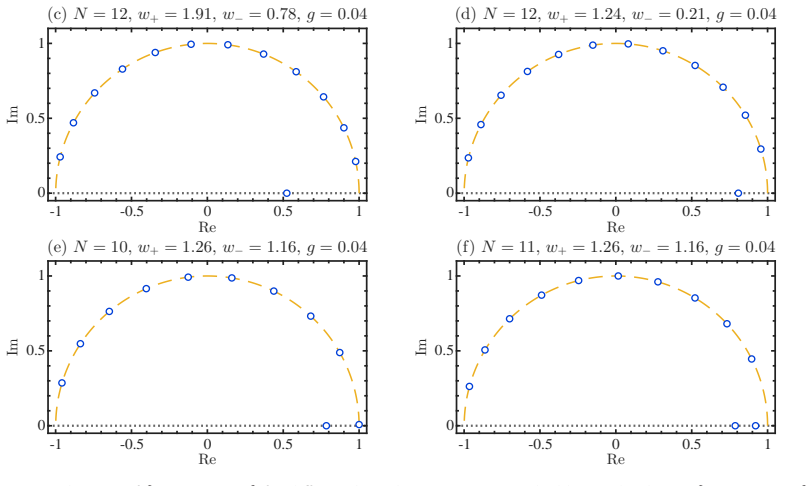
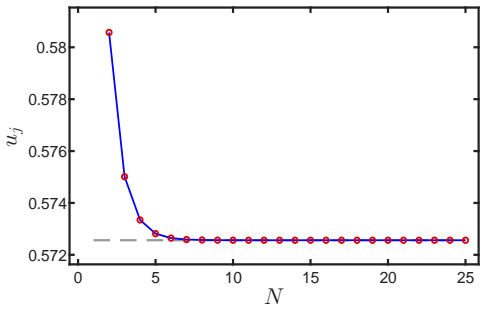
The spectrum is obtained exactly from the Bethe Ansatz equations whose roots must satisfy a definite parity condition and lie among the zeros of a unary function. Numerical evidence shows that the ground state and first excited state correspond to particular root configurations, and that elementary excitations arise from the simultaneous displacement of a pair of roots. These configurations yield an explicit closed-form expression for the ground-state energy in the thermodynamic limit.
What carries the argument
Bethe Ansatz equations whose roots are constrained to the zeros of a unary function and obey a fixed parity on their number.
If this is right
- The ground-state energy is given directly by the closed analytical formula without solving the full Bethe equations for large but finite chains.
- Elementary excitations always involve the cooperative shift of exactly two Bethe roots.
- The parity constraint on the total number of roots partitions the spectrum into allowed sectors.
- Any eigenenergy is determined once the positions of the roots at the unary zeros are known.
- The thermodynamic-limit energy expression is independent of the particular finite-size root pattern beyond the ground-state configuration.
Where Pith is reading between the lines
- The paired-root excitation rule may simplify the computation of dynamical correlation functions or quench dynamics in the same model.
- The unary-zero condition could be exploited to obtain exact expressions for boundary observables such as local magnetizations.
- Similar parity and unary-function structures may appear in related open XXZ chains, allowing analogous thermodynamic energies to be derived.
- The analytical energy formula supplies a precise target for testing approximate methods such as variational tensor networks on open spin chains.
- Large-scale numerics on chains of length several hundred would directly confirm or refute the extrapolation from the observed finite-size root patterns.
Load-bearing premise
The Bethe-root configurations identified numerically for the ground and first excited states remain valid when deriving the closed-form thermodynamic-limit energy expression.
What would settle it
Compute the ground-state energy by exact diagonalization or DMRG on chains of several hundred sites, extrapolate to infinite length, and test whether the result matches the proposed analytical formula within the expected 1/L corrections.
Figures

read the original abstract
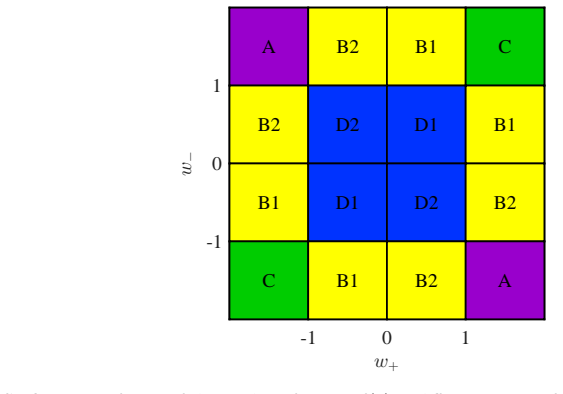
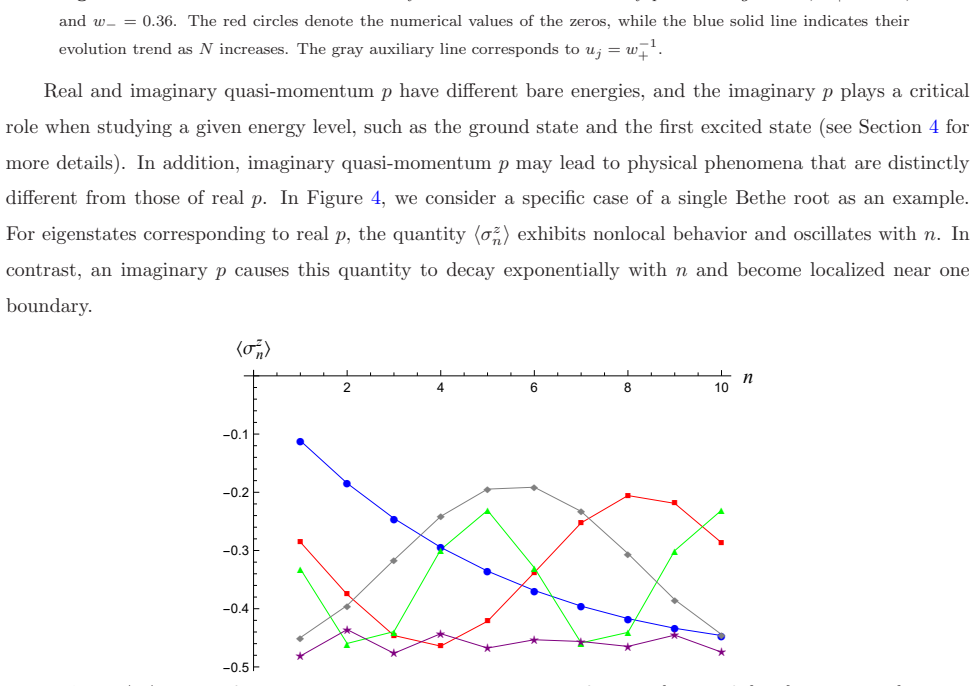
We study the exact spectrum of the XX spin chain with constrained non-diagonal boundary fields, which can be analyzed by solving the associated Bethe Ansatz equations. In these equations, the number of Bethe roots has a definite parity, and all Bethe roots are located at the zeros of a unary function. We investigate the possible positions of the Bethe roots. Based on numerical observations, we analyze the Bethe root configurations for the ground state and the first excited state. Our results show that elementary excitations are characterized by the cooperative change of a pair of Bethe roots. Furthermore, we obtain an analytical expression for the ground state energy in the thermodynamic limit.
Editorial analysis
A structured set of objections, weighed in public.
Referee Report
Summary. The manuscript analyzes the Bethe Ansatz equations for the XX spin chain with constrained non-diagonal boundary fields. It reports that the number of Bethe roots has definite parity and all roots lie at zeros of a unary function. Based on numerical observations, the authors identify root configurations for the ground state and first excited state, observe that elementary excitations involve cooperative shifts of a pair of roots, and derive a closed-form analytical expression for the ground-state energy in the thermodynamic limit.
Significance. An exact closed-form expression for the thermodynamic-limit ground-state energy of this boundary-value problem would be a useful addition to the literature on integrable spin chains with non-diagonal boundaries, provided the underlying root configurations are rigorously justified.
major comments (1)
- [Abstract] Abstract and the derivation of the thermodynamic-limit energy: the closed-form expression is obtained by taking the continuum limit of a sum over Bethe roots whose configuration (all roots real, fixed parity, located at zeros of the unary function) is identified numerically for finite N. No analytic argument is supplied showing that this pattern is the global energy minimizer for every N, that no admissible alternative set of roots (different cardinality or complex roots) yields lower energy, or that the pattern survives without rearrangement as N→∞. This assumption is load-bearing for the central claim.
minor comments (1)
- [Abstract] The phrase 'unary function' in the abstract is nonstandard; clarify whether 'univariate' is intended.
Simulated Author's Rebuttal
We thank the referee for their careful reading and for identifying the central assumption underlying the thermodynamic-limit result. We respond to the major comment below.
read point-by-point responses
-
Referee: [Abstract] Abstract and the derivation of the thermodynamic-limit energy: the closed-form expression is obtained by taking the continuum limit of a sum over Bethe roots whose configuration (all roots real, fixed parity, located at zeros of the unary function) is identified numerically for finite N. No analytic argument is supplied showing that this pattern is the global energy minimizer for every N, that no admissible alternative set of roots (different cardinality or complex roots) yields lower energy, or that the pattern survives without rearrangement as N→∞. This assumption is load-bearing for the central claim.
Authors: We agree that the closed-form expression rests on the root configuration identified numerically. The manuscript already states that the configurations are determined from numerical observations. Extensive checks for system sizes up to several hundred sites confirm that the ground-state roots are real, obey the fixed parity, and occupy zeros of the unary function, while other admissible sets (complex roots or altered cardinality) produce higher energies when compared with exact diagonalization for small N. Nevertheless, the manuscript supplies no analytic demonstration that the observed pattern is the unique global minimizer for every N or that it persists without rearrangement as N→∞. Such a proof lies outside the scope of the present analysis. revision: no
- Absence of an analytic proof that the numerically observed Bethe-root configuration is the global energy minimizer for all N and survives unchanged to the thermodynamic limit.
Circularity Check
No circularity: thermodynamic-limit expression derived from conjectured root patterns without reduction to fitted inputs or self-citations.
full rationale
The paper identifies Bethe-root configurations via numerical observation and then derives a closed-form thermodynamic-limit ground-state energy from the resulting sum over those roots. This is a standard conjecture-then-derive procedure rather than any of the enumerated circular patterns: no parameter is fitted and renamed as a prediction, no self-citation supplies a load-bearing uniqueness theorem, and the final expression is not definitionally equivalent to the numerical input. The dependence on the observed pattern is an assumption about which configuration is minimal, but the derivation itself does not collapse to that assumption by construction. Hence the central claim remains non-circular.
Axiom & Free-Parameter Ledger
axioms (1)
- domain assumption The transfer-matrix or algebraic Bethe-Ansatz construction remains valid under the stated boundary constraints.
Reference graph
Works this paper leans on
-
[1]
Heisenberg W 1928 Zeitschrift f¨ ur Physik49 619–636
1928
-
[2]
Mourigal M, Enderle M, Kl¨ opperpieper A, Caux J S, Stunault A and Rønnow H M 2013 Nature Physics 9 435–441
2013
-
[3]
Mikeska H J and Kolezhuk A K 2008 One-dimensional magnetism Quantum magnetism (Springer) pp 1–83
2008
-
[4]
Liu W Y, Gong S S, Li Y B, Poilblanc D, Chen W Q and Gu Z C 2022 Science bulletin 67 1034–1041
2022
-
[5]
Broholm C, Cava R J, Kivelson S, Nocera D, Norman M and Senthil T 2 020 Science 367 eaay0668
-
[6]
Jiang H C 2021 npj Quantum Materials 6 71
2021
-
[7]
Baxter R J 1982 Exactly Solved Models in Statistical Mechanics (Academic Press)
1982
-
[8]
Korepin V E, Korepin V E, Bogoliubov N and Izergin A 1997 Quantum Inverse Scattering Method and Correlation Functions (Cambridge University Press)
1997
-
[9]
Wang Y, Yang W L, Cao J and Shi K 2015 Off-diagonal Bethe ansatz for exactly solvable models (Springer)
2015
-
[10]
Bethe H 1931 Z. Phys. 71 205
1931
-
[11]
Baxter R J 2002 J. Statist. Phys. 108 1–48
2002
-
[12]
Nepomechie R I 2003 J. Phys. A 37 433–440
2003
-
[13]
Nepomechie R I and Ravanini F 2003 J. Phys. A 36 11391
2003
-
[14]
Yang W L and Zhang Y Z 2006 Nucl. Phys. B 744 312–329
2006
-
[15]
Takhtadzhan L and Faddeev L D 1979 Russ. Math. Surv. 34 11–68
1979
-
[16]
Cao J, Lin H Q, Shi K J and Wang Y 2003 Nucl. Phys. B 663 487–519
2003
-
[17]
Belliard S and Cramp´ e N 2013 SIGMA 9 072
2013
-
[18]
Takahashi M 1999 Thermodynamics of one-dimensional solvable models (Cambridge University Press, Cam- bridge)
1999
-
[19]
Cao J, Yang W L, Shi K and Wang Y 2013 Phys. Rev. Lett. 111 137201
2013
-
[20]
Cao J, Yang W L, Shi K and Wang Y 2013 Nucl. Phys. B 875 152–165
2013
-
[21]
Cao J, Yang W L, Shi K and Wang Y 2013 Nucl. Phys. B 877 152–175
2013
-
[22]
Niccoli G 2012 J. Stat. Mech. 2012 P10025
2012
-
[23]
Niccoli G 2013 Nucl. Phys. B 870 397–420
2013
-
[24]
Faldella S, Kitanine N and Niccoli G 2014 J. Stat. Mech. 1401 P01011
2014
-
[25]
Zhang X, Kl¨ umper A and Popkov V 2021 Phys. Rev. B 103 115435 21
2021
-
[26]
Zhang X, Kl¨ umper A and Popkov V 2021 Phys. Rev. B 104 195409
2021
-
[27]
Sklyanin E K 1988 J. Phys. A 21 2375–2389
1988
-
[28]
Cherednik I V 1984 Theor. Math. Phys 61 977–983
1984
-
[29]
Li Y Y, Cao J, Yang W L, Shi K and Wang Y 2014 Nucl. Phys. B 884 17–27
2014
-
[30]
Sun P, Xin Z R, Qiao Y, Hao K, Cao L, Cao J, Yang T and Yang W L 2019 J. Phys. A 52 265201
2019
-
[31]
Qiao Y, Cao J, Yang W L, Shi K and Wang Y 2021 Phys. Rev. B 103 220401
2021
-
[32]
Dong J S, Lu P, Sun P, Qiao Y, Cao J, Hao K and Yang W L 2023 Chinese Physics B 32 017501
2023
-
[33]
Kozlowski K and Pozsgay B 2012 Journal of Statistical Mechanics: Theory and Experiment 2012 P05021
2012
-
[34]
Pozsgay B and R´ akos O 2018 Journal of Statistical Mechanics: Theory and Experiment 2018 113102
2018
-
[35]
Kapustin A and Skorik S 1996 Journal of Physics A: Mathematical and General 29 1629–1638
1996
-
[36]
Jiang Y, Liu Y C, Miao Y and Tan Z X 2025 ( Preprint arXiv:2512.01551)
work page internal anchor Pith review Pith/arXiv arXiv 2025
-
[37]
Murgan R, Nepomechie R I and Shi C 2006 Boundary energy of th e open xxz chain from new exact solutions Annales Henri Poincar´ evol 7 (Springer) pp 1429–1448
2006
-
[38]
Chernyak D, Gainutdinov A M, Jacobsen J L and Saleur H 2023 SIGMA 19 046
2023
-
[39]
Lieb E, Schultz T and Mattis D 1961 Annals of Physics 16 407–466
1961
-
[40]
Biegel D, Karbach M, M¨ uller G and Wiele K 2004 Physical Review B 69 174404
2004
-
[41]
Zhang X, Kl¨ umper A and Popkov V 2022 Phys. Rev. B 106 075406 22
2022
discussion (0)
Sign in with ORCID, Apple, or X to comment. Anyone can read and Pith papers without signing in.