Half the Interference, Most of the Answer: Approximate Quantum Simulation via Path-Sum Pruning
Pith reviewed 2026-06-28 14:10 UTC · model grok-4.3
The pith
A threshold rule on accumulated amplitude lets simulators omit nearly half of endpoint interference reactions while retaining over 90 percent output accuracy on Deutsch-Jozsa, Grover, Simon, and small Shor circuits.
A machine-rendered reading of the paper's core claim, the machinery that carries it, and where it could break.
Core claim
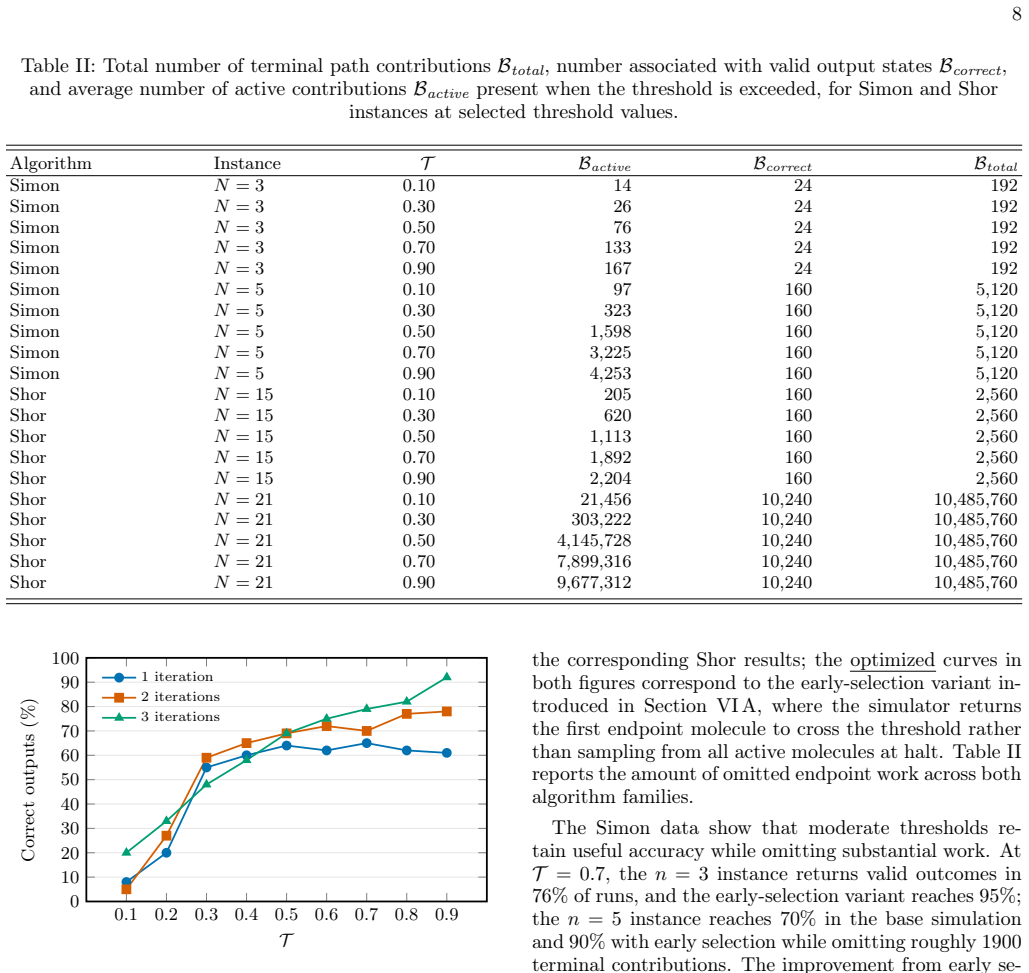
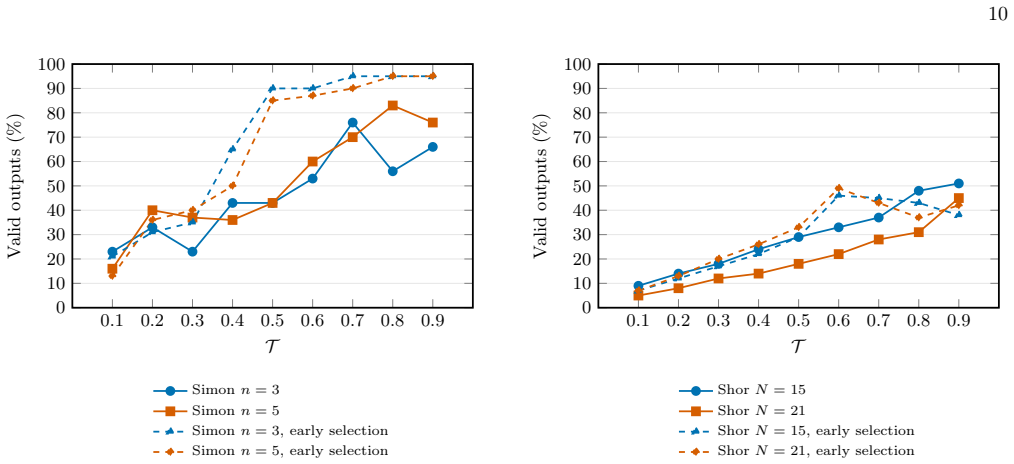
The central claim is that endpoint interference reactions can be pruned via a threshold on accumulated amplitude in the Chemical Abstract Machine model of weighted path contributions, allowing nearly 50 percent of such reactions to be omitted on benchmark circuits for Deutsch-Jozsa, Grover search, Simon's problem, and small Shor period-finding instances while maintaining over 90 percent output accuracy for most algorithms tested. The method does not improve worst-case complexity and is not presented as a general-purpose simulator; its purpose is to demonstrate that interference arithmetic is a structured resource admitting meaningful approximation.
What carries the argument
The threshold rule that terminates interference reactions for an endpoint once sufficient amplitude is accumulated, implemented within the Chemical Abstract Machine model where path contributions evolve as concurrent molecular species.
If this is right
- Interference arithmetic admits meaningful approximation through explicit scheduling and pruning.
- Pruning strategies of this form can be applied across path-sum, Pauli-path, and tensor-network simulation methods.
- Useful output distributions for the tested algorithms can be recovered without computing all coherent combinations at each endpoint.
- The approach targets specific algorithms and circuit sizes rather than worst-case performance.
Where Pith is reading between the lines
- The same threshold logic might be tested on larger or deeper circuits to check whether amplitude accumulation patterns remain stable enough for pruning to stay accurate.
- Hybrid simulators could combine exact handling of early interference steps with threshold pruning on later ones to balance cost and fidelity.
- Connections exist to truncation methods already used in tensor-network contractions, where similar decisions to drop small contributions are made during contraction.
- The framework could be adapted to variational or noisy intermediate-scale quantum circuits where only approximate distributions are needed anyway.
Load-bearing premise
Discarding remaining reactions once an endpoint accumulates sufficient amplitude does not materially distort the useful output distribution for the algorithms and circuit sizes examined.
What would settle it
A concrete falsifier would be a run on one of the benchmark circuits where enforcing the threshold causes measured output accuracy to drop below 90 percent for the dominant output states, or where the probability mass on the algorithmically correct outcomes shifts by more than 10 percent relative to the unpruned case.
Figures





read the original abstract
Classical simulation of quantum circuits is expensive for two distinct reasons. The obvious one is state-space size: an n-qubit system requires exponentially many amplitudes. The less obvious one is interference: useful output distributions emerge only after many computational histories have been coherently combined at common endpoints, and this aggregation step is itself a substantial source of cost. We introduce statistical interference sampling, a framework that makes this second bottleneck explicit by treating endpoint interference as a separately schedulable computation. Using the Chemical Abstract Machine (ChAM) as our model, weighted path contributions evolve as concurrent molecular species, and interference reactions combine contributions that share a common output state. A threshold rule terminates the process once an endpoint accumulates sufficient amplitude, discarding the remaining reactions. The method does not improve worst-case complexity and is not intended as a general-purpose simulator. Its purpose is to ask a more targeted question: how much of the interference calculation can be skipped while still recovering a useful output distribution? On benchmark circuits for Deutsch-Jozsa, Grover search, Simon's problem, and small Shor period-finding instances, we find that nearly 50% of endpoint interference reactions can be omitted while maintaining over 90% output accuracy for most algorithms tested. These results suggest that interference arithmetic is a structured resource that admits meaningful approximation, and that exposing it explicitly opens new opportunities for pruning strategies across path-sum, Pauli-path, and tensor-network simulation methods.
Editorial analysis
A structured set of objections, weighed in public.
Referee Report
Summary. The paper introduces statistical interference sampling, which models quantum circuit simulation via the Chemical Abstract Machine (ChAM) by treating endpoint interference as concurrent molecular reactions. A threshold rule prunes remaining reactions once an endpoint accumulates sufficient amplitude. The central empirical claim is that on small benchmark circuits for Deutsch-Jozsa, Grover search, Simon's problem, and Shor period-finding, nearly 50% of endpoint interference reactions can be omitted while retaining over 90% output accuracy for most algorithms tested. The method does not claim worst-case complexity improvements.
Significance. If the pruning rule can be shown to preserve output distributions with quantifiable error, the work would usefully demonstrate that interference arithmetic in path-sum methods is amenable to structured approximation, with potential carry-over to Pauli-path and tensor-network simulators. The explicit separation of interference scheduling is a clear conceptual contribution, and the reported 50% pruning on the listed small instances is a concrete empirical observation worth documenting.
major comments (2)
- [Abstract] Abstract: the claim of maintaining 'over 90% output accuracy' provides neither error bars on the accuracy metric, a description of how the threshold value is selected, nor any comparison against standard approximation baselines (e.g., truncated path sums or Monte-Carlo sampling), so the 50% pruning figure cannot be evaluated for robustness.
- [Abstract] Abstract (paragraph on threshold rule): the central assumption that 'discarding the remaining reactions' once an endpoint accumulates sufficient amplitude does not materially distort the output distribution lacks any derived bound on the induced error (total variation distance, ℓ₂ norm of the amplitude vector, or success-probability shift). This is load-bearing for the claim that the pruned contributions are negligible or cancel harmlessly.
Simulated Author's Rebuttal
We thank the referee for the constructive comments. We respond point by point to the major remarks and agree that the empirical claims in the abstract require additional supporting detail for clarity and robustness.
read point-by-point responses
-
Referee: [Abstract] Abstract: the claim of maintaining 'over 90% output accuracy' provides neither error bars on the accuracy metric, a description of how the threshold value is selected, nor any comparison against standard approximation baselines (e.g., truncated path sums or Monte-Carlo sampling), so the 50% pruning figure cannot be evaluated for robustness.
Authors: We agree that the abstract would be strengthened by these additions. In the revised version we will report error bars computed over repeated runs with different random seeds for the statistical sampling, specify the threshold selection rule (a fixed fraction of the largest amplitude accumulated at any endpoint), and include direct comparisons on the same benchmark circuits against truncated path-sum simulation and Monte-Carlo sampling of paths. These changes will make the 50% pruning observation easier to evaluate. revision: yes
-
Referee: [Abstract] Abstract (paragraph on threshold rule): the central assumption that 'discarding the remaining reactions' once an endpoint accumulates sufficient amplitude does not materially distort the output distribution lacks any derived bound on the induced error (total variation distance, ℓ₂ norm of the amplitude vector, or success-probability shift). This is load-bearing for the claim that the pruned contributions are negligible or cancel harmlessly.
Authors: The manuscript frames the pruning rule as a heuristic whose effect is measured empirically on small instances rather than as a general approximation with provable error bounds. No analytic bound on total variation distance or similar metrics is derived because the approach is not positioned as a rigorous approximation algorithm. We will expand the revision to report the observed total variation distances between pruned and unpruned output distributions for each benchmark family and to restate explicitly that the method offers no worst-case guarantee. revision: partial
Circularity Check
No significant circularity; central results are empirical observations on benchmarks with no derivation reducing to inputs by construction
full rationale
The paper introduces a threshold-based pruning heuristic for path-sum interference and reports measured savings (nearly 50% reactions omitted, >90% accuracy) on small benchmark circuits for Deutsch-Jozsa, Grover, Simon, and Shor instances. These are presented explicitly as experimental findings rather than predictions derived from equations. No load-bearing self-citation, fitted parameter renamed as prediction, or self-definitional step exists in the described method; the ChAM model and threshold rule are stated as modeling choices without reducing the reported accuracy figures to the inputs by construction. The absence of an error bound on the heuristic is a separate analytical limitation, not circularity.
Axiom & Free-Parameter Ledger
Reference graph
Works this paper leans on
-
[1]
Quan- tum mechanics and path integrals
Richard P. Feynman and Albert R. Hibbs. “Quan- tum mechanics and path integrals”. McGraw-Hill. New York (1965)
1965
-
[2]
The Chemical Abstract Machine
Gérard Berry and Gérard Boudol. “The Chemical Abstract Machine”. Theor. Comput. Sci.96, 217– 248 (1992)
1992
-
[3]
Quantum theory, the church-turing principle and the universal Quantum computer
David Deutsch. “Quantum theory, the church-turing principle and the universal Quantum computer”. Proc. R. Soc. Lond. A400, 97–117 (1985)
1985
-
[4]
Rapid solution of problemsbyQuantumcomputation
David Deutsch and Richard Jozsa. “Rapid solution of problemsbyQuantumcomputation”. Proc.R.Soc.Lond. A439, 553–558 (1992)
1992
-
[5]
Quantum com- putation and Quantum information
Michael A. Nielsen and Isaac L. Chuang. “Quantum com- putation and Quantum information”. Cambridge Uni- versity Press. Cambridge (2010). 10th anniversary ed. edition
2010
-
[6]
On the power of Quantum com- putation
Daniel R. Simon. “On the power of Quantum com- putation”. SIAM Journal on Computing26, 1474– 1483 (1997)
1997
-
[7]
A fast Quantum mechanical algorithm for database search
Lov K. Grover. “A fast Quantum mechanical algorithm for database search”. In Proceedings of the Twenty- Eighth Annual ACM Symposium on Theory of Com- puting. Pages 212–219. STOC ’96New York, NY, USA (1996). Association for Computing Machinery
1996
-
[8]
Polynomial-time algorithms for prime factorization and discrete logarithms on a Quantum com- puter
Peter W. Shor. “Polynomial-time algorithms for prime factorization and discrete logarithms on a Quantum com- puter”. SIAM Review41, 303–332 (1999)
1999
-
[9]
A herculean task: Classical simulation of quantum computers
Xiaosi Xu, Simon Benjamin, Jinzhao Sun, Xiao Yuan, and Pan Zhang. “A herculean task: Classical simulation of quantum computers” (2023). arXiv:2302.08880
-
[10]
Optimization of Quantum computing simulation with gate fusion
Hiroshi Horii and Jun Doi. “Optimization of Quantum computing simulation with gate fusion”. Technical Re- port 23. IBM Quantum, IBM Research Tokyo (2021)
2021
-
[11]
QuEST and High Performance Simula- tion of Quantum Computers
Tyson Jones, Anna Brown, Ian Bush, and Simon C. Benjamin. “QuEST and High Performance Simula- tion of Quantum Computers”. Scientific Reports9, 10736 (2019)
2019
-
[12]
Qiskit transpiler pass: Com- mutativeCancellation
Qiskit Development Team. “Qiskit transpiler pass: Com- mutativeCancellation” (2024)
2024
-
[13]
Quantum com- plexity theory
Ethan Bernstein and Umesh Vazirani. “Quantum com- plexity theory”. In Proceedings of the Twenty-Fifth An- nual ACM Symposium on Theory of Computing. Pages 11–20. STOC ’93New York, NY, USA (1993). Associa- tion for Computing Machinery
1993
-
[14]
Feynmanpath-sumquan- tum computer simulator
DavidAlvesCamposFerreira. “Feynmanpath-sumquan- tum computer simulator”. Master’s thesis. Universidade do Minho. (2023)
2023
-
[15]
A polynomial-time classical algo- rithm for noisy random circuit sampling
Dorit Aharonov, Xun Gao, Zeph Landau, Yunchao Liu, and Umesh Vazirani. “A polynomial-time classical algo- rithm for noisy random circuit sampling”. In Proceedings of the 55th Annual ACM Symposium on Theory of Com- puting. Pages 945–957. STOC ’23. ACM (2023)
2023
-
[16]
Pauli Propagation: A Computational Framework for Simulating Quantum Systems
Manuel S. Rudolph, Tyson Jones, Yanting Teng, Ar- mando Angrisani, and Zoë Holmes. “Pauli propagation: A computational framework for simulating Quantum sys- tems” (2025). arXiv:2505.21606
work page internal anchor Pith review Pith/arXiv arXiv 2025
-
[17]
Simulating quantum circuits with arbitrary local noise using Pauli Propagation
Armando Angrisani, Antonio A. Mele, Manuel S. Rudolph, M. Cerezo, and Zoë Holmes. “Simulating quan- tum circuits with arbitrary local noise using Pauli prop- agation” (2025). arXiv:2501.13101
work page internal anchor Pith review Pith/arXiv arXiv 2025
-
[18]
Magic resources of the Heisenberg picture
Neil Dowling, Pavel Kos, and Xhek Turkeshi. “Magic resources of the Heisenberg picture”. Physical Review Letters135, 050401 (2025)
2025
-
[19]
Cir- cuit compression for 2d quantum dynamics
Matteo D’Anna, Yuxuan Zhang, Roeland Wiersema, Manuel S. Rudolph, and Juan Carrasquilla. “Cir- cuit compression for 2d quantum dynamics” (2025). arXiv:2507.01883
-
[20]
Surface codes: Towards practi- cal large-scale quantum computation
Austin G. Fowler, Matteo Mariantoni, John M. Martinis, and Andrew N. Cleland. “Surface codes: Towards practi- cal large-scale quantum computation”. Phys. Rev. A86, 032324 (2012)
2012
-
[21]
Topological quantum memory
Eric Dennis, Alexei Kitaev, Andrew Landahl, and John Preskill. “Topological quantum memory”. Journal of Mathematical Physics43, 4452–4505 (2002)
2002
-
[22]
The emergence of classical properties through interaction with the environment
E. Joos and H. D. Zeh. “The emergence of classical properties through interaction with the environment”. Zeitschrift für Physik B59, 223–243 (1985)
1985
-
[23]
Decoherence and the transition from quantum to classical
Wojciech H. Zurek. “Decoherence and the transition from quantum to classical”. Physics Today44, 36–44 (1991)
1991
-
[24]
Dynamical suppressionof decoherence in two-state quantum systems
Lorenza Violaand Seth Lloyd. “Dynamical suppressionof decoherence in two-state quantum systems”. Phys. Rev. A58, 2733–2744 (1998)
1998
-
[25]
BosonSampling is far from uniform
Scott Aaronson and Alex Arkhipov. “BosonSampling is far from uniform”. Quantum Info. Comput.14, 1383– 1423 (2014)
2014
-
[26]
The classical complexity of Boson sampling
Peter Clifford and Raphaël Clifford. “The classical complexity of Boson sampling”. In Proceedings of the Twenty-Ninth Annual ACM-SIAM Symposium on Dis- crete Algorithms. Pages 146–155. SODA ’18USA (2018). Society for Industrial and Applied Mathematics
2018
discussion (0)
Sign in with ORCID, Apple, or X to comment. Anyone can read and Pith papers without signing in.