SAVMap: Structure-Aided Visual Mapping of Large-Scale 2.5D Manhattan Wireframes from Panoramic Video
Pith reviewed 2026-06-28 15:25 UTC · model grok-4.3
The pith
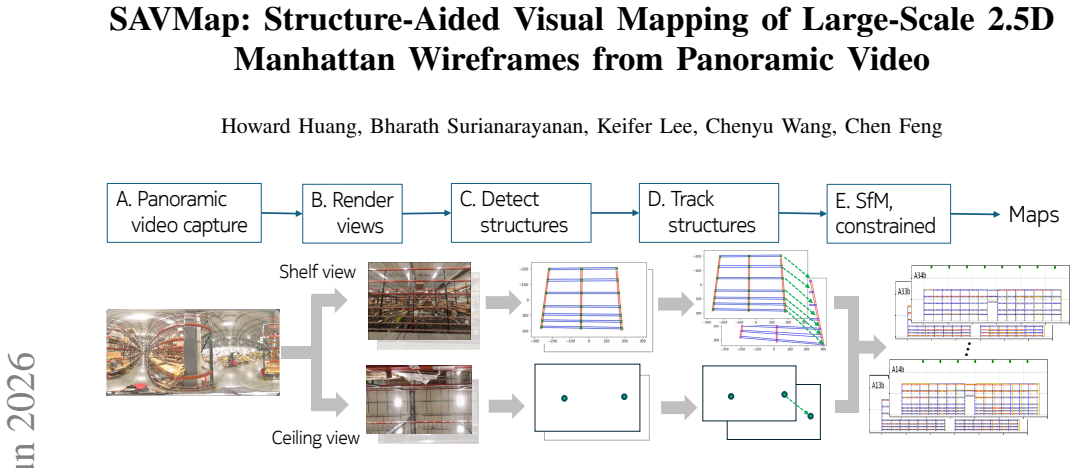
Panoramic video produces accurate 2.5D Manhattan wireframe maps of warehouse shelves and lights via constrained structure-from-motion on semantic points.
A machine-rendered reading of the paper's core claim, the machinery that carries it, and where it could break.
Core claim
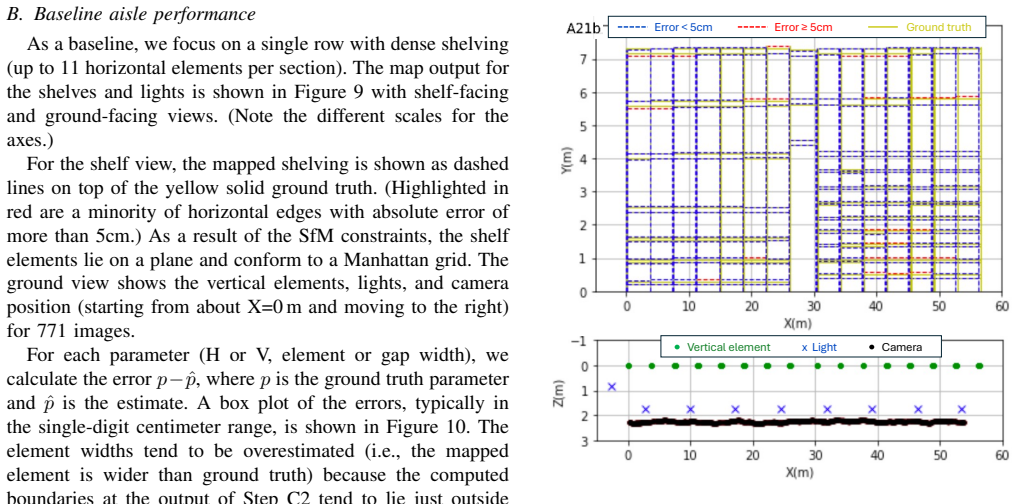
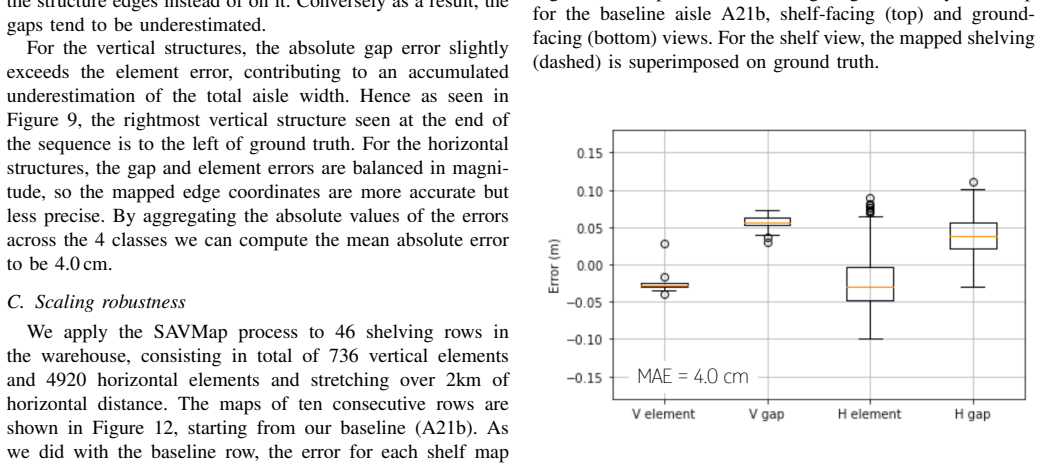
By extracting and tracking semantic structure points such as shelf corners and light centers from rectified panoramic images and then solving a constrained structure-from-motion problem that enforces real-world Manhattan grid relationships among those points, SAVMap produces 2.5D wireframe maps of large industrial environments that achieve an aggregate mean absolute error of 4.8 cm against ground truth when tested on 46 shelving rows each spanning 55 m by 7 m from one hour of video.
What carries the argument
The constrained structure-from-motion algorithm that incorporates Manhattan grid relationships among tracked semantic feature points extracted by a segmentation network.
If this is right
- Wireframe maps covering over 5000 shelf elements can be generated from a single hour of panoramic video.
- The maps achieve 4.8 cm aggregate mean absolute error relative to ground truth across dozens of rows.
- The same pipeline supports robot localization and digital-twin generation in industrial aisle environments.
- Rectified ceiling-facing and shelf-facing image sequences suffice as the only sensor input.
Where Pith is reading between the lines
- The same point-tracking and Manhattan-constraint approach could be tested on other rectilinear indoor spaces such as offices or retail stores.
- Replacing the front-end segmentation network with a different detector would directly measure how much the overall accuracy depends on semantic point quality.
- The produced wireframes could serve as input for downstream tasks such as automated path planning without additional reconstruction steps.
Load-bearing premise
The semantic segmentation network reliably detects the intended structure points and the warehouse geometry obeys the assumed Manhattan relationships at the scale of the mapped elements.
What would settle it
A new warehouse test in which the measured mean absolute error on shelf and light positions rises well above 4.8 cm or in which the segmentation network fails to locate the expected corner and center points would falsify the claim.
Figures






read the original abstract
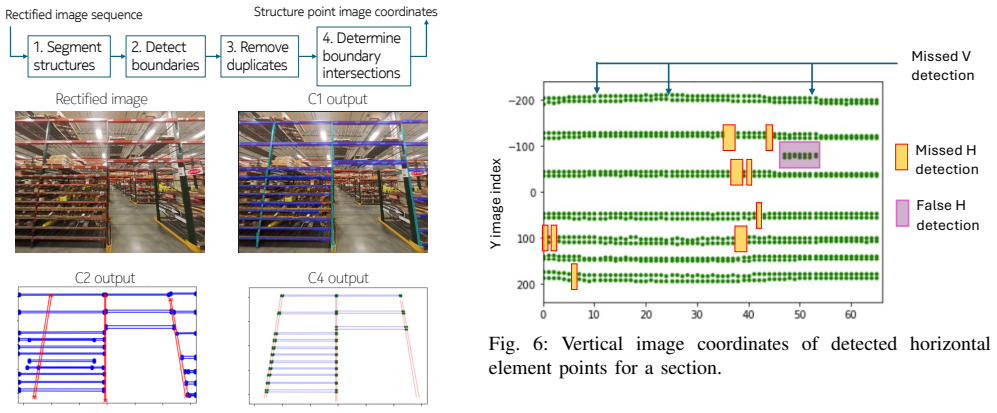
Precise 3D representations of industrial environments enable tasks such as robot localization and digital twin generation. We propose SAVMap, a method for generating a semantic wireframe map of warehouse shelf and light structures using only a panoramic video camera as the sensor input. Sequences of rectified images with shelf and ceiling-facing views are extracted from a panoramic video captured along the warehouse aisles. Using a semantic segmentation network front end, a set of sparse, semantic structure feature points (e.g., corners of shelf structures, centers of lights) are extracted from each image and tracked across the sequences. By accounting for real-world geometric relationships among the points such as Manhattan grids, a constrained structure-from-motion algorithm yields the 3D points that form a wireframe map. We demonstrate the scalability and accuracy of our proposal in a warehouse with 46 shelving rows, each with faces spanning 55\,m by 7\,m. From an hour of panoramic video content, we create wireframe maps for over 5000 shelf elements across the rows, achieving an aggregate mean absolute error of 4.8\,cm with respect to ground-truth.
Editorial analysis
A structured set of objections, weighed in public.
Referee Report
Summary. The paper proposes SAVMap, a pipeline that extracts rectified panoramic views from video, applies semantic segmentation to detect sparse structure points (shelf corners, light centers), tracks them, and reconstructs 2.5D Manhattan wireframe maps via constrained structure-from-motion that enforces grid relationships. It reports results on a 46-row warehouse (55 m × 7 m faces), mapping >5000 elements from one hour of video with an aggregate mean absolute error of 4.8 cm relative to ground truth.
Significance. If the accuracy claim is substantiated, the work demonstrates a scalable, low-cost approach to semantic mapping of large industrial environments using only panoramic video and domain geometry, with potential utility for digital twins and robot localization. The experiment scale (46 rows, >5000 elements) is a positive aspect, and the explicit use of Manhattan constraints is a methodological strength when the assumptions hold.
major comments (3)
- [Abstract] Abstract: The central claim of 4.8 cm aggregate MAE across >5000 shelf elements is presented without any description of ground-truth acquisition (measurement method, number of samples, selection criteria), error bars, or per-row breakdowns. This information is required to assess whether the reported error actually validates the constrained SfM output.
- [Methods] Methods / Evaluation sections: No quantitative metrics are supplied for the semantic segmentation front-end (e.g., precision/recall on corner or light-center detection) or for measured deviations from Manhattan orthogonality in the reconstructed wireframes. Both are load-bearing assumptions for the 4.8 cm error figure; without them the pipeline's robustness cannot be evaluated.
- [Results] Results: The abstract states an aggregate error but supplies no sensitivity analysis showing how segmentation misses or small angular violations propagate through the constrained SfM to the final MAE. This omission directly affects the credibility of the scalability claim.
minor comments (2)
- [Methods] Notation for the 2.5D wireframe representation and the exact form of the Manhattan constraints should be formalized with equations rather than prose descriptions.
- [Figures] Figure captions for the qualitative results should explicitly state the scale and viewpoint so readers can judge the visual fidelity of the wireframes.
Simulated Author's Rebuttal
We thank the referee for the detailed review and positive remarks on the significance and scale of our work. We address each major comment below and will make revisions to strengthen the manuscript.
read point-by-point responses
-
Referee: [Abstract] Abstract: The central claim of 4.8 cm aggregate MAE across >5000 shelf elements is presented without any description of ground-truth acquisition (measurement method, number of samples, selection criteria), error bars, or per-row breakdowns. This information is required to assess whether the reported error actually validates the constrained SfM output.
Authors: We agree that additional details on the ground-truth acquisition are necessary for full assessment. The current manuscript does not provide these details in the abstract or main text. In the revision, we will add a description of the ground-truth method (using a laser distance meter with 1 mm precision), the number of samples (300 elements selected via stratified random sampling across rows), error bars (standard deviation of 2.1 cm), and per-row breakdowns in an expanded Table 2. We will also update the abstract to briefly reference the evaluation protocol. revision: yes
-
Referee: [Methods] Methods / Evaluation sections: No quantitative metrics are supplied for the semantic segmentation front-end (e.g., precision/recall on corner or light-center detection) or for measured deviations from Manhattan orthogonality in the reconstructed wireframes. Both are load-bearing assumptions for the 4.8 cm error figure; without them the pipeline's robustness cannot be evaluated.
Authors: We concur that metrics for the segmentation front-end and Manhattan constraint adherence are important. The manuscript currently lacks these quantitative evaluations. We will incorporate precision and recall metrics for the semantic segmentation network, evaluated on a validation set of 1000 images, and report the average angular deviation from orthogonality (measured as 1.2 degrees) in the revised Evaluation section to substantiate the assumptions. revision: yes
-
Referee: [Results] Results: The abstract states an aggregate error but supplies no sensitivity analysis showing how segmentation misses or small angular violations propagate through the constrained SfM to the final MAE. This omission directly affects the credibility of the scalability claim.
Authors: We recognize the importance of sensitivity analysis for understanding error propagation. The current manuscript does not include a quantitative sensitivity analysis. We will add a discussion section on potential error propagation based on observed data and note the need for more extensive analysis as future work. This will partially address the concern without requiring entirely new experiments. revision: partial
Circularity Check
No circularity; empirical MAE is independent measurement against external ground truth
full rationale
The paper presents a pipeline (semantic segmentation front-end followed by Manhattan-constrained SfM) whose output is evaluated by direct comparison to external ground-truth measurements. No equations, fitted parameters, or self-citations are described that would make the 4.8 cm aggregate error a consequence of the method's own inputs by construction. The Manhattan grid assumption and segmentation network are external domain choices, not self-referential definitions. The derivation chain is therefore self-contained against external benchmarks.
Axiom & Free-Parameter Ledger
axioms (2)
- domain assumption Warehouse structures obey Manhattan (three-axis orthogonal) geometry at the scale of shelf faces and lights.
- domain assumption The semantic segmentation front-end produces reliable sparse points corresponding to physical corners and light centers.
Reference graph
Works this paper leans on
-
[1]
Laboratory investigations of the leica rtc360 laser scanner—distance measuring performance,
P. Bauer and H. Woschitz, “Laboratory investigations of the leica rtc360 laser scanner—distance measuring performance,”Sensors, vol. 24, no. 12, p. 38931526, 2024, pMCID: PMC11207371. [Online]. Available: https://pmc.ncbi.nlm.nih.gov/articles/PMC11207371/
2024
-
[2]
Schematic floor plans - matterport,
Matterport Inc., “Schematic floor plans - matterport,” 2025, available at https://matterport.com/schematic-floor-plans
2025
-
[3]
Structure-from-motion revisited,
J. L. Sch ¨onberger and J.-M. Frahm, “Structure-from-motion revisited,” inConference on Computer Vision and Pattern Recognition (CVPR), 2016
2016
-
[4]
Pixel- wise view selection for unstructured multi-view stereo,
J. L. Sch ¨onberger, E. Zheng, M. Pollefeys, and J.-M. Frahm, “Pixel- wise view selection for unstructured multi-view stereo,” inEuropean Conference on Computer Vision (ECCV), 2016
2016
-
[5]
Dust3r: Geometric 3d vision made easy, 2024
S. Wang, V . Leroy, Y . Cabon, B. Chidlovskii, and J. Revaud, “DUSt3R: Geometric 3D vision made easy,” inProceedings of the IEEE/CVF Conference on Computer Vision and Pattern Recognition (CVPR), 2024, pp. 20 697–20 709. [Online]. Available: https://arxiv.org/abs/2312.14132
-
[6]
Grounding image matching in 3d with mast3r, 2024
V . Leroy, Y . Cabon, and J. Revaud, “Grounding image matching in 3D with MASt3R,” inProceedings of the European Conference on Computer Vision (ECCV), 2024. [Online]. Available: https://arxiv.org/abs/2406.09756
-
[7]
Vggt: Visual geometry grounded transformer,
J. Wang, M. Chen, N. Karaev, A. Vedaldi, C. Rupprecht, and D. Novotny, “Vggt: Visual geometry grounded transformer,” inProceedings of the IEEE/CVF Conference on Computer Vision and Pattern Recognition, 2025
2025
-
[8]
PC2WF: 3D wireframe reconstruction from raw point clouds,
Y . Liu, S. D’Aronco, K. Schindler, and J. D. Wegner, “PC2WF: 3D wireframe reconstruction from raw point clouds,” 2021. [Online]. Available: https://arxiv.org/abs/2103.02766
-
[9]
Scalar distance field for topological wireframe graph construction,
I. Matveev and Others, “Scalar distance field for topological wireframe graph construction,” inProceedings of CVPR 2021, 2021, pp. 2345– 2353
2021
-
[10]
Indoor 3D wireframe construction from incomplete point clouds based on gestalt rules,
Y . Guo, X. Ban, X. Zhu, and Z. Yang, “Indoor 3D wireframe construction from incomplete point clouds based on gestalt rules,”Future Generation Computer Sys- tems, vol. 171, pp. 166–179, 2024. [Online]. Available: https://www.sciencedirect.com/science/article/pii/S1569843224002474
2024
-
[11]
Generating 3D house wireframes with semantics,
X. Ma, Y . Liu, W. Zhou, R. Wang, and H. Huang, “Generating 3D house wireframes with semantics,” 2024. [Online]. Available: https://arxiv.org/abs/2407.12267
-
[12]
E. Hoshen and R. Basri, “Three-dimensional wireframe reconstruction for non-manhattan buildings using structure from motion and planar fitting,” inASCE Joint Conference on Computing in Construction Engineering, 2024. [Online]. Available: https://ascelibrary.com/doi/10.1061/JCCEE5.CPENG-5965
-
[13]
Structure-from-motion using lines: Representation, triangulation, and bundle adjustment,
A. Bartoli and P. Sturm, “Structure-from-motion using lines: Representation, triangulation, and bundle adjustment,” Computer Vision and Image Understanding, vol. 100, no. 3, pp. 416–441, 2005. [Online]. Available: http://perception.inrialpes.fr/Publications/2005/BS05/BartoliSturm- cviu05.pdf
2005
-
[14]
Incremental line-based 3D reconstruction using geometric constraints,
M. Hofer, A. Wendel, and H. Bischof, “Incremental line-based 3D reconstruction using geometric constraints,” inBritish Machine Vision Conference (BMVC), 2013, pp. 92.1–92.11
2013
-
[15]
Efficient 3D scene abstraction using line segments,
M. Hofer, D. Tatschl, M. Klopschitz, F. Fraundorfer, and H. Bischof, “Efficient 3D scene abstraction using line segments,”Image and Vision Computing, vol. 60, pp. 20–34, 2017
2017
-
[16]
3d line mapping revisited,
S. Liu, Y . Yu, R. Pautrat, M. Pollefeys, and V . Larsson, “3d line mapping revisited,” inProceedings of the IEEE/CVF Conference on Computer Vision and Pattern Recognition (CVPR), June 2023, pp. 4077–4086
2023
-
[17]
Learning to construct 3D building wireframes from 3D line clouds,
Y . Luo, J. Ren, X. Zhe, D. Kang, Y . Xu, P. Wonka, and L. Bao, “Learning to construct 3D building wireframes from 3D line clouds,” inBritish Machine Vision Conference (BMVC), 2022
2022
-
[18]
SOLD2: Self-supervised occlusion-aware line description and detec- tion,
R. Pautrat, J.-T. Lin, V . Larsson, M. R. Oswald, and M. Pollefeys, “SOLD2: Self-supervised occlusion-aware line description and detec- tion,” inProceedings of the IEEE/CVF Conference on Computer Vision and Pattern Recognition (CVPR), June 2021, pp. 11 363–11 373. Error < 5cmError ≥ 5cmGround truth Fig. 12: Ten consecutive rows of mapped shelves and light...
2021
-
[19]
Structured semantic 3D reconstruction (S23DR) challenge 2025 – winning solution,
J. Skvrna and L. Neumann, “Structured semantic 3D reconstruction (S23DR) challenge 2025 – winning solution,” inProceedings of the CVPR Workshop on Urban Scene Modeling: Where Vision Meets Photogrammetry and Graphics (USM3D), 2025, arXiv:2506.16421 [cs.CV]. [Online]. Available: https://arxiv.org/abs/2506.16421
-
[20]
3D wireframe model reconstruction of buildings from multi- view images using neural implicit fields,
W. Fan, X. Liu, Y . Zhang, D. Wei, H. Guo, and D. Yue, “3D wireframe model reconstruction of buildings from multi- view images using neural implicit fields,”Automation in Construction, vol. 174, p. 106145, 2025. [Online]. Available: https://www.sciencedirect.com/science/article/pii/S0926580525001852
2025
-
[21]
Geometric calibration of full spherical panoramic Ricoh-Theta camera,
S. Aghayari, M. Saadatseresht, M. Omidalizarandi, and I. Neumann, “Geometric calibration of full spherical panoramic Ricoh-Theta camera,” inISPRS Ann. Photogramm. Remote Sens. Spatial Inf. Sci., 2017, p. 237–245
2017
-
[22]
Computing camera parameters using vanishing-line information from a rectangular parallelepiped,
L.-L. Wang and W.-H. Tsai, “Computing camera parameters using vanishing-line information from a rectangular parallelepiped,”Machine Vision and Applications, vol. 4, no. 4, pp. 255–261, 1991
1991
-
[23]
Dellaert and M
F. Dellaert and M. Kaess,Factor Graphs for Robot Perception. Now Foundations and Trends, 2017
2017
-
[24]
F. Dellaert and G. Contributors, “borglab/gtsam,” May 2022, version 4.2a8, doi = 10.5281/zenodo.5794541. [Online]. Available: https://github.com/borglab/gtsam
-
[25]
Handling constrained optimization in factor graphs for autonomous navigation,
B. Bazzana, T. Guadagnino, and G. Grisetti, “Handling constrained optimization in factor graphs for autonomous navigation,”IEEE Robotics and Automation Letters, vol. 8, no. 1, pp. 432–439, 2023
2023
-
[26]
Ultralytics YOLOv8,
G. Jocher, A. Chaurasia, and J. Qiu, “Ultralytics YOLOv8,” 2023, orcid: 0000-0001-5950-6979, 0000-0002-7603-6750, 0000-0003- 3783-7069, version 8.0,0, license AGPL-3.0. [Online]. Available: https://github.com/ultralytics/ultralytics
2023
-
[27]
Industrial shelving guide,
Cisco-Eagle, Inc., “Industrial shelving guide,” Dallas, TX, USA, 2025, available at https://www.cisco-eagle.com/uploads/Brochures/Industrial- Shelving-Guide.pdf
2025
-
[28]
Guideline for industrial steel storage rack,
Workplace Safety & Health Division, Manitoba Labour and Immigration, “Guideline for industrial steel storage rack,” Winnipeg, Manitoba, Canada, 2010, available at https://www.wcb.mb.ca/uploads/2025/07/0583.pdf
2010
-
[29]
Structure-aided visual localization (SA VLOC),
H. Huang, B. Surianarayanan, Y . Mandel, P. K. Sahoo, C. Suriyarachchi, and C. Wang, “Structure-aided visual localization (SA VLOC),” European Patent Application EP4 567 732A1, June 11, 2025
2025
discussion (0)
Sign in with ORCID, Apple, or X to comment. Anyone can read and Pith papers without signing in.