Molecular-to-polymeric crossover in ion diffusion in glyme-based electrolytes: from vehicular to hopping transport
Pith reviewed 2026-06-28 12:37 UTC · model grok-4.3
The pith
Glyme electrolytes switch ion transport from vehicular to hopping at chain length n≈8.
A machine-rendered reading of the paper's core claim, the machinery that carries it, and where it could break.
Core claim
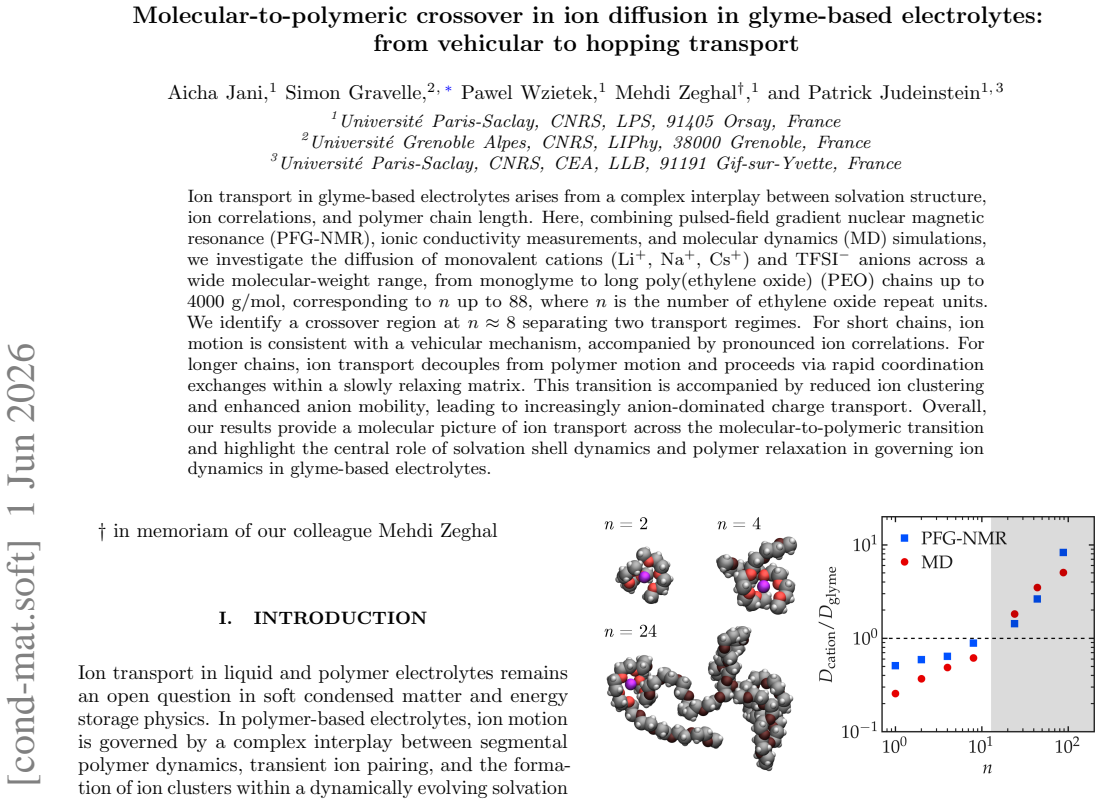
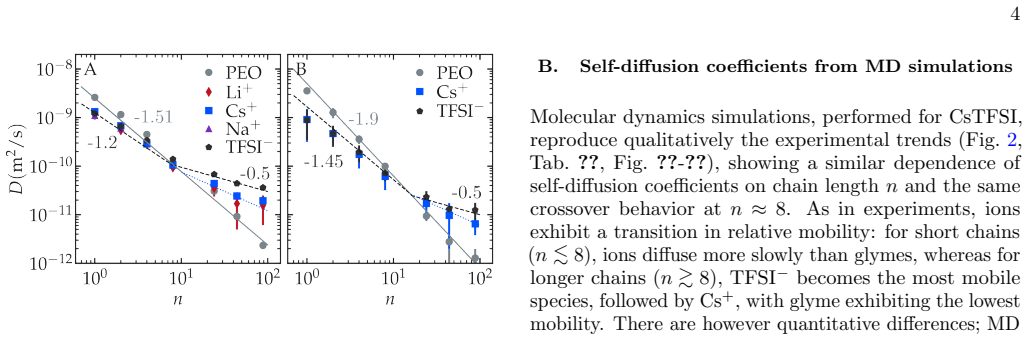
Combining PFG-NMR, conductivity measurements, and MD simulations across chain lengths from monoglyme to PEO with n up to 88, the work identifies a crossover at n ≈ 8. Short chains show vehicular ion motion with strong correlations, while longer chains feature ion transport via rapid coordination exchanges decoupled from slow polymer motion. The transition features less ion clustering and higher anion mobility, resulting in anion-dominated charge transport.
What carries the argument
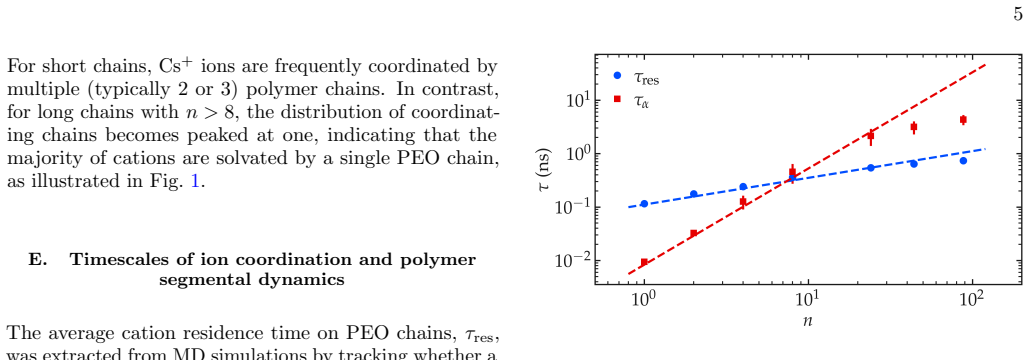
The n ≈ 8 crossover separating vehicular ion transport, where ions move together with solvent molecules, from hopping transport, where ions exchange coordination shells rapidly inside a slowly relaxing polymer matrix.
If this is right
- Short-chain (n<8) systems exhibit vehicular diffusion accompanied by pronounced ion correlations.
- Longer-chain systems show ion transport by coordination exchanges that decouples from polymer motion.
- Anion mobility increases relative to cations beyond the crossover, shifting charge transport toward anion dominance.
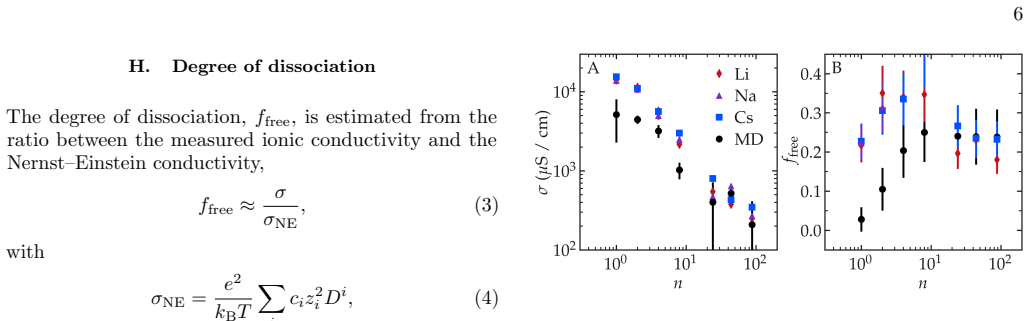
- Ion clustering decreases with increasing chain length across the transition.
Where Pith is reading between the lines
- Formulations near n=8 may optimize the balance between high conductivity and mechanical stability in related electrolytes.
- The same length-dependent crossover could appear in other ether-based or polymer electrolytes when solvation dynamics are similar.
- Varying cation size or anion identity would test whether the crossover location remains near eight repeat units.
Load-bearing premise
The PFG-NMR diffusion coefficients, conductivity data, and MD trajectories all probe the same long-time regime and the observed break at n≈8 is not an artifact of finite chain-length sampling, force-field choice, or the specific cations studied.
What would settle it
Absence of a distinct change in the ratio of ion diffusion coefficient to polymer diffusion coefficient or in the degree of ion clustering when chain length is varied continuously through n=8 in additional cations or simulation models.
Figures
read the original abstract
Ion transport in glyme-based electrolytes arises from a complex interplay between solvation structure, ion correlations, and polymer chain length. Here, combining pulsed-field gradient nuclear magnetic resonance (PFG-NMR), ionic conductivity measurements, and molecular dynamics (MD) simulations, we investigate the diffusion of monovalent cations (Li$^+$, Na$^+$, Cs$^+$) and TFSI$^-$ anions across a wide molecular-weight range, from monoglyme to long poly(ethylene oxide) (PEO) chains up to 4000~g/mol, corresponding to $n$ up to 88, where $n$ is the number of ethylene oxide repeat units. We identify a crossover region at $n \approx 8$ separating two transport regimes. For short chains, ion motion is consistent with a vehicular mechanism, accompanied by pronounced ion correlations. For longer chains, ion transport decouples from polymer motion and proceeds via rapid coordination exchanges within a slowly relaxing matrix. This transition is accompanied by reduced ion clustering and enhanced anion mobility, leading to increasingly anion-dominated charge transport. Overall, our results provide a molecular picture of ion transport across the molecular-to-polymeric transition and highlight the central role of solvation shell dynamics and polymer relaxation in governing ion dynamics in glyme-based electrolytes.
Editorial analysis
A structured set of objections, weighed in public.
Referee Report
Summary. The manuscript combines PFG-NMR diffusion measurements, ionic conductivity data, and MD simulations to study monovalent cation (Li+, Na+, Cs+) and TFSI- transport in glyme solvents and PEO chains spanning n=1 to n=88. It reports a crossover near n≈8 separating a short-chain vehicular regime (with strong ion correlations) from a long-chain regime in which ion motion decouples from polymer relaxation and occurs via rapid coordination-shell exchanges, accompanied by reduced clustering and a shift toward anion-dominated conductivity.
Significance. If the reported crossover and mechanistic assignment hold after verification of the long-time regime, the work supplies a concrete molecular picture of the molecular-to-polymeric transition that is directly relevant to the design of glyme- and PEO-based battery electrolytes. The multi-technique approach (experiment plus simulation across three cations) is a strength.
major comments (2)
- [Methods and Results (simulation protocol and diffusion-coefficient extraction)] The central claim of a regime crossover at n≈8 and the subsequent decoupling of ion from polymer motion both rest on the assumption that PFG-NMR, conductivity, and MD all access the same long-time diffusive limit. The manuscript does not report a quantitative check (e.g., mean-squared-displacement linearity or convergence of diffusion coefficients with simulation length) for the longest chains where polymer relaxation times become comparable to or longer than accessible MD times; this directly affects the validity of the decoupling interpretation.
- [Results (diffusion vs. n plots and accompanying text)] The crossover location is stated as n≈8 without an explicit criterion (e.g., intersection of fitted lines, change in scaling exponent, or statistical test on the n-dependence of D_ion/D_polymer). Because the position of the break is load-bearing for the two-regime narrative, the lack of a reproducible definition weakens the claim that the transition is sharply located at this value rather than being an artifact of the sampled chain lengths or cation set.
minor comments (2)
- [Figures] Figure captions and axis labels should explicitly state the chain lengths or n values corresponding to each data series so that the location of the reported crossover can be verified by the reader without cross-referencing the methods.
- [Abstract] The abstract uses the phrase 'pronounced ion correlations' without a forward reference to the quantitative metric (e.g., Haven ratio, distinct van Hove function, or conductivity–diffusion discrepancy) that supports it in the main text.
Simulated Author's Rebuttal
We thank the referee for the constructive comments. We address each major point below and will revise the manuscript to strengthen the presentation of the simulation analysis and the definition of the crossover.
read point-by-point responses
-
Referee: [Methods and Results (simulation protocol and diffusion-coefficient extraction)] The central claim of a regime crossover at n≈8 and the subsequent decoupling of ion from polymer motion both rest on the assumption that PFG-NMR, conductivity, and MD all access the same long-time diffusive limit. The manuscript does not report a quantitative check (e.g., mean-squared-displacement linearity or convergence of diffusion coefficients with simulation length) for the longest chains where polymer relaxation times become comparable to or longer than accessible MD times; this directly affects the validity of the decoupling interpretation.
Authors: We agree that explicit verification of the long-time diffusive regime is necessary to support the decoupling claim. In the revised manuscript we will add representative MSD-versus-time plots for both short and long chains (including n=88), confirm linearity in the extracted regime, and tabulate the simulation lengths and fitting windows used for each system. Diffusion coefficients were obtained from the linear portion after at least 50 ns of production sampling; these details will now be documented. revision: yes
-
Referee: [Results (diffusion vs. n plots and accompanying text)] The crossover location is stated as n≈8 without an explicit criterion (e.g., intersection of fitted lines, change in scaling exponent, or statistical test on the n-dependence of D_ion/D_polymer). Because the position of the break is load-bearing for the two-regime narrative, the lack of a reproducible definition weakens the claim that the transition is sharply located at this value rather than being an artifact of the sampled chain lengths or cation set.
Authors: The n≈8 location was identified from the point at which ion diffusion coefficients cease to decrease with increasing n while polymer diffusion continues to slow, accompanied by a change in the scaling of D_ion with n. To make the assignment reproducible we will add, in the revision, power-law fits to the D versus n data on either side of the transition, report the n value at which the exponent changes from negative to near zero, and include the n-dependence of the D_ion/D_polymer ratio with a clear threshold used to mark the crossover. revision: yes
Circularity Check
No significant circularity; claims rest on independent observations
full rationale
The paper reports an empirical crossover at n≈8 identified from PFG-NMR diffusivities, conductivity measurements, and MD trajectories across a range of chain lengths. No derivation chain, equations, or fitted parameters are invoked that would reduce the reported regimes or crossover location to quantities defined in terms of themselves. The central claim is a direct comparison of measured observables and is therefore self-contained against external benchmarks.
Axiom & Free-Parameter Ledger
Reference graph
Works this paper leans on
-
[1]
Laboratoire d’Excellence Physics Atoms Light Mater
Experiments were conducted at (60 ± 2) ◦C, and the temperature was calibrated using the self-diffusion coefficient of water [ 20] in a reference tube of similar geometry. The self-diffusion coefficient D was determined from the attenuation of the echo signal E according to [21–23]: E = exp h − γ2g2δ2(∆ − δ/3)D i , where γ is the gyromagnetic ratio of the ...
2025
-
[2]
Armand, J
M. Armand, J. Chabagno, and M. Duclot, Poly-ethers as solid electrolytes. North-Holland, Amsterdam, 1979
1979
-
[3]
Polymer electrolytes: conductivity and stability domain,
M. B. Armand, “Polymer electrolytes: conductivity and stability domain,” in Proceedings of the workshop on lithium nonaqueous battery electrochemistry, pp. 261–270, The Electrochemical Society, 1980
1980
-
[4]
F. M. Gray, Solid Polymer Electrolytes: Fundamentals and Technological Applications. Wiley-VCH, Weinheim, 1991
1991
-
[5]
Polymer Electrolytes,
D. T. Hallinan and N. P. Balsara, “Polymer Electrolytes,” Annual Review of Materials Research, vol. 43, pp. 503–525, July 2013
2013
-
[6]
Polymeric solid electrolytes,
M. Armand, J. Chabagno, and M. Duclot, “Polymeric solid electrolytes,” in Second International Meeting on Solid Electrolytes, 1978
1978
-
[7]
Improved synthesis of oxymethylene-linked poly(oxyethylene),
C. V. Nicholas, D. J. Wilson, C. Booth, and J. R. M. Giles, “Improved synthesis of oxymethylene-linked poly(oxyethylene),” British Polymer Journal , vol. 20, pp. 289–292, Jan. 1988
1988
-
[8]
Mecha- nism of ion transport in PEO/LiTFSI complexes: Effect of temperature, molecular weight and end groups,
D. Devaux, R. Bouchet, D. Gl´ e, and R. Denoyel, “Mecha- nism of ion transport in PEO/LiTFSI complexes: Effect of temperature, molecular weight and end groups,” Solid State Ionics, vol. 227, pp. 119–127, Oct. 2012
2012
-
[9]
Complex of alkali metal ions with poly(ethylene oxide),
D. E. Fenton, “Complex of alkali metal ions with poly(ethylene oxide),” Polymer, vol. 14, p. 589, 1973
1973
-
[10]
Microscopic Investigation of Ionic Conductivity in Alkali Metal Salts - Poly(Ethylene Oxide) Adducts,
C. Berthier, W. Gorecki, M. Minier, M. Armand, J. Chabagno, and P. Rigaud, “Microscopic Investigation of Ionic Conductivity in Alkali Metal Salts - Poly(Ethylene Oxide) Adducts,” Solid State Ionics, vol. 11, no. 1, pp. 91– 95, 1983
1983
-
[11]
Crystal structure of poly(ethylene oxide)—sodium iodide complex,
Y. Chatani and S. Okamura, “Crystal structure of poly(ethylene oxide)—sodium iodide complex,” Polymer, vol. 28, pp. 1815–1820, Oct. 1987
1987
-
[12]
Glyme-based nonaqueous electrolytes for rechargeable lithium cells,
S. Tobishima, H. Morimoto, M. Aoki, Y. Saito, T. Inose, T. Fukumoto, and T. Kuryu, “Glyme-based nonaqueous electrolytes for rechargeable lithium cells,” Electrochimica Acta, vol. 49, pp. 979–987, Mar. 2004
2004
-
[13]
Rechargeable lithium battery using non-flammable elec- trolyte based on tetraethylene glycol dimethyl ether and olivine cathodes,
D. Di Lecce, L. Carbone, V. Gancitano, and J. Hassoun, “Rechargeable lithium battery using non-flammable elec- trolyte based on tetraethylene glycol dimethyl ether and olivine cathodes,” Journal of Power Sources , vol. 334, pp. 146–153, Dec. 2016
2016
-
[14]
Towards a High-Performance Lithium-Metal Battery with Glyme Solution and an Olivine Cathode,
S. Wei, S. Inoue, D. Di Lecce, Z. Li, Y. Tominaga, and J. Hassoun, “Towards a High-Performance Lithium-Metal Battery with Glyme Solution and an Olivine Cathode,” ChemElectroChem, vol. 7, pp. 2376–2388, June 2020
2020
-
[15]
Glyme-based electrolytes: Suitable solutions for next-generation lithium batteries,
D. Di Lecce, V. Marangon, H.-G. Jung, Y. Tominaga, S. Greenbaum, and J. Hassoun, “Glyme-based electrolytes: Suitable solutions for next-generation lithium batteries,” Green Chemistry, vol. 24, no. 3, pp. 1021–1048, 2022
2022
-
[16]
Effect of Salt Concentration on Ion Clustering and Transport in Poly- mer Solid Electrolytes: A Molecular Dynamics Study of PEO–LiTFSI,
N. Molinari, J. P. Mailoa, and B. Kozinsky, “Effect of Salt Concentration on Ion Clustering and Transport in Poly- mer Solid Electrolytes: A Molecular Dynamics Study of PEO–LiTFSI,” Chemistry of Materials , vol. 30, pp. 6298– 6306, Sept. 2018
2018
-
[17]
Glyme-Lithium Bis(trifluoromethanesulfonyl)imide and Glyme-Lithium Bis(perfluoroethanesulfonyl)imide Phase Behavior and Solvate Structures,
W. A. Henderson, F. McKenna, M. A. Khan, N. R. Brooks, V. G. Young, and R. Frech, “Glyme-Lithium Bis(trifluoromethanesulfonyl)imide and Glyme-Lithium Bis(perfluoroethanesulfonyl)imide Phase Behavior and Solvate Structures,” Chemistry of Materials , vol. 17, 10 pp. 2284–2289, May 2005
2005
-
[18]
NMR studies of equilibriums in elec- trolytes,
A. Plewa-Marczewska, M. Kalita, M. Marczewski, and M. Siekierski, “NMR studies of equilibriums in elec- trolytes,” Electrochimica Acta, vol. 55, pp. 1389–1395, Jan. 2010
2010
-
[19]
Effect of Ionic Size on Solvate Stability of Glyme-Based Solvate Ionic Liquids,
T. Mandai, K. Yoshida, S. Tsuzuki, R. Nozawa, H. Masu, K. Ueno, K. Dokko, and M. Watanabe, “Effect of Ionic Size on Solvate Stability of Glyme-Based Solvate Ionic Liquids,” The Journal of Physical Chemistry B , vol. 119, pp. 1523–1534, Jan. 2015
2015
-
[20]
Stable solvates in solution of lithium bis(trifluoromethylsulfone)imide in glymes and other aprotic solvents: Phase diagrams, crys- tallography and Raman spectroscopy,
D. Brouillette, D. E. Irish, N. J. Taylor, G. Perron, M. Odziemkowski, and J. E. Desnoyers, “Stable solvates in solution of lithium bis(trifluoromethylsulfone)imide in glymes and other aprotic solvents: Phase diagrams, crys- tallography and Raman spectroscopy,” Physical Chem- istry Chemical Physics , vol. 4, pp. 6063–6071, Nov. 2002
2002
-
[21]
Temperature- dependent self-diffusion coefficients of water and six se- lected molecular liquids for calibration in accurate 1H NMR PFG measurements,
M. Holz, S. R. Heil, and A. Sacco, “Temperature- dependent self-diffusion coefficients of water and six se- lected molecular liquids for calibration in accurate 1H NMR PFG measurements,” Physical Chemistry Chemical Physics, vol. 2, no. 20, pp. 4740–4742, 2000
2000
-
[22]
Spin Diffusion Measure- ments: Spin Echoes in the Presence of a Time-Dependent Field Gradient,
E. O. Stejskal and J. E. Tanner, “Spin Diffusion Measure- ments: Spin Echoes in the Presence of a Time-Dependent Field Gradient,” The Journal of Chemical Physics, vol. 42, pp. 288–292, Jan. 1965
1965
-
[23]
Self-Diffusion of Supercooled Water to 238 K Using PGSE NMR Diffusion Measurements,
W. S. Price, H. Ide, and Y. Arata, “Self-Diffusion of Supercooled Water to 238 K Using PGSE NMR Diffusion Measurements,” The Journal of Physical Chemistry A , vol. 103, pp. 448–450, Jan. 1999
1999
-
[24]
W. S. Price, “Pulsed-field gradient nuclear magnetic reso- nance as a tool for studying translational diffusion: Part
-
[25]
Basic theory,” Concepts in Magnetic Resonance , vol. 9, no. 5, pp. 299–336, 1997
1997
-
[26]
GROMACS: High per- formance molecular simulations through multi-level paral- lelism from laptops to supercomputers,
M. J. Abraham, T. Murtola, R. Schulz, S. P´ all, J. C. Smith, B. Hess, and E. Lindahl, “GROMACS: High per- formance molecular simulations through multi-level paral- lelism from laptops to supercomputers,” SoftwareX, vol. 1– 2, pp. 19–25, Sept. 2015
2015
-
[27]
Po- larizable Molecular Dynamics and Experiments of 1,2- Dimethoxyethane Electrolytes with Lithium and Sodium Salts: Structure and Transport Properties,
T. P. Liyana-Arachchi, J. B. Haskins, C. M. Burke, K. M. Diederichsen, B. D. McCloskey, and J. W. Lawson, “Po- larizable Molecular Dynamics and Experiments of 1,2- Dimethoxyethane Electrolytes with Lithium and Sodium Salts: Structure and Transport Properties,” The Journal of Physical Chemistry B , vol. 122, pp. 8548–8559, Sept. 2018
2018
-
[28]
A smooth particle mesh Ewald method,
U. Essmann, L. Perera, M. L. Berkowitz, T. Dar- den, H. Lee, and L. G. Pedersen, “A smooth particle mesh Ewald method,” The Journal of Chemical Physics , vol. 103, pp. 8577–8593, Nov. 1995
1995
-
[29]
Glyme-Salt-MD: Cs–TFSI–PEO Molecular System Builder for GROMACS Simulations,
S. Gravelle, “Glyme-Salt-MD: Cs–TFSI–PEO Molecular System Builder for GROMACS Simulations,” May 2026. https://doi.org/10.5281/zenodo.20411031
-
[30]
Canonical sampling through velocity rescaling,
G. Bussi, D. Donadio, and M. Parrinello, “Canonical sampling through velocity rescaling,” The Journal of Chemical Physics, vol. 126, p. 014101, Jan. 2007
2007
-
[31]
Pressure control using stochas- tic cell rescaling,
M. Bernetti and G. Bussi, “Pressure control using stochas- tic cell rescaling,” The Journal of Chemical Physics , vol. 153, p. 114107, Sept. 2020
2020
-
[32]
Characteristics of glyme elec- trolytes for sodium battery: Nuclear magnetic resonance and electrochemical study,
L. Carbone, S. Munoz, M. Gobet, M. Devany, S. Green- baum, and J. Hassoun, “Characteristics of glyme elec- trolytes for sodium battery: Nuclear magnetic resonance and electrochemical study,” Electrochimica Acta, vol. 231, pp. 223–229, Mar. 2017
2017
-
[33]
Ion transport and association study of glyme-based elec- trolytes with lithium and sodium salts,
D. Morales, R. E. Ruther, J. Nanda, and S. Greenbaum, “Ion transport and association study of glyme-based elec- trolytes with lithium and sodium salts,” Electrochimica Acta, vol. 304, pp. 239–245, May 2019
2019
-
[34]
23Na NMR T 1 relaxation measurements as a probe for diffusion and dynamics of sodium ions in salt–glycerol mixtures,
C. D’Agostino, S. J. Davis, and A. P. Abbott, “23Na NMR T 1 relaxation measurements as a probe for diffusion and dynamics of sodium ions in salt–glycerol mixtures,” The Journal of Chemical Physics , vol. 154, p. 224501, June 2021
2021
-
[35]
Rubinstein and R
M. Rubinstein and R. H. Colby, Polymer Physics. Oxford Scholarship Online, Oxford: Oxford University Press, 2023
2023
-
[36]
Structure and Energetics of Poly(Ethylene Glycol) Cationized by Li + , Na+ , K+ and Cs+ : A First-Principles Study,
A. Memboeuf, K. V´ ekey, and G. Lendvay, “Structure and Energetics of Poly(Ethylene Glycol) Cationized by Li + , Na+ , K+ and Cs+ : A First-Principles Study,” European Journal of Mass Spectrometry , vol. 17, pp. 33–46, Feb. 2011
2011
-
[37]
NaFSI and NaTFSI Solutions in Ether Solvents from Monoglyme to Poly(ethylene oxide)—A Molecular Dynamics Study,
P. Wr´ obel, P. Kubisiak, and A. Eilmes, “NaFSI and NaTFSI Solutions in Ether Solvents from Monoglyme to Poly(ethylene oxide)—A Molecular Dynamics Study,” The Journal of Physical Chemistry B , vol. 125, pp. 10293– 10303, Sept. 2021
2021
-
[38]
Dynamics of unentangled cyclic and linear poly(oxyethylene) melts,
S. Nam, J. Leisen, V. Breedveld, and H. W. Beck- ham, “Dynamics of unentangled cyclic and linear poly(oxyethylene) melts,” Polymer, vol. 49, pp. 5467– 5473, Nov. 2008
2008
-
[39]
An X-Ray Diffraction Study on the Stucture of 18-Crown-6 Ether Complexes with Alkali Metal Ions in Aqueous Solution,
K. Ozutsumi, M. Natsuhara, and H. Ohtaki, “An X-Ray Diffraction Study on the Stucture of 18-Crown-6 Ether Complexes with Alkali Metal Ions in Aqueous Solution,” Bulletin of the Chemical Society of Japan, vol. 62, pp. 2807– 2818, Sept. 1989
1989
-
[40]
Ionic Conductivity of Lithium Salt/Oligo(ethylene oxide)-Based Liquid-Crystal Mixtures: The Effect of Molecular Architecture on the Conduction Process,
P. Judeinstein and F. Roussel, “Ionic Conductivity of Lithium Salt/Oligo(ethylene oxide)-Based Liquid-Crystal Mixtures: The Effect of Molecular Architecture on the Conduction Process,” Advanced Materials, vol. 17, pp. 723– 727, Mar. 2005
2005
-
[41]
Glymes as versatile solvents for chemical reactions and processes: From the laboratory to industry,
S. Tang and H. Zhao, “Glymes as versatile solvents for chemical reactions and processes: From the laboratory to industry,” RSC Advances, vol. 4, no. 22, p. 11251, 2014
2014
-
[42]
Molecular Dynamics-Based Optimization of Glyme Electrolytes,
J. Park, W. A. Goddard, and H. Kim, “Molecular Dynamics-Based Optimization of Glyme Electrolytes,” The Journal of Physical Chemistry B , vol. 129, pp. 12285– 12293, Nov. 2025
2025
-
[43]
Understanding the Lithium Transport within a Rouse-Based Model for a PEO/LiTFSI Polymer Electrolyte,
D. Diddens, A. Heuer, and O. Borodin, “Understanding the Lithium Transport within a Rouse-Based Model for a PEO/LiTFSI Polymer Electrolyte,” Macromolecules, vol. 43, pp. 2028–2036, Feb. 2010
2028
-
[44]
Polymer Electrolytes for Lithium-Ion Bat- teries,
W. H. Meyer, “Polymer Electrolytes for Lithium-Ion Bat- teries,” Advanced Materials, vol. 10, pp. 439–448, Apr. 1998
1998
-
[45]
Mechanistic Decomposition of Ion Transport in Amorphous Polymer Electrolytes via Molecular Dynamics,
P. A. Leon, K. Jun, K. Gordiz, Y. Shao-Horn, and R. Gomez-Bombarelli, “Mechanistic Decomposition of Ion Transport in Amorphous Polymer Electrolytes via Molecular Dynamics,” The Journal of Physical Chemistry Letters, vol. 16, pp. 12419–12427, Dec. 2025
2025
-
[46]
Mechanism of Ion Transport in Amorphous Poly(ethylene oxide)/LiTFSI from Molecular Dynamics Simulations,
O. Borodin and G. D. Smith, “Mechanism of Ion Transport in Amorphous Poly(ethylene oxide)/LiTFSI from Molecular Dynamics Simulations,” Macromolecules, vol. 39, pp. 1620–1629, Feb. 2006
2006
-
[47]
Physical properties of solid polymer elec- trolyte PEO(LiTFSI) complexes,
W. Gorecki, M. Jeannin, E. Belorizky, C. Roux, and M. Armand, “Physical properties of solid polymer elec- trolyte PEO(LiTFSI) complexes,” Journal of Physics: Condensed Matter, vol. 7, pp. 6823–6832, Aug. 1995
1995
-
[48]
Hayamizu, E
K. Hayamizu, E. Akiba, T. Bando, and Y. Aihara, “H 1 , Li7, and F19 nuclear magnetic resonance 11 and ionic conductivity studies for liquid electrolytes composed of glymes and polyetheneglycol dimethyl ethers of CH3O(CH2CH2O)nCH3 (n=3–50) doped with LiN(SO2CF3)2,” The Journal of Chemical Physics , vol. 117, pp. 5929–5939, Sept. 2002
2002
-
[49]
Effect of Chemical Variations in the Structure of Poly(ethylene oxide)-Based Polymers on Lithium Transport in Concentrated Elec- trolytes,
A. France-Lanord, Y. Wang, T. Xie, J. A. Johnson, Y. Shao-Horn, and J. C. Grossman, “Effect of Chemical Variations in the Structure of Poly(ethylene oxide)-Based Polymers on Lithium Transport in Concentrated Elec- trolytes,” Chemistry of Materials , vol. 32, pp. 121–126, Jan. 2020
2020
-
[50]
Intermolec- ular Interactions in Li + -glyme and Li + -glyme–TFSA- Complexes: Relationship with Physicochemical Proper- ties of [Li(glyme)][TFSA] Ionic Liquids,
S. Tsuzuki, W. Shinoda, S. Seki, Y. Umebayashi, K. Yoshida, K. Dokko, and M. Watanabe, “Intermolec- ular Interactions in Li + -glyme and Li + -glyme–TFSA- Complexes: Relationship with Physicochemical Proper- ties of [Li(glyme)][TFSA] Ionic Liquids,” ChemPhysChem, vol. 14, pp. 1993–2001, June 2013
1993
-
[51]
Analysis of diffusion in a solid polymer electrolyte in the context of a phase- separated system,
L. Edman, A. Ferry, and G. Or¨ add, “Analysis of diffusion in a solid polymer electrolyte in the context of a phase- separated system,” Physical Review E, vol. 65, p. 042803, Apr. 2002
2002
-
[52]
The influence of interface polarization on the determination of lithium transference numbers of salt in polyethylene oxide electrolytes,
M. Hiller, M. Joost, H. Gores, S. Passerini, and H.-D. Wiemh¨ ofer, “The influence of interface polarization on the determination of lithium transference numbers of salt in polyethylene oxide electrolytes,” Electrochimica Acta, vol. 114, pp. 21–29, Dec. 2013
2013
-
[53]
Electrolyte Depen- dence of Li + Transport Mechanisms in Small Molecule Solvents from Classical Molecular Dynamics,
E. Crabb, A. Aggarwal, R. Stephens, Y. Shao-Horn, G. Leverick, and J. C. Grossman, “Electrolyte Depen- dence of Li + Transport Mechanisms in Small Molecule Solvents from Classical Molecular Dynamics,” The Jour- nal of Physical Chemistry B , vol. 128, pp. 3427–3441, Apr. 2024
2024
-
[54]
Electrolytes and Interphases in Li-Ion Batteries and Beyond,
K. Xu, “Electrolytes and Interphases in Li-Ion Batteries and Beyond,” Chemical Reviews, vol. 114, pp. 11503– 11618, Dec. 2014
2014
-
[55]
Single-ion BAB triblock copolymers as highly efficient electrolytes for lithium-metal batteries,
R. Bouchet, S. Maria, R. Meziane, A. Aboulaich, L. Lien- afa, J.-P. Bonnet, T. N. T. Phan, D. Bertin, D. Gigmes, D. Devaux, R. Denoyel, and M. Armand, “Single-ion BAB triblock copolymers as highly efficient electrolytes for lithium-metal batteries,” Nature Materials, vol. 12, pp. 452–457, May 2013
2013
-
[56]
PEO: An immobile solvent?,
A. Thiam, C. Martinez-Cisneros, Y. Molm´ eret, C. Io- joiu, and J.-Y. Sanchez, “PEO: An immobile solvent?,” Electrochimica Acta, vol. 302, pp. 338–343, Apr. 2019
2019
discussion (0)
Sign in with ORCID, Apple, or X to comment. Anyone can read and Pith papers without signing in.