CARTE: A Benchmark for Mapping Language Model Knowledge Across France
Pith reviewed 2026-06-28 15:05 UTC · model grok-4.3
The pith
Language models show uneven performance on knowledge specific to different French regions.
A machine-rendered reading of the paper's core claim, the machinery that carries it, and where it could break.
Core claim
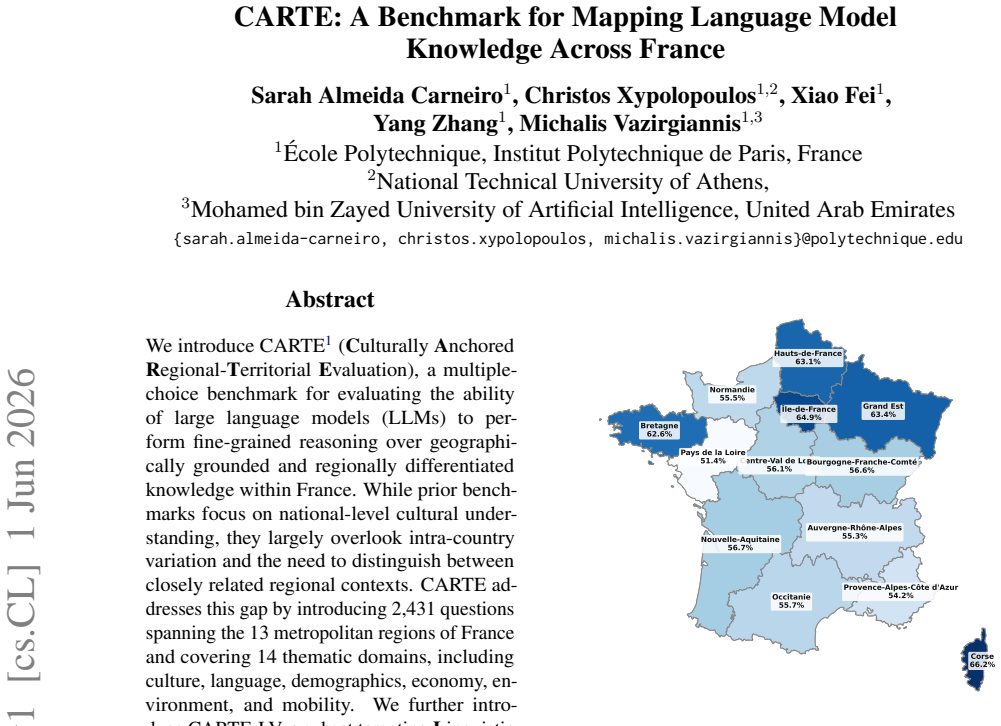
CARTE supplies 2,431 regionally labeled questions across 13 French metropolitan regions and 14 thematic domains to measure LLMs' fine-grained reasoning on geographically anchored knowledge. A linguistic-variation subset called CARTE-LV is included. Evaluation of 27 models under few-shot conditions shows performance disparities across regions and parameter scales, which the authors attribute to systematic gaps in pretraining coverage and limited robustness to intra-national variation.
What carries the argument
The CARTE benchmark, a collection of multiple-choice questions with explicit regional labels that distinguish closely related intra-country contexts.
If this is right
- Models achieve different accuracy depending on which of the 13 regions a question concerns.
- Increasing model size from 1B to 12B parameters does not remove the regional performance gaps.
- Pretraining data appears to under-represent certain regional contexts within France.
- Current models have limited ability to distinguish between closely related regional contexts.
Where Pith is reading between the lines
- Similar regionally anchored benchmarks could be built for other countries to map comparable knowledge gaps.
- Data collection for future model training might need explicit steps to balance representation of sub-national areas.
- Performance on these questions could serve as a proxy for how well a model would perform in region-specific applications.
Load-bearing premise
The 2,431 questions and their regional labels accurately and without bias represent the chosen knowledge domains and the real distinctions between French regions.
What would settle it
Repeating the evaluation with a fresh set of questions that keep the same regional labels but different content and finding no performance differences across regions would show the disparities are not systematic.
Figures
read the original abstract
We introduce CARTE 1 (Culturally Anchored Regional-Territorial Evaluation), a multiplechoice benchmark for evaluating the ability of large language models (LLMs) to perform fine-grained reasoning over geographically grounded and regionally differentiated knowledge within France. While prior benchmarks focus on national-level cultural understanding, they largely overlook intra-country variation and the need to distinguish between closely related regional contexts. CARTE addresses this gap by introducing 2,431 questions spanning the 13 metropolitan regions of France and covering 14 thematic domains, including culture, language, demographics, economy, environment, and mobility. We further introduce CARTE-LV, a subset targeting Linguistic Variation across French regions, enabling focused evaluation of language-related differences. We evaluate 27 LLMs ranging from 1B to 12B parameters under few-shot settings. Our experiments reveal performance disparities across regions and model scales, suggesting systematic gaps in pretraining coverage and limited robustness to intra-national variation.
Editorial analysis
A structured set of objections, weighed in public.
Referee Report
Summary. The paper introduces CARTE, a multiple-choice benchmark with 2,431 questions spanning 13 metropolitan French regions and 14 domains (culture, language, demographics, economy, environment, mobility), plus the CARTE-LV subset for linguistic variation. It evaluates 27 LLMs (1B–12B parameters) in few-shot settings and reports performance disparities across regions and scales, interpreting these as evidence of systematic gaps in pretraining coverage and limited robustness to intra-national variation.
Significance. If the questions and regional labels are shown to be free of systematic construction or selection artifacts, the work would provide a useful new resource for fine-grained evaluation of LLMs on intra-country cultural and linguistic knowledge, extending beyond existing national-level benchmarks. The scale of the evaluation across model sizes is a positive contribution to understanding how parameter count interacts with regional knowledge.
major comments (2)
- [§3] §3 (Benchmark Construction): No information is provided on question authorship, expert review per region, inter-annotator agreement, balancing procedures for difficulty or phrasing, or controls for regional bias in sourcing. This is load-bearing for the central claim, because the interpretation of regional performance gaps as pretraining coverage issues (Abstract) requires that the 2,431 items and their labels accurately represent the targeted domains without systematic artifacts.
- [Results] Results section (e.g., Table reporting per-region accuracies): Without the validation details above, the reported disparities cannot be confidently attributed to model knowledge gaps rather than potential confounds in question design or labeling; the abstract-only description leaves the soundness of this inference unassessable.
minor comments (2)
- [Abstract] The abstract and introduction could more explicitly state whether the CARTE dataset will be publicly released with the paper, as this would strengthen the contribution as a benchmark resource.
- [Introduction] Notation for CARTE-LV could be clarified earlier when first introduced to avoid any ambiguity with the full CARTE set.
Simulated Author's Rebuttal
We thank the referee for the detailed and constructive review. We agree that greater transparency on benchmark construction is needed to support the central claims and will revise the manuscript accordingly.
read point-by-point responses
-
Referee: [§3] §3 (Benchmark Construction): No information is provided on question authorship, expert review per region, inter-annotator agreement, balancing procedures for difficulty or phrasing, or controls for regional bias in sourcing. This is load-bearing for the central claim, because the interpretation of regional performance gaps as pretraining coverage issues (Abstract) requires that the 2,431 items and their labels accurately represent the targeted domains without systematic artifacts.
Authors: We agree that the manuscript does not currently detail question authorship, expert review, inter-annotator agreement, balancing procedures, or explicit controls for regional bias. In the revised version we will expand §3 to describe the actual construction process: questions were authored by the research team drawing on publicly available regional statistics, official government reports, and cultural references; balancing was performed by ensuring roughly equal coverage across the 14 domains and 13 regions; and regional labels were cross-checked against multiple sources to reduce obvious geographic misattribution. We will also add a limitations paragraph noting the absence of formal per-region expert panels and inter-annotator agreement statistics. These additions will allow readers to evaluate the strength of the pretraining-coverage interpretation. revision: yes
-
Referee: [Results] Results section (e.g., Table reporting per-region accuracies): Without the validation details above, the reported disparities cannot be confidently attributed to model knowledge gaps rather than potential confounds in question design or labeling; the abstract-only description leaves the soundness of this inference unassessable.
Authors: We accept that the current results section cannot be fully assessed without the missing construction details. The planned expansion of §3 (as described above) will supply the necessary context. We will also insert a short discussion in the results section that explicitly links the observed regional gaps to the documented sourcing and balancing steps, while acknowledging that residual confounds cannot be ruled out. This will make the inference from disparities to pretraining coverage more transparent and assessable. revision: yes
Circularity Check
No circularity: purely empirical benchmark evaluation
full rationale
The paper introduces CARTE, a 2,431-question multiple-choice benchmark across French regions and domains, then reports LLM performance under few-shot settings. No equations, parameter fitting, predictions derived from inputs, or self-citation chains appear in the abstract or described methodology. The central claim (regional performance gaps) rests on direct empirical measurement rather than any derivation that reduces to its own construction. This is a standard benchmark paper with no load-bearing self-referential steps.
Axiom & Free-Parameter Ledger
Reference graph
Works this paper leans on
-
[1]
arXiv preprint arXiv:2510.05046
Cole: a compre- hensive benchmark for french language understand- ing evaluation. arXiv preprint arXiv:2510.05046. Luiz Bonifacio, Vitor Jeronymo, Hugo Queiroz Abonizio, Israel Campiotti, Marzieh Fadaee, Roberto Lotufo, and Rodrigo Nogueira
-
[2]
arXiv preprint arXiv:2108.13897
mmarco: A multilingual version of the ms marco passage ranking dataset. arXiv preprint arXiv:2108.13897. Yu Ying Chiu, Liwei Jiang, Bill Yuchen Lin, Chan Young Park, Shuyue Stella Li, Sahithya Ravi, Mehar Bhatia, Maria Antoniak, Yulia Tsvetkov, Vered Shwartz, et al
-
[3]
arXiv preprint arXiv:2412.04261
Aya expanse: Combin- ing research breakthroughs for a new multilingual frontier. arXiv preprint arXiv:2412.04261. Martin d’Hoffschmidt, Wacim Belblidia, Quentin Hein- rich, Tom Brendlé, and Maxime Vidal
-
[4]
In Findings of the Association for Computational Linguistics: EMNLP 2020, pages 1193–1208
Fquad: French question answering dataset. In Findings of the Association for Computational Linguistics: EMNLP 2020, pages 1193–1208. Manuel Faysse, Patrick Fernandes, Nuno M Guer- reiro, António Loison, Duarte M Alves, Caio Corro, Nicolas Boizard, João Alves, Ricardo Rei, Pedro H Martins, et al
2020
-
[5]
arXiv preprint arXiv:2402.00786
Croissantllm: A truly bilin- gual french-english language model. arXiv preprint arXiv:2402.00786. Nathan Godey, Wissam Antoun, Rian Touchent, Rachel Bawden, Éric de la Clergerie, Benoît Sagot, and Djamé Seddah
-
[6]
arXiv preprint arXiv:2510.25771
Gaperon: A peppered english- french generative language model suite. arXiv preprint arXiv:2510.25771. Olivier Gouvert, Julie Hunter, Jérôme Louradour, Christophe Cerisara, Evan Dufraisse, Yaya Sy, Laura Rivière, Jean-Pierre Lorré, et al
-
[7]
arXiv preprint arXiv:2503.12294
The lucie-7b llm and the lucie training dataset: open resources for multilingual language generation. arXiv preprint arXiv:2503.12294. Yanzhu Guo, Simone Conia, Zelin Zhou, Min Li, Sa- loni Potdar, and Henry Xiao
-
[8]
arXiv preprint arXiv:2311.16840
The claire french dialogue dataset. arXiv preprint arXiv:2311.16840. Albert Q. Jiang, Alexandre Sablayrolles, Arthur Men- sch, Chris Bamford, Devendra Singh Chaplot, Diego de las Casas, Florian Bressand, Guy Lengyel, Guil- laume Lample, Lucile Saulnier, Léonard R. Lavaud, Marie-Anne Lachaux, Pierre Stock, Teven Le Scao, Thibaut Lavril, Thomas Wang, Timoth...
-
[9]
In 2024 5th International Conference on Image Processing and Capsule Networks (ICIPCN), pages 511–519
Fine tuning llms for low resource lan- guages. In 2024 5th International Conference on Image Processing and Capsule Networks (ICIPCN), pages 511–519. IEEE. Fajri Koto, Haonan Li, Sara Shatnawi, Jad Doughman, Abdelrahman Sadallah, Aisha Alraeesi, Khalid Al- mubarak, Zaid Alyafeai, Neha Sengupta, Shady She- hata, et al
2024
-
[10]
In Find- ings of the Association for Computational Linguistics: ACL 2024, pages 5622–5640
Arabicmmlu: Assessing massive multitask language understanding in arabic. In Find- ings of the Association for Computational Linguistics: ACL 2024, pages 5622–5640. Maxence Lasbordes and Sinoué Gad
2024
-
[11]
arXiv preprint arXiv:2506.04079
Eurollm-9b: Technical report. arXiv preprint arXiv:2506.04079. Hyangsuk Min, Yuho Lee, Minjeong Ban, Jiaqi Deng, Nicole Hee-Yeon Kim, Taewon Yun, Hang Su, Ja- son Cai, and Hwanjun Song
-
[12]
In International Conference on Learning Representations, volume 2025, pages 83291–83322
Include: Evaluating multilingual language understanding with regional knowledge. In International Conference on Learning Representations, volume 2025, pages 83291–83322. Gemini Team, Rohan Anil, Sebastian Borgeaud, Jean- Baptiste Alayrac, Jiahui Yu, Radu Soricut, Johan Schalkwyk, Andrew M Dai, Anja Hauth, Katie Millican, et al
2025
-
[13]
Gemini: A Family of Highly Capable Multimodal Models
Gemini: a family of highly capable multimodal models. arXiv preprint arXiv:2312.11805. Gemma Team, Thomas Mesnard, Cassidy Hardin, Robert Dadashi, Surya Bhupatiraju, Shreya Pathak, Laurent Sifre, Morgane Rivière, Mihir Sanjay Kale, Juliette Love, et al
work page internal anchor Pith review Pith/arXiv arXiv
-
[14]
Gemma: Open Models Based on Gemini Research and Technology
Gemma: Open models based on gemini research and technology. arXiv preprint arXiv:2403.08295. Klaudia Thellmann, Bernhard Stadler, Michael Fromm, Jasper Schulze Buschhoff, Alex Jude, Fabio Barth, Jo- hannes Leveling, Nicolas Flores-Herr, Joachim Köh- ler, René Jäkel, et al
work page internal anchor Pith review Pith/arXiv arXiv
-
[15]
Towards multilingual llm evaluation for european languages, 2024
Towards multilingual llm evaluation for european languages. arXiv preprint arXiv:2410.08928. Hugo Touvron, Thibaut Lavril, Gautier Izacard, Xavier Martinet, Marie-Anne Lachaux, Timothée Lacroix, Baptiste Rozière, Naman Goyal, Eric Hambro, Faisal Azhar, et al
-
[16]
LLaMA: Open and Efficient Foundation Language Models
Llama: Open and effi- cient foundation language models. arXiv preprint arXiv:2302.13971. Yubo Wang, Xueguang Ma, Ge Zhang, Yuansheng Ni, Abhranil Chandra, Shiguang Guo, Weiming Ren, Aaran Arulraj, Xuan He, Ziyan Jiang, et al
work page internal anchor Pith review Pith/arXiv arXiv
-
[17]
BLOOM: A 176B-Parameter Open-Access Multilingual Language Model
Bloom: A 176b- parameter open-access multilingual language model. arXiv preprint arXiv:2211.05100. Yuemei Xu, Ling Hu, Jiayi Zhao, Zihan Qiu, Kexin Xu, Yuqi Ye, and Hanwen Gu
work page internal anchor Pith review Pith/arXiv arXiv
-
[18]
Qwen3 technical report. arXiv preprint arXiv:2505.09388. Jiahao Ying, Wei Tang, Yiran Zhao, Yixin Cao, Yu Rong, and Wenxuan Zhang
work page internal anchor Pith review Pith/arXiv arXiv
-
[19]
In Findings of the Association for Computational Linguistics: EMNLP 2024, pages 7035–7055
Turk- ishmmlu: Measuring massive multitask language un- derstanding in turkish. In Findings of the Association for Computational Linguistics: EMNLP 2024, pages 7035–7055. Yang Zhang, Mersin Konomi, Christos Xypolopoulos, Konstantinos Divriotis, Konstantinos Skianis, Gian- nis Nikolentzos, Giorgos Stamou, Guokan Shang, and Michalis Vazirgiannis
2024
-
[20]
où ?”), explication (“pourquoi ?
Greekmmlu: A native-sourced multitask benchmark for evalu- ating language models in greek. arXiv preprint arXiv:2602.05150. A CARTE-LV Question Generation Prompt The following text is the prompt used for the gen- eration of the questions used in CARTE-LV: RÔLE:Vous êtes un expert des variations linguistiques à travers les régions françaises. ENTRÉE: À par...
discussion (0)
Sign in with ORCID, Apple, or X to comment. Anyone can read and Pith papers without signing in.