Branch-Aware Quantum Constant Propagation for Dynamic Quantum Circuits
Pith reviewed 2026-06-28 14:39 UTC · model grok-4.3
The pith
Branch-aware tracking of measurement outcomes lets compilers simplify dynamic quantum circuits more than prior constant propagation.
A machine-rendered reading of the paper's core claim, the machinery that carries it, and where it could break.
Core claim
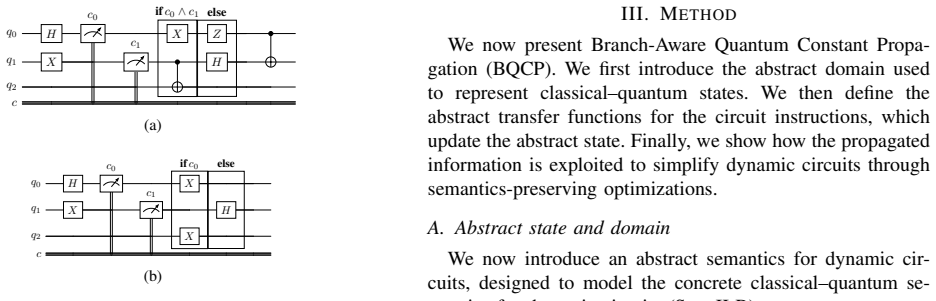
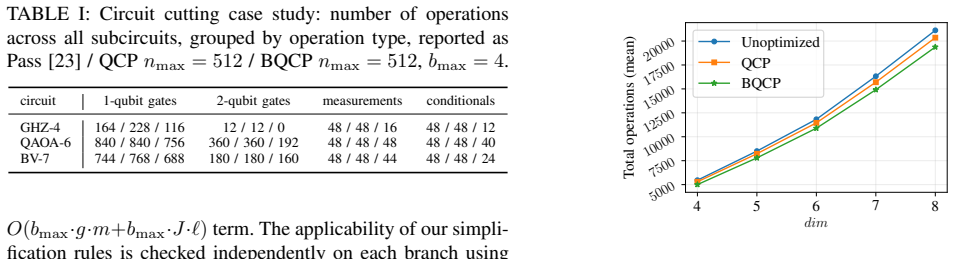
BQCP extends QCP by tracking the classical information produced by mid-circuit measurements together with the corresponding post-measurement quantum states across different execution branches. This enables path-sensitive reasoning inside conditional blocks and more precise information propagation than QCP. Using the information inferred by the analysis, the method applies semantics-preserving simplifications to circuit operations while bounding state size and branch count for scalability.
What carries the argument
Branch-aware tracking of classical measurement outcomes together with post-measurement quantum states across execution paths.
If this is right
- Larger circuit-size reductions than QCP or other existing passes on dynamic circuits.
- Semantics-preserving simplifications inside conditional blocks that depend on measurement outcomes.
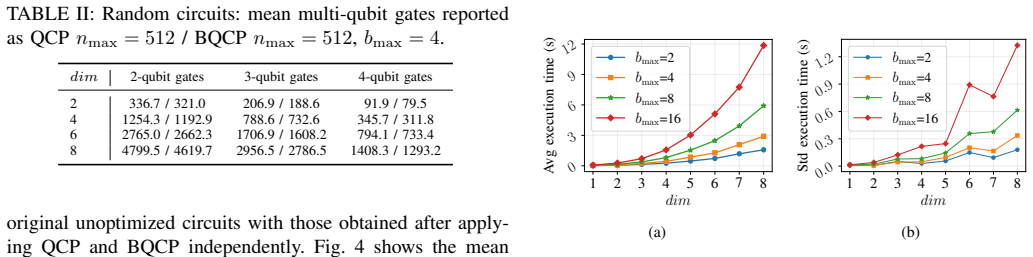
- Sound analysis that remains practical through explicit bounds on state and branch tracking.
- Consistent gains on both application-driven and synthetic benchmarks.
Where Pith is reading between the lines
- Compilers for hardware supporting mid-circuit measurements could adopt similar path tracking to reduce overhead from classical feedforward.
- The same bounding idea might apply to other analyses that mix classical control flow with quantum state.
- Tighter integration with classical constant-folding passes could further reduce the cost of tracking branches.
Load-bearing premise
Bounding the quantum-state representation size and the number of tracked branches still captures enough information to produce meaningful simplifications on realistic dynamic circuits.
What would settle it
A dynamic-circuit benchmark in which the extra reductions claimed by BQCP disappear once the branch or state bound is lowered to the point where path distinctions needed for those reductions are lost.
Figures


read the original abstract
Compile-time optimization is important for improving the efficiency and reliability of quantum circuits on current noisy hardware. While many existing methods simplify circuits using structural patterns or quantum-state information, most of them target only unitary circuits and do not support dynamic circuits with mid-circuit measurements and classical feedforward. In this work, we present Branch-Aware Quantum Constant Propagation (BQCP), a compile-time analysis for dynamic circuits. BQCP extends Quantum Constant Propagation (QCP) by tracking the classical information produced by mid-circuit measurements together with the corresponding post-measurement quantum states across different execution branches. This enables path-sensitive reasoning inside conditional blocks and more precise information propagation than QCP. To keep the analysis scalable, we bound both the size of the quantum-state representation and the number of tracked branches. Using the information inferred by the analysis, we apply semantics-preserving simplifications to circuit operations. We prove the soundness of both the analysis and the simplifications. Experimental results on both application-driven and synthetic benchmarks show that, on dynamic circuits, our method consistently achieves larger reductions than other existing passes including QCP.
Editorial analysis
A structured set of objections, weighed in public.
Referee Report
Summary. The manuscript presents Branch-Aware Quantum Constant Propagation (BQCP), an extension of Quantum Constant Propagation (QCP) for dynamic quantum circuits containing mid-circuit measurements and classical feedforward. BQCP tracks classical measurement outcomes together with post-measurement quantum states across execution branches to support path-sensitive constant propagation and simplifications inside conditional blocks. Both quantum-state representation size and the number of tracked branches are bounded for scalability; the authors prove soundness of the bounded analysis and the derived simplifications, and report larger circuit reductions than existing passes (including QCP) on application-driven and synthetic dynamic-circuit benchmarks.
Significance. Dynamic circuits are increasingly relevant for near-term hardware, yet most existing optimizations target only unitary circuits. A sound, path-sensitive analysis that safely exploits mid-circuit measurement information could improve compilation quality for this class of programs. The explicit soundness proof for both analysis and simplifications, together with the experimental comparison on realistic benchmarks, would be genuine strengths if the bounding policy is shown to preserve the claimed precision advantage.
major comments (2)
- [Abstract] Abstract: the central experimental claim ('consistently achieves larger reductions than ... QCP') rests on the bounded analysis still delivering 'more precise information propagation.' The manuscript states that both quantum-state size and branch count are bounded, yet provides no ablation or sensitivity data on the chosen bounds and their effect on the reported reductions. Without such data it is impossible to verify that the truncation policy does not systematically discard measurement-dependent constants on the evaluated benchmarks.
- [Abstract] The soundness proof is asserted for the bounded version of the analysis, but the abstract supplies neither a proof sketch nor an indication of how the bounding operators (merge, drop, or limit) are shown to preserve the required semantic properties. Because soundness alone does not guarantee utility, the proof must address whether the bounded analysis remains sufficiently precise to justify the performance claims over QCP.
Simulated Author's Rebuttal
We thank the referee for the constructive feedback highlighting the importance of dynamic-circuit optimizations. We address the two major comments on the abstract below. We are willing to revise the abstract to better highlight the experimental support and proof structure while keeping it concise.
read point-by-point responses
-
Referee: [Abstract] Abstract: the central experimental claim ('consistently achieves larger reductions than ... QCP') rests on the bounded analysis still delivering 'more precise information propagation.' The manuscript states that both quantum-state size and branch count are bounded, yet provides no ablation or sensitivity data on the chosen bounds and their effect on the reported reductions. Without such data it is impossible to verify that the truncation policy does not systematically discard measurement-dependent constants on the evaluated benchmarks.
Authors: The full manuscript reports concrete reductions on application-driven and synthetic dynamic-circuit benchmarks that exceed those of QCP, with the chosen bounds (on state size and branch count) selected to preserve the path-sensitive constants needed for those gains. The soundness proof establishes that the bounding operators never discard information required for the simplifications we apply. While the abstract itself contains no ablation table, the experimental section demonstrates that the bounded analysis delivers the claimed precision advantage on the evaluated workloads. We will add a short clause to the abstract referencing this experimental validation. revision: partial
-
Referee: [Abstract] The soundness proof is asserted for the bounded version of the analysis, but the abstract supplies neither a proof sketch nor an indication of how the bounding operators (merge, drop, or limit) are shown to preserve the required semantic properties. Because soundness alone does not guarantee utility, the proof must address whether the bounded analysis remains sufficiently precise to justify the performance claims over QCP.
Authors: The manuscript contains a complete soundness proof showing that the merge, drop, and limit operators are monotonic over-approximations that preserve the semantic properties needed for constant propagation and the subsequent simplifications. The proof further shows that the bounded analysis remains sufficiently precise to justify the observed reductions over QCP. We will revise the abstract to include one sentence indicating that the bounding operators preserve both soundness and the precision required for the reported improvements. revision: partial
Circularity Check
No significant circularity; derivation and validation are self-contained
full rationale
The paper defines BQCP as an extension of prior QCP that adds branch tracking for mid-circuit measurements, applies explicit bounds on state size and branch count for scalability, proves soundness of the analysis and simplifications, and reports experimental reductions on benchmarks versus existing passes including QCP. No equations, predictions, or central claims reduce by construction to fitted parameters, self-citations, or renamed inputs from the same work; the soundness proof and benchmark comparisons constitute independent content.
Axiom & Free-Parameter Ledger
Reference graph
Works this paper leans on
-
[1]
Quantum Computing in the NISQ era and beyond,
J. Preskill, “Quantum Computing in the NISQ era and beyond,”Quan- tum, vol. 2, p. 79, Aug. 2018
2018
-
[2]
Noisy intermediate- scale quantum algorithms,
K. Bharti, A. Cervera-Lierta, T. H. Kyaw, T. Haug, S. Alperin-Lea, A. Anand, M. Degroote, H. Heimonen, J. S. Kottmann, T. Menke, W.-K. Mok, S. Sim, L.-C. Kwek, and A. Aspuru-Guzik, “Noisy intermediate- scale quantum algorithms,”Rev. Mod. Phys., vol. 94, p. 015004, Feb 2022
2022
-
[3]
Assertion-based optimization of quantum programs,
T. H ¨aner, T. Hoefler, and M. Troyer, “Assertion-based optimization of quantum programs,”Proc. ACM Program. Lang., vol. 4, Nov. 2020
2020
-
[4]
Relaxed peephole optimization: a novel compiler optimization for quantum circuits,
J. Liu, L. Bello, and H. Zhou, “Relaxed peephole optimization: a novel compiler optimization for quantum circuits,” inProceedings of the 2021 IEEE/ACM International Symposium on Code Generation and Optimization, CGO ’21, p. 301–314, IEEE Press, 2021
2021
-
[5]
Quantum constant propagation,
Y . Chen and Y . Stade, “Quantum constant propagation,” inStatic Analysis(M. V . Hermenegildo and J. F. Morales, eds.), (Cham), pp. 164– 189, Springer Nature Switzerland, 2023
2023
-
[6]
Openqasm 3: A broader and deeper quantum assembly language,
A. Cross, A. Javadi-Abhari, T. Alexander, N. De Beaudrap, L. S. Bishop, S. Heidel, C. A. Ryan, P. Sivarajah, J. Smolin, J. M. Gambetta, and B. R. Johnson, “Openqasm 3: A broader and deeper quantum assembly language,”ACM Transactions on Quantum Computing, vol. 3, Sept. 2022
2022
-
[7]
Classical feedforward and control flow (dynamic circuits) — IBM Quantum Documentation — quantum.cloud.ibm.com
“Classical feedforward and control flow (dynamic circuits) — IBM Quantum Documentation — quantum.cloud.ibm.com.” https://quantum. cloud.ibm.com/docs/en/guides/classical-feedforward-and-control-flow. [Accessed 02-03-2026]
2026
-
[8]
Classical control — Cirq — Google Quantum AI — quantu- mai.google
“Classical control — Cirq — Google Quantum AI — quantu- mai.google.” https://quantumai.google/cirq/build/classical control. [Ac- cessed 02-03-2026]
2026
-
[9]
Exploiting dynamic quantum circuits in a quantum algorithm with superconducting qubits,
A. D. C ´orcoles, M. Takita, K. Inoue, S. Lekuch, Z. K. Minev, J. M. Chow, and J. M. Gambetta, “Exploiting dynamic quantum circuits in a quantum algorithm with superconducting qubits,”Phys. Rev. Lett., vol. 127, p. 100501, Aug 2021
2021
-
[10]
Theory of quantum error-correcting codes,
E. Knill and R. Laflamme, “Theory of quantum error-correcting codes,” Phys. Rev. A, vol. 55, pp. 900–911, Feb 1997
1997
-
[11]
Qubit-reuse compilation with mid-circuit measurement and reset,
M. DeCross, E. Chertkov, M. Kohagen, and M. Foss-Feig, “Qubit-reuse compilation with mid-circuit measurement and reset,”Phys. Rev. X, vol. 13, p. 041057, Dec 2023
2023
-
[12]
Optimal Qubit Reuse for Near-Term Quantum Computers ,
S. Brandhofer, I. Polian, and K. Krsulich, “ Optimal Qubit Reuse for Near-Term Quantum Computers ,” in2023 IEEE International Confer- ence on Quantum Computing and Engineering (QCE), (Los Alamitos, CA, USA), pp. 859–869, IEEE Computer Society, Sept. 2023
2023
-
[13]
Constructing a virtual two-qubit gate by sampling single-qubit operations,
K. Mitarai and K. Fujii, “Constructing a virtual two-qubit gate by sampling single-qubit operations,”New Journal of Physics, vol. 23, p. 023021, feb 2021
2021
-
[14]
Reducing Mid-Circuit Mea- surements via Probabilistic Circuits,
Y . Chen, I. Fulginiti, and C. B. Mendl, “Reducing Mid-Circuit Mea- surements via Probabilistic Circuits,” in2024 International Conference on Quantum Computing and Engineering, 5 2024
2024
-
[15]
Optimization framework for reducing mid-circuit measurements and resets,
Y . Chen, I. Fulginiti, and C. B. Mendl, “Optimization framework for reducing mid-circuit measurements and resets,” inComputational Science – ICCS 2025 Workshops(M. Paszynski, A. S. Barnard, and Y . J. Zhang, eds.), (Cham), pp. 150–164, Springer Nature Switzerland, 2025
2025
-
[16]
Compile-time simplification of classically controlled operations in dynamic circuits,
I. Fulginiti, Y . Chen, C. B. Mendl, and H. Seidl, “Compile-time simplification of classically controlled operations in dynamic circuits,” 2026
2026
-
[17]
What limits the simulation of quantum computers?,
Y . Zhou, E. M. Stoudenmire, and X. Waintal, “What limits the simulation of quantum computers?,”Phys. Rev. X, vol. 10, p. 041038, Nov 2020
2020
-
[18]
Qubit mapping and routing via maxsat,
A. Molavi, A. Xu, M. Diges, L. Pick, S. Tannu, and A. Albarghouthi, “Qubit mapping and routing via maxsat,” in2022 55th IEEE/ACM International Symposium on Microarchitecture (MICRO), pp. 1078– 1091, 2022
2022
-
[19]
Robust qubit mapping algorithm via double-source optimal routing on large quantum circuits,
C.-Y . Cheng, C.-Y . Yang, Y .-H. Kuo, R.-C. Wang, H.-C. Cheng, and C.-Y . R. Huang, “Robust qubit mapping algorithm via double-source optimal routing on large quantum circuits,”ACM Transactions on Quantum Computing, vol. 5, Sept. 2024
2024
-
[20]
Optimizing Gate Decomposition for High-Level Quantum Programming,
E. C. R. Rosa, E. I. Duzzioni, and R. de Santiago, “Optimizing Gate Decomposition for High-Level Quantum Programming,”Quantum, vol. 9, p. 1659, Mar. 2025
2025
-
[21]
Quantum gate decomposition: A study of compilation time vs. execution time trade-offs,
E. C. R. Rosa, J. Marchi, E. I. Duzzioni, and R. de Santiago, “Quantum gate decomposition: A study of compilation time vs. execution time trade-offs,” 2025
2025
-
[22]
Simulating large quantum circuits on a small quantum computer,
T. Peng, A. W. Harrow, M. Ozols, and X. Wu, “Simulating large quantum circuits on a small quantum computer,”Phys. Rev. Lett., vol. 125, p. 150504, Oct 2020
2020
-
[23]
HoareOptimizer (latest version) — IBM Quantum Documentation — quantum.cloud.ibm.com
“HoareOptimizer (latest version) — IBM Quantum Documentation — quantum.cloud.ibm.com.” https://quantum.cloud.ibm.com/docs/en/ api/qiskit/qiskit.transpiler.passes.{H}oare{O}ptimizer. [Accessed 21- 03-2026]
2026
-
[24]
M. Tejedor, B. Cervera, J. Conejero, A. Cervera-Lierta, and R. M. Badia, “Distributed Quantum Circuit Cutting for Hybrid Quantum-Classical High-Performance Computing,” inhttps://arxiv.org/abs/2505.01184, pp. 1–12, 2025
-
[25]
M. A. Nielsen and I. L. Chuang,Quantum Computation and Quantum Information: 10th Anniversary Edition. Cambridge University Press, 2010
2010
-
[26]
Qaoa- based mrmr algorithm for feature selection,
X. Jiang, Z. Chen, J. Zhang, Z. Yu, L. Wang, and H. Mei, “Qaoa- based mrmr algorithm for feature selection,” inProceedings of the 2023 International Conference on Advances in Artificial Intelligence and Applications, AAIA ’23, (New York, NY , USA), p. 277–282, Association for Computing Machinery, 2024
2023
-
[27]
Quantum complexity theory,
E. Bernstein and U. Vazirani, “Quantum complexity theory,”SIAM Journal on Computing, vol. 26, no. 5, pp. 1411–1473, 1997
1997
-
[28]
random (latest version) — IBM Quantum Documentation — quan- tum.cloud.ibm.com
“random (latest version) — IBM Quantum Documentation — quan- tum.cloud.ibm.com.” https://quantum.cloud.ibm.com/docs/en/api/qiskit/ circuit random. [Accessed 27-02-2026]
2026
discussion (0)
Sign in with ORCID, Apple, or X to comment. Anyone can read and Pith papers without signing in.