Planar Symmetric Pattern Generation
Pith reviewed 2026-06-28 15:35 UTC · model grok-4.3
The pith
A symmetrization method converts any 2D continuous representation into one that respects arbitrary planar group symmetries while preserving continuity.
A machine-rendered reading of the paper's core claim, the machinery that carries it, and where it could break.
Core claim
The central discovery is a symmetrization framework for arbitrary planar groups that transforms any 2D continuous representation into a symmetric one without disrupting continuity. The framework includes a mathematical formulation of the representation, a demonstration of its ability to approximate any symmetric function, and a detailed construction method.
What carries the argument
The symmetrization framework, which applies transformations to group elements while maintaining continuity for non-reflective symmetries.
Load-bearing premise
The transformation step for non-reflective group elements can be defined so that continuity is preserved for arbitrary planar groups.
What would settle it
A concrete test case where the constructed symmetric version of a known continuous 2D function exhibits a discontinuity at a boundary between transformed regions for a chosen planar group.
Figures
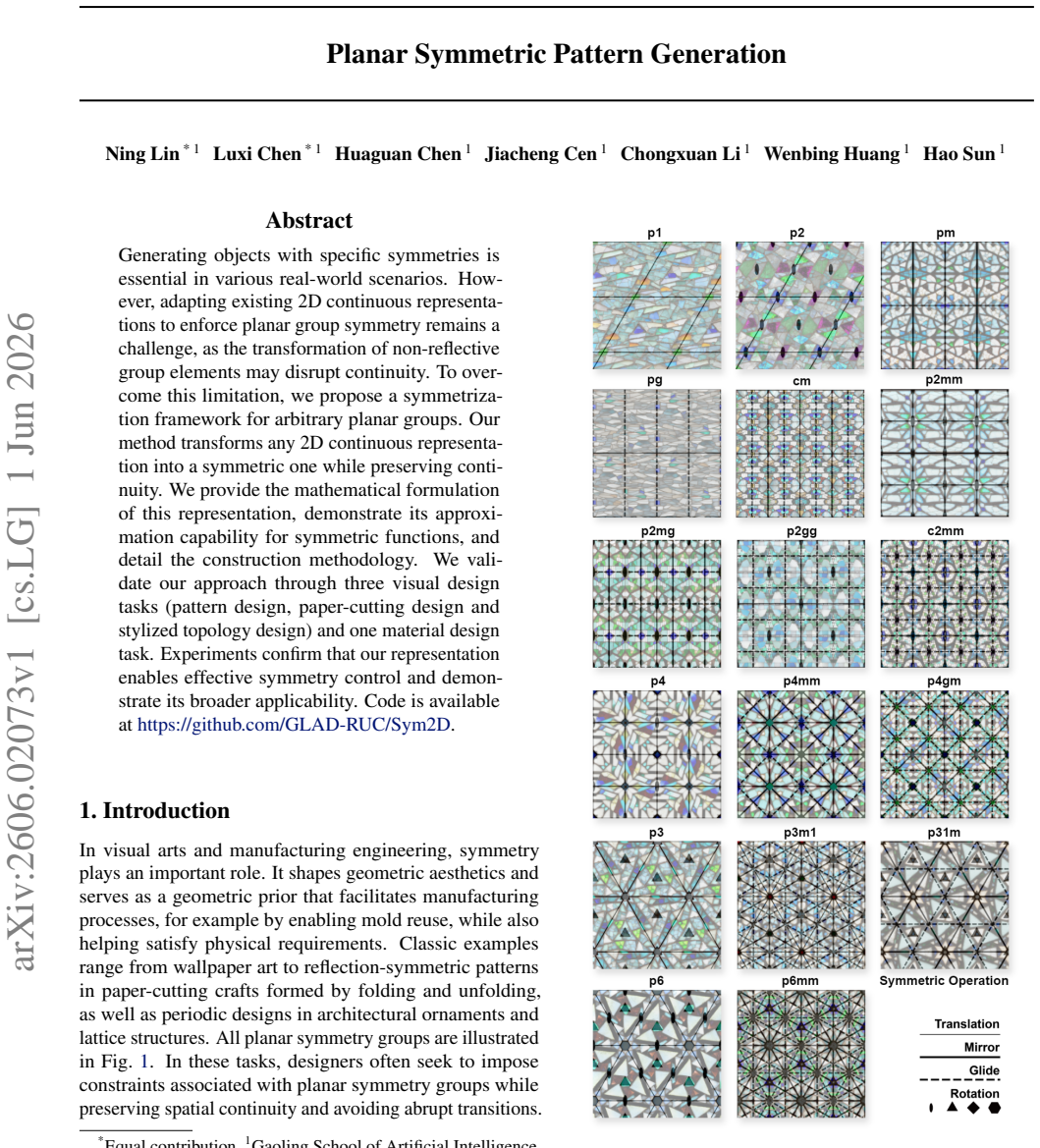
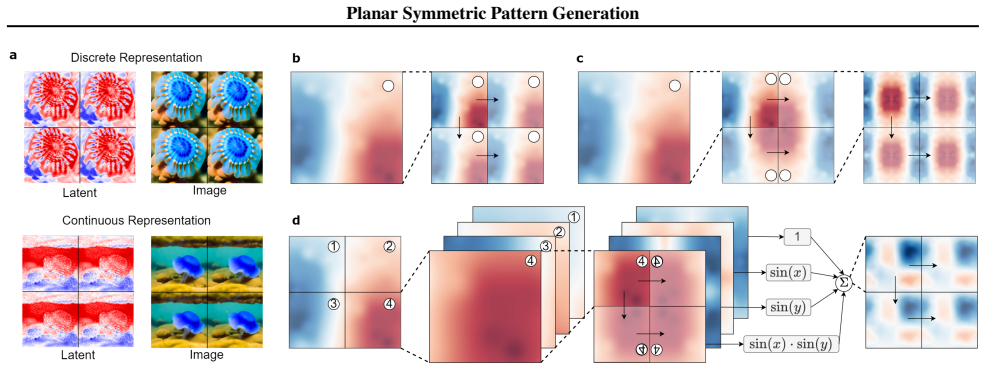

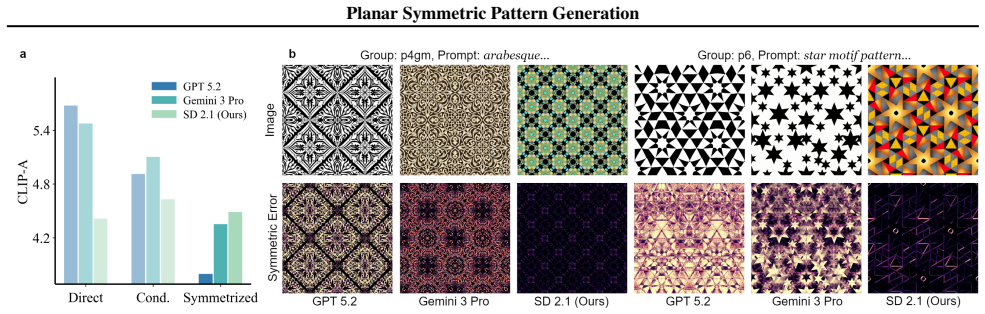


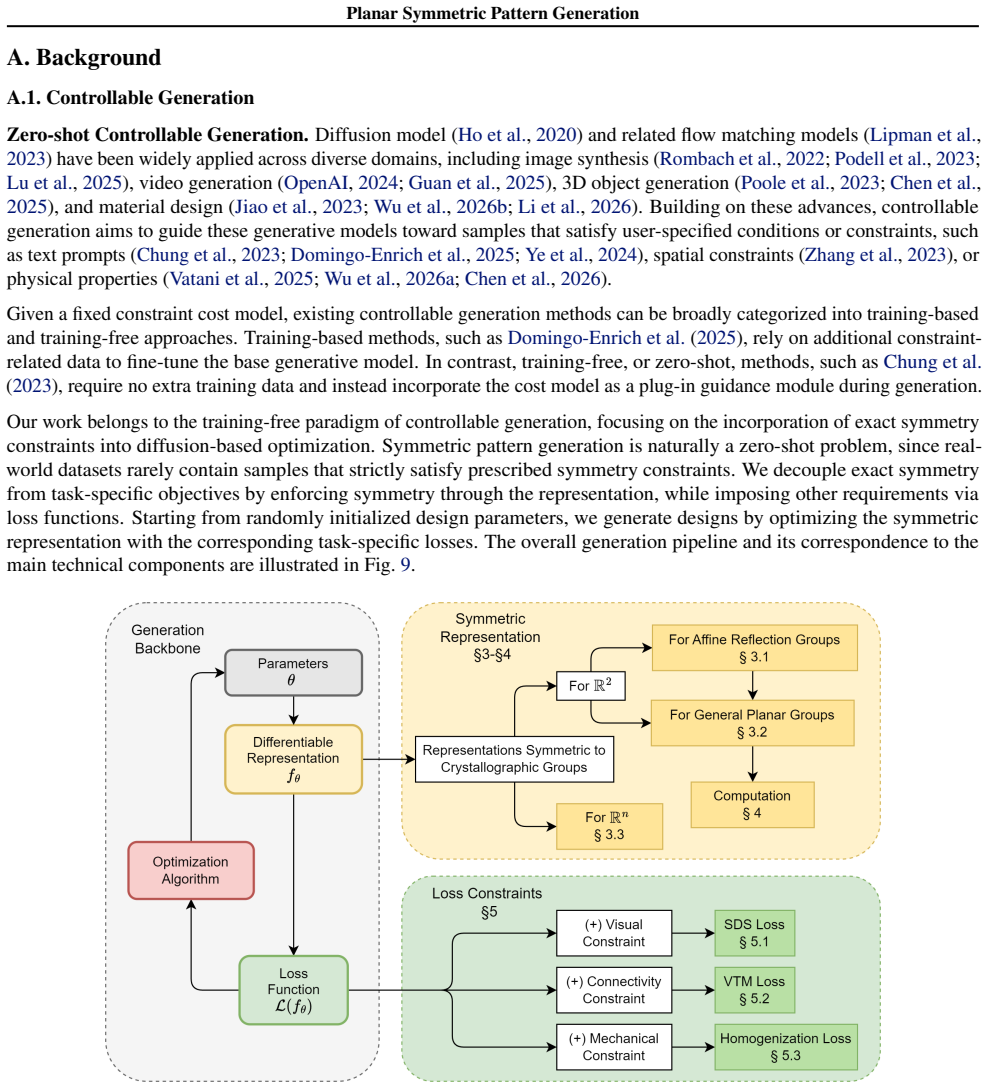




read the original abstract
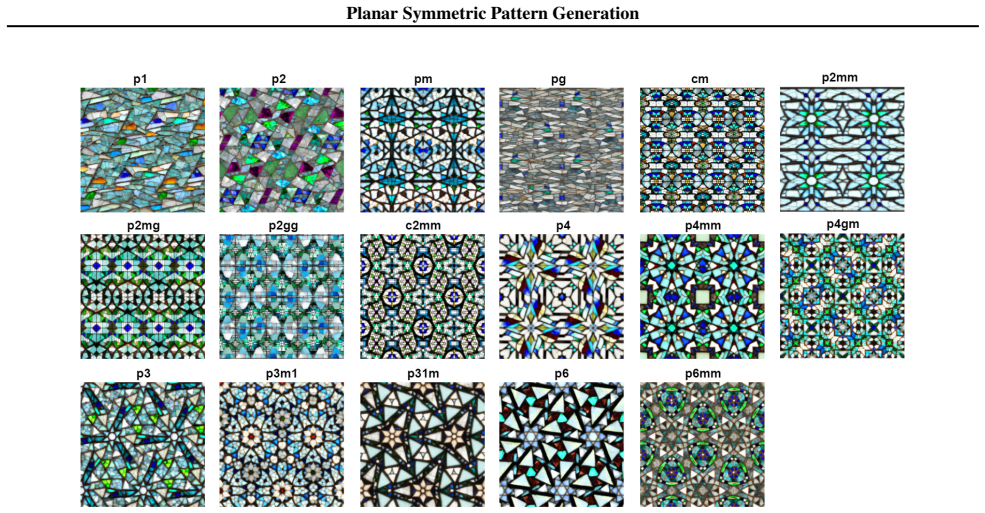
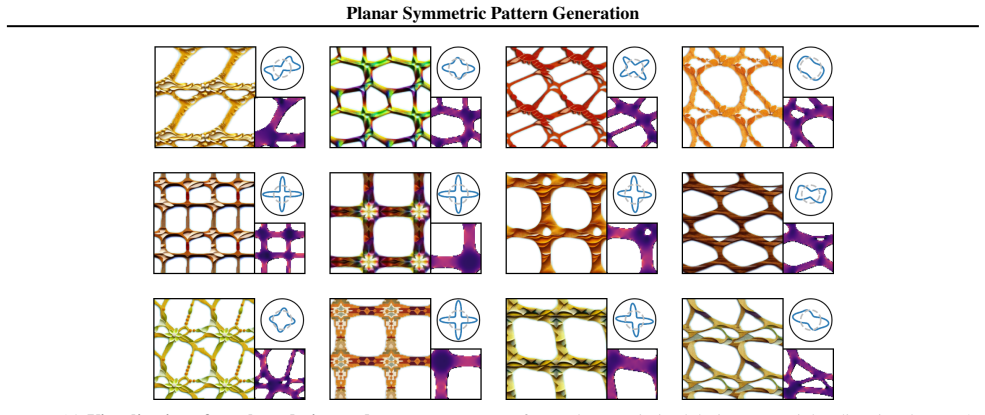
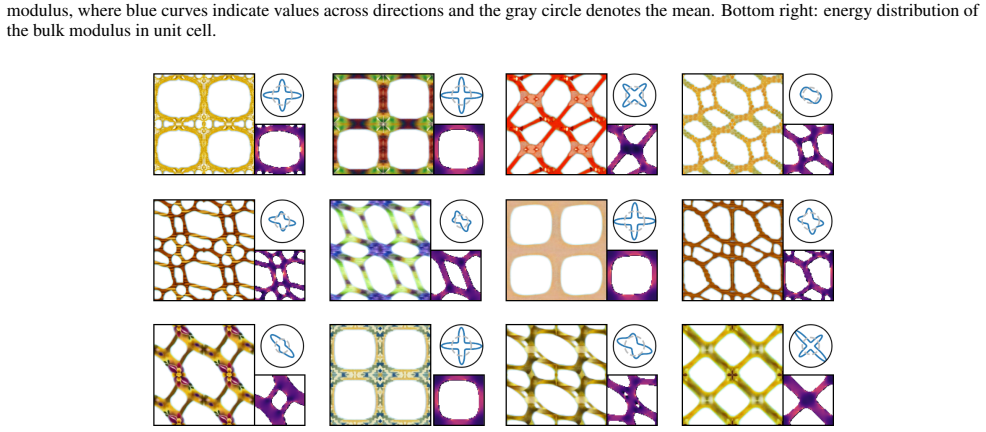
Generating objects with specific symmetries is essential in various real-world scenarios. However, adapting existing 2D continuous representations to enforce planar group symmetry remains a challenge, as the transformation of non-reflective group elements may disrupt continuity. To overcome this limitation, we propose a symmetrization framework for arbitrary planar groups. Our method transforms any 2D continuous representation into a symmetric one while preserving continuity. We provide the mathematical formulation of this representation, demonstrate its approximation capability for symmetric functions, and detail the construction methodology. We validate our approach through three visual design tasks (pattern design, paper-cutting design and stylized topology design) and one material design task. Experiments confirm that our representation enables effective symmetry control and demonstrate its broader applicability.
Editorial analysis
A structured set of objections, weighed in public.
Referee Report
Summary. The manuscript proposes a symmetrization framework for arbitrary planar groups that transforms any 2D continuous representation into a symmetric one while preserving continuity. It supplies a mathematical formulation of the representation, demonstrates approximation capability for symmetric functions, details the construction methodology, and validates the approach on three visual design tasks (pattern design, paper-cutting design, stylized topology design) plus one material design task, claiming effective symmetry control.
Significance. If the continuity-preserving transformation holds for arbitrary planar groups (including non-reflective elements), the framework could enable controlled symmetric pattern generation with broader applicability in design and materials. The generality claim and experimental validation on multiple tasks would be strengths if the core mathematical step is rigorously established.
major comments (1)
- [Mathematical formulation] Mathematical formulation section (as referenced in the abstract): the transformation for non-reflective group elements (rotations, translations, glide reflections) is asserted to map any continuous 2-D function to a symmetric one without introducing discontinuities, yet no explicit continuity argument at orbit boundaries or fixed-point loci, no machine-checked proof, and no counter-example search over wallpaper or frieze groups is supplied; this step is load-bearing for the central claim of applicability to arbitrary planar groups.
Simulated Author's Rebuttal
We thank the referee for their thorough review and for highlighting the importance of rigorously establishing continuity preservation. We address the single major comment below and will incorporate the requested clarifications in a revised manuscript.
read point-by-point responses
-
Referee: [Mathematical formulation] Mathematical formulation section (as referenced in the abstract): the transformation for non-reflective group elements (rotations, translations, glide reflections) is asserted to map any continuous 2-D function to a symmetric one without introducing discontinuities, yet no explicit continuity argument at orbit boundaries or fixed-point loci, no machine-checked proof, and no counter-example search over wallpaper or frieze groups is supplied; this step is load-bearing for the central claim of applicability to arbitrary planar groups.
Authors: We agree that an explicit continuity argument at orbit boundaries and fixed-point loci is necessary to support the central claim. The current manuscript states the preservation result but does not supply a self-contained proof or boundary analysis. In the revision we will add a dedicated subsection deriving continuity of the symmetrized function for rotations, translations, and glide reflections, including explicit handling of orbit boundaries and fixed-point loci. We will also report the results of a systematic counter-example search over the 17 wallpaper groups and 7 frieze groups (implemented via numerical sampling on a dense grid) and note that no discontinuities were observed; a machine-checked formalization is beyond the scope of the present work but the added analytic argument will be fully rigorous. revision: yes
Circularity Check
No circularity: new symmetrization construction presented without reduction to inputs or self-citations
full rationale
The abstract and context present a proposed symmetrization framework with mathematical formulation, approximation capability, and construction methodology for enforcing planar group symmetry while preserving continuity. No equations, fitted parameters, or self-citations are quoted that reduce any claim to its own inputs by construction. The derivation is framed as an independent construction rather than a prediction or renaming of prior results. This matches the default expectation of a self-contained paper with no load-bearing circular steps.
Axiom & Free-Parameter Ledger
axioms (1)
- domain assumption Planar symmetry groups admit continuous representations on 2D domains
Reference graph
Works this paper leans on
-
[1]
Crystallography and
Hiller, Howard , year = 1986, month = dec, journal =. Crystallography and
1986
-
[2]
, year = 1992, series =
Humphreys, James E. , year = 1992, series =. Reflection Groups and
1992
-
[3]
Multiplicative Invariant Theory , author =
-
[4]
The Ring of Invariant Real Functions on the
Kim, J , year = 2001, journal =. The Ring of Invariant Real Functions on the
2001
-
[5]
Tahara, Ken-Ichi , year = 1971, journal =. On the
1971
-
[6]
Bourbaki, Nicolas , year = 2002, series =. Lie
2002
-
[7]
, editor =
Plesken, W. , editor =. Some Applications of Representation Theory , booktitle =
-
[8]
International tables for crystallography volume A: Space-group symmetry , editor =
-
[9]
Differential Topology , author =
-
[10]
Bruns, Winfried and Herzog, J. Cohen-
-
[11]
Bulletin (New Series) of the American Mathematical Society , volume =
Invariants of Finite Groups and Their Applications to Combinatorics , author =. Bulletin (New Series) of the American Mathematical Society , volume =
-
[12]
The Red Book of Varieties and Schemes , author =
-
[13]
, year = 1986, journal =
Farkas, Daniel R. , year = 1986, journal =. Reflection. 44236989 , eprinttype =
1986
-
[14]
, year = 1994, publisher =
Atiyah, Michael and Macdonald, Ian G. , year = 1994, publisher =. Introduction
1994
-
[15]
Computational Invariant Theory , author =
-
[16]
The Eleventh International Conference on Learning Representations , year=
DreamFusion: Text-to-3D using 2D Diffusion , author=. The Eleventh International Conference on Learning Representations , year=
-
[17]
Proceedings of the IEEE/CVF conference on computer vision and pattern recognition , pages=
High-resolution image synthesis with latent diffusion models , author=. Proceedings of the IEEE/CVF conference on computer vision and pattern recognition , pages=
-
[19]
ICLR , volume=
LoRA: Low-Rank Adaptation of Large Language Models , author=. ICLR , volume=
-
[20]
GitHub repository , howpublished =
Patrick von Platen and Suraj Patil and Anton Lozhkov and Pedro Cuenca and Nathan Lambert and Kashif Rasul and Mishig Davaadorj and Dhruv Nair and Sayak Paul and William Berman and Yiyi Xu and Steven Liu and Thomas Wolf , title =. GitHub repository , howpublished =. 2022 , publisher =
2022
-
[21]
Shubnikov, A. V. and Koptsik, V. A. , year = 1974, publisher =
1974
-
[22]
Structural and Multidisciplinary Optimization , volume =
Topology Optimization with Text-Guided Stylization , author =. Structural and Multidisciplinary Optimization , volume =
-
[23]
Proceedings of the 2025
Wang, Huanchen and Qiu, Tianrun and Li, Jiaping and Lu, Zhicong and Ma, Yuxin , year = 2025, series =. Proceedings of the 2025
2025
-
[24]
Advances in neural information processing systems , volume=
Laion-5b: An open large-scale dataset for training next generation image-text models , author=. Advances in neural information processing systems , volume=
-
[25]
Proceedings of the 2025 CHI Conference on Human Factors in Computing Systems , pages=
HarmonyCut: Supporting creative Chinese paper-cutting design with form and connotation harmony , author=. Proceedings of the 2025 CHI Conference on Human Factors in Computing Systems , pages=
2025
-
[26]
and Tancik, Matthew and Barron, Jonathan T
Mildenhall, Ben and Srinivasan, Pratul P. and Tancik, Matthew and Barron, Jonathan T. and Ramamoorthi, Ravi and Ng, Ren , year = 2021, journal =
2021
-
[27]
ACM Transactions on Graphics (TOG) , publisher =
Instant Neural Graphics Primitives with a Multiresolution Hash Encoding , author =. ACM Transactions on Graphics (TOG) , publisher =
-
[28]
Structural and Multidisciplinary Optimization , volume =
Structural Topology Optimization Considering Connectivity Constraint , author =. Structural and Multidisciplinary Optimization , volume =
-
[29]
Learning
Bergmann, Urs and Jetchev, Nikolay and Vollgraf, Roland , year = 2017, pages =. Learning. Proceedings of the 34th
2017
-
[30]
Structural and multidisciplinary optimization , volume=
Design of materials using topology optimization and energy-based homogenization approach in Matlab , author=. Structural and multidisciplinary optimization , volume=. 2015 , publisher=
2015
-
[31]
11th International Conference on Learning Representations, ICLR 2023 , year=
Diffusion posterior sampling for general noisy inverse problems , author=. 11th International Conference on Learning Representations, ICLR 2023 , year=
2023
-
[32]
International Conference on Learning Representations , volume=
Adjoint matching: Fine-tuning flow and diffusion generative models with memoryless stochastic optimal control , author=. International Conference on Learning Representations , volume=
-
[33]
Advances in Neural Information Processing Systems , volume=
Tfg: Unified training-free guidance for diffusion models , author=. Advances in Neural Information Processing Systems , volume=
-
[34]
Physics of Fluids , volume=
TripOptimizer: Generative three-dimensional shape optimization and drag prediction using triplane variational autoencoder networks , author=. Physics of Fluids , volume=. 2025 , publisher=
2025
-
[36]
32nd SIGKDD Conference on Knowledge Discovery and Data Mining - AI for Sciences Track , year=
One Path to Model Them All: Learnable-Time Flow Matching for Crystal Structure and Energy Prediction , author=. 32nd SIGKDD Conference on Knowledge Discovery and Data Mining - AI for Sciences Track , year=
-
[37]
32nd SIGKDD Conference on Knowledge Discovery and Data Mining - AI for Sciences Track , year=
DMFlow: Disordered Materials Generation by Flow Matching , author=. 32nd SIGKDD Conference on Knowledge Discovery and Data Mining - AI for Sciences Track , year=
-
[39]
Proceedings of the IEEE/CVF international conference on computer vision , pages=
Adding conditional control to text-to-image diffusion models , author=. Proceedings of the IEEE/CVF international conference on computer vision , pages=
-
[40]
Machine Intelligence Research , volume=
Dpm-solver++: Fast solver for guided sampling of diffusion probabilistic models , author=. Machine Intelligence Research , volume=. 2025 , publisher=
2025
-
[41]
Communications of the ACM , volume=
Nerf: Representing scenes as neural radiance fields for view synthesis , author=. Communications of the ACM , volume=. 2021 , publisher=
2021
-
[42]
2024 , month = feb, url =
2024
-
[44]
IEEE Transactions on Pattern Analysis and Machine Intelligence , year=
MicroDreamer: Efficient 3D Generation in 20 Seconds by Score-based Iterative Reconstruction , author=. IEEE Transactions on Pattern Analysis and Machine Intelligence , year=
-
[45]
Advances in Neural Information Processing Systems , volume=
Crystal structure prediction by joint equivariant diffusion , author=. Advances in Neural Information Processing Systems , volume=
-
[46]
2013 , publisher=
Topology optimization: theory, methods, and applications , author=. 2013 , publisher=
2013
-
[47]
Structural and Multidisciplinary Optimization , volume=
Efficient topology optimization in MATLAB using 88 lines of code , author=. Structural and Multidisciplinary Optimization , volume=. 2011 , publisher=
2011
-
[48]
ACM Transactions on Graphics (TOG) , volume=
Structure and appearance optimization for controllable shape design , author=. ACM Transactions on Graphics (TOG) , volume=. 2015 , publisher=
2015
-
[49]
Machine Intelligence Research , volume=
Vlp: A survey on vision-language pre-training , author=. Machine Intelligence Research , volume=. 2023 , publisher=
2023
-
[50]
International conference on machine learning , pages=
Learning transferable visual models from natural language supervision , author=. International conference on machine learning , pages=. 2021 , organization=
2021
-
[52]
The Twelfth International Conference on Learning Representations , year=
Space Group Constrained Crystal Generation , author=. The Twelfth International Conference on Learning Representations , year=
-
[53]
Science advances , volume=
Designing complex architectured materials with generative adversarial networks , author=. Science advances , volume=. 2020 , publisher=
2020
-
[54]
Advances in neural information processing systems , volume=
Denoising diffusion probabilistic models , author=. Advances in neural information processing systems , volume=
-
[55]
The Eleventh International Conference on Learning Representations , year=
Flow Matching for Generative Modeling , author=. The Eleventh International Conference on Learning Representations , year=
-
[56]
2008 , publisher=
Algorithms in invariant theory , author=. 2008 , publisher=
2008
-
[57]
S., and Sigmund, O
Andreassen, E., Clausen, A., Schevenels, M., Lazarov, B. S., and Sigmund, O. Efficient topology optimization in matlab using 88 lines of code. Structural and Multidisciplinary Optimization, 43 0 (1): 0 1--16, 2011
2011
-
[58]
Aroyo, M. I. (ed.). International tables for crystallography volume A: Space-group symmetry, volume A. International Union of Crystallography, 2 edition, 2016
2016
-
[59]
Artin, M. Algebra. Pearson Education, 2nd ed edition, 2011
2011
-
[60]
and Macdonald, I
Atiyah, M. and Macdonald, I. G. Introduction To Commutative Algebra . Westview Press, 1994
1994
-
[61]
Bendsoe, M. P. and Sigmund, O. Topology optimization: theory, methods, and applications. Springer Science & Business Media, 2013
2013
-
[62]
Learning Texture Manifolds with the Periodic Spatial GAN
Bergmann, U., Jetchev, N., and Vollgraf, R. Learning Texture Manifolds with the Periodic Spatial GAN . In Proceedings of the 34th International Conference on Machine Learning , pp.\ 469--477. PMLR, 2017
2017
-
[63]
Lie Groups and Lie Algebras : Chapters 4-6
Bourbaki, N. Lie Groups and Lie Algebras : Chapters 4-6 . Elements of Mathematics. Springer, 2002
2002
-
[64]
and Herzog, J
Bruns, W. and Herzog, J. Cohen- Macaulay Rings . Number 39 in Cambridge Studies in Advanced Mathematics. Cambridge Univ. Press, rev. ed. edition, 1998
1998
-
[65]
Vlp: A survey on vision-language pre-training
Chen, F.-L., Zhang, D.-Z., Han, M.-L., Chen, X.-Y., Shi, J., Xu, S., and Xu, B. Vlp: A survey on vision-language pre-training. Machine Intelligence Research, 20 0 (1): 0 38--56, 2023
2023
-
[66]
Optimization and Generation in Aerodynamics Inverse Design
Chen, H., Lin, N., Chen, L., Zhang, R., Huang, W., Li, C., and Sun, H. Optimization and generation in aerodynamics inverse design. arXiv preprint arXiv:2602.03582, 2026
work page internal anchor Pith review Pith/arXiv arXiv 2026
-
[67]
Microdreamer: Efficient 3d generation in 20 seconds by score-based iterative reconstruction
Chen, L., Wang, Z., Zhou, Z., Gao, T., Su, H., Zhu, J., and Li, C. Microdreamer: Efficient 3d generation in 20 seconds by score-based iterative reconstruction. IEEE Transactions on Pattern Analysis and Machine Intelligence, 2025
2025
-
[68]
T., Klasky, M
Chung, H., Kim, J., McCann, M. T., Klasky, M. L., and Ye, J. C. Diffusion posterior sampling for general noisy inverse problems. In 11th International Conference on Learning Representations, ICLR 2023, 2023
2023
-
[69]
and Kemper, G
Derksen, H. and Kemper, G. Computational Invariant Theory. Number Volume 130 in Encyclopaedia of Mathematical Sciences . Springer, 2002
2002
-
[70]
Domingo-Enrich, C., Drozdzal, M., Karrer, B., and Chen, R. T. Adjoint matching: Fine-tuning flow and diffusion generative models with memoryless stochastic optimal control. In International Conference on Learning Representations, volume 2025, pp.\ 53791--53846, 2025
2025
-
[71]
Farkas, D. R. Reflection Groups and Multiplicative Invariants . The Rocky Mountain Journal of Mathematics, 16 0 (2): 0 215--222, 1986
1986
-
[72]
Gemini , 2025
Google DeepMind . Gemini , 2025. URL https://deepmind.google/models/gemini/
2025
-
[73]
Taming Text-to-Sounding Video Generation via Advanced Modality Condition and Interaction
Guan, K., Wang, X., Lai, Z., Cheng, X., Zhang, P., Liu, X., Song, R., and Cao, M. Taming text-to-sounding video generation via advanced modality condition and interaction. arXiv preprint arXiv:2510.03117, 2025
work page internal anchor Pith review arXiv 2025
-
[74]
and Pollack, A
Guillemin, V. and Pollack, A. Differential Topology. Prentice Hall, 1974
1974
-
[75]
Crystallography and Cohomology of Groups
Hiller, H. Crystallography and Cohomology of Groups . The American Mathematical Monthly, December 1986
1986
-
[76]
Denoising diffusion probabilistic models
Ho, J., Jain, A., and Abbeel, P. Denoising diffusion probabilistic models. Advances in neural information processing systems, 33: 0 6840--6851, 2020
2020
-
[77]
J., Shen, Y., Wallis, P., Allen-Zhu, Z., Li, Y., Wang, S., Wang, L., Chen, W., et al
Hu, E. J., Shen, Y., Wallis, P., Allen-Zhu, Z., Li, Y., Wang, S., Wang, L., Chen, W., et al. Lora: Low-rank adaptation of large language models. ICLR, 1 0 (2): 0 3, 2022
2022
-
[78]
Humphreys, J. E. Reflection Groups and Coxeter Groups . Number 29 in Cambridge Studies in Advanced Mathematics. Cambridge Univ. Press, 1 ed. edition, 1992
1992
-
[79]
Crystal structure prediction by joint equivariant diffusion
Jiao, R., Huang, W., Lin, P., Han, J., Chen, P., Lu, Y., and Liu, Y. Crystal structure prediction by joint equivariant diffusion. Advances in Neural Information Processing Systems, 36: 0 17464--17497, 2023
2023
-
[80]
Space group constrained crystal generation
Jiao, R., Huang, W., Liu, Y., Zhao, D., and Liu, Y. Space group constrained crystal generation. In The Twelfth International Conference on Learning Representations, 2024
2024
-
[81]
The ring of invariant real functions on the Brillouin zone
Kim, J. The ring of invariant real functions on the Brillouin zone. Physics Reports, 341 0 (1-6): 0 337--376, 2001
2001
-
[82]
S., Kaba, S.-O., Zhu, Q., Lee, K
Levy, D., Panigrahi, S. S., Kaba, S.-O., Zhu, Q., Lee, K. L. K., Galkin, M., Miret, S., and Ravanbakhsh, S. Symmcd: symmetry-preserving crystal generation with diffusion models. arXiv preprint arXiv:2502.03638, 2025
-
[83]
Structural topology optimization considering connectivity constraint
Li, Q., Chen, W., Liu, S., and Tong, L. Structural topology optimization considering connectivity constraint. Structural and Multidisciplinary Optimization, 54 0 (4): 0 971--984, 2016
2016
-
[84]
One path to model them all: Learnable-time flow matching for crystal structure and energy prediction
Li, S., Li, M., Liu, Q., Cen, J., Wu, L., Xu, T., Rong, Y., Zhao, D., and Huang, W. One path to model them all: Learnable-time flow matching for crystal structure and energy prediction. In 32nd SIGKDD Conference on Knowledge Discovery and Data Mining - AI for Sciences Track, 2026
2026
-
[85]
T., Ben-Hamu, H., Nickel, M., and Le, M
Lipman, Y., Chen, R. T., Ben-Hamu, H., Nickel, M., and Le, M. Flow matching for generative modeling. In The Eleventh International Conference on Learning Representations, 2023
2023
discussion (0)
Sign in with ORCID, Apple, or X to comment. Anyone can read and Pith papers without signing in.