Can scrambling protect quantum state distinguishability under noise?
Pith reviewed 2026-06-28 14:27 UTC · model grok-4.3
The pith
The distinguishability of noisy 2-design ensembles shows a sharp threshold governed by channel conditional entropy.
A machine-rendered reading of the paper's core claim, the machinery that carries it, and where it could break.
Core claim
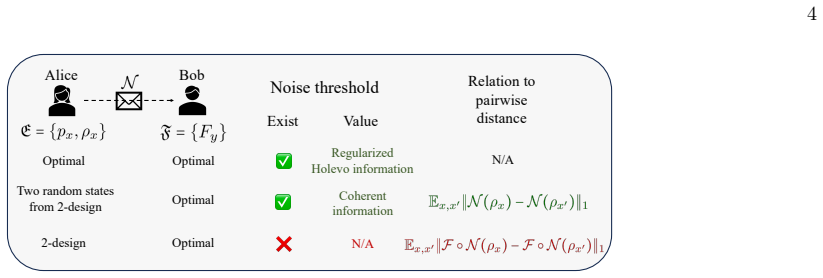
Using a rigorous decoupling approach, the distinguishability of noisy 2-design ensembles exhibits a sharp threshold and phase-transition behavior governed by channel conditional entropy: below the threshold, the states remain mutually distinguishable with high probability, while above it, distinguishability undergoes a sudden power-law decay and then collapses exponentially. On the other hand, under local purity-shrinking noise, post-measured noisy 2-design ensembles become exponentially indistinguishable for any measurement, precluding a noise threshold for learning tasks such as shadow tomography.
What carries the argument
The decoupling approach applied to 2-design ensembles to obtain tight bounds on noisy ensemble distinguishability in terms of channel conditional entropy.
If this is right
- Below the conditional entropy threshold, noisy 2-design states remain mutually distinguishable with high probability.
- Above the threshold, distinguishability first decays according to a power law and then collapses exponentially.
- Post-measured 2-design ensembles under local purity-shrinking noise become exponentially indistinguishable for any measurement.
- Learning tasks such as shadow tomography have no protected noise regime when applied to these post-measured ensembles.
Where Pith is reading between the lines
- The protected regime for unmeasured ensembles may allow scrambling to aid quantum communication or cryptography when measurements are avoided.
- The phase transition could be checked in small-scale quantum simulations by preparing approximate 2-designs and applying tunable noise channels.
- Results imply that measurement effects must be accounted for separately when applying scrambling to cryptographic or learning protocols.
- Similar threshold behavior might appear in other ensemble designs if the decoupling method can be extended beyond 2-designs.
Load-bearing premise
That 2-designs constitute an adequate model of minimally scrambled ensembles whose distinguishability properties under noise can be tightly bounded via the decoupling approach without additional assumptions on the noise channel beyond conditional entropy.
What would settle it
Measure the average pairwise trace distance for a 2-design ensemble after a noise channel whose conditional entropy is varied across the predicted threshold value and check whether distinguishability stays high below the threshold and drops sharply above it.
Figures
read the original abstract
Quantum state distinguishability is a fundamental concept in quantum information science that underpins a wide range of important practical tasks. Traditionally formulated for pairs of states, quantum state distinguishability is here extended to quantum state ensembles, which we characterize through the average pairwise trace distance. Motivated by both theoretical and practical interest in noisy quantum information processing, we ask whether ``minimally'' scrambled ensembles modeled by 2-designs protect distinguishability under noise, which sheds light on the fundamental competition between noise and information scrambling. Using a rigorous decoupling approach, we establish tight bounds on noisy ensemble distinguishability. We show that the distinguishability of noisy 2-design ensembles exhibits a sharp threshold and phase-transition behavior governed by channel conditional entropy: below the threshold, the states remain mutually distinguishable with high probability, while above it, distinguishability undergoes a sudden power-law decay and then collapses exponentially. On the other hand, under local purity-shrinking noise, post-measured noisy 2-design ensembles become exponentially indistinguishable for any measurement, precluding a noise threshold for learning tasks such as shadow tomography. These results reveal a sharp difference between unmeasured and post-measured scrambled ensembles: the former can retain high distinguishability for sufficiently small noise, whereas the latter exhibits no such protected regime. We discuss the implications of these results for crucial tasks ranging from quantum communication and cryptography to learning.
Editorial analysis
A structured set of objections, weighed in public.
Referee Report
Summary. The manuscript extends quantum state distinguishability to ensembles via average pairwise trace distance and models minimally scrambled states with 2-designs. Using a decoupling approach, it derives tight bounds showing that noisy 2-design distinguishability exhibits a sharp threshold and phase transition governed by channel conditional entropy: below threshold the states remain mutually distinguishable with high probability, while above it distinguishability first decays as a power law then exponentially. For post-measured ensembles under local purity-shrinking noise, the ensembles become exponentially indistinguishable for any measurement, with no protected regime. Implications for communication, cryptography, and learning tasks such as shadow tomography are discussed.
Significance. If the decoupling bounds are tight and the conversion from average to high-probability statements is rigorously controlled, the results would provide a clear characterization of when scrambling protects ensemble distinguishability under noise, highlighting a sharp difference between unmeasured and post-measured cases with relevance to quantum information processing tasks.
major comments (2)
- [Decoupling approach and phase-transition analysis] The decoupling approach controls expected pairwise trace distance, but the central claim of mutual distinguishability 'with high probability' below the threshold (abstract and main result) requires tail bounds or concentration inequalities on the finite 2-design ensemble. Conditional entropy alone does not supply these tails; the manuscript must explicitly provide the variance control or moment bound used, or the sharpness of the claimed phase transition is not guaranteed for all channels.
- [Post-measured ensemble analysis] For the post-measured case under local purity-shrinking noise, the exponential indistinguishability claim for any measurement should include an explicit uniform bound over the measurement set and confirm that the decay rate is independent of the specific measurement choice.
minor comments (2)
- [Abstract] The abstract states 'rigorous decoupling approach' without naming the specific decoupling theorem or inequality; adding this reference would aid readability.
- [Notation and definitions] Notation for the average pairwise trace distance should be defined once and used consistently in all subsequent sections and equations.
Simulated Author's Rebuttal
We thank the referee for their careful reading and constructive comments, which have helped us identify areas for clarification. We address each major comment below and will incorporate the requested additions into the revised manuscript.
read point-by-point responses
-
Referee: [Decoupling approach and phase-transition analysis] The decoupling approach controls expected pairwise trace distance, but the central claim of mutual distinguishability 'with high probability' below the threshold (abstract and main result) requires tail bounds or concentration inequalities on the finite 2-design ensemble. Conditional entropy alone does not supply these tails; the manuscript must explicitly provide the variance control or moment bound used, or the sharpness of the claimed phase transition is not guaranteed for all channels.
Authors: We agree that the decoupling bound controls the expectation and that an explicit concentration argument is needed to rigorously support the high-probability claim. In the revision we will add a dedicated subsection deriving a variance bound for the average pairwise trace distance that exploits the 2-design property (specifically, the second-moment calculation over the design yields a variance scaling as O(1/|E|), where |E| is the ensemble size). Chebyshev's inequality then converts the expectation bound into a high-probability statement whose failure probability decays with ensemble size, independent of the particular channel. This establishes the sharpness of the phase transition for all channels whose conditional entropy satisfies the threshold condition. revision: yes
-
Referee: [Post-measured ensemble analysis] For the post-measured case under local purity-shrinking noise, the exponential indistinguishability claim for any measurement should include an explicit uniform bound over the measurement set and confirm that the decay rate is independent of the specific measurement choice.
Authors: We will strengthen the post-measured analysis by deriving an explicit uniform bound. Because the noise is local and purity-shrinking, the trace-distance decay after measurement can be bounded by averaging the design over all possible post-measurement states; the resulting exponential rate depends only on the noise strength and the design order, not on the particular POVM. We will state this uniform bound explicitly and confirm its measurement independence in the revised text. revision: yes
Circularity Check
No circularity: bounds derived from external channel property via decoupling
full rationale
The derivation relies on a decoupling approach to bound average pairwise trace distance for 2-design ensembles, with the threshold and phase transition explicitly governed by the channel's conditional entropy (an input property independent of the distinguishability quantity being bounded). No self-definitional reductions, fitted parameters renamed as predictions, or load-bearing self-citations appear in the claims. The central results are presented as mathematical consequences of the decoupling inequality applied to the external entropy parameter, making the chain self-contained against external benchmarks.
Axiom & Free-Parameter Ledger
Reference graph
Works this paper leans on
-
[1]
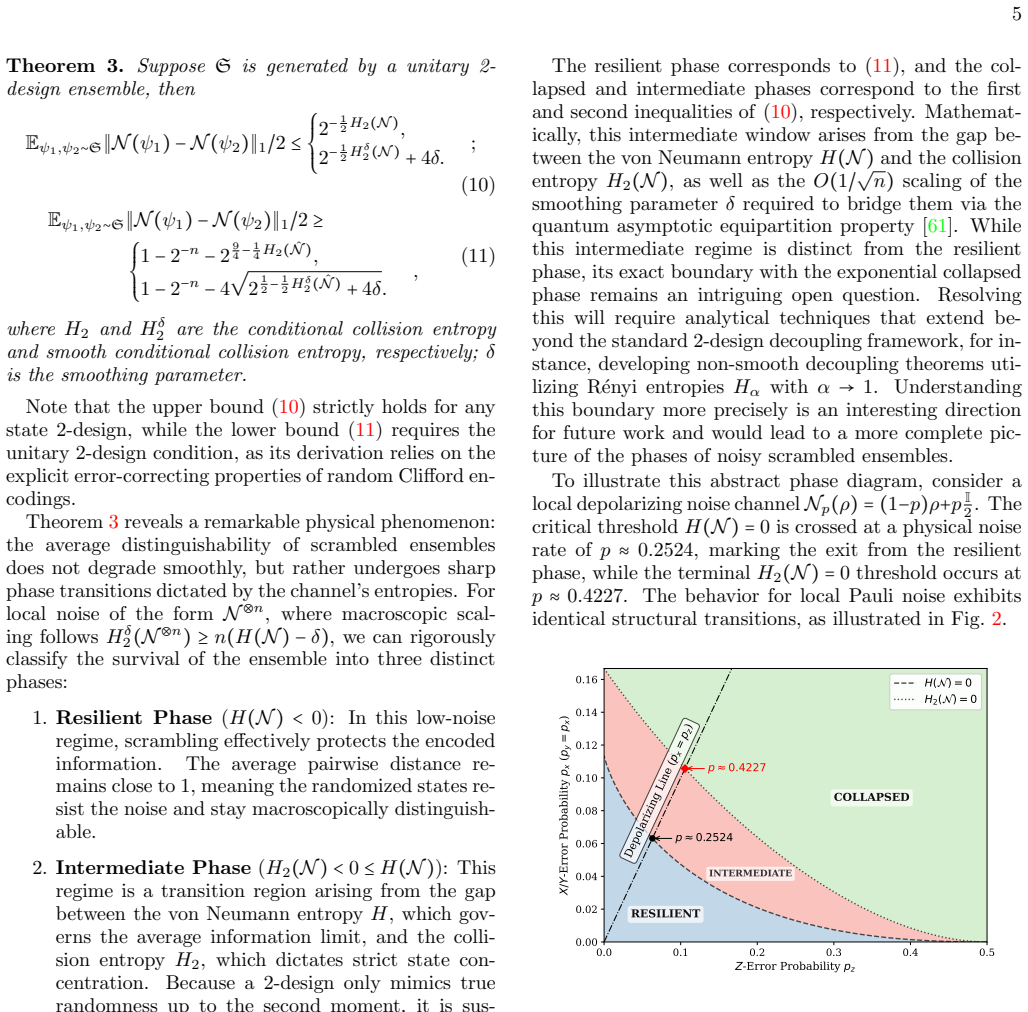
The behavior for local Pauli noise exhibits identical structural transitions, as illustrated in Fig
The critical thresholdH(N)=0 is crossed at a physical noise rate ofp≈0.2524, marking the exit from the resilient phase, while the terminalH 2(N)=0 threshold occurs at p≈0.4227. The behavior for local Pauli noise exhibits identical structural transitions, as illustrated in Fig. 2. 0.0 0.1 0.2 0.3 0.4 0.5 Z-Error Probability pz 0.00 0.02 0.04 0.06 0.08 0.10...
-
[2]
If the state ensemble forms a2-design, then N=Ω( log∣X∣ ∥N⊗2(S)∥∞ ).(20)
-
[3]
Consequently, the learning protocol necessar- ily demands an exponentially large sample complexity, rendering it inefficient without fault tolerance
If the POVM elements form a2-design, then N=Ω( log∣X∣ ∥N†⊗2(S)∥∞ ).(21) For unital and local purity-shrinking noise like depolar- izing noise,∥N ⊗2(S)∥∞=∥N †⊗2(S)∥∞ is exponentially small inn. Consequently, the learning protocol necessar- ily demands an exponentially large sample complexity, rendering it inefficient without fault tolerance. The implicatio...
-
[4]
A. S. Holevo, Statistical decision theory for quantum sys- tems, J. Multivariate Anal.3, 337 (1973)
1973
-
[5]
C. W. Helstrom, Quantum detection and estimation the- ory, J. Stat. Phys.1, 231 (1969)
1969
-
[6]
M. A. Nielsen and I. L. Chuang,Quantum Computation and Quantum Information(Cambridge University Press, Cambridge, 2000)
2000
-
[7]
Buhrman, R
H. Buhrman, R. Cleve, J. Watrous, and R. de Wolf, Quantum fingerprinting, Phys. Rev. Lett.87, 167902 (2001)
2001
-
[8]
Aaronson, The learnability of quantum states, Proc
S. Aaronson, The learnability of quantum states, Proc. R. Soc. A463, 3089 (2007)
2007
-
[9]
Huang, R
H.-Y. Huang, R. Kueng, and J. Preskill, Predicting many properties of a quantum system from very few measure- ments, Nat. Phys.16, 1050 (2020)
2020
-
[10]
D. P. DiVincenzo, D. W. Leung, and B. M. Terhal, Quan- tum data hiding, IEEE Trans. Inf. Theory48, 580 (2002)
2002
-
[11]
Hayden, D
P. Hayden, D. Leung, P. W. Shor, and A. Winter, Ran- domizing quantum states: Constructions and applica- tions, Commun. Math. Phys.250, 371 (2004)
2004
-
[12]
Matthews, S
W. Matthews, S. Wehner, and A. Winter, Distinguisha- bility of quantum states under restricted families of mea- surements with an application to quantum data hiding, Commun. Math. Phys.291, 813 (2009)
2009
-
[13]
D¨ ur and H.-J
W. D¨ ur and H.-J. Briegel, Stability of macroscopic entan- glement under decoherence, Phys. Rev. Lett.92, 180403 (2004)
2004
-
[14]
S. Arunachalam, S. Bravyi, A. Dutt, and T. J. Yoder, Optimal algorithms for learning quantum phase states (2023), arXiv:2208.07851 [quant-ph]
-
[15]
D. N. Page, Average entropy of a subsystem, Phys. Rev. Lett.71, 1291 (1993)
1993
-
[16]
Nahum, J
A. Nahum, J. Ruhman, S. Vijay, and J. Haah, Quantum entanglement growth under random unitary dynamics, Phys. Rev. X7, 031016 (2017)
2017
-
[17]
Hosur, X.-L
P. Hosur, X.-L. Qi, D. A. Roberts, and B. Yoshida, Chaos in quantum channels, J. High Energ. Phys.2016(2), 004
2016
-
[18]
Z.-W. Liu, S. Lloyd, E. Y. Zhu, and H. Zhu, Entan- glement, quantum randomness, and complexity beyond scrambling, J. High Energ. Phys.2018(7), 041
2018
-
[19]
Gottesman,Stabilizer codes and quantum error cor- rection(California Institute of Technology, 1997)
D. Gottesman,Stabilizer codes and quantum error cor- rection(California Institute of Technology, 1997)
1997
-
[20]
Brown and O
W. Brown and O. Fawzi, Short random circuits define good quantum error correcting codes, in2013 IEEE In- ternational Symposium on Information Theory(2013) pp. 346–350
2013
-
[21]
M. J. Gullans, S. Krastanov, D. A. Huse, L. Jiang, and S. T. Flammia, Quantum coding with low-depth random circuits, Phys. Rev. X11, 031066 (2021)
2021
-
[22]
Kong and Z.-W
L. Kong and Z.-W. Liu, Near-optimal covariant quan- tum error-correcting codes from random unitaries with symmetries, PRX Quantum3, 020314 (2022)
2022
-
[23]
A. S. Darmawan, Y. Nakata, S. Tamiya, and H. Ya- masaki, Low-depth random clifford circuits for quantum coding against pauli noise using a tensor-network de- coder, Phys. Rev. Res.6, 023055 (2024)
2024
-
[24]
J. Yi, W. Ye, D. Gottesman, and Z.-W. Liu, Complex- ity and order in approximate quantum error-correcting codes, Nature Physics20, 1798 (2024)
2024
-
[25]
Nelson, G
J. Nelson, G. Bentsen, S. T. Flammia, and M. J. Gullans, Fault-tolerant quantum memory using low-depth random circuit codes, Phys. Rev. Res.7, 013040 (2025)
2025
-
[26]
G. Liu, Z. Du, Z.-W. Liu, and X. Ma, Approximate quan- tum error correction with 1D log-depth circuits, PRX Quantum7, 010331 (2026)
2026
-
[27]
S. Choi, Y. Bao, X.-L. Qi, and E. Altman, Quantum er- ror correction in scrambling dynamics and measurement- induced phase transition, Phys. Rev. Lett.125, 030505 (2020)
2020
-
[28]
Morvan, B
A. Morvan, B. Villalonga, X. Mi, S. Mandr` a, A. Bengts- son, P. V. Klimov, Z. Chen, S. Hong, C. Erickson, I. K. Drozdov, J. Chau, G. Laun, R. Movassagh, A. As- faw, L. T. A. N. Brand˜ ao, R. Peralta, D. Abanin, R. Acharya, R. Allen, T. I. Andersen, K. Anderson, M. Ansmann, F. Arute, K. Arya, J. Atalaya, J. C. Bardin, A. Bilmes, G. Bortoli, A. Bourassa, J...
2024
-
[29]
Aharonov, X
D. Aharonov, X. Gao, Z. Landau, Y. Liu, and U. Vazi- rani, A polynomial-time classical algorithm for noisy ran- dom circuit sampling, inProceedings of the 55th Annual ACM Symposium on Theory of Computing(2023) pp. 945–957
2023
-
[30]
Fefferman, S
B. Fefferman, S. Ghosh, M. Gullans, K. Kuroiwa, and K. Sharma, Effect of nonunital noise on random-circuit sampling, PRX Quantum5, 030317 (2024)
2024
-
[31]
Hayden and J
P. Hayden and J. Preskill, Black holes as mirrors: Quan- tum information in random subsystems, J. High Energ. Phys.2007(9), 120
2007
-
[32]
Z.-W. Liu, S. Lloyd, E. Y. Zhu, and H. Zhu, Generalized entanglement entropies of quantum designs, Phys. Rev. Lett.120, 130502 (2018)
2018
-
[33]
Szehr, F
O. Szehr, F. Dupuis, M. Tomamichel, and R. Renner, Decoupling with unitary approximate two-designs, New J. Phys.15, 053022 (2013)
2013
-
[34]
D. A. Roberts and B. Yoshida, Chaos and complexity by design, J. High Energ. Phys.2017(4), 121
2017
-
[35]
Emerson, Y
J. Emerson, Y. S. Weinstein, M. Saraceno, S. Lloyd, and D. G. Cory, Pseudo-random unitary operators for quan- tum information processing, Science302, 2098 (2003)
2098
-
[36]
Dankert, R
C. Dankert, R. Cleve, J. Emerson, and E. Livine, Exact and approximate unitary 2-designs and their application to fidelity estimation, Phys. Rev. A80, 012304 (2009)
2009
-
[37]
A. W. Harrow and R. A. Low, Random quantum circuits are approximate 2-designs, Commun. Math. Phys.291, 257 (2009)
2009
-
[38]
F. G. S. L. Brand˜ ao, A. W. Harrow, and M. Horodecki, Local random quantum circuits are approximate polynomial-designs, Commun. Math. Phys.346, 397 (2016)
2016
-
[39]
Cleve, D
R. Cleve, D. Leung, L. Liu, and C. Wang, Near-linear constructions of exact unitary 2-designs, Quantum Inf. Comput.16, 721 (2016)
2016
-
[40]
Qubit stabilizer states are complex projective 3-designs
R. Kueng and D. Gross, Qubit stabilizer states are complex projective 3-designs (2015), arXiv:1510.02767 [quant-ph]
work page internal anchor Pith review Pith/arXiv arXiv 2015
-
[41]
Zhu, Multiqubit clifford groups are unitary 3-designs, Phys
H. Zhu, Multiqubit clifford groups are unitary 3-designs, Phys. Rev. A96, 062336 (2017)
2017
-
[42]
Webb, The clifford group forms a unitary 3-design, Quantum Info
Z. Webb, The clifford group forms a unitary 3-design, Quantum Info. Comput.16, 1379–1400 (2016)
2016
-
[43]
Bravyi and D
S. Bravyi and D. Maslov, Hadamard-free circuits expose the structure of the Clifford group, IEEE Trans. Inf. The- ory67, 4546 (2021)
2021
-
[44]
C.-F. Chen, J. Haah, J. Haferkamp, Y. Liu, T. Met- ger, and X. Tan, Incompressibility and spectral gaps of random circuits, in2025 IEEE 66th Annual Symposium on Foundations of Computer Science (FOCS)(2025) pp. 1304–1312
2025
- [45]
-
[46]
Schuster, J
T. Schuster, J. Haferkamp, and H.-Y. Huang, Random unitaries in extremely low depth, Science389, 92 (2025)
2025
-
[47]
LaRacuente and F
N. LaRacuente and F. Leditzky, Approximate unitaryk- designs from shallow, low-communication circuits, Com- mun. Math. Phys.407, 51 (2026)
2026
-
[48]
Knill, D
E. Knill, D. Leibfried, R. Reichle, J. Britton, R. B. Blakestad, J. D. Jost, C. Langer, R. Ozeri, S. Seidelin, and D. J. Wineland, Randomized benchmarking of quan- tum gates, Phys. Rev. A77, 012307 (2008)
2008
-
[49]
Elben, S
A. Elben, S. T. Flammia, H.-Y. Huang, R. Kueng, J. Preskill, B. Vermersch, and P. Zoller, The randomized measurement toolbox, Nat. Rev. Phys.5, 9 (2023)
2023
-
[50]
Zhou and S
S. Zhou and S. Chen, Randomized measurements for multiparameter quantum metrology, PRX Quantum7, 010314 (2026)
2026
-
[51]
Arute, K
F. Arute, K. Arya, R. Babbush, D. Bacon, J. C. Bardin, R. Barends, R. Biswas, S. Boixo, F. G. S. L. Brandao, D. A. Buell, B. Burkett, Y. Chen, Z. Chen, B. Chiaro, R. Collins, W. Courtney, A. Dunsworth, E. Farhi, B. Foxen, A. Fowler, C. Gidney, M. Giustina, R. Graff, K. Guerin, S. Habegger, M. P. Harrigan, M. J. Hartmann, A. Ho, M. Hoffmann, T. Huang, T. S...
2019
-
[52]
Bouland, B
A. Bouland, B. Fefferman, C. Nirkhe, and U. Vazirani, On the complexity and verification of quantum random circuit sampling, Nature Physics15, 159 (2019)
2019
-
[53]
Wu, W.-S
Y. Wu, W.-S. Bao, S. Cao, F. Chen, M.-C. Chen, X. Chen, T.-H. Chung, H. Deng, Y. Du, D. Fan, M. Gong, C. Guo, C. Guo, S. Guo, L. Han, L. Hong, H.-L. Huang, Y.-H. Huo, L. Li, N. Li, S. Li, Y. Li, F. Liang, C. Lin, J. Lin, H. Qian, D. Qiao, H. Rong, H. Su, L. Sun, L. Wang, S. Wang, D. Wu, Y. Xu, K. Yan, W. Yang, Y. Yang, Y. Ye, J. Yin, C. Ying, J. Yu, C. Zh...
2021
-
[54]
Dupuis, M
F. Dupuis, M. Berta, J. Wullschleger, and R. Renner, One-shot decoupling, Commun. Math. Phys.328, 251 (2014)
2014
-
[55]
Quantum conditional entropies from convex trace functionals
R. Rubboli, M. M. Goodarzi, and M. Tomamichel, Quan- tum conditional entropies from convex trace functionals (2026), arXiv:2410.21976 [quant-ph]
work page internal anchor Pith review Pith/arXiv arXiv 2026
-
[56]
Hayden, M
P. Hayden, M. Horodecki, A. Winter, and J. Yard, A de- coupling approach to the quantum capacity, Open Syst. Inf. Dyn.15, 7 (2008)
2008
-
[57]
Hausladen, R
P. Hausladen, R. Jozsa, B. Schumacher, M. Westmore- land, and W. K. Wootters, Classical information capacity of a quantum channel, Phys. Rev. A54, 1869 (1996)
1996
-
[58]
Datta, M
N. Datta, M. Mosonyi, M.-H. Hsieh, and F. G. S. L. Brand˜ ao, A smooth entropy approach to quantum hy- pothesis testing and the classical capacity of quantum channels, IEEE Trans. Inf. Theory59, 8014 (2013)
2013
-
[59]
S. M. Barnett and S. Croke, Quantum state discrimina- tion, Adv. Opt. Photon.1, 238 (2009)
2009
-
[60]
Schumacher and M
B. Schumacher and M. D. Westmoreland, Sending classi- cal information via noisy quantum channels, Phys. Rev. A56, 131 (1997)
1997
-
[61]
A. S. Holevo, The capacity of the quantum channel with general signal states, IEEE Trans. Inf. Theory44, 269 (1998)
1998
-
[62]
K. M. R. Audenaert, A sharp continuity estimate for the von Neumann entropy, J. Phys. A: Math. Theor.40, 8127 (2007)
2007
-
[63]
B´ eny and O
C. B´ eny and O. Oreshkov, General conditions for approx- imate quantum error correction and near-optimal recov- ery channels, Phys. Rev. Lett.104, 120501 (2010)
2010
-
[64]
Tomamichel, R
M. Tomamichel, R. Colbeck, and R. Renner, A fully quantum asymptotic equipartition property, IEEE Trans. Inf. Theory55, 5840 (2009)
2009
-
[65]
C. Lupo, M. M. Wilde, and S. Lloyd, Quantum data hid- ing in the presence of noise, IEEE Trans. Inf. Theory62, 3745 (2016)
2016
-
[66]
Ledoux,The Concentration of Measure Phenomenon, Mathematical Surveys and Monographs, Vol
M. Ledoux,The Concentration of Measure Phenomenon, Mathematical Surveys and Monographs, Vol. 89 (Amer- ican Mathematical Society, 2001)
2001
-
[67]
Chen, Z.-C
X. Chen, Z.-C. Gu, and X.-G. Wen, Local unitary trans- formation, long-range quantum entanglement, wave func- tion renormalization, and topological order, Phys. Rev. B82, 155138 (2010)
2010
-
[68]
Tomamichel, M
M. Tomamichel, M. Berta, and M. Hayashi, Relating dif- ferent quantum generalizations of the conditional R´ enyi entropy, J. Math. Phys.55, 082206 (2014)
2014
-
[69]
Fulton and J
W. Fulton and J. Harris,Representation Theory: A First Course(Springer, New York, NY, 2004)
2004
-
[70]
J. J. Wallman and S. T. Flammia, Randomized bench- marking with confidence, New J. Phys.16, 103032 (2014)
2014
-
[71]
Dall’Arno, G
M. Dall’Arno, G. M. D’Ariano, and M. F. Sacchi, Infor- mational power of quantum measurements, Phys. Rev. A 83, 062304 (2011). Appendix A: Preliminaries
2011
-
[72]
We denote the Hilbert space asH, the set of the states on HasD(H), the set of the general matrices onHasM(H)
Basic notations and quantities Let us start with the basic notations used in this work. We denote the Hilbert space asH, the set of the states on HasD(H), the set of the general matrices onHasM(H). The qubit Hilbert space is denoted withH 2 with basis {∣0⟩,∣1⟩}. The Hilbert space of then-qubit system isH⊗n 2 . The Hilbert spaceH SE of the combined systemS...
-
[73]
The twirling operation is defined over an ensemble of quantum unitary operations,S
Random operations and states, twirling, and design In this part, we introduce the concept of twirling and the design associated with random unitary operations. The twirling operation is defined over an ensemble of quantum unitary operations,S. We consider the followingt-th order twirling operation overS: Φt S(O)=E U∼SU⊗tOU †⊗t.(A17) whereUis drawn from th...
-
[74]
We first present a more general theorem than that in the main text as follows
Bounds of average pairwise distance Below, we show that the decoupling approach can provide both the upper bounds and lower bounds for the average pairwise distance,E ψ1∈S1,ψ2∈S2∥N(ψ1)−N(ψ2)∥1. We first present a more general theorem than that in the main text as follows. Then we give the proof. Theorem 4.Suppose state setS i can be generated by unitary e...
-
[75]
That is,S i ={p i, ψi}={p(U), U∣0n⟩⟨0n∣U†}whereU={p(U), U}is a unitary 2-design
Average pairwise distance of two-design ensembles Here, we prove Theorem 3 where the two sets are invariant under the action of the same unitary 2-design ensemble. That is,S i ={p i, ψi}={p(U), U∣0n⟩⟨0n∣U†}whereU={p(U), U}is a unitary 2-design. Obviously, in this case,S i is a state 2-design. Also, note thatU W is always a unitary 2-design for arbitrary u...
-
[76]
One can view the sending stateρ x =N(ψ x)as the original noiseless stateψ x passing through the noise channelN
Relation between mutual information and average pairwise distance We first discuss the case where Alice uses a noisy state ensembleE={p x, ρx}to encode the classical message X, sends one of the states to Bob, and Bob measuresρ X with a POVMF={F y}to get a measurement outcome. One can view the sending stateρ x =N(ψ x)as the original noiseless stateψ x pass...
-
[77]
Accessible information of noisy 2-design Below, we use the average pairwise distance of a noisy 2-design ensemble to provide upper bounds for its accessible information or information power. As mentioned before, when using the noisy 2-design to encode classical information, the upper bound of the accessible information can be given by I(X∶Y(N))≤1 2 Nlog(d...
-
[78]
Recall that the probability of Bob getting outcomeygiven Alice sentxisP(y∣x)=tr(F yN(ρ x))
Upper bound of mutual information for noisy two-design POVM In this part, we present another way to upper bound the mutual information given the input state or measurement forming a noisy state 2-design, while the other side can be chosen freely. Recall that the probability of Bob getting outcomeygiven Alice sentxisP(y∣x)=tr(F yN(ρ x)). The mutual informa...
-
[79]
She prepares ann-qubit stateρ X to encodeX, and she sendsNcopies ofρ X to Bob
Alice selects a classical random variableX, which equalsxwith probability distributionp X(x). She prepares ann-qubit stateρ X to encodeX, and she sendsNcopies ofρ X to Bob. Here, we require that any stateρ x can be transformed into the same stateρby a unitary operation,ρ x =U xρU † x, whereU x can be chosen freely
-
[80]
The elements satisfyF y ≥0,F † y =F y, and ∑y Fy =I
For each copy ofρ X, Bob individually performs the POVMF={F y}on the received state to obtain measurement results. The elements satisfyF y ≥0,F † y =F y, and ∑y Fy =I. The group of all measurement outcomes is denoted asY=Y (N) =(Y 1, Y2,⋯, YN)whereY i is thei-th measurement outcome
discussion (0)
Sign in with ORCID, Apple, or X to comment. Anyone can read and Pith papers without signing in.