Decomposition of the axial-vector current in a finite box
Pith reviewed 2026-06-28 11:51 UTC · model grok-4.3
The pith
The axial-vector current matrix element between nucleons requires a larger set of form factors in a finite box than the standard two.
A machine-rendered reading of the paper's core claim, the machinery that carries it, and where it could break.
Core claim
In a finite box the matrix element of the axial-vector current between two nucleon states cannot be parametrized by the two usual form factors alone. At one loop in the chiral Lagrangian with explicit Delta degrees of freedom the authors obtain expressions for the complete set of form factors. These expressions satisfy the axial Ward identity in the chiral limit.
What carries the argument
The complete set of finite-volume form factors for the axial-vector current derived from the one-loop chiral effective Lagrangian with nucleon and Delta degrees of freedom.
If this is right
- Full finite-box results are required for precise determination of the form factors from lattice data.
- The Delta-isobar plays an important role in the finite-volume corrections.
- The axial Ward identity holds in the chiral limit for the finite-volume expressions.
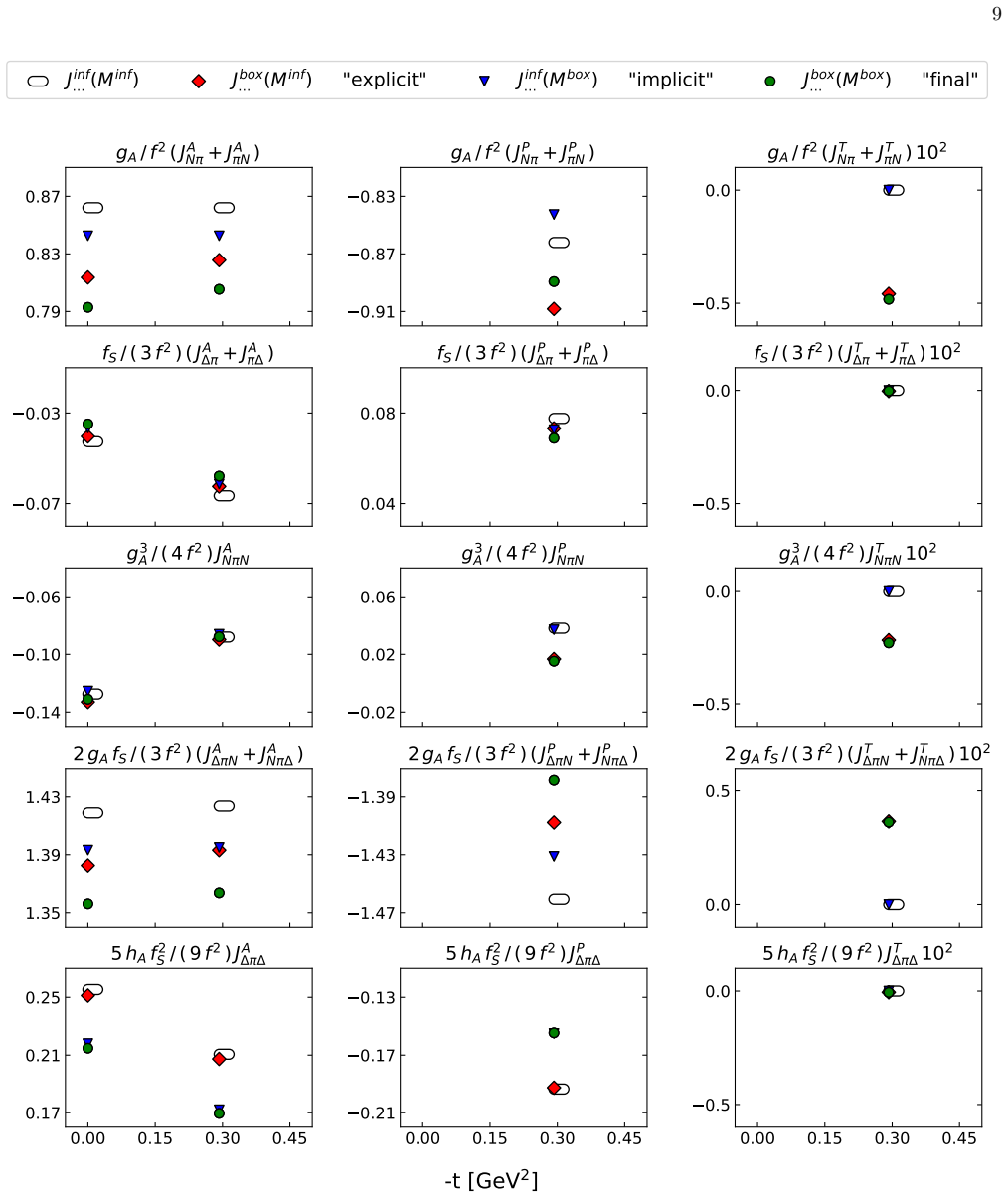
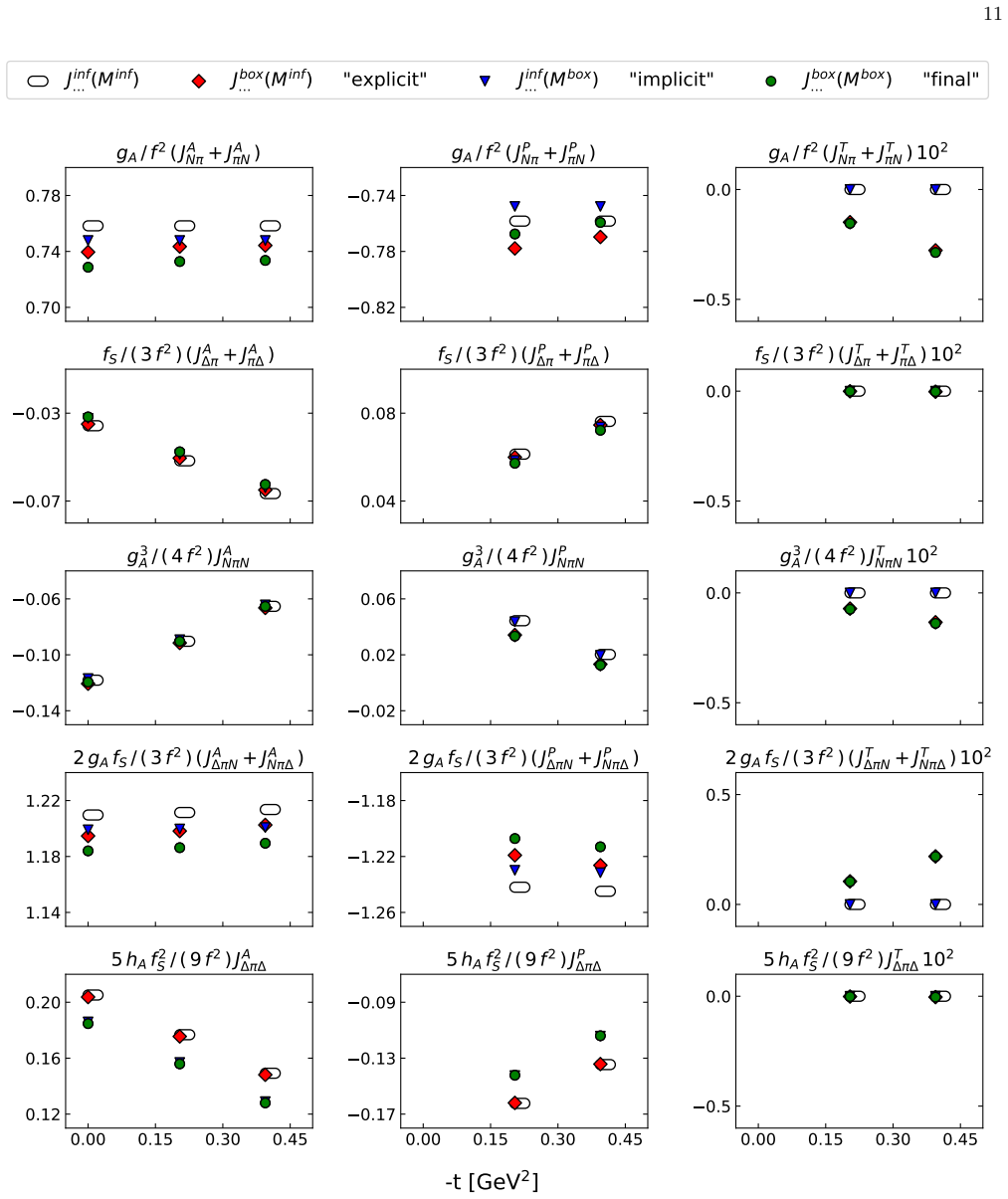
- Sizable finite-volume effects appear in numerical results for two flavor-SU(2) lattice ensembles.
Where Pith is reading between the lines
- This decomposition may be needed when analyzing other currents or matrix elements in finite volume.
- Infinite-volume extrapolations in lattice QCD for axial quantities should account for these additional structures to avoid systematic bias.
- The approach could be extended to three-flavor calculations or higher chiral orders to check convergence.
Load-bearing premise
The leading finite-volume corrections to the axial current matrix element are captured by the one-loop truncation of the chiral Lagrangian with explicit Delta-isobar degrees of freedom.
What would settle it
A direct lattice computation of the axial current matrix element in a finite box that shows no need for additional form factors beyond the usual two, or that contradicts the one-loop predictions for the extra terms.
Figures
read the original abstract
We consider the matrix element of the axial-vector current between two nucleon states in a finite box. Starting from the chiral Lagrangian density with nucleon and $\Delta$-isobar degrees of freedom, we study the finite-volume effects at the one-loop level. We show that the standard decomposition into the axial-vector and pseudoscalar form factor is incomplete in a finite box. We derive expressions for the complete set of form factors at one loop. We verify that the axial Ward identity holds in the chiral limit. Selected numerical results are shown for two flavor-SU(2) lattice ensembles. Sizable finite-volume effects are observed, with an important role for the $\Delta$-isobar. We discuss the implications of our results for lattice studies of the axial-vector current. We conclude that full finite-box results are crucial for a precise determination of the form factors.
Editorial analysis
A structured set of objections, weighed in public.
Referee Report
Summary. The manuscript claims that the standard two-form-factor decomposition of the nucleon axial-vector current matrix element is incomplete in a finite box. Starting from the SU(2) chiral Lagrangian with explicit nucleon and Delta-isobar degrees of freedom, it performs a one-loop calculation of finite-volume effects, derives the complete set of form factors, verifies that the axial Ward identity holds in the chiral limit, and presents selected numerical results on two flavor-SU(2) lattice ensembles. The work concludes that the Delta plays an important role and that full finite-box results are needed for precise lattice determinations of the form factors.
Significance. If the central claim is robust within the stated framework, the result would be significant for lattice QCD studies of nucleon axial form factors, because it indicates that finite-volume corrections may require a larger set of Lorentz structures than conventionally assumed. The explicit Delta degrees of freedom and the Ward-identity check are constructive elements. The significance is tempered by the need to confirm that the reported extra structures are not artifacts of the one-loop truncation.
major comments (1)
- Abstract, paragraph 2 and the one-loop calculation: the claim that the standard decomposition is incomplete in a finite box rests on the one-loop result capturing the leading finite-volume corrections. The truncation with explicit Delta at the order used may miss two-loop or higher-resonance contributions that generate additional Lorentz structures of comparable magnitude when the Delta pole lies close to threshold; without a power-counting argument or estimate showing these terms are parametrically suppressed, the incompleteness could be specific to the truncation rather than a general finite-box feature. This is load-bearing for the central claim.
minor comments (1)
- Numerical results section: the selected results on two ensembles would be strengthened by explicit error estimates, a data table, and a brief discussion of the fitting procedure used to extract the form factors.
Simulated Author's Rebuttal
We thank the referee for the careful reading and the constructive comment. We address the concern regarding the robustness of the central claim below.
read point-by-point responses
-
Referee: Abstract, paragraph 2 and the one-loop calculation: the claim that the standard decomposition is incomplete in a finite box rests on the one-loop result capturing the leading finite-volume corrections. The truncation with explicit Delta at the order used may miss two-loop or higher-resonance contributions that generate additional Lorentz structures of comparable magnitude when the Delta pole lies close to threshold; without a power-counting argument or estimate showing these terms are parametrically suppressed, the incompleteness could be specific to the truncation rather than a general finite-box feature. This is load-bearing for the central claim.
Authors: The additional Lorentz structures are generated by the finite-volume modification of the loop integrals (which do not vanish as they do under continuous integration in infinite volume). Within the SU(2) chiral EFT power counting employed, these one-loop diagrams with explicit Delta constitute the leading finite-volume corrections; two-loop and higher-resonance contributions enter at higher order in the expansion parameter (m_π/(4πf_π))^2 and are parametrically suppressed. The explicit inclusion of the Delta already accounts for its near-threshold effects at the working order. We will add a short paragraph clarifying this power-counting argument and providing a rough numerical estimate of the expected size of omitted terms. revision: partial
Circularity Check
No significant circularity; derivation is a direct one-loop computation from standard Lagrangian
full rationale
The paper performs a standard one-loop evaluation of the axial current matrix element in finite volume using the chiral Lagrangian with explicit Delta degrees of freedom. The central result—that the usual two-form-factor decomposition is incomplete and must be extended—is obtained by explicit computation of all allowed Lorentz structures at this order, without any parameter fitting inside the paper or reduction of the output to the input by definition. No self-citation is invoked as a load-bearing uniqueness theorem, and the axial Ward identity check is an independent consistency test rather than a tautology. The derivation chain therefore remains self-contained against external benchmarks.
Axiom & Free-Parameter Ledger
axioms (1)
- domain assumption One-loop chiral Lagrangian with nucleon and Delta degrees of freedom is adequate for leading finite-volume corrections
Reference graph
Works this paper leans on
-
[1]
S. R. Beane and M. J. Savage, Baryon axial charge in a finite volume, Physical Review D70, 074029 (2004), arXiv:hep-ph/0404131
Pith/arXiv arXiv 2004
-
[2]
A. Khan, M. Gockeler, Ph. Hagler,et al., Axial coupling constant of the nucleon for two flavours of dynamical quarks in finite and infinite volume, Physical Review D 74, 094508 (2006), arXiv:hep-lat/0603028
Pith/arXiv arXiv 2006
-
[3]
G. S. Bali, S. Collins, B. Gl¨ assle, M. G¨ ockeler, J. Na- jjar, R. H. R¨ odl, A. Sch¨ afer, R. W. Schiel, W. S¨ oldner, and A. Sternbeck, Nucleon isovector couplings from Nf=2 lattice QCD, Physical Review D91, 054501 (2015), arXiv:1412.7336 [hep-lat]
Pith/arXiv arXiv 2015
-
[4]
S. Capitani, M. Della Morte, D. Djukanovic, G. M. von Hippel, J. Hua, B. J¨ ager, P. M. Junnarkar, H. B. Meyer, T. D. Rae, and H. Wittig, Isovector axial form fac- tors of the nucleon in two-flavor lattice QCD, Interna- tional Journal of Modern Physics A34, 1950009 (2019), arXiv:1705.06186 [hep-lat]
Pith/arXiv arXiv 2019
-
[5]
C. Alexandrou, M. Constantinou, K. Hadjiyiannakou, K. Jansen, C. Kallidonis, G. Koutsou, and A. Va- quero Aviles-Casco, Nucleon axial form factors using Nf = 2 twisted mass fermions with a physical value of the pion mass, Physical Review D96, 054507 (2017), arXiv:1705.03399 [hep-lat]
Pith/arXiv arXiv 2017
-
[6]
G. Bali, S. Collins, M. Gruber, A. Sch¨ afer, P. Wein, and T. Wurm, Solving the PCAC puzzle for nucleon axial and pseudoscalar form factors, Physics Letters B789, 666 (2019), arXiv:1810.05569 [hep-lat]
Pith/arXiv arXiv 2019
-
[7]
C. Alexandrou, S. Bacchio, M. Constantinou, J. Finken- rath, R. Frezzotti, B. Kostrzewa, G. Koutsou, G. Spanoudes, and C. Urbach (Extended Twisted Mass), Nucleon axial and pseudoscalar form factors using twisted-mass fermion ensembles at the physical point, Physical Review D109, 034503 (2024), arXiv:2309.05774 [hep-lat]
arXiv 2024
- [8]
-
[9]
R. Gupta, Isovector Axial Charge and Form Factors of Nucleons from Lattice QCD, Universe10, 135 (2024), arXiv:2401.16614 [hep-lat]
arXiv 2024
-
[10]
D. Djukanovic, G. von Hippel, H. B. Meyer, K. Ottnad, and H. Wittig, Improved analysis of isovector nucleon matrix elements with Nf=2+1 flavors of O(a) improved Wilson fermions, Physical Review D109, 074507 (2024), arXiv:2402.03024 [hep-lat]
arXiv 2024
-
[11]
G. S. Bali, S. Collins, S. Heybrock, M. L¨ offler, R. R¨ odl, W. S¨ oldner, and S. Weish¨ aupl (RQCD), Octet baryon isovector charges from Nf=2+1 lattice QCD, Phys. Rev. D108, 034512 (2023), arXiv:2305.04717 [hep-lat]
arXiv 2023
-
[12]
R. Gupta, Y.-C. Jang, B. Yoon, H.-W. Lin, V. Cirigliano, and T. Bhattacharya, Isovector Charges of the Nucleon from 2+1+1-flavor Lattice QCD, Physical Review D98, 034503 (2018), arXiv:1806.09006 [hep-lat]
Pith/arXiv arXiv 2018
-
[13]
G. S. Bali, S. Collins, W. S¨ oldner, and S. Weish¨ aupl (RQCD), Leading order mesonic and baryonic SU(3) low energy constants from Nf=3 lattice QCD, Physical Re- view D105, 054516 (2022), arXiv:2201.05591 [hep-lat]
arXiv 2022
-
[14]
S. Park, R. Gupta, T. Bhattacharya, F. He, S. Mondal, H.-W. Lin, and B. Yoon, Flavor diagonal nucleon charges using clover fermions on MILC HISQ ensembles, Physical Review D112, 054508 (2025), arXiv:2503.07100 [hep- lat]
arXiv 2025
-
[15]
L. Greil, T. R. Hemmert, and A. Schafer, Finite Volume Corrections to the Electromagnetic Current of the Nu- cleon, The European Physical Journal A48, 53 (2012), arXiv:1112.2539 [hep-ph]
Pith/arXiv arXiv 2012
-
[16]
Z. B. Hall, D. A. Pefkou, A. S. Meyer,et al., Signs of nonmonotonic finite-volume corrections to gA, Physical Review C113, 055206 (2026), arXiv:2503.09891 [hep- lat]
arXiv 2026
-
[17]
M. Lutz, R. Bavontaweepanya, C. Kobdaj, and K. Schwarz, Finite volume effects in the chiral extrap- olation of baryon masses, Physical Review D90, 054505 (2014), arXiv:1401.7805 [hep-lat]
Pith/arXiv arXiv 2014
-
[18]
M. M. Lutz, Y. Heo, and X.-Y. Guo, On the conver- gence of the chiral expansion for the baryon ground- state masses, Nuclear Physics A977, 146 (2018), arXiv:1801.06417 [hep-lat]
arXiv 2018
-
[19]
M. F. Lutz, U. Sauerwein, and R. G. E. Timmermans, On the axial-vector form factor of the nucleon and chi- ral symmetry, The European Physical Journal C80, 844 (2020), arXiv:2003.10158 [hep-lat]
arXiv 2020
-
[20]
M. F. Lutz, Y. Heo, and X.-Y. Guo, Low-energy con- stants in the chiral Lagrangian with baryon octet and decuplet fields from Lattice QCD data on CLS ensem- bles, The European Physical Journal C83, 440 (2023), arXiv:2301.06837 [hep-lat]
arXiv 2023
-
[21]
F. Hermsen, T. Isken, M. F. Lutz, and D. Thoma, How much strangeness is needed for the axial-vector form factor of the nucleon?, Physical Review D109, 114029 (2024), arXiv:2402.04905 [hep-ph]
arXiv 2024
-
[22]
E. E. Jenkins and A. V. Manohar, Baryon chiral pertur- bation theory using a heavy fermion Lagrangian, Physics Letters B255, 558 (1991)
1991
-
[23]
E. E. Jenkins and A. V. Manohar, Chiral corrections to the baryon axial currents, Physics Letters B259, 353 (1991)
1991
-
[24]
T. Fuchs and S. Scherer, Pion electroproduction, PCAC, chiral ward identities, and the axial form-factor revis- ited, Physical Review C68, 055501 (2003), arXiv:nucl- th/0303002
arXiv 2003
-
[25]
M. Procura, B. Musch, T. Hemmert, and W. Weise, Chiral extrapolation of g(A) with explicit ∆(1232) de- grees of freedom, Physical Review D75, 014503 (2007), arXiv:hep-lat/0610105
Pith/arXiv arXiv 2007
-
[26]
T. Ledwig, J. Martin-Camalich, V. Pascalutsa, and M. Vanderhaeghen, The Nucleon and ∆(1232) form fac- tors at low momentum-transfer and small pion masses, Phys. Rev. D85, 034013 (2012), arXiv:1108.2523 [hep- ph]
Pith/arXiv arXiv 2012
-
[27]
D.-L. Yao, L. Alvarez-Ruso, and M. J. Vicente-Vacas, Extraction of nucleon axial charge and radius from lat- tice QCD results using baryon chiral perturbation theory, Physical Review D96, 116022 (2017), arXiv:1708.08776 [hep-ph]
Pith/arXiv arXiv 2017
-
[28]
F. Alvarado and L. Alvarez-Ruso, Light-quark mass de- pendence of the nucleon axial charge and pion-nucleon scattering phenomenology, Physical Review D105, 074001 (2022), arXiv:2112.14076 [hep-ph]. 27
arXiv 2022
- [29]
- [30]
-
[31]
J. Bijnens and J. Relefors, Masses, Decay Constants and Electromagnetic Form-factors with Twisted Bound- ary Conditions, Journal of High Energy Physics05, 015 (2014), arXiv:1402.1385 [hep-lat]
Pith/arXiv arXiv 2014
-
[32]
F. Hermsen, T. Isken, M. F. Lutz, and R. G. Timmer- mans, The axial-vector form factor of the nucleon in a fi- nite box, arXiv:2504.11902 [hep-lat] (2025), accepted for publication in EPJA
arXiv 2025
-
[33]
M. Schindler, T. Fuchs, J. Gegelia, and S. Scherer, Ax- ial, induced pseudoscalar, and pion-nucleon form-factors in manifestly Lorentz-invariant chiral perturbation the- ory, Physical Review C75, 025202 (2007), arXiv:nucl- th/0611083
arXiv 2007
-
[34]
Weinberg, Charge symmetry of weak interactions, Physical Review112, 1375 (1958)
S. Weinberg, Charge symmetry of weak interactions, Physical Review112, 1375 (1958)
1958
-
[35]
M. Schindler and S. Scherer, Nucleon Form Factors of the Isovector Axial-Vector Current: Situation of Experi- ments and Theory, The European Physical Journal A32, 429 (2007), arXiv:hep-ph/0608325
Pith/arXiv arXiv 2007
-
[36]
N. Cabibbo, E. C. Swallow, and R. Winston, Semilep- tonic hyperon decays, Annual Review of Nuclear and Par- ticle Science53, 39 (2003), arXiv:hep-ph/0307298
Pith/arXiv arXiv 2003
-
[37]
V. Bernard, N. Kaiser, T. Lee, and U.-G. Meißner, Threshold pion electroproduction in chiral perturbation theory, Physics Reports246, 315 (1994), arXiv:hep- ph/9310329
arXiv 1994
-
[38]
V. Bernard, H. W. Fearing, T. R. Hemmert, and U.- G. Meißner, The form factors of the nucleon at small momentum transfer, Nuclear Physics A635, 121 (1998), arXiv:hep-ph/9801297
Pith/arXiv arXiv 1998
-
[39]
H. W. Fearing, R. Lewis, N. Mobed, and S. Scherer,µ capture by a proton in heavy baryon chiral perturbation theory, Physical Review D56, 1783 (1997), arXiv:hep- ph/9702394
arXiv 1997
-
[40]
T. Fuchs, J. Gegelia, G. Japaridze, and S. Scherer, Renor- malization of relativistic baryon chiral perturbation the- ory and power counting, Physical Review D68, 056005 (2003), arXiv:hep-ph/0302117
Pith/arXiv arXiv 2003
-
[41]
Y.-H. Chen, D.-L. Yao, and H. Zheng, Analyses of pion- nucleon elastic scattering amplitudes up to O(p 4) in extended-on-mass-shell subtraction scheme, Physical Re- view D87, 054019 (2013), arXiv:1212.1893 [hep-ph]
Pith/arXiv arXiv 2013
-
[42]
S.-i. Ando and H. W. Fearing, Ordinaryµcapture on a proton in manifestly Lorentz invariant baryon chiral per- turbation theory, Physical Review D75, 014025 (2007), arXiv:hep-ph/0608195
Pith/arXiv arXiv 2007
-
[43]
T. R. Hemmert, M. Procura, and W. Weise, Quark mass dependence of the nucleon axial vector coupling con- stant, Physical Review D68, 075009 (2003), arXiv:hep- lat/0303002
arXiv 2003
-
[44]
P. J. Ellis and H.-B. Tang, Pion nucleon scattering in a new approach to chiral perturbation theory, Phys. Rev. C57, 3356 (1998)
1998
-
[45]
U. Sauerwein, M. F. Lutz, and R. G. Timmermans, Axial-vector form factors of the baryon octet and chi- ral symmetry, Physical Review D105, 054005 (2022), arXiv:2105.06755 [hep-ph]
arXiv 2022
-
[46]
Passarino and M
G. Passarino and M. Veltman, One Loop Corrections for e+e− Annihilation Intoµ + µ− in the Weinberg Model, Nuclear Physics B160, 151 (1979)
1979
-
[47]
G. S. Bali, L. Barca, S. Collins, M. Gruber, M. L¨ offler, A. Sch¨ afer, W. S¨ oldner, P. Wein, S. Weish¨ aupl, and T. Wurm (RQCD), Nucleon axial structure from lattice QCD, Journal of High Energy Physics05, 126 (2020), arXiv:1911.13150 [hep-lat]
arXiv 2020
-
[48]
C. Alexandrou, R. Baron, B. Blossier,et al.(European Twisted Mass), Light baryon masses with dynamical twisted mass fermions, Physical Review D78, 014509 (2008), arXiv:0803.3190 [hep-lat]
Pith/arXiv arXiv 2008
-
[49]
C. Alexandrou, M. Brinet, J. Carbonell, M. Constanti- nou, P. Harraud, P. Guichon, K. Jansen, T. Korzec, and M. Papinutto (ETM), Axial Nucleon form factors from lattice QCD, Physical Review D83, 045010 (2011), arXiv:1012.0857 [hep-lat]
Pith/arXiv arXiv 2011
-
[50]
S. Capitani, M. Della Morte, D. Djukanovic, G. von Hip- pel, J. Hua, B. J¨ ager, B. Knippschild, H. Meyer, T. Rae, and H. Wittig, Nucleon electromagnetic form factors in two-flavor QCD, Physical Review D92, 054511 (2015), arXiv:1504.04628 [hep-lat]
Pith/arXiv arXiv 2015
-
[51]
M. E. Peskin and D. V. Schroeder,An Introduction to quantum field theory(Addison-Wesley, Reading, USA, 1995)
1995
-
[52]
M. Lutz and E. Kolomeitsev, Relativistic chiral SU(3) symmetry, large N(c) sum rules and meson baryon scat- tering, Nuclear Physics A700, 193 (2002), arXiv:nucl- th/0105042
arXiv 2002
-
[53]
A. Semke and M. Lutz, Baryon self energies in the chi- ral loop expansion, Nuclear Physics A778, 153 (2006), arXiv:nucl-th/0511061
Pith/arXiv arXiv 2006
-
[54]
Haberzettl, Propagation of a massive spin 3/2 particle, arXiv:nucl-th/9812043 (1998)
H. Haberzettl, Propagation of a massive spin 3/2 particle, arXiv:nucl-th/9812043 (1998)
Pith/arXiv arXiv 1998
discussion (0)
Sign in with ORCID, Apple, or X to comment. Anyone can read and Pith papers without signing in.