CEON: Circular Economy Ontology Network
Pith reviewed 2026-06-28 14:44 UTC · model grok-4.3
The pith
A new ontology network defines cross-sector concepts to support circular economy data sharing.
A machine-rendered reading of the paper's core claim, the machinery that carries it, and where it could break.
Core claim
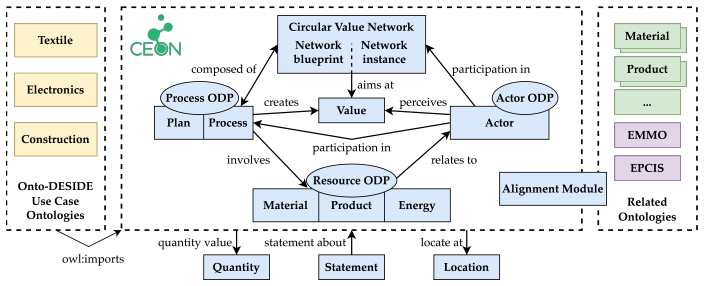
The authors present CEON as an ontology network that fills gaps in circular economy knowledge representation by defining cross-sectorial concepts, enabling semantics-aware data documentation across multiple industry sectors involved in product life cycles.
What carries the argument
The Circular Economy Ontology Network (CEON), which provides a structured set of cross-sectorial concepts for semantic data documentation in circular economy applications.
If this is right
- Cross-industry data documentation becomes possible in construction, electronics, and textile sectors.
- Semantic interoperability is achieved for information sharing in circular strategies.
- Product life cycle communication between sectors is facilitated through shared ontology terms.
Where Pith is reading between the lines
- If CEON is adopted widely, it could reduce data silos in sustainability reporting.
- Extensions might integrate with existing standards like those in supply chain management.
- Testing in additional sectors like automotive could validate broader applicability.
Load-bearing premise
The cross-sectorial concepts defined in CEON are sufficient to enable semantic interoperability across the product life cycle in multiple industry sectors.
What would settle it
A demonstration where CEON fails to represent or interoperate data from construction, electronics, and textile sectors would disprove its utility.
Figures
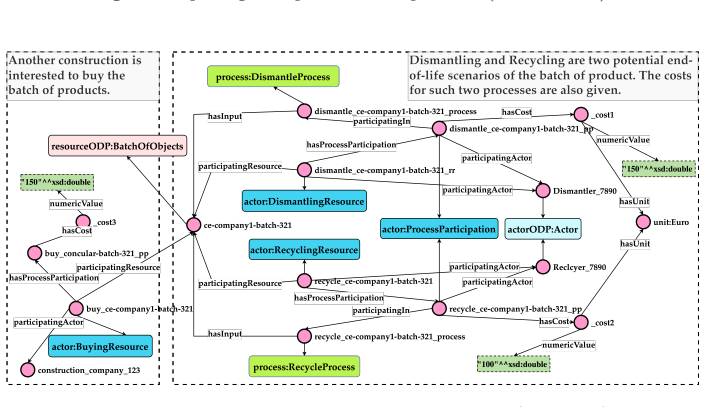
read the original abstract
Increasing the circularity of resource use in our society has been recognized as a path to sustainability, i.e., transitioning into a more circular economy. There are many different circular strategies to do so, such as reusing products and components, refurbishing and remanufacturing used products, or recycling left-over or used materials. To enable these strategies, it is necessary to share information at the infrastructure level and to communicate between industry sectors along the product life cycle. Enabling semantic interoperability in this information sharing and communication is therefore a key to increasing circularity. However, knowledge representation for the circular economy (CE) domain, which involves many relevant industry sectors related to product life cycles, remains challenging. To bridge this gap, we developed the Circular Economy Ontology Network (CEON) within the Onto-DESIDE project. This ontology network aims to fill gaps in CE by defining cross-sectorial concepts and to enable semantics-aware data documentation. We demonstrate CEON through cross-industry data documentation scenarios spanning construction, electronics, and textile sectors.
Editorial analysis
A structured set of objections, weighed in public.
Referee Report
Summary. The paper claims to develop the Circular Economy Ontology Network (CEON) within the Onto-DESIDE project to address gaps in knowledge representation for the circular economy. By defining cross-sectorial concepts, CEON is positioned to enable semantic interoperability and semantics-aware data documentation across industry sectors along product life cycles. This is demonstrated through descriptive cross-industry data documentation scenarios in the construction, electronics, and textile sectors.
Significance. If the central claim holds and the defined concepts prove sufficient for interoperability, the work would contribute a reusable ontology network artifact that supports information sharing for circular strategies such as reuse, refurbishment, and recycling. This could aid multi-sector coordination toward sustainability goals. The paper explicitly ships a new ontology network as its primary artifact.
major comments (1)
- [Demonstration section] Demonstration section (cross-industry scenarios): The scenarios spanning construction, electronics, and textile are purely descriptive and report no metrics such as query success rates, data fusion outcomes, or before/after comparisons to establish that the cross-sectorial concepts actually enable semantic interoperability. This directly undercuts the claim that CEON enables semantics-aware data documentation across sectors, as the weakest assumption (sufficiency of the concepts) remains untested.
minor comments (1)
- [Abstract] The abstract states that CEON 'aims to fill gaps... by defining cross-sectorial concepts' but does not list or exemplify any specific new concepts; adding a brief enumeration would improve clarity without altering the central claim.
Simulated Author's Rebuttal
We thank the referee for the constructive comments on our manuscript. We address the major comment below regarding the demonstration section.
read point-by-point responses
-
Referee: [Demonstration section] Demonstration section (cross-industry scenarios): The scenarios spanning construction, electronics, and textile are purely descriptive and report no metrics such as query success rates, data fusion outcomes, or before/after comparisons to establish that the cross-sectorial concepts actually enable semantic interoperability. This directly undercuts the claim that CEON enables semantics-aware data documentation across sectors, as the weakest assumption (sufficiency of the concepts) remains untested.
Authors: We acknowledge that the scenarios are descriptive illustrations rather than quantitative evaluations. The manuscript's primary contribution is the CEON ontology network as a reusable artifact defining cross-sectorial concepts, with the scenarios serving to exemplify their application for data documentation across construction, electronics, and textile sectors. The paper does not claim or perform empirical testing of interoperability (e.g., via query success rates or data fusion), as such validation would require separate implementation work, datasets, and system benchmarks outside the scope of an ontology engineering contribution. The ontology is publicly released to enable exactly these follow-on evaluations. We have added a brief clarification in the revised manuscript on the illustrative purpose of the scenarios. revision: partial
Circularity Check
No circularity: ontology creation is self-contained artifact development
full rationale
The paper presents the development of CEON as a new ontology network to address identified gaps in circular economy knowledge representation, defining cross-sectorial concepts and demonstrating via descriptive scenarios in construction, electronics, and textile sectors. No equations, fitted parameters, predictions, or derivations are present that could reduce to inputs by construction. No self-citation load-bearing steps, uniqueness theorems, or ansatzes are invoked. The result is the ontology artifact itself, created from domain needs, with no reduction of any claimed outcome to prior fitted values or self-referential definitions. This is the normal case of a non-circular descriptive paper.
Axiom & Free-Parameter Ledger
axioms (1)
- domain assumption Semantic interoperability is necessary for increasing circularity in resource use.
invented entities (1)
-
CEON
no independent evidence
Reference graph
Works this paper leans on
-
[1]
In: Proceedings of the 14th Workshop on Ontology Design and Patterns (WOP 2023)
Blomqvist, E., Li, H., Keskis¨ arkk¨ a, R., Lindecrantz, M., Abd Nikooie Pour, M., Li, Y., Lambrix, P.: Cross-domain Modelling – A Network of Core Ontologies for the Circular Economy. In: Proceedings of the 14th Workshop on Ontology Design and Patterns (WOP 2023). CEUR Workshop Proceedings, vol. 3636, pp. 1–12. CEUR-WS.org (2023),https://ceur-ws.org/Vol-3...
2023
-
[2]
Li, H., Abd Nikooie Pour, M., Li, Y., Lindecrantz, M., Blomqvist, E., Lambrix, P.: A Survey of General Ontologies for the Cross-Industry Domain of Circular Economy. In: Companion Proc. of the ACM Web Conference 2023. ACM (2023). https://doi.org/10.1145/3543873.3587613
-
[3]
Computers in Industry 178, 104465 (2026).https://doi.org/10.1016/j.compind.2026.104465
Seddiqui, M.H., Farazi, F., Giunchiglia, F., Bagchi, M., Bocca, S., Akroyd, J., Mos- bach, S., Arifin, F., Ahmed, R., Arman, M., Di Cesare, L., Pipino, A., Hala¸ co˘ glu, U., Korkmaz, Z., Islam, T., Kiˇ zys, K., Gendvilas, D., Berkay, A., Yildiz, S., Kraft, M.: A Material Passport Ontology for a circular economy. Computers in Industry 178, 104465 (2026).h...
-
[4]
Bader, S., Pullmann, J., Mader, C., Tramp, S., Quix, C., M¨ uller, A.W., Aky¨ urek, H., B¨ ockmann, M., Imbusch, B.T., Lipp, J., Geisler, S., Lange, C.: The In- ternational Data Spaces Information Model – An Ontology for Sovereign Ex- change of Digital Content. In: The Semantic Web – ISWC 2020: 19th Inter- national Semantic Web Conference, Athens, Greece,...
-
[5]
In: 2025 IEEE 8th International Conference on Industrial Cyber- Physical Systems (ICPS)
Lam, A.N., Avogadro, R., Martin-Recuerda, F., Elvesæter, B., Ma, X., Nystad, E.J., Roman, D., Berre, A.J.: Towards a Toolkit for Semantic Interoperability in Data Spaces. In: 2025 IEEE 8th International Conference on Industrial Cyber- Physical Systems (ICPS). pp. 1–7 (2025).https://doi.org/10.1109/ICPS65515. 2025.11087848
-
[6]
Rezvani, S., Asgharzadeh, F., Neumann, M.: Reincarnate D1.1 – An ontology for circular management of buildings (May 2024).https://doi.org/10.5281/zenodo. 11354328
-
[7]
In: Life Cycle Analysis and Assessment in Civil Engineering: Towards an Integrated Vision, pp
Sauter, E., Lemmens, R.L.G., Pauwels, P.: CEO & CAMO Ontologies: A circu- lation medium for materials in the construction industry. In: Life Cycle Analysis and Assessment in Civil Engineering: Towards an Integrated Vision, pp. 1645–
-
[8]
CRC Press (Taylor & Francis), London (2018).https://doi.org/10.1201/ 9781315228914
2018
-
[9]
In: Proceedings of the 37th International Conference of CIB W78 (2021),https://itc.scix.net/pdfs/ w78-2021-paper-081.pdf
Morkunaite, L., Al Naber, F., Petrova, E., Svidt, K.: An Open Data Plat- form for Early-Stage Building Circularity Assessment. In: Proceedings of the 37th International Conference of CIB W78 (2021),https://itc.scix.net/pdfs/ w78-2021-paper-081.pdf
2021
-
[10]
Sustainability13(8), 4265 (2021)
Bicchielli, C., Biancone, N., Ferri, F., Grifoni, P.: BiOnto: An Ontology for Sustainable Bioeconomy and Bioproducts. Sustainability13(8), 4265 (2021). https://doi.org/10.3390/su13084265
-
[11]
1111/jiec.13426
Kirchherr, J., Urbinati, A., Hartley, K.: Circular economy: A new research field? Journal of Industrial Ecology27(5), 1239–1251 (2023).https://doi.org/10. 1111/jiec.13426
2023
-
[12]
In: Proceedings of the Workshop on Ontology Pat- terns (WOP 2009)
Presutti, V., Daga, E., Gangemi, A., Blomqvist, E.: eXtreme Design with Con- tent Ontology Design Patterns. In: Proceedings of the Workshop on Ontology Pat- terns (WOP 2009). CEUR Workshop Proceedings, vol. 516. CEUR-WS.org (2009), https://ceur-ws.org/Vol-516/pap21.pdf
2009
-
[13]
In: Hitzler, P., Gangemi, A., Janowicz, K., Krisnadhi, A., Presutti, V
Blomqvist, E., Hammar, K., Presutti, V.: Engineering Ontologies with Patterns – The eXtreme Design Methodology. Ontology Engineering with Ontology Design Patterns25, 23–50 (2016).https://doi.org/10.3233/978-1-61499-676-7-23
-
[14]
Shimizu, C., Hammar, K., Hitzler, P.: Modular ontology modeling. Semantic Web: - Interoperability, Usability, Applicability14, 459–489 (2023).https://doi.org/ 10.3233/SW-222886
-
[15]
In: Proceedings of the Sev- enth International Conference on Enterprise Information Systems (ICEIS)
Blomqvist, E., Sandkuhl, K.: PATTERNS IN ONTOLOGY ENGINEERING: CLASSIFICATION OF ONTOLOGY PATTERNS. In: Proceedings of the Sev- enth International Conference on Enterprise Information Systems (ICEIS). vol. 3, pp. 413–416. Citeseer (2005).https://doi.org/10.5220/0002518804130416
-
[16]
In: Ontology Engineering in a Networked World, pp
Presutti, V., Blomqvist, E., Daga, E., Gangemi, A.: Pattern-Based Ontology De- sign. In: Ontology Engineering in a Networked World, pp. 35–64. Springer (2012). https://doi.org/10.1007/978-3-642-24794-1_3
-
[17]
Engi- neering Applications of Artificial Intelligence111, 104755 (2022).https://doi
Poveda-Villal´ on, M., Fern´ andez-Izquierdo, A., Fern´ andez-L´ opez, M., Garc´ ıa- Castro, R.: LOT: An industrial oriented ontology engineering framework. Engi- neering Applications of Artificial Intelligence111, 104755 (2022).https://doi. org/10.1016/j.engappai.2022.104755
-
[18]
In: Dragoni, M., Poveda-Villal´ on, M., Jimenez-Ruiz, E
Peroni, S.: A Simplified Agile Methodology for Ontology Development. In: Dragoni, M., Poveda-Villal´ on, M., Jimenez-Ruiz, E. (eds.) OWL: Experiences and Direc- tions – Reasoner Evaluation. pp. 55–69. Springer International Publishing (2017). https://doi.org/10.1007/978-3-319-54627-8_5
-
[19]
Scientific Data3(1), 1–9 (2016), https://doi.org/10.1038/sdata.2016.18
Wilkinson, M.D., Dumontier, M., Aalbersberg, I.J., Appleton, G., Axton, M., Baak, A., Blomberg, N., Boiten, J.W., da Silva Santos, L.B., Bourne, P.E., Bouw- man, J., Brookes, A.J., Clark, T., Crosas, M., Dillo, I., Dumon, O., Edmunds, S., Evelo, C.T., Finkers, R., Gonzalez-Beltran, A., Gray, A.J., Groth, P., Goble, C., Grethe, J.S., Heringa, J., ’t Hoen, ...
-
[20]
Blomsma, F., Brennan, G.: Circularity Thinking: Systems Thinking for Circular Product and Business Model (Re)design — Identifying Waste Flows and Redi- recting Them for Value Creation and Capture. In: Charter, M. (ed.) Design- ing for the Circular Economy, pp. 133–147. Routledge, London (2018).https: //doi.org/10.4324/9781315113067-13
-
[21]
Ch´ avez-Feria, S., Garc´ ıa-Castro, R., Poveda-Villal´ on, M.: Chowlk: from UML- Based Ontology Conceptualizations to OWL. In: Groth, P., Vidal, M.E., Suchanek, F., Szekley, P., Kapanipathi, P., Pesquita, C., Skaf-Molli, H., Tamper, M. (eds.) The Semantic Web. pp. 338–352. Springer International Publishing, Cham (2022). https://doi.org/10.1007/978-3-031-...
-
[22]
In: Proceedings of the 3rd International Workshop on Knowledge Graphs for Sustain- ability (KG4S2025)
Li, H., Vataˇ sˇ cinov´ a, J., Zamazal, O., Li, Y., Lambrix, P., Blomqvist, E.: Results and Discussions from Aligning Ontologies in the Circular Economy Domain. In: Proceedings of the 3rd International Workshop on Knowledge Graphs for Sustain- ability (KG4S2025). CEUR Workshop Proceedings, vol. 4002, pp. 13–24. CEUR- WS.org (2025),https://ceur-ws.org/Vol-...
2025
-
[23]
Del Nostro, P., Friis, J., Ghedini, E., Goldbeck, G., Holtz, O., Roscioni, O., Za- ccarini, F., Toti, D.: Elementary Multiperspective Material Ontology: Leveraging Perspectives via a Showcase of EMMO-Based Domain and Application Ontologies. In: Proceedings of the 16th International Joint Conference on Knowledge Discov- ery, Knowledge Engineering and Knowl...
-
[24]
Quantities, Units, Dimensions and Datatypes (QUDT).https://qudt.org, ac- cessed: 2026-05-04
2026
-
[25]
Battle, R., Kolas, D.: Enabling the geospatial Semantic Web with Parliament and GeoSPARQL. Semantic Web: - Interoperability, Usability, Applicability3(4), 355– 370 (2012).https://doi.org/10.3233/SW-2012-0065
-
[26]
In: Knowledge Engineering and Knowledge Management
Blomqvist, E., Seil Sepour, A., Presutti, V.: Ontology Testing - Methodology and Tool. In: Knowledge Engineering and Knowledge Management. Lecture Notes in Computer Science, vol. 7603, pp. 216–226. Springer, Berlin, Heidelberg (2012). https://doi.org/10.1007/978-3-642-33876-2_20
-
[27]
Poveda-Villal´ on, M., G´ omez-P´ erez, A., Su´ arez-Figueroa, M.C.: OOPS! (OntOlogy Pitfall Scanner!): An On-line Tool for Ontology Evaluation. International Journal on Semantic Web and Information Systems (IJSWIS)10(2), 7–34 (2014).https: //doi.org/10.4018/ijswis.2014040102
-
[28]
In: International Semantic Web Conference (ISWC) 2021: Posters, Demos, and Industry Tracks
Garijo, D., Corcho, O., Poveda-Villal´ on, M.: FOOPS!: An Ontology Pitfall Scanner for the FAIR Principles. In: International Semantic Web Conference (ISWC) 2021: Posters, Demos, and Industry Tracks. CEUR Workshop Proceedings, vol. 2980. CEUR-WS.org (2021),https://ceur-ws.org/Vol-2980/paper321.pdf
2021
-
[29]
In: Proceedings of the 2nd International Workshop on Knowledge Graphs for Sustainability (KG4S2024)
De Mulder, G., De Vleeschauwer, E., De Meester, B., Colpaert, P., Hartig, O.: The Open Circularity Platform: a Decentralized Data Sharing Platform for Circular Value Networks. In: Proceedings of the 2nd International Workshop on Knowledge Graphs for Sustainability (KG4S2024). CEUR Workshop Proceedings, vol. 3753. CEUR-WS.org (2024),https://ceur-ws.org/Vol...
2024
-
[30]
Technical Report (2021), https://solidproject.org/TR/, accessed: 2026-05-07
W3C Solid Community Group: Solid Technical Reports. Technical Report (2021), https://solidproject.org/TR/, accessed: 2026-05-07
2021
-
[31]
IFAC-PapersOnLine59(10), 643–648 (2025).https://doi.org/10.1016/j.ifacol.2025.09.110
Gallina, V., Lanbach, E., Ahmeti, A., Ritter, S., Revenko, A., Belova, A., Steinwen- der, A., Bachlechner, D.: Creating a Digital Product Passport Using Data Spaces and Ontologies: A Case Study at a Furniture Dealer. IFAC-PapersOnLine59(10), 643–648 (2025).https://doi.org/10.1016/j.ifacol.2025.09.110
-
[32]
Available at SSRN 6447959
Kebede, R., Blomqvist, E., Li, H.: Towards Interoperable Knowledge Representa- tion for Digital Product Passports and the Circular Economy. Available at SSRN 6447959
-
[33]
Bernier, C., Li, W., Kuiper, J., Stojanovic, L., Hbeich, E., Pellegrini, T., Havur, G., Ahmeti, A., David, R., Alexiev, V., Avgoustinos, H., Dimitriou, N., Berg, H., Boutillier, K., Toma, I., Plociennik, C., Nazeri, A., Danash, F., Glachs, D., Strohmeier, F., Correia, A., Konchakova, N., Klein, P., Sinha, A., Rimaz, H., Lindekrans, M., Blomqvist, E., Li, ...
-
[34]
In: Proceedings of the 4th Inter- national Workshop on Knowledge Graphs for Sustainability (KG4S2026)
Blomqvist, E., de Leng, D., Keskis¨ arkk¨ a, R., Lindecrantz, M., Storm, O., St˚ alhandske, C., Wannerberg, K.: Ontology-based Data Documentation for the Circular Economy - The Case of Flat Glass. In: Proceedings of the 4th Inter- national Workshop on Knowledge Graphs for Sustainability (KG4S2026). CEUR Workshop Proceedings, CEUR-WS.org (2026)
2026
discussion (0)
Sign in with ORCID, Apple, or X to comment. Anyone can read and Pith papers without signing in.