Regularized Large Neighborhood Search
Pith reviewed 2026-06-28 15:12 UTC · model grok-4.3
The pith
Regularizing local subproblems turns large neighborhood search into exact block Gibbs sampling.
A machine-rendered reading of the paper's core claim, the machinery that carries it, and where it could break.
Core claim
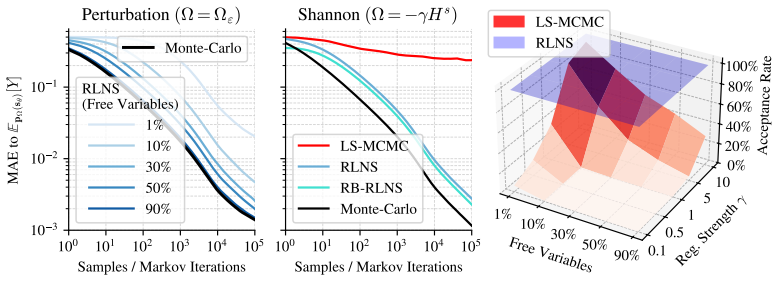
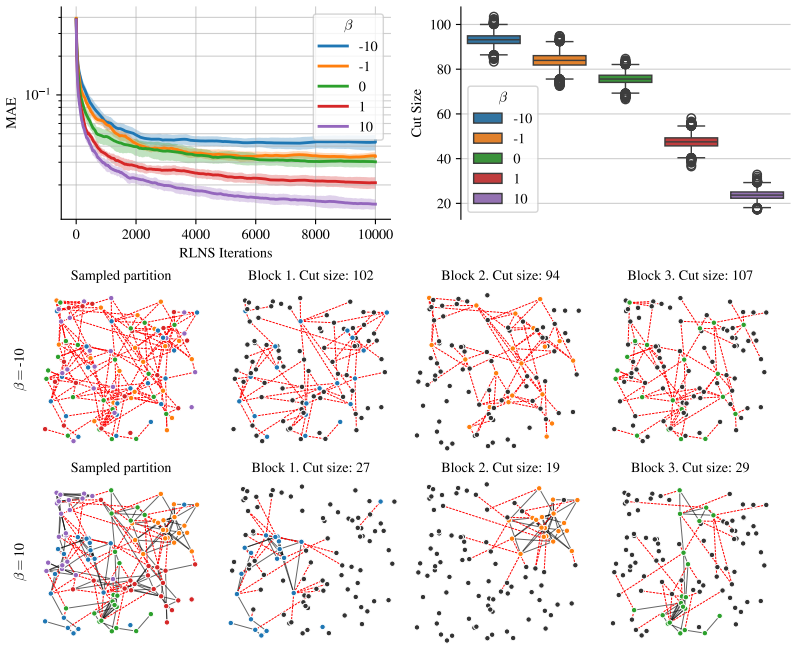
Regularized large neighborhood search (RLNS) perturbs or regularizes the local subproblems in LNS to create a valid MCMC transition kernel whose stationary distribution matches the desired distribution over feasible solutions. With entropic regularization, RLNS performs exact block Gibbs sampling. Varying the iteration count interpolates between pseudolikelihood and maximum likelihood estimation for training without global solvers.
What carries the argument
The regularized local subproblem solver that generates MCMC transitions in the space of feasible solutions.
If this is right
- Allows training models with hard combinatorial constraints using only local solvers.
- Provides a continuous trade-off between approximate and exact likelihood via iteration budget.
- Demonstrated on k-subset selection, generalized assignment and stochastic vehicle scheduling.
Where Pith is reading between the lines
- The method may generalize to other local search procedures used in operations research.
- It could reduce the computational cost of training on problems where exact solvers scale poorly.
- Connections to existing work on differentiable combinatorial optimization might be strengthened by this sampling view.
Load-bearing premise
That adding regularization or perturbation to the local subproblems creates a Markov chain with the target stationary distribution.
What would settle it
Computing the empirical distribution of solutions visited by long RLNS runs on a small instance and checking whether it matches the exact target distribution obtained by enumeration.
Figures
read the original abstract
Operations research practitioners typically tackle NP-hard combinatorial problems using large neighborhood search (LNS), a scalable heuristic that iteratively refines a current solution by locally re-optimizing subsets of its variables. In contrast, most existing approaches for integrating combinatorial optimization layers into neural networks still assume access to an exact global solution, which is computationally intractable. We bridge this gap by introducing regularized LNS (RLNS). By regularizing or perturbing local subproblems, we turn the LNS heuristic into an efficient MCMC sampler over the combinatorial set of feasible solutions, with associated Fenchel-Young losses. Under entropic regularization, we prove that RLNS performs exact block Gibbs sampling. Furthermore, adjusting the number of RLNS iterations allows us to interpolate between pseudolikelihood and exact maximum likelihood estimation, for end-to-end learning without global solvers. We demonstrate our approach on $k$-subset selection, generalized assignment, and stochastic vehicle scheduling problems.
Editorial analysis
A structured set of objections, weighed in public.
Referee Report
Summary. The paper introduces regularized large neighborhood search (RLNS) to convert the LNS heuristic into an MCMC sampler over feasible combinatorial solutions by regularizing or perturbing local subproblems, yielding associated Fenchel-Young losses. It claims that entropic regularization makes RLNS perform exact block Gibbs sampling and that varying the number of RLNS iterations interpolates between pseudolikelihood and exact maximum likelihood estimation, enabling end-to-end neural network learning without global solvers. The method is demonstrated on k-subset selection, generalized assignment, and stochastic vehicle scheduling.
Significance. If the proof of exact block Gibbs sampling and the interpolation property hold under the stated conditions, the work would be significant for enabling scalable, differentiable combinatorial layers in neural networks on NP-hard problems where exact global solvers are intractable. The approach bridges heuristic search with probabilistic inference in a way that could support training without access to global optima.
major comments (2)
- [Abstract] Abstract: the central claim that 'under entropic regularization, we prove that RLNS performs exact block Gibbs sampling' is load-bearing for both the sampling guarantee and the subsequent interpolation between pseudolikelihood and exact MLE, yet the manuscript supplies neither the proof steps, the precise form of the entropic regularization added to the local combinatorial objective, nor the reversibility argument ensuring the kernel's stationary distribution matches the target measure over feasible solutions.
- [Abstract] Abstract: the interpolation result (few iterations ≈ pseudolikelihood, many iterations ≈ exact MLE) rests on the local regularized subproblem inducing exactly the conditional p(block | fixed variables) under the global target; without the derivation showing that the perturbation preserves this conditional and that the chosen neighborhoods yield a valid reversible kernel, the claimed continuum cannot be verified.
Simulated Author's Rebuttal
We thank the referee for their careful reading and for identifying the need for greater explicitness around the central theoretical claims. We will revise the manuscript to supply the requested proof steps, precise regularization form, and derivations.
read point-by-point responses
-
Referee: [Abstract] Abstract: the central claim that 'under entropic regularization, we prove that RLNS performs exact block Gibbs sampling' is load-bearing for both the sampling guarantee and the subsequent interpolation between pseudolikelihood and exact MLE, yet the manuscript supplies neither the proof steps, the precise form of the entropic regularization added to the local combinatorial objective, nor the reversibility argument ensuring the kernel's stationary distribution matches the target measure over feasible solutions.
Authors: We agree that the current presentation would be strengthened by an expanded derivation. The entropic regularization added to each local subproblem is exactly τ H(x_S), where H is the entropy over the block variables and τ > 0 is the temperature; this turns the local solver into an exact sampler from the conditional p(x_S | x_{V\S}) under the global target. The resulting transition kernel is reversible w.r.t. the target because each step is a standard block-Gibbs update. We will insert a dedicated subsection (new Section 3.2) containing the full proof steps, including the explicit local objective and the reversibility argument. revision: yes
-
Referee: [Abstract] Abstract: the interpolation result (few iterations ≈ pseudolikelihood, many iterations ≈ exact MLE) rests on the local regularized subproblem inducing exactly the conditional p(block | fixed variables) under the global target; without the derivation showing that the perturbation preserves this conditional and that the chosen neighborhoods yield a valid reversible kernel, the claimed continuum cannot be verified.
Authors: The interpolation holds because a single RLNS iteration reduces to a regularized local optimization whose optimum is the mode of the conditional (recovering a pseudolikelihood-style objective), while repeated iterations produce a Markov chain whose stationary distribution is the global target, recovering exact MLE in the limit. The entropy perturbation preserves the conditional exactly, and the neighborhoods are chosen so that the blocks cover all variables, guaranteeing irreducibility and hence a valid reversible kernel. We will add the explicit derivation of conditional preservation and kernel validity to the revised manuscript. revision: yes
Circularity Check
No circularity: claimed proof of exact block Gibbs sampling stands as independent derivation
full rationale
The paper asserts a proof that entropic regularization turns RLNS into exact block Gibbs sampling and enables interpolation between pseudolikelihood and MLE. No equations, fitted parameters, or self-citations are exhibited in the abstract or summary that reduce this result to a self-definition, a renamed input, or a load-bearing prior result by the same authors. The central step is presented as a mathematical proof rather than a tautological re-expression of the inputs, rendering the derivation self-contained against external benchmarks.
Axiom & Free-Parameter Ledger
Reference graph
Works this paper leans on
-
[1]
2019 , eprint=
The Limited Multi-Label Projection Layer , author=. 2019 , eprint=
2019
-
[2]
, volume =
The generalized simplex method for minimizing a linear form under linear inequality restraints. , volume =. Pacific Journal of Mathematics , author =. 1955 , keywords =
1955
-
[3]
Mathematical Communications , volume=
Entropy functions and functional equations , author=. Mathematical Communications , volume=. 2011 , publisher=
2011
-
[4]
The Fibonacci Quarterly , volume=
Entropy of terminal distributions and the Fibonacci trees , author=. The Fibonacci Quarterly , volume=. 1988 , publisher=
1988
-
[5]
Learning with
Berthet, Quentin and Blondel, Mathieu and Teboul, Olivier and Cuturi, Marco and Vert, Jean-Philippe and Bach, Francis , month = jun, year =. Learning with
-
[6]
Blondel, Mathieu and Martins, André F. T. and Niculae, Vlad , month = mar, year =. Learning with
-
[7]
Interior
Mandi, Jayanta and Guns, Tias , month = oct, year =. Interior
-
[8]
and Parmentier, Axel and Schiffer, Maximilian , month = apr, year =
Baty, Léo and Jungel, Kai and Klein, Patrick S. and Parmentier, Axel and Schiffer, Maximilian , month = apr, year =. Combinatorial. doi:10.48550/arXiv.2304.00789 , abstract =
-
[9]
and Parmentier, Axel and Rohmer, Sonja U
Greif, Toni and Bouvier, Louis and Flath, Christoph M. and Parmentier, Axel and Rohmer, Sonja U. K. and Vidal, Thibaut , month = feb, year =. Combinatorial. doi:10.48550/arXiv.2402.04463 , abstract =
-
[10]
Blondel, Mathieu and Martins, André F. T. and Niculae, Vlad , month = feb, year =. Learning. doi:10.48550/arXiv.1805.09717 , abstract =
work page internal anchor Pith review Pith/arXiv arXiv doi:10.48550/arxiv.1805.09717
-
[11]
Blondel, Mathieu and Teboul, Olivier and Berthet, Quentin and Djolonga, Josip , month = jun, year =. Fast. doi:10.48550/arXiv.2002.08871 , abstract =
-
[12]
Vlastelica, Marin and Paulus, Anselm and Musil, Vít and Martius, Georg and Rolínek, Michal , month = feb, year =. Differentiation of. doi:10.48550/arXiv.1912.02175 , abstract =
-
[13]
Journal of Artificial Intelligence Research , author =
Decision-. Journal of Artificial Intelligence Research , author =. 2024 , note =. doi:10.1613/jair.1.15320 , abstract =
-
[14]
Vivier--Ardisson, Germain and Forel, Alexandre and Parmentier, Axel and Vidal, Thibaut , month = may, year =
-
[15]
Carreira-Perpiñán, Miguel Á and Hinton, Geoffrey , month = jan, year =. On. International
-
[16]
Niepert, Mathias and Minervini, Pasquale and Franceschi, Luca , month = oct, year =. Implicit. doi:10.48550/arXiv.2106.01798 , abstract =
-
[17]
Yuille, Alan L , year =. The. Advances in
-
[18]
Dalle, Guillaume and Baty, Léo and Bouvier, Louis and Parmentier, Axel , month = dec, year =. Learning with. doi:10.48550/arXiv.2207.13513 , abstract =
-
[19]
Barrier Frank-Wolfe for Marginal Inference
Krishnan, Rahul G. and Lacoste-Julien, Simon and Sontag, David , month = nov, year =. Barrier. doi:10.48550/arXiv.1511.02124 , abstract =
work page internal anchor Pith review Pith/arXiv arXiv doi:10.48550/arxiv.1511.02124
-
[20]
Vivier-Ardisson, Germain and Blondel, Mathieu and Parmentier, Axel , month = may, year =. Learning with. doi:10.48550/arXiv.2505.14240 , abstract =
-
[21]
Martins, André F. T. and Astudillo, Ramón Fernandez , month = feb, year =. From. doi:10.48550/arXiv.1602.02068 , abstract =
work page internal anchor Pith review Pith/arXiv arXiv doi:10.48550/arxiv.1602.02068
-
[22]
Niculae, Vlad and Martins, André F. T. and Blondel, Mathieu and Cardie, Claire , month = jun, year =. doi:10.48550/arXiv.1802.04223 , abstract =
work page internal anchor Pith review Pith/arXiv arXiv doi:10.48550/arxiv.1802.04223
-
[23]
Primal-dual algorithm for contextual stochastic combinatorial optimization , url =
Bouvier, Louis and Prunet, Thibault and Leclère, Vincent and Parmentier, Axel , month = may, year =. Primal-dual algorithm for contextual stochastic combinatorial optimization , url =. doi:10.48550/arXiv.2505.04757 , abstract =
-
[24]
and McCallum, A
Lafferty, J. and McCallum, A. and Pereira, Fernando , month = jun, year =. Conditional
-
[25]
Hoppe, Heiko and Baty, Léo and Bouvier, Louis and Parmentier, Axel and Schiffer, Maximilian , month = may, year =. Structured. doi:10.48550/arXiv.2505.19053 , abstract =
-
[26]
Journal of Applied Probability , author =
Sensitivity and. Journal of Applied Probability , author =. 2005 , note =
2005
-
[27]
Besag, Julian , year =. Spatial. Journal of the Royal Statistical Society. Series B (Methodological) , publisher =
-
[28]
Learning with
Asuncion, Arthur and Liu, Qiang and Ihler, Alexander and Smyth, Padhraic , month = mar, year =. Learning with. Proceedings of the
-
[29]
Varin, Cristiano and Reid, Nancy and Firth, David , year =. An. Statistica Sinica , publisher =
-
[30]
Composite likelihood methods , author=. Statistical Inference from Stochastic Processes: Proceedings of the AMS-IMS-SIAM Joint Summer Research Conference Held August 9-15, 1987, with Support from the National Science Foundation and the Army Research Office , volume=. 1988 , organization=
1987
-
[31]
Besag, Julian , year =. On the. Journal of the Royal Statistical Society. Series B (Methodological) , publisher =
-
[32]
Bertasius, Gedas and Liu, Qiang and Torresani, Lorenzo and Shi, Jianbo , month = oct, year =. Local. doi:10.48550/arXiv.1605.07686 , abstract =
work page internal anchor Pith review Pith/arXiv arXiv doi:10.48550/arxiv.1605.07686
-
[33]
McKenzie, Daniel and Fung, Samy Wu and Heaton, Howard , month = jul, year =. Differentiating. doi:10.48550/arXiv.2301.13395 , abstract =
-
[34]
Differentiable Dynamic Programming for Structured Prediction and Attention
Mensch, Arthur and Blondel, Mathieu , month = feb, year =. Differentiable. doi:10.48550/arXiv.1802.03676 , abstract =
work page internal anchor Pith review Pith/arXiv arXiv doi:10.48550/arxiv.1802.03676
-
[35]
Sklaviadis, Sophia and Martins, Andre and Figueiredo, Mario , month = aug, year =. Fenchel-. doi:10.48550/arXiv.2502.10295 , abstract =
-
[36]
Sahoo, Subham Sekhar and Paulus, Anselm and Vlastelica, Marin and Musil, Vít and Kuleshov, Volodymyr and Martius, Georg , month = mar, year =. Backpropagation through. doi:10.48550/arXiv.2205.15213 , abstract =
-
[37]
Tyrrell , year =
Rockafellar, R. Tyrrell , year =. Convex
-
[38]
and Parmentier, Axel and Blondel, Mathieu , month = jan, year =
Vivier-Ardisson, Germain and Sander, Michaël E. and Parmentier, Axel and Blondel, Mathieu , month = jan, year =. Differentiable. doi:10.48550/arXiv.2601.21775 , abstract =
-
[39]
First- and second-order expectation semirings with applications to minimum-risk training on translation forests , isbn =
Li, Zhifei and Eisner, Jason , month = aug, year =. First- and second-order expectation semirings with applications to minimum-risk training on translation forests , isbn =. Proceedings of the 2009
2009
-
[40]
SIAM Journal on Applied Mathematics , author =
The. SIAM Journal on Applied Mathematics , author =. 1966 , pages =. doi:10.1137/0114053 , abstract =
-
[41]
Amos, Brandon and Kolter, J. Zico , month = dec, year =. doi:10.48550/arXiv.1703.00443 , abstract =
-
[42]
MIPaaL: Mixed Integer Program as a Layer
Ferber, Aaron and Wilder, Bryan and Dilkina, Bistra and Tambe, Milind , month = jul, year =. doi:10.48550/arXiv.1907.05912 , abstract =
work page internal anchor Pith review Pith/arXiv arXiv doi:10.48550/arxiv.1907.05912 1907
-
[43]
Blondel, Mathieu and Berthet, Quentin and Cuturi, Marco and Frostig, Roy and Hoyer, Stephan and Llinares-López, Felipe and Pedregosa, Fabian and Vert, Jean-Philippe , month = oct, year =. Efficient and. doi:10.48550/arXiv.2105.15183 , abstract =
-
[44]
Agrawal, Akshay and Amos, Brandon and Barratt, Shane and Boyd, Stephen and Diamond, Steven and Kolter, Zico , month = oct, year =. Differentiable. doi:10.48550/arXiv.1910.12430 , abstract =
-
[45]
Consistency of. Neural Computation , author =. 2006 , pages =. doi:10.1162/neco.2006.18.10.2283 , abstract =
-
[46]
EURO Journal on Computational Optimization , volume=
A survey on matheuristics for routing problems , author=. EURO Journal on Computational Optimization , volume=. 2014 , publisher=
2014
-
[47]
Handbook of metaheuristics , pages=
Large neighborhood search , author=. Handbook of metaheuristics , pages=. 2018 , publisher=
2018
-
[48]
Kellerer, Hans and Pferschy, Ulrich and Pisinger, David , year =. Knapsack. doi:10.1007/978-3-540-24777-7 , language =
-
[49]
, year =
Hinton, rey E. , year =. Training
-
[50]
Papandreou, George and Yuille, Alan L. , month = nov, year =. Perturb-and-. 2011. doi:10.1109/ICCV.2011.6126242 , abstract =
-
[51]
Learning structured approximations of combinatorial optimization problems , url =
Parmentier, Axel , month = feb, year =. Learning structured approximations of combinatorial optimization problems , url =. doi:10.48550/arXiv.2107.04323 , abstract =
-
[52]
Sadana, Utsav and Chenreddy, Abhilash and Delage, Erick and Forel, Alexandre and Frejinger, Emma and Vidal, Thibaut , month = feb, year =. A. doi:10.48550/arXiv.2306.10374 , abstract =
-
[53]
Schiffer, Maximilian and Hoppe, Heiko and Su, Yue and Bouvier, Louis and Parmentier, Axel , month = jan, year =. Combinatorial. doi:10.48550/arXiv.2601.10583 , abstract =
-
[54]
Parmentier, Axel , month = jan, year =. Learning to. Operations Research , publisher =. doi:10.1287/opre.2020.2094 , abstract =
-
[55]
Roberts, Gareth and Rosenthal, Jeffrey , month = jan, year =. Geometric. Electronic Communications in Probability , publisher =. doi:10.1214/ECP.v2-981 , abstract =
-
[56]
and Zanella, Giacomo , month = jan, year =
Ascolani, Filippo and Roberts, Gareth O. and Zanella, Giacomo , month = jan, year =. Scalability of. doi:10.48550/arXiv.2403.09416 , abstract =
-
[57]
Advances in Applied Probability , author =
Convergence of. Advances in Applied Probability , author =. 2014 , keywords =. doi:10.1239/aap/1401369701 , abstract =
-
[58]
Blondel, Mathieu and Roulet, Vincent , month = jun, year =. The. doi:10.48550/arXiv.2403.14606 , abstract =
-
[59]
Knapsack problems: algorithms and computer implementations , isbn =
Martello, Silvano and Toth, Paolo , month = oct, year =. Knapsack problems: algorithms and computer implementations , isbn =
-
[60]
Foundations and Trends® in Machine Learning , author =
Graphical. Foundations and Trends® in Machine Learning , author =. 2008 , pages =. doi:10.1561/2200000001 , abstract =
-
[61]
Generalized assignment problems , isbn =
Martello, Silvano and Toth, Paolo , editor =. Generalized assignment problems , isbn =. Algorithms and. 1992 , keywords =. doi:10.1007/3-540-56279-6_88 , abstract =
-
[62]
An efficient graph convo- lutional network technique for the travelling salesman problem,
Joshi, Chaitanya K. and Laurent, Thomas and Bresson, Xavier , month = oct, year =. An. doi:10.48550/arXiv.1906.01227 , abstract =
-
[63]
Journal of Statistical Planning and Inference , author =
Markov chain. Journal of Statistical Planning and Inference , author =. 2000 , keywords =. doi:10.1016/S0378-3758(99)00079-8 , abstract =
-
[64]
Jung, Kyomin and Kohli, Pushmeet and Shah, Devavrat , year =. Local. Advances in
-
[65]
International Conference on Machine Learning , pages=
Lp-sparsemap: Differentiable relaxed optimization for sparse structured prediction , author=. International Conference on Machine Learning , pages=. 2020 , organization=
2020
discussion (0)
Sign in with ORCID, Apple, or X to comment. Anyone can read and Pith papers without signing in.