I-(OT)²: A Client-optimal Oblivious Transfer Protocol for IoT Devices
Pith reviewed 2026-06-28 13:46 UTC · model grok-4.3
The pith
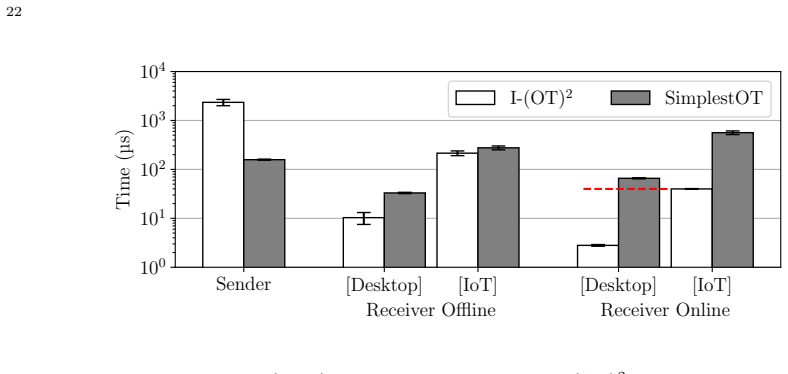
I-(OT)^2 achieves online oblivious transfer costs of 39.90 μs on IoT devices for the receiver at 128-bit security.
A machine-rendered reading of the paper's core claim, the machinery that carries it, and where it could break.
Core claim
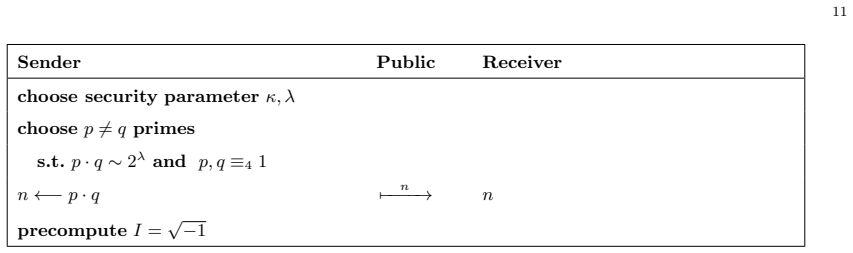
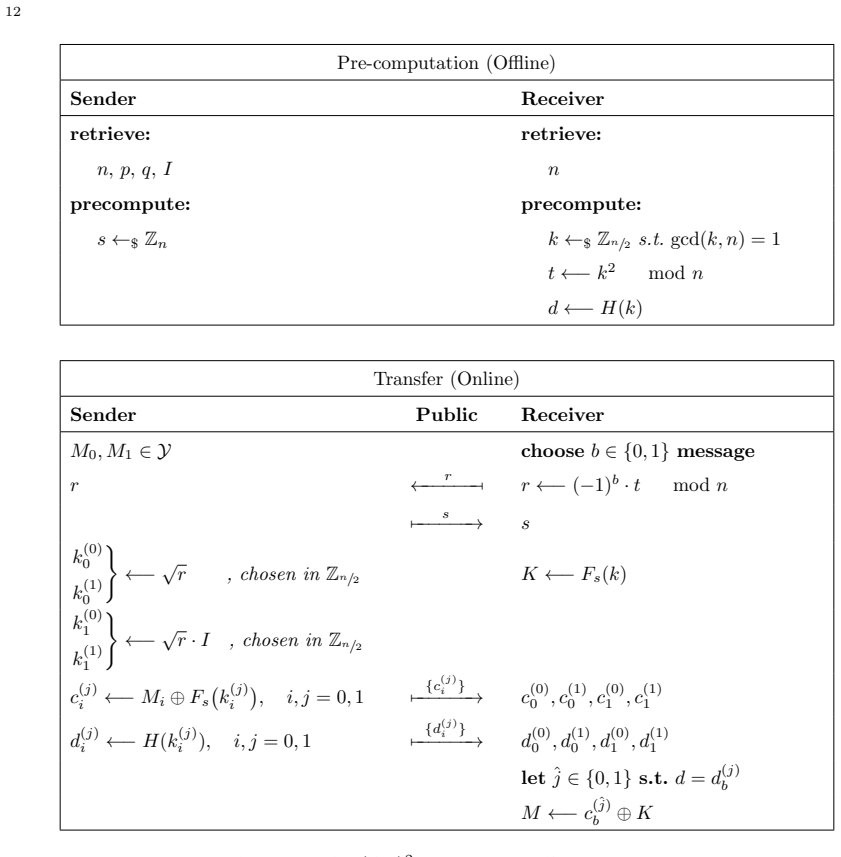
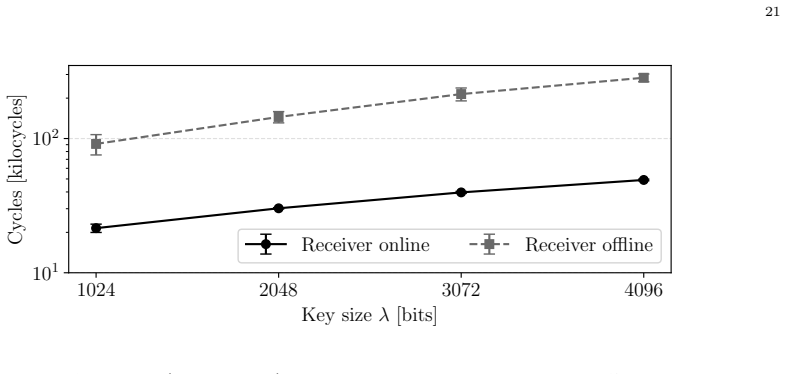
I-(OT)^2 is a novel base 1-out-of-2 OT protocol grounded in the quadratic residuosity problem, specifically designed to minimise receiver-side computation and interaction. Through a lightweight offline pre-computation phase, I-(OT)^2 shifts the on-transfer computational burden almost entirely to the Sender, while reducing online communication to only six messages and four digests exchanged. The protocol comes with a formal proof of its security, and an implementation achieves average online costs per OT as low as 2.80 μs on desktop and 39.90 μs on IoT devices for 128-bit security with 3072-bit RSA modulus, more than 10× faster than SimplestOT.
What carries the argument
The I-(OT)^2 construction, a quadratic-residuosity-based 1-out-of-2 OT that uses offline pre-computation to move computation from receiver to sender.
If this is right
- Base OT protocols remain necessary when the number of transfers is modest or communication latency dominates.
- The design supports client-server architectures with the receiver on constrained IoT hardware.
- Online phase requires only six messages and four digests.
- Formal security is established under the quadratic residuosity assumption.
- Measured receiver costs exceed 10× improvement over SimplestOT on IoT devices.
Where Pith is reading between the lines
- The receiver-side savings could extend the range of real-time IoT applications that can afford OT-based privacy features.
- The offline-to-online split might transfer to other cryptographic building blocks on power-limited devices.
- Hybrid use with OT-extension methods could combine low per-instance cost with high-volume amortisation.
- Re-running the benchmarks on additional IoT platforms would test whether the reported speedups generalise beyond the tested hardware.
Load-bearing premise
Security and reported performance hold if the quadratic residuosity assumption is valid and the implementation realizes the protocol without unaccounted side-channel or practical attacks.
What would settle it
An experiment measuring substantially higher receiver online times than 39.90 μs on comparable IoT hardware, or a reduction of the quadratic residuosity problem to a tractable computation for the stated modulus size, would disprove the central performance and security claims.
Figures
read the original abstract
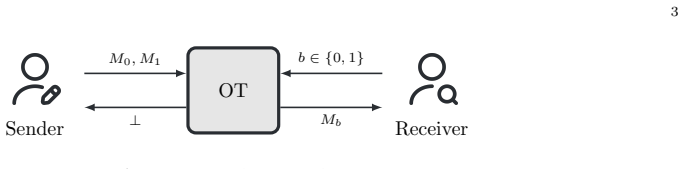
Oblivious Transfer (OT) is a fundamental cryptographic primitive enabling privacy-preserving computation and constitutes a core building block for secure multi-party computation while supporting a wide range of security-sensitive applications: private information retrieval, zero-knowledge proofs, and password-authenticated key exchange, to cite a few. While recent advances in OT extension have significantly reduced amortised costs, their reliance on batches of random base OTs and substantial pre-computation phases limits their practicality in scenarios where the number of transfers is modest or where communication latency and client-side computation are critical constraints. In such settings, efficient base OT protocols remain both relevant and necessary. In this work, we introduce $I$-$(OT)^2$, a novel base 1-out-of-2 OT protocol grounded in the quadratic residuosity problem, specifically designed to minimise receiver-side computation and interaction. Our construction is particularly appealing on client--server architectures in which the receiver operates on low-power hardware, such as Internet of Things (IoT) devices. Through a lightweight offline pre-computation phase, $I$-$(OT)^2$ shifts the on-transfer computational burden almost entirely to the Sender, while reducing online communication to only six messages and four digests exchanged. We provide a detailed description of the protocol, accompanied by a formal proof of its security. Moreover, to demonstrate the viability of $I$-$(OT)^2$, we also present an open-source proof-of-concept implementation (in C language) evaluated on real IoT hardware. Results are staggering: for 128-bit security using a 3072-bit RSA modulus, the receiver incurs an average online cost per OT as low as 2.80 {\mu}s on desktop platforms and 39.90 {\mu}s on IoT devices, more than 10$\times$ faster than the well known SimplestOT.
Editorial analysis
A structured set of objections, weighed in public.
Referee Report
Summary. The paper introduces I-(OT)^2, a base 1-out-of-2 oblivious transfer protocol based on the quadratic residuosity assumption. It features an offline pre-computation phase that shifts most computation to the sender, reduces the online phase to six messages and four digests, includes a formal security proof, and provides an open-source C implementation benchmarked on real IoT hardware. For 128-bit security with 3072-bit RSA, it reports average online costs of 2.80 μs on desktop and 39.90 μs on IoT devices, claimed to be more than 10× faster than SimplestOT.
Significance. If the security reduction and implementation details hold, the protocol would represent a meaningful practical advance for base OT in client-server settings with resource-constrained receivers such as IoT devices. The formal security proof under the quadratic residuosity assumption, the open-source reproducible implementation, and the hardware-specific benchmarks are explicit strengths that support verifiability and adoption.
minor comments (3)
- [Abstract] Abstract: the informal phrasing 'Results are staggering' should be replaced with quantitative or measured language consistent with the rest of the manuscript.
- [Evaluation] The performance comparison is limited to SimplestOT; additional baselines (e.g., other QR-based or lattice-based base OT constructions) would strengthen the evaluation section.
- [Protocol Description] Notation for the six-message online flow and the offline phase should be cross-referenced explicitly to the security proof to aid readability.
Simulated Author's Rebuttal
We thank the referee for the positive assessment of our manuscript on I-(OT)^2, the recognition of its practical contributions for IoT settings, and the recommendation for minor revision. No major comments were raised in the report.
Circularity Check
No significant circularity
full rationale
The paper introduces a new base OT protocol construction under the standard quadratic residuosity assumption, accompanied by an explicit protocol description, a formal security proof, and direct empirical benchmarks from an open-source C implementation on real hardware. No load-bearing step reduces by definition or construction to its own inputs; performance figures are measured outputs rather than fitted predictions; no self-citation chain or ansatz smuggling is indicated in the provided material. The derivation is self-contained against external assumptions and measurements.
Axiom & Free-Parameter Ledger
axioms (1)
- domain assumption Quadratic residuosity problem is computationally hard
Reference graph
Works this paper leans on
-
[1]
M. O. Rabin, How to exchange secrets with oblivious transfer, IACR Cryptol. ePrint Arch. (1981 (2005)) 187. URLhttp://eprint.iacr.org/2005/187
1981
-
[2]
A. Rajagopalan, K. Singh, B. Jayashrri, A. E. John, Zero knowledge bi-party computation using oblivious transfers for recommender systems (Mar. 2024).doi:10.21203/rs.3.rs-3228844/v5
-
[3]
P. Schmitt, A. Edmundson, A. Mankin, N. Feamster, Oblivious DNS: practical privacy for DNS queries, Proc. Priv. Enhancing Technol. 2019 (2) (2019) 228–244.doi:10.2478/POPETS-2019-0028
-
[4]
Z. Chen, S. Yu, M. Fan, X. Liu, R. H. Deng, Privacy-enhancing and robust backdoor defense for federated learning on heterogeneous data, IEEE Trans. Inf. Forensics Secur. 19 (2024) 693–707.doi:10.1109/TIFS.2023.3326983
-
[5]
L. T¨ obke, O. Grote, A. Ahrens, A practical approach to quantum resilient cloud usage obtaining data privacy, in: 2023 International Interdisciplinary PhD Workshop (IIPhDW), IEEE, 2023, pp. 1–4.doi:10.1109/IIPhDW54739. 2023.10124397
-
[6]
Z. G. Al-Mekhlafi, S. A. Lashari, J. M. H. Altmemi, M. A. Al-Shareeda, B. A. Mohammed, A. A. Sallam, B. A. Al- Qatab, M. T. Alshammari, A. M. Alayba, Oblivious transfer-based authentication and privacy-preserving protocol for 5g-enabled vehicular fog computing, IEEE Access 12 (2024) 100152–100166.doi:10.1109/ACCESS.2024.3429179
-
[7]
W. Tzeng, Efficient 1-out-of-n oblivious transfer schemes with universally usable parameters, IEEE Trans. Com- puters 53 (2) (2004) 232–240.doi:10.1109/TC.2004.1261831
-
[8]
M. Naor, B. Pinkas, Efficient oblivious transfer protocols, in: Proceedings of the Twelfth Annual ACM-SIAM Symposium on Discrete Algorithms, SODA ’01, Society for Industrial and Applied Mathematics, USA, 2001, pp. 448–457. URLhttps://dl.acm.org/doi/10.5555/365411.365502
-
[9]
V. Goyal, A. Jain, Z. Jin, G. Malavolta, Statistical zaps and new oblivious transfer protocols, in: A. Canteaut, Y. Ishai (Eds.), Advances in Cryptology - EUROCRYPT 2020 - 39th Annual International Conference on the Theory and Applications of Cryptographic Techniques, Zagreb, Croatia, May 10-14, 2020, Proceedings, Part III, Vol. 12107 of Lecture Notes in ...
-
[10]
G. Asharov, Y. Lindell, T. Schneider, M. Zohner, More efficient oblivious transfer extensions with security for malicious adversaries, in: E. Oswald, M. Fischlin (Eds.), Advances in Cryptology - EUROCRYPT 2015 - 34th Annual International Conference on the Theory and Applications of Cryptographic Techniques, Sofia, Bulgaria, April 26-30, 2015, Proceedings,...
-
[11]
Beaver, Correlated pseudorandomness and the complexity of private computations, in: G
D. Beaver, Correlated pseudorandomness and the complexity of private computations, in: G. L. Miller (Ed.), Pro- ceedings of the Twenty-Eighth Annual ACM Symposium on the Theory of Computing, Philadelphia, Pennsylvania, USA, May 22-24, 1996, ACM, 1996, pp. 479–488.doi:10.1145/237814.237996
-
[12]
Y. Ishai, J. Kilian, K. Nissim, E. Petrank, Extending Oblivious Transfers Efficiently, Springer Berlin Heidelberg, 2003, pp. 145–161.doi:10.1007/978-3-540-45146-4_9
-
[13]
R. Canetti, A. K. Sarkar, C. Wang, Blazing fast oblivious transfer from pseudorandomness, in: Public-Key Cryp- tography – PKC 2020, Springer, 2020, pp. 327–356.doi:10.1007/978-3-030-45388-6_11
-
[14]
T. Chou, C. Orlandi, The simplest protocol for oblivious transfer, in: Progress in Cryptology – LATINCRYPT 2015, Springer International Publishing, 2015, p. 40–58.doi:10.1007/978-3-319-22174-8_3
-
[15]
S. Even, O. Goldreich, A. Lempel, A randomized protocol for signing contracts, Commun. ACM 28 (6) (1985) 637–647.doi:10.1145/3812.3818
-
[16]
M. Bellare, S. Micali, Non-interactive oblivious transfer and applications, in: G. Brassard (Ed.), Advances in Cryptology - CRYPTO ’89, 9th Annual International Cryptology Conference, Santa Barbara, California, USA, August 20-24, 1989, Proceedings, Vol. 435 of Lecture Notes in Computer Science, Springer, 1989, pp. 547–557. doi:10.1007/0-387-34805-0_48
-
[17]
R. L. Rivest, Unconditionally secure commitment and oblivious transfer schemes using private channels and a trusted initializer (1999). URLhttps://people.csail.mit.edu/rivest/pubs/Riv99d.pdf
1999
-
[18]
C. Cr´ epeau, K. Morozov, S. Wolf, Efficient unconditional oblivious transfer from almost any noisy channel, in: C. Blundo, S. Cimato (Eds.), Security in Communication Networks, 4th International Conference, SCN 2004, Amalfi, Italy, September 8-10, 2004, Revised Selected Papers, Vol. 3352 of Lecture Notes in Computer Science, Springer, 2004, pp. 47–59.doi...
-
[19]
C. Peikert, V. Vaikuntanathan, B. Waters, A framework for efficient and composable oblivious transfer, in: Advances in Cryptology – CRYPTO 2008, Springer Berlin Heidelberg, 2008, pp. 554–571.doi:10.1007/978-3-540-85174-5_ 31
-
[20]
Y. Ishai, E. Kushilevitz, R. Ostrovsky, M. Prabhakaran, A. Sahai, J. Wullschleger, Constant-rate oblivious transfer from noisy channels, in: P. Rogaway (Ed.), Advances in Cryptology - CRYPTO 2011 - 31st Annual Cryptology Conference, Santa Barbara, CA, USA, August 14-18, 2011. Proceedings, Vol. 6841 of Lecture Notes in Computer Science, Springer, 2011, pp....
-
[21]
Lindell, B
Y. Lindell, B. Pinkas, Secure two-party computation via cut-and-choose oblivious transfer, in: Y. Ishai (Ed.), Theory of Cryptography - 8th Theory of Cryptography Conference, TCC 2011, Providence, RI, USA, March 28-30, 24
2011
-
[22]
6597 of Lecture Notes in Computer Science, Springer, 2011, pp
Proceedings, Vol. 6597 of Lecture Notes in Computer Science, Springer, 2011, pp. 329–346.doi:10.1007/ 978-3-642-19571-6_20
2011
-
[23]
M. Liu, Y. Hu, Universally composable oblivious transfer from ideal lattice, Frontiers Comput. Sci. 13 (4) (2019) 879–906.doi:10.1007/S11704-018-6507-4
-
[24]
D. Mansy, P. Rindal, Endemic oblivious transfer, in: Proceedings of the 2019 ACM SIGSAC Conference on Computer and Communications Security, CCS ’19, ACM, 2019, p. 309–326.doi:10.1145/3319535.3354210
-
[25]
N. D¨ ottling, S. Garg, M. Hajiabadi, D. Masny, D. Wichs, Two-round oblivious transfer from CDH or LPN, in: A. Canteaut, Y. Ishai (Eds.), Advances in Cryptology - EUROCRYPT 2020 - 39th Annual International Conference on the Theory and Applications of Cryptographic Techniques, Zagreb, Croatia, May 10-14, 2020, Proceedings, Part II, Vol. 12106 of Lecture No...
-
[26]
N. Aragon, O. Blazy, N. Fournaise, P. Gaborit, CROOT: code-based round-optimal oblivious transfer, in: P. Samar- ati, S. D. C. di Vimercati, M. S. Obaidat, J. Ben-Othman (Eds.), Proceedings of the 17th International Joint Conference on e-Business and Telecommunications, ICETE 2020 - Volume 2: SECRYPT, Lieusaint, Paris, France, July 8-10, 2020, ScitePress,...
-
[27]
Y. Lai, S. D. Galbraith, C. D. de Saint Guilhem, Compact, efficient and UC-secure isogeny-based oblivious transfer, in: A. Canteaut, F. Standaert (Eds.), Advances in Cryptology - EUROCRYPT 2021 - 40th Annual International Conference on the Theory and Applications of Cryptographic Techniques, Zagreb, Croatia, October 17-21, 2021, Proceedings, Part I, Vol. ...
2021
-
[28]
S. Badrinarayanan, D. Masny, P. Mukherjee, Efficient and tight oblivious transfer from PKE with tight multi-user security, in: G. Ateniese, D. Venturi (Eds.), Applied Cryptography and Network Security - 20th International Conference, ACNS 2022, Rome, Italy, June 20-23, 2022, Proceedings, Vol. 13269 of Lecture Notes in Computer Science, Springer, 2022, pp....
-
[29]
P. Branco, N. D¨ ottling, A. Srinivasan, Two-round maliciously-secure oblivious transfer with optimal rate, in: M. Joye, G. Leander (Eds.), Advances in Cryptology – EUROCRYPT 2024, Springer Nature Switzerland, Cham, 2024, pp. 271–300.doi:10.1007/978-3-031-58751-1_10
-
[30]
Abadi, Y
A. Abadi, Y. Desmedt, Supersonic OT: Fast unconditionally secure oblivious transfer, Cryptology ePrint Archive, Paper 2024/1012 (2024). URLhttps://eprint.iacr.org/2024/1012
2024
-
[31]
G. Couteau, L. Devadas, S. Devadas, A. Koch, S. Servan-Schreiber, QuietOT: Lightweight oblivious transfer with a public-key setup, in: K.-M. Chung, Y. Sasaki (Eds.), Advances in Cryptology – ASIACRYPT 2024, Springer Nature Singapore, Singapore, 2025, pp. 197–231.doi:10.1007/978-981-96-0888-1_7
-
[32]
F. Berti, C. Hazay, I. Levi, LR-OT: leakage-resilient oblivious transfer, Cryptography and Communications 17 (5) (2025) 1191–1248.doi:10.1007/s12095-025-00824-4
-
[33]
Y.-G. Yang, S. Qiu, Y. Chang, G.-B. Xu, D.-H. Jiang, D. Li, Quantum oblivious transfer for quantum messages, Physical Review A 112 (4) (2025) 042617.doi:10.1103/8963-6537
-
[34]
Y.-G. Yang, S. Qiu, R.-C. Huang, Y.-C. Wang, G.-B. Xu, D.-H. Jiang, D. Li, All-or-nothing quantum oblivious transfer for unknown unitary operations, Advanced Quantum Technologies 8 (11) (2025) e00511.doi:10.1002/ qute.202500511
2025
-
[35]
A. Abadi, Y. Desmedt, Oblivis: A framework for delegated and efficient oblivious transfer, to appear at PETS 2026 (2026).arXiv:2603.14492,doi:10.48550/arXiv.2603.14492
-
[36]
V. K. Yadav, N. Andola, S. Verma, S. Venkatesan, A survey of oblivious transfer protocol, ACM Comput. Surv. 54 (10s) (Sep. 2022).doi:10.1145/3503045
-
[37]
M. Naor, B. Pinkas, Oblivious transfer and polynomial evaluation, in: Proceedings of the thirty-first annual ACM symposium on Theory of Computing, STOC99, ACM, 1999, p. 245–254.doi:10.1145/301250.301312
-
[38]
Di Crescenzo, T
G. Di Crescenzo, T. Malkin, R. Ostrovsky, Single database private information retrieval implies oblivious transfer, in: Advances in Cryptology – EUROCRYPT 2000, Springer Berlin Heidelberg, 2000, pp. 122–138.doi:10.1007/ 3-540-45539-6_10
2000
-
[39]
T. Chou, C. Orlandi, The simplest protocol for oblivious transfer, Cryptology ePrint Archive, Paper 2015/267 (rev 2018). URLhttps://eprint.iacr.org/2015/267
2015
-
[40]
the simplest protocol for oblivious transfer
Z. A. Gen¸ c, V. Iovino, A. Rial, “the simplest protocol for oblivious transfer” revisited, Inf. Process. Lett. 161 (2020) 105975.doi:10.1016/J.IPL.2020.105975
-
[41]
S. Sarkar, V. Srivastava, T. Mohanty, S. K. Debnath, S. Mesnager, An efficient quantum oblivious transfer protocol, Cluster Computing 27 (10) (2024) 14037–14048.doi:10.1007/s10586-024-04642-w
-
[42]
X. Zhang, C. Wei, S. Qin, F. Gao, Q. Wen, Practical efficient 1-out-of-n quantum oblivious transfer protocol, Quantum Inf. Process. 22 (2) (2023) 99.doi:10.1007/S11128-022-03817-X
-
[43]
A. Gan, S. Yuki, T. Rogers, Z. Ghodsi, Cuot: Accelerating oblivious transfer on gpus for privacy-preserving com- putation, in: 2025 IEEE International Symposium on Hardware Oriented Security and Trust (HOST), IEEE, 2025, pp. 300–311.doi:10.1109/HOST64725.2025.11050054. 25
-
[44]
C. Lin, K. Yang, T. Xu, L. Liang, Y. Wang, Z. Chen, R. Wang, M. Gao, M. Li, Ironman: Accelerating oblivious transfer extension for privacy-preserving AI with near-memory processing, in: Proceedings of the 58th IEEE/ACM International Symposium on Microarchitecture, 2025, pp. 354–368.doi:10.1145/3725843.3756025
-
[45]
Abadi, Y
A. Abadi, Y. Desmedt, Scalable post-quantum oblivious transfers for resource-constrained receivers, IACR Cryptol. ePrint Arch. (2025) 36. URLhttps://eprint.iacr.org/2025/036
2025
-
[46]
Barker, Recommendation for key management:: part 1 - general, Tech
E. Barker, Recommendation for key management:: part 1 - general, Tech. Rep. 800-57 Pt1, National Institute of Standards and Technology (U.S.), Gaithersburg, MD (2020).doi:10.6028/nist.sp.800-57pt1r5
-
[47]
National Institute of Standards and Technology (U.S.), SHA-3 standard: permutation-based hash and extendable- output functions, Tech. Rep. 202, National Institute of Standards and Technology (U.S.), Gaithersburg, MD (Aug. 2015).doi:10.6028/nist.fips.202
-
[48]
I. McQuoid, M. Rosulek, L. Roy, Batching base oblivious transfers, in: M. Tibouchi, H. Wang (Eds.), Advances in Cryptology - ASIACRYPT 2021 - 27th International Conference on the Theory and Application of Cryptology and Information Security, Singapore, December 6-10, 2021, Proceedings, Part III, Vol. 13092 of Lecture Notes in Computer Science, Springer, 2...
-
[49]
Bellare, A
M. Bellare, A. Desai, D. Pointcheval, P. Rogaway, Relations among notions of security for public-key encryption schemes, in: Advances in Cryptology — CRYPTO ’98, Springer Berlin Heidelberg, 1998, pp. 26–45.doi:10.1007/ bfb0055718
1998
-
[50]
R. Pass, A. Rosen, New and improved constructions of non-malleable cryptographic protocols, in: H. N. Gabow, R. Fagin (Eds.), Proceedings of the 37th Annual ACM Symposium on Theory of Computing, Baltimore, MD, USA, May 22-24, 2005, ACM, 2005, pp. 533–542.doi:10.1145/1060590.1060670
-
[51]
R. J. Davis, R. Zuccherato, J. Randall, Comments on nist special publication 800-57, recommendation for key management, part 1: General, Draft comments, National Institute of Standards and Technology (NIST) (2005). URLhttps://csrc.nist.gov/files/pubs/sp/800/57/pt1/final/docs/sp800-57-pt1-draft-apr2005-comments. pdf
2005
-
[52]
R. Canetti, Universally composable security: A new paradigm for cryptographic protocols, in: Proceedings of the 42nd Annual IEEE Symposium on Foundations of Computer Science (FOCS), IEEE, 2001, pp. 136–145.doi: 10.1109/SFCS.2001.959888. AppendixA.Probabilistic and Bayesian Analysis of the Check-Congruency Game In this appendix, we present a thorough proba...
discussion (0)
Sign in with ORCID, Apple, or X to comment. Anyone can read and Pith papers without signing in.