Layer-Resolved Nonlinear Optics in Finite-Thickness Two-Dimensional Systems
Pith reviewed 2026-06-28 13:28 UTC · model grok-4.3
The pith
Stacking order organizes second-order nonlinear optical responses into skin, weak-skin, and hidden layer effects in finite-thickness 2D multilayers.
A machine-rendered reading of the paper's core claim, the machinery that carries it, and where it could break.
Core claim
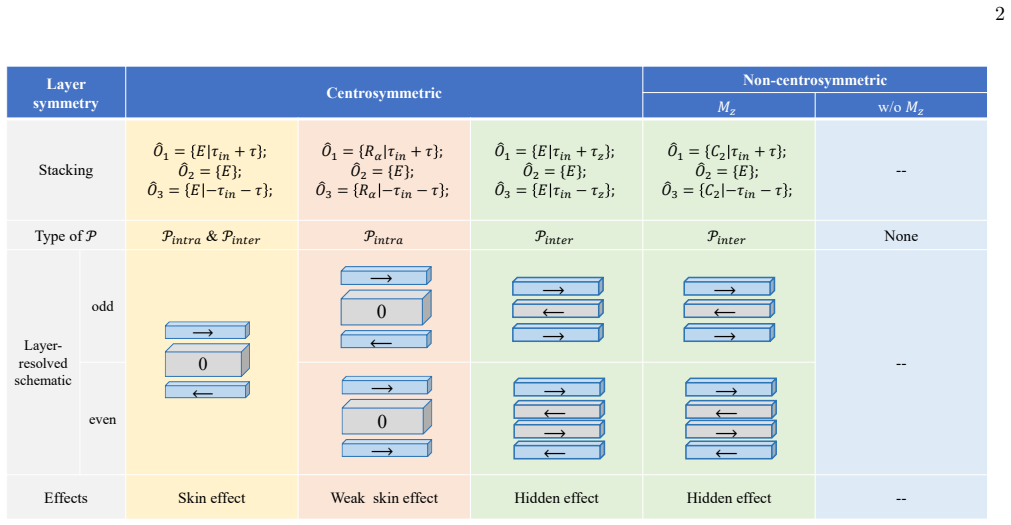
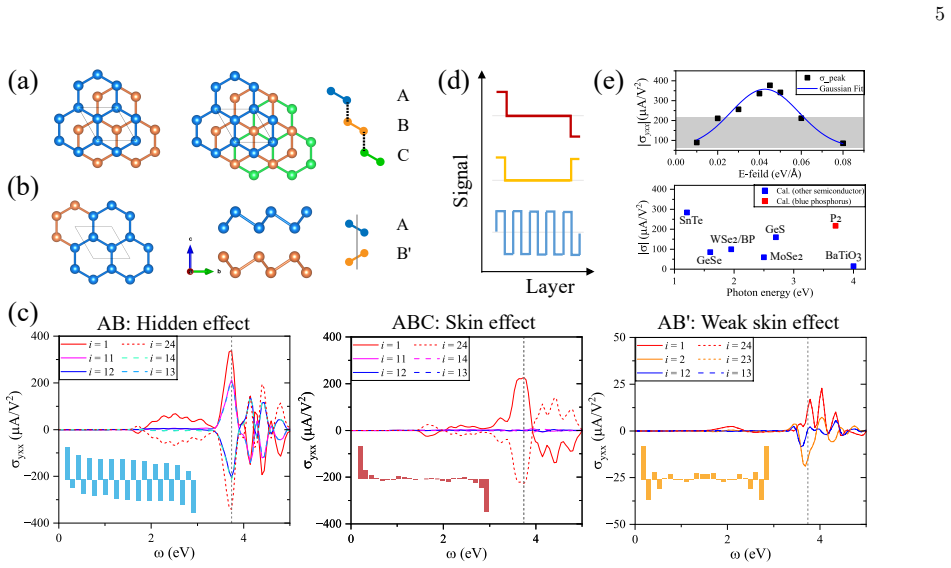
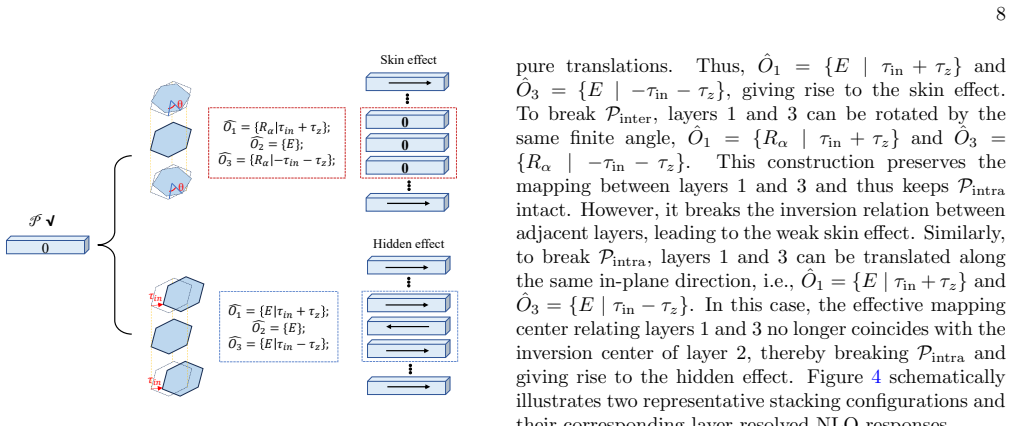
A symmetry-based framework classifies second-order NLO responses in multilayers into skin, weak-skin, and hidden effects governed by local symmetry and stacking order; stacking geometry alone suffices to reshape both the spatial pattern and magnitude of the response beyond what bulk averaging can explain.
What carries the argument
Layer-resolved classification of second-order NLO responses into skin, weak-skin, and hidden effects determined by local symmetry and stacking order.
If this is right
- Stacking geometry functions as a control knob for engineering surface-selective NLO responses without altering chemical composition.
- Bulk-based spatial averaging fails for device-relevant finite-thickness multilayers.
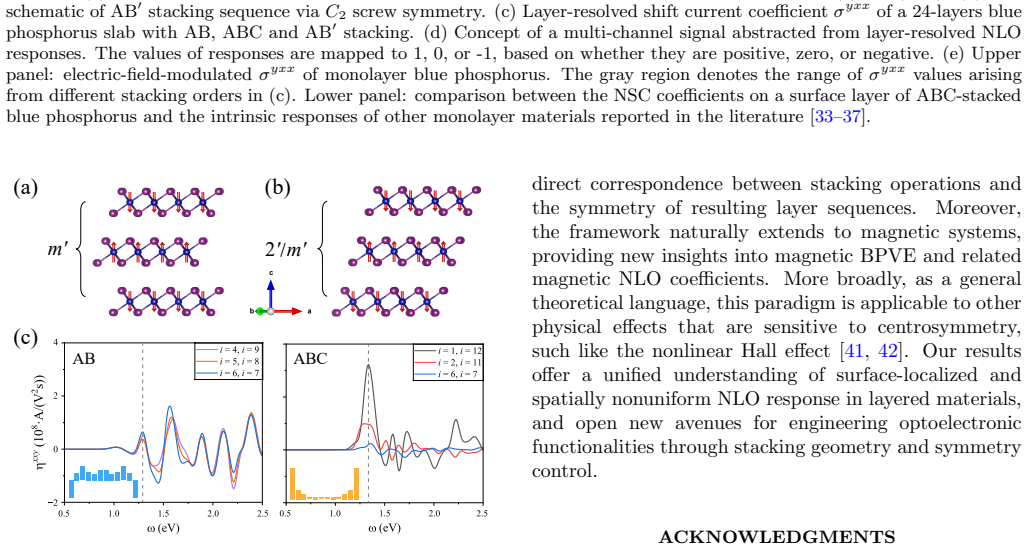
- The same classification applies across both nonmagnetic and spin-polarized systems.
- Layer position, not just total thickness, sets the dominant contribution to each NLO process.
Where Pith is reading between the lines
- The framework may extend to other layer-resolved response functions such as photocurrent or thermal transport in the same stacks.
- Device modeling codes for 2D heterostructures could incorporate the skin/hidden distinction to predict interface-dominated nonlinear signals.
- Experimental layer-selective probes, such as depth-resolved second-harmonic generation, could directly test the predicted spatial organization.
Load-bearing premise
Local symmetry and stacking order alone determine how responses organize into skin, weak-skin, and hidden effects.
What would settle it
A first-principles or experimental map of the second-order NLO response across layers in a trilayer or thicker stack that fails to match the predicted skin/weak-skin/hidden pattern for its stacking sequence.
Figures
read the original abstract
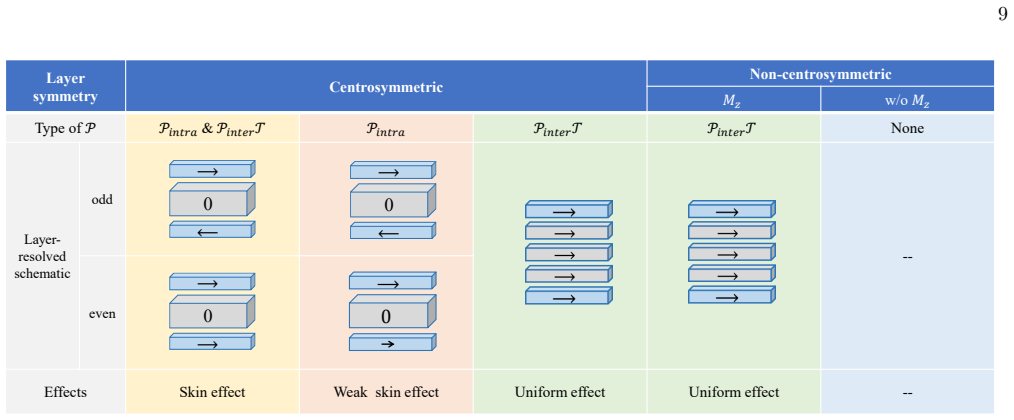
Nonlinear optical (NLO) responses in two-dimensional quantum-confined systems are typically described within bulk-based frameworks as macroscopic spatial averages. In finite-thickness van der Waals multilayers directly relevant to nanoscale devices, this picture substantially breaks down. Here, we establish a general symmetry-based framework for classifying second-order NLO responses in multilayers. We reveal a layer-resolved organization into skin, weak-skin, and hidden effects governed by local symmetry and stacking order. First-principles calculations for both nonmagnetic and spin-polarized systems confirm our predictions, demonstrating that stacking alone suffices to dramatically reshape both the spatial pattern and magnitude of the NLO response, a phenomenon not explainable within standard bulk theory. Our results establish stacking geometry as an effective knob for engineering surface-selective NLO responses in layered materials.
Editorial analysis
A structured set of objections, weighed in public.
Referee Report
Summary. The manuscript develops a symmetry-based framework to classify second-order nonlinear optical (NLO) responses in finite-thickness van der Waals multilayers. Responses are organized into skin, weak-skin, and hidden categories governed by local symmetry and stacking order. First-principles calculations on nonmagnetic and spin-polarized systems are presented as confirmation that stacking geometry alone can dramatically alter both the spatial pattern and magnitude of the NLO response in ways not captured by standard bulk theory, thereby positioning stacking as a control parameter for surface-selective NLO engineering.
Significance. If the classification and first-principles results hold, the work supplies a practical organizing principle for NLO responses in device-relevant finite-thickness 2D systems and identifies stacking as an effective engineering knob. The explicit treatment of both nonmagnetic and spin-polarized cases broadens applicability. The layer-resolved perspective directly addresses limitations of macroscopic bulk averaging.
major comments (1)
- [Symmetry classification and first-principles confirmation sections] The central claim that 'stacking alone suffices to dramatically reshape' the NLO response rests on the assertion that local symmetry and stacking order fully determine the skin/weak-skin/hidden organization. The first-principles confirmation must therefore demonstrate that interlayer hybridization, charge redistribution, or modified screening do not produce layer-resolved susceptibilities outside this classification; the abstract provides no indication that such effects were isolated or shown to be negligible.
minor comments (1)
- [Abstract] The abstract would benefit from naming the specific multilayer systems and NLO processes (e.g., SHG, shift current) examined in the calculations.
Simulated Author's Rebuttal
We thank the referee for the careful review and constructive feedback. We address the major comment below, providing clarification on how our first-principles results incorporate relevant physical effects while validating the symmetry classification.
read point-by-point responses
-
Referee: [Symmetry classification and first-principles confirmation sections] The central claim that 'stacking alone suffices to dramatically reshape' the NLO response rests on the assertion that local symmetry and stacking order fully determine the skin/weak-skin/hidden organization. The first-principles confirmation must therefore demonstrate that interlayer hybridization, charge redistribution, or modified screening do not produce layer-resolved susceptibilities outside this classification; the abstract provides no indication that such effects were isolated or shown to be negligible.
Authors: We agree that the first-principles results must be shown to remain within the symmetry classification even when interlayer effects are active. Our DFT calculations are fully self-consistent and therefore include interlayer hybridization, charge redistribution, and modified screening by construction. The computed layer-resolved second-order susceptibilities nevertheless conform exactly to the skin/weak-skin/hidden categories predicted solely from local symmetry and stacking sequence. This outcome indicates that the additional interactions do not generate responses outside the symmetry framework. The abstract is a concise summary; the full manuscript details the DFT methodology and the agreement with symmetry predictions. We will add an explicit paragraph in the revised manuscript stating that the calculations incorporate these effects yet still validate the classification, thereby reinforcing that stacking geometry alone can dramatically reshape the response. revision: yes
Circularity Check
No significant circularity detected
full rationale
The paper derives a symmetry-based classification of layer-resolved second-order NLO responses (skin/weak-skin/hidden) directly from local symmetry and stacking order, then invokes first-principles calculations as independent confirmation of the resulting predictions. No equations, definitions, or citations in the abstract or described framework reduce any load-bearing claim to a self-referential fit, ansatz, or prior self-citation chain. The central assertion that stacking alone reshapes responses beyond bulk theory rests on symmetry arguments plus external verification and remains self-contained.
Axiom & Free-Parameter Ledger
axioms (1)
- domain assumption Local symmetry and stacking order govern the layer-resolved organization of second-order NLO responses into skin, weak-skin, and hidden effects.
Reference graph
Works this paper leans on
-
[1]
R. W. Boyd, A. L. Gaeta, and E. Giese, Nonlinear optics, inSpringer Handbook of Atomic, Molecular, and Optical Physics, edited by G. W. F. Drake (Springer International Publishing, Cham, 2023) pp. 1097–1110
2023
-
[2]
P. A. Franken, A. E. Hill, C. W. Peters, and G. Weinreich, Generation of optical harmonics, Phys. Rev. Lett.7, 118 (1961)
1961
-
[3]
V. M. Fridkin, Bulk photovoltaic effect in noncentrosymmetric crystals, Crystallography Reports 46, 654 (2001)
2001
-
[4]
Y. Li, Y. Rao, K. F. Mak, Y. You, S. Wang, C. R. Dean, and T. F. Heinz, Probing Symmetry Properties of Few-Layer MoS2 and h-BN by Optical Second-Harmonic Generation, Nano Letters13, 3329 (2013)
2013
-
[5]
L. Z. Tan and A. M. Rappe, Enhancement of the bulk photovoltaic effect in topological insulators, Physical review letters116, 237402 (2016)
2016
-
[6]
Z. Sun, Y. Yi, T. Song, G. Clark, B. Huang, Y. Shan, S. Wu, D. Huang, C. Gao, Z. Chen,et al., Giant nonreciprocal second-harmonic generation from antiferromagnetic bilayer cri3, Nature572, 497 (2019)
2019
-
[7]
Dirnberger, J
F. Dirnberger, J. Quan, R. Bushati, G. M. Diederich, M. Florian, J. Klein, K. Mosina, Z. Sofer, X. Xu, A. Kamra, F. J. Garc´ ıa-Vidal, A. Al` u, and V. M. Menon, Magneto-optics in a van der Waals magnet tuned by self-hybridized polaritons, Nature620, 533 (2023)
2023
-
[8]
D. S. James and P. J. Campagnola, Recent Advancements in Optical Harmonic Generation Microscopy: Applications and Perspectives, BME frontiers2021, 3973857 (2021)
2021
-
[9]
Ma, S.-Y
Q. Ma, S.-Y. Xu, H. Shen, D. MacNeill, V. Fatemi, T.-R. Chang, A. M. Mier Valdivia, S. Wu, Z. Du, C.-H. Hsu,et al., Observation of the nonlinear hall effect under time-reversal-symmetric conditions, Nature565, 337 (2019)
2019
-
[10]
T. J. Kippenberg, S. M. Spillane, and K. J. Vahala, Kerr-nonlinearity optical parametric oscillation in an ultrahigh-qtoroid microcavity, Phys. Rev. Lett.93, 083904 (2004)
2004
-
[11]
Z. Sun, A. Martinez, and F. Wang, Optical modulators with 2D layered materials, Nature Photonics10, 227 (2016)
2016
-
[12]
P. G. Zotev, P. Bouteyre, Y. Wang, S. A. Randerson, X. Hu, L. Sortino, Y. Wang, T. Shegai, S.-H. Gong, A. Tittl, I. Aharonovich, and A. I. Tartakovskii, Nanophotonics with multilayer van der Waals materials, Nature Photonics19, 788 (2025)
2025
-
[13]
J. Ji, G. Yu, C. Xu, and H. J. Xiang, General theory for bilayer stacking ferroelectricity, Phys. Rev. Lett.130, 146801 (2023)
2023
-
[14]
B. Shao, X. Jiang, J. Berges, S. Meng, and B. Huang, Engineering interlayer hybridization in energy space via dipolar overlayers, Chinese Physics Letters40, 087303 (2023)
2023
-
[15]
Hsu, Z.-A
W.-T. Hsu, Z.-A. Zhao, L.-J. Li, C.-H. Chen, M.-H. Chiu, P.-S. Chang, Y.-C. Chou, and W.-H. Chang, Second Harmonic Generation from Artificially Stacked Transition Metal Dichalcogenide Twisted Bilayers, ACS Nano8, 2951 (2014)
2014
-
[16]
Y. Shan, Y. Li, D. Huang, Q. Tong, W. Yao, W.-T. Liu, and S. Wu, Stacking symmetry governed second harmonic generation in graphene trilayers, Science Advances4, eaat0074 (2018)
2018
-
[17]
C. Fox, Y. Mao, X. Zhang, Y. Wang, and J. Xiao, Stacking Order Engineering of Two-Dimensional Materials and Device Applications, Chemical Reviews 124, 1862 (2024)
2024
-
[18]
Zhou, R.-C
H. Zhou, R.-C. Xiao, S.-H. Zhang, W. Gan, H. Han, H.-M. Zhao, W. Lu, C. Zhang, Y. Sun, H. Li, and D.-F. Shao, Skin Effect of Nonlinear Optical Responses in Antiferromagnets, Physical Review Letters133, 236903 (2024)
2024
-
[19]
X. Mu, Q. Xue, Y. Sun, and J. Zhou, Magnetic proximity enabled bulk photovoltaic effects in van der waals heterostructures, Physical Review Research5, 013001 (2023)
2023
-
[20]
C.-Y. Zhu, Z. Zhang, J.-K. Qin, Z. Wang, C. Wang, P. Miao, Y. Liu, P.-Y. Huang, Y. Zhang, K. Xu, L. Zhen, Y. Chai, C.-Y. Xu,et al., Two-dimensional semiconducting SnP 2Se6 with giant second-harmonic-generation for monolithic on-chip electronic-photonic integration, Nature Communications 14, 2521 (2023)
2023
-
[21]
Maj´ erus, L
B. Maj´ erus, L. Henrard, and P. Kockaert, Optical modeling of single and multilayer two-dimensional materials and heterostructures, Physical Review B107, 045429 (2023)
2023
-
[22]
Wang and X
H. Wang and X. Qian, Giant Optical Second Harmonic Generation in Two-Dimensional Multiferroics, Nano Letters17, 5027 (2017)
2017
-
[23]
L. Ye, W. Zhou, D. Huang, X. Jiang, Q. Guo, X. Cao, S. Yan, X. Wang, D. Jia, D. Jiang, Y. Wang, X. Wu, X. Zhang, Y. Li, H. Lei, H. Gou, and B. Huang, Manipulation of nonlinear optical responses in layered ferroelectric niobium oxide dihalides, Nature Communications14, 5911 (2023)
2023
-
[24]
A. K. Geim and K. S. Novoselov, The rise of graphene, Nature Materials6, 183 (2007)
2007
-
[25]
C. H. Lui, Z. Li, Z. Chen, P. V. Klimov, L. E. Brus, and T. F. Heinz, Imaging Stacking Order in Few-Layer Graphene, Nano Letters11, 164 (2011)
2011
-
[26]
Huang, G
B. Huang, G. Clark, E. Navarro-Moratalla, D. R. Klein, R. Cheng, K. L. Seyler, D. Zhong, E. Schmidgall, M. A. McGuire, D. H. Cobden, W. Yao, D. Xiao, P. Jarillo-Herrero, and X. Xu, Layer-dependent ferromagnetism in a van der Waals crystal down to the monolayer limit, Nature546, 270 (2017)
2017
-
[27]
Zhang, Q
X. Zhang, Q. Liu, J.-W. Luo, A. J. Freeman, and A. Zunger, Hidden spin polarization in inversion-symmetric bulk crystals, Nature Physics 10, 387 (2014)
2014
-
[28]
Q. Liu, X. Zhang, H. Jin, K. Lam, J. Im, A. J. Freeman, and A. Zunger, Search and design of nonmagnetic centrosymmetric layered crystals with large local spin polarization, Physical Review B91, 235204 (2015)
2015
-
[29]
M. S. Dresselhaus, G. Dresselhaus, and A. Jorio,Group Theory: Application to the Physics of Condensed Matter (Springer, Berlin Heidelberg, 2008)
2008
-
[30]
J. E. Sipe and A. I. Shkrebtii, Second-order optical response in semiconductors, Physical Review B61, 5337 (2000)
2000
-
[31]
Wang and X
H. Wang and X. Qian, Electrically and magnetically switchable nonlinear photocurrent in pt-symmetric magnetic topological quantum materials, npj Computational Materials6, 199 (2020)
2020
-
[32]
H. Chen, M. Ye, N. Zou, B.-L. Gu, Y. Xu, and W. Duan, Basic formulation and first-principles implementation of 7 nonlinear magneto-optical effects, Physical Review B 105, 075123 (2022)
2022
-
[33]
S. M. Young and A. M. Rappe, First principles calculation of the shift current photovoltaic effect in ferroelectrics, Physical review letters109, 116601 (2012)
2012
-
[34]
Rangel, B
T. Rangel, B. M. Fregoso, B. S. Mendoza, T. Morimoto, J. E. Moore, and J. B. Neaton, Large bulk photovoltaic effect and spontaneous polarization of single-layer monochalcogenides, Physical review letters119, 067402 (2017)
2017
-
[35]
Wang and X
H. Wang and X. Qian, Ferroicity-driven nonlinear photocurrent switching in time-reversal invariant ferroic materials, Science advances5, eaav9743 (2019)
2019
-
[36]
Akamatsu, T
T. Akamatsu, T. Ideue, L. Zhou, Y. Dong, S. Kitamura, M. Yoshii, D. Yang, M. Onga, Y. Nakagawa, K. Watanabe,et al., A van der waals interface that creates in-plane polarization and a spontaneous photovoltaic effect, Science372, 68 (2021)
2021
-
[37]
Jin and L
G. Jin and L. He, Peculiar band geometry induced giant shift current in ferroelectric snte monolayer, npj Computational Materials10, 23 (2024)
2024
-
[38]
Jiang, C
P. Jiang, C. Wang, D. Chen, Z. Zhong, Z. Yuan, Z.-Y. Lu, and W. Ji, Stacking tunable interlayer magnetism in bilayer CrI3, Physical Review B99, 144401 (2019)
2019
-
[39]
W. Chen, Z. Sun, Z. Wang, L. Gu, X. Xu, S. Wu, and C. Gao, Direct observation of van der Waals stacking–dependent interlayer magnetism, Science366, 983 (2019)
2019
-
[40]
T. Song, Z. Fei, M. Yankowitz, Z. Lin, Q. Jiang, K. Hwangbo, Q. Zhang, B. Sun, T. Taniguchi, K. Watanabe, M. A. McGuire, D. Graf, T. Cao, J.-H. Chu, D. H. Cobden, C. R. Dean, D. Xiao, and X. Xu, Switching 2D magnetic states via pressure tuning of layer stacking, Nature Materials18, 1298 (2019)
2019
-
[41]
Ma, S.-Y
Q. Ma, S.-Y. Xu, H. Shen, D. MacNeill, V. Fatemi, T.-R. Chang, A. M. Mier Valdivia, S. Wu, Z. Du, C.-H. Hsu, S. Fang, Q. D. Gibson, K. Watanabe, T. Taniguchi, R. J. Cava, E. Kaxiras, H.-Z. Lu, H. Lin, L. Fu, N. Gedik, and P. Jarillo-Herrero, Observation of the nonlinear Hall effect under time-reversal-symmetric conditions, Nature 565, 337 (2019)
2019
-
[42]
Sodemann and L
I. Sodemann and L. Fu, Quantum Nonlinear Hall Effect Induced by Berry Curvature Dipole in Time-Reversal Invariant Materials, Physical Review Letters115, 216806 (2015). END MA TTER General classification of layer-stacking operator.To investigate the local symmetry of a target layer in multilayer slabs, we construct a trilayer slab model including only near...
2015
discussion (0)
Sign in with ORCID, Apple, or X to comment. Anyone can read and Pith papers without signing in.